… noblemen in France (in the rest of Europe too, but France’s old kingdom was special for how wide the disparity was) were used to being by far the richest in their surroundings. And they were used to the peasants being less than dirt under their feet. Or their chariot wheels.
And then that changed, in what is a cultural eye-blink. Forget the crazy slogan. Humans don’t like change. Particularly they hate change that challenges their status. Unable to actually increase their net worth (within the prescribed realms in which noblemen could do such) or stop spending, the nobility instead went for displays of wealth. Big and extravagant ones. And the wigs were … quite, quite insane.
So what does that have to do with Facebook?
For a few generations, since the left captured the academia, entertainment and the industrial-news complex, aka, the opinion makers, to be a leftist has been synonymous with being smart.
And being smart, since the renaissance, but definitely since the world wars has been the greatest social “good” there is.
No, I’m not saying the left was smart. Increasingly, most of them weren’t, because as it became a matter of social display, the easily led started imitating it.
No, I’m saying that to parrot leftist ideas was to be considered smart. Partly because of the left’s conceit that Marxism was “scientific” there has always been, attached to the modern left the idea that to believe as they do is “rational” and “smart” and that their opponents are stupid.
Not only did they hold onto this while their ideas were proven wrong by reality over and over again, but having captured academia, they pushed leftist ideas as synonymous with being educated. I mean, if you’d attended an elite school, you received these ideas, and the way to signal you’ve attended the school is to parrot it. Thus leftism became the old school tie (mostly around the neck of our economy, but never mind.)
While they had full control of the media, be it entertainment or informational, they could reinforce the message, as well as revile anyone who challenged them as stupid, wrong and illiterate, and GET AWAY WITH IT.
With intelligence being the highest status-good in our society, the left had secure status. Forever, they thought.
The change has been very rapid. The fall of the USSR and [the rise of] talk radio were the beginning, and since the internet took off, they’ve been trying to hold on to the tail of the comet, as it streaks away from them.
I’ve said it before and I maintain it. If Mr. Obama had been president in a country where the information tech was the same as in the 30s, all his failures would have been hidden, and people would believe him a staggering genius, instead of the little man who wasn’t there. Because that’s how the industrial-media complex presented him.
And then … And then they went all in for Hillary! They were “With her” 300%.
Unbelievably, it didn’t work.
I think they’d suspected, before, that things had changed. But they could still tell themselves stories, dismiss the opposition, preen on having all the power. And then … it failed.
Since then they’ve been running scared with social insecurity. They display their “brilliance” for all the world, and it didn’t work? Oh. Must signal louder, larger, crazier.
All the “Wokeness” over everything possible (and mostly imaginary) in the last few years? That’s social signaling by a social group losing power and trying to regain it.
The less it works, the more extravagant it will get. I am in premonitory awe over what will happen should Trump beat the margin of fraud in 2020. You thought the Democratic Socialist meeting was funny? You ain’t seen nothing yet. They won’t be able to open their mouths without announcing “point of personal privilege” and their pronouns, and interrupting each other with ever finer intersectional victimhood.
If you think having a woman who won an SF award malign the person the award is named after with a bunch of ahistorical nonsense, and seeing the institution cave within days was peak wokeness, you’re deluding yourself.
Soon and very soon the “Wokeness” displays will be the equivalent of having live birds in your hair.
Because in their subconscious, if they just signal loud enough they’ll regain their status as “smart” and “educated”.
Meanwhile, we’ll be buying popcorn stocks and saying “Is that a ship on your head, or are you that insecure?”
Sarah Hoyt, “Is That A Ship On Your Head?”, Libertarian Enterprise, 2019-09-01.
January 4, 2024
QotD: Displays of intelligence as a status good
January 3, 2024
Highlights of Diocletian’s Palace in Split
Scenic Routes to the Past
Published 6 Oct 2023A Roman historian’s tour of the Palace of Diocletian in Split, Croatia.
Chapters
0:00 Diocletian and his palace
0:59 Overview and layout
2:37 South facade
3:07 East facade
3:39 Porta Aurea
4:09 Peristyle
4:48 Temple of Jupiter
5:49 Reception rooms (vestibule and substructures)
6:23 Mausoleum of Diocletian / Cathedral
January 2, 2024
Vugrek’s Cell Phone Gun for Organized Crime
Forgotten Weapons
Published 11 Sept 2023The Vugrek family of Croatia (Marko Sr, Marko Jr, and Ivan) were talented firearms designers, who ended up supplying organized crime. Their best-known development was the Agram 2000 submachine gun, a very well-built weapon submitted to Croatian military trials in the early 1990s. In the wake of prosecution for making the Agram illicitly after its military rejection, Marko Vugrek developed a number of guns specifically for illicit use, including this well-done cell phone gun. They began to turn up in the Balkans and throughout Europe around 2007, and investigations traced them back to their Croatian creator.
A big thanks to the Croatian Police Museum (Muzej Policije) in Zagreb for giving me access to film this rare piece for you! Check them out at: https://muzej-policije.gov.hr
(more…)
January 1, 2024
Michael Palin’s Great-Uncle Harry
In The Critic, Peter Caddick-Adams reviews Michael Palin’s Great-Uncle Harry:
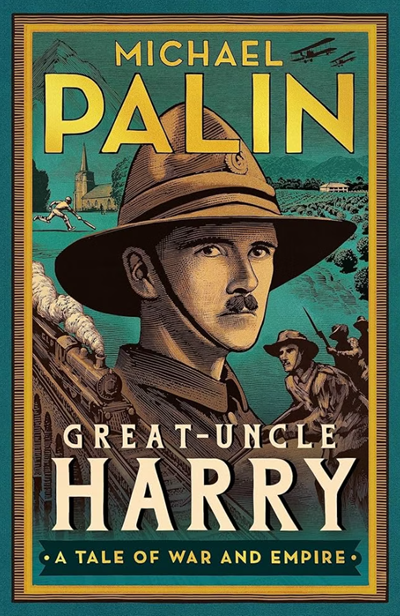
The first of last week’s volumes nestling on my desk, with its immediately identifiable Ripping Yarns cover illustration, was Sir Michael Palin’s story of his forebear, Great Uncle Harry, who travelled the world but disappeared on the Somme. Here, I felt an immediate connection, not least because Michael, I and his Great Uncle Harry Palin had hauled ourselves through the same academy of learning, Shrewsbury School, though at different times. There are plenty of 1914-18 memoirs and tributes around, but this is one of the best. The further the Great War (as it used to be called) recedes, the more we seem to need to torture ourselves with the staggering sacrifices it involved. I read my copy over Remembrance weekend, which made it doubly poignant.
In Great Uncle Harry, Palin’s gift is to give us the hinterland of his ancestor. Many First World War authors, here I could mention the great Lyn Macdonald, Richard Holmes and Martin Middlebrook, all of whom I place on pedestals, provide us with erudite studies, laced with gripping eyewitness accounts. I find myself doing the same with 1939-45, but of necessity there is no room to give the brave and the damned a back story. They are parachuted into the text. They fight and live or die and exit stage left. It is refreshing, therefore, to hold the hand of a first war warrior from birth unto death. Palin was lucky his Great Uncle Harry kept a series of notebooks and diaries of his time in khaki, and was able to research his globe-trotting years before battle. Our man was brought up in Herefordshire, and after school drifted out to British India. He had two stints, first working as a railway manager and latterly as overseer on tea plantations. The reader is fortunate that Palin the documentary-maker filmed in both environments and is able to look over his forebear’s shoulder and summon up the Edwardian social standards of the day, with its solar topees and chota pegs (sunset whiskeys), its heat and its dust. Palin the younger’s many diaries and written travelogues, of which I find New Europe (2007) the best, are equally good.
But Great Uncle Harry Palin was restless. The youngest and most headstrong of seven, he flounced out of each of his two jobs serving the Raj, and ended up trying his hand at farming in New Zealand. There he seemed more settled, but not quite. The Palin under the microscope, notes his great nephew, was one of the first to volunteer for war service with the 12th (Nelson) Regiment, a South Island infantry outfit, in August 1914 and sailed with them overseas, initially to Egypt. There they were absorbed into the Canterbury Battalion, and deployed to Gallipoli, from which Great Uncle Harry emerged without a scratch.
Gallipoli is a conjurer’s name. Now known by the Turks as their Gelibolu Peninsula, overlooking the ancient Hellespont (today’s Dardanelles Strait), its southern tip lies 200 miles from what was then Turkey’s capital, Constantinople, officially Istanbul after 1930. Only since the 1990s has this strategically significant sliver of land, across the Dardanelles from ancient Troy, and guarding entry to the Bosphorus and Black Sea, been opened up for tourists. The 1915 operation was dreamt up by Winston Churchill to break the stalemate of the Western Front. He advocated a naval advance on Constantinople, as a way of knocking the Austro-German alliance out of the war. Such a stratagem would then have offered Paris and London the ability to supply the troops of Tsar Nicholas the Last with modern arms and munitions to prevail against the Central Powers.
Instead of breaking the Western Front, Gallipoli broke Churchill. It was a campaign endlessly refought in the inter-war years, which generally concluded that amphibious warfare had no future, though Lieutenant Colonel George S. Patton in his 1936 General Staff study, The Defense of Gallipoli, found it fascinating. It was one reason why the allies had no maritime landing capability in 1939-40, to Britain’s detriment at Dunkirk, and later Germany’s disadvantage when planning a seaborne assault against southern England. Valuable lessons of what to do, and not to do, had to be relearned before D-Day in 1944 could be a success. My own assessment is right idea, wrong commanders. Gallipoli might have offered the success Churchill desired, but was executed poorly.
The original plan had been to overwhelm Constantinople with battleships, and there is evidence that the Turks were preparing to surrender. However, the Franco-British war fleet encountered German-supplied Krupp cannon along both shores of the Dardanelles and a minefield in the middle, and suffered catastrophic losses. A land campaign was then initiated to clear the Turkish land-based defences. This should have been foreseen and a simultaneous, rather than sequential, maritime-land attack might well have delivered the goods.
Instead, the few Turkish defenders on Gallipoli could see a landing was imminent, called in reinforcements and dug trenches ferociously. On the peninsula, amidst scrub, trench and memorials lie scattered British, Commonwealth, Ottoman and French (yes, they were there too) cemeteries, hinting at stirring tales of derring-do. Last time I was there, I encountered not only rifle cartridges, pieces of pottery rum jars, and shell cases, but human bones. My guide observed, “Probably wild pigs dislodging the topsoil. It happens all the time.” An indication of the 300,000 Allied and 255,000 Turkish killed, wounded and missing in a campaign where illness often took as many as combat wounds. Along the western coast, amidst shards of amphorae from pre-history, lie many wrecks associated with the 1915 campaign in crystal-clear water. It remains high on my recommended battlefields to visit.
“On numerous occasions in 2023 I’ve been tempted to go places with a placard saying ‘Ultimi barbarorum‘”
Brendan O’Neill in Spiked:
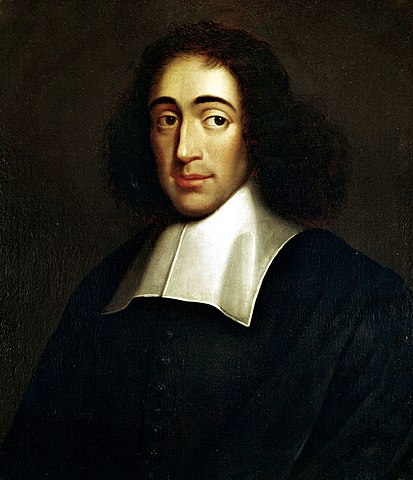
Portrait of Benedictus de Spinoza (1632-1677)
Unknown artist, from the Herzog August Library via Wikimedia Commons.
My favourite story about Spinoza concerns the time he lost his cool. A philosopher, a Jew and history’s finest defender of Enlightenment, Spinoza was normally a picture of quiet reason. But when he heard about the lynching of Johan and Cornelis de Witt he became gripped by an uncommon fury. The de Witt brothers were key political figures in the Dutch Republic, the enlightened new nation in which Spinoza enjoyed such great liberty to think and write. On 20 August 1672, at The Hague, they were set upon by a ferocious mob that held them responsible for the invasion of the republic by a French-English alliance. They were murdered, mutilated and clumps of their flesh were eaten.
Spinoza was enraged. He made a plan to visit the site of the mob’s savagery to hold a one-man protest. Think Greta Thunberg, but enlightened. He prepared a placard to hold up. But his landlord restrained him, fearing he too would be slain by the mob. And so history was denied the image of one of our great philosophers staging a lonely, angry protest. What did his makeshift placard say? It had two words on it. “Ultimi barbarorum“. Rough translation: “You are the greatest of barbarians”.
This year more than any other I’ve understood how Spinoza felt. On numerous occasions in 2023 I’ve been tempted to go places with a placard saying “Ultimi barbarorum“. To the kibbutzim of southern Israel following Hamas’s fascistic savagery against the Jews there on 7 October. To George Washington University after students projected the words “Glory to our martyrs” on the side of the library building: young Americans of unimaginable privilege taking pleasure in the butchery of Jews. To the lovely, leafy campus of Columbia in New York City where students planned to hold a meeting on Hamas’s stirring “counter-offensive”. To those “pro-Palestine” marches in London at which the morally treacherous middle classes marched alongside individuals dressed as Hamas terrorists and extremists chanting for yet more slaughter in Israel: “Jihad, jihad, jihad!”
To New York University where students shouted, “We don’t want no Jew state / We want all of it”: a cry by the comfortable for Hamas to finish the genocidal job of eliminating Jews in the Middle East. To the streets of Manhattan where protesters shouted “Shame on you!” at an Israeli woman whose daughter was kidnapped and brutalised by Hamas. Shaming the victims of racist terror – a low even for the unhinged woke. To any gathering of politically minded Gen Zers, to be frank, after polls found that huge numbers of them view Jews as an “oppressor class” and believe Hamas’s pogrom was “justified”. And to the Sydney Opera House, where radical Islamists chanted “Gas the Jews” and “Fuck the Jews” mere days after Hamas murdered the Jews. Nazi-style parades, uncontained glee at genocidal violence, on the streets of a Western city.
At every place I’ve wanted to say “Ultimi barbarorum“. To call out both barbarism and its intellectual apologists. To express Spinoza-style disgust for these new enemies of Western civilisation. For make no mistake, that’s what they are. From Hamas to the radical Islamists in Europe who feel inspired by Hamas to the West’s own sons and daughters of privilege who make excuses for Hamas – all have proven themselves in 2023 to be the adversaries of truth, culture and reason. Surely no one will now deny that Western civilisation is under assault on two fronts: from without and within?
The West’s bourgeois left loves to larp as Marxists, often quoting the great Rosa Luxemburg: “Socialism or barbarism!” This year we discovered which side of that clash they take – it isn’t Luxemburg’s. The apologism for Hamas in privileged circles has been mind-blowing. Hamas’s bestial violence against the Jews has been denied, downplayed or outright justified. A “day of celebration” is how one privately educated pretend radical in Britain described the racist butchery of 7 October. This sympathy with barbarism, this receptiveness to acts of staggering dehumanisation, goes beyond Israelophobia. It speaks to more than the witless hate for Israel that’s been rampant in right-thinking circles for years.
QotD: The Panto
What made it worse was that I was about 14; I’d almost managed to get through childhood without experiencing this strange British tradition and then, just at the age when you’re most vulnerable to cringe, I got dragged in. Anyway, I think I’m over it now.
Pantomime is one of those very British things that makes me feel a strange sense of alienation from my countrymen, like celebrating the NHS or twee. I’m glad that other people enjoy it, and that it brings a lot of work to actors and to theatres during the Christmas period. I just personally don’t get it.
For those who don’t know about the ins and outs of our island culture, panto is a sort of farcical theatre featuring lots of sexual innuendo and contemporary pop culture references; I think when I watched it there must have been one or two ex-Neighbours stars because they all finished by singing the theme tune.
A key part of this British institution is drag, with men playing the roles of Widow Twankey and the Ugly Sisters. Drag is quite an established tradition in England, such a part of popular entertainment that there is even a photograph of British soldiers in dresses fighting in the Second World War.
Pantomime is thought to have evolved from the medieval Feast of Fools, a day of the year (around the Christmas/New Year period) when social norms would be inverted; laymen would be elected bishops, lords would serve their retainers drinks, and men and women would even swap roles. Social norms could be temporarily broken, which continues today in the often risqué humour incongruously aimed at family audiences (hilariously portrayed in the Les Dennis episode of Extras.)
This kind of drag is obviously humourous, the aim being for the men to look as ridiculous as possible; think of the ungainly Bernard Bresslaw in Carry on Doctor. It is very different to the later pop culture gender fluidity pioneered by David Bowie in which males might be presented as beautifully feminine, even alluring; that was aimed at challenging and disturbing the audience, while panto is aimed at amusing and reassuring. Indeed, the whole point of spending a day inverting social norms is that, by doing so, you are implicitly accepting and defending those social norms.
This form of drag is obviously quite different to the more modern drag queen, a form of entertainment that can be far more explicit and which has in the 21st century become yet another one-of-those-talking-points, chiefly because people seem so keen on letting children watch it.
Ed West, “The last conservative moral panic”, Wrong Side of History, 2023-02-08.
December 31, 2023
Justinian I
In The Critic, George Woudhuysen reviews Justinian: Emperor, Soldier, Saint, by Peter Sarris:
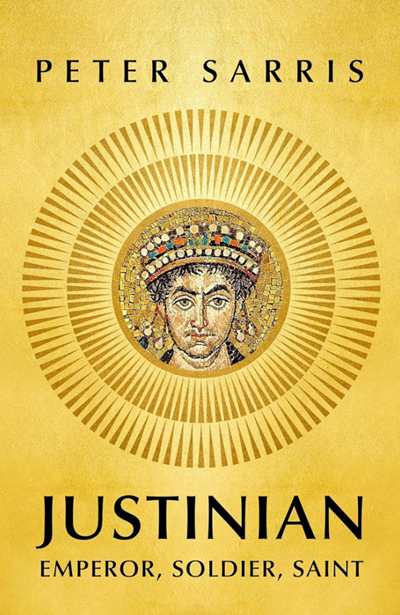
The emperor Justinian did not sleep. So concerned was he for the welfare of his empire, so unremitting was the tide of business, so deep was his need for control that there simply was not time for rest. All this he explained to his subjects in the laws that poured forth constantly from his government — as many as five in a single day; long, complex and involved texts in which the emperor took a close personal interest.
The pace of work for those who served Justinian must have been punishing, and it is perhaps unsurprising that he found few admirers amongst his civil servants. They traded dark hints about the hidden wellsprings of the emperor’s energy. One who had been with him late at night swore that as the emperor paced up and down, his head had seemed to vanish from his body. Another was convinced that Justinian’s face had become a mass of shapeless flesh, devoid of features. That was no human emperor in the palace on the banks of the Bosphorus, but a demon in purple and gold.
There is something uncanny about the story of Justinian, ruler of the eastern Roman Empire from 527 to 565. Born into rural poverty in the Balkans in the late 5th century, he came to prominence through the influence of his uncle Justin. A country boy made good as a guards officer, he became emperor almost by accident in 518. Justinian soon became the mainstay of the new regime and, when Justin died in 527, he was his obvious and preordained successor. The new emperor immediately showed his characteristically frenetic pace of activity, working in consort with his wife Theodora, a former actress of controversial reputation but real ability.
A flurry of diplomatic and military action put the empire’s neighbours on notice, whilst at home there was a barrage of reforming legislation. More ambitious than this, the emperor set out to codify not only the vast mass of Roman law, but also the hitherto utterly untamed opinions of Roman jurists — endeavours completed in implausibly little time that still undergird the legal systems of much of the world.
All the while, Justinian worked ceaselessly to bring unity to a Church fissured by deep theological divisions. After getting the best of Persia — Rome’s great rival — in a limited war on the eastern frontier, Justinian shrewdly signed an “endless peace” with the Sasanian emperor Khusro II in 532. The price — gold, in quantity — was steep, but worthwhile because it freed up resources and attention for more profitable ventures elsewhere.
In that same year, what was either a bout of serious urban disorder that became an attempted coup, or an attempted coup that led to rioting, came within an ace of overthrowing Justinian and levelled much of Constantinople. Other emperors might have been somewhat put off their stride, but not Justinian. The reform programme was intensified, with a severe crackdown on corruption and a wholesale attempt to rewire the machinery of government.
Constantinople was rebuilt on a grander scale, the church of Hagia Sophia being the most spectacular addition, a building that seems still to almost defy the laws of physics. At the same time, Justinian dispatched armies to recover regions lost to barbarian rulers as the western Roman Empire collapsed in the course of the 5th century. In brilliant and daring campaigns, the great general Belisarius conquered first the Vandal kingdom in North Africa (533–34) and then the much more formidable Ostrogothic realm in Italy (535–40), with armies that must have seemed almost insultingly small to the defeated.
If Justinian had had the good fortune to die in 540, he would have been remembered as the greatest of all Rome’s many emperors. Unfortunately for him, he lived. The 540s was a low, depressing decade for the Roman Empire. Khusro broke the endless peace, and a Persian army sacked the city of Antioch. The swift victories in the west collapsed into difficult wars of pacification, which at points the Romans seemed destined to lose.
Budapest Under Siege – WW2 – Week 279 – December 30, 1944
World War Two
Published 30 Dec 2023In the west, the Allies break the siege of Bastogne, but the fight for the Ardennes continues. and British commander Bernard Montgomery is maneuvering to take command of the Western Front ground forces. In Hungary Budapest is cut off by the Soviets and under siege, with hundreds of thousands of civilians still in the city. The fight in Italy is winding down for the winter, but the fight in the Philippines continues. In fact, American landings on Luzon are planned to go off soon.
00:00 INTRO
01:22 The Siege of Bastogne
03:10 The failure of 5th and 6th Panzer Armies
06:11 Montgomery wants command
09:27 Guderian appeals to Hitler, “stop the Ardennes Offensive!”
12:11 Budapest surrounded and under siege
17:04 Wrapping up the Gothic Line Campaign
19:29 Churchill in Athens
20:30 The fight in the Philippines
23:07 SUMMARY
(more…)
The British army in Northern Ireland, 1966-1975
Patrick Mercer reviews Huw Bennett’s Uncivil War: The British Army and the Troubles, 1966-1975 for The Critic:
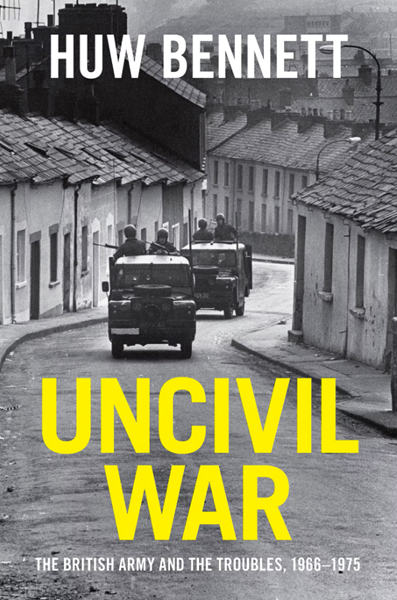
Seen from today’s perspective, the litany of campaigns Britain fought between the World Wars seems unimportant. Yet disasters such as the Jallianwala Bagh massacre in Amritsar in April 1919, and the depredations of the Auxiliaries or Black and Tans in Ireland at much the same time, imperilled imperial strategy. [Richard Dannatt & Robert Lyman’s] Victory to Defeat underlines the actions of relatively small numbers of troops which threatened to unhinge whole campaigns. It makes the perfect counterpoint to Huw Bennett’s Uncivil War, which covers the opening years of the crisis in Northern Ireland in meticulous detail.
Bennett looks at operations in Northern Ireland only up until 1975 — arguably the most intense period — with a promise of further volumes to follow. This is the first, comprehensive attempt to deal in parallel with the political aspects of the campaign as well as the purely military ones. Although densely written, Uncivil War gives a very readable account of the first of three decades of conflict which dominated the everyday life of most of the combat arms of the Army. It now seems ironic, though, that Ulster was always treated as something of a sideshow when compared with the “real soldiering” of deterring the Soviets in Germany.
Central to Bennett’s book is the debacle of “Bloody Sunday” in January 1972, when paratroopers ran amok in Londonderry at a point of the campaign when the IRA was exhausted and finding it almost impossible to recruit. Politically, there might have been a breakthrough; militarily the terrorists were teetering on collapse, but one black sheep unit and the ham-fisted response by the chain of command galvanised the IRA. With a rifle’s crack, they guaranteed bloodshed for years to come.
If ever a victory was turned into defeat in modern times, this was it. Bennett pulls no punches in pointing that out. The interesting contrast with Lyman and Dannatt’s work is that no matter how much had been learnt from the Second World War, the doctrine that emerged could only be tested by blank firing exercises in Germany. Whilst the highly unlikely possibility of a war in Europe was constantly analysed, very little strategic thinking was put into the grinding, long-term campaign in Ulster that was actually killing people.
Certainly there were political initiatives and the intelligence machinery was constantly evolving, but the many battalions and regiments who were charged with everyday deterrence and occasional attrition wandered the streets with little imagination or flair, often only seeming to provide targets for the terrorists. If war against the Soviets was remote, bombs, snipers and ambushes in Ulster were certain. By contrast, the Field Service Pocket Book (India) of 1930 laid out clear advice and principles for operations on the North-West Frontier. In Ulster, we just blundered on.
If the lessons of 1918 were neglected, those that led to victory in 1945 were carefully studied, although any coherent tactical doctrine took until the 1980s to be published. Perversely, the operations that followed both world wars were much the same: small, far-flung, post-imperial scuffles which owed little to “conventional” fighting. Indeed, it might be argued that the real lessons that the Army needed to heed after 1945 were not those of a European war, but those which might have prepared it for long years in Northern Ireland or the former colonies.
This library has every book ever published
Tom Scott
Published 11 Sept 2023The British Library is one of the six legal deposit libraries for the UK — and the only one that doesn’t pick and choose, or have to ask for copies. That’s a lot of books to store, and the internet’s only making it worse. ■ The BL: https://bl.uk ■ UK Web Archive: https://www.webarchive.org.uk/
(more…)
December 30, 2023
In defence of … cufflinks?
In The Critic, Peter Caddick-Adams makes the case for sartorial splendour over modern-day slovenly dress, and particularly for the cufflink:
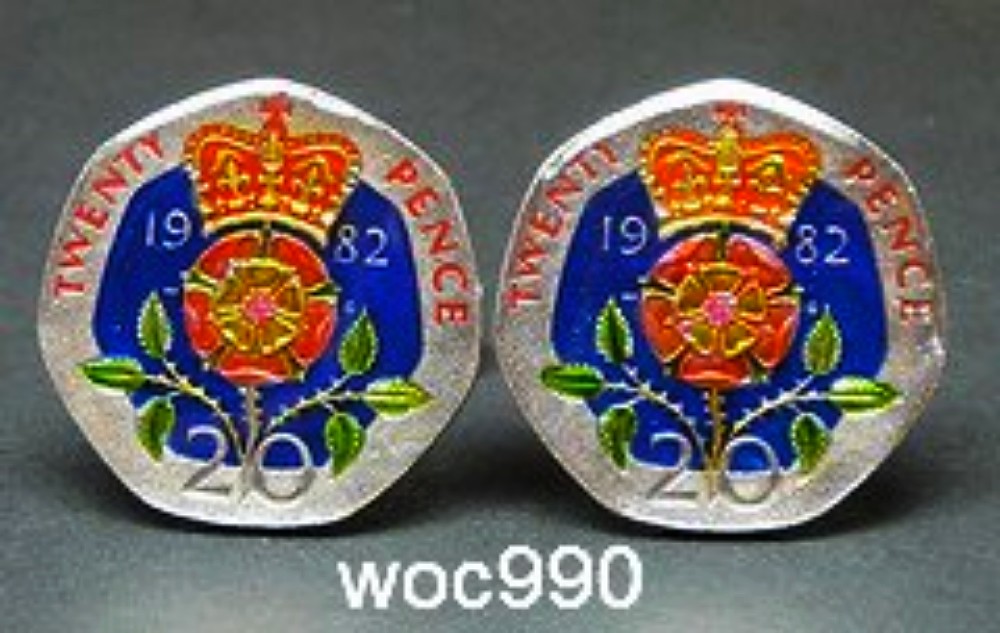
“Great British coin cufflinks” by wowcoin is licensed under CC BY-SA 2.0 

 .
.
… these traditional baubles are fast becoming the clothing language of the old guard. Although fashion is always on the move, we are less stylish than we once were. Perhaps propelled by Mrs Thatcher’s homely handbags, refinement in dress is receding from everyday life. The fact that our current Prime Minister, like his predecessor-but-one, rarely sports cufflinks is a symptom of a greater sartorial malaise.
Links evolved in the 19th century as a means of displaying wealth and class, following the ruffled nonsense of the Elizabethan and Baroque eras and floppy sleeves sported by Beau Brummell and his Regency dandies. After Prince Albert had popularised the watch chain named after him, masculine fashion was bowled over by his son, the frock-coated Prince of Wales, later Edward VII. “Gentlemen, you may smoke,” he proclaimed on ascending the throne in 1901, instantly removing Queen Victoria’s ban on puffing away on the royal estates.
Apart from making a profession out of cigar-smoking, the new king influenced many clothing innovations, including trouser turn-ups (a last-minute tailor’s resort), those monstrous “Windsor” tie-knots, and leaving the bottom button of a waistcoat undone (due to the imperial stomach). The most colourful were His Majesty’s shirt embellishments designed by Fabergé. They immediately prompted Europe’s middle classes to weigh-in with gold, enamelled or monogrammed cuff jewellery, without which the aspiring Edwardian-era male was, frankly, naked.
Not compatible with the rigours of combatting the Bosche in the trenches of the Great War (when the affectation of tucking a muddied or bloodied handkerchief into one’s coat sleeve re-emerged), cuff-links returned with vigour during the Jazz Age. Their reappearance, along with spats (worn around the ankle) was due to the lack of central heating in His Majesty’s realm. All those draughty corridors in smart houses (and lack of instant remedies for colds and flu) necessitated warm ankles, with silk-wrapped necks and wrists protected by elaborate studs and links.
Resurgence was brief, for the aforesaid gentleman’s accessories almost vanished in 1939–45 with the advent of austerity imposed by adversity. Skullduggery by German submarine captains created shortages of fine shirting. The resultant famine of silk and cotton in turn destroyed the double cuff, which hitherto had been bound together so effectively by links. As it was deemed unpatriotic in the many countries at war to advertise luxury, these flourishes fell out of fashion completely.
Winston Churchill compounded this utilitarian mood with his man-of-the-people “siren suits” (predecessor of today’s onesies). They reflected the epoch of clothing short-cuts, such as collar-attached shirts, zip fasteners and trouser belts, replacing collar studs, fly buttons and braces — all, you will note, gifts from our Transatlantic cousins. Although men’s hats were retained for warmth, mainly disappearing in the 1960s because of our extended lives in automobiles, these moves to simpler clothing (even if, in Churchill’s case, adorned with a spotted bow tie) also threatened the permanent demise of the cuff-link. More correctly, they threatened cufflinks, for these are only of value in the plural.
Indeed, “what is the point of cufflinks?”, I hear you ponder. Anthropologists will tell you that man is a curious creature. From the dawn of time, he has had a weakness for asserting individuality, to signify class or leadership, or oft-times as part of a mating ritual. Archaeologists will reference troves of treasured jewellery in excavated graves. Historians cite portraits, engravings, photographs and uniforms, monocles and cravats as proof of this down to modern times. Staying with a barrister friend recently, I was shown his collection of about fifty pairs of cufflinks. Their designs reflected his three lives as a reserve officer, lawyer and freemason.
Building the Walls of Constantinople
toldinstone
Published 15 Sept 2023This video, shot on location in Istanbul, explores the walls of Byzantine Constantinople — and describes how they finally fell to the Ottoman Turks in 1453.
(more…)
QotD: Post-Christmas dining
Amanda (@Pandamoanimum), Twitter, 2021-12-29.
December 29, 2023
The Christianization of England
Ed West‘s Christmas Day post recounted the beginnings of organized Christianity in England, thanks to the efforts of Roman missionaries sent by Pope Gregory I:
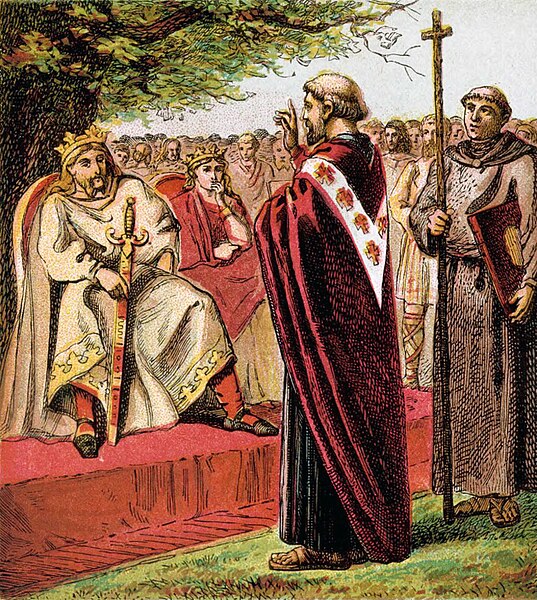
“Saint Augustine and the Saxons”
Illustration by Joseph Martin Kronheim from Pictures of English History, 1868 via Wikimedia Commons.
The story begins in sixth century Rome, once a city of a million people but now shrunk to a desolate town of a few thousand, no longer the capital of a great empire of even enjoying basic plumbing — a few decades earlier its aqueducts had been destroyed in the recent wars between the Goths and Byzantines, a final blow to the great city of antiquity. Under Pope Gregory I, the Church had effectively taken over what was left of the town, establishing it as the western headquarters of Christianity.
Rome was just one of five major Christian centres. Constantinople, the capital of the surviving eastern Roman Empire, was by this point far larger, and also claimed leadership of the Christian world — eventually the two would split in the Great Schism, but this was many centuries away. The other three great Christian centres — Jerusalem, Alexandria, and Antioch — would soon fall to Islam, a turn of events that would strengthen Rome’s spiritual position. And it was this Roman version of Christianity which came to shape the Anglo-Saxon world.
Gregory was a great reformer who is viewed by some historians as a sort of bridge between Late Antiquity and the Middle Ages, the founder of a new and reborn Rome, now a spiritual rather than a military empire. He is also the subject of the one great stories of early English history.
One day during the 570s, several years before he became pontiff, Gregory was walking around the marketplace when he spotted a pair of blond-haired pagan slave boys for sale. Thinking it tragic that such innocent-looking children should be ignorant of the Lord, he asked a trader where they came from, and was told they were “Anglii”, Angles. Gregory, who was fond of a pun, replied “Non Angli, sed Angeli” (not Angles, but angels), a bit of wordplay that still works fourteen centuries later. Not content with this, he asked what region they came from and was told “Deira” (today’s Yorkshire). “No,” he said, warming to the theme and presumably laughing to himself, “de ira” — they are blessed.
Impressed with his own punning, Gregory decided that the Angles and Saxons should be shown the true way. A further embellishment has the Pope punning on the name of the king of Deira, Elle, by saying he’d sing “hallelujah” if they were converted, but it seems dubious; in fact, the Anglo-Saxons were very fond of wordplay, which features a great deal in their surviving literature and without spoiling the story, we probably need to be slightly sceptical about whether Gregory actually said any of this.
The Pope ordered an abbot called Augustine to go to Kent to convert the heathens. We can only imagine how Augustine, having enjoyed a relatively nice life at a Benedictine monastery in Rome, must have felt about his new posting to some cold, faraway island, and he initially gave up halfway through his trip, leaving his entourage in southern Gaul while he went back to Rome to beg Gregory to call the thing off.
Yet he continued, and the island must have seemed like an unimaginably grim posting for the priest. Still, in the misery-ridden squalor that was sixth-century Britain, Kent was perhaps as good as it gets, in large part due to its links to the continent.
Gaul had been overrun by the Franks in the fifth century, but had essentially maintained Roman institutions and culture; the Frankish king Clovis had converted to Catholicism a century before, following relentless pressure from his wife, and then as now people in Britain tended to ape the fashions of those across the water.
The barbarians of Britain were grouped into tribes led by chieftains, the word for their warlords, cyning, eventually evolving into its modern usage of “king”. There were initially at least twelve small kingdoms, and various smaller tribal groupings, although by Augustine’s time a series of hostile takeovers had reduced this to eight — Kent, Sussex, Essex, and Wessex (the West Country and Thames Valley), East Anglia, Mercia (the Midlands), Bernicia (the far North), and Deira (Yorkshire).
In 597, when the Italian delegation finally finished their long trip, Kent was ruled by King Ethelbert, supposedly a great-grandson of the semi-mythical Hengest. The king of Kent was married to a strong-willed Frankish princess called Bertha, and luckily for Augustine, Bertha was a Christian. She had only agreed to marry Ethelbert on condition that she was allowed to practise her religion, and to keep her own personal bishop.
Bertha persuaded her husband to talk to the missionary, but the king was perhaps paranoid that the Italian would try to bamboozle him with witchcraft, only agreeing to meet him under an oak tree, which to the early English had magical properties that could overpower the foreigner’s sorcery. (Oak trees had a strong association with religion and mysticism throughout Europe, being seen as the king of the trees and associated with Woden, Zeus, Jupiter, and all the other alpha male gods.)
Eventually, and persuaded by his wife, Ethelbert allowed Augustine to baptise 10,000 Kentish men on Christmas Day, 597, according to the chronicles. This is probably a wild exaggeration; 10,000 is often used as a figure in medieval history, and usually just means “quite a lot of people”.
The Soviet follow-on operation after Bagration
Big Serge discusses the state of the Germans on the Eastern Front at the end of the massive Soviet attacks that collapsed Army Group Centre in 1944:
But now, as Bagration began to run out of momentum, the Soviets really did put Model’s army group in the crosshairs with an enormous follow up offensive — the second phase of their summer blockbuster. Model’s army group consisted of two Panzer Armies (the 4th and 1st), and an allied Hungarian force guarding the southern flank. On paper, a pair of Panzer Armies was a formidable force, but like all German units at this stage in the war they were understrength, and by this point they were already bleeding strength as panzer divisions were scrambled north to try and slow down Operation Bagration.
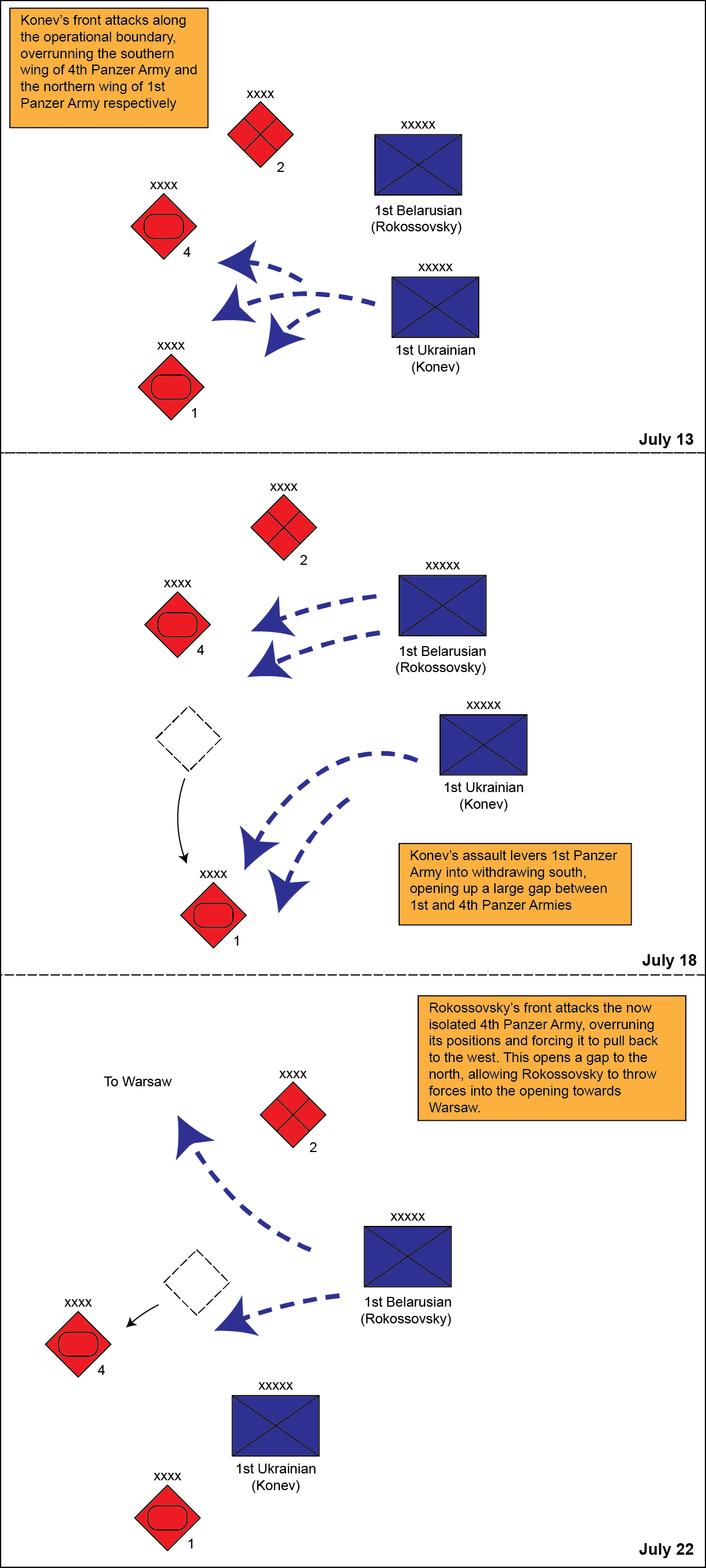
Arrayed against Model’s force were two Soviet Fronts (the equivalent of an Army Group) under a pair of the Red Army’s best operators. The lead off assault came on July 13, with Marshal Ivan Konev’s 1st Ukrainian Front forcing positions in the interstitial zone between Model’s two Panzer Armies. Konev’s intention was to split the two armies apart, force a penetration between them, and then curl into the rear to encircle one, or if possible both of them. Therefore, Konev’s initial assault was highly concentrated, with as much as 70 percent of his artillery and 90 percent of his armor assembled in a few narrow sectors selected for breaching.
With this level of force concentration by the attackers, there was really little that the Germans could do. Nevertheless, a somewhat lethargic and stiff German response helped make the disaster even worse. 4th Panzer Army headquarters initially believed Konev’s opening assault to be only a local attack – later defensively arguing that “there were as yet no signs of the attack being extended to other sections of the front” — and so attempted to respond with local counterattacks by its own reserves. As a result, by the second day of the Soviet offensive the Panzer Army had already committed all of its organic reserves while failing to withdraw from defensive positions that were already compromised. By the time they realized that Konev was launching a serious offensive operation, it was too late. Konev had already bashed into critical seams in the German front, turning his forces into a giant splitting wedge, in place to pry the whole front open.
[…]
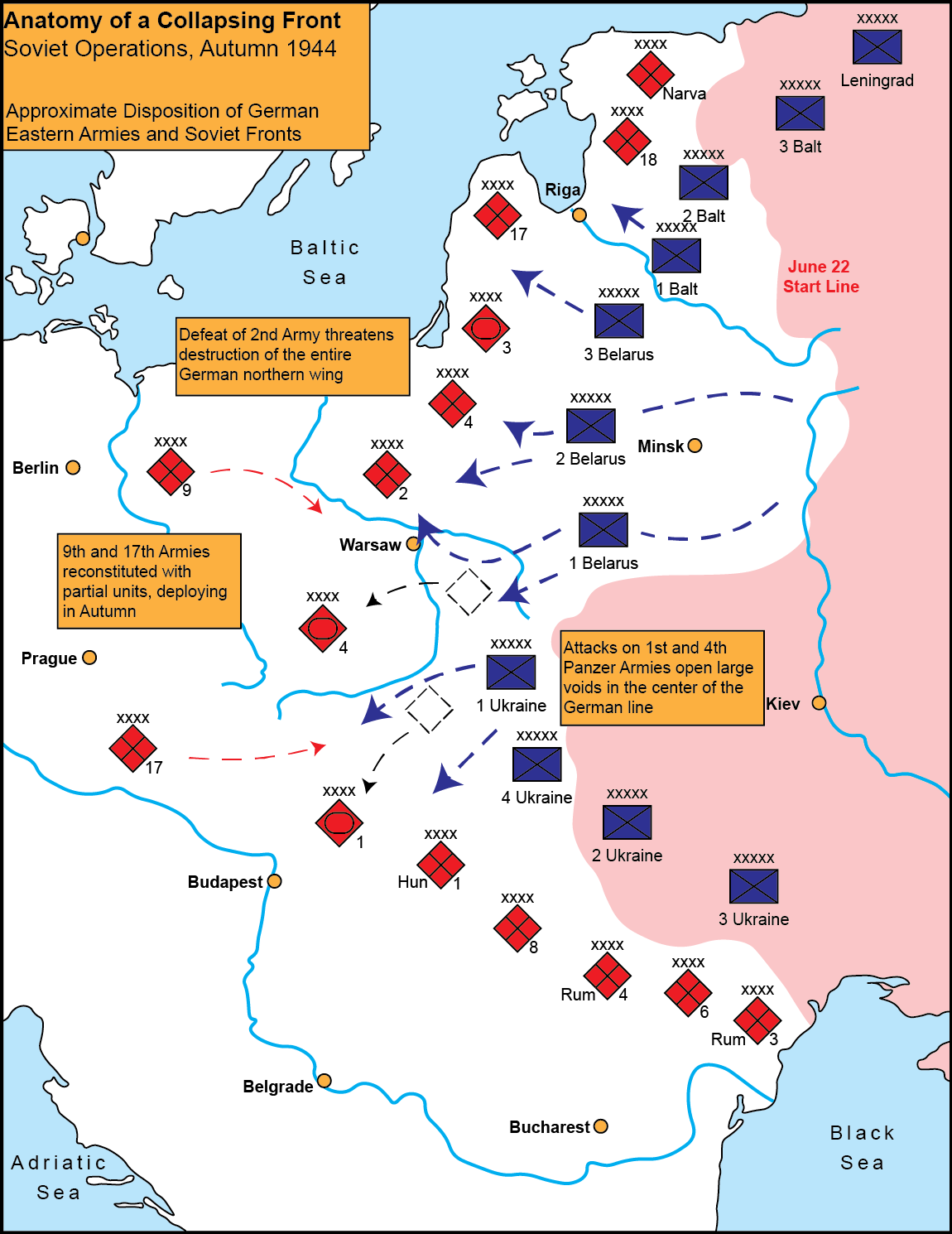
What the Soviets had achieved with their enormous assaults on Army Group North Ukraine was remarkable. By precisely targeting the seams in the German formations, the initial attacks had pried open the German position like a clam, forcing the two panzer armies to retreat in opposite directions — the 1st pulling back to the south towards Hungary, and the 4th withdrawing westward towards Krakow. These diverging withdrawals opened enormous voids in the German line — the official German history of the war simply refers to this sequence of events as “the loss of a continuous front”. In a war where the enemy wielded vast mechanized forces, such gaps were fatal.
Rokossovsky and Konev had essentially overrun an entire German army group — and the best equipped group in the east, at that — in the space of about ten days, wedging the German line open and creating vast voids to drive into. Most importantly, Rokossovsky now faced one of the more tantalizing opportunities of the entire war. A great space now beckoned him to drive north towards Warsaw, and in his path was only the tired remnant of German second army — a force with no armor whatsoever, caught completely out of position.
Any wargamer could look at the map as Rokossovsky saw it and see that the opportunity to win a seminal, world-historical victory was now within reach. A sharp drive on Warsaw would put him in position to not only capture the city (a major transportation, administrative, and supply base), but also smash through the threadbare German 2nd Army and drive to the Baltic Coast. If he could achieve this, fully half of the German eastern forces would be encircled — the entirety of Army Group North (still fighting on the Baltic Coast) and everything that remained of Army Group Center. Rokossovksy now saw little standing between his powerful Front and one of the greatest encirclements — perhaps the greatest — of all time. No less than six German armies were sitting, naked and vulnerable, on the proverbial silver platter.
The Eastern Front was on the verge of total collapse. If Rokossovsky could bash through Warsaw (a seemingly simple proposition, given the enormous overmatch that he enjoyed over German 2nd Army), he would wipe out half the German eastern army and face no meaningful German forces between him and Berlin.