
Forces News
Published Jun 3, 2024Tanks, soft-skin vehicles, bunkers and buildings — the PIAT could deal with them all.
The PIAT — Projector, Infantry, Anti-Tank — was a British weapon that proved its worth during the Normandy Landings.
It was introduced in 1943, first seeing action in Tunisia, but was used to good effect in France, and despite its name it was a true multi-purpose weapon.
(more…)
September 12, 2024
PIAT: The weapon that could punch through steel but needed nerves to match
Comments Off on PIAT: The weapon that could punch through steel but needed nerves to match
September 11, 2024
The Korean War Week 012 – Green Light for Incheon – September 10, 1950
The Korean War by Indy Neidell
Published 10 Sep 2024Douglas MacArthur’s brazen plan to land two full divisions far behind enemy lines and sabotage the North Korean logistics finally gets the green light from the President and the Joint Chiefs of Staff, despite the myriad difficulties everyone knows the operation will face. It is to go off next week. In the field, the North Korean offensive against the Naktong Bulge continues, though it seems to be running out of steam, and the UN forces get beefed up as the first British troops to arrive in Korea join the battle line.
Chapters
01:03 Recap
01:23 KPA Offensive and Counterattacks
07:31 JCS Approve Incheon
10:33 Eugene Clark Investigates
13:32 More UN Forces for the fight
15:00 Summary
15:24 Conclusion
18:14 Call to Action
(more…)
Comments Off on The Korean War Week 012 – Green Light for Incheon – September 10, 1950
⚔️Parry! ⚔️Parry! 🗡️Thrust! 🗡️Thrust! GOOD!
Jill Bearup
Published Jun 3, 2024They’re MEN. They’re men in TIGHTS (tight tights!) Please enjoy the extended edition of this video with many random digressions that will mostly be cut for the public version 😀
00:00 Robin Hood: Men in Tights
00:50 The Plot, It Goeth Thusly
03:03 Prince of Thieves/Men in Tights/Maid Marian and Her Merry Men
04:50 What kind of fight do you like?
06:19 Setup for the ending fight
07:03 The Prince of Thieves fight
07:38 The Adventures of Robin Hood fight
07:53 FIGHT!
08:53 My favourite thing (compare and contrast)
10:03 The first phrase
10:39 The second phrase
11:24 The third phrase
11:43 The fourth phrase
12:29 The fifth phrase
12:40 and FIN
13:13 I love it, I really do
14:17 Book chat
15:52 Men hitting each other with sticks
17:40 Matching vibes
18:46 Just Stab Me Now audiobook update
(more…)
Comments Off on ⚔️Parry! ⚔️Parry! 🗡️Thrust! 🗡️Thrust! GOOD!
September 10, 2024
Chilling effect (with a British accent) – “No one is now sure what they are allowed to say”
Spaceman Spiff makes a bid to star in one of Gauleiter Keir Stürmer’s big show trials, coming far too soon to a town hall near you:
In Britain many of us now walk on eggshells.
The country and its systems are broken. Free speech is being outlawed. Many are frightened to say anything, although it doesn’t stop them noticing and thinking.
Recent emphasis on invented categories of offence — misinformation, disinformation and now malinformation — mean almost anything can come under the purview of the State and its informers, from ill-timed comments to jokes and humorous observations.
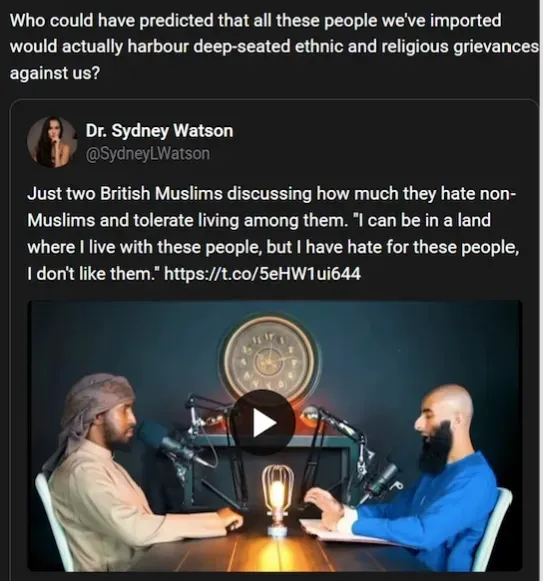
Famously, memes based on simple observation are admissible in Britain’s world-famous show trials, including this one no doubt:1
It is difficult to know what people are thinking when they endorse the importation of people who want to kill them for their lifestyle choices.
Everything must be monitored because less and less can be tolerated by those in positions of authority. Their narratives are failing, and they are panicking. They are getting desperate.
Noticing is verboten
Many of the topics that trigger the strongest response by the British Government are simply unpopular policies that normal people can no longer ignore.
More accurately, policies that directly affect growing numbers of law-abiding taxpayers who did not vote for them.
Do not discuss immigration
Mass immigration is the supreme example. Britain’s cities are being flooded with “asylum seekers”, most of whom are economic migrants with no right to settle in the country.
Many are alien peoples from distinct cultures with no connection to Europe and a poor track record of assimilation.
They are aided by an army of well-funded human rights lawyers who distort laws designed to help the genuinely dispossessed, which most immigrants are not.
Thanks to our generosity many privileges are extended to foreigners that are unavailable to natives such as free housing and financial help on the understanding these are used sparingly and temporarily to aid the desperate.
These myriad of kindnesses did not emerge to serve those who want the benefits of first-world living while dodging the corresponding costs; the development of high-trust social structures, the communal spirit that transcends tribalism, and the selflessness it all requires. These are rare phenomenon much of the world cannot produce or maintain, and they are being squandered in Western nations by the selfish obsessed with demonstrating their own virtue.
No serious discussion of immigration is tolerated at any level in Britain. However, this does not stop the erosion of goodwill upon which most of their schemes depend. The generosity they abuse is a limited resource and the magnanimity upon which it depends is evaporating quickly.
1. Many are being jailed in Britain for posting memes and related social media content. The judges often go to some lengths to confirm it is not the content of the material they are questioning as they are perfectly legal, but the perceived intent behind the posting itself.
This unprecedented legal descent into clairvoyance, hate speech and arrogance is relatively new. It will not age well and tells us more about the decline in competency in the judiciary than anything else. Standards are clearly not what they once were.
To put this kind of absurd reasoning on display in irremovable public court records speaks to the level of delusion and arrogance we are now dealing with in Britain. Our social betters are truly lost in a world of their own.

Comments Off on Chilling effect (with a British accent) – “No one is now sure what they are allowed to say”
September 8, 2024
Romney Marsh and the Battle of Britain (BBC 1976)
BBC Archive
Published Jun 2, 2024Romney Marsh has been dubbed the “sixth continent”, due to its size and the sense that it has its own rules.
A shingle beach that silently grows bigger every year, scattered debris from the Battle of Britain, an old-fashioned lighthouse hidden from the sea by a nuclear power station. It has a character unlike anywhere else in the UK.
Presented by Dilys Morgan and Bernard Clark.
Clip taken from Nationwide on the Road: Romney Marsh, originally broadcast on BBC One, Wednesday 7 April, 1976.
You have now entered the BBC Archive, a time machine that will transport you back to the golden age of TV to educate, entertain and enlighten you with classic clips from the BBC vaults.
Comments Off on Romney Marsh and the Battle of Britain (BBC 1976)
QotD: Life in pre-mechanical times
Anyway, because I’m actually interested in how people are and how they lived, I love “living history”. I know, I know, I’m the one who brought up the Civil War, but though I admire (in a very limited sense) the dedication of “reenactors”, we ain’t going there, lest the comments get way off track. Instead, I’ll refer you to the works of Ruth Goodman. She apparently shows up on a lot of “living history” shows in Britain, which are apparently quite popular over there, and she writes good books about the experience, most with “How to” in the title: I’ve read How to be a Victorian and How to be a Tudor, and they’re both great fun.
The thing you’ll notice right away if you read them is how utterly tedious life was pre-electricity. Actually, no, tedious is the wrong word, since in our usage it implies “mindless” and that’s exactly the opposite of Victorian and especially Tudor life. A much better word is “laborious”, maybe even just “hard”. Life was hard back then. Even the simplest tasks took hours, because everything had to be done by hand. You had a few simple machines, of course — simple in the mechanical sense, though nearly every page brings its “gosh, I never would’ve thought of that!” surprise — but mostly it’s muscle power. If you’re lucky, a horse’s or a donkey’s muscles do some of the heaviest work, but mostly it’s straight-up human effort.
And it’s far from mindless. How to be a Tudor has a long section on baking bread, for instance, and it’s fascinating. There’s a reason bakers had their own guild and were considered tradesmen; it takes a lot of well-honed skill to make anything but the coarsest peasant stuff. And of course that coarse peasant stuff takes a decent amount of skill itself, which is just one of a zillion little skills your average housewife would have. If you read the section on bread-baking and really try to imagine doing it, you’ll find yourself almost physically exhausted … and that’s just one minor chore among dozens, maybe hundreds, that everyday people had to do each and every day.
In other words, everyday Tudor people were “simple”, in the old sense that means “unsophisticated”, but they were never, ever bored. Even the relatively well-off, even when everything was peaceful and prosperous and functioning perfectly, were constantly mentally engaged with the world. They had to be. Imagine if getting your daily bread took not just two hours’ labor, but an actual plan. If you didn’t start your day figuring out how you were going to get fed that day, you wouldn’t eat. They had dozens, probably hundreds, more daily tasks than we ever have, and while any one of those tasks can probably be performed on autopilot if taken in isolation, they were never taken in isolation. Maybe the housewife could bake bread on autopilot, but while her hands were doing that seemingly of their own volition, her mind was lining up the zillion other things she had to do that day. Her mind was constantly engaged.
And “housewife” was a deeply meaningful term back then. The next thing that strikes you, after the sheer amount of effort everything took, is the necessity of communal life. Just the basics of day-to-day living pretty much requires a nuclear family — husband, wife, a few kids. And that’s your hardy yeoman type on the edge of starvation on the forest’s fringes. In any larger settlement, everyone knows everyone, intimately, because your very life depends on it — not only do you know the miller personally, you’ve got a major, indeed mortal, interest in how he lives his life, because if he’s shorting you, you die … or, at least, your already hard life gets a whole lot harder. There’s basically no such thing as privacy, because there can’t be.
Severian, “On Boredom”, Rotten Chestnuts, 2021-08-17.
Comments Off on QotD: Life in pre-mechanical times
September 5, 2024
Matilda I – The Little Tank That Did | Tank Chat #176
The Tank Museum
Published May 24, 2024In 1940, this small but well armoured tank was pretty much all that stood between the German Blitzkrieg and a battered British Army that was retreating to the coast.
Slow, small, and armed only with a machine gun, the A11 Infantry Tank (Matilda I) would achieve great things in its only significant battlefield action – effectively saving the British Expeditionary Force from annihilation.
At Arras on 21st May 1940, Matilda Is and IIs of 4th and 7th Royal Tank Regiment counterattacked the rapidly advancing 7th Panzer Division. In doing so, they successfully halted the German advance and unnerved Hitler so much that he issued an order forbidding further advances — thus giving the British and French chance to organize the Dunkirk evacuation.
In this video, David Willey covers the history of this diminutive and often ridiculed little tank which altered the course of history by saving an entire army.
This video features archive footage courtesy of British Pathé.
Comments Off on Matilda I – The Little Tank That Did | Tank Chat #176
September 4, 2024
The Korean War Week 011 – Destroy the Perimeter! – September 3, 1950
The Korean War by Indy Neidell
Published 3 Sep 2024The North Korean forces launch a huge new offensive against the entire Pusan Perimeter, hoping to break through at least somewhere along the line. They are aware that time is of the essence, for the UN forces grow in number daily, while they are losing a battle of attrition. Some new UN arrivals this week are the first British ground troops in Korea for the fight. Meanwhile, Douglas MacArthur’s plans for his upcoming surprise counteroffensive hit all sorts of snags thanks to Korean geography.
Chapters
00:51 Recap
01:26 The British Arrive
03:47 New KPA Strategy
06:49 The New KPA Offensive
12:26 More Incheon Issues
15:16 The US and China
17:12 Summary
(more…)
Comments Off on The Korean War Week 011 – Destroy the Perimeter! – September 3, 1950
British Foreign Secretary David Lammy indulges himself with a Trudeau-esque bit of geopolitical posturing
In Spiked, Brendan O’Neill outlines the British government’s odd choice of timing to announce suspension of (some) arms shipments to Israel:

Bereft of vision, the modern politician is obsessed with “optics”. Which makes foreign secretary David Lammy’s announcement this week that the UK will be suspending some arms exports to Israel all the more surreal. The optics of withholding weapons from the Jewish State the day after we discovered that its enemy is so ruthless it will happily murder young Jews in cold blood are atrocious. Did not one functionary in the Foreign Office think to raise his or her hand and say: “Sir, should we at least wait until the bodies of those six Israeli hostages are cold before we shame and punish the nation they came from?”
This goes way beyond optics, of course. It is more than a failure of spin. It is a failure – a colossal, unforgivable one – of morality. As the bodies of the six slain Jews found in one of Hamas’s hellish lairs in Rafah were being transported back to a grief-stricken Israel, our government took action not against the Islamist extremists who carried out this unutterable atrocity, but against the nation that suffered it. Mere hours after the discovery of an act of fascistic savagery, our government handed a propaganda victory to the fascists by dragging Israel’s name through the mud. What were they thinking? Shameful doesn’t cover it.
Mr Lammy has said around 10 per cent of arms sales to Israel will be suspended. Thirty out of 350 arms-exports licences will be cancelled, primarily affecting parts for fighter jets, helicopters and drones. The reason for this smug, haughty smackdown of the Jewish State? Because there’s a “clear risk”, said Lammy, that such equipment will be used to “commit or facilitate a serious violation of international humanitarian law”. Big talk from a politician who noisily supported the West’s imperial bombardment of Iraq that led to the deaths of hundreds of thousands of civilians and the widescale torture and rape of prisoners.
Many are damning Lammy’s partial embargo as gesture politics. “What is the point?”, headlines wonder. Denying Israel a few parts for planes won’t make much difference, some moan. For the frothing Israelophobes of the iffy left, nothing less than a complete arms embargo will do. They want not one gun to go to crazy Israel. If only there was a word to describe people who agitate morning, noon and night for the disarming of a Jewish nation that recently suffered the worst act of anti-Semitic violence since the Holocaust.
The obsession with the partial nature of Lammy’s reprimanding of Israel misses the point. What the Foreign Office has just done is huge – and profoundly troubling. Sure, it won’t make much of a dent in Israel’s ability to fight Hamas, but it will cast aspersions on Israel’s fight against Hamas. It won’t militarily weaken Israel’s war on the pogromists that slaughtered more than a thousand of its people on 7 October, but it might morally weaken that war with its sly implication that there’s a criminal element to this crusade against Hamas’s army of anti-Semites. The partial arms embargo is indicative of something far more unsettling: a solidarity embargo as Britain slowly but surely turns its back on the Jewish nation.
Comments Off on British Foreign Secretary David Lammy indulges himself with a Trudeau-esque bit of geopolitical posturing
QotD: The modern tribal divide – the “Somewheres” versus the “Anywheres”
Boris Johnson’s election victory has once again brought this divide to the surface.
Anywheres tend to be younger and place more value on career and education – that is, they see themselves in terms of what they have achieved. They are also more comfortable with ethnic diversity and mass immigration, precisely because their identities are less rooted to place and group.
Somewheres, by contrast, are older and place greater value on the communities in which they live. This is not to say that Anywheres do not care about their community. Rather, Anywheres can see themselves prospering in any community.
Goodhart estimates that around 50 per cent of the population are Somewheres, 25 per cent are Anywheres, and the remainder occupy the grey area between the two camps. Both worldviews are perfectly legitimate, but the problem is that they can conflict.
From sitting in seminar after seminar, packed with policymakers, politicians, journalists and academics, Goodhart became painfully aware of how much the Anywhere view dominates public discussion, despite being a minority view.
Richard Norrie, “The revenge of the Somewheres”, Spiked, 2020-01-13.
Comments Off on QotD: The modern tribal divide – the “Somewheres” versus the “Anywheres”
September 3, 2024
Sten MkII: Just When You Thought It Couldn’t Get Simpler
Forgotten Weapons
Published May 29, 2024The Sten MkI had barely been approved for production when the Sten MkII was born. Initially requested to produce a version of the gun suitable for paratroopers, in March 1941 Harold Turpin redesigned the front end of the Sten to have a quickly detachable barrel and a rotating magazine well (for compact storage). This new model was tests in late June and early July, approved for use, and contracts for it were issued in August 1941.
Named the MkII, this model of the Sten would quickly become the standard, and it was ultimately produced by six major factories (with the assistance of hundreds of subcontractors) on three continents to the tune of 2.6 million examples made. In addition to the barrel removal, the new model has a simpler front sight, simpler stock, and a revised bolt locking notch (upward, instead of downward like on the MkI).
(more…)
Comments Off on Sten MkII: Just When You Thought It Couldn’t Get Simpler
August 31, 2024
Forgotten War Ep2 – You Walk, You Walk Or You Die Mate
HardThrasher
Published 30 Aug 2024Please consider donations of any size to the Burma Star Memorial Fund who aim to ensure remembrance of those who fought with, in and against 14th Army 1941–1945 – https://burmastarmemorial.org/
(more…)
Comments Off on Forgotten War Ep2 – You Walk, You Walk Or You Die Mate
Britain’s police double down on “non-crime hate incidents” as a tool of repression
Andrew Doyle admits he was over-optimistic by predicting that the British police forces’ use of “non-crime hate incidents” — after court judgments and Home Office instructions to stop using them — would not last for much longer. That was in 2022:
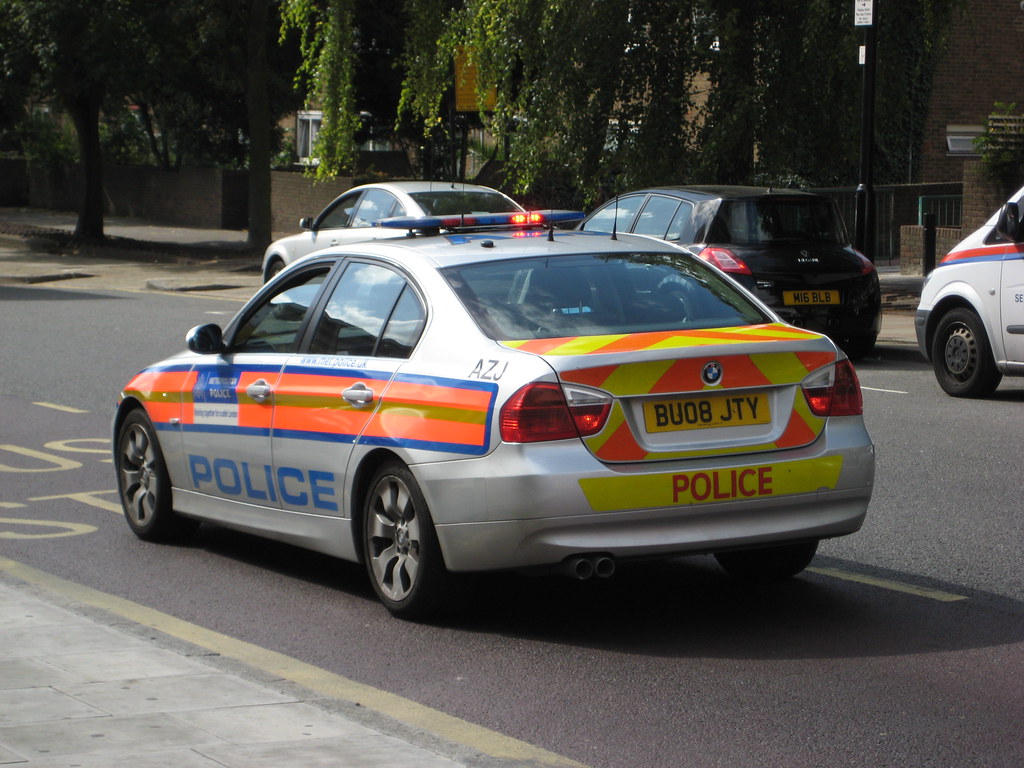
“Metropolitan Police London England” by William Mewes is marked with CC0 1.0 
 .
.
I have a tendency to be over-optimistic. In my 2022 book The New Puritans, I wrote about “non-crime hate incidents” and how they were still being recorded by police, in spite of the Court of Appeal’s ruling that they were “plainly an interference with freedom of expression” and direct instructions from the Home Office that the police must stop this illiberal and unethical practice. However, I concluded that ultimately “it seems unlikely that ‘non-crime hate incidents’ will last for much longer”.
Of course I was wrong, because I had not counted on just how authoritarian a new Labour government might be. It was bad enough that the Education Secretary Bridget Phillipson scotched the Higher Education (Freedom of Speech) Act just one day before parliament went into recess — presumably to avoid having to debate the matter — but now the Home Secretary Yvette Cooper has reversed the Conservatives’ pledge to limit the recording of “non-crime”. Labour is bringing back this absurd policy, and has convinced itself that this is somehow a progressive measure.
It should go without saying that the police have no business recording “non-crime”, particularly when such records are based on accusations alone (that is to say, the “perception” of the “victim” is what counts, rather than actual evidence of hatred). The Tory government should have eliminated the entire practice in its entirety, but instead decided that such “incidents” ought to stay on record if there was a “real risk of escalation causing significant harm or a criminal offence”. The science fiction writer Philip K. Dick had a phrase for this: “pre-crime”.
So let’s leave aside the woefully inadequate restrictions put in place by the Tories. Let’s also leave aside the obvious point that hatred, along with all other emotions, will never be eradicated through legislation and that the state is wasting its time trying to alter human nature. Let’s focus instead on why the Labour government is so determined to control the speech and thought of its citizens.
How does it help anyone for the name of the schoolboy who accidentally scuffed a copy of the Koran at a school in Wakefield to be on police records? His “non-crime” was duly recorded after the event, but why? Does the government really suppose that this child is one step away from torching a mosque? Even if he had deliberately scuffed the Koran, what has this to do with the police? I don’t much approve of defacing books, but vandalism of one’s own property is a matter for individual conscience.
Of course, Labour will say that the recent riots have proven the necessity for cracking down on the private thoughts of citizens. In truth, these acts of violence are being exploited to justify further authoritarian policies. We have seen how quick our politicians are to seize upon these moments to advance their own goals. The murder of Sir David Amess had precisely nothing to do with social media, and yet politicians immediately began to argue that his death was evidence of the need to curb free speech online. This was grotesque opportunism from a political class that does not trust the public.
Comments Off on Britain’s police double down on “non-crime hate incidents” as a tool of repression
August 30, 2024
Two-Tier Keir’s “mask off” moment(s)
Millennial Woes presents a disturbingly long summary of British Prime Minister Keir Starmer’s responses to popular non-violent protests:

The situation in Britain now is so perverse that, if you could convey it to people from a century ago, I think they, after getting over the disbelief and astonishment and accepting that this really was true, would assume it could not possibly have come about by chance. Whatever their complaints about the Britain of 1900, they wouldn’t have believed it capable — on its own — of the degeneration we have seen. They would insist that it must have been wickedly subverted, every failsafe removed, and entire systems of governance, culture and morality repurposed, made to achieve the opposite of their purported function.
I hardly need list the symptoms of this, but for the sake of posterity …
- The control nexus (of which the government is merely one node) ships massive numbers of unassimilable foreigners into the country against the repeatedly expressed wishes of the natives, and in clear violation of their best interests.
- Natives who complain about this are hounded, doxed, demonised, made unemployable, and often imprisoned.
- Their children are systematically indoctrinated by fiction media to accept their dispossession. They are encouraged to despise the “bigoted” attitudes of their parents and grandparents, and to loathe their nation’s history. The boys are encouraged to idolise non-native men. The girls are encouraged to race-mix with them.
- Teachers deliver the same indoctrination in the classroom — in every classroom. You won’t be allowed to become a teacher unless you voice enthusiasm for such things. Alternative views have been eradicated from the classroom and the lecture hall.
- Natives are systematically disadvantaged in numerous sectors of education and employment.
- Natives are demonised in fiction and news media while non-natives are made to look wonderful.
- The mass sexual abuse of native children by non-natives is systematically down-played by news media, who shift discussion to false “equivalents”.
- Natives’ history is systematically distorted in education and fiction media.
- The very existence of the natives, as a group, and their ownership of their homeland, are systematically denied by education, fiction media, news media, and phoney “science”.
- The police do whatever they are told to do, kneeling for the participants in one riot, hunting down the participants in a different riot.
- Judges pass obviously outrageous prison sentences upon certain people, for blatantly political reasons. These people are denied bail and pressured to plead guilty for fear of sentences even more outrageous. All of this is to send a message to other people: “don’t dare complain or the same will happen to you”.
- The media rushes to concoct fake narratives about events, to keep the public misinformed.
- A so-called “charity”, which is heavily linked to the government and the civil service, seeks to indoctrinate the young and ruin the lives of “troublemakers”, and actively aids the government in concocting fake narratives in order to control public thought and direct events.
- Fake news from such Establishment agents is forgiven, fake news from the Establishment’s enemies is answered with threats of prosecution.
- The media “memory hole” stories of appalling violence by non-natives, explain away such incidents with talk of mental illness, tell natives “don’t look back in anger”, and at all costs defend the suicidal ideologies that make such incidents possible.
- The prisons are emptied of rapists, child molesters and murderers so that troublesome natives can be assigned their cells. They are placed alongside non-natives who might well be violent to them, and journalists gloat about it.
- The slaughtering of three little girls by a non-native is dismissed by the Prime Minister, who says “it doesn’t matter” that the rioting was a response to this outrageous crime, which was enabled by the outrageous government policies that the natives have been complaining about for decades. Their shock, their trauma, their resentment, their dignity, their pain… “doesn’t matter”. This is in stark contrast with how he reacted to Black people rioting several years before.
- The natives’ freedom of speech is continually undermined, one government after another actively seeking to erode it further.
- Not one single organisation is fighting for the wellbeing, rights or interests of the natives.
- Any political party that would do anything about any of this is refused the right to stand in elections, debanked, demonised and, in most cases, destroyed.
Any one of these examples would, in itself, be cause for great alarm. The whole lot together indicate a society that is not just largely, not just fundamentally, but wholly opposed to the continued existence of its native population. To underline: British society is actively perpetrating the destruction of the native British people.
It has been said that the ruthless authoritarian response of the fledgling Starmer government to this summer’s (White) riots is a “mask off” moment for the Labour Party. Others have called it a “mask off” moment for the British Establishment, which transcends the particular party in office. Indeed, things that didn’t happen under the Conservatives have suddenly happened under Labour; things that one would more neatly associate with the former have instead happened under the latter. That can only mean either that the Labour Party has utterly lost its sense of itself, or that the particular party in office simply doesn’t matter, because the Establishment abides.
I think, in fact, all of these statements are true. It has been a “mask off” moment for the Labour Party, and for Keir Starmer himself, and for the Establishment which enables and directs them. The Labour Party has lost its sense of itself — or, to put it less romantically, has been completely repurposed. And the Establishment does abide; no matter which party is in office, things only ever evolve in one direction. And after all, while Starmer’s behaviour casts a bad light on him, he is only Prime Minister in the first place because the Establishment wanted him, not someone who might have reacted to these riots in a different manner. (Boris Johnson is good at stoking war abroad, but not so willing to stoke it at home.)
But in the end it doesn’t really matter. We don’t need to pin the blame on Starmer, Labour, the British Establishment or Davos; they are all one and the same miasma. Yes, the Conservative Party might have reacted differently to the riots, so to some extent we can blame Labour’s ideology or Starmer’s personality, but the pendulum is kept swinging for a reason. One empty suit is shifted out, another is shifted in. Each one might be enthusiastically on-board with the agenda or compelled to go along with it, this being the only variance. And thus the Establishment abides, always getting what it wants against the wishes of the natives, and always degrading and dispossessing them.
Comments Off on Two-Tier Keir’s “mask off” moment(s)
Sten MkI & MkI*: The Original Plumber’s Nightmare
Forgotten Weapons
Published May 22, 2024The Sten gun was designed by RSAF Senior Draftsman (sorry, Draughtsman) Harold Turpin in December, 1940. He sketched out a simple trigger mechanism on December 2, showed it to Major Reginald Shepherd the next day, and then finished out the rest of the submachine gun design that week. The first prototype gun was completed on January 8, 1941 and it was tested by the Small Arms School that same month. The design was approved for production (alongside the Lanchester) March 7th, 1941 and the first of 300,000 Sten MkI guns was delivered to the British military on October 21, 1941. The MkI and MkI* Stens were all manufactured by the Singer sewing machine company in Glasgow, with three contracts for 100,000 guns each issued in 1941.
The Sten was the British response to a dire need for a large number of cheap infantry weapons, and it served that purpose well. The MkI was quickly followed by a somewhat simplified MkI*, which discarded the unnecessary flash cone and the wooden front grip. An even simpler MkII optimized for mass production followed, along with a MkIII. As the end of the war approached the MkV was introduced which had much improved handling, and it would remain in service until the 1950s, when it was finally supplanted by the Sterling.
(more…)
Comments Off on Sten MkI & MkI*: The Original Plumber’s Nightmare


