… this morning I was thinking about monasteries. Specifically, monasteries as the one place in the Middle Ages where you might could test my theories about Information Velocity and Caloric Surplus.
I don’t know whether you need much in the way of background, but since some of you seem to enjoy the “inside baseball” stuff … History, as an academic discipline, has always suffered from a “source base” problem. We deal with artifacts; more specifically with documents. If it ain’t written down … see what I mean? This is why whoever-it-was wasn’t wrong when he said that History is just the biographies of Great Men. It’s the biographies of the best-documented men, anyway. I’m exaggerating for effect, obviously, but you see what I mean.
So when, in the Seventies, we had the “cultural turn“, a whole new series of techniques had to be developed to expand the source base. Some of those were good and necessary. Others … well, Wiki quotes Frederic Jameson, one of the most prominent early-90s obfuscators (Indie band name?):
The very sphere of culture itself has expanded, becoming coterminous with market society in such a way that the cultural is no longer limited to its earlier, traditional or experimental forms, but it is consumed throughout daily life itself, in shopping, in professional activities, in the various often televisual forms of leisure, in production for the market and in the consumption of those market products, indeed in the most secret folds and corners of the quotidian. Social space is now completely saturated with the image of culture.
Translated from the PoMo, it’s your standard, tiresome stuff about “critique”. Culture just IS Capitalism, which IS Consumerism, blah blah blah, you know the drill. It’s tedious, but it’s not entirely wrong — what people “consume” (in the egghead sense, not the biomechanical sense) can give us important clues about their world. So long as you avoid the teleological temptation (didn’t they tour with EVC?) of attributing everything to “Capitalism”, you can do good work.
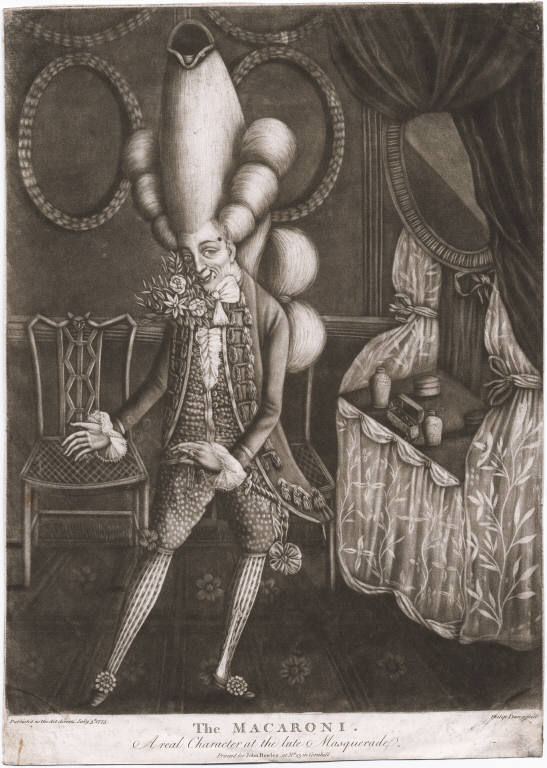
The “problem” with recent history is that the “centers of cultural production” do seem to be identifiable, and so are their motives. They are “Madison Avenue” and “to make money”, respectively, and so it’s easy — and profitable!! — to do the tiresome PoMo CultMarx thing. The further back into The Past you go, though … well, consider this:
As you can see from the caption, that style is called “macaroni” — like from the old song “Yankee Doodle,” which the Colonials appropriated in an early example of “owning the insult.” Wiki sez:
Stereotypically, men in the macaroni subculture dressed, spoke, and behaved in an unusually epicene and androgynous manner. The term “macaroni” pejoratively referred to a man who “exceeded the ordinary bounds of fashion” in terms of high-end clothing, fastidious eating, and gambling. He mixed Continental affectations with his British nature …
… The macaronis became seen in stereotyped terms in Britain, being seen as a symbol of inappropriate bourgeois excess, effeminacy, and possible homosexuality – which was then legally viewed as sodomy. At the time, homosexuality was frowned upon, and was even punishable by death. Many modern critics view the macaroni as representing a general change in 18th-century British society such as political change, class consciousness, new nationalisms, commodification, and consumer capitalism.
You see the typical “critical” blah blah blah there at the end, and it’s not wrong, just tedious, predictable, and tediously predictable. It’s also much harder to find a “purpose” for this behavior. It’s easy to do for the modern analogue of the macaroni, the hipster […] which Wiki documents extensively, because of course they do, it’s right there underneath “macaroni”. But the whole “culture industry” thing wasn’t there yet in the 18th century, so it might actually be down to an individual person. It’d be theoretically possible to find “the first macaroni” — it was the Marquis de Whatever, and he decided to dress like that because reasons, and all the best people decided to copy him, also because reasons, and that’s pretty much all your “cultural turn” can do, because that’s the only documentation we have.
Since we here are not bound by the canons of scholarship, however, we can speculate. I want to focus on this bit about macaronis:
In the 18th century, wealthy young British men traditionally took a trip around Europe upon their coming of age, known as the Grand Tour. Italy was a key destination of these tours. During their trip, many developed a taste for maccaroni, a type of pasta little known in Britain then, and so they were said to belong to the Macaroni Club, founded in 1764 by those returning from the Grand Tour. They would refer to anything that was fashionable or à la mode as “very maccaroni”.
That’s Information Velocity, preindustrial-style. They had to go there personally — or, at the very least, have access to the in-house journals of those who did:
The song “Yankee Doodle” from the time of the American Revolutionary War mentions a man who “stuck a feather in his hat and called it macaroni”. Dr. Richard Shuckburgh was a British surgeon and also the author of the song’s lyrics; the joke which he was making was that the Yankees were naive and unsophisticated enough to believe that a feather in the hat was a sufficient mark of a macaroni.
In America, only a select few persons would have access to that kind of thing, because only a few would move in those circles.
Go back a bit further, and cultural trends are far less traceable, but “centers of cultural production” are much easier to find, in one specific sense: They’re monasteries. And there you have a group which speaks a common language — extremely rare in the Middle Ages — is literate (ditto), and has something close to, if not caloric surplus, then at least “chronic caloric sufficiency”, I guess we’ll have to call it. Monks worked hard in the Middle Ages, by our standards, but not as hard as the peasantry. They were well-fed, or at least consistently fed, in a way the peasantry weren’t.
In other words, whatever Information Velocity existed in the Middle Ages, they had it. They made a virtue out of circulating books, and all those books were in a common tongue. Since they also produced books — indeed, were pretty much the only ones who did — they were also, by definition, au courant with whatever the high fashions were, because they illustrated the books that were such a crucial part of the aristocracy’s gift-giving culture.
Severian, “Monastic Vices”, Founding Questions, 2026-01-13.
August 25, 2026
QotD: “… and called it macaroni”
August 24, 2026
It’s no wonder that people have lost trust in formerly prestigious institutions
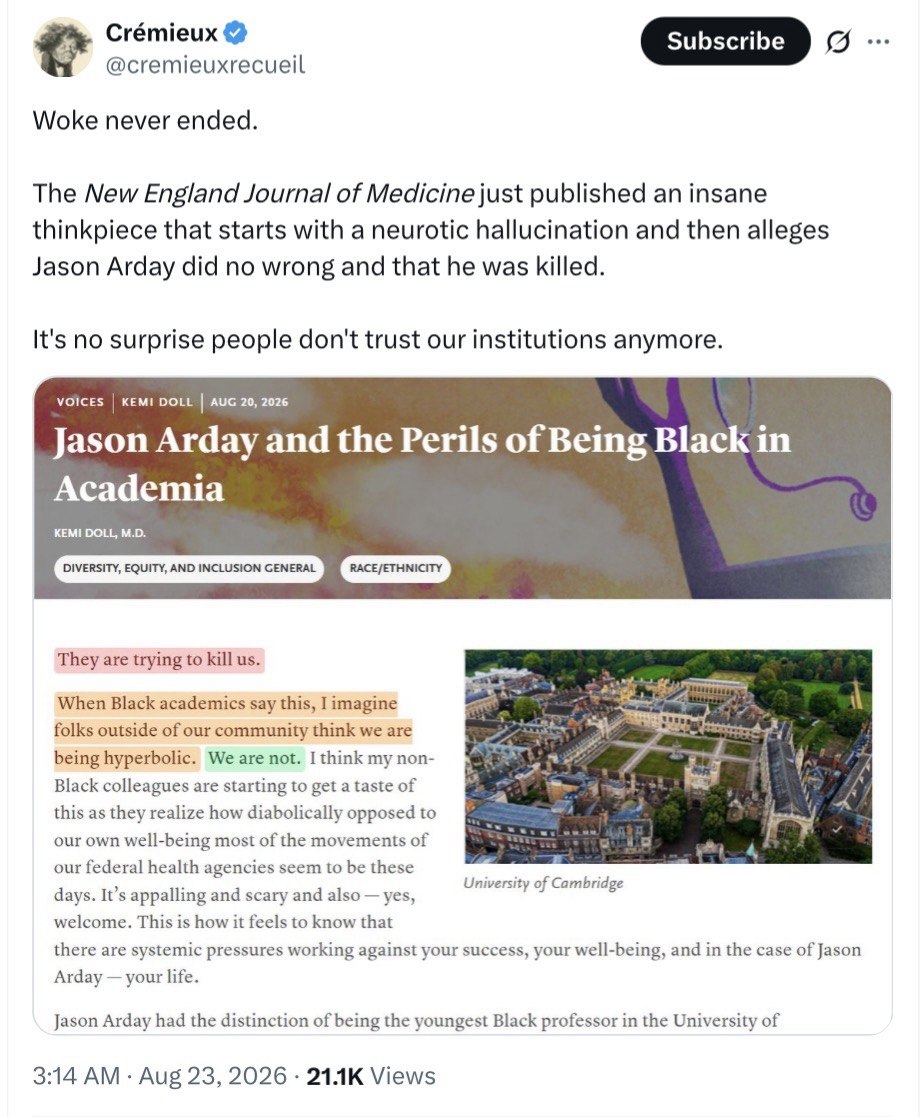
Lorenzo Warby on the two cases that are currently front-and-centre with the terminally online left, one a recently deceased academic grifter and another a confessed multiple murderer (of her own children):
We are currently observing attempts to turn the late Jason Arday — a fabulist who produced nothing of intellectual merit — and Lindsay Clancy, a woman who murdered her three children, into moral heroes. The former is allegedly a martyr for the cause of anti-racism and care for the neurodivergent/autistic, the latter for motherhood — or at least postpartum depression and psychosis. Both are construed as victims.
There is a real push to put the truly awful into Affluent White Female Urban Liberal. It’s almost as if there are some issues with feminisation. On the other hand, a woman being an open supporter of Lindsay Clancy is an excellent negative signal for men.
Just when you think progressivist purity spirals can’t get any worse, they do. Thus, we not only get the above hagiographical elevations of the grotesquely unworthy, we also see the physical mutilations of trans-surgery used to rehabilitate female genital mutilation.
But, of course, any such surprise is having far too contemporary a focus. Left-progressivism has a long history of elevating some of history’s most appalling monsters, most tyrannical mass murderers — Lenin, Stalin, Mao — as heroes of world-history and human liberation.
The use and abuse of moral mascots
The worse a group or individual behaves, the more progressives like them. If a group is noted for high levels of violence or various social dysfunctions, left-progressives adopt them as moral mascots.
The concept of such mascots comes from economist Thomas Sowell. Mascots are people or individuals that “the Anointed” — those who see themselves as at forefront of human liberation — adopt to be extolled and defended. This is connected to Thomas Sowell’s analysis of Constrained and Unconstrained political visions.
The Constrained Vision says there are no complete solutions, there are just trade-offs, all the way down. Human nature is one of those constraints. Biologist E.O. Wilson‘s famous observation about Communism — great idea, wrong species — is a pithy expression of the Constrained Vision.
In the Constrained Vision, history is an enormous memory well where we learn about ourselves. This is because the humans who made history are just like us. Their experience, their triumphs and failures, even their mundanities, are lessons for us.
History is contingent, it has no particular direction. The Constrained Vision finds it easy to take people’s choices as having authority because there is no direction of historical travel to which they must conform.
The Unconstrained Vision denies that human nature is a constraint in that way, so it’s possible to create a society of transformative human liberation. History is not a source of lessons, but a record of failures to achieve that liberation — a record of corruption and sin.
Moreover, history has a proper direction — towards transformative human liberation or another, related telos. Hence, choices that support that direction are legitimate, those that go against it are not. The politics of the Unconstrained Vision turns elections into legitimating rituals: citizens’ votes are blocked from overturning any of the policies the Anointed have decided represent history’s proper direction.
The Anointed evince what writer Wesley Yang labels the non-electoral politics of institutional capture. If you want to see that in its most complete form among the Western democracies, PM Tony Blair’s debauching of Britain’s constitutional order through quangoes, human rights legislation that empowered judges over elected ministers, and devolving decision-making to the EU — thereby massively increasing the degree to which elections became legitimating rituals that change remarkably little — is the current gold standard case. However, all Western democracies face similar pressures, albeit to considerably differing degrees.
The commitment of The Anointed to this vision of human liberation gives them such a sense of trumping moral authority that they see themselves as owning morality. They have the right-to-decide what is moral and then to impose their decisions on everyone else.
August 23, 2026
The End of the Battleship Era – Force Z
TimeGhost Cartographic and World War Two
Published 22 Aug 2026In December 1941, Britain is fighting a global war on multiple fronts when Japan enters the conflict in Southeast Asia. At the centre of Britain’s strategy is Singapore, and the arrival of two powerful warships is meant to demonstrate that the Royal Navy can still project its power across the region.
HMS Prince of Wales and HMS Repulse, accompanied by a small destroyer force, form Force Z and sail into increasingly dangerous waters. But without the aircraft carrier originally intended to accompany them, the squadron is operating under a serious disadvantage.
As Japanese forces begin their invasion of Malaya, Force Z sets out to disrupt the landings. What follows becomes one of the most dramatic naval actions of the early Pacific War, as British battleships find themselves facing a threat they were never designed to fight alone.
Why This “Foreign” Commonwealth Truck Was Built In 800,000 Units And Supplied Every Front
BritishWarLegends and BritishWarArmory
Published 31 Mar 2026The Canadian Military Pattern truck was built by two rival factories in Ontario for a nation of eleven million people. It ended up supplying the British Eighth Army across North Africa, Italy, Normandy, and Burma — and Canada built more of them than Germany, Italy, and Japan built trucks combined.
Almost nobody knows it existed.
When Rommel captured two thousand of them at Tobruk in 1942, he didn’t scrap them. The Afrika Korps pressed them straight into active German service. An enemy with his own purpose-built military trucks chose to keep using captured Canadian vehicles instead.
The full forgotten story.
Update: I generally try to avoid watching or re-posting clearly AI-generated slop, but this was the first video I’d encountered discussing the hundreds of thousands of CMP trucks that Canada built during WW2. At some point between me scheduling the video and today, the channel has been banned. You’ve undoubtedly seen CMP vehicles in WW2 stills or movie footage, as they’re pretty distinctive – https://en.wikipedia.org/wiki/Canadian_Military_Pattern_truck
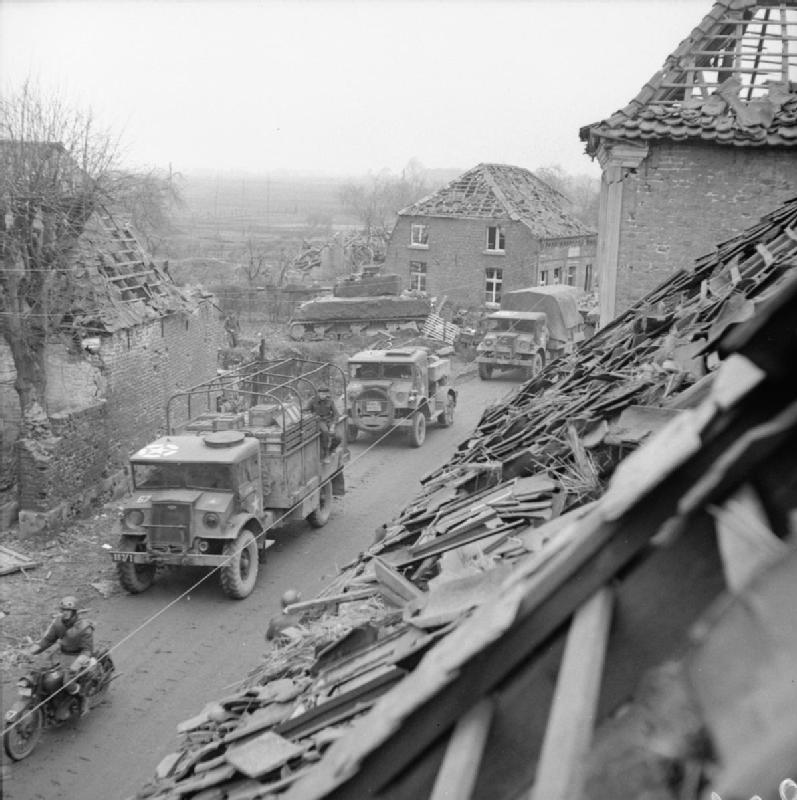
From The British Army in North-west Europe 1944-45,
CMP lorries passing through Uedem, 2 March 1945.
Photo by Carpenter (Sgt), No 5 Army Film & Photographic Unit, Photograph B 14966 from the Imperial War Museums via Wikimedia Commons.
August 22, 2026
“No pleasure is worth giving up for the sake of two more years in a geriatric home in Weston-Super-Mare”
On his Substack, Christopher Gage discusses how to shorten your life (but not for the usual reasons):

St George’s Nursing Home in Weston-Super-Mare. I’m sure the staff are fine, but this reminds me strongly of the hospice my grandmother ended her days in.
My Dharma or reason for being is devilishly simple: to maximise pleasure and to shuffle off this mortal coil before the nursing home beckons.
Fatally, at least for those with a yen for acronyms and self-hatred, my ultimate goal corrupts their hallowed SMART strictures. It is not quite specific. It is measurable. It is attainable. It is relevant. It is not time-based. I’m not resolved to stubbing out the fags, abandoning the booze, or chasing around Soho the doomed affections of neurotic artists. I refuse to wake at 5 a.m., invest in crypto, or bore my tastebuds with rainbow carrots.
I’ll take my cue from the great novelist, ardent womaniser, and prodigious piss artist, Kingsley Amis: “No pleasure is worth giving up for the sake of two more years in a geriatric home in Weston-Super-Mare”.
In an age which toggles between grind-culture puritanism and brain-rot hedonism, we must chart a more amenable path. So, the pursuit of pleasure, it is. I resolve to pursue pleasure deliberately, intelligently, doggedly, ethically and without apology — not to escape but to evolve.
Pleasure gets a bad name. What, with all our competing isms and illities. Those journeys of immiseration and self-loathing. One cannot move for ice baths and magnesium supplements and alcohol-free and protein-rich and wellness retreats and fucking motivational podcasts. Antisocial tech billionaires inject the blood of teenagers in a demented bid to live forever. It is a new secular puritanism. These longevity bros trade the profound depth of life for its mere length. They are terrified of death, yet terrified to actually live. It must stop.
For myself, I’m not at all eager to die, but I don’t view the mechanical prolongation of life as a worthwhile end in itself. Living a bit longer, but at the cost of giving up some or all of the things that make life worth living seems a particularly bad bargain. I’ve never smoked, so that quick’n’easy “stay healthy” recommendation doesn’t apply, but I enjoy drinking wine and beer. Not to excess, as I don’t enjoy being drunk, but as a social relaxant, a pleasure in its own right, something to look forward to at the end of a long day. Matching the right wine to the food on your plate is a worthwhile skill to develop, as it increases two pleasurable things at the same time.
August 21, 2026
This is something we genuinely need today
Plus, as Kate at Small Dead Animals often points out “Mischief is important“:

In one of the only three management books anyone should bother to read — and everyone should read the three — Robert Townsend says that a CEO should, while on the road, try phoning his own company. Try the helpline and see how far he gets. Try calling his own office. Sure, you should end up with the Executive Secretary who then directs it to the right person but sometimes that correct person is going to be you. Say, Warren Buffett calling to make you rich by buying the company and thus crystallising all your stock options and RSUs.
This is a lesson that has been forgotten. From a Guardian list of things government should pass laws to make happen:
Force companies to put a phone number on their homepage
You’ve got a problem with a company and you want to get it sorted – and then you realise you cannot find a number for it anywhere. There are communications companies that have no “contact us” link anywhere to be seen, and energy companies that send you all round the houses looking for a way to get in touch.
One of the recurring themes of Guardian Money readers’ problems is the struggle to find someone to help when something goes wrong. Clearly, once you have published a phone number, you need staff at the other end answering the phone and offering some joined-up thinking, so this is only the start of the solution – but at least customers would not feel like companies were trying to hide from them.
This does not work as there is no guarantee that anyone will answer the call.
We’ve also that basic point that Burke and his Little Platoons can — and often do — solve problems better than government. So, here’s the pitch for that private sector service.
We set up a database of the home and work and mobile phone numbers — emails too — of the management of companies. Most importantly, the board of directors. If the company is owned by private equity — say — then the General Partners of the PE company.
Obviously, if a company has a helpline, which people answer, then all of that information stays private to us. If a company does not then we publish it as a page saying these are the contact numbers for that company. Say, Evri, the delivery people. The board members get their numbers and email publicly revealed. As I recall it they’re PE as well so some number of GPs over in the US also start getting aggrieved calls from Lesser Wallop about non-delivery. Not that any Septic would be able to understand Ms. Aggrieved of Lesser Wallop but it’s the instance of the call that matters. Evri is used as an example for a bit of looking around a few months back seemed to reveal that they had no UK phone number at all. Thus the directors it will be.
The top management of companies that do not provide a helpline — nor answer the one they claim to have — will have the customer complaints calls directed toward them. This will, of course, rapidly mean the opening of a useful customer complaint line that people actually answer. Those making that £250k a year as the board member of whatever do not want to be talking to Ms. Aggrieved of Lesser Wallop. Therefore phone calls from Ms. Aggrieved will lead to the creation of a useful customer services department.
At which point, of course, we take the board members’ phone numbers down and job done. But, clearly, we keep monitoring to ensure that those service times don’t then decline.
Make the bastards who make the decisions suffer the consequences of those decisions. Works this does, really, it works.
Now, there will be some who say that government can do that. Why use the Little Platoons when a law can simply be passed?
Which is to miss a basic philosophic point, which is that we should only use government when we, ourselves, cannot do it. Government is for when the Little Platoons cannot achieve it. Letters of Marque are lovely things but biffing the Frenchies is better done with a Royal Navy. Assuming we still had one of course. RNLI, on the other hand, works better without government than it would with.
But much more than that. For who are the worst at providing a contact number that works? Why, that would be government, wouldn’t it? Anyone ever tried to ‘phone HMRC? Quite.
August 20, 2026
“It’s a form of libel by sleight-of-hand”
On his Substack, Andrew Doyle discusses the fine art of writing libellous things about someone without quite giving enough legally actionable material for the victim to have a chance to retaliate successfully:
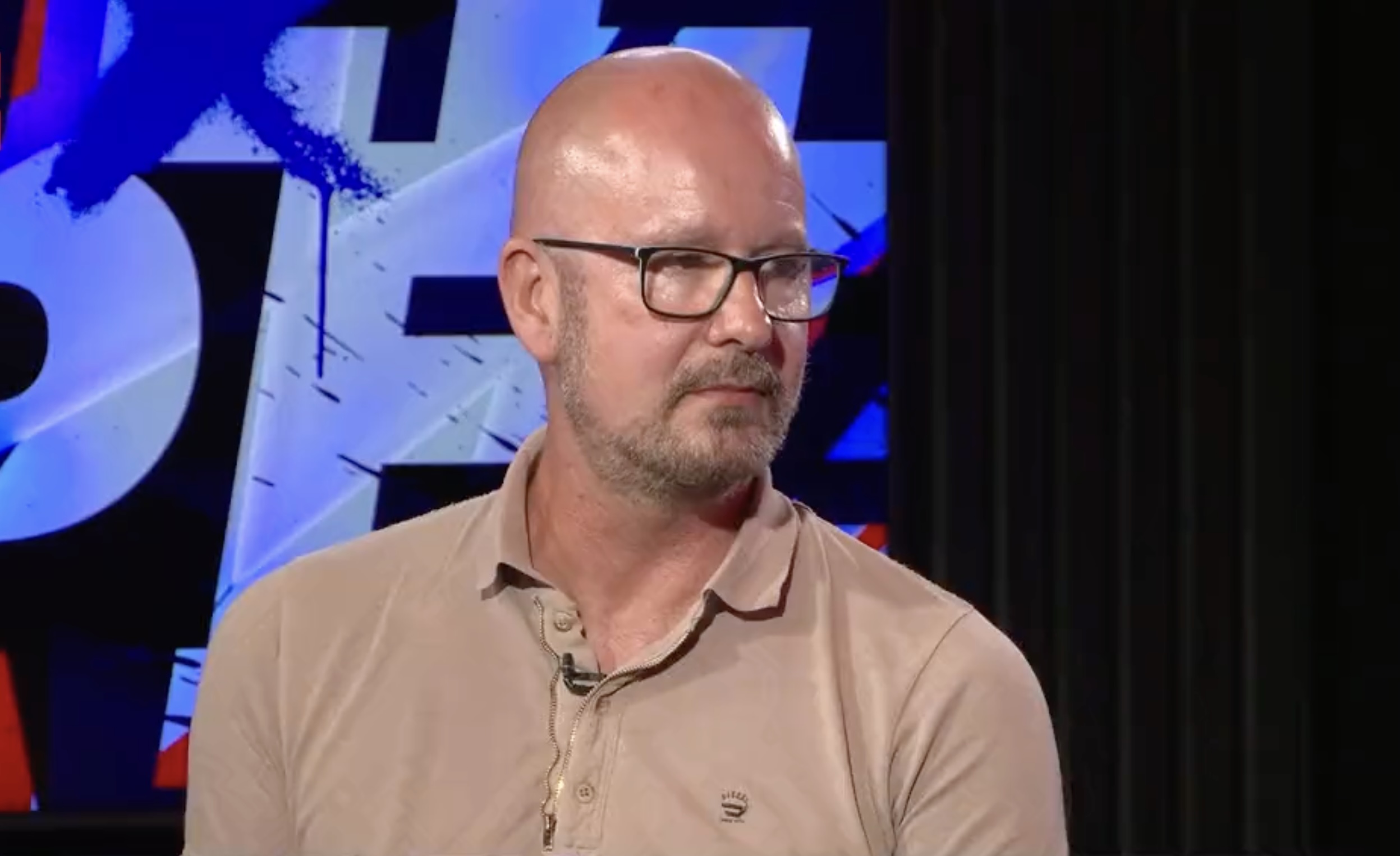
Simon Edge on GB News.
Screencap from Andrew Doyle
How does one libel an opponent and get away with it? I’ve lost count of the number of people online who’ve made false accusations against me. Sometimes I’m a fascist, other times a communist. Sometimes I’m a homophobe, other times a degenerate sodomite. Some have branded me a “racist” for supporting Martin Luther King’s ideal of a colour-blind society. White supremacists have denounced me as a traitor for my opposition to racism.
It’s all noise, of course, and best filtered out. These aren’t serious people, and no serious person would believe their smears. However, last week an author called Simon Edge, well-known in gender-critical circles, published a blog post about me that I can only describe as defamatory. He’s very lucky that I’ve no appetite for litigation, but I think it’s worth discussing the nature of his smearing technique because it’s become so common among activists of the more mendacious ilk.
It’s a form of libel by sleight-of-hand. Perhaps we should call it prestidefamation. Here’s how it works. You take a series of unremarkable facts, out-of-context quotations and tenuous associations, arrange them in a suggestive manner, omit any contrary evidence, invite the reader to draw the worst possible conclusion and then congratulate them for drawing it.
Edge has done precisely this. I have a long and well-documented record of opposing fascism and the far right. I’ve written books and articles about it, spoken about it endlessly on television, radio and podcasts. My latest book The End of Woke makes the case against all forms of authoritarianism, and opens with an epigraph explicitly attacking Nazi ideology. Yet Edge has managed to write an article insinuating that I support Nazis. It would be like writing a piece about Oscar Wilde’s robust and unwavering heterosexuality.
Here’s how he did it. Recently, it was announced on X that Oldspeak Books, which bills itself as “Britain’s only centre-right bookshop”, has closed its doors. The manager posted a message on social media to explain.
Over time, it became increasingly difficult to maintain a welcoming environment due to the constant hostility I experienced. The uncertainty around which customers were genuine, made it hard for me to greet everyone warmly, and my customer service suffered.
This looked like a clear case of cancel culture to me and, since Oldspeak had been kind enough to stock my books, I reposted her message with a comment to the effect that it was a shame that she had been pressurised into closing her shop. This was, according to Edge, my first foray into the murky world of fascist apologism. Who knew it could be so easy?
QotD: George Bernard Shaw’s role as Stalin’s useful idiot
Shaw toured Ukraine during the height of the Holodomor, when Soviet grain requisitions had stripped peasants of every scrap of food. Conservative estimates put the death toll at 3.5 million Ukrainians. Shaw saw the empty villages, the skeletal survivors, the mass graves. Then he signed a public letter praising Stalin’s “remarkable progress” and told Western journalists that reports of famine were capitalist propaganda.
Why would an intelligent man become Stalin’s useful idiot? Shaw believed in central planning with religious fervor. He thought brilliant intellectuals like himself could design society better than millions of individuals making their own choices. When confronted with central planning’s inevitable result (mass death), he chose to lie rather than admit his ideology killed people. Shaw preferred beautiful theory to ugly facts.
Shaw deliberately used his celebrity status to give Stalin cover while Ukrainian children died of starvation. He returned to Britain and spent years defending Soviet policies, even as refugee testimonies and photographic evidence exposed the genocide. The man who wrote about moral awakening in Pygmalion had abandoned his own moral compass entirely.
Free market economists warned that socialist calculation was impossible, that without prices and property rights, economies would collapse into chaos and death. Shaw dismissed these warnings as bourgeois nonsense while standing ankle-deep in their vindication.
Handre, The social media site formerly known as Twitter, 2026-05-13.
Update, 21 August: Welcome, Instapundit readers! Have a look around at some of my other posts you may find of interest. I send out a daily summary of posts here through my Substack – https://substack.com/@nicholasrusson that you can subscribe to if you’d like to be informed of new posts in the future.
August 19, 2026
Why The Allied Western Front Offensives in 1915 Failed
The Great War
Published 13 Mar 2026By the spring of 1915, the Western Front had bogged down into trench warfare. Allied offensives tried to break the deadlock in spring and fall 1915. The fall offensives were among the bloodiest of the war. After unprecedented bloodletting and use of munitions, the Western Front was still locked in a stalemate at the end of 1915.
(more…)
QotD: The Kwantung Army was the tail wagging the Japanese Imperial dog
The Lytton Commission was commissioned by the League of Nations to investigate the Mukden Incident, which was one of those false flags the Kwantung Army was fond of. They used it to seize Manchuria — technically a province of China — and set up a puppet government they called “Manchukuo” (under the Qing Emperor who was deposed in 1911 — who was 5 at the time — thus giving it a veneer of historical legitimacy). The Lytton Commission concluded that the Mukden Incident was indeed a false flag; that Japan was the aggressor; and that Manchukuo was a puppet state that should be dissolved, with Manchuria returning to Chinese sovereignty.
That’s bad, because if you’re Japan and you do any of that, you’ve now knuckled under to not just the West, but the worst hypocrites of them all (“Lytton” was Victor Bulwer-Lytton, the 2nd Earl of Lytton, formerly governor of Bengal and Viceroy of India, and oh, by the way, how exactly did Britain come to rule in India? The shit they pulled makes the Mukden Incident look like very small beer indeed). And it’s bad from the Chinese side, too, because now you’ve basically tied their hands in any peace negotiations — they can’t conclude any kind of honorable peace without getting Manchuria back, and as should be obvious from the above, you must pry Mantetsu from Japan’s cold, dead hands.
Still, Japan might’ve disciplined guys like Ishiwara … but how? You can’t cashier him; the Army would go insane. You can’t really transfer him — as much trouble as he’s causing in Manchuria, if you bring him home you might well have another February 26 Incident, and it might work this time. You certainly can’t execute him, because a) you’d have to take his entire faction with him, which would decimate your officer corps, and b) perhaps more importantly, the seizure of Manchuria was pretty popular. Mantetsu’s Media boys hadn’t been sitting on their hands during all of this, of course, and the Army’s Media people had been going nuts too.
In the end, the Japanese pretty much had no choice: They gave the League of Nations the finger. Which of course emboldened the KA even more, such that they cooked up an even faker and gayer false flag, the Marco Polo Bridge Incident, and WWII was on.
Severian, “Slipping the Leash”, Founding Questions, 2022-08-27.
August 15, 2026
QotD: “The progressive is a walking paradox”
If I loudly claim to love vanilla ice cream, yet every time I return from the Mr Whippy van I’m holding a choc-ice, my revealed preference is evidently for chocolate — not vanilla.
Thus the truth of a person’s preferences is revealed through their actual choices and behaviour, not by what they claim to prefer.
It’s unfortunate we can’t simply listen to their words, but they are so oriented toward the external, the aesthetic, and the performative (“Theater Kid Progressivism”) that we must instead look at their proximal behaviours — where they actually choose to live and raise their families, for example, to extrapolate backwards their true feelings on mass migration and its consequences.
This is the lens through which we should try to understand our Progressive class.
The bitterest irony, the irony of ironies, is this: progressives, especially those who voted for it, self-evidently do not feel at home in the societies they helped create.
If they were genuine believers, they would live contentedly amidst their new friends.
Instead, they scuttle off into the countryside, the leafy suburbs, or gated enclaves, abandoning the very demographic transformation they imposed on others.
It is often said that if liberals didn’t have double standards they wouldn’t have any at all, but while this is very funny (and true), there’s more to it.
It reveals a profound non-confluence between their stated attitudes and their actual behaviours, indicative of extreme cognitive distortion.
They protest performatively that open borders and rapid demographic change are a universal good, even moral imperatives and (admittedly less often nowadays) sources of strength.
Yet when it comes to their most intimate revealed preference — where they opt to live and raise their families — they consistently prioritise homogeneity, good schools, and cultural familiarity.
They lobby and vote without end for policies that maximise immigration into lower- and middle class neighbourhoods, then abandon those very communities for pastures anew, safely insulated by postcodes and house prices.
Their revealed preference is that do not want to live in the Canada (or Britain, or America, or Europe) they are busily helping to construct.
They enjoy the vibes, the moral status, the Instagram aesthetics, while quietly falling back to the leafy, high-trust environments their grandparents took for granted.
Progressives love to speak of taboos (indeed if there is a pastime more alluring and intoxicating to the progressive than “breaking taboos”, I am yet to come across it, but I digress) yet is the greatest taboo of all right in front of us after all, carrying a basket of organic fruit and veg from Waitrose?
To interrupt the Progressive in the midst of his communal dream state, to turn our collective eye away from the brave new world they are building for us and to instead look inwards, to look the Liberal cuckoo directly in the eye and put words to the disparity between their words and their actions …
The subject of lawful and legal deportations is increasingly mainstream, yet what of urban renewal and rewilding by means of progressive importations?
The Progressive is a walking paradox, he is both the centre of attention and the ghost at the feast all at once.
Æthelstan, The social media site formerly known as Twitter, 2026-05-14.
August 14, 2026
What Did the Builders of Stonehenge Eat?
Tasting History with Max Miller
Published 17 Feb 2026Roasted pork ribs with blackberries and honey with Stonehenge Nettle and Hazelnut Soup
City/Region: Britain
Time Period: 3000-1500 BCEAbout 2 miles from Stonehenge is Durrington Walls, the place that archaeologists believe was the living settlement for the people who built and used Stonehenge. Amongst the evidence of what was eaten, there are a lot of bones, about 90% of them being pig bones. Based on scientific analysis of the pig teeth found there, they were probably fattened on something sweet, which would have probably been honey or berries, so I’m using both to prepare these pork ribs.
This is a simple preparation, but these ribs are so good. The honey is the dominant flavor and the blackberry does come through. The other 10% of bones found at Durrington Walls were mostly cattle, so you could use beef ribs instead if you’d like, you’ll just have to cook them longer.
(more…)
August 12, 2026
QotD: The art of admitting our mistakes
The painting below by Paul Cézanne demands our consideration. It cannot be passively observed. The glassy patch of water in the lower right-hand corner is where the painting – “Reflections in the Water” – gets its name. Our eyes are naturally drawn to the thick tree on the bank whose ghost is captured on the surface of the pond where the foliage gives way, but really it is the slim sapling, unreflected, unbroken, rising boldly along the canvas’s left edge, that is the true subject of this piece. It is a triumph of subtlety and nerve.
Except that I’m wrong. I’ve been looking at the painting on its side and forming a completely inaccurate impression. Oh well. I’m probably not the first. There is an unconfirmed story that this painting by Cézanne was hung sideways for thirty-one years in London’s National Gallery. The origin of this gossip is from the economist Oswald Toynbee Falk (1879–1972), who lays the blame at the feet of one of its trustees, John Hugh Smith, exactly the kind of person who would in those days have had a hand in such decisions. I can find no corroboration of the story, but I do hope it’s true.
Of course, an establishment as prestigious as the National Gallery would be unlikely to admit to such a galloping blunder. And anyway, as I’ve said, the sideways version has much to recommend it. If there’s a moral to this story, it’s surely that once we commit to an error of thinking for too long it can be mortifying to correct ourselves, particularly if public humiliation is to be the outcome.
It strikes me that the culture war is largely characterised by groups of intelligent people investing in delusional ideas with such gusto that to backtrack would be a kind of social death. One might sooner teach a mule to moonwalk than persuade a celebrity who has championed gender identity ideology to admit that human beings cannot change sex. After demonising women for insisting on single-sex spaces, making excuses for the medicalisation of healthy children, and encouraging the dismantling of gay rights – all in the name of progress – it must be tremendously difficult to admit that it was all for nothing.
For many, the response to being corrected is simply to deny there was any mistake at all and to double down. This is certainly the position of the Green Party, whose representatives are now wholeheartedly wedded to the absurd proposition that human beings have an innate gendered soul that can be misaligned from their body. Their supporters are even congratulating them for their doggedness in the face of reason and evidence, so there is no incentive to course-correct.
Andrew Doyle, “The art of admitting our mistakes” ($), Andrew Doyle, 2026-05-08.

August 11, 2026
Cambridge has turned into a “Quality Learing Centre”
Even as I typed Sunday’s headline, I knew the fallout from the Jason Arday affair wasn’t going to be over quickly: it’s too high profile and gores far too many sacred cows to just fade out of the headlines. On his Substack, Francis Turner remembers what a Cambridge education used to mean and what progressive racists have turned it into now:
Once upon a time I was an undergraduate at Cambridge. Back in the day when men were real men, women were real women and Cambridge’s contribution to the national sense of humour were people like John Cleese, Tom Sharpe and Douglas Adams. Cambridge students were well aware that we were at the top of the intellectual tree and generally proud of the fact. In fact for many of us (e.g. your humble correspondent) coming to Cambridge was where we discovered that there were people far far smarter than we were for pretty much the first time in our lives. It was humbling. And once we got over that, exhilarating. You could have discussions about quantum mechanics or code optimizations or whatever with people who understood the concepts at least as well as you did. You could be lectured by professors who had Fields Medals or Nobel Prizes; often they had literally written the standard text book in the field. Sometimes they would drop digs about colleagues or rivals and you had to know that “Tony” was Tony Hoare who was in charge of Computer Science at the slightly inferior other place. And so on. Yes it was elitist. I’d say it was proudly so. Yes there were concerns about there being too many Old Etonians and other “public school”1 students compared to those from state schools but the solution was seen as going out to state schools and ruthlessly headhunting the top students rather than putting a cap on the number of privately educated students.
Some forty years later it seems that Cambridge no longer aspires to such intellectual heights — at least not for some areas of study. It is true that back then we generally held the Education Department and the associated students of Homerton College to be at a slightly lower level of intellect — and since they were mostly of the female persuasion many male chauvinist jokes were made at their expense. Also those of us reading for the more challenging degrees also disparaged some of the less challenging ones (sociology, land economy …) but even the most elitist MCPs agreed that even the ladies of Homerton had some intellectual assets to go along with what John Cleese might have called their attractive large tracts of land. However I doubt that even the ladies studying education back then would have put up with the quality of tuition offered today by professors such as J Arday, PhD.
However it isn’t just that the quality has gone down, what has also happened is that the racism, sexism and disableism has gone up at the same time as a deliberate part of the process. What do I mean by the racism etc. has risen?
Start with this excellent substack by Katy Barnett
You should read the whole thing because it is truly excellent, but the most relevant bit is this:
Arday’s appointment might make Arday’s enablers feel a righteous glow in the short term — “Look at how wonderful we are, we appointed a Black, disabled scholar!” — but when the web of falsehood disintegrates, it leads people to doubt the worth of all Black or disabled scholars more generally. It also does a disservice to all scholars and students at an institution. From what I have seen on social media, several former Cambridge graduates who had come from less advantaged backgrounds, and had worked exceptionally hard to be admitted, felt particularly betrayed.
I can understand this: they must feel that their hard work has been mocked. Instead of working so hard, why did they not embroider a story of sadness and use that instead? I, too, have felt this bitterness. Am I fool for not using my disadvantage?
If you want to know my “lived experience” before you think I’m worth listening to, you can have it. I have suffered from cerebral palsy since birth, because I was born at 29 weeks — and yes, I have proof of this! — but I do not think that this is relevant to my academic work. […]
I do not think my disability is a reason to promote me, nor do I think it is a reason why I am better than other people. It is certainly not a reason why I am more worth listening to on questions of private law. […]
Just presuming that someone is worthwhile simply because he is Black and disabled and from a disadvantaged background is patronising. But so, too, is dismissing someone simply because he is Black and disabled and from a disadvantaged background. These two positions are two sides of the one coin: using a simple, superficial heuristic to decide worth, without looking at the reality.
The sole relevant consideration is does this person produce good work, and can they do what is needed? I worry that the coin may flip in society, and we’ll go to a position where women and those from minority or disadvantaged backgrounds are presumed to be worthless. If the academy continues on this path, they will produce the very thing they fear: a backlash against minorities.
This is bit at the end is exactly the problem. If you promote incompetents to positions they are not suited for because of their gender, race etc. then you inspire everyone to look at other people with the same gender, race etc. and wonder if they too are incompetent. This is not a philosophical point, it is a real practical issue. I know people, some of whom read this substack, who make a conscious choice of choosing the older, white, male doctor if they can because they can be sure that this doctor was not given a helping hand due to his gender, race etc. and that therefore he will be more likely to give correct medical treatment.
Medicine is far from the only field where this is the case. You may recall the DC crash in early 2025 where a female helicopter pilot collided with a jet. There was a lot of commentary wondering whether (or outright saying that) she was unqualified and only got the job because she was a woman of the right (i.e. left) political leaning. I don’t know whether that is true or not — from what I recall at least some of the so-called evidence against her turned out to be rubbish — but the fact that such commentary sounds plausible and the responses are mostly of the form “Sexist!!!” with no evidence provided makes my point. Likewise the Florida university bridge collapse where the primary engineering firm was all female and (IIRC) Hispanic.
The fact that the phrase “DEI hire” exists and that everyone knows that a DEI hire is known to be less capable is the result of this racist behavior. And I do in fact mean racist. To quote Katy again:
In fact, their attitude strikes me as profoundly racist and not in the least “progressive”. The subtext is, “Black and disabled people can’t manage it, let’s turn a blind eye to any flaws and let this guy in anyway, so we can look good.”
This is the soft bigotry of low expectations.
- i.e. private, boarding school