
Published on 20 Apr 2017
The legendary comedy group Monty Python was once a force of nature, influencing everything that came after them with their surreal, absurdist approach to comedy. So, why don’t we hear from them anymore? When Graham Chapman ceased to be in 1989, fellow Python member Terry Jones described it as “the worst case of party-pooping [he’d] ever seen.” His death came the day before Python’s 20th anniversary, and what followed was a bizarre but fitting eulogy, written to pay tribute to the man who’d written a dead parrot into one of the troupe’s most famous sketches. Chapman becoming an ex-person seemed to put a damper on any kind of authentic reunion, but what about the others? What happened to the late, great Monty Python?
Terry Jones’s illness | 0:44
Michael Palin’s travel shows | 1:54
John Cleese’s purism | 3:01
Terry Gilliam’s moved on | 4:13
Eric Idle’s Broadway ambitions | 5:06
They want to finish on a good note | 6:02Read more here → http://www.grunge.com/53323/never-hear-monty-python-anymore-2/
April 23, 2017
The Real Reason We Never Hear From Monty Python Anymore
April 22, 2017
Tank Chats #7 British Mark II
Published on 2 Jul 2015
The seventh in a series of short films about some of the vehicles in our collection presented by The Tank Museum’s historian David Fletcher MBE.
Only fifty tanks each of Marks II and III were produced. They were unarmoured, in the sense that the steel from which they were built was not heat treated to make it bullet proof. The reason being that these tanks were only intended for use as training machines.
The chief external differences from Mark I lay in the tail wheels, which were not used on Marks II and III and later heavy tanks, the narrower driver’s cab and the ‘trapezoid’ hatch cover on the roof.
April 20, 2017
We now know that there are more than 30,000 registered gun owners in London
What’s disturbing about the knowledge is that London’s Metropolitan Police revealed that information to a private company and may have violated British privacy laws in the process:
London gun owners are asking questions of the Metropolitan Police after the force seemingly handed the addresses of 30,000 firearm and shotgun owners to a direct mail marketing agency for a commercial firm’s advertising campaign.
The first any of the affected people knew about the blunder was when the leaflet (pictured below) landed on their doormats in Tuesday’s post.
Titled “Protect your firearms and shotguns with Smartwater”, the leaflet – which features Met Police logos – advises firearm and shotgun certificate holders to “buy a firearms protection pack at a reduced price” of £8.95.
Smartwater is basically invisible ink. You mark your property using it and if you are burgled, police can use a UV light reader to see who rightfully owns stolen items. The company behind it was formed by an ex-police detective and his industrial chemist brother, and the firm has since forged very close links with a number of UK police forces. Its website boasts of the “traceable liquid’s” crime-reducing properties, something that police actively endorse.
[…]
The front and reverse of the Metropolitan Police Smartwater firearms leaflet
Questions were immediately raised as to whether the Met had broken the law. The data protection statement that both police and certificate holders agree to is found in Firearms Form 201 (PDF), the application form for a firearm certificate. It says:
I understand that all information submitted will be handled in accordance with the Data Protection Act 1998 and the Freedom of Information Act 2000 and connected legislation. I understand and give consent for information contained within my application form or obtained in the course of deciding the application to be shared with: my GP, other government departments, regulatory bodies or enforcement agencies in the course of either deciding the application or in pursuance of maintaining public safety or the peace.
Note: Any information shared will be shared in accordance with data sharing protocols. We do not share your personal or company details with other applicants or members of the public and treat information in connection with the application in confidence, but individuals should be aware that we may be required to disclose some information in accordance with the legislation referred to above.
The Register has made the Information Commissioner’s Office aware of the breach and is awaiting a statement from the data watchdog.

April 18, 2017
Western Front Artillery At The Outbreak of World War 1 I THE GREAT WAR Special
Published on 17 Apr 2017
World War 1 was a war of artillery, 75% of casualties are attributed to artillery fire. And since the late 19th century the development of field canons, howitzers and mortars had made rapid progress. We are taking a look at the standard artillery pieces of the German, French and British Army at the outbreak of the war in this first part of a new series.
April 16, 2017
If Walls Could Talk The History of the Home Episode 3 The Bedroom
Published on 1 Feb 2017
April 15, 2017
Tank Chats #6 Vickers Light MKVI B
Published on 5 Jun 2015
The first mass-produced British tank.
Being, in terms of numbers, the most significant British tank at the outbreak of war, the Mark VIB saw service with the British Expeditionary Force in France, the Eighth Army in North Africa and in various subsidiary theatres. As a reconnaissance vehicle it was satisfactory, as a fighting tank quite useless since armour protection was minimal and the armament ineffective against enemy tanks.
QotD: “Healthy” food choices
Whenever I find myself choosing my next meal I always like to look out for the sign that says “healthy option.” In this age of variety and abundance it can often be hugely difficult making up your mind as to what to eat next. “Healthy option” makes things so much easier. It tells me: “Avoid like the plague.”
Good news, then, for takeaway customers in Rochdale, Greater Manchester. No fewer than six local fish and chip shops have taken on board the advice of their local council’s Healthier Choices Manager and introduced special, non-greasy, low-fat menu options. So now when customers find themselves torn between the battered sausage, the chicken nuggets and the “rock salmon” at least they can be sure of what they don’t want: that insipid-looking fillet of steamed cod on a bed of salad, with so few chips they barely even qualify as a garnish.
“It’s too early to say if steamed fish will be a hit,” says an article on the council’s website. And I’ll bet when they know the answer they won’t tell us. That’s because this well-meaning scheme is doomed to flop like a wet kipper. Of course it is. No one in their right mind goes to a takeaway as part of a calorie controlled diet. You do it when you fancy a treat.
And the reason it’s a treat is precisely because that food is so deliciously greasy. As the late Clarissa Dickson-Wright, the generously girthed cook from TV’s Two Fat Ladies, once explained to me, fry-ups, sizzling bacon, battered fish, and so on will always taste nicer than the “healthy option” because fat is a great carrier of flavour.
Clarissa (who was as big an expert on the science of food as she was on cooking and eating it) remained, to the end, a great defender of butter, cream and full-fat milk. She claimed they were much better for you than most of the supposedly healthy, low-fat alternatives. And it turns out she was right. Recent studies have shown that it’s the “trans-fats” in artificial health products like margarine that are the killer, not natural animal fats you find in butter.
What’s more, the evidence increasingly suggests, that it’s sugar not fat which is most responsible for our supposed obesity epidemic. So by trying to stop customers eating fried fish in Rochdale, the council is barking up the wrong tree. It’s the cafes pushing sweet cakes and doughnuts they should be investigating.
James Delingpole, “I prefer my cod in batter, thanks very much”, James Delingpole, 2015-08-15.
April 14, 2017
Happy Easter from Scarfolk!
The Scarfolk Council is pleased to present a 1970s solution to a modern problem:

Back in the 1970s, many people complained that the word “Easter” had been dropped from the packaging of chocolate eggs. They also claimed it was only a matter of time before other Christian Easter imagery, such as anthropomorphised cartoon chicks playing with bashful ducks or dungaree-wearing bunny rabbits, received the same treatment.
The Scarfolk Confectionery Company was only too happy to remind consumers of the true biblical events surrounding Easter: Gruesome acts of mutilation and torture, filicide/suicide, crude carpentry and auto-exhumation were all necessary to atone for the original sin that most people agree is historically unfounded, though still blame on one woman’s innocent desire for a healthy snack.
April 12, 2017
Construction on the A1 near Catterick, North Yorkshire, reveals lost Roman settlement
Rossella Lorenzi reports for Live Science on recent finds during roadwork on the A1 in North Yorkshire:
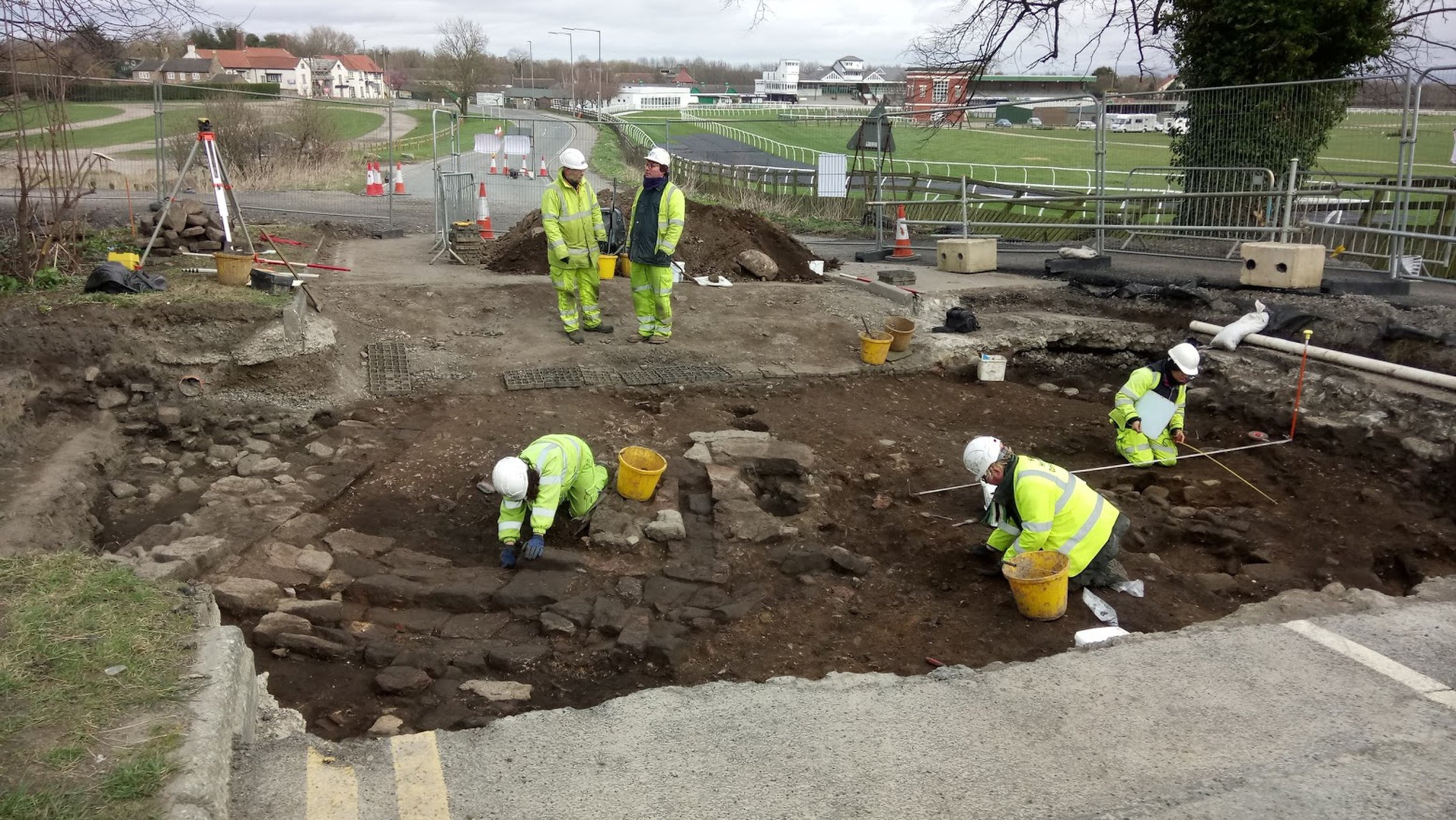
Excavations at Catterick earlier this year. The features on show are the foundations of ovens and hearths dating to the 4th century. © Historic England
Construction work to upgrade Britain’s longest road into a major highway has revealed a treasure trove of rare artifacts from one of the earliest and wealthiest Roman settlements in the country.
The findings include ancient shoes, cups, a rare silver ring, keys, a high-relief glass bowl and an elaborately carved amber figurine, archaeologists with the public group Historic England announced yesterday (April 6).
Archaeologists uncovered the artifacts in North Yorkshire along the A1, which stretches 410 miles (660 kilometers) from London to Edinburgh, Scotland, during a major project to improve the existing roadway. [See Photos of the Excavation and Roman Artifacts]
“It is fascinating to discover that nearly 2,000 years ago, the Romans were using the A1 route as a major road of strategic importance and using the very latest technological innovations from that period to construct the original road,” Tom Howard, project manager at the government agency Highways England, said in a statement.
[…]
The excavations have also led to the discovery of a major Roman settlement at Scotch Corner, one of the best-known junctions in the country.
Taking its name from an old Roman road called Scots Dyke, Scotch Corner links Scotland with England and the east coast with the west coast.
Right there, the archaeologists with the professional consultant group Northern Archaeological Associates unearthed the remains of a large settlement dating back to A.D. 60, thus predating settlements in York and Carlisle by 10 years.
April 11, 2017
Evolution of the British Infantry during World War 1 I THE GREAT WAR Special
Published on 10 Apr 2017
The professional British soldier of 1914 had little to do with the British conscript of 1918. So, even though World War 1 is often perceived as something static, the British infantry underwent a considerable evolution during the war.
April 5, 2017
If Walls Could Talk The History of the Home Episode 2: The Bathroom
Published on 31 Jan 2017
QotD: Sir John Falstaff
… in the back of my mind always ran the great anti-perfectionist utterance of Sir John Falstaff, Shakespeare’s indelible comic character, in Part 1 of Henry IV: “Banish plump Jack, and banish all the world.” A world of perfect sense and good behavior would be well-nigh intolerable: we need Falstaffs, even if we are not Falstaffian ourselves.
If we were to describe a man as deceitful, drunken, cowardly, dishonest, boastful, unscrupulous, gluttonous, vainglorious, lazy, avaricious, and selfish, we should hardly leave room in him for good qualities. No one would take it as a compliment to be described in this way, and we would avoid a person described in such a fashion. Falstaff was all those things, but probably no character in all literature is better loved. Only Don Quixote can compete; and our love of Falstaff is not despite his roguery but because of it. Certainly we would rather spend an evening in his company than with the totally upright Lord Chief Justice of Part 2 of Henry IV. A world of such rectitude, in which everyone had the justice’s probity, would be better, no doubt: but it would not be much fun.
But there is everything in the fat old knight to repel us also: he is almost certainly dirty, and, as a doctor, I would not have looked forward to performing a physical examination on him. He is so fat that the slightest physical effort causes him to exude greasy sweat. As Prince Hal says, he “lards the lean earth as he walks along.” To enjoy Falstaff, you have to be in a tavern; but the world, for most people, cannot be a giant tavern, and outside that setting, Falstaff is distinctly less amusing.
[…]
When Falstaff toward the end of Part 2 of Henry IV learns from Pistol that the old king is dead and that Prince Hal has succeeded him, he immediately sees his opportunity for the unmerited advancement not only of himself but of his cronies. He knows the worthlessness of the rural magistrate, Robert Shallow, and of the ensign, Pistol, only too well; yet he says: “Master Robert Shallow, choose what office thou wilt in the land, ’tis thine. Pistol, I will double charge thee with dignities.” He gives not a moment’s thought—he is temperamentally incapable of doing so—to the consequences of treating public office as a means only of living perpetually at other people’s expense.
Again, when given the task of raising foot soldiers, Falstaff has no compunction in selling exemptions from service and appropriating to himself the money for arms and equipment, leaving his soldiers ill prepared for the battle and with, as he says, “not a shirt and a half” between them: “I have led my ragamuffins where they are peppered [with shot]. There’s not three of my hundred and fifty left alive.” Falstaff sheds not even a crocodile tear for his lost men; their fate simply does not interest him, once they have served his turn and he has made his profit from having recruited them. Even Doctor Johnson is too indulgent when he says: “It must be observed that he is stained with no enormous or sanguinary crimes, so that his licentiousness is not so offensive but that it may be borne for his mirth.” True, he is not sanguinary as a sadist is sanguinary; but depriving 150 men of the means to fight before a battle that ends in their deaths is no mere peccadillo, either.
Why, then, do we forgive and even still love him? If he had been thin, we might have been much less accommodating of his undoubted vices (Hazlitt, in his essay on Falstaff, emphasized the importance of his fatness). At a time when to be a “stuffed cloak-bag of guts,” as Prince Hal calls him, was unusual and most men were, of necessity, thin, Falstaff’s immense size was a metonym for jollity and good cheer — as fatness still is with Santa Claus. It would not have made sense for Julius Caesar, after noting that “Yon Cassius has a lean and hungry look,” to say that such men are well contented. And had Falstaff been slender, he would not have been what Johnson called him, “the prince of perpetual gaiety.”
Falstaff appeals to us because he holds up a distorting mirror to our weaknesses and makes us laugh at them. Falstaff’s dream is that of half of humanity: of luxurious ease and continual pleasure, untroubled by the necessity to work or to do those things that he would rather not do (Falstaff will do anything for money except work for it). There is luxury in time as well as in material possessions, and no figure lives in greater temporal luxury than Falstaff, to whom the concept of punctuality or a timetable would be anathema. Former Italian prime minister Silvio Berlusconi was — or rather, appeared to be — a kind of Falstaff figure, admired by many, though eventually detested by even more, who seemed to lead an effortless life of merrymaking and who was unafraid of the world’s censure. He was therefore able to say heartless but witty things that the rest of us, cowed by the moral disapproval of others, laughed at under our breaths but would not dare to say ourselves.
Theodore Dalrymple, “Why We Love Falstaff: There is some of Shakespeare’s incorrigible rogue in all of us”, City Journal, 2015-08-16.
April 4, 2017
Archaeological evidence of corpse mutilation in deserted medieval village of Wharram Percy
A bit of gruesome post-death ritual from the middle ages in Wharram Percy:
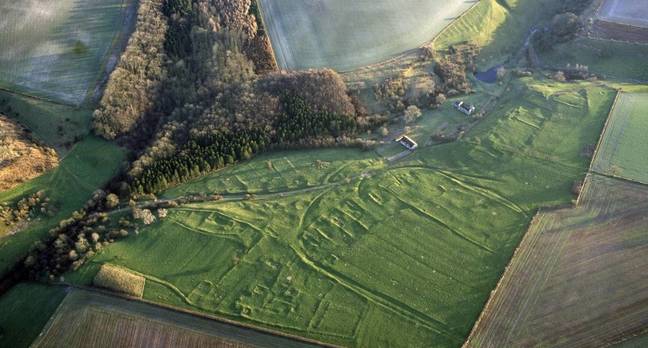
Wharram Percy, aerial view © Wharram Research Project/Historic England
Archaeologists investigating human bones excavated from the deserted mediaeval village of Wharram Percy in North Yorkshire have suggested that the villagers burned and mutilated corpses to prevent the dead from rising from their graves to terrorise the living.
Although starvation cannibalism often accounts for the mutilation of corpses during the Middle Ages, when famines were common, researchers from Historic England and the University of Southampton have found that the ways in which the Wharram Perry remains had been dismembered suggested actions more significant of folk beliefs about preventing the dead from going walkabout.
Their paper, titled A multidisciplinary study of a burnt and mutilated assemblage of human remains from a deserted mediaeval village in England, is published today in the Journal of Archaeological Science.
Located in the Yorkshire Wolds, Wharram Percy was continuously occupied for about 600 years, and was probably founded in the 9th or 10th century, but had become deserted by the early 16th century as a result of gradual abandonment and forced evictions. The ruined church is the last-standing mediaeval building, beside it remaining the grassed-over foundations of two manors and about 40 peasant houses and their outbuildings.
Since 1948 the settlement has been the focus of intensive research, which has made it Europe’s best-known deserted mediaeval village, and in what may be the first good archaeological find regarding the practice, human remains from the site suggest the predominance of folk beliefs regarding revenants in 11th-13th century England.
Tank Chats #4 Vickers Armstrongs Type E
Published on 15 Apr 2015
The fourth in a series of short films about some of the vehicles in our collection presented by The Tank Museum’s historian David Fletcher MBE.
Alongside their work for the British armed forces Vickers-Armstrongs produced military equipment for foreign buyers. Their earliest commercial tank designs failed to sell but in 1928 they produced a masterpiece. Known as the 6-ton or ‘six-tonner’, it was a remarkable design, with a rear-mounted, air-cooled engine driving to a gearbox and track sprockets at the front of the tank. There were two main variants; some tanks were supplied with two machine-gun turrets (Type A) while others carried a larger single turret (Type B) like our exhibit.
Following trials the British Army turned it down but the tank was a major export success. It sold all around the world, from South America to Japan and was even studied by the United States Army. It was built under licence in Russia (see our T-26 exhibit) and influenced tank design in many other countries. Our exhibit is displayed in the fancy camouflage style adopted by Vickers for their commercial offerings; it is seen at a mythical army equipment exhibition some time in the thirties.
Shortly before World War II Vickers built a new version, powered by a Rolls-Royce engine (the Mark F) but this failed to sell. Subsequent to this the government of Siam (Thailand) placed a repeat order but specified the original Armstrong-Siddeley engine. These were completed closer to the Mark F design but few, if any, reached their destination. With the outbreak of war the British Government impounded all commercial tanks still in the factories and the remaining stock of six-tonners, of which this is one, were used by British forces for training.
April 2, 2017
Yes, Prime Minister – The need to know
Published on 23 Sep 2014
Scene from season 2, episode 8.


