Quotulatiousness

June 30, 2024

The medieval salt trade in the Baltic

Filed under: Economics, Europe, Food, History — Tags: , , , , , , — Nicholas @ 03:00

In the long-awaited third part of his series on salt, Anton Howes discusses how the extremely low salt level of water in the Baltic Sea helped create a vast salt trade dominated by the merchant cities of the Hanseatic League:

The extent of the Hanseatic League in 1400.
Plate 28 of Professor G. Droysen’s Allgemeiner Historischer Handatlas, published by R. Andrée, 1886, via Wikimedia Commons.

It’s difficult to appreciate salt’s historical significance because it’s now so abundant. Societies used to worry about salt supplies — for preparing and preserving food — as a matter of basic survival. Now we use the vast majority of it for making chemicals or chucking on our roads to keep them from getting icy, while many salt-making plants don’t even operate at full capacity. Yet the story of how we came to achieve salt superabundance is a long and complicated one.

In Part I of this series we looked at salt as a kind of general-purpose technology for the improvement of food, as well as a major revenue-raiser for empires — especially when salt-producing coastal areas could dominate salt-less places inland. In Part II we then looked at a couple of places that were all the more interesting for being both coastal and remarkably salt-less: the coast of Bengal and the Baltic Sea. One was to be exploited by the English East India Company, which needlessly propped up a Bengalese salt industry at great human cost. The other, however, was to prove a more contested prize — and ultimately the place that catalysed the emergence of salt superabundance.

It’s worth a brief recap of where we left the Baltic. Whereas the ocean is on average 3.5% salt, along the Baltic coast it’s at just 0.3% or lower, which would require about twelve times as much time and fuel to produce a given quantity of salt. Although there are a few salt springs near the coast, they were nowhere near large enough to supply the whole region. So from the thirteenth century the Baltic’s salt largely came from the inland salt springs at Lüneburg, supplied via the cities of Lübeck and Hamburg downstream. These two cities had a common interest against the kingdom of Denmark, which controlled the straits between the North and Baltic seas, and created a coalition of trading cities that came to be known as the Hanseatic League. The League resoundingly defeated the Danes in the 1360s and 1430s so that their trade in salt — and the fish they preserved with it — could remain free.

But Lüneburg salt — and by extension the League itself — was soon to face competition.

Lüneburg could simply not keep up with the growth of Baltic demand, as the region’s population became larger and wealthier. And so more and more salt had to come from farther afield, from the Bay of Biscay off France’s western coast, as well as from Setúbal in Portugal and from southern Spain.1 This “bay salt” — originally referring to just the Bay of Bourgneuf, but then extended to the entire Bay of Biscay, and often to all Atlantic solar-evaporated salt — was made by the sun and the wind slowly evaporated the seawater from a series of shallow coastal pools, with the salt forming in coarse, large-grained pieces that were skimmed off the top. Bay salt, however, inevitably ended up mixed with some of the sand and dirt from the bottoms of the pools in which it was held, while the seawater was never filtered, meaning that the salt was often brown, green, grey or black depending on the skill of the person doing the skimming — only the most skilled could create a bay salt that was white. And it often still contained lots of other chemicals found in seawater, like magnesium chloride and sulphate, calcium carbonate and sulphate, potassium chloride and so on, known as bitterns.2

Bay or “black” salt, made with the heat of the sun, was thus of a lower quality than the white salt boiled and refined from inland salt springs or mined as rock. Its dirt discoloured and adulterated food. Its large grains meant it dissolved slowly and unevenly, slowing the rate at which it started to penetrate and preserve the meat and fish — an especially big problem in warmer climates where flesh spoiled quickly. And its bitterns gave it a bitter, gall taste, affecting the texture of the flesh too. Bay salt, thanks to the bitterns, would “draw forth oil and moisture, leading to dryness and hardness”, as well as consuming “the goodness or nutrimental part of the meat, as moisture, gravy, etc.”3 The resulting meat or fish was often left shrunken and tough, while bitterns also slowed the rate at which salt penetrated them too. Bay-salted meat or fish could often end up rotten inside.

But for all these downsides, bay salt required little labour and no fuel. Its main advantage was that it was extremely cheap — as little as half the price of white Lüneburg salt in the Baltic, despite having to be brought from so much farther away.4 Its taste and colour made it unsuitable for use in butter, cheese, or on the table, which was largely reserved for the more expensive white salts. But bay salt’s downsides in terms of preserving meat and fish could be partially offset by simply applying it in excessive quantities — every three barrels of herring, for example, required about a barrel of bay salt to be properly preserved.5

By 1400, Hanseatic merchants were importing bay salt to the Baltic in large and growing quantities, quickly outgrowing the traditional supplies. No other commodity was as necessary or popular: over 70% of the ships arriving to Reval (modern-day Tallinn in Estonia) in the late fifteenth century carried salt, most of it from France. But Hanseatic ships alone proved insufficient to meet the demand. The Danes, Swedes, and even the Hanseatic towns of the eastern Baltic, having so long been under the thumb of Lübeck’s monopoly over salt from Lüneburg, were increasingly happy to accept bay salt brought by ships from the Low Countries — modern-day Belgium and the Netherlands. Indeed, when these interloping Dutch ships were attacked by Lübeck in 1438, most of the rest of the Hanseatic League refused Lübeck’s call to arms. When even the Hanseatic-installed king of Denmark sided with the Dutch as well, Lübeck decided to back down and save face. The 1441 peace treaty allowed the Dutch into the Baltic on equal terms.6 Hanseatic hegemony in the Baltic was officially over.

The Dutch, by the 1440s, had thus gained a share of the carrying trade, exchanging Atlantic bay salt for the Baltic’s grain, timber, and various naval stores like hemp for rope and pitch for caulking. But this was just the beginning.


    1. Philippe Dollinger, The German Hansa, trans. D. S. Ault and S. H. Steinberg, The Emergence of International Business, 1200-1800 (Macmillan and Co Ltd, 1970), pp.219-220, 253-4.

    2. L. Gittins, “Salt, Salt Making, and the Rise of Cheshire”, Transactions of the Newcomen Society 75, no. 1 (January 2005), pp.139–59; L. G. M. Bass-Becking, “Historical Notes on Salt and Salt-Manufacture”, The Scientific Monthly 32, no. 5 (1931), pp.434–46; A. R. Bridbury, England and the Salt Trade in the Later Middle Ages (Clarendon Press, 1955), pp.46-52. Incidentally, some historians, like Jonathan I. Israel, Dutch Primacy in World Trade, 1585-1740 (Clarendon Press, 1989) p.223, note occasional reports of French bay salt having been worse than the Portuguese or Spanish due to its high magnesium content, “which imparted an unattractive, blackish colour”. This must be based on a misunderstanding, however, as the salts would have been identical other than in terms of the amount of dirt taken up with the salt from the pans. At certain points in the seventeenth century the French workers skimming the salt must simply have been relatively careless compared to those of Iberia.

    3. John Collins, Salt and fishery a discourse thereof (1682), pp.17, 54-5, 66-8.

    4. Bridbury, pp.94-7 for estimates.

    5. Karl-Gustaf Hildebrand, “Salt and Cloth in Swedish Economic History”, Scandinavian Economic History Review 2, no. 2 (1 July 1954), pp.81, 86, 91.

    6. For this section see: Dollinger, pp.194-5, 201, 236, 254, 300.

June 29, 2024

Oh no! The filthy proles are getting too many calories! Let’s re-impose rationing!

Tim Worstall suggests that the regular “viewing with alarm” thumbsuckers about purchased meals having “too many calories” are actually an indication of a strong desire by the great and the good to stick their regulatory noses into the lives of ordinary people:

“Indian take away in Farrer Park” by Kai Hendry is licensed under CC BY 2.0 .

This headline is, of course, wrong.

    Some takeaway meals contain more calories than daily limit, UK study finds

There is no daily limit. We do not have laws stating how much food we are allowed to eat. Of course, there are those who want there to be such laws but there aren’t, as yet. What there is is a series of recommendations about the limits we should impose upon ourselves:

    Some takeaway meals contain more calories in one sitting than someone is advised to consume in an entire day, a study of British eating habits has revealed.

That’s better.

    Cafes, fast-food outlets, restaurants, bakeries, pubs and supermarkets are fuelling the UK’s obesity crisis because so many meals they sell contain dangerously large numbers of calories, it found.

That’s not better. Because a plate of food containing a lot of calories is not a danger. Eating many of them might be but that the average household can get a gutbuster for some trivial portion of household earnings is a glory of modern civilisation, the very proof we require that we’re all as rich as Croesus.

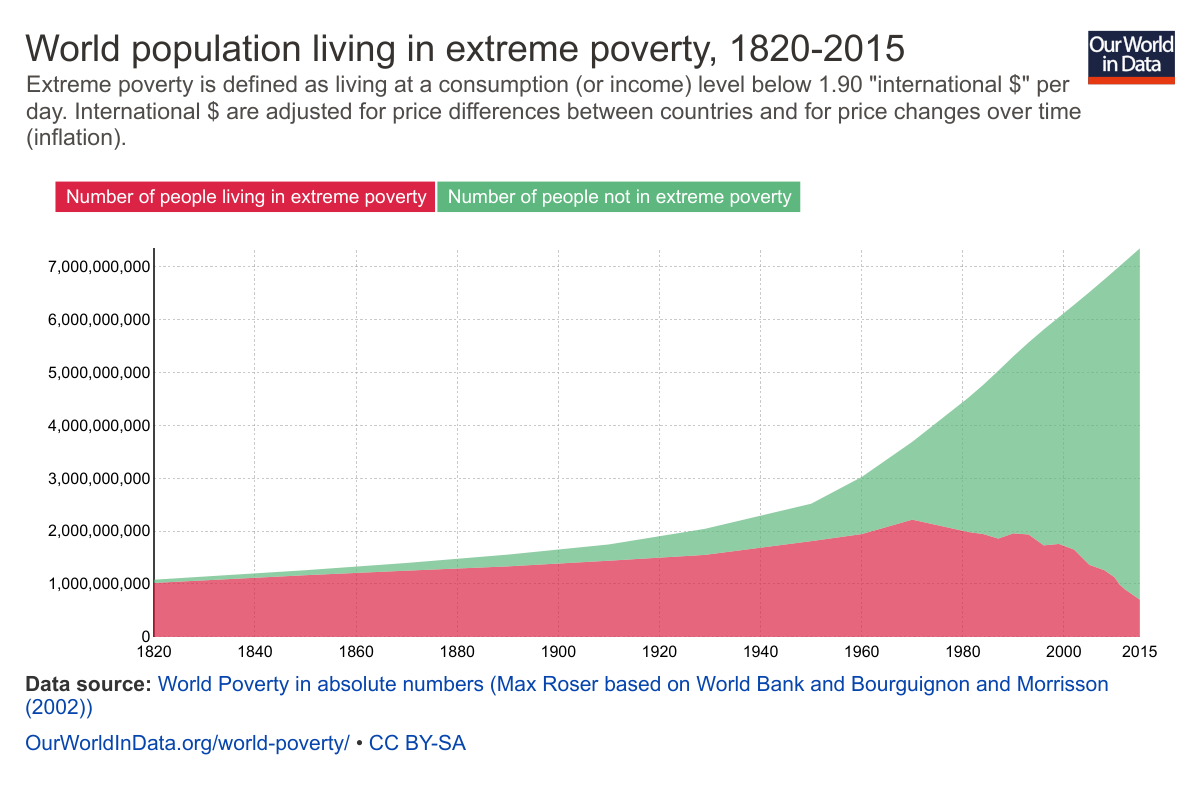
And this is actually true too. That we are gloriously rich and it’s our food supply that proves this. As Brad Delong likes to point out back 200 years (yes, about right, 1820s is as it was really changing but 300 years would be better) it took a full day’s work to be able to gain 2,000 calories a day for a day labourer. There are 800 million out there still living at that standard of living. We can buy 2,000 calories — if we go boring stodge — for 30 minutes work now.

By history and by certain geographies we are foully rich these days. Which is the complaint of the wowsers of course. They’re a revival of the puritans and their sumptuary laws. How dare it be true that people fill their bellies with food they actually like?

    Six out of 10 takeaway meals contain more than the 600-calorie maximum that the government recommends people should stick to for lunch and dinner in order to not gain weight, according to the research, which was carried out by the social innovation agency Nesta.

    One in three contain at least 1,200 calories – double the recommended limit.

And? So, folk can buy lots of food for not much money. This is the very thing that makes having a civilisation possible — cheap food. My wife and I do indeed partake of an Indian occasionally — and find the takeout portions rather large. So, we have one amount for lunch or dinner and we’ve a refrigerator in which to keep the excess for a supper or snack another day. This is not beyond the wit of man to organise.

We don’t order in food very often, but when we do we usually manage to get both dinner on the night and lunch on the morrow from a typical order. If the nosey parkers have their way, they’d limit what we were allowed to buy — for our own good, of course — so we’d almost certainly still pay the same amount for less food. Such a deal!

June 25, 2024

In all places and at all times, the true minimum wage is zero

Filed under: Business, Economics, Food — Tags: , , , — Nicholas @ 03:00

Tim Worstall explains why fast food restaurants like McDonalds and Burger King are reported to be introducing new low-priced value meals to try and attract and keep more customers in the current economy:

“McDonald’s restaurant, Toledo OH, 1967” by DBduo Photography is licensed under CC BY-SA 2.0 .

It’s terribly unfashionable to say that minimum wage rises have any effects — other than that the minimum wage workers earn more, of course. It’s supposed to be one of those areas where only good things can come from poking a stick in the market. The justification is that the only jobs these folks can get are slinging fries (If that is the case then I’d probably start with education system reform so that grievance studies graduates are skilled enough to do something else but maybe that’s just me), therefore MaccyD’s and the like have a monopoly on employing them (a “monopsony”) and so omniscient and caring politicians and bureaucrats can correct this market error without there being any side effects.

Hmm. Seems unlikely but that is the story.

[…]

The standard economics of a minimum wage rise is — well, was before the progressive smokeblowing about monopsony — that the money’s got to come from somewhere. It could be that profits fall and therefore there’s less investment — even a move away from having invested in — that activity and so employment falls. Or, wages are higher for those fewer people employed and some lose their jobs — also known as rising productivity and also known as fewer jobs. Or, customers get to pay higher prices, fewer now buy the item and so employment falls as the sector shrinks.

Hmm, well, we can get all serious about monopsony but that one doesn’t work to my mind either as even if profits were excessive a fall in them will still lead to less investment in the sector and we’re back at option 1) above. But, many have convinced themselves.

But here we’ve got a general agreement that Americans are eating fast food less. They’re eating at home more. The only thing that’s changed in the varied cost structures is the price of fast food labour. Sorry, the only thing that’s changed in the *relative* cost structures is that labour as the minimum wage is pushed up. Whatever food inflation has been it’s been no better or worse for MaccyD’s than it has been in Albertsons or King Super. It’s also true that US real incomes have been rising so it’s not a general retreat on the part of consumers. The price of fast food relative to home prepared has risen, people are buying less fast food. The only cost pressure causing this is the pushing up of the minimum wage in recent years (for chains, in California, it’s now $20 an hour).

Myself I take that as being proof of the original and base minimum wage argument in standard economics. Trying to recoup that fall in sales is what is leading to these special offers — and don’t forget they’re special, not for all time and so should be considered advertising, not a long term change in price levels.

As a larger lesson I take it to mean that we should be very wary indeed of those claiming that there’s some special little economic trick that makes what they want to do anyway such a good idea. Why, yes, that does include any special little tricks I might want to claim. But many really did convince themselves that fast food wages were different, that pushing them up would have only good, not ill, effects.

Seems it ain’t so.

Over the weekend, there were a few stories about a small fancy coffee chain whose employees had successfully unionized to get better wages, only for the owners to shut down all three stores because even before the workers unionized, they were losing money on the business. Rather than the higher wages the employees were expecting (while keeping their unusually generous benefits for such entry-level jobs), all their jobs were lost and nobody won. Small businesses like restaurants operate on a far smaller profit margin than most people believe … according to Statistics Canada, the average restaurant of all types made a 4.3% profit in 2022.

June 21, 2024

“Neoliberal ideology is antidemocratic at its very core. Its aim is to give free-reign over our societies to corporations, not citizens”

Tim Worstall responds to a recent Medium essay by Julia Steinberger which illustrates that “neoliberal” has joined “fascist” as a generic term to indicate strong disapproval of a person, organization, or idea:

The idea that an adult woman can believe these things is just amazeballs. But here we are. A tweet from Julia Steinberger leads to her Medium essay about what’s wrong with the world.

An upheaval in 10 chapters:

    1. The cause. We know the climate crisis is brought to us by highly unequal and undemocratic economic systems.

Err, no? Emissions are emissions. 100 people emitting one tonne each is exactly the same as 1 person emitting 100 tonnes. Sure, it’s true that a more unequal society will have more people emitting those 100 tonne personal amounts. But a more equal society will have more people able to emit another 1 tonne each. For, more equality is by definition the movement of some of those assets of the richer to those poorer — the economic assets which either allow or do the emitting. Sure, Jim Ratcliffe’s £50,000 private jet flight emits more than my £100 Easyjet one. But if we take the £50k off Jim and give it to 500 folk like me then all 500 of us might spend the marginal income on an Easyjet flight each — which would be more emissions than Jim’s spending of the money.

It simply is not true that economic inequality is the heart, the core or the cause of climate change. It’s idiocy to think it is too.

Of course, we know what’s happening here. Climate Change is Bad, M’Kay? Which it is, obviously. Economic inequality is Bad, M’Kay? Well, there the evidence is a great deal more mixed but whatever. But in the minds of the stupid all bad things have the same cause. So, if inequality is bad, climate change is bad, then they must be the same thing because they’re Bad, M’Kay?

    2. The rise. The recent history of these economic systems, in the Americas and Eurasia, is dominated by the ascendance of neoliberal ideology.

Oh, that is good. Given that I am a neoliberal — a fully paid up one, Senior Fellow at the Adam Smith Institute and all — that’s very good. Given HS2, looming wealth taxation, the increased bite of idiot regulation and all that I can’t say that I see neoliberalism as winning right now but that might depend upon your starting point. If you’re a socialist — or an idiot but I repeat myself — you might well regard the plenitude of bananas in the supermarket as neoliberal. After all, that is something that socialism never did achieve.

    3. The threat. Neoliberal ideology is antidemocratic at its very core. Its aim is to give free-reign over our societies to corporations, not citizens.

And, well, you know, bollocks. The very beating heart of neoliberalism is that corporations need to be controlled and they’re best controlled by the citizens. In the form of free markets rather than voting on which bureaucrats get the gold plated pension, true. But neoliberals are between indifferent and actually against capitalist power. The whole nub of the idea is that markets do the job of controlling capitalists better than bureaucrats, politicians or, obviously, capitalists.

There’s not really any way for her thesis to survive after getting so much of the basics wrong, is there?

But just one more tidbit:

    Hayek and his neoliberal colleagues now needed another, antidemocratic way, to organise society. They didn’t want democracy, but they wanted some kind of self-maintaining organisation — by which they meant hierarchy. Organisation was supposed to be supplied by the market, and hierarchy by competition within markets. (It’s worth noting that neoliberals in the 1950s did not, although they should have, predict that unfettered markets lead to concentrations in monopolies or cartels. They would arguably disapprove of the vast corporations running our current economies, even though their market-above-democracy policies predictably brought them into being.)

Well, that wasn’t actually the last tidbit. But the idea that Friedman, Mises, Menger, Hayek and the rest didn’t worry about monopolies? Jesu C is really bouncin’ on that pogo stick right now. And then the idea that democracy will be better bulwark against monopolies than markets? Can you actually do backflips on a pogo stick?

June 18, 2024

“If you convince a group of Homo sapiens that that group over there are economic parasites … then you have primed them for mass murder”

Lorenzo Warby on the malign influence of Karl Marx:

Despite — in some ways because of — all his Theorising about “capitalism”, Marx made no serious attempt to understand the actual dynamics of commerce, creating a (false) theory of economic parasitism (“surplus value”) that — both predictably, and in practice — motivated mass murder. If you convince a group of Homo sapiens that that group over there are economic parasites — and you and your society is better off without them — then you have primed them for mass murder. Hence, Marx’s theory was used to justify actual Marxist mass-murders, starting with Lenin’s infamous hanging order.

Marx’s economistic systematising created a pretence of being social scientist — to himself and even more to Engels — that many people have maintained ever since. Hence a pre-Darwinian metaphysician is even now regularly treated as if he was a social scientist. This despite being wrong about more or less everythingclass, commerce, surplus, immiseration, the state, patterns of history, commodification, division of labour, foraging societies …

As I have noted elsewhere:

    To have a state, farming niches have to be sustainable after taxes are extracted. That means resources are extracted before they turn into extra babies. This means that states create surplus (income above subsistence): indeed, they dominate the creation and extraction of surplus.

The perennial dominance of the state in extraction of surplus — and hence the creation of class structures — is nowhere more obvious than in Marxist states.

Philosopher Charles Taylor pointed out the tension between the claim to being science — and the causal determinism that goes with that — and the messianic vision that motivates Marx’s and Marxist activism. In any tension between the two, the latter wins because it is so powerfully motivating. This includes with Marx himself, which is why his “science” is so profoundly wrong in fact. It exists to justify the messianic vision.

No political (or religious) movement has killed and tyrannised more people than revolutionary Marxism. A Marxist is someone for whom no amount tyranny and mass murder will stop them worshipping the splendour in their head. This testifies to the power of the messianic vision.

Marx was the original launderer of ideas. Over decades of wrestling with the economics of Smith and Ricardo, he laundered — via economic reasoning — the metaphysical conclusions he reached in the 1840s to create a system that would “scientifically” generate and justify those conclusions. That those conclusions went mostly unpublished in his lifetime — with the most dramatic exception being The Communist Manifesto (1848) — does not belie this. Marx himself insisted on the centrality of this period of “self-clarification”.

Nothing he published later significantly contradicted those conclusions. Marx is the archetypal activist scholar, whose activism drives, and so degrades, his scholarship and analysis. He is the key formulator of the Dialectical Faith, that has generated various disastrous spin-offs, from his own economism to Lenin’s Jacobinising of Marxism to the Cultural Marxism of Lukacs and Gramsci, Critical Theory, and all forms of Critical Social Justice.

No form or derivative of the Dialectical Faith have ever generated a net positive contribution to human flourishing, or understanding, compared to available alternatives.

Ibn Khaldun was a far more acute analyst of the role of the state in the economy, and patterns within history, than Marx. Ibn Khaldun sought systematically to understand what he observed, participated in and read about. He was not laundering ideas, not justifying pre-set conclusions, nor judging evidence by his Theory.

Ibn Khaldun was a social scientist (arguably the first). Marx was not, he was pretending to be one (including to himself).

The Dialectical Faith holds that history is driven by dialectical process that transforms society from an oppressive past to a future liberated from constraints, if the oppressive elements of society are suppressed or abolished. As Marx tells us, our productive capacity will be so great, that we will so humanise the world, that division of labour will end for:

    In communist society, where nobody has one exclusive sphere of activity but each can become accomplished in any branch he wishes, society regulates the general production and thus makes it possible for me to do one thing today and another tomorrow, to hunt in the morning, fish in the afternoon, rear cattle in the evening, criticise after dinner, just as I have a mind, without ever becoming hunter, fisherman, herdsman or critic.

Marx was not engaged in scientific enquiry but pseudo-scientific, or scientistic — the form of science without the substance — justification of already reached conclusions. He regularly judges and chooses evidence based on Theory, a pattern that has become endemic within all forms of Marxism and its spinoffs (such as Critical Theory). Marx exemplifies the activist principle that “what I can imagine — however self-contradictory — is so much better than what others have struggled to achieve”.

Marx’s picture of the evils of division of labour is metaphysical twaddle flatly contradicted by any serious study of the role of division of labour — and, for that matter, commodification — in production at scale. How can division of labour be such an alienating evil when it is built into sexual reproduction, into every eusocial species, even into the cells of every single complex organism?

The answer is via a ludicrous quasi-theological metaphysical inflation of human consciousness and creativity. Marx collectivises — through his notion of species-being — the Romantic notion of human fulfilment through self-expression.

June 16, 2024

“What the hell is going on in Canada?”

Filed under: Cancon, Economics — Tags: , , , , , — Nicholas @ 03:00

If you’re not Canadian or have any Canadian friends, you may not understand just how badly broken the country is — and the federal government is still desperately pretending that we’re all onboard with the Net Zero/Carbon Tax/”you’ll own nothing” bullshit and piling on the long-term debt:

One of Canada’s intelligence agencies, a couple of months ago, sent a memo to the Liberal federal government informing them that, in the near-future years to come, they are worried about revolutionary activity. I believe Canada is a good case study because it seems the country has been a sociological testing ground for the powers that be to see what happens. Canada is a surreal twilight zone where it feels like every psyop known to man is hurled its way. Canada unquestionably has the worst demographic and immigration issues, the worst housing issues, the worst social stability, and upwards mobility issues, all adjusted and proportional to its population and size, of course. For our purposes, I believe Canada serves as the worst-case scenario of how bad the dating market can be, and how bad it will continue to get.

Canada has some of the lowest upward social mobility among developed nations, especially for young people, particularly within the OECD and G8. This means that young people in Canada find it relatively difficult to move up the economic ladder compared to their parents.

In 2022, Canada’s population growth was significantly driven by immigration. According to Statistics Canada, approximately 95% of the population growth in that year was attributed to immigration. This includes both permanent and temporary residents, with a notable influx of international students, temporary workers, and permanent residents. Only a meagre 5% of Canada’s population growth, including recent immigrants, was from organic growth and childbirth. Below are the national origins of immigrants over the last twenty-four years. The combined total number of people entering Canada per year, including international students, temporary foreign workers, legal immigrants, and refugee claimants, is approximately 1,133,770 individuals officially. In reality, the government over the last four years has lost count.

As of April 2024, the average home price in Canada is approximately CAD $703,446. This is €477,121.93 and USD $511,466.93. Would you like to see what $703k CAD can get you in France? Hint: a lot more than in Canada.

This has been noticed so much by Canadians that it is now a meme, with Conservative Party and opposition leader Pierre Poilievre pointing it out in the House of Commons. You can compare the price of homes and the cost of living with Canadian wages. You can also compare how far those meagre wages would go in other first-world countries like France, Germany, or Sweden. The answer is much farther. Much, much farther. There is currently no hope, short of radical action by the government unheard of in Canadian history, for this situation to be rectified. The only other option is best left unsaid.

“Educated” Women Lead

In Canada, among ethnic Canadians, a significant portion of the female population is more educated and makes more money than Canadian men. Canadian men make, on average, CAD $48,500, while women make CAD $42,000. However, only 56% of men have post-secondary education, while 68% of women do. Men have completed higher levels of high school, and women have completed higher levels of college or university. This has led to a massive gap in socioeconomic status between men and women. It gets worse when you include non-ethnic Canadians. Completed levels of post-secondary education for men remain at 56%, while women’s rise to 73%.

We know that in our post-industrial world, resources translate to money. Money and completed levels of education translate to status. Women are 50% more likely to divorce men when they make more money. When women are already the initiators of divorce 70% of the time, it starts looking pretty ugly, fast.

June 13, 2024

Debunking the “miraculous” Marshall Plan

If you’ve read anything about the state of Europe in the aftermath of the Second World War, you’ll undoubtedly have heard of the way the Marshall Plan did wonders to get (western) Germany and the other battle-devastated nations back on their feet economically. At FEE, Christian Monson suggest that you’ve been provided with a very rosy scenario that doesn’t actually accord with the facts:

Konrad Adenauer in conversation with Ludwig Erhard.
KAS-ACDP/Peter Bouserath, CC-BY-SA 3.0 DE via Wikimedia Commons.

Unfortunately, the ubiquity of the myth that the Marshall Plan rebuilt Germany is proof that state-controlled education favors propaganda over economic literacy. Despite the fact that most modern historians don’t give the Marshall Plan much credit at all for rebuilding Germany and attribute to it less than 5 percent of Germany’s national income during its implementation, standard history textbooks still place it at the forefront of the discussion about post-war reconstruction.

Consider this section from McDougal Littell’s World History (p. 968), the textbook I was given in high school:

    This assistance program, called the Marshall Plan, would provide food, machinery, and other materials to rebuild Western Europe. As Congress debated the $12.5 billion program in 1948, the Communists seized power in Czechoslovakia. Congress immediately voted approval. The plan was a spectacular success.

Of course, the textbook makes no mention of the actual cause of the Wirtschaftwunder: sound economic policy. That’s because, for the state, the Marshall Plan makes great statist mythology.

Not only is it frequently brought up to justify the United States getting involved in foreign conflicts, but it simply gives support for central planning. Just look at the economic miracle the government was able to create with easy credit, they say.

And of course, admitting that the billions of dollars pumped into Germany after WWII accomplished next to nothing, especially when compared to something as simple as sound money, would be tantamount to admitting that the government spends most of its time making itself needed when it isn’t and thereby doing little besides getting in the way.

The Inconvenient Truth of Currency Reform

You are unlikely to find the real cause of the Wirtschaftwunder mentioned in any high school history textbook, but here is what it was. In 1948, the economist and future Chancellor of West Germany Ludwig Erhard was chosen by the occupational Bizonal Economic Council as their Director of Economics. He went on to liberalize the West German economy with a number of good policies, the most important being currency reform.

The currency in Germany immediately after WWII was still the Reichsmark, and both the Nazis and then the occupying Soviet authorities had increased the amount in circulation significantly. As a result, by 1948 the Reichsmark was so worthless that people had turned to using cigarettes and coffee as money.

To give people a true store of value so that they could calculate economic costs accurately, assess risk and invest in the future, Erhard created the Deutsche Mark, West Germany’s new currency. Like ripping off a bandaid, he decreased the money supply by 93 percent overnight.

It’s also worth noting that while Erhard, following his school of Ordoliberalism, did form a central bank, it was at least designed independent from the government and followed a hard-money policy (preserving a stable amount of money) through the length of the Wirtschaftswunder. In fact, the original Bank Deutsche Länder was rather limited in scope until it was reorganized as the considerably more centralized Bundesbank in 1957, incidentally when Germany’s economic miracle began to lose steam.

Other notable liberal policies instituted by Erhard included removing all price controls and lowering taxes from the Nazis’ absurd 85 percent to 18 percent. The American occupational authorities opposed these reforms, but Erhard went through with them anyway. This liberalization had an immediate effect. The black market disappeared almost overnight, and in one year, industrial output almost doubled.

Perhaps most poignantly, unemployment dropped from more than 10 percent to around 1 percent by the end of the 1950s. Normally the government tries to justify currency manipulation as a means to eliminate unemployment, but the Wirtschaftwunder is evidence that sound money does the job far better.

June 12, 2024

“Consumption inequality” really has fallen significantly since Orwell’s day

Filed under: Books, Britain, Economics, History, USA — Tags: , , , — Nicholas @ 04:00

Tim Worstall on some of the points raised by Christopher Snowdon’s new introduction to Orwell’s Nineteen Eighty-Four:

Eric (“George Orwell”) Blair’s press card portrait, 1943

Eric Blair, the useful one, once pointed out that:

    In a world in which everyone worked short hours, had enough to eat, lived in a house with a bathroom and a refrigerator, and possessed a motor-car or even an aeroplane, the most obvious and perhaps the most important form of inequality would already have disappeared. If it once became general, wealth would confer no distinction.

That’s from Chris Snowdon’s new intro to 1984 – you should buy a copy.

Not that Eric knew enough economics to know this but what he’s talking about is consumption inequality.

Sure, we’ve Oxfam squealing that wealth inequality is rising summat fearsome. It ain’t — they fail to account for what we already do to reduce wealth inequality. Many tell us that income inequality is rising summat fearsome. It ain’t. Global income inequality has been falling this past 40 years and as all men are indeed brothers it’s the global number that matters.

But the one that’s really fallen like a stone is that consumption inequality. Consumption is also really the only one of the three that matters. Sure, a world in which there are those without three squares and a crib is not a good one. But once all do have three squares etc. then whatever other inequality there is is, well, it’s not actually all that important is it?

[…]

We really have got to what Orwell thought would be equality. In 1930s England (which was his mental reference point) all of these things – all – were signifiers of significant wealth or income:

As a poorer country the UK was a little behind on these things but my best guess would be that we’re ahead of the US on washing machines today (the US still has a habit of communal machines in apartment blocks). And it amuses that central heating isn’t even on the list. This was something very middle class indeed in the 1960s, really only became “normal” in the UK in the late 70s into the 80s. As with double glazing. These days you’re defined as being in fuel poverty if you cannot heat your house, always and all of it, to a level that no one at all could before that central heating. No, really, coal fire heated houses might average 10oC in winter and that would only be in rooms with an actual fire — others would be at 0oC.

This is not to get into a Four Yorkshiremen but people would be astonished at how cold houses were 1970s and earlier. My own arrival in the US in 1981 had me wondering how they had heating systems that heated all the house, properly, all winter. How could anyone afford that?

June 10, 2024

South Africa’s “Rainbow Nation” falters

Filed under: Africa, Economics, Government, History, Media, Politics — Tags: , , , , , — Nicholas @ 05:00

Niccolo Soldo’s weekly roundup included a lengthy section on the recent election results in South Africa and what they might mean for the nation’s short- and medium-term stability:

Being a teen, the issue of South African Apartheid didn’t really fit all that well within the overarching Cold War paradigm. Unlike most other global issues, this one didn’t break down cleanly between the “freedom-loving West” and the “dictatorial, oppressive communist bloc”, as the push to dismantle the regime came from western liberals who were in agreement with the reds.

This slight bit of complexity did not faze most people, as Apartheid was seen as a relic of an older world, one to be consigned to the proverbial dustbin of history. It’s elimination did fit well enough into the Post-Berlin Wall world, one in which freedom and democracy were to reign supreme. This was more than enough reason for almost all people to cheer the release of Nelson Mandela and applaud South Africa’s embrace of western liberal democracy.

In the early 1990s, men once again dared to flirt with utopian ideas, and South Africa’s “Rainbow Nation” was to be its centrepiece: out with authoritarianism, racism, ethnocentrism, etc., and in with multiracialism, multiethnicity, democracy and individual liberty. We could all leave the past where it belonged (in the past) and live in peace and harmony, as democracy would defend it, secure it, and preserve it. South Africa would lead the way, and would in fact teach us westerners how it is to be done.

Oddly enough, South Africa quickly fell off of the radar of mainstream media in the West when it failed to live up to these lofty goals. Rather than living up to the hype of being the “Rainbow Nation”, it instead was quickly mired in the politics of corruption and race, showing itself to be all too human, just like the rest of us. South Africa had failed to immediately resolve its inherent internal tensions, whether they be racial, economic, ethnic, or ideological, and by extension it had failed to deliver its promise to western liberals. “Out of sight, out of mind” became the best practice, replacing the utopianism of the first half of the 1990s.

Granted, a lot of grace was given to South Africa by western media so long as Nelson Mandela remained in office (and even after that), but the failures were plainly evident to see: an explosion in crime and in corruption were its most obvious characteristics, ones that could not be brushed under the carpet. The African National Congress (ANC), the party that would deliver the promise of the Rainbow Nation, was instead shown to be little more than a powerful engine of corruption and patronage. Luckily for the ANC, it was fueled in large part by the legacy of Mandela and the goodwill that he had accumulated over the years while he sat in prison.

The post-Mandela era has not been kind to the ANC (nor to South Africa as a whole), as the party could no longer hide behind his fading legacy, and could no longer cash in on the goodwill that came from it. It could “put up”, and would it not “shut up”. The ANC over time became a lumbering beast, too big to slay, but too slow to destroy its opposition when compared to its nimble youth.

What has the party delivered in its three decades of power? It did help dismantle Apartheid, but it did not deliver economic prosperity and opportunity to all. Instead, it simply swapped out elites where it could, preferring to keep the new ones in house. An inability to tame crime and to keep the national power grid running has turned the country into a bit of a joke, especially when it is lumped into the BRICS group alongside Brazil, Russia, India, and China. Despite its abundance of natural wealth, South Africa has been economically mismanaged.

South Africa is an important country to watch for the simple reason that there is so much tinder lying around, ready to be set ablaze. Luckily for South Africans, dire projections of widespread civil strife have not come to pass. Unluckily for South Africans, their national trajectory is headed in the wrong direction. Last week’s national elections saw the ANC lose their parliamentary majority for the first time ever, and the only way to read the results is to conclude that no matter how one may feel about this very corrupt party, it is an ominous sign.

Elite contempt for democracy is fuelling anti-immigration “far right” sentiment in the west

Even for people who are generally happy with robust immigration, the numbers being recorded (or, more likely, under-recorded) in Canada, the United States and Europe are far too high to pretend that the new arrivals will quickly integrate into their new countries, and they are generally not being encouraged to do so anyway. Complaints to the people who have enabled these massive inflows — at best — are waved off or ignored, but often are seized upon as examples of hateful far-right xenophobia to be punished and suppressed:

Not so long ago, as many of us reeled from the political earthquakes of Brexit and Trump, it seemed sensible for responsible mainstream political parties to adopt tighter immigration control to keep the populist right at bay. Mass migration in Europe had led to a far-right resurgence; in the US and UK, Trump and the Johnson-era Tories seemed to grasp this and moved to co-opt the anti-immigrant fervor. Democracy was working to accommodate a shift in the public mood.

Or so it seemed. Nearly a decade later, something else has happened: an immigration explosion. In response to a volatile public mood, Western elites actually intensified their policy of importing millions of people from the developing world to replace their insufficiently diverse and declining domestic populations.

The recent figures from the US, UK and Canada are mind-blowing. The graphs all look like a hockey stick, with a massive spike in the last three years alone. Under Trump, the average number of illegal crossings a year was around 500,000; under Biden, that has quadrupled to two million a year — from a much more diverse group, from Africa, China and India. To add insult to injury, Biden has also all but shut down immigration enforcement in the interior; and abused his parole power to usher in nearly 1.3 million illegal migrants in 2023 alone. The number of undetained illegal migrants living in the US has thereby ballooned under Biden: from 3.7 million in 2021 to 6.2 million in 2023, according to ICE. If a fraction of those millions turns up for asylum hearings, I’ll be gob-smacked.

Canada has seen something similar. For much of the 21st century, Canada had around 200,000 to 300,000 immigrants a year; but in the last two years, this has nearly doubled. In Britain, the same story. In 2015, the year before Brexit, net migration (the numbers of people immigrating minus the number emigrating) was 329,000; in the last two years, it has more than doubled to over 700,000. And whereas most immigration before Brexit was from the EU, today, immigrants from the developing world outnumber European immigrants by almost 10 to 1. For those Brits who voted for Brexit to lower the number of foreigners in the country, it’s been surreal.

If you want to understand why Biden keeps trailing in the swing states, why the Tories are about to be wiped out in a historic collapse, and why Trudeau is at all-time low in approval at 28 percent, this seems to me to be key. As the public tried to express a desire to slow down the pace of demographic change, elites in London, Ottawa, and Washington chose to massively accelerate it. It’s as if they saw the rise in the popularity of the far right and said to themselves: well now, how can we really get it to take off?

This week, CNN ran a poll on Biden and immigration. Here’s what they found: in May 2020, only one percent of Americans put immigration as their top concern — in 15th place among issues; in May 2024, 18 percent put it first. In 2020, Biden edged Trump by one percent on who was best to tackle the border crisis; four years later, Trump is ahead on the issue by 27 points. As a coup de grâce, CNN also found that foreign-born Americans preferred Trump to Biden on immigration by 47 to 44 percent. Turns out that this immigrant’s worries are widely shared by my fellow new Americans.

Biden, of course, is now desperately scrambling to salvage something from this disaster. This week, he contradicted himself by saying he has the unilateral capacity as president to shut down the border, and attempted to blame the GOP for the problem. Yes, the GOP was unhelpful and cynically political earlier this year — but that won’t muddy the waters for most voters who have been conscious for the past three years. But I am grateful nonetheless to hear the president echo what the Dish has been saying for years now, and for which I was routinely called a racist:

    To protect America as a land that welcomes immigrants, we must first secure the border and secure it now. The simple truth is there is a worldwide migrant crisis, and if the United States doesn’t secure our border, there is no limit to the number of people who may try to come here, because there is no better place on the planet than the United States of America.

Now that didn’t hurt, did it? But why did he keep telling us there was no crisis for the last three and a half years? And why would anyone trust a re-elected Biden to enact this if he had a Congressional majority? I sure don’t.

Even under Biden’s “crackdown”, he is still prepared to admit at least 1.75 million illegal immigrants a year! Last week, Chuck Schumer declared that the ultimate goal was to legalize every single illegal immigrant — because Americans are not having enough children. Without open borders, of course, our economy wouldn’t look so good: in the last year, according to the Bureau of Labor Statistics, foreign-born workers gained 600,000 new jobs, while native-born Americans lost 300,000. But don’t you dare mention the “Great Replacement Theory“!

June 8, 2024

El Loco, Argentina’s “skunk at the garden party”

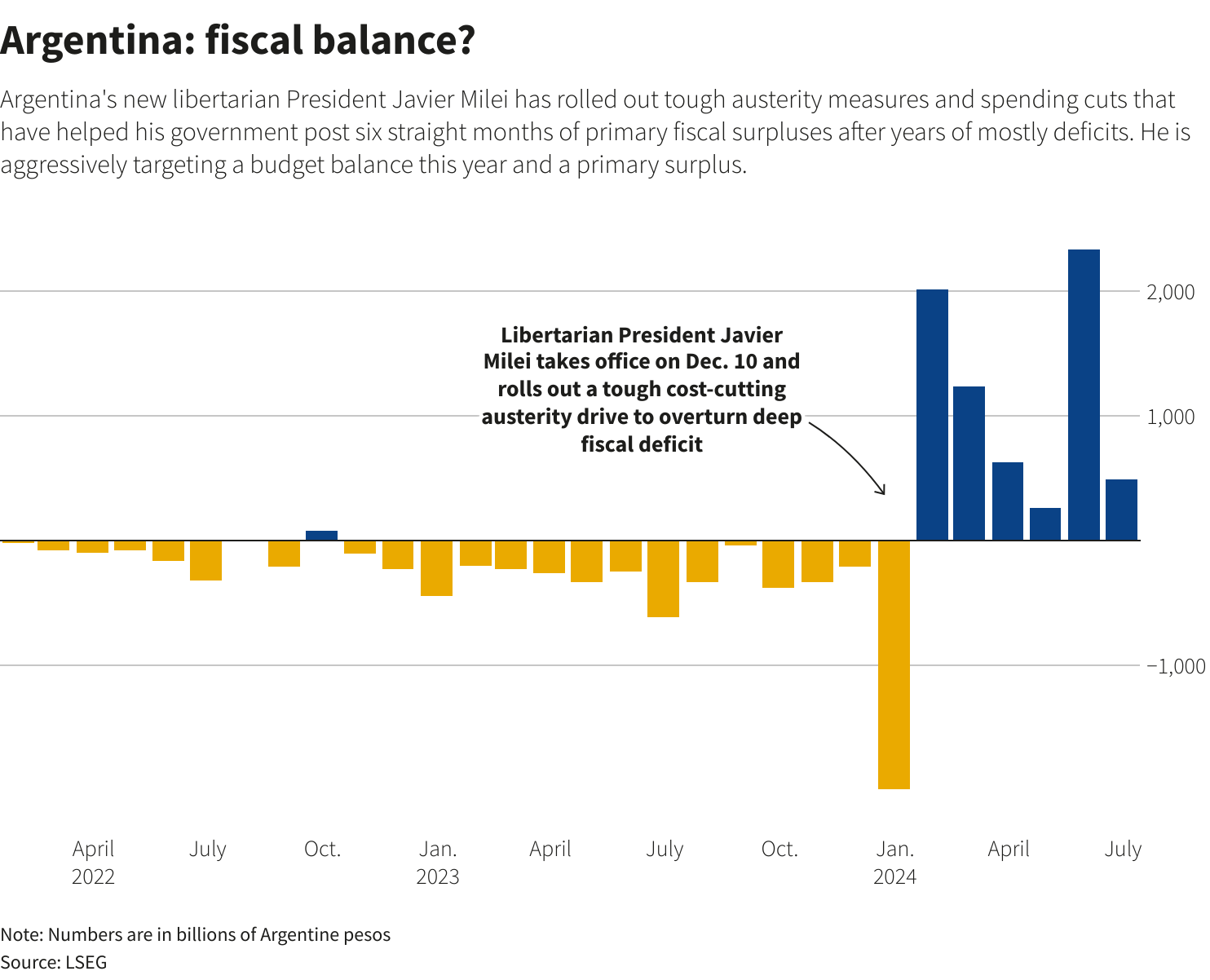
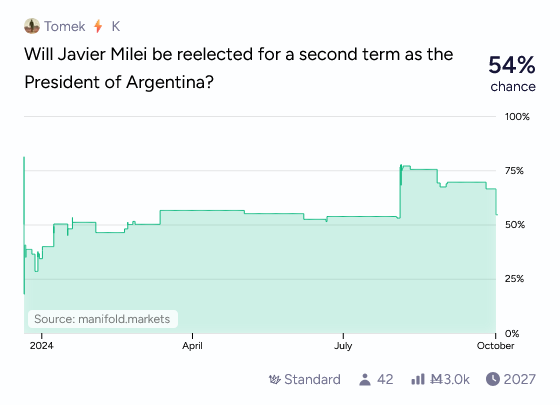
In The Free Press, Bari Weiss talks to Argentinian President Javier Milei (through a translator) about his first six months in office:

At the start of the twentieth century, Argentina was one of the wealthiest countries in the world. The capital, Buenos Aires, was known as “the Paris of South America”.

A lot can happen in a hundred years.

Argentina today is in grave crisis. It has defaulted on its sovereign debt three times since 2001, and a few months ago, it faced an annualized inflation rate of over 200 percent — one of the highest in the world.

Why? What happened?

Argentina’s new president says it’s simple: socialism.

When Javier Milei took office in December 2023, he became the world’s first libertarian head of state. During his campaign, he made his views clear: “Let it all blow up, let the economy blow up, and take this entire garbage political caste down with it”. In case the chainsaw he wielded on the campaign trail left any question about his intentions, during his victory speech last year, he reiterated his vision: “Argentina’s situation is critical. The changes our country needs are drastic. There is no room for gradualism, no room for lukewarm measures.”

There is nothing gradual about what Milei is now doing.

He’s eliminating government ministries and services, cutting regulations, privatizing state-run companies, and purposely creating a recession to curb the out-of-control inflation.

This is why people voted for him: change. They saw someone who could shake things up in a way that could turn out to be lifesaving for the country — even if it meant short-term economic pain.

But will it work? Not all Argentines think so. And not everyone is willing or able to wait for things to improve. In April, with food prices rising and poverty up 10 percent, tens of thousands of Argentines took to the streets to protest Milei’s aggressive austerity measures.

Milei is a strange and idiosyncratic creature. There are the obvious things: He says he doesn’t comb his hair (and he doesn’t appear to). He has four cloned mastiffs that he refers to as his “four-legged children“, and which he’s named for his favorite free-market economists. He was raised Catholic, but studies the Torah. (He even quoted a Midrash during our conversation.) He used to play in a Rolling Stones cover band. And he has been known since grade school in the ’80s as El Loco, on account of his animated outbursts, which would later bring him stardom as a TV, radio, and social media celebrity.

But that’s all the superficial stuff. What really makes Milei unusual is that he is the ultimate skunk at the garden party. In a world of liberals and conservatives, he doesn’t represent either side. He is ultra-liberal on economics, but right-wing and populist on rhetoric. He is anti-abortion, but favors the legalization of prostitution. He wants to deregulate the gun market and legalize the organ trade.

He calls himself an anarcho-capitalist, which basically means he believes the state, as he told me, is “a violent organization that lives from a coercive source which is taxes”. Essentially, he’s a head of state who really doesn’t believe in states. Or at least, not theoretically.

In January, Milei showed up at Davos, the Alpine mountain resort that hosts the annual World Economic Forum. This is traditionally a place where people who all think the same way go to drink champagne and tell each other how smart they are. Milei arrived, flying commercial, and blew up that comfortable consensus: “Today, I’m here to tell you that the Western world is in danger. And it is in danger because those who are supposed to have defended the values of the West are co-opted by a vision of the world that inexorably leads to socialism and thereby to poverty.”

All of this is why I was eager to talk to Milei and put some of these questions to him: How long will it take for things to improve in Argentina? Why does he believe the Western world is in danger? What’s the difference between social justice and socialism? Can the free market really solve all of our civic problems? And how does he feel about being the skunk at the garden party? (Spoiler: He loves it.)

And despite having called journalists “extortionists”, “liars”, “imbeciles”, “freeloaders”, and “donkeys”, for some reason, he agreed to sit down with me.

June 7, 2024

Since 2015, the Trudeau Liberals have done a fantastic job of suppressing the Canadian economy

If Canadians elected Justin Trudeau and the Liberal Party to make major changes from what had gone on under Stephen Harper’s Conservatives, then they got their wish in so many different ways, but especially economically:

Reports of Canada’s dismal economic outcomes seem never to end. Why should they? For years Canadians have had the same federal government delivering the same deleterious economic policies and the same expansion in regulatory initiatives and spending that have invariably depressed economies and reduced standards of living whenever and wherever they are imposed. Therefore, until the federal government or its policies change, we should not expect the miserable results to materially improve.

The latest negative report is the release of Canada’s 2024-Q1 GDP numbers on Friday, which again showed sluggish growth relative to population, resulting in yet another quarterly decline in real GDP per capita. Relative to 2015-Q3, the last full quarter before the Trudeau government took office, cumulative real GDP per capita is up only about 0.7 per cent. A recent RBC Economics analysis showed from around 1991 to 2015, cumulative real GDP per capita growth in Canada approximately tracked with the U.S., but not since Justin Trudeau took office. Compared to 0.7 per cent growth in Canada from 2015-Q3 to 2024-Q1, real GDP per capita is up 15.7 per cent in the U.S. in the same time period.

Where the 0.7 per cent comes from matters, too. In real per capita terms, some components of GDP — mainly government — expanded while others contracted. Alarmingly, business investment, which drives productivity and standards of living, is down 13.9 per cent. This includes real per capita reductions of 15.2 per cent in residential structures, 18.4 per cent in machinery and equipment, and 19.3 per cent in non-residential structures, with an increase in intellectual property investment not nearly enough to offset the reductions in other categories.

To understand why business investment and economic performance in Canada are so poor under the Trudeau government, let us consider the following representative example of its economic strategy.

The government believes many families struggle with the cost of caring for young children, which is a legitimate concern. A reasonable solution, which the Harper government implemented in 2006, is to send money to families with young children and let parents buy for their children what they need. After the Liberals expanded that program, they could have left it at that, but what have they done instead? The government initiated a national takeover of child care, effectively expropriating child care entrepreneurs’ businesses by flooding their sector with public money and then controlling private companies’ revenues and operations. The result is child care entrepreneurs’ investments have been wiped out or severely reduced, control of their business operations have been wrestled away by government, and they are unable to properly serve their customers (the families), as evidenced by the drastic reduction in parental options and widespread shortages.

June 5, 2024

“Stop viewing every inconvenience discovered in the economy as a market failure needing government intervention”

Filed under: Americas, Economics — Tags: , , , — Nicholas @ 03:00

Argentine President Javier Milei visited the Hoover Institution at Stanford and spoke about his approach to addressing Argentina’s many economic issues during his first six-months in office:

Milei recalled his years as an economist with HSBC Argentina and work advising a large pension fund. He explained how he had to remain adaptable to changing market conditions and new ideas and not make assumptions based on static economic models.

“Reality is complex, but when the model doesn’t match reality, you get rid of it,” he said. “You don’t get angry with reality.”

Milei argued that many twenty-first-century leaders see every failure of an economic model as proof of a market failure warranting government intervention.

He added that the state interventions are slowly strangling our ability to generate economic growth.

“Let us not allow the fatally conceited to destroy our lives with regulations.”

Throughout his speech of more than one hour, Milei brought up luminaries who’ve shaped his worldview, including Adam Smith, Friedrich von Hayek, Milton Friedman, Henry Hazlitt, and Murray N. Rothbard. He described how they influenced his view that everything should flow from the promotion of private enterprise and maximum possible growth, and that state intervention often only exacerbates the problem it was intended to solve.

Milei described himself as a libertarian and a minarchist who believes the role of the state is only to protect individuals and their property from aggression.

While talking about the challenges of governing and the Austrian school of economists who influenced his worldview, he suggested that it may have been his love of conflict that brought him away from work as an economist and television commentator and into the position he finds himself today.

“That’s probably why I got into politics. I love conflict.”

Milei said that his government is working to tame inflation and get public spending under control, and he applauded his economy minister, Luis Caputo, sitting in the audience.

“He’s in charge of the chainsaw operation,” Milei said, alluding to the chainsaw he brought with him to campaign rallies to symbolize his anti-spending agenda. “We are getting rid of a whole lot of things.”

“I am very happy when my economy minister gets applause. He’s making the greatest adjustment not only in the history of Argentina but in the whole history of humanity. We have already adjusted by 13 percent of GDP.”

He then turned to confront those he called “statists” and “regulators” who oppose his efforts in Argentina.

“They’re sitting in an office, and they create regulation just to justify their own existence,” he said. “This has a direct impact on innovation … They regulate just out of ignorance or just to justify the chair [they sit on], and they’re ruining our lives.”

He argued that most people in economics can’t even articulate where the state ends and the market begins.

“The market is ourselves,” he said. “When there’s talk of the market, we are the market.”

He described the market as a “social cooperation process” where “property rights are voluntarily exchanged”. He contrasted this with interaction with the state, where participants are compelled to act in a certain way.

“State intervention is always bad, because it’s based on coercion, on force, and nothing based on coercion can be good.”

June 4, 2024

QotD: “Let the market handle it”

Filed under: Economics, Government, Quotations — Tags: , — Nicholas @ 01:00

The argument is quite common. It’s also wrong. Its error is that it incorrectly identifies the set of choices for dealing with problems (and with “problems”).

Rodrik’s argument appears to be the height of reasonableness. “It is dogmatic and dangerous,” the argument’s champions rightly note, “to assume that one solution or one approach is the answer to every problem. Some problems call for the use of screwdrivers, others call for the use of hammers. Only a benighted fool insists on using a screwdriver to hammer in nails and on using a hammer to insert screws. The wise, non-ideological, enlightened, open-minded, reasonable, and scientifically aware person sometimes uses a screwdriver and other times uses a hammer. What could be more reasonable?!”

The error in this formulation is that markets are many tools. Markets are a toolkit with far more tools in it than government has access to. While government has only a few tools – mostly hammers (some sledge), saws, and clamps – the market is filled with many, almost countless, tools. And the market’s tools are much more varied, nuanced, specialized, and creative than are the government’s simple set of tools.

Put differently, to say “Let the market handle it” is just a shorthand way of saying “Let whoever is most willing, most able, most experienced, most knowledgeable, and best equipped be free to try his or her hand at dealing with each specific problem.” And to say “Let the market always handle it” is not – contrary to what Rodrik’s argument suggests – to propose a single, simple fix for all problems; it is to propose that the field be left open for as many fixes as are feasible to be tried. To say “Let the market always handle it” is to warn that using government as a fix crowds out – prevents – experimentation with many other possible fixes.

In short, the choice is not between only two alternative possible fixes: the market or the government. Instead, the choice is between a gigantically large and varied set of possible fixes (the market, with its many detailed specialized carpenters and master builders) or a tiny set featuring one possible fix (the government, with its hammering, sawing, and clamping officials, none of whom – unlike the case with market participants – can be reasonably presumed to know enough of the finer details of any of the problems that they are called upon to “fix”).

The truly reasonable person – the one who understands the benefits of having access to as many “solutions” to problems as possible – supports the market because he or she knows that to turn to government solutions is to drastically reduce the number of “solutions” that will be tried.

Don Boudreaux, “Very Bad Framing, or In Defense of ‘Let the Market Handle It'”, Café Hayek, 2016-08-12.

June 3, 2024

QotD: Economic feedback

Filed under: Economics, Government, Quotations — Tags: , , , , — Nicholas @ 01:00

Well, now I think about it, most feedback is annoying.

Economics is full of it — as are other economic systems — and humans find it so annoying they have devised various means of shutting it down, and then become puzzled and do crazy stuff when the system goes out of control.

Take price controls. They deliberately shut down feedback. The idea is “people need to eat and the essentials should be cheap”. We went tons of rounds on this in the seventies in Portugal. It was FUN — not — and responsible for empty grocery shelves and problems getting the essentials. Because when cooking oil was dirt cheap by price control, everyone who had ridden this pony before (with bread, with toilet paper, with …) would buy everything in the grocery shelves. Meanwhile, because it was impossible for merchants to make a profit on the thing, they didn’t stock it. Which was okay, because the factories that made it couldn’t afford to at that price, so they stopped. And all the way down the line.

This is because what the idiot politicians were shutting down was the feedback. Prices are many things — and sometimes annoying when you really want a good pair of noise-cancelling headphones but your bank account is crying, to use a totally random example — but MOSTLY? They’re information. They’re feedback.

Because, yes, people work for profit, and profit — things that Warren and Sanders will never get — is not dirty, it’s what people live on, when prices go up — meaning there’s more demand than supply — people go “hey, you can make a profit in this” and start making more, until the supply and demand match, and you can’t make as much money, so people wander off to do other stuff.

You shut down the signal, and things go insane. You keep it shut down long enough while handing down lists of things that the government wants you to make, and vast famines sweep the land but you have a surplus of size 35 shoes for the left foot only. Because the directive handed the factory made that the easiest thing to do.

But it is not just in economics (though eh, everything is a branch of economics, as my reading in my 30s informed me. Which means that’s probably when I started going insane) that humans love shutting down feedback.

The truth is we don’t like reality very much, and are more or less perpetually at war with it.

We have this image of how things should be, and because we imagine it so clearly we think it’s a moral imperative.

Sarah Hoyt, “Shutting Off Feedback or How We Got Into This Fine Mess”, According to Hoyt, 2019-11-04.

« Newer PostsOlder Posts »

Powered by WordPress