
Despite this being North London we’re not talking about common people here and the tragedy of their entering the precincts of the progressives. Rather, the tragedy of common resources.
One fact about those bathing ponds on the Heath:
Honesty boxes for bathers to pay to swim were introduced in 2005. There were plans for a compulsory charge in 2012, but they came to nothing.
We have open access to a resource, Marxian access. We also have one other fact:
It was once a well-kept secret. Now the bathing ponds on Hampstead Heath are among the most crowded parts of London on a hot summer’s day.
We have – by one measure at least – excessive use of that resource, use that needs to be limited in some manner.
This is a problem that has been noted before, it’s called the Tragedy of the Commons. As Garrett Hardin points out there are only two ways of restricting such access, capitalist – charge for it – or socialist – regulate.
The third option, Elinor Ostrom’s, does not work with this number of people. That communal agreement tops out at about 3,000 peeps, not 10 million.
Which of the two solutions works depends upon the specific circumstance and isn’t the point to be made here. Rather, the lesson to learn is that Marxian access just doesn’t work when demand is at or above capacity. A useful thing to think about when contemplating other areas of the economy.
Tim Worstall, “Hampstead Heath Ponds And The Tragedy Of The Commons”, Continental Telegraph, 2020-01-19.
November 14, 2024
QotD: The tragedy of the commons in North London
November 12, 2024
Canada in the news … for all the wrong reasons
In the National Post, Tristin Hopper explains why your non-Canadian friends may be finding their opinions on the dysfunctional Dominion getting more and more sour in recent years:
… within just the last few years, multiple foreign outlets have profiled Canada for the singular purpose of asking what happened to it, and worrying if Canada’s ills will soon be their own. What’s more, these articles are not limited to a single topic; so much is going sideways in Canada right now that everything from our assisted-suicide regime to our economy to our internet legislation is attracting overseas notice like never before.
Below, a cursory guide to some of them. If you’re noticing that your non-Canadian friends suddenly have a darker picture of your home country than they used to, here’s a clue as to why.
“Justin Trudeau is killing Canada’s liberal dream”
Ever since the 2019 federal election, The Economist‘s coverage of Prime Minister Justin Trudeau has usually followed a general theme of noting that the bloom is off the rose of his photogenic ascendancy to power in 2015. But in a trio of articles published last month, the publication laid into the Canadian leader as an icon of what not to do.
Justin Trudeau is killing Canada’s liberal dream, published on Oct. 14. Canada’s Trudeau trap, published on Oct. 17. And then, just for good measure, Justin Trudeau is paying for solar panels in the cold, dark Arctic.
[…]
“Canada Is Disintegrating”
The Telegraph in the U.K. ran an entire series of essays last week on the topic of Canada taking it to the limit on progressive laws covering everything from drugs to national identity.
[…]
“Canada’s Extremist Attack on Free Speech”
The June tabling of the Online Harms Act prompted a wave of foreign coverage unlike few pieces of Canadian legislation. Although virtually every non-U.S. country has legislated controls on extreme speech, the Online Harms Act went noticeably farther than its peer countries in two respects: It prescribes a life sentence for the speech crime of “advocating or promoting genocide”, and it authorizes pre-emptive custody for anyone suspected of committing hate speech in future.
November 10, 2024
WW2 in Numbers
World War Two
Published 9 Nov 2024World War II wasn’t just the deadliest conflict in history — it was a war of unprecedented scale. From staggering casualty numbers to military production and economic costs, this episode breaks down the biggest statistics that defined the global conflict.
(more…)
November 8, 2024
An alternative path to meeting Canada’s 2% of GDP defence-spending aspirations
I’m not convinced that Brian Graff is correct here, but it’s certainly a bit of unusually out-of-the-box thinking on Canada’s defence shortcomings:

Canada has sent a few tanks over to Ukraine, as well as other supplies and financial aid. We will have to replenish these things, and this might be an opportunity to expand Canada’s capacity to make and export military arms and equipment. Maybe our defense policy and spending has been wrongheaded. Since we have so few troops, are unlikely to need to defend our own soil, and are far from any country likely to be in conflict, we may be able to meet our 2% target with some innovative thinking.
Since the Second World War, the US has described itself as the “arsenal of democracy”, a phrase which Franklin Roosevelt used in 1940 when the US was supporting Britain (and Canada) by sending arms, most notably through the “Lend Lease” program that sent ships and equipment to Britain, technically on loan.
Maybe a bigger part of Canada’s own defence policy should be to make and stockpile arms, equipment, and supplies to send to our allies or friends in times of need. Such equipment need not be “state of the art” like F-35 fighter jets. Canada could also expand production of parts for equipment assembled in other NATO countries – particularly for spare parts we need for ourselves.
We need not limit this to new equipment. Canada could also promote companies that refurbish older equipment to be stockpiled or resold. And of course, Canada could determine which countries benefit from our stockpiles of military equipment. We could ensure that this equipment is not acquired by countries with regimes we oppose, and we would have the leeway to give or sell only to the “right” side of a conflict, possibly with strings attached.
Take our Leopard 2 tanks that were built in Germany. We have given some to Ukraine. We have unfortunately scrapped even older Leopard 1 tanks, that could have been refurbished or modified to serve as platforms for other uses. Canada should probably give the rest of our tanks to Ukraine, then get into the business of buying older Abrams tanks from the US to refurbish as replacements or for re-export.
Israel is a good example of a nation that builds up its military capacity with secondhand tanks and other equipment, and is now a major exporter of military equipment that it developed at least in part for its own defence.
The trend in US equipment has been to build state of the art equipment, and buy smaller quantities of it. But the conflict in Ukraine has shown that even when fighting a country with advanced military technology like Russia, using some older equipment combined with innovative new designs has been successful for both sides. Along with the introduction of drones, the Russians have modified older bombs to become guided bombs that are accurate and far cheaper than building new missiles.
November 6, 2024
Running out of minerals means we’re all going to dieeeeeeeeee!!
Tim Worstall responds to another pants-wetting panic attack that we’re running out of atoms and that means we’re all going to die unless we do this thing I wanted you to do anyway:

“Artisanal cobalt miners in the Democratic Republic of Congo” by The International Institute for Environment and Development is licensed under CC BY 2.5 
 .
.
There’s a guy working up in Finland who keeps trying to tell us that we’re all about to run out of lovely metals. Therefore — as with the Club of Rome beforehand, Blueprint for Survival and all those guys — we’re all gonna die.
Aiee, eh?
Now it is possible to work through all his assumptions and nip at them in detail. For example, he assumes we need about 20 million tonnes of lithium in order to replace the global internal combustion engine fleet with battery powered. Not a bad assumption. The Tesla Master Plan 3 comes to the same answer. But if we want to have weeks and weeks of battery power for the whole of society we’re going to need much more than that. Which is a problem, mineral resources are only around 90 million tonnes, so, we’re stuffed.
And, well. Here’s the problem. We’re all — including Michaux — using United States Geological Survey Numbers. In 2023 lithium:
Owing to continuing exploration, identified lithium resources have increased substantially worldwide and total about 98 million tons.
Owing to continuing exploration, measured and indicated lithium resources have increased substantially worldwide and total about 105 million tons.
Wait, what? We can get more mineral resources if we go looking for them? Well, if that’s true then the size of mineral resources cannot be the limitation on how much is out there, right?
This then brings us to the basic mistake that has been made here. We’ve been through this here a number of times.
Figures 28 & 29 shows the needed quantity of metal to phase out fossil fuels (assuming all four power storage buffer capacities) is compared against the total metal content in the whole planetary environment, including the deep ocean polymetallic nodules under sea resources (Hein et al. 2020). So, Figure 28 shows reported mineral reserves plus estimated mineral resources on land plus estimated undersea mineral resources. This is the summation of mineral reserves, resources, on land and under the sea, in the planetary environment. Even with this extreme summation of conventional and unconventional sources, there was not enough copper, nickel, lithium, cobalt, or vanadium to manufacture even just the first generation of renewable technology to replace the existing fossil fuel industrial system.
That’s on page 240 and yes, I had to read (OK, speed read/skim) to get to his simple statement of his mistake. You owe me guys, 239 pages worth.
He’s right that mineral resources can be converted into mineral reserves by the application of time and effort — capital, really. But he thinks that mineral resources are the definition of the mineral deposits that exist. Which just ain’t true — mineral resources are mineral deposits that people have applied time and effort — capital really — to defining. That’s how mineral resources, as defined by our common source at USGS, can increase year on year.
November 2, 2024
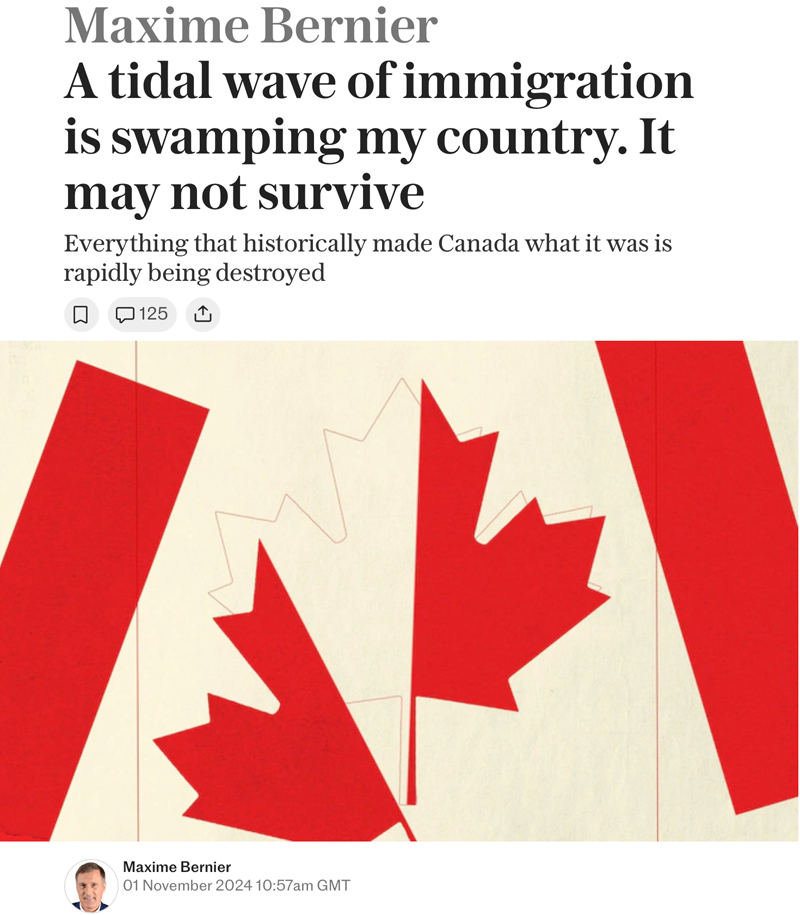
Maxime Bernier on Canada’s immigration crisis
This article has been posted at the Telegraph in the UK and mailed out by the PPC here in Canada, so I guess it’s okay to share it here:
Newsflash: Canada is in the process of falling apart.
No, it’s not because Quebec is once again threatening to hold a referendum on separation, although this may happen again in the coming years.
Our country is experiencing a series of crises because of the deliberate policy of mass immigration instigated by Justin Trudeau’s Liberal government soon after its election in 2015.
Last year, Canada’s population increased by almost 1.3 million people, or 3.2 per cent. This was the fastest annual population growth rate since the post-war years. The difference however is that this was not caused by a baby boom, since 97 per cent of the growth was due to international migration, mostly from Asia and Africa.
This includes not only immigrants per se – or “permanent residents” – but also so-called temporary foreign workers, foreign students, and asylum seekers. Although supposed to be temporary, the last categories have in fact become pathways to seek permanent residency.
Because of this, housing in Canada has now become completely unaffordable. Young couples who want to have children just cannot afford to buy a home with a nice backyard where they can raise them any more, with the result that our birth rate has dropped dramatically.
Our hospitals, social services, and infrastructures are being overburdened by this massive demographic tsunami.
Immigration is often justified by its supposed positive impact on the economy. But productivity and wages have been stagnant for a decade in Canada, as cheap immigrant labour is favoured by employers over capital investment and automation.
Canadian politics has been mired for months in scandals over foreign interference, in particular China and India. India has been the largest source of immigrants to Canada for several years. Last week, Canada and India expelled diplomats over allegations by the Trudeau government that Indian diplomats have been involved in attacks against Khalistani militants in our country, including the murder last year of one that India considers a terrorist.
Because of mass immigration, Canadian politics is more and more focused not on actual Canadian issues, but on ethnic, religious, and foreign issues and wars, with establishment politicians spending an extraordinary amount of time courting the votes of minority ethnic groups in suburban marginal ridings.
The third most important national party, the New Democratic Party that has kept the Trudeau minority government in power, is headed by Jagmeet Singh. A Sikh by background, he initially declined to condemn Talwinder Singh Parmar, the mastermind responsible for the 1985 bombing of an Air India plane in which hundreds of Canadians were killed. However Singh did change his stance when a Canadian inquiry concluded that Parmar was definitely behind the outrage.
For his part, the leader of the Conservative Party and very likely our next prime minister, Pierre Poilievre, is known for donning national or religious dress as he panders to members of various communities.
In 2018, as a then Conservative Member of Parliament, I posted a series of tweets that denounced what I called Trudeau’s “cult of diversity” which, I contended, would lead to the Balkanisation of Canadian society, and potentially to violence.
Almost daily scenes of Muslims attacking Jewish institutions, Sikhs burning the Indian flag, and Ethiopian factions fighting each other in the streets of our cities, have proven me right.
Publicly attacking these woke dogmas wasn’t allowed at the time in Canada though, and it provoked a huge outcry. Even my leader and colleagues in the Conservative Party denounced me, which led me to resign and launch a populist right-wing party which is broadly the Canadian equivalent of Nigel Farage’s Reform Party.
If you believe that more diversity is always good and always enriches your society, then it’s logical and inevitable that you will end up importing lots of people with incompatible values and attitudes from around the world, including religious fanatics and even terrorists, who can’t possibly integrate in a country with a European, secular Christian heritage.
That’s what we’ve been doing for years, and that’s why everything that historically made Canada what it was is rapidly being destroyed. I know there has been a similar trend in the UK and other European countries, but Canada went way further down this road.
Canada’s demise started when what was already a very diverse country (with Indigenous, French and British founding peoples, and many different regional cultures) fell for this radical version of multiculturalism instead of tempering it with a focus on shared values and attitudes, pride in our history, and in the achievements of Western civilisation.
Now, not only are our democratic institutions, our economy, and our social peace and cohesion, falling apart, but so are our very identity and reason to exist as a country.
All these trends are so overwhelming that, unable to deny the reality any more, the Trudeau government finally announced last week that they would be gradually lowering their immigration targets in the coming years instead of continuing to increase them.
Although this is a massive U-turn for this government, it is far from being a sufficient reduction, and a lot more will need to be done to repair the damage. Otherwise, I don’t believe Canada will survive the 21st century.
QotD: UBI discourages low-income workers
Earlier this month, a cross-border team of North American economists published the results of a landmark study, probably the best and most careful yet done, of how low-income workers respond to an unconditional guaranteed income. Not so long ago this would have been a plus-sized news item in narcissistic Canada, for the lead author of the study is a rising economics star at the University of Toronto, Eva Vivalt. The economists, working through non-profit groups, recruited 3,000 people below a certain income cutoff in the suburbs of Dallas and Chicago. A thousand of these, chosen at random, were given a thousand dollars a month for three years. The rest were assigned to a control group that got just $50 a month, plus small extra amounts to encourage them to stay with the study and fill in questionnaires.
That randomization is an important source of credibility, and the study has several other impressive methodological bona fides. If you have an envelope to scribble on the back of, you can see that the payments alone were beyond the wildest dreams of most social science: most of the money was provided by the AI billionaire Sam Altman. But the study also had help from state governments, who agreed to forgo welfare clawbacks from the participants to make sure the observed effects weren’t obscured by local circumstances. Participant households were also screened carefully to make sure nobody in them was already receiving disability insurance. (Free money doesn’t discourage work among people who can’t work — or who absolutely won’t.) And the study combined questionnaire data with both smartphone tracking and state administrative records, yielding an unusually strong ability to answer difficult behavioural questions.
The big picture shows that the free cash — a “universal basic income” (UBI) for a small group of individuals — discouraged paying work, even though everybody in the study was starting out poor. Labour market participation among the recipients fell by two percentage points, even though the study period was limited to three years, and the earned incomes of those getting the cheques declined by $1,500 a year on average. There is no indication that the cash recipients used their augmented bargaining power to find better jobs, and no indication of “significant effects on investments in human capital”, i.e., training and education. The largest change in time use in the experiment group was — wait for it! — “time spent on leisure”.
Colby Cosh, “Universal basic income is a recipe for fiscal suicide (for so many reasons)”, National Post, 2024-07-30.
November 1, 2024
“[H]er plan will mean the obliteration of your savings, the end of banks and even the destruction of ‘money as we know it'”
It’s astonishing how many highly placed bureaucrats, NGO functionaries, and the very, very wealthy are super gung-ho for reducing the rest of us to the status (and living conditions) of medieval serfs:

This week, VW announced plans to cut tens of thousands of jobs and to close three factories. That is a very big deal, because they have never closed a single German factory before. I try to avoid economic topics, but this story is so much bigger than economics. As Daniel Gräber wrote in Cicero last month, “the VW crisis has become a symbol for the decline of our entire country“.
The Green leftoid establishment are eagerly blaming management for these failures, which is on the one hand not entirely wrong, but on the other hand not nearly an absolution. The German state of Lower Saxony holds a 20% stake in Volkswagen, and so they also manage the company. Recently, in a fit of virtue, they placed a Green politician – Julia Willie Hamburg – on its supervisory board. Hamburg does not even own a car and has used her position to argue that Volkswagen should regard itself not as an automobile manufacturer but as a “mobility services provider” and shift its focus away from “individual transport”.
The absurdly named Julia Willie Hamburg is merely symptomatic of a broader phenomenon. Germany has succumbed to political forces that have nothing but indifference and disdain for the industries that have made us prosperous. Our sitting Economics Minister, Robert Habeck, gave an interview to taz in 2011 in which he said that “fewer cars will not lead to less economic growth, but to new industries”, and attacked “the old growth theory, based on gross domestic product“. And behind Green politicians like Habeck are even more radical forces, like Ulrike Herrmann, the editor of taz, for many years a member of the Green Party and also an open advocate of wide-scale deindustrialisation. Because I am going to quote Herrmann saying some very crazy things, you need to know that she is in no way a fringe figure. She appears regularly on all the respectable evening talkshows and every politically informed person in the Federal Republic knows who she is.
Herrmann has outlined her political views in various books like The End of Capitalism: Why Growth and Climate Protection Are Not Compatible – and How We Will Live in the Future. From these monographs, we learn that Herrmann sees climatism as a means of imposing a centrally planned economy in which we will own nothing and be happy. Happily, Herrmann also talks a lot, and in her various speeches and interviews she states her vision for decarbonising Germany in very radical terms. I am grateful to this twitter user for highlighting typical remarks that Herrmann delivered in April of this year before a sympathetic audience of climate lunatics.
There, Herrmann elaborated on her vision for a future economy in which all major goods would have to be rationed:
Talking about rationing: It’s clear that if we shrink economically, we won’t have to be as poor as the British were in 1939; rather, we’d have to be as rich as the West Germans were in 1978. That is a huge difference, because we can take advantage of all the growth of the post-war period and the entire economic miracle.
The central elements of the economy would have to be rationed. First of all, living space, because cement emits endless amounts of CO2. Actually, new construction would have to be banned outright and living space rationed to 50 square metres per capita. That should actually be enough for everyone. Then meat would have to be rationed, because meat production emits enormous amounts of CO2. You don’t have to become a vegetarian, but you’ll have to eat a lot less meat.
Then train travel has to be rationed. So this idea, which many people also have – “so okay then I don’t have a car but then I always travel on the Intercity Express trains” – that won’t work either, because of course air resistance increases with speed. Yes, it’s all totally insane. Trains won’t be allowed to travel faster than 100 kilometres per hour, but you can still travel around locally quite a lot. This is all in my book, okay? But I didn’t expand on it there because I didn’t want to scare all the readers.
At this point Herrmann begins to cackle manically, ecstatic at the thought that millions of Germans will be stuck riding rationed kilometres on slow local public transit.

October 31, 2024
Riley Donovan – “October 24th was a tragic day …”
Riley Donovan enumerates some of the most notable losers from the federal government’s belated realization that cutting immigration numbers was politically necessary:
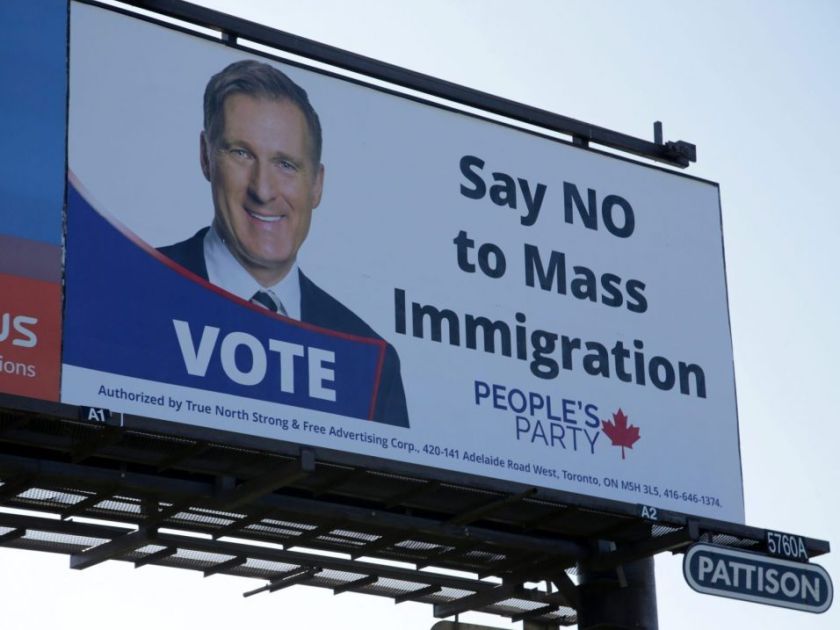
A billboard in Toronto in 2019, showing Maxime Bernier and an official-looking PPC message. The PPC has been the only federal party against mass immigration from its founding.
Photo from The Province
October 24th was a tragic day for real estate developers, speculators, cheap labour employers, business lobbyists, slumlords, corrupt immigration consultants, and strip mall diploma mill operators. On that day, Prime Minister Justin Trudeau reluctantly caved to public opinion and announced that the Liberal government will slash permanent resident levels by 21%.
Less than one week before the October 24th announcement, an Abacus poll revealed that support for immigration restriction has reached 72% – a statistical supermajority. This includes a majority of all four major political parties and every age group. A month before the announcement, a Leger poll found that majorities of both white and non-white Canadians want lower immigration.
It is now impossible to find even one demographic subset of Canadians that registers majority support for high immigration – except perhaps if you exclusively surveyed CEOs, bank presidents, or woke university professors (politics makes for strange bedfellows).
There is no prominent, well-funded immigration restriction lobby in this country – in fact, there is a prominent, well-funded pro-immigration lobby. Columnists – with the exception of yours truly – almost never wrote the word “immigration” before the summer of 2023. The Canadian public was not goaded by public figures into opposing mass immigration by a margin of three to one; this trend was entirely grassroots.
The shift in public attitudes was the result of countless private conversations in which regular people shared worries about job lines full of international students that stretched around the block, Canadian youth outcompeted by foreign workers for positions at Tim Horton’s, seniors living in RVs because of sky-high rent, and hospitals overcrowded by an annual inflow of 1.3 million newcomers.
October 29, 2024
The slavery reparations grift – “it’s not possible for us to compensate a man for having made him better off”
The demands for reparations from Britain over the slave trade are not based on the actual history as much as emotion and selective blindness to the facts:
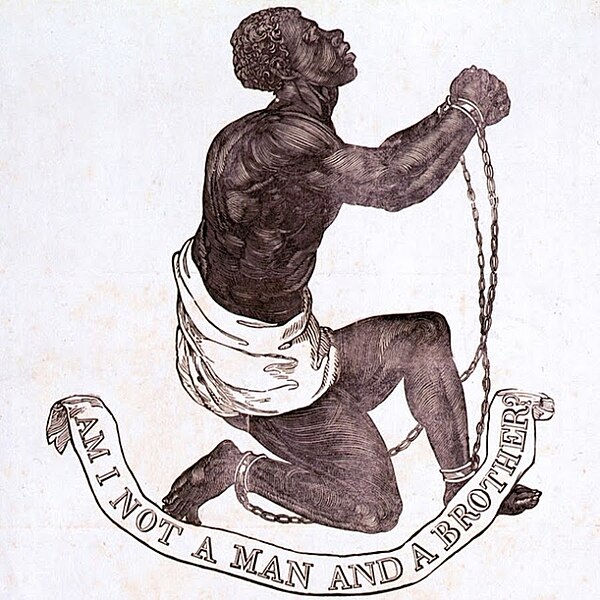
The Official Medallion of the British Anti-Slavery Society, by Josiah Wedgwood 1795.
British Abolition Movement via Wikimedia Commons.
No, no, stop squealing. Yes, slavery was appalling, vile, we’re all damn glad we don’t do it any more. But slave labour was not free.
We could — possibly should — look at the difference between that subsistence level that the slaves got and what free labour — not free as in at no cost, free as in free to choose — got at the same time. The answer being not much difference in fact. If we’re to believe Jason Hickel (which, of course, we shouldn’t) free labour in England got below subsistence incomes. To be Marxist, what was the expropriation from those slaves, from the value of their labour? And, well, not a hugely different amount from that of free labour at the time.
While imperial Britain soared to sustainable economic development and global military superpower status, the enslaved and their descendants were left to this day with enduring pain, persistent poverty and systemic suffering.
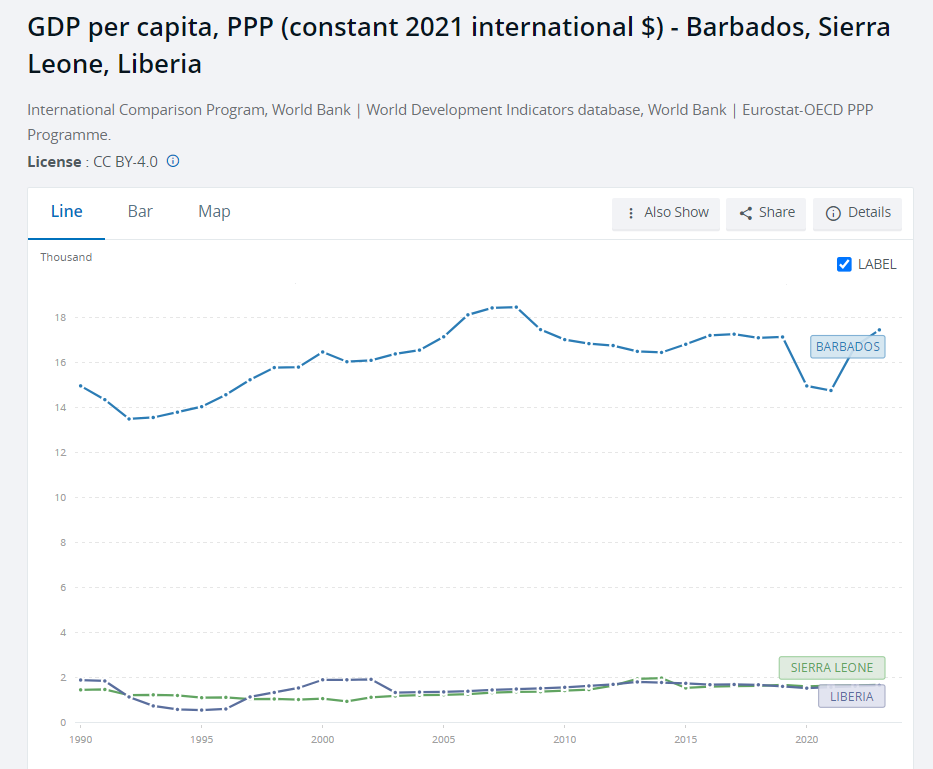
This is, as the cool kids say, problematic. Beckles is from Barbados. So, let us use Barbados numbers. And compare them to Sierra Leone and Liberia. The places that slaves not transported across to their servitude were freed into.
So, Hils, Matey, what is this poverty and pain you’re condemned to?
An obvious point — it’s not possible for us to compensate a man for having made him better off.
But we need to go further too. Britain did not benefit from this labour anyway. We did not then have a state controlled economy, we do not now have a state controlled economy. Britain didn’t own the slaves so it’s not Britain that — even if you can prove that there should be reparations — which should pay for owning the slaves it didn’t.
This does then rather leave the reparations argument being that Barbados — or whoever — needs to go around suing, individually, the estates of those who owned slaves. Good luck with that one.
The so-called Slavery Abolition Act, the most racist legislation ever passed in the British parliament,
Aha, have you ever in your puff seen such a perfect perisher of an argument? That abolition of slavery itself was the most racist legislation ever?
Aha, aha, aha. Becks must have practised that one in the mirror a lot for no audience would be able to hear that without screaming in laughter.
compensation of £20m in cash paid as reparations to the enslavers. The enslaved were valued at £47m, and the remaining amount was paid off with labour in kind for four extra years of enslavement after they were freed. They received no compensation for the theft of their labour or the denial of their human identity.
A £20 million bribe and cheap at twice the price. For that’s what it was. A bribe. One we’re still paying off today — no, Osborne did not pay it off, he issued more gilts to pay off the old ones — and I’m wholly happy to be paying my mite of that amount. Absolute damn bargain, freeing 700k people from slavery for such a trivial sum. As to the slaves, well, they gained their freedom. Which is of value. Actually, that’s rather the point, freedom has value, no?
October 26, 2024
Our solar energy future – “In September alone, Germany paid 2.6 billion Euro to renewables producers for electricity that had a market value of a mere 145 million Euro”
Checking in with what’s been happening in Germany, eugyppius explains why solar power is far from the cost-free energy source that politicians and scam artists try to claim:
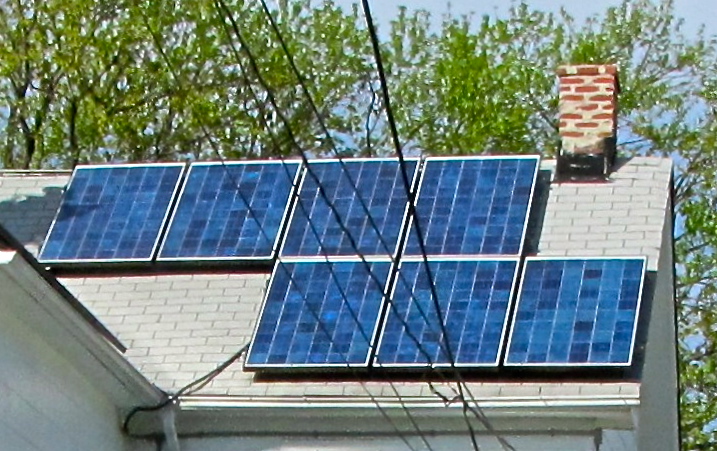
Photovoltaic panels on a roof, 28 April, 2015.
Photo by Antonio Chaves, via Wikimedia Commons.
Climatism in Germany is attended by all manner of naive ideas and bright pink fairytale slogans. Among the latter is a dubious proverb proclaiming that “The sun doesn’t send any bills” (in German: “Die Sonne schickt keine Rechnung“). Such proverbs always seem initially plausible (is there anything freer and more democratic than sunshine?) while proving to be basically the opposite of the truth. In fact, the energy transition has landed German taxpayers in the position of paying billions of Euros for the sun to shine. It is becoming an unmitigated disaster, and what is worse, the more we expand solar capacity, the more we will have to pay. For something that does not send any bills, sunshine has sure become very expensive here in the Federal Republic.
Welt calls it “the solar trap,” and it works like this: Our Renewable Energy Sources Act (EEG) pledges to pay renewables producers fixed tariffs for every kilowatt hour of electricity their installations feed into the grid. Whether you are an ordinary climate-conscious person with solar panels on your house or you run massive solar farms, the EEG entitles you to receive these fixed “feed-in tariffs” for a period of twenty years. The EEG also requires grid operators to accept your electricity regardless of demand and to sell it on the electricity exchange.
Now the sun, although it may not charge for its services, turns out to have this naughty habit of shining in many places all at once. When this happens, electricity supply often exceeds electricity demand and exchange prices fall. They can fall all the way to zero, or in extreme situations of excessive sunshine they can even go negative. Negative prices mean that you have to actually pay “buyers” to take the excess power off your hands. Whether the prices are merely very low, or zero, or negative, the German taxpayer has obligated himself, via the EEG, to pay these producers of unwanted if extremely green and climate-friendly electricity their fixed feed-in tariffs anyway. That is, we are on the hook for the difference between the actual exchange value of excess electricity and the feed-in tariffs promised to producers. In this way we have ended up literally paying for the sun to shine.
In September alone, Germany paid 2.6 billion Euro to renewables producers for electricity that had a market value of a mere 145 million Euro. Our sunny autumn is destroying our already-fragile government budget. Federal number-crunchers had originally allocated 10.6 billion Euros for feed-in tariffs in 2024, but already the government owes 15 billion and the year is not yet over. Scholz’s cabinet are thus trying to allocate an additional 8.8 billion Euro for the rest of the year. The parliament have yet to approve the additional funds, though, and also the damned sun will just not stop fucking shining, and so probably even this supplementary allocation won’t be enough. We’re bleeding money, all for a sun that doesn’t send any bills.
This problem will get worse before it gets better. The more solar panels we install, the greater oversupply we’ll face when the sun shines, and the larger the spread between the fixed feed-in tariffs and the actual market value of this green electricity. In 2024, as I said, the government projected that feed-in tariffs would cost 10.6 billion Euros, but they’ll probably end up costing 20 billion at least. Next year, the costs are projected to be even higher, and the year after that, they will be higher still. As Welt report, the German government plans to triple our solar capacity to 215 gigawatts over the next six years – “the equivalent of 215 nuclear power plants” every time the sun emerges from behind a blessed cloud.
The energy transitioners know they messed up. The new plan is to change the rules for solar subsidies. When prices go negative, larger producers won’t receive their fixed tariffs, and they’ll also have to sell their electricity themselves. In this way, they will become newly sensitive to market demand and stop overproducing electricity when nobody wants it. It is almost like creating a blind system totally oblivious to market incentives was a bad idea. Unfortunately, the new rules will apply only to new solar installations. The German government will still have to honour its insane agreement to pay the operators of older solar plants for years to come. We will light billions on fire for nothing.
October 13, 2024
Occupation of Germany, Plunder and Enslavement?
World War Two
Published 12 Oct 2024The Allies’ occupation of Germany was marked by competing visions for its future, ranging from France’s focus on security to the Soviet push for reparations. This episode dives into the complex negotiations that determined Germany’s borders, industrial disarmament, and economic management, all of which would shape Europe’s post-war order and fuel the East-West divide.
(more…)
October 12, 2024
Canadians don’t hate their banks enough
In the latest SHuSH newsletter, Ken Whyte follows up on an earlier item thanks to the many Canadians who responded with their own tales of woe in their dealings with Canadian banks:
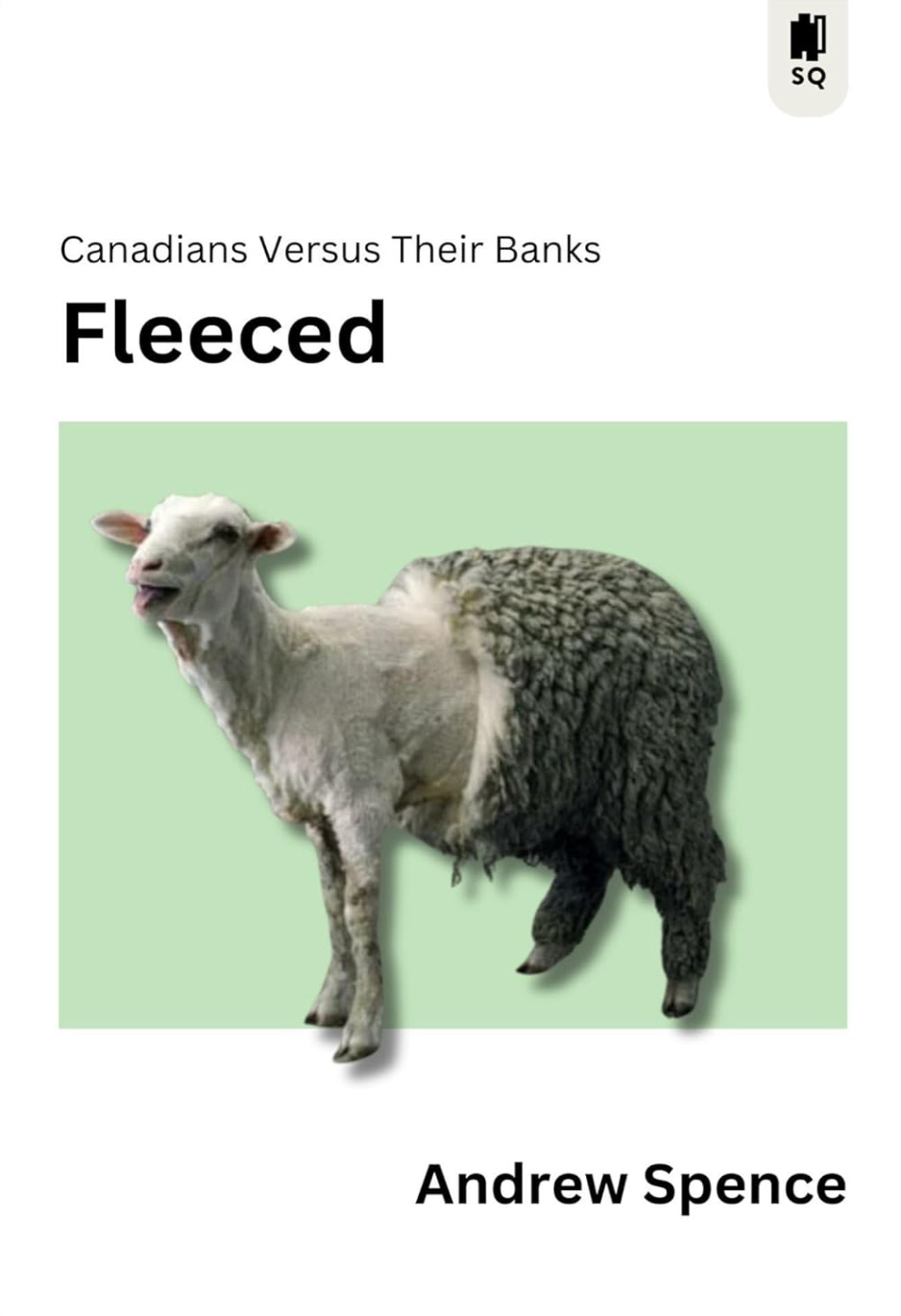
Since I mentioned a couple of weeks ago that we have published Andrew Spence’s Fleeced: Canadians Versus Their Banks, the latest edition of Sutherland Quarterly, I’ve been inundated with people’s horror stories of their dealings with Canada’s chartered banks. Jack David’s tale in the above interview is a classic of the genre.
In Fleeced, Andrew lays out in aggravating detail how Canadian banks, although chartered by the federal government to facilitate economic activity in the broader economy, do all they can to avoid lending to small and medium businesses, never mind that small and medium businesses employ two-thirds of our private-sector labour force and account for half of Canada’s gross domestic product.
By OECD standards, small businesses in Canada are starved of bank credit, and when they are able to secure a loan, they pay through the nose. The spread between interest rates on loans to small businesses and large businesses in Canada is a whopping 2.48 percent, compared to .42 percent in the US — more than five times higher.
Why? Because Canada’s banks are a tight little oligopoly, impervious to meaningful competition. Their cozy situation allows them to be exceedingly greedy. Their profits and returns to shareholders are wildly beyond those of banks in the US and UK (and, as Andrew demonstrates, their returns from their Canadian operations are far in excess of those from the US market, meaning they screw the home market hardest.)
Our banks never miss an opportunity to impose a new fee, or off-load risk. From their perspective, small business involves too much risk — some of them will inevitably fail. The banks prefer that publishers and dry-cleaners and restaurateurs either finance themselves by pledging their homes, or use their credit cards to cover fluctuations in cash flow or make investments that will help them hire, expand, and grow. And that’s what entrepreneurs do. According to a survey by the Canadian Federation of Independent Business, only one in five respondents accessed a bank loan or line of credit. Half of respondents financed themselves, tapped existing equity and personal lines of credit, and about 30 percent used their high-interest credit cards.
By severely rationing credit and making it exceedingly expensive, Canada’s banks siphon off an ungodly share of entrepreneurial profit to themselves while leaving the entrepreneur with all the risk. Their insistence on putting their own profits above service to the Canadian economy is one of the main reasons Canada has such a slow-growing, unproductive economy and a stagnant standard of living.
There is much else in this slim volume to make your blood boil: exorbitant fees on chequing and savings accounts; mutual fund expenses that torpedo investments; ridiculous mortgage restrictions, infuriating customer service …
Fleeced: Canadians Versus Their Banks is a stunning exposé of the inner workings of our six major banks — something only a reformed banker and financial services veteran such as Andrew could write. He also explodes the myth that a bloated, uncompetitive banking sector is the price we have to pay for stability in times of financial crisis.
We are in desperate need of banking reform in Canada. Read this book and you’ll be shouting at your member of Parliament for prompt action.
October 10, 2024
Trump’s tariff proposals will rival Smoot-Hawley for self-inflicted economic woes
J.D. Tuccille explains why Trump’s economic plans are very much a curate’s egg of good and bad ideas, but the proposed tariff plans would more than compensate for any good positive effects from the rest of his proposals:
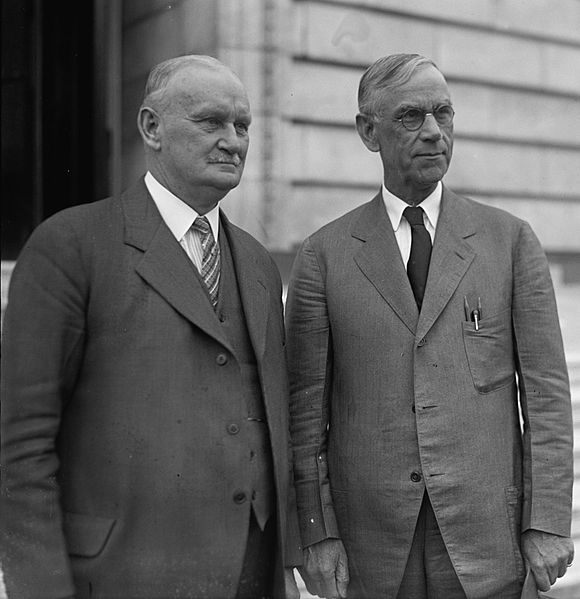
Willis C. Hawley (left) and Reed Smoot in April 1929, shortly before the Smoot–Hawley Tariff Act passed the House of Representatives.
Library of Congress photo via Wikipedia Commons.
Former president and current Republican presidential candidate Donald Trump wants to extend the tax cuts passed when he was in the White House, which are due to expire next year. That would not just be welcomed by the many Americans who would benefit, it could boost economic activity. But there’s a big problem: The protectionist tariffs favored by Trump would undo the good done by his tax cuts, reducing rather than increasing prosperity.
Tariffs Not Seen Since the Great Depression
“Former President Donald Trump’s proposals to impose a universal tariff of 20 percent and an additional tariff on Chinese imports of at least 60 percent would spike the average tariff rate on all imports to highs not seen since the Great Depression,” warns Erica York of the Tax Foundation.
Trump has actually been a little vague on the size of his universal tariff, first floating it at 10 percent while allowing “it may be more than that”, and then upping the ante to 20 percent. Either way, it’s a cost that ends up being largely paid by Americans in terms of higher retail prices and more expensive imported parts and materials for domestic manufacturing.
The Trump administration’s 2018 “tariffs resulted in higher prices for a wide variety of goods that U.S. consumers and businesses purchase,” the Tax Foundation’s Alex Durante and Alex Muresianu concluded.
Even when tariffs don’t directly affect the cost of imported goods purchased by consumers, they still drive up the prices of many things made in the U.S. The Cato Institute’s Pierre Lemieux points out that “a tariff on an input (say, steel) is paid by the American importer who will typically pass it down the supply chain to his customers and eventually to the consumers of the final good (say, a car)”. Instead of boosting domestic production, that can do harm, instead.
“For manufacturing employment, a small boost from the import protection effect of tariffs is more than offset by larger drags from the effects of rising input costs and retaliatory tariffs,” Federal Reserve Board economists found when they researched the 2018 tariffs.
That’s not to say Trump is alone in his protectionism. Last month, Bob Davis noted for Foreign Policy that “the Biden administration is the first since at least President John F. Kennedy’s time to fail to negotiate a major free trade deal, instead embracing tariffs” while Trump pursued both tariffs and trade deals.
The Road to Serfdom by F.A. Hayek
David Warren recommends one of the first economics books I ever read and I fully concur with his appreciation of Friedrich Hayek’s most famous work:

For those who have an interest in politics, who also wish to have some knowledge of this subject, I can recommend a book published in 1944. It is by Friedrich Hayek, and is dedicated “To the socialists of all parties”. The title is, The Road to Serfdom.
It is extraordinarily well-written, for an academic whose native language wasn’t English, in less than two hundred exhilarating pages. The book predicts, correctly, that while they will lose the War, German ideological notions that began to prevail before the War in e.g. Germany, Russia, Italy, and throughout the West, would continue to do so, in Britain and America. They were plausible and were thought to have been proved in wartime. In the coming peacetime, all the intellectuals would be on board.
Yet they were wrong, and had always been wrong. The professor, Hayek, shows why neither a little nor a lot of socialism will ever work; why it invariably makes everyone poorer, except for an ideological elite; and why it traps whole societies in the condition of serfdom. Oddly enough, almost no one wants to be a serf, but some wish to have power over serfs. Hence the popularity of socialism among the power-hungry.
Too, ambiguous and poorly understood political terms fool people. (My father explained this as the Triple-B principle: “Bullshit Baffles Brains”.)
The idle reader should still be captivated by this book, which hasn’t dated, even slightly. Re-reading it, as I have been doing since high school, I find the arguments irresistible and compelling. Other members of the “Austrian School” out of which Hayek sprang (it was originally a Catholic movement, incidentally) are also informative, but none are so articulate.
The “Chicago School”, of Milton Friedman et alia, was the nearest American equivalent. But that was based on numbers, more than upon the ironical ideas, which old Austro-Hungaria had the leisure to mull.


