Quotulatiousness

March 15, 2015

Toronto’s streetcars

Filed under: Cancon, Railways — Tags: , , — Nicholas @ 03:00

In a post somewhat misleadingly titled “Narrow-gauge railways”, David Warren comments on Toronto’s still-extant streetcars:

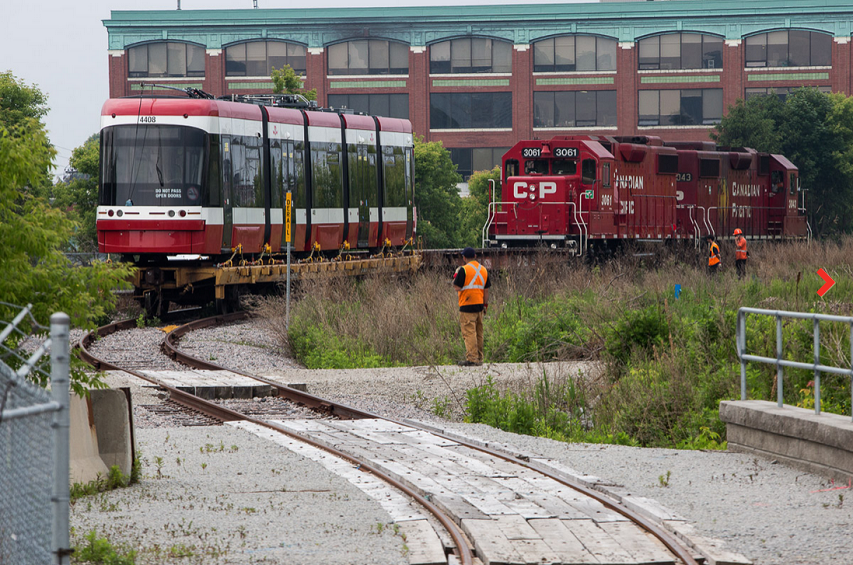
We have trolleys still, in Toronto. For decades the bureaucrats have been trying to get rid of them, and replace them with “environmental” buses, but praise the Lord, He has always put something in their way. I mentioned gauge earlier, and I wanted to explain what makes the city so special. It is the unique gauge of our trolley tracks: four feet, ten and seven-eighths. Our new, articulated, “environmental” streetcars — high-tech and incredibly expensive, compared even to the last round of million-dollar cars — had to be specially adapted to this gauge. It was selected in the nineteenth century by the city fathers, and for good reason: so that no other train in Canada, or on the planet for that matter, could ride on our rails. They were prissy, these fine old Orangemen: they didn’t want freight trains shunting downtown, the way they then did in Hamilton and elsewhere, with their steam and coal-dust billowing everywhere. They wanted electric, “environmental” streetcars. The Greater Parkdale Area has been under the tyranny of the do-goods for a long time.

Actually, if I remember correctly, the streetcar gauge was adopted more to keep out the radial railway companies than to prevent freight from intruding into Toronto’s urban streets.

Neil Young – Harvest Moon (unplugged)

Filed under: Cancon, Media — Tags: — Nicholas @ 02:00

Uploaded on 13 Oct 2010

Neil Young and friends on MTV Unplugged playing Harvest Moon.

March 12, 2015

Clickbait … about the Avro Arrow

Filed under: Cancon, Military, Technology — Tags: , , , — Nicholas @ 03:00

I’ve called it the only truly Canadian conspiracy theory … I’ve also described it as “artisanal Canadian myth-making, hand-woven, fair-trade, and 100% organic” … it’s the revenge of the return of the son of the Avro Arrow cancellation! At Aviation Week, Bill Sweetman looks back on the technical achievements and eventual disappointment that was the Avro Arrow project:

1957- Avro CF-105 Arrow1-1The cancellation of the Avro Canada CF-105 interceptor in February 1959 was a traumatic event for Canada’s emerging aerospace industry. When Aviation Week reported on the fighter’s rollout, in October 1957, the magazine called it “a serious contender for the top military aircraft of the next several years”. High praise indeed, for a non-U.S. aircraft, given that the XB-58 supersonic bomber was in flight test and that new aircraft in the works included the A-5 Vigilante and the F-4 Phantom.

But the Arrow was extraordinary, and more so, given that the industry that produced it was less than a decade old when the prototype contract was issued in March 1955. Avro Canada had been formed by Britain’s Hawker Siddeley Group after World War 2 and had quickly produced the CF-100 interceptor, the C-102 jet airliner (the world’s second to fly), and the CF-100’s Orenda engine, which was also fitted to Canadian-built Sabre fighters.

[…]

The performance requirements meant that almost everything on the airplane had to be invented. No existing engine would do the job, so Avro spun off a new Orenda Engines subsidiary to produce the Iroquois, the most powerful supersonic engine of the 1950s. The airframe took Canada into the world of integrally machined skins, and both airframe and engine used titanium. The CF-105 was the first aircraft to use 4,000 psi hydraulics. Canada enlisted Hughes for help with the radar and missiles, but the radar was new and the missile was the active-homing Sparrow II. Management was a huge challenge, both because the aircraft was complex (the second-biggest Mach 2 airplane anywhere) and because of the program’s sheer size: at its peak, Avro Canada was the nation’s third-largest company and in the world Top 100.

March 10, 2015

Magna Carta in the modern world

Filed under: Britain, Cancon, Government, History, Liberty, USA — Tags: , , , , — Nicholas @ 04:00

Mark Steyn talks about the decline in state observance (and in David Cameron’s case, even awareness) of the significance of Magna Carta:

Real rights are like Magna Carta: restraints on state power. Too many people today understand the word “rights” to mean baubles and trinkets a gracious sovereign bestows on his subjects — “free” health care, “free” community college, “safe spaces” from anyone saying anything beastly — all of which require a massive, coercive state regulatory regime to enforce.

But, to give it is full name, Magna Carta Libertatum (my italics – I don’t think they had ’em back then) gets it the right way round. It was in some respects a happy accident. In 1215, a bunch of chippy barons were getting fed up with King John. In those days, in such circumstances, the malcontents would usually replace the sovereign with a pliable prince who’d be more attentive to their grievances. But, having no such prince to hand, the barons were forced to be more inventive, and so they wound up replacing the King with an idea, and the most important idea of all — that even the King is subject to the law.

In this 800th anniversary year, that’s a lesson worth re-learning. Restraints on state power are increasingly unfashionable among the heirs to Magna Carta: in America, King Barack decides when he wakes up of a morning what clauses of ObamaCare or US immigration law he’s willing to observe or waive according to royal whim; his heir, Queen Hillary, operates on the principle that laws are for the other 300 million Americans, not her. In the birthplace of Magna Carta, a few miles from that meadow at Runnymede, David Cameron’s constabulary leans on newsagents to cough up the names and addresses of troublesome citizens who’ve committed the crime of purchasing Charlie Hebdo.

The symbolism was almost too perfect when Mr Cameron went on TV with David Letterman, and was obliged to admit that he had no idea what the words “Magna Carta” meant. Magna Carta Libertatum: The Great Charter of Liberty. I’m happy to say Mr Cameron’s Commonwealth cousins across the Atlantic in Ottawa are more on top of things: One of the modestly heartening innovations of Stephen Harper’s ministry is that, when immigrants to Canada take the oath of citizenship, they’re given among other things a copy of Magna Carta.

Why? Because everything flows therefrom — from England’s Glorious Revolution to the US Constitution and beyond. It’s part of the reason why the English-speaking world, in contrast to Continental Europe, has managed to sustain its freedoms across the generations.

On the topic of Cameron’s inability to say what Magna Carta translates to in English, Richard Anderson is convinced it was a deliberate ploy by Cameron to downplay his (expensive) educational background:

A Prime Minister of the United Kingdom, a graduate of Eton and Brasenose no less, no more forgets stuff like this then he forgets his wife’s name or his archenemy’s personal weaknesses. He flubbed it on purpose. Boris Johnson, the rather eccentric Tory mayor of London, figured out Davy pretty much from the start:

    Johnson, a classics scholar, said: “I think he was only pretending. I think he knew full well what Magna Carta means. It was a brilliant move in order to show his demotic credentials and that he didn’t have Latin bursting out of every orifice.”

A bit of context is required here. Since the Roman Empire went the way of all flesh Latin has been the language of the European elite. At first this was for practical purposes. For centuries any useful knowledge that had survived after the fall of the Empire in the west was in either in Latin or Greek. But long after Gutenberg, whose revolution made the vernacular languages of Europe important stores of knowledge, Latin remained the mark of a gentleman.

[…]

Mr Cameron is a graduate of Eton, an Old Etonian as they say. What is Eton? It makes Upper Canada College look like a cheap poseur. It is a super private high school that has produced nineteen of Britain’s fifty-three Prime Ministers. Harvard has produced a mere eight American Presidents. The University of Toronto a corporal’s guard of four Canadian PMs. Harold Macmillan, Britain’s snottiest modern PM, once derisively quipped that Mrs Thatcher’s cabinet had more Estonians than Etonians. A meritocratic break from an aristocratic past. At least it seemed at the time. Cameron’s particular team of rivals is decidedly Toff heavy. His Chancellor of the Exchequer, George Osborne, is a descendant of Henry III and his father was a baronet.

And what distinguishes the education of a Toff, even in these fallen times, is a sprinkling of Latin. Two millennia after the Romans decided the British Isles, or at least the warmer bits of it, were worth conquering the language of Cicero is still the mark of the Great and Good. Boris Johnson was perfectly correct. David Cameron almost certainly knew what Magna Carta meant. He was pandering to the lowest common denominator by pretending not to know.

But knowing the meaning of the name of the foundational document of British liberty, and by extension the liberty of the English speaking peoples, isn’t quite like being able to translate Virgil from the original into the Greek. It’s not specialized knowledge and should never be seen as such. This is what every schoolboy should and did know until the day before yesterday. That the Prime Minister of the day should think it politically advantageous to pretend not to know basic historical information is a chilling thought. That he was pandering was disgraceful but hardly shocking. That such pandering would be successful is a condemnation of modern Britain as severe as anything found in the works of Anthony Daniels.

There is stooping to conquer and then there is surrendering to the modern Vandals. David Cameron is the man holding the gate wide open.

QotD: The role of the political bagman in Quebec politics

Filed under: Cancon, Politics, Quotations — Tags: , — Nicholas @ 01:00

I am shocked, shocked to find corruption in Quebec politics. I’m also shocked that it’s cold in Winnipeg in February. Politics has never been a game for choir boys. However by international political standards Canadian politics is incredibly tame. M. Lortie may have walked around with hundreds of thousands of dollars in his briefcase, try getting past airport security with that today, but he didn’t make a habit of killing political opponents. In most countries Joe Clark wouldn’t have been deposed, he would have been assassinated.

Even by global standards of graft, bribery and influence peddling this is kid’s stuff. Anyone with a passing familiarity of politics in Latin America knows that M. Lortie is a rank amateur compared to the real professionals beyond our humble dominion. Nor is his temporary alignment with the PQ all that surprising. Allegiance in Quebec politics is that most fluid of things. There are very few real federalists and real sovereignists in La Belle Province. There’s a long running petty feud between cousins about how best to fleece the Canadian taxpayer. The rest is theatre.

These stories are important, they help teach Canadians that politics is rarely public service, but quite often self-service with a taxpayer’s expense account. Beneath the noble rhetoric there’s some guy with silly hair shuffling money around.

Richard Anderson, “The Man With The Briefcase”, The Gods of the Copybook Headings, 2014-06-16.

March 8, 2015

Neil Young – Long May You Run (unplugged)

Filed under: Cancon, Media — Tags: — Nicholas @ 05:00

Uploaded on 13 Oct 2010

Neil Young and friends at MTV Unplugged playing Long May You Run.

H/T to Brendan McKenna for the link.

March 7, 2015

22 Minutes: Halifax Tourism Ad

Filed under: Cancon, Humour — Tags: , , , — Nicholas @ 03:00

Published on 3 Mar 2015

The capital of Nova Scotia attempts to attract tourism by embracing winter’s reality.

March 5, 2015

Tax Free Savings Accounts

Filed under: Cancon, Economics, Law — Tags: , , , — Nicholas @ 02:00

At Worthwhile Canadian Initiative, Livio Di Matteo talks about tax free savings accounts (TFSAs), registered retirement savings plans (RRSPs), and why some people are getting upset that some Canadians benefit more from these financial tools than others do:

A major theme running under most of these arguments goes something like this — Registered Retirement Savings Plans (RRSPs) at least leave “a legacy of tax revenue to future governments” whereas TFSAs may generate “supernormal” returns that will escape taxation and on top of it will accrue primarily to the well-off.

However, when I think of RRSPs and TFSAs, I see them both as essentially the same. They are both “tax expenditures” that are designed to encourage saving by promising some type of tax incentive. The broader debate should really be about how we want to encourage more saving and then about “tax expenditures” in general rather than how much we should allow as limits to either RRSP or TFSA contributions.

However, if we are going to argue about RRSPs and TFSAs, to my mind what differs is the timing of the break. For an RRSP, you are getting the tax incentive upfront and deferring the taxes until you withdraw the money. For a TFSA, you are making the contribution with after tax dollars and allowing the contribution to accumulate tax free — the tax benefit comes down the road as the money grows.

[…]

Young households with children who face more cash constraints might find the RRSP more attractive while older households would probably find the TFSA more attractive. All other things given, both vehicles are of greater advantage to higher rather than low income earners because higher incomes are more likely to be able to save — period. If you are going to make the argument that TFSAs are somehow favouring the wealthy or higher income earners, you need to acknowledge that the same argument applies to RRSPs.

Update, 7 March: It kinda helps when I remember to include the correct link to an article…

March 2, 2015

Food naming oddities

Filed under: Cancon, Food, India, Randomness — Tags: , , — Nicholas @ 04:00

David Warren on the oddly named “Digby Chicken” and “Bombay Duck” along with a paean to the joys of food shopping in Parkdale:

Parkdale, which is to say, the inner core of the Greater Parkdale Area, in which the High Doganate is located, is a melting pot of innumerable overlapping ethnications. Among our most exotic immigrants are those from the far east: Nova Scotia, for instance, and Newfoundland. Shopping, at least for food in Parkdale, is a treat. We have every sort of specialist grocery, and in effect, groceries within groceries. One gets one’s Tibetan yak sausage, for instance, from a Serbian butcher whose store is cowboy-themed; ingredients for one’s Somali maraq from the Sinhalese grocery (via their Maldivian connexion); but the exhilarating, cardamom-infused gashaato instead via the Sikh Punjabis, as supplement to their Bengali sweets. Note, this culinary cross-dressing is the opposite of multiculturalism. Rather I would call it, “downmarket fusion.”

This being Lent, I try to avoid fish on Fridays. There’s enough of that for the other days, beans on rice will do, or perhaps sinfully on the last two Fridays, I indulged a craving for sweet potato in a Siamese red sauce. I woke this morning with a craving for salt, as well as protein, and as God is merciful, recalled to mind a little platter of Digby chicks in my fridge — obtained some days before from the Maritime ethnic section of a cheap local supermarket.

Digby Chicken has long been Nova Scotia’s answer to Bombay Duck. The latter, also salty, and so powerful in flavour and scent that it requires careful packaging, is actually a fish, the bummalo. Gentle reader may already be trying to construct an etymology from that, but there is no hope for him. The fish is actually harvested from the waters off Bombay. It was transported from there by rail, in the good old days of British Imperialism, aboard the Bombay Dhak (i.e. the Bombay Mail), which gave rise to such expressions as, e.g. “You smell like the Bombay Dhak.” Surely, that will be enough to go on.

February 24, 2015

A Victorian-era effort equivalent to a moon landing in the 20th century

Filed under: Americas, Britain, Cancon, History — Tags: , — Nicholas @ 05:00

At sp!ked, Alexander Adams tries to put the Franklin Expedition into a context we can understand:

In May 1845, two Royal Navy ships, HMS Terror and Erebus, embarked from London on a voyage with ambitious aims. The mission would forge a passage through the partially mapped channels of northern Canada and pioneer the Northwest Passage. This route from Greenland to Alaska via the icy channels on the Arctic Circle would open new trading routes and allow vessels to forgo the dangerous and lengthy passage around Cape Horn. The attempt would use new technology pioneered in Britain — coal-fired engines powering propeller screws for locomotion, and tinned food.

The Admiralty decided on a large party in two ships under the command of Arctic veteran Sir John Franklin. Hostile conditions, the use of new technology, and — critically — operating beyond immediate assistance of the few trading forts and whaling stations to the south, meant the expedition was the equivalent of a Victorian-era moon landing. If men, supplies, technology, knowhow or leadership failed, then deaths could be expected. However, experience suggested that if the attempt met insurmountable obstacles there was a fair chance of retreating with only minor casualties, if leadership was decisive enough.

For the purposes of communication, the expedition was supplied with watertight brass tubes to hold written messages, to be left behind in coastal cairns. Provisions for three years were supplied, as it was expected that two overwinterings, locked in sea ice, would have to be borne. Without coal and food depoted ahead, and without a supply ship following the next season, the Admiralty’s plan left Franklin perilously reliant on his own resources.

[…]

It became plain, as search parties brought back the few clues, that 129 officers and men had died in the greatest single disaster in Arctic exploration. A rough outline became clear. All had started well but the ships had been woefully underpowered by their engines and relied on their sails. Much of the tinned food — produced by a contractor who was the lowest bidder — turned out to be rotten. A later expedition, using identical tins, discovered that much of their provisions were inedible. Some tins of meat included bone, which reduced the edible content to half of what it should have been. Loose beads of solder may have caused lead poisoning and inadequate preparation of tinned food may have given rise to cases of botulism. Franklin’s ships became beset during their second and third summers, rendering them prey to tidal movements in ice and leaving men dangerously short of supplies. Their margin for survival had been cut to a bare minimum, as evidence of a terse note (the only one ever found) demonstrates. The message said that Franklin had died and survivors were abandoning the ships to head south with rowing boats. It was an impossibly long journey for starving men. (One of those boats — with skeletons — was discovered.)

February 17, 2015

Ontario’s political future seems unusually feminine

Filed under: Cancon, Politics — Tags: , , , — Nicholas @ 03:00

After the last serious challenger dropped out of the race to be leader of the Progressive Conservatives, Christine Elliot (my local MPP) now appears to be the default choice to fill the leadership role. Richard Anderson has a characteristic take on the near future of Ontario politics:

So that leaves Christine Elliott and a bunch of other people. I could, of course, look up the names of the other people but that would be a waste of valuable electrons. No doubt they are all honourable and public spirit individuals whose contributions to the political process Ontarians eagerly acknowledge. I guess. One would assume given the circumstances.

Christine Elliott is now unofficially the leader of the official opposition. In 2019 she will have the honour of being defeated by Kathleen Wynne in another improbable landslide. To some this sounds like a daunting and terrifying prospect. Don’t worry. When 2019 comes around you won’t be worried about another Win for Wynne. No sir. You’ll be too busy fighting for food at the burnt-out Loblaws to give a damn about politics. Change that you can believe in.

[…]

Growing up in that dark epoch known as the 1980s I well recall feminists complaining about how the world was run by cranky old men stuck in the past. Ancient dinosaurs who monopolized power and prevented those with youth and innovative ideas from coming to the fore of public life. So much has changed since that time. The male gerontocracy of the Reagan Era has been swept away by the female gerontocracy of the Wynne-Elliott Era. You’ve come a long way baby.

Now that feminism has utterly triumphed, with all three of the major parties run by women, we can appreciate how right the early feminists were about, well, everything. Now that women rule Ontario the economy is humming along splendidly, the finances are managed like a prudent housewife of old and peace and love has spread through out the land. Ordinary voters look to the Ontario matriarchy with a degree of trust and understanding that no male politician has ever commanded.

Let us give a moment of thanks.

February 16, 2015

Ontario Southland Railway plow chase

Filed under: Cancon, Railways — Tags: , — Nicholas @ 06:00

Published on 12 Feb 2015

On February 3, Ontario Southland operated their first plow of the season from Salford south to Tillsonburg, then west to St. Thomas. This was also the first time a pair of F units have been used in plow duty on the railroad.

H/T to Laura Spring for the link.

Operation CRABSTICK

Filed under: Cancon, History, Military, WW2 — Tags: , — Nicholas @ 02:00

Think Defence looks back at an anti-invasion project to deny airfields to German forces along the southeast coast of England after the Dunkirk evacuation and onset of the Battle of Britain:

A method was also sought to deny the runway to enemy gliders and transport aircraft and so the Canadian Pipe Mine was devised by the 1st Canadian Tunnelling Company. 50-70mm steel pipes were inserted into the ground using hydraulic pipe pushing equipment and laid in a criss cross pattern about 6ft under the surface. They were subsequently filled with explosives, usually a blasting gelignite called ‘Polar Blasting Gelignite’ which was very powerful.

They were also called McNaughton Tubes after the GOC of 1 Canadian Division who according to his biographer got the idea for using hydraulic rams from bootleggers who used the method for creating an offsite distribution point for their whiskey!

Only 9 airfields were identified for mining initially but this rose to include other locations, by the end of 1942, after the threat of invasion had receded, 30 locations were mined, not all of them airfields. It is estimated that over 40,000ft of pipe mines were installed.

During the war some of the pipe mines were made safe and removed because of the deterioration of the explosive filler but most were left in situ. After the war Canadian engineers were tasked with removal but it seems from reading different sources that records were incomplete and some doubt exists whether the clearance activity was completed. Additional clearance efforts were made, one that resulted in the death of a Ukrainian worker at one of the locations.

WW2 Canadian pipe mine

February 15, 2015

A new rifle for the Canadian Armed Forces?

Filed under: Cancon, Military, Weapons — Tags: , , — Nicholas @ 04:00

Popular Science has a brief overview of a proposed new small arm for the Canadian Armed Forces:

Maybe Canada’s Armed Forces are fighting a Wendigo infestation no one knows about. Perhaps they’re engaged in a secret war against Bigfoot and his moose army for control of the Northwest Passage. There’s also the reality that Canada is a NATO partner and fights regular wars overseas; Canadian troops fought alongside American ones in Afghanistan from 2001 until March 2014. Well, to make Canada ready to take on their next foe, Colt Canada just released a video demonstration of a new prototype gun for the Canadian military. And it looks ridiculous.

The gun is a “bullpup,” meaning the magazine is fed into the gun behind the trigger rather than in front. The main effect of the bullpup design is that rifles can be shorter without losing any effectiveness. The gun can install either a three-round grenade launcher or a shotgun. Shotguns are useful in close quarters, while grenade launchers give more range than just hand-tossing a small explosive. The main gun fires 5.56 ammo, a standard NATO round. Future plans for the gun include smart targeting systems, like those found in TrackingPoint rifles.

They also include a rather bland video of the proposed new weapon firing 5.56mm rifle rounds, 12-gauge shotgun shells, and 40mm grenades:

February 12, 2015

“… the Canadians have a reputation for being very effective in combat”

Filed under: Cancon, Middle East, Military — Tags: , , , — Nicholas @ 03:00

Strategy Page explains why Canadian military instructors in Kurdistan sometimes need to use their weapons even if they may not technically be “in combat”:

Canada has sent 625 troops (11 percent of them commandos) to train Iraqis (mainly Kurds) to more effectively fight ISIL. Canadian legislators (not to mention the media and many Canadians) insisted that these troops not be directly involved in combat. Then it became known that Canadian troops had, in the last three months, called in at least 13 air strikes on ISIL and in several instances Canadian commandos used sniper rifles to “neutralize” ISIL mortars and machine-guns. The military responded that this was not exactly involving Canadian troops in combat. Calling in air strikes is something you want to entrust to people with experience especially since Canada also has six F-18 fighter bombers operating over Iraq. Training Kurds to call in air strikes involves showing them how it is done. This is best done at the front line, and demonstrations by the more experienced Canadians is a very useful training technique.

The commandos firing on ISIL fighters was because some commandos were assigned as security for senior Kurdish commanders and Canadian advisors visiting the front lines. When the Canadians and Kurds came under fire the commandos quickly located and “neutralized” (killed or caused to flee) the ISIL men involved. Most of the critics accepted these explanations, which basically said that if you are going to train and advise combat commanders you have to spend some time near where the fighting it taking place. This is not only more realistic, but gives your trainers more credibility of your students can see their instructors in action.

« Newer PostsOlder Posts »

Powered by WordPress