
Drachinifel
Published 24 Jan 2025Today we take a look at my proposed system for classifying battleships!
00:00 – Intro
01:55 – Ship Generations
(more…)
June 20, 2025
Generations of Battleships – A Reasonable Guide to Classifying your Capital Ships
Comments Off on Generations of Battleships – A Reasonable Guide to Classifying your Capital Ships
QotD: The innate appeal of socialism
It’s easy to understand Socialism’s emotional appeal. It’s undiminished, even now, despite it all, because it touches something deep — something good — in the human soul. Read Oliver Twist and you’ll see it right away. Or if Dickens isn’t your thing, do an image search for Jacob Riis’s How the Other Half Lives. It’ll break your heart. No matter if their parents are gutter drunks […] no child deserves to live like that.
And the material side of Socialism is technically feasible. Obviously so, and indeed it was obvious by 1865. Consider what the Union Army had to do to keep one million men in the field, simultaneously, spread over hundreds of thousands of square miles. This was not without its problems, of course — soldiers finally receiving their back pay spurred a minor economic boom in 1865-6 — but it was not just possible, but an everyday occurrence, for hundreds of thousands of men, dispersed over a huge geographic area, to receive their entire subsistence from the government. Clothes, shoes, food — the stuff Riis’s “street Arabs” would’ve killed for — all at public expense, delivered with clockwork efficiency.
If Socialism were just that, then indeed we could’ve “built Socialism”, as the Bolsheviks would have it, by the end of the 19th century. And cheaply, too — by the late 1880s, the US Treasury’s massive surplus was a major campaign issue for both parties. The “Yankee Leviathan“, as political historian Richard Bensel put it, was as close to actual Fascism as has ever been put into practice (alas, the term hadn’t been invented yet), and it was just aces at delivering the material goods. (It’s Alanis-level ironic that the Confederacy was even more actual capital-F Fascistic than the Union, given the whole “states’ rights” thing, but that’s what happens in totaler Krieg — win first, sort the theory out later).
Severian, “Purpose”, Founding Questions, 2021-12-06.
Comments Off on QotD: The innate appeal of socialism
June 19, 2025
The Guns of the South: Checkmate, Alt-Hist Plausibility Sticklers
Feral Historian
Published 24 Jan 2025Harry Turtledove’s The Guns of the South gives us a look at a victorious Confederate States as they grapple with the consequences of slavery, war, and the challenges of building a new nation. It also skewers a favorite activity of alt-history readers, the nitpicking of plausibility in the points of divergence, by dropping South African time travelers with AKs into the middle of the Civil War.
00:00 Intro
02:08 America Will Break
04:49 Right and Left
05:36 CSA at odds with AWB
08:08 Forrest
10:16 Technology
13:16 “Why then …”
Comments Off on The Guns of the South: Checkmate, Alt-Hist Plausibility Sticklers
QotD: Peer review and the replication crisis
Well, about that.
The replication crisis has been festering throughout the academic community for the better part of a decade, now. It turns out that a huge part of the scientific literature simply can’t be reproduced. In many cases the works in question are high-impact papers, the sort of work that careers are based on, that lead to million-dollar grants being handed out to laboratories across the world. Indeed, it seems that the most-cited works are also the least likely to be reproduced (there’s a running joke that if something was published in Nature or Science, you know it’s probably wrong). Awkward.
The scientific community has completely failed to draw the obvious conclusion from the replication crisis, which is that peer review doesn’t work at all. Indeed, it may well play a causal role in the replication crisis.
The replication crisis, I should emphasize, is probably not mostly due to deliberate fraud, although there’s certainly some of that. There was a recent scandal involving the connection of amyloid plaques to Alzheimer’s disease which seems to have been entirely fraudulent, and which led to many millions – perhaps billions – of dollars in biomedical research programs being pissed away, to say nothing of the uncountable number of wasted man-hours. There have been many other such scandals, in almost every field you can name, and God alone knows how many are still buried like undiscovered time bombs in the foundations of various sub-fields. Most scientists, however, are not deliberately, consciously deceptive. They try to be honest. But the different models, assumptions, and methods they adopt can lead to wildly divergent results, even when analyzing the same data and testing the same hypothesis. Beyond that, they can also be sloppy. And the sloppiness, compounded across interlinked citation chains in the knowledge network, builds up.
Scientists know quite well that just because something has received the imprimatur of publication in a peer-reviewed journal with a high impact factor doesn’t mean that it’s correct. But while they know this intellectually, it’s very difficult to avoid the operating assumption that if something has passed peer review it’s probably mostly okay, and they’re not inclined to spend valuable time checking everything themselves. After all, they need to publish their own papers – in order to finish their PhD, get that faculty position, or get that next grant – and papers that are just trying to reproduce the results of other papers, that aren’t doing something novel, aren’t very interesting on their own, hence unlikely to be published. So instead of checking carefully yourself, you assume a work is probably reliable, and you use it as an element of your own work, maybe in a small way – taking a number from a table to populate an empty field in your dataset – or maybe in an important way, as a key supporting measurement or fundamental theoretical interpretative framework.
But some of those papers, despite having been peer reviewed, will be wrong, in small ways and large, and those erroneous results will propagate through your own results, possibly leading to your own paper being irretrievably flawed. But then your paper passes peer review, and gets used as the basis for subsequent work. Over time the entire scientific literature comes to resemble a house of cards.
Peer review gives scientists – and the lay public – a false sense of security regarding the soundness of scientific results. It also imposes an additional, and quite unnecessary, barrier to publication. It frequently takes months for a paper to work its way through the review process. A year or more is not unheard of, particularly if a paper is rejected, and the authors must start the whole process anew at a different journal, submitting their work as a grindstone for whatever rusty old axe the new referee is looking to sharpen. Far from ensuring errors are corrected, peer review slows down the error correction process. A bad paper can persist in the literature – being cited by other scientists – for some time, for years, before the refutation finally makes it to print … at which point some (not all) will consider the original paper debunked, and stop citing it (others, not being aware of the debunking, will continue to cite it). But what if the refutation is itself tendentious? The original authors may wish to reply, but their refutation of the refutation must now go through the peer review process as well, and on and on it interminably drags …
As to what is happening behind the scenes, no one – not the public, not other scientists – has any idea. The correspondence between referees and authors is rarely published along with the paper. Whether the review was meticulous or sloppy, whether the referee’s critiques warranted or absurd, is entirely opaque.
In essence, the peer review process slows down the publication duty cycle, thereby slowing down scientific debate, while taking much of that debate behind closed doors, where its quality cannot be evaluated by anyone but the participants.
John Carter, “DIEing Academic Research Budgets”, Postcards from Barsoom, 2025-03-17.
Comments Off on QotD: Peer review and the replication crisis
June 18, 2025
Canada’s Supply Management system – protecting us from cheaper milk, eggs, and chicken
On the social media site formerly known as Twitter, The Food Professor celebrates the latest achievement in Canada’s omni-competent supply management system:
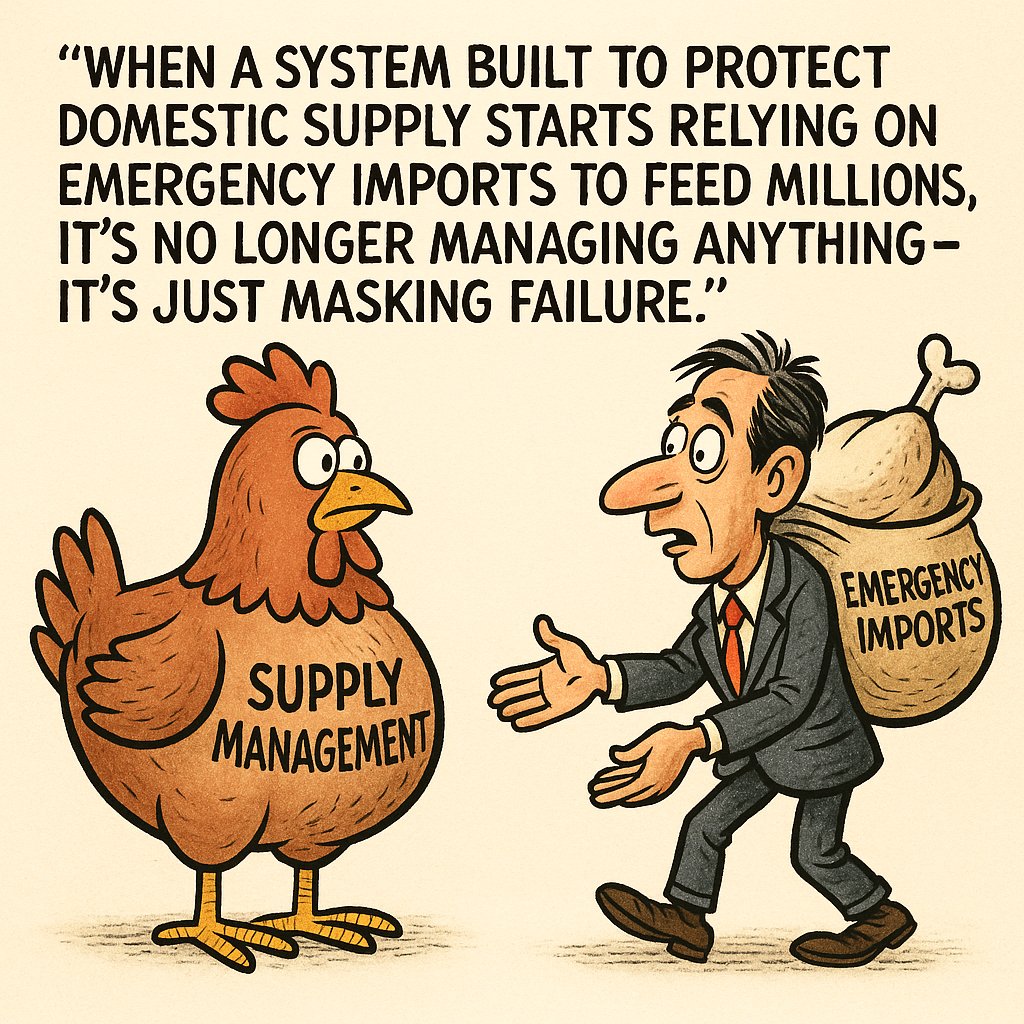
The Chicken Crisis Supply Management Won’t Admit
Canada’s supply management system—once heralded as a pillar of food security and agricultural self-sufficiency—is failing at its most basic function: ensuring reliable domestic supply.
According to the latest figures from the Canadian Association of Regulated Importers (CARI), Canada imported over 66.9 million kilograms of chicken as of June 14 — a 54.6% increase from the same period last year. To put that in perspective, this volume could feed 3.4 million Canadians for an entire year, based on per capita poultry consumption. That’s roughly 446 million individual meals — meals that, under a tightly managed quota system, were meant to be produced domestically.
To be fair, the avian influenza outbreak in Canada has disrupted poultry production, and it partially explains some of the shortfall. But even accounting for that disruption, the numbers are staggering. Imports under trade quotas established by the WTO, CUSMA, and CPTPP are all running at or near pro-rata levels, signaling not just opportunity — but urgency. Supplementary import permits — meant to be emergency tools — have already surpassed 48 million kilograms, exceeding the total annual import volumes of some previous years. This is not a seasonal hiccup. It is systemic failure.
Canada’s poultry sector is supposed to be insulated from global volatility through supply management. Yet internal shocks — like the domestic avian flu outbreak — have shown how fragile the system truly is. When emergency imports become routine, we must ask: what exactly is being managed?
The original intent of supply management was to align production with domestic demand while stabilizing prices and farm incomes. But that balance is clearly off. The A195 production period, ending May 31, 2025, showed one of the worst underproduction shortfalls in more than 50 years. Producers remain constrained by rigid quota allocations, while consumers continue to face rising poultry prices. More imports. Higher costs. Diminished confidence.
Some defenders will insist this is an isolated event. It’s not. This is the second week in a row Canada has reached pro-rata import levels across all chicken categories. Bone-in and processed poultry products — once minor parts of emergency programs — are now central to keeping the market supplied.
The dysfunction extends beyond chicken. Egg imports under the shortage allocation program have already topped 14 million dozen, up 104% from last year. Just months ago, Canadians were criticizing high U.S. egg prices — yet theirs have fallen. Ours haven’t.
All this in a country with $30 billion in quota value, intended to protect domestic production and reduce reliance on imports. Instead, we are importing more — and paying more.
Meanwhile, Bill C-202, now before the Senate, aims to shield supply management from future trade negotiations, making it even harder to adapt or reform. So we must ask: is this what we’re protecting? A system that fails to meet demand, relies on foreign supply, and costs Canadians more at the checkout?
Our trading partners are seizing the moment. Chile, for instance, has increased its chicken exports to Canada by over 63%, now representing nearly 96% of CPTPP-origin imports. While we double down on rigidity, others are gaining long-term footholds in our market.
It’s time to face the facts. Supply management no longer guarantees supply. And when a system meant to ensure resilience becomes the source of fragility, it’s no longer an asset — it’s an economic liability.
Comments Off on Canada’s Supply Management system – protecting us from cheaper milk, eggs, and chicken
The Korean War Week 52 – MacArthur Fades, Ceasefire Hopes Rise – June 17 , 1951
The Korean War by Indy Neidell
Published 17 Jun 2025The UN troops continue their advance to the Kansas Line, meeting no resistance at Pynoggang, but heavy resistance beyond it inside the Iron Triangle. 8th Army Commander Jim Van Fleet does not want to advance much beyond where they are now, though, since territory further north would be tougher to defend, should ceasefire talks begin. And Douglas MacArthur continues to tour the states, but to ever smaller crowds.
(more…)
Comments Off on The Korean War Week 52 – MacArthur Fades, Ceasefire Hopes Rise – June 17 , 1951
Fixing the CAF will require a lot more than just money
 The Canadian Armed Forces are in a dire state. I could literally have written that in any year since I started blogging in 2004 … with brief, unsustained funding boosts for unplanned military commitments here and there that actually made the overall situation worse rather than better. Canada’s military procurement system seems incapable of doing anything quickly … or inexpensively, so pouring billions more into a broken process won’t work out well. There used to be a meme about being able to get whatever you wanted — “good, fast, cheap … pick two”. The CAF can’t even get one of those options.
We’ve had surprising numbers of media folks paying attention to the crippling recruiting crisis, as even on current funding, the CAF is short thousand and thousands of soldiers, sailors, and aircrew. Sadly, but predictably, most of that media attention looks at the shortfall of new recruits being trained for those jobs, which is true but incomplete. The biggest problem on the intake side of the CAF is the bureaucratic inability to bring in new recruits in anything remotely like a timely fashion. The last time I saw annual numbers, the CAF had huge numbers of volunteers coming in the door at recruiting centres, but getting the paperwork done and getting those volunteers into uniform and on to job training was an ongoing disaster area. More than seventy thousand would-be recruits applied to join the CAF and the system managed to process less than five thousand of those applicants and get them started on their military careers.
At a time that we’re losing highly trained technicians in all branches to overwork, underpay, and vocational burn-out, we somehow lack the competence to take in more than one in twenty applicants? That is insane.
In the National Post, Michel Maisonneuve says much the same as I just did, but rather more coherently:
I’m told the Treasury Board has already approved the new funds, making this more than just political spin. Much of the money appears to be going where it’s most needed. Pay and benefit increases for serving members should help with retention, and bonuses for re-enlistment are reportedly being considered. Recruiting and civilian staffing will also get a boost, though I question adding more to an already bloated public service. Reserves and cadet programs weren’t mentioned but they also need attention.
Equipment upgrades are just as urgent. A new procurement agency is planned, overseen by a secretary of state — hopefully with members in uniform involved. In the meantime, accelerating existing projects is a good way to ensure the money flows quickly. Restocking ammunition is a priority. Buying Canadian and diversifying suppliers makes sense. The Business Council of Canada has signalled its support for a national defence industrial strategy. That’s encouraging, but none of it will matter without follow-through.
Infrastructure is also in dire shape. Bases, housing, training facilities and armouries are in disrepair. Rebuilding these will not only help operations but also improve recruitment and retention. So will improved training, including more sea days, flying hours and field operations.
All of this looks promising on paper, but if the Department of National Defence can’t spend funds effectively, it won’t matter. Around $1 billion a year typically lapses due to missing project staff and excessive bureaucracy. As one colleague warned, “implementation (of the program) … must occur as a whole-of-government activity, with trust-based partnerships across industry and academe, or else it will fail.”
The defence budget also remains discretionary. Unlike health transfers or old age security, which are legally entrenched, defence funding can be cut at will. That creates instability for military suppliers and risks turning long-term procurement into a political football. The new funds must be protected from short-term fiscal pressure and partisan meddling.
One more concern: culture. If Canada is serious about rebuilding its military, we must move past performative diversity policies and return to a warrior ethos. That means recruiting the best men and women based on merit, instilling discipline and honour, and giving them the tools to fight and, if necessary, make the ultimate sacrifice. The military must reflect Canadian values, but it is not a place for social experimentation or reduced standards.

They finally did retire the Sea King, long after almost everyone else did. All CAF equipment is expected to have far longer working lives than any of our allies’ equipment.
Comments Off on Fixing the CAF will require a lot more than just money
AG42 Ljungman: Sweden Adopts a Battle Rifle in WWII
Forgotten Weapons
Published 29 Jan 2025
All the best firearms history channels streaming to all major devices:
weaponsandwar.tvSweden developed, adopted, and produced a new self-loading rifle during World War Two. The process began in 1938, with an attempt by the state rifle factory to convert Swedish Mauser bolt actions into semiautomatic; that did not go well. Trials for a ground-up semiauto followed shortly thereafter, with the two finalists being the Pelo rifle from Finland and a design by Erik Eklund of the C.J. Ljungmans Verkstäder, a company that made gas pumps and had no prior small arms experience. Eklund focused on making his rifle as simple as possible, and created a direct gas impingement system with a tilting bolt and a rather unique method of operation. It was chambered for the 6.5x55mm cartridge, with a detachable 10-round magazine (which was intended to be reloaded with stripper clips).
The rifle went into production in 1942, and by 1944 rifles were being delivered to the military. They were never a complete replacement for the various patterns of Swedish Mauser, instead being used to supplement squad firepower. In 1953 a major refit program was put in place, making a number of changes and creating the Ag m/42B pattern. Those rifles remained in use until eventually replaced by the AK4, the Swedish model of the G3 rifle from Heckler & Koch.
(more…)
Comments Off on AG42 Ljungman: Sweden Adopts a Battle Rifle in WWII
QotD: The “doctrine of media untruth”
Put another way, the media’s “truth” is a good guide to what is abjectly false. Perhaps we can call the lesson of this valuable service, the media’s inadvertent ability to convey truth by disguising it with transparent bias and falsehood, the “Doctrine of Media Untruth”.
Victor Davis Hanson, “The Doctrine of Media Untruth”, American Greatness, 2020-05-24.
Comments Off on QotD: The “doctrine of media untruth”
June 17, 2025
BC is buying ferries from China … to spite Trump!
After all the “buy Canadian” blather of the last federal election campaign, it was only a matter of time before the feds or one of the provinces did something astoundingly out-of-step with the mantra. Smart money was always on Quebec being the first (because that often makes sense for internal provincial political reasons), but no, this time it’s British Columbia going a long way out of their way to not buy Canadian for a huge government purchase:

BC Ferries’ MV Spirit Of Vancouver Island between Galiano Island (Bluffs Park) and Mayne Island, en route from Tsawwassen to Swartz Bay, BC on April 6, 2022.
Photo by Gordon Leggett via Wikimedia Commons.
British Columbia’s transportation minister claimed Friday that buying new ferries from European shipyards would have cost roughly $1.2 billion more than buying them from a Chinese government-owned shipyard in Weihai, Shandong province, which is a city roughly the size of Montreal that I had never heard of until this week. China knows how to build cities. They burst into existence from nothing, like popcorn. China also knows how to build ships, and highways, and high-speed rail, and just about anything else you would care to name, better and more efficiently than the Canadian public service can realistically comprehend.
The four ships B.C. Ferries is fixing to replace, of 1960s and 1970s vintage, were built at Seaspan in North Vancouver (which is an active shipyard), at the Victoria Machinery Depot (which is no longer an active shipyard), and at the Burrard Dry Dock (which is also defunct). Canada’s shipyards, for better or worse — certainly for expensive! — are very busy building things for the navy.
B.C. Ferries has plenty of experience with foreign-built vessels. Its current fleet includes ships built in Romania, Poland, Germany and Greece. Other than the Baynes Sound cable ferry on Vancouver Island — which is not especially popular — the Crown corporation’s newest Canadian-built boat went into service in 1997. So “foreign” obviously isn’t the problem.
But China is China, and that’s legitimately another thing. China is not a Canadian ally. They try to screw with our democracy, and most other democracies by the sounds of it. And right now we are in a profoundly protectionist moment: Across the political spectrum, mostly because of President Donald Trump, “buy Canadian” is the only philosophy really on offer.
But does that make sense? We should pay over the odds for ferries … because of Trump? There wasn’t half of all this foofaraw when Marine Atlantic on the East Coast bought its newest ferry from Weihai. Since last year it has safely been shepherding Canadians between Nova Scotia and Newfoundland, without a whisper of controversy in the Rest of Canada.
I don’t quite get the Trump angle, which is perhaps why I’m more interested in Dean Broughton‘s take:
… I’m not just disappointed — I’m furious — about the NDP government’s decision to award the construction of four new BC Ferries vessels to a Chinese state-owned shipyard. This isn’t just outsourcing. It’s betrayal dressed up as budget management.
Back in 2021, the NDP government unveiled a “Made-in-B.C.” shipbuilding strategy with great fanfare. They formed a Shipbuilding Advisory Committee, posed for cameras, and promised to rebuild a long-neglected industry. It was supposed to be a turning point, a real investment in local jobs and industrial capacity.
Now, many of those same politicians have turned their backs on everything they claimed to support. Not only did they ship the contracts overseas, but, according to Eric McNeely, president of the BC Ferry and Marine Workers’ Union, they didn’t even give B.C. shipyards a fair shot. The procurement process was so rushed and restrictive that no local yard could realistically compete. They didn’t lose the bid — they were boxed out.
That’s not fiscal prudence. That’s political cowardice.
The hypocrisy is staggering. This is the same government that talks endlessly about investing in clean industry and supporting working families, and they just handed a massive public contract to a country with a well-documented record of environmental abuses and human rights violations.
They talk about reconciliation and sustainable development—and then funnel hundreds of millions to an authoritarian regime.
Worse still, they did this knowing full well that B.C.’s industrial base is already in decline.
We have so little left beyond resource extraction. Shipbuilding could have been part of our economic renewal. Instead, it’s another casualty of government optics and empty promises.
I remember my father’s outrage in 1990 when the federal government cancelled the Polar 8 icebreaker — a Canadian-built vessel meant to defend our Arctic sovereignty. That decision was dismissed as a “cost-saving measure” and today our claim to the North has never been weaker.
The BC Ferries decision reeks of the same short-sighted logic.
Comments Off on BC is buying ferries from China … to spite Trump!
The Crewless Tank Experiment | Project Crazy Horse
The Tank Museum
Published 31 Jan 2025This might just be one of the greatest missed opportunities in the history of tank development. Project Crazy Horse: a full-sized, crewless, remote-control tank – developed 35 years ago.
Being shot at is as unpleasant as it is dangerous. But in the 1980s, the Ministry of Defence needed to trial the cutting-edge TRIGAT missile system with a mobile target. The MOD approached the Royal Armament Research and Development Establishment (RARDE) with a unique challenge – design us a tank that can operate by remote control.
With a limited budget, the project team selected an old Mark I Chieftain as the test bed for their vehicle. Stripping out any unnecessary components and piecing together the needed parts from a range of tech, Crazy Horse was successfully trialed in 1988.
But despite the innovations of both the team and the technology, the project was shut down due to budget cuts and issues of unreliability. The team was reassigned, and Crazy Horse was sent to The Tank Museum. There is currently no such thing as an unmanned, remote controlled main battle tank. But 35 years ago, we came tantalisingly close.
00:00 | Introduction
00:39 | A Moving Target
03:00 | Less Than A Million Dollars?
04:40 | Previous Attempts
07:47 | Creating Crazy Horse
10:16 | A Stormer!
13:47 | Slow Death of Crazy Horse
18:23 | A Missed Opportunity?In this film Chris Copson and Paul Famojuro explore the extraordinary story of Project Crazy Horse. This unique Chieftain target tank was developed in the 1980s, by an enthusiastic team that used their expertise to create the biggest remote-controlled tank in the world. Sadly, despite several glimmers of a resurrection, Crazy Horse would never see its full potential. Both Crazy Horse and its Stormer control vehicle were saved from scrap, and are now on display at The Tank Museum, where visitors can discover more about this revolutionary design.
(more…)
Comments Off on The Crewless Tank Experiment | Project Crazy Horse
QotD: What is a “tank”?
And we should stop to note that as with any question of definition, this one too is language-sensitive. The exact confines of a term vary from one language to another; kampfpanzer, for instance is not necessarily an exact synonym for “tank”.
In any event, the basic demands of early tanks were dictated by the realities of the Western Front: a tank needed to be able to resist small arms fire (particularly machine guns), deliver direct supporting fire itself, it needed to be able to move on the muddy, artillery-flattened ground and it needed to be able to cross a trench. This last requirement – the need to be able to both climb a parapet (usually c. 4ft) and then cross over an 8ft wide trench – was significant in the design of early tanks.
Those factors in turn dictated a lot of the design of early tanks. The armor demands of resisting small arms fire meant that the vehicle would be heavy (and indeed, as soon as tanks appeared amongst Allied troops, their German opponents began introducing more powerful bullets, like the K bullet and later the 13.2mm anti-tank round fired from the Mauser 1918 T-Gewehr). And here is the first advantage of tracks. The weight of a vehicle is distributed along all of the area of contact it has with the ground; with tires that area is limited to the bottom of the tire so the total area of ground contact is fairly low, which is fine for most vehicles.
But tanks are heavy. Really heavy. Even something like the Renault FT could mass around 7 tons and by later standards that would be classified as a tankette (a “mini-tank” as it were); by WWII, medium tanks often clocked in around 30 tons. If you put a vehicle like that on tires, you are going to create a LOT of pressure on those small points of contact. That might still be OK if you are just going to drive on roads and other firm surfaces which can take the pressure. But remember: tanks were designed for the Western Front, which looks like this.
Fortunately for the landship committee, this wasn’t a new problem: farming tractors were also heavy and also had to operate in churned up (in this case, plowed) soft soil; the heaviest of these vehicles had much the same problem and the solution was continuous tracks or “treads”. When kept properly tensioned – tune in, by the by, to Nicholas “The Chieftain” Moran’s YouTube for more than you ever want to know about track tension – the track distributes the weight of the tank across the entire section of the track touching the ground, which reduces the ground pressure at any given point, allowing a big heavy tank to roll over terrain where even a much lighter wheeled vehicle would get stuck.
This is one of those points where the functionality of a tank (what a tank does) has such a strong influence on design that the design implications of the functionality become part of the definition: a tank has to be heavily armored and has to be able to move off-road and as a result has to be tracked, not wheeled. One might be able to imagine some sort of exotic technology that might make it possible to do all of the things a tank does without tracks, but we don’t have that yet.
The other factor was fire. I’ve mentioned this before, but one of the significant background factors of WWI is that a lot of the belligerents misjudged the kind of artillery they’d need for a general European war. Not to get too deep into the weeds here, but most of the belligerents expected a relatively rapid war of maneuver and so thought that light, direct-fire artillery like the famed French ’75 (the Matériel de 75mm Mle 1897) would be the most useful. Those guns could be moved quickly and could deliver a lot of quick firepower on static or moving formations of enemy infantry in support of friendly infantry.
The problem is that in the conditions of trench warfare, those guns – as they were configured, at least – were far less useful. They were, first off, much shorter in range which meant they had to be brought dangerously far forward to do their direct fire role – often so far forward they could be engaged by enemy rifles and machine guns. This was compounded by the fact that direct fire at range was ineffective against trench works (which are dug down into the earth). But at the same time, the value of rapid firing (because these lighter guns could fire a lot faster than the heavy, indirect fire artillery) direct fire artillery remained high, if only you could get it to the fight.
This was also a problem a tank could solve: as a mobile, armored platform it could move a rapid-firing direct fire gun forward without immediately being knocked out by enemy small arms to support the infantry. There is, I should note, early complexity on this point, with both “male” (heavy direct fire cannon focused) and “female” (machine gun focused) tanks in WWI though in the end “hermaphrodite” designs with both capabilities (but much more focus on the main cannon) triumph, so that’s what we’ll focus on.
And that gets us the fundamental role structure for tanks: enough armor to resist enemy small arms (but with the understanding that some weapons will always be effective against the tank), enough mobility to cross the churned up battlefield and some direct fire capability to support the infantry crossing it at the same time.
Bret Devereaux, “Collections: When is a ‘Tank’ Not a Tank?”, A Collection of Unmitigated Pedantry, 2022-05-06.
Comments Off on QotD: What is a “tank”?
June 16, 2025
The Machine of Terror: How the Soviet Secret Police Ruled – W2W 32
TimeGhost History
Published 15 Jun 2025From Tsarist Russia to Stalin and the Cold War, the Soviet secret police evolved through endless name changes — but their mission never wavered: repress, control, and terrify. Discover how these agencies — from the Okhrana to the Cheka, GPU, OGPU, NKVD, and eventually the KGB, shaped Soviet life with ruthless efficiency. Torture, purges, and mass surveillance weren’t just tactics; they were the system.
(more…)
Comments Off on The Machine of Terror: How the Soviet Secret Police Ruled – W2W 32
Why Orwell’s choristers wouldn’t solve the CBC problem
Peter Stockland was looking for a George Orwell quote in the four-volume Essays, Journalism and Letters collection, but instead he found something that painfully briefly gave him hope on how to resolve the eternal CBC problem:

Orwell had been employed by the BBC for about nine months at the time. He writes of the Beeb’s “atmosphere (being) somewhere halfway between a girls’ school and a lunatic asylum (where) all we are doing is useless, or slightly worse than useless”. But that didn’t prevent him observing the following and writing it down for potential reference:
The only time one hears people singing in the BBC is in the early morning, between 6 and 8. That is the time when the charwomen are at work. A huge army of them arrives all at the same time. They sit in the reception hall waiting for their brooms to be issued to them and making as much noise as a parrot house, and then they have wonderful choruses, all singing together as they sweep the passages. The place has quite a different atmosphere at this time from what it has later in the day.
There’s no overt opining. No proselytizing. No being a loud mouthed schnook. No. Instead, there’s quiet observing. Passerby paying attention. After the fact drafting of an attempt at understanding. All of it brings us journalistically face to face with the vitality – the potential for beauty – of ordinary, practical work using the tools available. It stands in stark contrast to the “useless or slightly worse than useless” abstractionism going on among the great, the good, and the self-important in the BBC bureaucracy.
When I first read the diary entry, it stirred me with eureka-like enthusiasm. That’s it! That’s the solution! We can finally let go of the never-never-land fantasy of abolishing the CBC/Radio Canada. Parliament can instead issue an immediate edict for Mother Corp to hire a “huge army” of cleaning persons, issue them brooms, and unleash them to sing their hearts out. They would soon sweep away the journalistic detritus and parrot droppings in the Corpse’s downtown Toronto and Montreal buildings. A little bit of hallway husbandry married to some glorious working class song: That would fix the GD CBC.
Alas, I was quickly shaken by remembering: This is Canada. Bureaucratism is the irreversible necrosis of the national spirit.
Within months – weeks? – there would be a follow up Clean Canada Choristers Control Act. A federal agency with a $50 million annual starter budget would police against misinformation being sung by the cleaners. It would deploy a gender equitable intersectional analysis to prevent settler colonial bias affecting distribution of bass, tenor, alto and soprano voices. Above all, it would regulate the size and status of the brooms to prevent any unionized chorister feeling unsafe or excluded.
I exaggerate? Not so much. Consider this week’s confirmation that Prime Minister Mark Carney’s urgency to “fast track” projects deemed of “national interest” is about to spawn its own Major Federal Projects Office – a bureaucracy to reduce the bureaucracy of getting down to work and building Canadian things that Canadians need.
You might think some journalist somewhere might ask, like, you know, “Why can’t they just reduce the bureaucracy instead of, like, you know, creating another one with more bureaucrats? Kind of, you know, play DOGE Ball North: ‘You! Bureaucrats! You’ve been tagged! You’re out!!'”
But no. Remember, as I was obliged to, this is Canada. Those kinds of questions aren’t asked even by journalists who should be asking them because … those kinds of thoughts are no longer thunk here. (I don’t think they’re actually illegal. Yet.)
Comments Off on Why Orwell’s choristers wouldn’t solve the CBC problem
History of Britain, III: Celtic Britain
Thersites the Historian
Published 21 Jan 2025Although most of our early information about the Celts comes from Greek and Roman writers whose experience was with Celtic tribes on the continent, we can glean some insights into the Celts of Britain. We also introduce the fact that Ireland eventually became the world’s greatest repository of Celtic cultural preservation.
Comments Off on History of Britain, III: Celtic Britain


