
World War Two
Published 26 Jun 2025A rogue preacher breaks into the Reichstag and steals silverware, banned erotica, and the 1848 German Constitution. As Germany’s banks collapse and panic spreads, the press is captivated by the strange tale of Walter Wohlgemuth: pastor, thief, and accidental symbol of a republic in crisis.
(more…)
June 27, 2025
Germany’s Constitution, Erotica, and a Pastor’s Dignity – Rise of Hitler 19, July 1931
Comments Off on Germany’s Constitution, Erotica, and a Pastor’s Dignity – Rise of Hitler 19, July 1931
The fading Boomer Laurentianus
Last week in The Critic, Charles Kirwin described the people who saddled us with three terms of Justin Trudeau and hope to continue their reign of error by supporting Mark Carney with his Europhile whims and intolerance for dissent:
Boomer Laurentianus is a Canadian subspecies of Boomerus Senectus, so named because he models himself on the so-called Laurentian Elite, Canada’s governing class that inhabit the “Laurentian corridor”, the narrow strip of land along the Saint Laurence river between Montreal and Toronto that, for a certain kind of Canadian, is the only bit of the country that matters.
In spirit, he is a child of the sixties and still believes he is a radical at heart. Despite this he expects to be treated with the deference reserved for those awarded the Victoria Cross, despite his closest experience to combat being glancing longingly at pictures of the cancelled Avro Arrow or campaigning to defend the local parking lot from being turned into affordable houses.
Like his British and American cousin, he supports progressive policies like safe supply of drugs, lenient sentences and bail conditions for criminals, and whatever economic policies keep his pension fund high and his property values increasing. Naturally, he lives in neighbourhoods untouched by the crime and addiction that are the direct result of the policies he supports.
It is important to note that while his modes of thinking and beliefs are those of the Laurentian Elite, his mind is shaped by the institutions of the Laurentian Elite: The Canada Council for the Arts, the Canadian Broadcasting Corporation, the Governor General’s Literary Award, various other high-minded organisations that form the intellectual life of Laurentian Canada, Boomerus Laurentianus is not necessarily “of” them.
Molson Canadian is the spirit of his patriotism. In 2000, Molson released a beer advertisement in which a typical Canadian played by actor Jeff Douglas shouts into a microphone to an audience of Americans, dismissing various Canadian stereotypes (we say aboot, drive dogsleds, are all lumberjacks and fur traders et cetera) and notes some of the differences that make Canada not the US. “I have a Prime Minister not a President … I believe in Peacekeeping not policing … I can proudly sew my country’s flag on my backpack while travelling”. The advertisement is something of a cult hit in Canada and has been parodied by just about everyone including William Shatner.
This one-minute advertisement swells at the heart of the Boomer Laurentianus view of his country. It is both superficial and, in places, factually incorrect (the equivalent of the US president is not the Prime Minister but the King or Queen of Canada). But he has built his entire sense of nationalism around myths such as peacekeeping or being liked by foreigners more than Americans. This last point is sacred to his sense of identity.
Boomerus Laurentianus exists in a superposition state usually reserved for Schrödinger’s cat wherein he is both completely American and not American at all. It was often claimed of Rhodesians that they were “More British than the British”. Boomer Laurentianus is more Yank than the Yanks. Despite his reverence for the CBC, he gets his recipes from the New York Times and his opinions from CNN. He watches American television, travels to the US frequently, may even own a second home there. He can almost convince himself that they are the same country, sometimes to the point of putting up signs supporting, Democratic political candidates, seemingly unaware that he cannot vote in foreign elections.
Comments Off on The fading Boomer Laurentianus
India’s FAL: The 1A1 Inch/Metric Hybrid
Forgotten Weapons
Published 5 Feb 2025For political reasons, India decided to adopt the 7.62mm NATO cartridge when it needed to replace its No1 MkIII SMLE bolt action rifles with a modern self-loader. They chose the FN FAL as the rifle to adopt, but wanted a license to produce it domestically at the Ishapore rifle factory. FN insisted on the Indians buying Belgian tools as part of the agreement, which India was unwilling to do. So instead, Ishapore used the samples it had of both British L1A1 and Belgian FAL rifles to produce its own reverse-engineered drawings.
The resulting plans use a mixture of British (“inch”) and Belgian (“metric”) parts, and are not interchangeable with either standard pattern. As a result, the Indian 1A1 rifle is a clone of the FAL that is not actually parts compatible with the FAL. That did not prevent Ishapore from producing hundreds of thousands of them, with production apparently ending only in 2012.
Thanks to Sellier & Bellot for giving me access to this 1A1 example to film for you!
(more…)
Comments Off on India’s FAL: The 1A1 Inch/Metric Hybrid
QotD: The dangers of “doing too much principal component analysis”
John: I’ve never read a fashion magazine or watched a runway show, so I just naively assumed that models were stunningly attractive and feminine. But as Mears points out, the models are not actually to most men’s tastes. They tend to have boyish figures and to be unusually tall.1 Is this because the fashion industry is dominated by gay men, who gravitate towards women who look like teen boys? Whatever the origins of it, there is a model “look”, and the industry has slowly optimized for a more and more extreme version of it, like a runaway neural network, or like those tribes with the rings that stretch their necks or the boards that flatten their skulls. There’s actually a somewhat uncanny or even posthuman look to many of the models. The club promoters denigrate women who lack the model look as “civilians”, but freely admit that they’d rather sleep with a “good civilian” than with a model. The model’s function, as you say, is as a locus of mimetic desire. They’re wanted because they’re wanted, in a perfectly tautological self-bootstrapping cycle; and because, in the words of one promoter: “They really pop in da club because they seven feet tall”.
[…]
By the way, the fact that models are beautiful in a highly specific way, and that there exist women who are similarly beautiful but condemned to be “civilians”, is a good reminder of the dangers of doing too much principal component analysis.2 In so many areas of life, we are obsessed with collapsing intrinsically high-dimensional phenomena onto a single uni-dimensional axis. You see this a lot with the status games that leftists play around privilege and oppression — I feel like a rational leftist would say that a disabled white lesbian and a wealthy scion of Haitian oligarchs are just incomparable, each more privileged than the other in some senses and less in other senses. But no, instead there’s an insistence that we find an absolute total ordering of oppression across all identity categories, a single hierarchy that allows us to compare any two individuals and produce a mathematical answer as to which one is more deserving of DEI grants. My hunch is a lot of the internal tensions and bickering within American leftism are actually produced by this insistence, which makes sense because it’s totally zero sum.
But the disease of trying to pin everything to a single number is hardly confined to the left. You see it on the right in the obsession with IQ, as if a single number could capture the breathtaking range of variation of cognitive capabilities across all humanity. I mean for goodness sake, Intel learned the hard way that this doesn’t even work for computers, and human brains are much weirder and more complicated than microprocessors. But the even dumber version of this is the 1-10 scale of female beauty. There’s something so sublime about seeing a beautiful human being, because so much of it is either bound up in subtle interrelationships between different features (this is why plastic surgery often makes people uglier — there’s no such thing as a “perfect nose”, and if you pick one out of a catalog you’ll probably end up with one that doesn’t fit your face), or it’s irretrievably evanescent — a fleeting glance, or the way her hair falls across her face just so, gone the moment after it happens. Taking something so ineffable and putting it on a 1-10 scale only makes sense as a form of psychological warfare. And I get it, amongst the young people relations between the sexes have degenerated to the point of more or less open warfare, but come on, this is pornbrained nonsense.
Speaking of both the DEI olympics and the classification of female beauty, some parts of this book are really charmingly naive, and I snickered a bit at Mears’s mystification at why all of the models are white and blonde. The really funny part is that she says something like: “I expected this legacy of white supremacy to be in retreat given that so many of the big spenders in clubs these days are from Asia and the Middle East”. Is she really not aware that men of other races have an even stronger aesthetic preference for white women than white men do?3
John Psmith and Gabriel Rossman, “GUEST JOINT REVIEW: Very Important People, by Ashley Mears”, Mr. and Mrs. Psmith’s Bookshelf, 2024-03-04.
1. In fact, an unusually high proportion of models are intersex individuals with a Y-chromosome and androgen insensitivity syndrome.
2. Not the only danger of too much principal component analysis!
3. Gabriel: Kimberly Hoang did an ethnography as a bar girl in several Vietnam bars. At the bar that catered to Vietnamese elites, the other bar girls made her lighten her skin with cosmetics and wear a black minidress, with the target look being tall, pale, and slender K-pop idol. When she moved to another bar catering to white sex tourists, the other bar girls told her to wear bronzer and a slutty version of traditional Asian dress with the target look being exoticized sexiness. See: Hoang, Kimberly Kay. 2015. Dealing in Desire: Asian Ascendancy, Western Decline, and the Hidden Currencies of Global Sex Work. University of California Press.
Comments Off on QotD: The dangers of “doing too much principal component analysis”
June 26, 2025
NYC doubles down on Luxury Beliefs
New York City voters appear to have selected the ultimate “luxury beliefs” candidate as the presumptive next mayor of NYC in Zohran Mamdani:
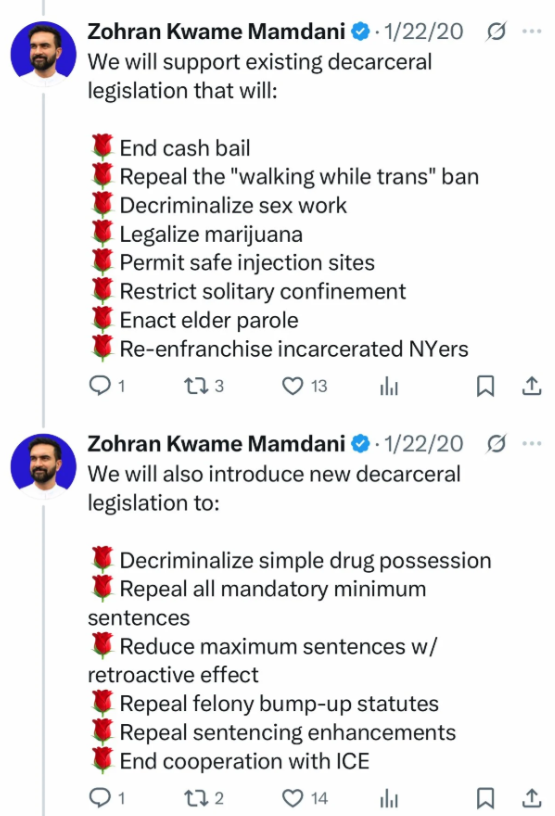
The luxury belief class has just done the equivalent of plucking a random grad student from an Ivy League Hamas encampment and nominating them for mayor.
Take the New York City subway early in the morning from the outer boroughs and you’ll find it packed with cleaners, nannies, restaurant staff, hotel workers and construction workers coming off the night shift. Some are heading home. Some are just starting their day. It’s “the help” arriving and departing.
Like many other large cities, New York runs on a two-tier system. There’s the professional class clustered in the centre, and there are the people who keep the centre running but can’t afford to live in it.
And so they must endure long rides on public transportation to get to work. They keep their heads down and ignore the trash, the smell, the homeless men passed out across the seats. Working-class commuters see the sprawled-out bodies and try to make it through the ride without being harassed or stepping in puddles of urine.
Many politicians and media outlets act like the public disorder problem is overblown. But fare evasion, open drug use and serious mental illness on the subway are still part of daily life.
It’s in this polarised environment that the mayoral candidate Zohran Mamdani has gained traction among the city’s richest voters. At only 33, Mamdani is one of the youngest people ever to run for mayor of America’s largest city. Mamdani, a self-proclaimed nepo baby who has spent four years as an Albany assemblyman and is described by The New York Times as a “a TikTok savant”, has virtually no experience for the job.
And yet, what’s really worrying about this candidate is that he’s a poster child for luxury beliefs.
“Luxury beliefs” — a term I coined years ago — means opinions that confer status on the upper class at little to no cost for them, while inflicting serious cost on the lower classes. And the very people who back Mamdani are the ones who most resemble him: affluent, overeducated, and eager to prove their virtue at someone else’s expense.
As is often true of those who embrace luxury beliefs, Mamdani purports to care most about the working class. He says he wants free buses, government-run grocery stores, and a freeze on rent increases.
But his platform would hurt the working classes a lot more than it would help them.
Comments Off on NYC doubles down on Luxury Beliefs
German police raid homes to counteract online “hate speech” by “digital arsonists”
Things are getting worse for free speech in Germany, as eugyppius reports:

Apollo News reports on the newest, most irregular German holiday, which consists of the police conducting coordinated raids on and interrogations of ordinary people who are alleged to have said rude things on the internet:
On Tuesday morning police across Germany conducted raids targeting “hate speech and incitement” on the internet. According to the news agency dpa, there are currently 170 operations underway, including house searches and other measures. Those accused are charged with insulting politicians and inciting hatred …
The Federal Criminal Police Office (BKA) is in charge of the operation … In North Rhine-Westphalia, several police authorities struck simultaneously at 6 a.m. Police from Düsseldorf, Dortmund, Gelsenkirchen, Cologne, Bielefeld, Münster, Hagen, and Bonn are among those involved. Fourteen suspects are to be questioned and two search warrants executed.1 The individuals in question frequently express themselves on social media, such as on X.
… The Action Day against alleged hate posts has been taking place regularly for years. On June 18, the BKA joined forces with the reporting center “REspect!” to participate in the “International Day Against Hate and Incitement”. People were called upon to report posts that allegedly spread hate.
Today was the twelfth such “Action Day against Hate and Incitement on the Internet”. That is only an approximate title; it varies slightly across press sources. This dubious ritual began in 2016, after Merkel opened the German borders to the entirety of the developing world and our politicians grew tired of people calling them imbeciles online. Police are very open that the goal of these coordinated Action Days is intimidation – or, as they put it, “deterrence”.
Our federal police love this holiday so much they often celebrate it twice a year, which is why are already on the twelfth such day, even though we have only had nine years since the establishment of this custom. Sometimes our betters even throw in bonus action days that for some reason don’t count, as during Covid when they conducted a special “Action Day against Political Hate Postings” after the seventh “Nationwide Action Day against Hate Postings” but before the eighth “Nationwide Action Day against Hate Postings”. Who knows how many such action days we have really had, especially considering that since 2020 the broader EU has adopted this sporadic holiday and occasionally coordinates its own Continent-wide “Action Day against Hatred and Incitement on the Internet”.
[…]
By calling these Action Days idiotic, I don’t mean to minimise them. They are borderline illegal, for they exploit what should be purely investigative tactics (interrogations, house searches) to scare and punish people in advance of any criminal conviction. The emphasis is not only on right-leaning posters, but invariably and most disgracefully on ordinary people with relatively little social media reach, whose posts in many cases have been seen a mere handful of times. The message is clear: They can get you, whoever you are; they can get anybody. Living in a country whose authorities amuse themselves by periodically harassing their own citizens in this way is disturbing. It’s an absolute scandal that all the major political parties support this, save for Alternative für Deutschland. It’s a reason to vote AfD all by itself.
Comments Off on German police raid homes to counteract online “hate speech” by “digital arsonists”
NATO members “commit” to a new 5% defence spending target
As many predicted, just as Canada finally gets around to at least pretending to meet the 2% defence spending target we agreed to over a decade ago, those goalposts get moved:

So today the leaders of Nato convene for a landmark summit:
NATO countries agree to increase defence spending to 5%
That headline isn’t strictly accurate. Member states have apparently agreed to commit to a target of 5% by 2035, to mark the start of the fourteenth anniversary of the Ukraine war. Which means that, as always with Nato, they’ll all look butch at the photo-op, and then they’ll do bugger all. Even the “commitment” to a “target” is too much for Spain, which has secured an opt-out.
But hang on a minute: Nato has been at war — or at proxy-war — with Russia for three-and-a-half years now. So it’s been on a war-footing, supposedly, for seven-eighths of the length of the First World War. How’s that war-footing going? Per Nato’s head honcho, Mark Rutte (the woeful former Dutch PM — ask our pal Eva Vlaardingerbroek), earlier this month:
The Russian army is developing its war capabilities by multiple times more than that of NATO despite having an economy 25 times smaller, NATO’s secretary general has warned …
“The Russians, as we speak are reconstituting themselves at a rapid pace and producing four times more ammunition in three months than the whole of NATO in a year,” said Rutte.
That’s a rather confusing way of putting it; what he means is: the Russians (who, as Mark Levin assures us, “scare nobody”) produce more ammunition in three weeks than the whole of Nato does in a year. Can even Nato be that worthless?
Taking the Secretary-General at his word, if you’re wondering why the Pentagon has to divert ammo marked for Israel to Ukraine and then divert it back from Ukraine to Israel … well, let’s do what everybody else does and dredge up the only historical analogy anybody knows — not the First World War, but the Second (see Levin’s “Iranian Nazi regime”): We’re asked to believe that Nato needs longer than the US was in the Second World War for to move to a war-production footing.
To be sure, supply chains are always difficult: Iran’s threat to close the Strait of Hormuz could have seriously impacted McDonald’s need to recall the hash browns it sent to Montenegro and divert them to Kiribati.
Trump gets something very basic: Flying the highest of high-tech weaponry seven thousand miles to drop down a ventilation shaft opening the size of a dishwasher is the kind of brilliant, dazzling one-off only the United States can do. But what next? Almost all geopolitical conflicts start with a bit of shock-&-awe (Pearl Harbor, even the assassination of the Archduke) and then dwindle down to old-school wars of attrition – as the United States should certainly know after taking twenty years to lose to goatherds with fertiliser, and three years to lose to “a gas station masquerading as a country” (thank you, John McCain). In wars of attrition, old-fashioned unglamorous things become important, like the ability to manufacture bullets in a timely manner. The basic arithmetical calculations are not complex: Don’t get into a long war with an enemy whose stock of long-range ballistic missiles outnumbers your surface-to-air missiles.
So Trump had the narrowest window of opportunity, and used it.
On the other side, the last week-and-a-half mostly revealed the shallowness of the War Party. You’ll recall, for example, that Ted Cruz got into a spat with Tucker over the actual population of Iran. Last week, a UK podcast had a brief discussion on The US Army-Marine Corps Counter-Insurgency Field Manual, which notes the following (foot of page xxvi):
The troop demands are significant. The manual’s recommendation is a minimum of twenty counterinsurgents per 1,000 residents.
That’s roughly what the British had in Malaya. Which they won, by the way. Twenty-two years ago, a couple of weeks after the fall of Saddam, I stopped on the shoulder of the main western highway from Jordan to Baghdad to fill up from an enterprising Iraqi who’d retrieved some supplies from a looted petrol station and was anxious to sell them to any passing Canadian tourists. As he was topping off, I asked him how agreeable he found the western soldiery. He grinned a big toothless grin and pointed to a chopper that had just come up over the horizon to hover above our heads. Then he said: “Americans only in the sky.”
We did not win that one, you’ll recall. Instead, we created an Iranian client-state.
That’s why Ted Cruz’s breezy indifference when Tucker asked him the population of Iran was so revealing. The senator told Tucker that it doesn’t matter whether the population of Iran is eighty million or a hundred million. Really?
Because, per the Pentagon’s own field manual, the latter figure would require finding an extra 400,000 troops. Oh, wait. If it’s a Nato mission, the other members could muster 127 guys between them, so it would only require 399,873 extra Americans.
Even if the public were minded to put one-and-a-half million pairs of boots on the ground, it couldn’t do it. “Americans only in the sky” equals what an Australian prime minister told me, after a flying visit to the troops in Afghanistan, was “the Crusader fort mentality”.
It doesn’t work. The political divide in America is between, crudely, Trumpians and neocons. The former are anti-war; the latter are pro-war … but a way of war that doesn’t work.
Comments Off on NATO members “commit” to a new 5% defence spending target
A Basic Explanation Of The First Punic War
MoAn Inc.
Published 8 Jan 2025GEOGRAPHY NOTES
Messina is the modern name for Messana. Both are correct.
Acragas / Akragas was renamed as Agrigentum by the Romans. Most videos on YouTube use the name Agrigentum for convenience purposes … so again, both are correct.
Panormus is modern day Palermo.
Drepana / Drepanum is modern day Trapani.
Lilybaeum is modern day Marsala.!READ THE SOURCES FOR FREE!
Livy: https://www.perseus.tufts.edu/hopper/…
Polybius: https://www.perseus.tufts.edu/hopper/…
Cassius Dio: https://www.perseus.tufts.edu/hopper/…
(more…)
Comments Off on A Basic Explanation Of The First Punic War
QotD: Credentialism versus meritocracy
Harvard’s motto is “Veritas” — truth — but it ought to be “ludificationes pertinet“, which the internet informs me is how you say “delusions of competence” in Latin. I meant it when I said that the “Ministry of Talent”, as these jerkoffs unironically called themselves, actually had some serious brainpower and real accomplishments … but the Peter Principle is also true, and though they had some real brains and actual accomplishments, neither their brains nor their accomplishments at Harvard translated to anything out in the real world, any more than some Late Republic social climber’s “experience” as curule aedile translated to anything real in their world.
Just as the Roman Senate had no idea how to deal with a Julius Caesar, then, despite it all, so no American “leader” had any idea how to deal with a guy like Ho Chi Minh, even though he, like Caesar, had always been perfectly open and forthright about what he was doing and why. It never occurred to “the best and brightest” to even ask the question “What does Ho Chi Minh want?”, because after all, Ho Chi Minh wasn’t a Harvard man.
And all this was 60 years ago. These days, the AINO cursus honorum is so widespread that every kid who manages to fill out a college app has a resume that would give McGeorge Bundy an erection lasting more than four hours. You’ll have to trust me on this, I guess, but I wouldn’t be surprised to learn that Flyover State — which is respectable but rinky-dink; the kind of outfit where you see their team losing a late December bowl game and you think “Gosh, I guess that state has a third college in it” — had several hundred student organizations …
… all of which seem to exist for no other reason than to have “officers”, to which these little social climbers can be “elected”, the better to pad their law, med, and grad school apps. By the end of my career, probably 3/4 of the students who ever sent me an email had an auto-signature on it, and that auto-signature was longer than my entire CV. President of this, Vice-Treasurer of that, Assistant Grand Poobah (junior grade) of the other thing. Grandpa Simpson was a piker compared to these kids:
I’m an Elk, a Mason, a Communist. I’m the president of the Gay and Lesbian Alliance for some reason. Ah, here it is. The Stonecutters!
Instead of giving potential movers and shakers some practical experience, our modern cursus honorum casts the widest possible net for sociopathy. McGeorge Bundy is your absolute best case scenario. He wasn’t actively evil; he was just a goofy egghead who thought he was way smarter and more accomplished than he actually was, because he’d never been in a position to find out otherwise. (An anecdote that tells you everything you need to know, courtesy of Wikipedia: “When applying to Yale, Bundy wrote on the entrance exam ‘This question is silly. If I were giving the test, this is the question I would ask, and this is my answer.’ Despite this, he was still admitted to Yale as he was awarded a perfect score on his entrance exam”).
Think about that the next time you go to the doctor. Even if your MD — or, much more likely these days, PA — isn’t a prize graduate of Bollywood Upstairs Medical College, xzhey most likely spent xzheyr college years as an Elk, a Mason, a Communist …
Your worst case scenario is, of course, another Caesar. A fake and gay one, it goes without saying — this being Clown World — but a fake and gay Caesar can still do tremendous damage, because they’re the worst of both worlds: Bundy-level goofs, and angry ethnic sociopaths with huge chips on their shoulders. These are the kids who have been “team leads” doing “original research” since about age 12. Not only have they never failed, they’ve never been exposed to the merest hint of the possibility of failure. All their “success” is theirs by right. They have Caesar’s vaulting ambition, his utter disregard for tradition, his absolute cutthroat ruthlessness … and none of his experience, to say nothing of his competence.
Severian, “Cursus Honorum”, Founding Questions, 2021-12-27.
Comments Off on QotD: Credentialism versus meritocracy
June 25, 2025
It’s fine to refer to their bead-and-feather superstitious beliefs as a mythology, but not our holy revealed faith!
kulak responds to the “do you really believe this?” question:
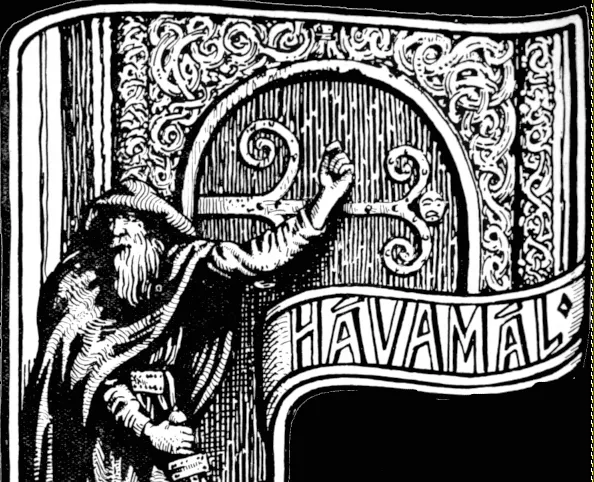
One of the reoccurring critiques and challenges I get from Christians and others regarding Paganism is the accusation that I don’t “Really” believe in the Pagan Gods … that I believe or “believe” only as some calculated political/philosophical expedient or aesthetic choice and that really my professed “belief” is some sort of white or darker shade of lie or “LARP”, and that I must plainly KNOW that the Greek, Roman, Nordic, Celtic and other pantheons and only legends, mere mythologies, and cute stories …
I wish I could find it … but there was actually a twitter thread about a group of Christians and Jews responding with OUTRAGE when a group of academics, quite detachedly and seemingly meaning nothing by it, referred to Behemoth, Leviathan, the Flood, the Destruction of Sodom and Gomorrah, David’s defeat of Goliath, Adam and Eve, the Nephilim, the Plagues of Egypt, and Abraham and Issac as stories and figures of “Hebrew Mythology”.
“Mythology” to their mind was not a neutral term referring merely to cultural stories of a supernatural or historically unverifiable nature whose historicity, origin, and attachment to actual events cannot be verified to the standard of primary history — Stories of cultural import which may or may not be true or fictionalized to some extent we can’t differentiate (Imagine if Gone with the Wind was the last American book to survive and then arguing the Battle of Atlanta was fictional and never happened), the way Homer’s account of the sloped walls of Troy turned out to be shockingly accurate when Troy was found, whereas his accounts of Chariot warfare seemed to be confused by the subsequent 300 years without Greeks employing chariot archers. Rather “Mythology” to their minds denotes FALSE STORIES. SUPERSTITIONS with no attachment to reality, and thus to refer to even the most fantastical and supernatural of biblical stories as events or aspects of “Hebrew Mythology” was to state the Bible was false.
Troy, Gilgamesh, the Arthurian Legends, the Buddha, the conquests of Mohammed, the war of the Three Kingdoms, the Battle of Goths and Huns, the Hiawatha, the Wendigo, Quetzalcoatl (the God and the hypothesized historical ruler), the various unconfirmed Pharaoh stories, the Mormon Corpus … THESE ARE MYTHOLOGY. Even the stuff that’s been archeologically confirmed. Our collection of of texts and books though … you can’t call that mythology. It’s the truth!
Ironically many of these same people within nearly the same breath that they accuse me of being a “LARPER” will also accuse me of making pacts with “Demons” and claim that the beings I believe in are in fact vastly more real than I can possibly comprehend and that I am playing with the most dangerous of hellfire … so pressingly REAL and dangerous are the Ancient “Gods” who are actually Satanic Demons in barely concealed disguise.
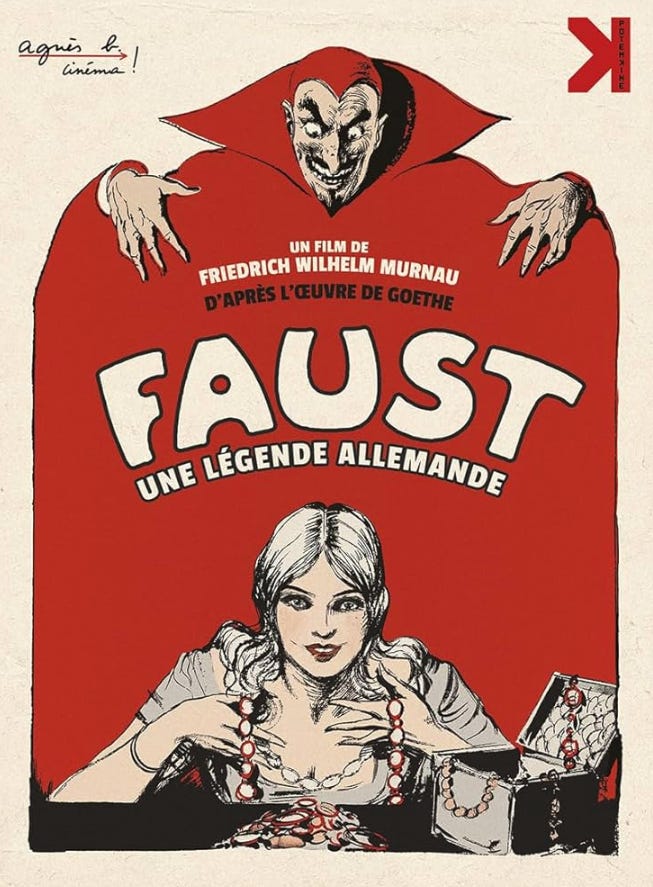
Somehow I am simultaneously a cringe 90s mall goth playing at witchcraft and also a Later-Day Faustus dealing in a damnable deadly game with the Devil himself.
Amazing film BTW (Faust 1926)
“But do you actually believe in the Pagan Gods?”
Yes. Vastly more deeply and in more ways than the vast majority of Christian believe in their religion.
Comments Off on It’s fine to refer to their bead-and-feather superstitious beliefs as a mythology, but not our holy revealed faith!
The Korean War Week 53 – Moscow Says ‘End the War!’ – June 24, 1951
The Korean War by Indy Neidell
Published 24 Jun 2025Soviet Ambassador Jacob Malik speaks to the world on UN radio, saying that the Soviet position on Korea is that ceasefire talks should begin among the belligerents. The Americans are thinking of how they can bring in more non-American UN units, even as South Korean President Syngman Rhee denounces the British and Commonwealth forces and says they should go home.
00:00 Intro
00:41 Recap
01:07 Jacob Malik Speaks
02:02 Chinese Change Plans
03:19 10th Corps Advances
05:37 More Non-American UN Units
07:52 Rhee Denounces his Allies
12:17 Summary
12:40 Conclusion
14:15 Call to action
(more…)
Comments Off on The Korean War Week 53 – Moscow Says ‘End the War!’ – June 24, 1951
Experts – “The shorter, the better”. Audiences – “Gimme more long-form, stat!”
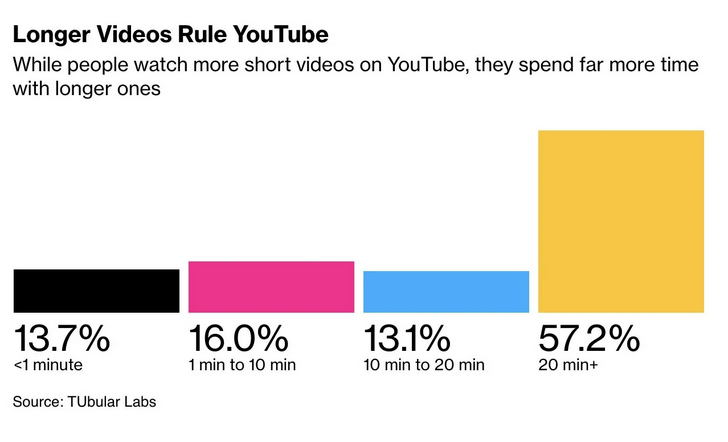
At The Honest Broker, Ted Gioia notes that the experts are all-in on shorter videos, but actual audiences are clearly now more interested in much longer-form treatments:
When I saw the numbers, I couldn’t believe them.
Every digital platform is flooding the market with short videos, but the audience is now spending more time with longform video — and by a huge margin.
Source: Tubular Labs
Some video creators have already figured this out. That’s why the number of videos longer than 20 minutes uploaded on YouTube grew from 1.3 million to 8.5 million in just two years.
That’s a staggering six-fold increase. But even short videos are now getting longer. Social media consultants call this the “long short” format. Sometimes they are used as teasers to draw viewers to still longer media (often on another platform).
Movies are also getting longer. At first glance, that makes no sense — more people are watching films at home on small digital devices, where Hollywood fare has to compete with bite-sized junk from TikTok and Instagram.
You might think that filmmakers would feel forced to compress their storytelling, but the opposite is true. They are learning that audiences crave something longer and more immersive than a TikTok.
At first, Hollywood insiders tried to imitate the ultra-short aesthetic, but they failed — sometimes in colossal fashion. (Does anyone remember the Quibi fiasco?)
Now they not only embrace long films, but happily release sprawling mega-movies longer than the Boston Marathon. Dune Two ran for 166 minutes — not even Eliud Kipchoge does that. Oppenheimer clocked in at 180 minutes. Scorsese’s Killers of the Flower Moon lasted a mind-boggling 206 minutes.
The studios would have vetoed these excesses just a few years ago. Not anymore.
Songs are also getting longer. The top ten hits on Billboard actually increased twenty seconds in duration last year. Five top ten hits ran for more than five minutes.
Two of those long hit songs came from Taylor Swift — who has been a champion of longer immersive musical experiences, most notably in her insanely successful Eras tour. She set the record for the biggest money-generating roadshow in music history, and did it with a performance twice as long as a Mahler symphony.
These Swift concerts run for three-and-a-half hours (just like Scorsese at his most maniacal), and include more than 40 songs. They’re grouped in ten separate acts, each built around a different era in her career.
Ten acts? Really?
Even Wagner stopped short of that. But the Eras tour generated more than $2 billion in revenues. And all this happened while experts were touting 15-second songs on TikTok as the future of music.
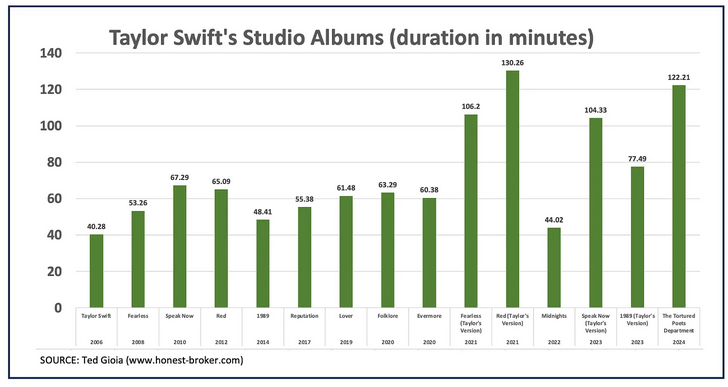
I’ve charted the duration of Swift’s studio albums over the last two decades, and it tells the same story. She has gradually learned that her audience prefers longer musical experiences.
The New York Times complained about the length of her most recent album — calling it “sprawling and often self-indulgent.” It mocked her for believing that “more is more.”
It summed up her whole worldview with a dismissive claim that she has fallen in love with “abundance”. In fact, the Times opened its article with that accusation.
But I note that a year after the Times laughed at Swiftian abundance, the hottest topic in the culture is a book with that same word as its title. (Full disclosure: I’ll be doing a live Substack conversation with its co-author Derek Thompson in a few days.)
Abundance has dominated the New York Times non-fiction bestseller list for the last several months. Even more to the point, the word seems to tap into the public’s hunger for something bigger, deeper, and more expansive than it’s been getting.
Comments Off on Experts – “The shorter, the better”. Audiences – “Gimme more long-form, stat!”
H.G. Wells’ Things To Come: Through The Eyes of its Time
Feral Historian
Published 10 Jan 2025H.G. Wells’ Things To Come played much differently in 1936 than it does today. So much so that it offers us an insight into the politics of the period if we can step back from our post-WWII understanding and look at it on its own terms.
Link to the Coupland essay.
http://digamoo.free.fr/coupland2000.pdf00:00 Intro
02:08 Revolution Envy
05:15 The Gulf of Time
06:32 Wells and the BUF
08:02 Empire and Establishment
12:11 The World State
15:18 To Understand the Past …
Comments Off on H.G. Wells’ Things To Come: Through The Eyes of its Time
QotD: Marie Antoinette and the “Diamond Necklace” scandal
The origins of the affair stretched back to Louis XV, who wished to lavish on his mistress, Madame du Barry, a splendid diamond necklace containing 647 stones and weighing 2,800 carats (worth roughly $15 million today). But Louis XV died before the sale of the necklace was concluded. And when young Louis XVI took the throne, the Paris jewelers Boehmer and Bassenge hoped the new king would purchase the same necklace for his own queen, Marie Antoinette. However, she refused to accept a piece of jewelry that had been created for the previous king’s mistress.
Meanwhile, a socially ambitious minor aristocrat named Jeanne de la Motte was plotting to get her hands on the necklace. Married to the Comte de la Motte, she was also the mistress of Cardinal de Rohan, former French ambassador to Marie Antoinette’s native Austria. Madame de la Motte managed to convince Cardinal de Rohan not only that Marie Antoinette wished to possess the necklace, but that she was acting on the Queen’s behalf. He could ingratiate himself at court, she insisted, by obtaining it. Cardinal Rohan foolishly purchased the necklace on credit, under the naive belief that he’d be repaid by Marie Antoinette. The scam concluded with Madame de la Motte stealing the necklace from the cardinal and, using her husband’s louche connections, selling it in pieces through fences in England.
This tawdry business was closer to comic opera than an affair of state. But when the fraud was discovered, the scandal gripped Parisian society. Louis XVI was so infuriated that he had Cardinal de Rohan arrested and imprisoned in the Bastille, which only heightened public interest. Marie Antoinette was already being caricatured in pamphlets as a depraved nymphomaniac. It was now open season.
In some caricatures, she appeared as a wild beast, a tiger feeding on the French nation. In others, she was depicted as an ostrich, a French wordplay with her home country Autriche, for Austria, which reads like autruche for ostrich. Even worse, she was depicted in pornographic postures, legs open and genitals gaping, cuckolding her obese husband with a succession of lovers, including lesbian trysts. Allusions to her sexual appetites suggested a carnal relationship with Satan. Robespierre’s publication Le Journal des hommes libres described her as “more bloodthirsty than Jezebel, more conniving than Agrippina”. The pamphlets blamed Marie Antoinette for all the nation’s misfortunes, including economic recession. She was so hated by the French public that there were serious concerns for her physical safety.
[…]
Cardinal de Rohan, meanwhile, was tried for his role in the Diamond Necklace affair. Astonishingly, he was acquitted. The scheming Madame de la Motte met a different fate. She was found guilty of theft and sentenced to be whipped and branded on the shoulder with the letter V for voleuse (thief). She was also incarcerated in the Salpêtrière prison in Paris, but escaped to London. In 1789, she published a book, Mémoires justificatifs, a scathing tell-all memoir about Marie Antoinette. It was a good year to attack the French monarchy, for the revolution was just getting going. Madame de la Motte was never returned to France to face justice. Exiled in London, she died in 1791 after falling from a window, apparently fleeing debt collectors. She was buried in St. Mary’s Churchyard in south London.
Matthew Fraser, “Marie Antoinette: Figure of Myth, Magnet for Lies”, Quillette, 2020-06-24.
Comments Off on QotD: Marie Antoinette and the “Diamond Necklace” scandal
June 24, 2025
Political violence increases as the power of the state increases
Many people note that they don’t remember political conflicts being quite so nasty in years past as they are now, but the more power that accretes to the state the higher the perceived — and actual — risk of allowing the state to fall into the hands of your opponents. We’d be far better off if partisans would consider the possibility that the latest addition to state power they support will be used by their political opponents after the next partisan shift in electoral fortunes … if you fear this power in the hands of a Trump, you shouldn’t put it in the hands of a Biden.

As should be obvious to anybody following news about riots, assassinations, and arson attacks, politics have become far too important in America. With government large, growing, and reaching into every nook and cranny of our lives, Americans perceive politics as too much of a high-stakes game to lose. And so, they have divided into hostile camps to make sure their side comes out on top — and some turn ideological conflict into literal war.
A Surge in Political Violence
That point came home to me after Israel launched its preemptive attacks against Iran’s nuclear facilities. My wife’s rabbi (she’s Jewish and I’m not) called me and asked if I was willing to work security during services on Saturday. “No Kings” protests were planned across the country for the day, with the potential to turn nasty at the hands of people who insist anybody wearing a Star of David bears responsibility for the Israeli government’s actions. Tensions were already high after the Molotov cocktail attack on Jews in Boulder, the murder of two Israeli embassy staffers in Washington, D.C., and the firebombing of Pennsylvania Gov. Josh Shapiro’s official residence on the first night of Passover.
So, I spent much of Saturday standing in front of the synagogue, wearing a ballistic vest, with a pistol holstered on one hip and pepper spray on the other.
Underlining the point was that two Minnesota state lawmakers were targeted by an assassin the same Saturday — fatally in the case of one legislator and her husband. The day’s protests were predominantly, but not entirely, peaceful. That’s better than we’ve seen at recent protests against immigration enforcement that turned violent in Los Angeles and Portland, and at some pro-Palestine demonstrations.
That’s all recent. If we go back in time just a little, there’s the bombing of a fertility clinic by an “anti-natalist”; attacks on Tesla cars, dealerships, chargers, and owners by people opposed to Elon Musk’s temporary role in the Trump administration; and, notably, the murder of Brian Thompson, the CEO of UnitedHealthcare. The alleged assassin, Luigi Mangione, has become something of a celebrity.
“Targeted violence is becoming normalized online and in the real world,” warned a December 2024 report from the Network Contagion Research Institute, affiliated with Rutgers University. “Memes, viral content, gamification and the lionization of Luigi Mangione are constructing frameworks that endorse and legitimize violence, encouraging harassment and further acts of violence against corporate figures.”
The report added that “the spread and scope of justifications for murder have significantly eroded what was once a barrier between mainstream society and fringe online communities that supported violence and glorified killers.”
Comments Off on Political violence increases as the power of the state increases


