
Denmark invested heavily in wind power, on the assumption that they could generate enough electricity from their vast wind farms on the North Sea coast to replace other forms of generation. As Bjorn Lomborg points out, it’s not adding up the way the Danes hoped it would:
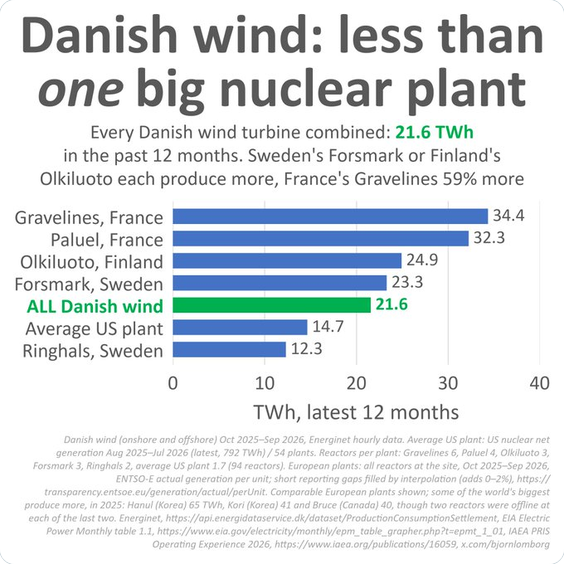
Denmark spent decades building nearly 5,000 wind turbines
Together, they produced 21.6 TWh in the last 12 months
One nuclear plant in Sweden made 23.3 TWh
Oh, and nuclear runs 24/7 — wind doesn’t
There’s one big reason Denmark has some of the most expensive electricity in the world
https://transparency.entsoe.eu/generation/actual/perUnit
https://api.energidataservice.dk/dataset/ProductionConsumptionSettlement
https://eia.gov/electricity/monthly/epm_table_grapher.php?t=epmt_1_01
Krzysztof Szczawinski explains the mistake is the same one that Soviet bureaucrats made repeatedly:
Counting terawatt-hours is the classic communist mistake: measuring quantity instead of value.
The Soviet Union produced record tonnes of steel nobody needed and millions of left shoes. There’s an old Soviet joke: when the nail factory’s quota was set by weight, it produced one giant nail. When it was set by number, it produced millions of tiny useless ones.
What matters in electricity is not how much – it is when. Electricity when it is needed has value. Electricity when nobody needs it has none. Wind turbines often produce exactly then – on a windy night, when demand is low. The price turns negative: the system is literally paying someone to take it, and the surplus only strains the grid. And when the wind stops, someone else has to keep the lights on.
A price is a message: this is needed, now. A negative price says: please, stop. A system that keeps producing anyway isn’t green. It’s deaf.
That’s mental communism applied to energy: the wish before reality.
Regimes that entertain such delusions end up going broke – and then they collapse.


