
OTD Military History
Published 7 Aug 2023The Battle of Amiens started on August 8 1918. It started the process that caused the final defeat of the German Army on the battlefield during World War 1. Many people falsely claimed that the German Army was not defeated on the battlefield but at home by groups that wished to see German fall. One person who helped to create this myth was German General Erich Ludendorff. He called August 8 “the black day of the German Army”.
See how this statement connects to the stab in the back myth connects to Amiens and the National Socialists in Germany.
(more…)
August 8, 2023
How the Battle of Amiens Influenced the “Stab in the Back” Myth
Comments Off on How the Battle of Amiens Influenced the “Stab in the Back” Myth
June 19, 2022
Why Hate Speech Laws Backfire
ReasonTV
Published 26 Feb 2022Here’s a brutal irony about regulating hate speech: Such laws often end up hurting the very people they are supposed to protect.
——————
Follow us on Twitter: https://twitter.com/reasonReason is the planet’s leading source of news, politics, and culture from a libertarian perspective. Go to reason.com for a point of view you won’t get from legacy media and old left-right opinion magazines.
—————-
That’s one of the central lessons in Jacob Mchangama’s important new book, Free Speech: A History from Socrates to Social Media. Mchangama heads up the Danish think tank Justitia. He’s worried about a proposal that would make hate speech a crime under European Union (EU) law and give bureaucrats in Brussels sweeping powers to prosecute people spewing venom at religious and ethnic minorities, members of the LGBT+ community, women, and others.Europe’s history with such laws argues against them. In the 1920s, Germany’s Weimar Republic strictly regulated the press and invoked emergency powers to crack down on Nazi speech. It censored and prosecuted the editor of the anti-Semitic Nazi paper Der Stürmer, Julius Streicher, who used his trial as a platform for spreading his views and his imprisonment as a way of turning himself into a martyr and his cause into a crusade. When the Nazis took power in the early ’30s, Mchangama stresses, they expanded existing laws and precedents to shut down dissent and freedom of assembly.
Contemporary scholarship suggests that there can be a “backlash effect” when governments shut down speech, leading otherwise moderate people to embrace fringe beliefs. Mchangama points to a 2017 study published in the European Journal of Political Research that concluded extremism in Western Europe was fueled in part by “extensive public repression of radical right actors and opinions.”
In 1965, the United Kingdom passed a law banning “incitement to racial hatred,” but one of the very first people prosecuted under it was a black Briton who called whites “vicious and nasty people” in a speech. More recently, Mchangama notes that radical feminists in England “have been charged with offending LGBT+ people because they insist there are biological differences between the sexes. In France, ‘an LGBT+ rights organization was fined for calling an opponent of same-sex marriage a ‘homophobe.'”
“Once the principle of free speech is abandoned,” warns Mchangama, “any minority can end up being targeted rather than protected by laws against hatred and offense.”
That’s what happened in Canada in the 1990s after the Supreme Court there ruled that words and images that “degrade” women should be banned. The decision was based in part on the legal theories of feminist author Andrea Dworkin, whose books on why pornography should be banned were briefly seized by Canadian customs agents under the laws she helped to inspire.
First Amendment rights are still popular in the United States, with 91 percent of us in a recent survey agreeing that “protecting free speech is an important part of American democracy.” But 60 percent of us also said that the government should prohibit people from sharing a racist or bigoted idea.
Hearing hateful words and ideas outrages and discomforts most of us, but Mchangama’s history of free speech underscores that state suppression can grant those words and ideas more power and influence. And that the best antidote to hate in a free and open society is not to hide from it but to openly—and persuasively—confront it.
Listen to my Reason Interview podcast with Jacob Mchangama at https://reason.com/podcast/2022/02/16….
Written by Nick Gillespie. Edited by Regan Taylor.
Comments Off on Why Hate Speech Laws Backfire
November 17, 2021
QotD: From Theda Bara to Lady Gaga
… despite showing acres of pallid flesh in the fetish-bondage garb of urban prostitution, Lady Gaga is far less sexy than Stefani Germanotta used to be. In fact, Gaga isn’t sexy at all — she’s like a gangly marionette or plasticised android. How could a figure so calculated and artificial, so clinical and strangely antiseptic, so stripped of genuine eroticism have become the icon of her generation? Can it be that Gaga represents the exhausted end of the sexual revolution? In Gaga’s manic miming of persona after persona, over-conceptualised and claustrophobic, we may have reached the limit of an era.
In 1933, the critic I.A. Richards, writing about “The Waste Land”, spoke of T.S. Eliot’s “persistent concern with sex, the problem of our generation, as religion was a problem of the last.” After the first world war, sexual experimentation and titillating smart talk became the hallmark of the emancipated new woman, who smoked, drank, bobbed her hair and danced the antic Charleston. Hollywood discovered that sex was great box office — leading to pressure from civic and religious groups for a production code, which movie-makers found ingenious ways to evade.
We are approaching the 100-year anniversary of Hollywood sex: Theda Bara’s incarnation as The Vamp in A Fool There Was (1915), a lurid femme fatale who slew overnight the lingering Victorian ideal of the pure, saintly woman-child, portrayed on screen by Mary Pickford and Dorothy and Lilian Gish. Theda Bara, like Lady Gaga, was a manufactured personality; although the studio publicity department claimed she was born in the Sahara to a French artist and Arabian princess, she was actually Theodosia Goodman, the daughter of a Jewish tailor in Cincinnati.
The sexual icon of 1920s Hollywood was Clara Bow, a madcap flapper who was probably falsely rumoured to have bedded the entire University of Southern California football team. Lithe Louise Brooks, with her signature bobbed hair, made landmark films of decadent eroticism in Germany. Wicked Mae West and lushly buxom Jean Harlow began the tradition of the sex bomb, which continued through Hedy Lamarr to Jane Russell and Marilyn Monroe, whose influence endures around the globe. But the cardinal sexual pioneer was Marlene Dietrich, who exploded on the international scene in 1930 as the heartless cabaret singer of The Blue Angel. In her subsequent films with the director Josef von Sternberg, Marlene toyed with transvestism (based on the drag balls of Weimar Berlin) and created the sophisticated look of hard glamour that remains a staple of fashion magazines.
Marlene was Madonna Louise Ciccione’s idol; the seductive, commanding Marlene permeates Madonna’s brilliant videos of the 1980s and the early ’90s, with their dominatrix, transvestite and bisexual motifs. Madonna wanted to play Marlene on film, but the idea was overruled by Marlene herself, who (as the proud daughter of a Prussian officer) decreed Madonna “too vulgar”.
Weimar cabaret was recreated in the 1972 film Cabaret, based on Christopher Isherwood’s Berlin stories. Bob Fosse’s dazzlingly aggressive choreography in that blockbuster film was adopted by Madonna for her videos and stage shows — all of which have been doggedly imitated by Lady Gaga. Gaga has borrowed so heavily from Madonna (as in her latest “Alejandro” video) that it must be asked, at what point does homage become theft? But the main point is that the young Madonna was on fire. She was indeed the imperious Marlene Dietrich’s true heir. Madonna’s incandescence is still on view in videos like “Open Your Heart”, “Vogue” and “Express Yourself”. However, for Gaga, sex is mainly decor and surface; she’s like a laminated piece of ersatz rococo furniture. Alarmingly, Generation Gaga can’t tell the difference. Is it the death of sex? Perhaps the symbolic status that sex had for a century has gone kaput; that blazing trajectory is over.
Camille Paglia, “Lady Gaga: The Death of Sex”, Sunday Times, 2010-09-12.
Comments Off on QotD: From Theda Bara to Lady Gaga
October 12, 2021
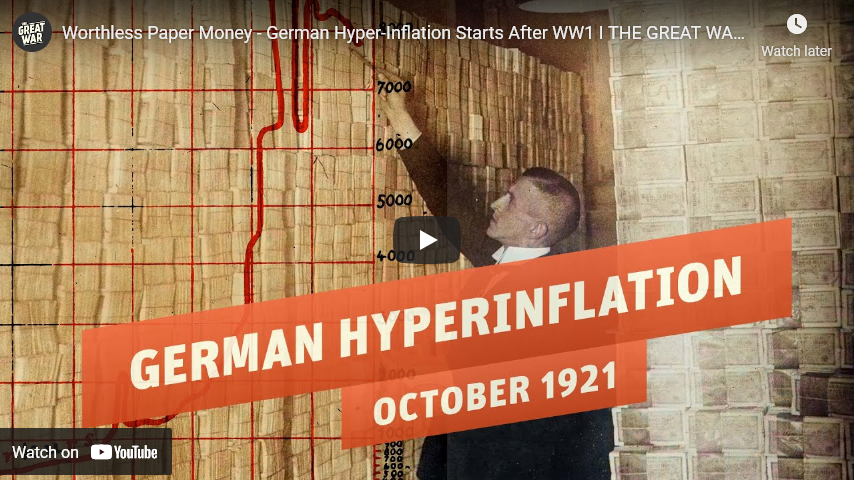
Worthless Paper Money – German Hyper-Inflation Starts After WW1 I THE GREAT WAR 1921
The Great War
Published 8 Oct 2021Sign up for Curiosity Stream and get Nebula bundled in and SAVE 26%: https://curiositystream.com/thegreatwar
The German post-WW1 economy was under pressure: the loss of territory, the war bonds issued during the war and the reparations under the Treaty of Versailles. All this lead to a downward spiral of rising inflation and living costs for German citizens.
» SUPPORT THE CHANNEL
Patreon: https://www.patreon.com/thegreatwar
Shop: https://www.realtimehistory.net» OUR PODCAST
https://realtimehistory.net/podcast – interviews with World War 1 historians and background info for the show.» BUY OUR SOURCES IN OUR AMAZON STORES
https://realtimehistory.net/amazon *
*Buying via this link supports The Great War (Affiliate-Link)» SOURCES
Feldman, Gerald: Vom Weltkrieg zur Weltwirtschaftskrise. Studien zur deutschen Wirtschafts-und Sozialgeschichte 1914-1932. 1984.Fergusson, Adam: Das Ende des Geldes. Hyperinflation und ihre Folgen für die Menschen am Beispiel der Weimarer Republik, 1975.
Grosch, Waldemar: Deutsche und polnische Propaganda während der Volksabstimmung in Oberschlesien 1919-1921. 2002.
Lewek, Peter: Arbeitslosigkeit und Arbeitslosenversicherung in der Weimarer republik 1918-1927. 1989.
Michalczyk, Andrezej: Celebrating the nation: the case of Upper Silesia after the plebiscite in 1921.
Neubach, Helmut: Die Abstimmung in Oberschlesien am 20. März 1921. 2002.
» MORE THE GREAT WAR
Website: https://realtimehistory.net
Instagram: https://instagram.com/the_great_war
Twitter: https://twitter.com/WW1_Series
Reddit: https://reddit.com/r/TheGreatWarChannel»CREDITS
Presented by: Jesse Alexander
Written by: Jesse Alexander
Director: Toni Steller & Florian Wittig
Director of Photography: Toni Steller
Sound: Toni Steller
Editing: Jose Gamez
Motion Design: Philipp Appelt
Mixing, Mastering & Sound Design: http://above-zero.com
Maps: Daniel Kogosov (https://www.patreon.com/Zalezsky)
Research by: Jesse Alexander
Fact checking: Florian WittigChannel Design: Yves Thimian
Contains licensed material by getty images
All rights reserved – Real Time History GmbH 2021
Comments Off on Worthless Paper Money – German Hyper-Inflation Starts After WW1 I THE GREAT WAR 1921
September 2, 2021
Road to WWII: A Basic Causal Analysis
Thersites the Historian
Published 19 Nov 2019This video is a primer for undergraduates in broad history survey courses that will hopefully help make sense of the interwar years between World War I and World War II.
Patreon link: https://www.patreon.com/thersites
PayPal link: paypal.me/thersites
Twitter link: https://twitter.com/ThersitesAthens
Minds.com link: https://www.minds.com/ThersitestheHis…
Steemit/dtube link: https://steemit.com/@thersites/feed
BitChute: https://www.bitchute.com/channel/jbyg…
Backup Channel: https://www.youtube.com/channel/UCUrD…
Comments Off on Road to WWII: A Basic Causal Analysis
August 7, 2021
QotD: “The English spoke of the ‘German custom’, the French referred to the vice allemande, and Italians called gay men and women ‘Berlinese'”
The Weimar Republic, the zenith of modernism, witnessed new social liberalization and experimentation. Fritz Lang premiered his Expressionist film Metropolis in 1927, Alfred Döblin published his dizzyingly innovative novel Berlin Alexanderplatz in 1929, and the following year Hannah Höch unveiled her Dadaist photomontage Marlene. And alongside reinventing traditional forms of artistic expression, Germans began interrogating gender roles and sexual identities. As the historian Clayton Whisnant observes, “Perhaps more than anywhere else, Weimar Germany became associated with experimentation in sexuality.” Berlin was the undisputed queer capital of Europe. By 1900, over fifty thousand gay men and lesbians lived there, and countless more visited, looking for friendship, love, and sex. By 1923, some hundred gay bars in Berlin catered to diverse groups: men and women, the old and the young, the affluent and the working class. Nightclubs like the Mikado, the Zauberflöte, and the Dorian Gray became international hot spots, and the city’s elaborate queer balls attracted worldwide attention. Associations offered opportunities for socializing and political organization. Crucially, relaxed rules of censorship allowed for the publication of dozens of pulpy gay novels, queer periodicals, and even personal ads. The British writer Christopher Isherwood, whose account of his thirties stay in Germany inspired the musical Cabaret, put it simply: “Berlin meant boys.” In 1928, the poet W. H. Auden similarly described the German capital as “the bugger’s daydream.” In her famous guide to the Berlin lesbian scene from the same year, Ruth Margarete Roellig concluded, “Here each one can find their own happiness, for they make a point of satisfying every taste.”
The experience was different for trans people. The Third Sex [likely the world’s first magazine devoted to trans issues] bore the subtitle “The Transvestites”, but at the time, the historian Laurie Marhoefer notes, the term meant different things to different people. German speakers were in the middle of developing a critical vocabulary to describe the expansion of recognized identities. Karl-Maria Kertbeny coined the word homosexual in 1869, and in 1910 Magnus Hirschfeld invented the term transvestite. It described both cross-dressers and transgender people. According to contemporary self-reports, some transvestites considered themselves homosexual, but most did not. Many wore clothes traditionally associated with the opposite sex only on special occasions. Others lived fully as a gender different from their sex at birth. A majority seemed interested in passing and adhering to expectations of respectability, while a minority sought to challenge the normative order. Gender affirmation surgeries were available — the first such operation was conducted in 1920 by, no surprise, a German doctor — but uncommon. From today’s perspective, it is therefore unclear whether an individual who identified as a transvestite in thirties Germany, including Hans Hannah Berg, was what we would today consider transgender, nonbinary, a cross-dresser, or something else altogether. In the very first issue of The Third Sex, an essay by Dr. Wegner acknowledges the richness of the term. “Just as people are all different in their outward appearance and inner attitudes, so are the characteristics of transvestites.” Many queer activists in the Weimar Republic were concerned that the population of gender variant people was too fragmented. Trans people were not as visible or as organized as gays and lesbians. Friedrich Radszuweit, the leader of the Federation for Human Rights and the publisher of several queer periodicals, saw a solution. To foster a trans community, he produced The Third Sex.
Matthew H. Birkhold, “A Lost Piece of Trans History”, The Paris Review, 2019-01-15.
Comments Off on QotD: “The English spoke of the ‘German custom’, the French referred to the vice allemande, and Italians called gay men and women ‘Berlinese'”
July 21, 2021
June 3, 2021
The Supernatural Adventures of Arthur Conan Doyle | B2W:ZEITGEIST! I E.19 Spring – 1923
TimeGhost History
Published 2 Jun 2021Being the creator of the legendary Sherlock Holmes has made Arthur Conan Doyle famous for his scientific rationality. But Doyle also has a deeply held belief in the existence of the spirit universe. In a world still reeling from the shock of the Great War, he is not alone.
(more…)
Comments Off on The Supernatural Adventures of Arthur Conan Doyle | B2W:ZEITGEIST! I E.19 Spring – 1923
January 20, 2021
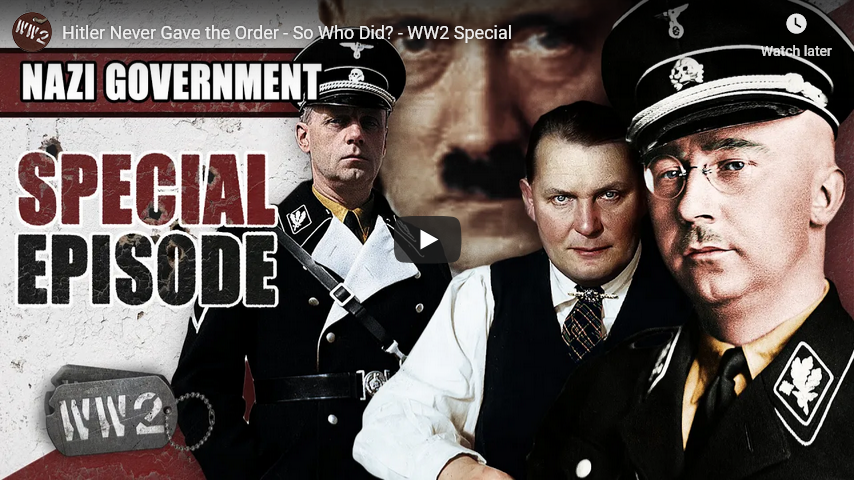
Hitler Never Gave the Order – So Who Did? – WW2 Special
World War Two
Published 19 Jan 2021The structure of decision-making in the Nazi Party and the German government is clouded in ambiguity and implicit power-structures. We explore how this leads to a rat-race, resulting in an endless spiral of irrational decisions and violence.
Join us on Patreon: https://www.patreon.com/TimeGhostHistory
Or join The TimeGhost Army directly at: https://timeghost.tvFollow WW2 day by day on Instagram @ww2_day_by_day – https://www.instagram.com/ww2_day_by_day
Between 2 Wars: https://www.youtube.com/playlist?list…
Source list: http://bit.ly/WW2sourcesWritten by: Joram Appel and Spartacus Olsson
Hosted by: Spartacus Olsson
Director: Astrid Deinhard
Producers: Astrid Deinhard and Spartacus Olsson
Executive Producers: Astrid Deinhard, Indy Neidell, Spartacus Olsson, Bodo Rittenauer
Creative Producer: Maria Kyhle
Post-Production Director: Wieke Kapteijns
Research by: Joram Appel
Edited by: Iryna Dulka
Sound design: Marek Kamiński
Map animations: Eastory (https://www.youtube.com/c/eastory)Colorizations by:
– Dememorabilia – https://www.instagram.com/dememorabilia/
– Olga Shirnina, a.k.a. Klimbim – https://klimbim2014.wordpress.com/
– Julius Jääskeläinen – https://www.facebook.com/JJcolorization/Sources:
– Yad Vashem 4331_15, 7283-146, 48AO4Soundtracks from the Epidemic Sound:
– Philip Ayers – “Ominous”
– Howard Harper-Barnes- “Underlying Truth”
– Craft Case – “Secret Cargo”
– Rannar Sillard – “Split Decision”
– Farrell Wooten – “Mystery Minutes” (STEMS INSTRUMENTS)
– Jon Bjork – “For the Many” (STEMS INSTRUMENTS)
– Philip Ayers – “Trapped in a Maze”Archive by Screenocean/Reuters https://www.screenocean.com.
A TimeGhost chronological documentary produced by OnLion Entertainment GmbH.
Comments Off on Hitler Never Gave the Order – So Who Did? – WW2 Special
August 30, 2020
Andrew Sullivan – “… let’s be frank about this and call this by its name: this is very Weimar. The center has collapsed.”
In the latest Weekly Dish, Andrew Sullivan finds himself in agreement with Marcus Aurelius: “The object of life is not to be on the side of the majority, but to escape finding oneself in the ranks of the insane.”
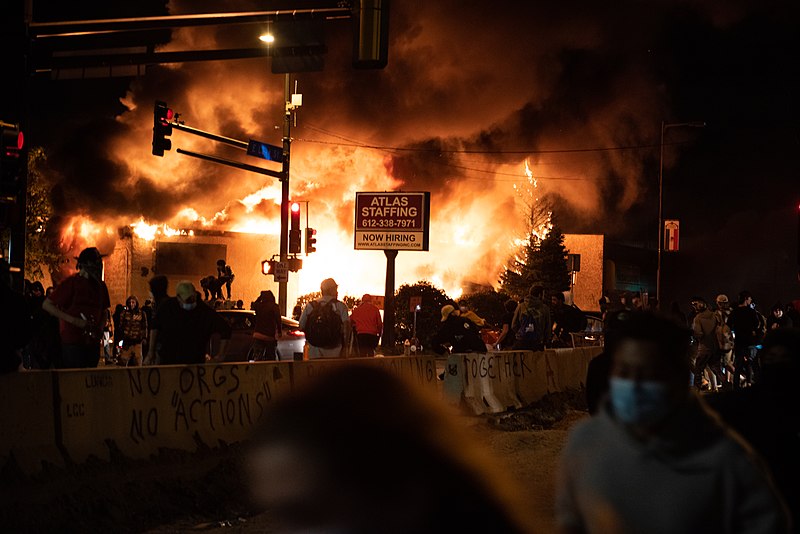
A building burning in Minneapolis following the death of George Floyd.
Photo by Hungryogrephotos via Wikipedia.
I don’t think I’m the only one, as even the Democrats seem now to realize. And this massive blindspot is not hard to understand. When a political party finds itself so wedded to a new and potent ideology it cannot call out violence when it sees it, then it is walking straight into a trap. When the discourse on the left has become one in which scholars and editors and Tweeters vie with one another to up the ante on how inherently evil America has always been, redescribe it as a slaveocracy, and endorse racist books that foment the most egregious stereotypes about “whiteness”, most ordinary people, who love their country and are mostly proud of its past, will rightly balk. One of the most devastating lines in president Trump’s convention speech last night was this: “Tonight, I ask you a very simple question: How can the Democrat Party ask to lead our country when it spends so much time tearing down our country?” A cheap shot, yes. But in the current context, a political bullseye.
The key theme of the RNC was reminding people of the American narrative that once was. Yes, it was unbelievably vulgar. Yes, it looked like a cross between a sophisticated CGI video-game and a crude car dealer ad with a dollop of Leni Riefenstahl. But it was extremely effective. To see that, you have to remove your frontal cortex and put it in a jar, accept that it’s all going to be a series of lies so massive they stupefy us into stutters, and then cop the feels. Pence gave us a vision of America that was a souped up Disney special from the early 1960s — from Fort McHenry no less. And look at the icons Trump invoked: Wyatt Earp, Annie Oakley, Davy Crockett, and Buffalo Bill. You can mock. But in the midst of a culture being redescribed by the left as a form of foul and relentless “white supremacy”, and in a moment of arson and rioting, it felt like a kind of balm.
All this reassurance played out against a backdrop of Kenosha, which was burning, and Minneapolis, where a suicide led to a bout of opportunistic looting, and Washington DC, where mobs of wokesters went through the city chanting obscenities, invading others’ spaces, demanding bystanders raise fists in solidarity, with occasional spasms of violence. These despicable fanatics, like it or not, are now in part the face of the Democrats: a snarling bunch of self-righteous, entitled bigots, chanting slogans rooted in pseudo-Marxist claptrap, erecting guillotines — guillotines! — in the streets as emblems of their agenda. They are not arguing; they are attempting to coerce. And liberals, from the Biden campaign to the New York Times, are too cowardly and intimidated to call out these bullies and expel them from the ranks.
[…]
And let’s be frank about this and call this by its name: this is very Weimar. The center has collapsed. Armed street gangs of far right and far left are at war on the streets. Tribalism is intensifying in every nook and cranny of the culture. The establishment right and mainstream left tolerate their respective extremes because they hate each other so much.
The pattern is textbook, if you learn anything from history: an economic crisis resulting in mass unemployment; the pent-up psychological disorders a long period of lockdown can and will unleash; a failure of nerve on the part of liberals to defend the values and institutions of liberal democracy, and of conservatives to keep their own ranks free of raw demagogues and bigots. But critically: a growing sense of disorder and violence and rioting as simply the background noise; and a sense that authorities do not have the strength or the stomach to restore order. What most people want in that kind of nerve-wracking instability is a figure who will come in and stamp it out. In Trump, we have someone who would happily trample any liberal democratic norm to do it. And the left seems to be all but begging him to do it — if only to prove them right.
A long time ago, I was mocked for saying that I believed that the election of Donald Trump was an extinction-level event for liberal democracy. But this is where we are. There is no place for liberal debate or dissent, just competing mobs deploying propaganda, intimidation and mutual racial hatred. Norms are trashed, from the shameful cooptation of national monuments for partisan purposes, to violating the privacy and peace of ordinary citizens because they are not in the ranks of agitators. Liberals are now illiberal; conservatives are revolutionaries. The Republican convention we are witnessing makes no pretense of even publishing a platform — all to demonstrate total and unfailing fealty to the leader whose own family is now assumed to succeed him. What about this pattern of events do we not already understand?
August 13, 2020
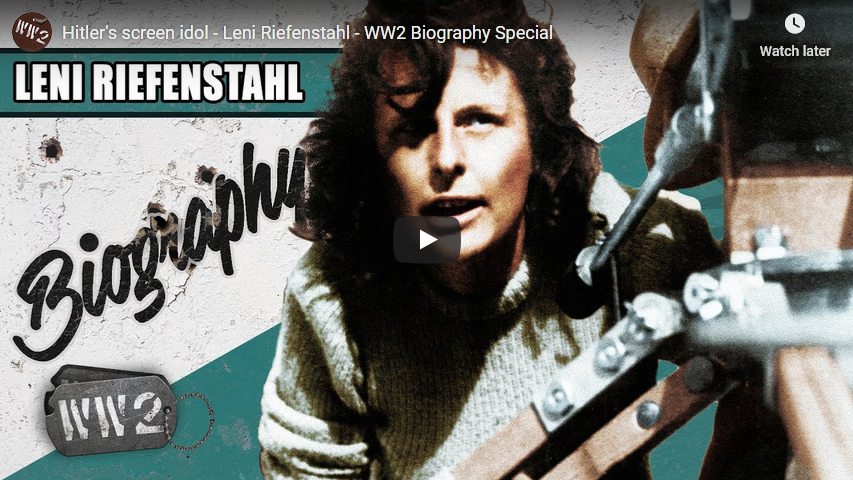
Hitler’s screen idol – Leni Riefenstahl – WW2 Biography Special
World War Two
Published 12 Aug 2020Leni Riefenstal’s film techniques were groundbreaking and are still influential today. She did, though, create her most famous works in the service of Adolf Hitler.
Join us on Patreon: https://www.patreon.com/TimeGhostHistory
Or join The TimeGhost Army directly at: https://timeghost.tvFollow WW2 day by day on Instagram @World_war_two_realtime https://www.instagram.com/world_war_two_realtime
Between 2 Wars: https://www.youtube.com/playlist?list…
Source list: http://bit.ly/WW2sourcesWritten and Hosted by: Indy Neidell
Director: Astrid Deinhard
Producers: Astrid Deinhard and Spartacus Olsson
Executive Producers: Astrid Deinhard, Indy Neidell, Spartacus Olsson, Bodo Rittenauer
Creative Producer: Joram Appel
Post-Production Director: Wieke Kapteijns
Research by: Madeline Johnson
Edited by: Monika Worona
Sound design: Marek Kamiński
Map animations: Eastory (https://www.youtube.com/c/eastory)Colorizations by:
– Norman Stewart – https://oldtimesincolor.blogspot.com/
– Olga Shirnina, a.k.a. Klimbim – https://klimbim2014.wordpress.com/Sources:
– BundesarchivArchive by Screenocean/Reuters https://www.screenocean.com.
A TimeGhost chronological documentary produced by OnLion Entertainment GmbH.
From the comments:
World War Two
4 hours ago
Thanks to Madeline Johnson for the research for this episode. In many ways it’s our community who keep TimeGhost going. If you want to be part of this then join the TimeGhost Army on www.patreon.com/timeghosthistory or https://timeghost.tv.Please let us know what other Bios you’d like to see. And if you have a question about the war you’re dying to have answered, submit it for our Q&A series, Out of the Foxholes at: https://community.timeghost.tv/c/Out-of-the-Foxholes-Qs.
Comments Off on Hitler’s screen idol – Leni Riefenstahl – WW2 Biography Special
July 13, 2020
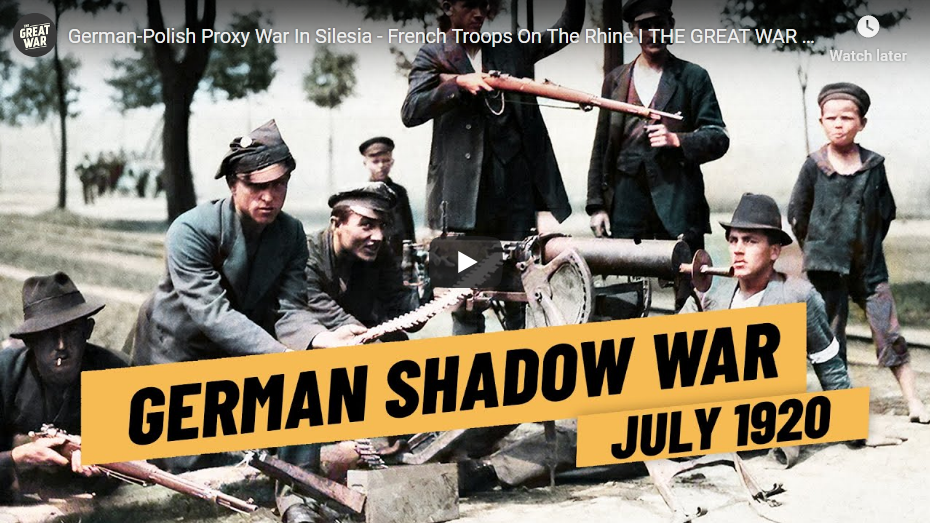
German-Polish Proxy War In Silesia – French Troops On The Rhine I THE GREAT WAR 1920
The Great War
Published 11 Jul 2020Sign up for Curiosity Stream and get Nebula bundled in: https://curiositystream.com/thegreatwar
The summer of 1920 was marked by escalating tensions on the borders of the German Reich. In the Rhineland, a neutral zone per the Versailles Treaty, the revolutionary uprising after the failed Kapp Putsch was put down with the help of the army and the Freikorps. In Upper Silesia, the conflict between Poland and Germany was escalating into a proxy war. And all that while the German government was negotiating the payments of reparations at the Spa Conference.
» SUPPORT THE CHANNEL
Patreon: https://www.patreon.com/thegreatwar» OUR PODCAST
https://realtimehistory.net/podcast – interviews with World War 1 historians and background info for the show.» BUY OUR SOURCES IN OUR AMAZON STORES
https://realtimehistory.net/amazon *
*Buying via this link supports The Great War (Affiliate-Link)» SOURCES
Buat, Edmond. 8 (Perrin, 2015)
Beaupré, Nicolas. Occuper l’Allemagne après 1918 (Revue historique des armées, 2009)
Böhler, Jochen. Civil War in Central Europe, 1918-1921 (Oxford University Press, 2019)
Gietinger, Klaus. Kapp-Putsch (Stuttgart: Schmetterling, 2020)
le Naour, Jean Yves. La Honte Noire (Hachette, 2004)
Le Figaro, numéro du 8 avril 1920 (via Gallica)
Stengers, Jean. L’accord militaire franco-belge de 1920 et le Luxembourg (Revue belge de de Philologie et d’Histoire, 2004)
https://www.dhm.de/lemo/jahreschronik…
Pöppinghege, Rainer: Republik im Bürgerkrieg. Kapp-Putsch und Gegenbewegung an Ruhr und Lippe 1919/1920 (2019)
van Galen Last, Dick. Des soldats noirs dans une guerre de blancs (1914-1922): une histoire mondiale (Editions de l’Université de Bruxelles, 2015)» MORE THE GREAT WAR
Website: https://realtimehistory.net
Instagram: https://instagram.com/the_great_war
Twitter: https://twitter.com/WW1_Series
Reddit: https://reddit.com/r/TheGreatWarChannel»CREDITS
Presented by: Jesse Alexander
Written by: Jesse Alexander
Director: Toni Steller & Florian Wittig
Director of Photography: Toni Steller
Sound: Toni Steller
Editing: Toni Steller
Motion Design: Philipp Appelt
Mixing, Mastering & Sound Design: http://above-zero.com
Maps: Daniel Kogosov (https://www.patreon.com/Zalezsky)
Research by: Jesse Alexander
Fact checking: Florian WittigChannel Design: Alexander Clark
Original Logo: David van StepholdContains licensed material by getty images
All rights reserved – Real Time History GmbH 2020
Comments Off on German-Polish Proxy War In Silesia – French Troops On The Rhine I THE GREAT WAR 1920
June 18, 2020
The origins of Antifa
Kyle Shideler outlines the history of Antifa from the Weimar Republic to the streets of cities all over the western world:
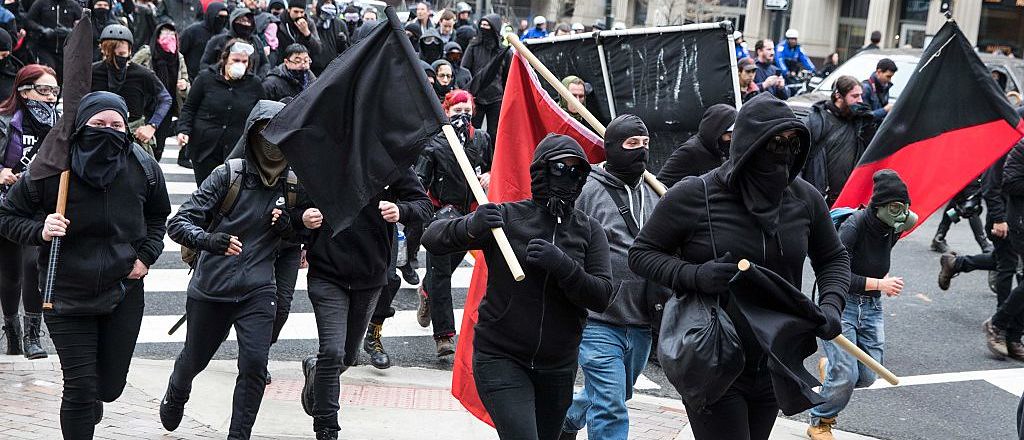
“antifa 8973ag” by cantfightthetendies is licensed under CC BY 2.0

With riots and civil unrest metastasizing across the United States, the president declared he intends to designate Antifa as a terrorist group. Predictably, the talking heads rushed out to declare that Antifa doesn’t really exist, and even if it did the president couldn’t possibly target it using that legal designation. They argue Antifa is an amorphous blob of discontents, not a functioning organization, and certainly not one which could be designated and targeted for concentrated counterterrorism enforcement.
As usual, the Twitterati don’t know what they are talking about. Reality is both simpler and more complex.
To begin at the beginning: Antifa — real name: Antifaschisitsche Aktion — was born during the street-fights of the 1932 Weimar Republic. It was founded by the Stalinist Communist Party of Germany (KPD), although various Communist “anti-fascist defense” units were associated with the KPD much earlier.
Anti-fascist Action’s sole purpose was to help the KPD combat other political parties for control of the streets in the revolutionary politics of the rapidly failing Weimar Republic.
And yes, they fought the Nazis.
But they also fought liberal parties, conservative parties, and anyone and everyone who got in their way. While these early antecedents were short-lived, it is useful to view Antifa in this context. More than anything, Antifa exists to serve as a tool of revolutionary politics in a failed (or failing) state.
Antifa would reestablish itself in the early 1980s, also in Germany, out of Autonomism. Autonomism is an anti-authoritarian anarcho-Marxist ideology associated with the Communist urban guerilla organizations of 1970s and ’80s Europe like Red Army Faction and the Red Brigade. Autonomism would find a home among the young punks of Germany’s squatters’ rights movement. Around this time, Antifa tactics like the “black block,” where large numbers of rioters dress in black and move together in formation as part of a larger protest, were developed.
H/T to Rafe Champion for the link.
Comments Off on The origins of Antifa
May 30, 2020
QotD: The “Americanization” of German philosophy
Allan Bloom, The Closing of the American Mind, 1987.
Comments Off on QotD: The “Americanization” of German philosophy
March 1, 2020
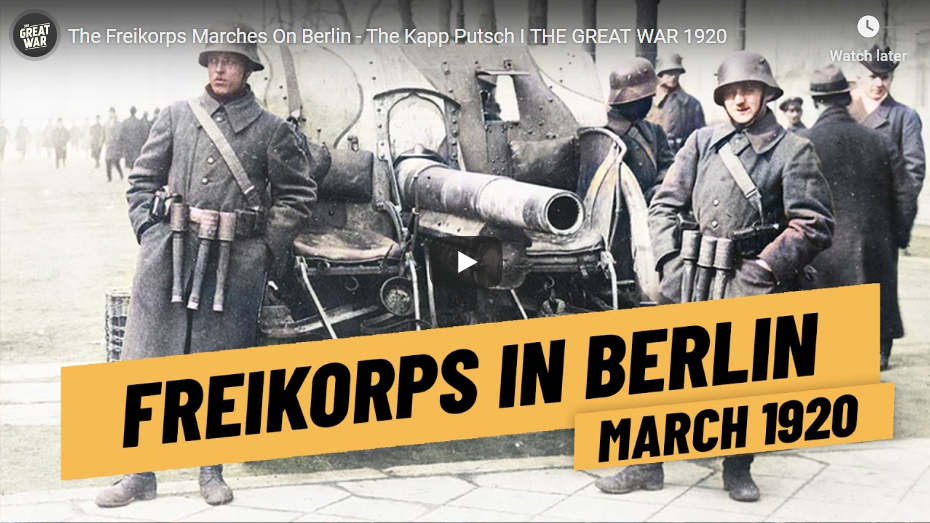
The Freikorps Marches On Berlin – The Kapp Putsch I THE GREAT WAR 1920
The Great War
Published 28 Feb 2020Sign up for Curiosity Stream and Nebula: https://curiositystream.com/thegreatwar
Dissatisfied with the new German Republic and the terms of the Treaty of Versailles, parts of the new Reichswehr and the paramilitary Freikorps decide to take matters into their own hands. The Marinebrigade Ehrhardt marches on Berlin to topple the government: It’s the Kapp Putsch.
» SUPPORT THE CHANNEL
Patreon: https://www.patreon.com/thegreatwar
Merchandise: https://shop.spreadshirt.de/thegreatwar/» SOURCES
Grevelhörster, Ludwig: Kleine Geschichte der Weimarer Republik. 1918-1933. Ein
problemgeschichtlicher Überblick, 2000.
Haffner, Sebastian: Die Deutsche Revolution 1918/1919. 2010.
Heiden, Konrad: Adolf Hitler: Das Zeitalter der Verantwortungslosigkeit. Ein Mann gegen
Europa, 2016.
Kotowski, Georg (Hrsg.): Historisches Lesebuch. 1914-1933, 1968.
Möller, Horst: Die Weimarer Republik. Demokratie in der Krise, 2018.
Pöppinghege, Rainer: Republik im Bürgerkrieg. Kapp-Putsch und Gegenbewegung an Ruhr
und Lippe 1919/1920, 2019.
Stackelberg, Roderick & Winkle, Sally (Ed.), The Nazi Germany Sourcebook: An Anthology of Texts, (Florence : Taylor and Francis, 2003)
Ulrich, Volker: Adolf Hitler. Band 1: Die Jahre des Aufstiegs 1889-1939. 2013.
Sturm, Reinhard (2011). “Weimarer Republik, Informationen zur politischen Bildung”. Bonn: Bundeszentrale für politische Bildung.» SOCIAL MEDIA
Instagram: https://instagram.com/the_great_war
Twitter: https://twitter.com/WW1_Series
Reddit: https://reddit.com/r/TheGreatWarChannel»CREDITS
Presented by: Jesse Alexander
Written by: Mark Newton
Director: Toni Steller & Florian Wittig
Director of Photography: Toni Steller
Sound: Toni Steller
Editing: Toni Steller
Mixing, Mastering & Sound Design: http://above-zero.com
Maps: Daniel Kogosov (https://www.patreon.com/Zalezsky)
Research by: Markus Linke
Fact checking: Florian WittigChannel Design: Alexander Clark
Original Logo: David van StepholdA Mediakraft Networks Original Channel
Contains licensed material by getty images
All rights reserved – Real Time History GmbH 2020
Comments Off on The Freikorps Marches On Berlin – The Kapp Putsch I THE GREAT WAR 1920


