Quotulatiousness

March 15, 2019

Big business and the rise of Hitler and the Nazi party

Filed under: Books, Business, Germany, History — Tags: , , , — Nicholas @ 03:00

Alec Stapp reviews a new book by Tim Wu which contends that big business in the US is going to enable the rise of fascism just as it did in Germany in the 1930s … except that wasn’t how it happened in the Weimar Republic:

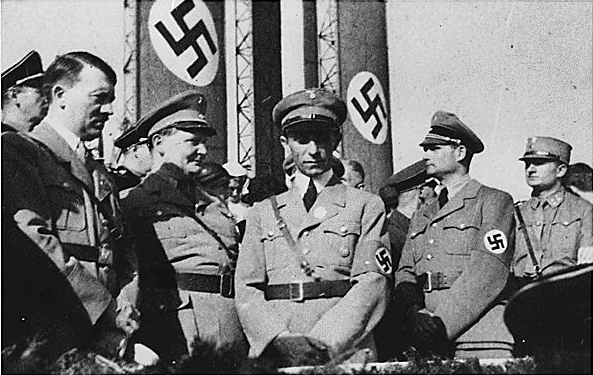
Hitler, Göring, Goebbels and Hess.
Photo via Wikimedia Commons.

The recent increase in economic concentration and monopoly power make the United States “ripe for dictatorship,” claims Columbia law professor Tim Wu in his new book, The Curse of Bigness. With the release of Senator Elizabeth Warren’s proposal to “break up” technology companies like Amazon and Google, fear of bigness is clearly on the rise. Professor Wu’s book adds a new dimension to that fear, arguing that cooperation between political and economic power are “closely linked to the rise of fascism” because “the monopolist and the dictator tend to have overlapping interests.” Economist Hal Singer calls this the book’s “biggest innovation.”

The argument is provocative, but wrong. As I show below, the claim that big business contributed to the rise of the Nazi Party is simply inconsistent with the consensus among German historians. While there is some evidence industrial concentration contributed in Hitler’s ability to consolidate power after he was appointed chancellor in 1933, there is no evidence monopolists financed Hitler’s rise to power, and ample evidence showing industry leaders opposed his ascent.

Thomas Childers, a professor of history at the University of Pennsylvania, calls the idea that Hitler was bankrolled by big corporate donors a “persistent myth.” This, among myriad other reasons, should give us pause before comparing 1930s Germany to the present-day United States. If fascism does come to the United States, big business won’t be to blame.

[…]

In the run-up to the presidential election in the spring of 1932, Hitler gave a speech to “a gathering of some 650 members of the Düsseldorf Industry Club in the grand ballroom of Düsseldorf’s Park Hotel.” British historian Sir Ian Kershaw recounts the event in Hitler: A Biography (p. 224):

    Hitler’s much publicized address … did nothing, despite the later claims of Nazi propaganda, to alter the skeptical stance of big business. The response to his speech was mixed. But many were disappointed that he had nothing new to say, avoiding all detailed economic issues by taking refuge in his well-trodden political panacea for all ills. And there were indications that workers in the party were not altogether happy at their leader fraternizing with industrial leaders. Intensified anti-capitalist rhetoric, which Hitler was powerless to quell, worried the business community as much as ever. During the presidential campaigns of spring 1932, most business leaders stayed firmly behind Hindenburg, and did not favour Hitler … The NSDAP’s funding continued before the ‘seizure of power’ to come overwhelmingly from the dues of its own members and the entrance fees to party meetings. Such financing as came from fellow-travellers in big business accrued more to the benefit of individual Nazi leaders than the party as a whole. Göring, needing a vast income to cater for his outsized appetite for high living and material luxury, quite especially benefited from such largesse. Thyssen in particular gave him generous subsidies, which Göring — given to greeting visitors to his splendrously adorned Berlin apartment dressed in a red toga and pointed slippers, looking like a sultan in a harem — found no difficulty in spending on a lavish lifestyle.

As Ralph Raico, a professor of history at Buffalo State College, points out, the aim of these “relatively minor subsidies” to particular Nazis “was to assure (the donors) of ‘friends’ in positions of power, should the Nazis enter the state apparatus.” In Hitler: Ascent, 1889-1939, German historian and journalist Volker Ullrich details the extent of the industrialists’ support for center-right parties during the time of the Düsseldorf speech (p. 292):

    [T]he American historian Henry A. Turner and others following in his footsteps have corrected this outmoded narrative about the relationship between National Socialism and major German industry. By no means had the entire economic elite of the Ruhr Valley attended Hitler’s speech… The crowd’s reaction to Hitler was also by no means as positive as (Nazi Press Chief Otto) Dietrich’s report had its readers believe. When Thyssen concluded his short word of thanks with the words “Heil, Herr Hitler,” most of those in attendance found the gesture embarrassing. Hitler’s speech also did little to increase major industrialists’ generosity when it came to party donations. Even Dietrich himself admitted as much in his far more sober memoirs from 1955: “At the ballroom’s exit, we asked for donations, but all we got were some well-meant but insignificant sums. Above and beyond that there can be no talk of ‘big business’ or ‘heavy industry’ significantly supporting, to say nothing of financing, Hitler’s political struggle.” On the contrary, in the spring 1932 Reich presidential elections, prominent representatives of industry like Krupp and Duisberg came out in support of Hindenburg and donated several million marks to his campaign.

The period immediately following Hitler’s speech to the Düsseldorf Industry Club was similarly fruitless for fundraising, as Richard J. Evans, a professor of history at the University of Cambridge, describes in The Coming of the Third Reich (p. 245):

    Neither Hitler nor anyone else followed up the occasion with a fund-raising campaign amongst the captains of industry. Indeed, parts of the Nazi press continued to attack trusts and monopolies after the event, while other Nazis attempted to win votes in another quarter by championing workers’ rights. When the Communist Party’s newspapers portrayed the meeting in conspiratorial terms, as a demonstration of the fact that Nazism was the creature of big business, the Nazis went out of their way to deny this, printing sections of the speech as proof of Hitler’s independence from capital. The result of all this was that business proved not much more willing to finance the Nazi Party than it had been before.

Hitler lost the spring 1932 presidential election to Hindenburg. But the Nazi party achieved a plurality of seats in parliament for the first time in the July 1932 elections. Unable to form a government without Nazi cooperation after yet another round of elections in November 1932, Hindenburg appointed Hitler chancellor on January 30, 1933. With Hitler now in power, things changed.

In a 2014 review, Larry Schweikart wrote:

Still, more than a few voices critical of such historical hanky-panky have been raised. Perhaps the most influential is that of Henry A. Turner, Jr., who has provided an accurate and verifiable history of the Weimar period in his German Big Business and the Rise of Hitler. Turner sensibly avoids class struggle as a theme and simply asks if big business liked Hitler. Did business leaders support him? Did they give him money? Turner concludes that they did not. Only “through gross distortion can big business be accorded a crucial, or even major, role in the downfall of the Republic” (p. 340). Turner claims that bias “appears over and over again in treatments of the political role of big business even by otherwise scrupulous historians” (p. 350).

In his own examination of the evidence, Turner looked at the correspondence of German business leaders, minutes of their meetings, and their contributions. While it might be reassuring for some to think that Hitler came to power through the financial support of a few evil businessmen, the facts are that most of the Nazis’ money came from the German people. Turner carefully dis­cusses Hitler’s policy stances toward business. Hitler was always wary of alienating the business­men, but his failure to present a clear, procapitalistic economic program made the corporate leaders all the more leery of him. Modern Marx­ists, quite naturally, would like to implicate capitalism in the Holocaust. But, of course, Hitler’s themes were those of Stalin and, in our own day, Gorbachev. Nazism, as Turner suggests but never makes sufficiently clear, resembled Marxism in many ways, including Jew-hatred and hostility to the individual. In any case, Turner’s book has completely refuted the accepted notions that German corporations supported Hitler.

H/T to Colby Cosh for the initial link.

February 14, 2019

New Wars and Revolutions – Demobilisation I THE GREAT WAR January 1919

The Great War
Premiered 88 minutes ago

In our first new episode, our host Jesse takes a look at the German Revolution of 1918/1919 and how the Spartacists under Karl Liebknecht and Rosa Luxemburg tried to take power. We also take a look at the new conflicts that emerge right after the supposed “war to end all wars” and explain how the massive armies of the great powers were demobilized.

» SUPPORT THE CHANNEL
Patreon: https://www.patreon.com/thegreatwar
Merchandise: https://shop.spreadshirt.de/thegreatwar/

» MAIN SOURCES [for Amazon links, go to the YouTube page]

Mark Jones, Founding Weimar. Violence and the German Revolution of 1918-19 (Cambridge University Press, 2016)

Robert Gerwarth, The Vanquished. Why the First World War Failed to End, 1917-1923 (Penguin, 2017)

» ADDITIONAL SOURCES
Audoin-Rouzeau, Stéphane and Annette Becker. 14-18, retrouver la guerre (Npp : Gallimard, 2000).

Bessel, Richard. “Post War Societies,” in 1914-1918 online. International Encyclopedia of the First World War. https://encyclopedia.1914-1918-online…

Cabanes, Bruno. “Démobilisations et retour des hommes,” in Stéphane Audoin-Rouzeau and Jean-Jacques Becker, eds. Encyclopédie de la Grande guerre 1914-1918 (Paris : Bayard, 2013) : 987-1003.

Cook, Tim. Shock Troops. Canadians Fighting the Great War 1917-1918, vol. 2 (Toronto: Penguin, 2008).

Gerwarth, Robert. “The Continuum of Violence,” in J. Winter (Ed.), The Cambridge History of the First World War (Cambridge: Cambridge University Press, 2014): 638-662

» SOCIAL MEDIA

Instagram: https://instagram.com/the_great_war
Twitter: https://twitter.com/WW1_Series
Reddit: https://reddit.com/r/TheGreatWarChannel

»CREDITS

Presented by: Jesse Alexander
Written by: Jesse Alexander
Director: Toni Steller & Florian Wittig
Director of Photography: Toni Steller
Sound: Toni Steller
Editing: Toni Steller
Mixing, Mastering & Sound Design: http://above-zero.com
Motion Design: Christian Graef – GRAEFX
Maps: Daniel Kogosov (http://patreon.com/Zalesky)
Research by: Jesse Alexander
Fact checking: Florian Wittig

Channel Design: Alexander Clark
Original Logo: David van Stephold

A Mediakraft Networks Original Channel

Contains licenced material by getty images
All rights reserved – RTH – Real Time History GmbH i.Gr. 2019

From the comments:

The Great War
1 hour ago

WE’RE BACK! What did you think about our first new episode with a brand new concept and, of course, a brand new host? We’re glad you’re on this new journey with us and we hope you enjoyed our first step together in a new direction. If you missed our coverage of the Paris Peace Conference, you will just need to wait a little longer till our next episode.

We will be much more diligent about our sources and sourcing from now on. You can usually find sources for certain statements on screen or in the subtitles as well as all sources used for an episode in the video description

May 10, 2018

Enter ADOLF HITLER stage left I BETWEEN 2 WARS I 1919 Part 4 of 4

Filed under: Germany, History — Tags: , , , , , — Nicholas @ 04:00

TimeGhost History
Published on 8 May 2018

The fledgling democracy in Germany struggles to survive as the German Revolution escalates into a downright civil war. In one of the German States Bavaria, Adolf Hitler appears on the stage within the context of the Bavarian Soviet Revolution.

Click here for the rest of the Between 2 Wars series: http://goo.gl/enXJWf

Join the TimeGhost Army at https://timeghost.tv
or on Patreon: https://www.patreon.com/TimeGhostHistory

Hosted by: Indy Neidell
Written by Spartacus Olsson and Indy Neidell
Directed by: Spartacus Olsson
Produced by: Astrid Deinhard
Executive Producers: Bodo Rittenauer, Astrid Deinhard, Indy Neidell, Spartacus Olsson

A TimeGhost chronological documentary produced by OnLion Entertainment GmbH


CORRECTION: Article 48 of the Weimar Constitution gave the PRESIDENT of the German Reich the power to suspend civil rights and take armed action, nothing else… our apologies. In this episode we meet Adolf Hitler for the first time. Now some might be surprised about how we portray Hitler and his political views in 1919 and this needs some commentary. Before you go off in any specific direction about Hitler and Naziism, you should therefore read our commentary here https://community.timeghost.tv/t/enter-adolf-hitler-from-the-left-between-2-wars-1919-part-4-of-4/262/3:

Commentary regarding our portrayal of Hitler:

Those of you who follow our work since a longer time will know that we are loath to tell a skewed or biased version of the events we portray. Our aim with how we tell Hitler’s story is neither to exonerate him, nor to vilify him; the facts speak for themselves and we are convinced that we neither need to add, nor subtract emphasis to the story of Hitler and the Nazis.

In many other works covering Hitler you will see a tendency to hang the events of this epoch on the leaders that rose to power in the period. While it is unquestionable that the impact of those leaders was far reaching and instrumental in how the events evolved, it should not be forgotten that these men (and a few women) were not created in a bubble. As postulated in the main historiographical theory dealing with the impact of leadership, Zeitgeist Theory (from where we take or brand name btw.) it is easily seen at that it was not the characters that created the times, but the times that created the characters who then steered the events as they evolved.

This is an uncomfortable position to take, because it leads to the next conclusion: Germany, Japan and Italy did also not exist inside bubbles. This in turn leads us to have to look at the entire picture of the world to understand the events that followed. Inevitably this will not lead to a black and white picture of good guys vs. bad guys. Instead we face a complex situation where many cogwheels interact to bring about the situation that eventually leads to war.

To be clear: once again we are not seeking to exonerate, or vilify anyone. What with the extensive crimes against humanity perpetrated by the Axis powers before and during the war, there is always the risk of comparing apples and oranges when you dive into this area. To avoid that conundrum, the war crimes perpetrated by the Allies are often brushed aside, or simply justified as an unfortunate part of war. Again to be clear: while the firebombing of Dresden, Hamburg, Tokyo, Osaka and many other cities does constitute war crimes, it does not exonerate the murder of tens of millions of people by the Nazis. Furthermore the sheer difference in numbers and method speak for themselves (if you must look at a comparison of who was worse than the other).

Our interest will always be to tell the story as accurately as we can and let the story itself provide judgement. At no point will we waiver from telling a part of the story just because it makes one side or the other look better or worse. Also, we will not get involved in the moral arguments surrounding this, such as that certain acts were justified because they led to victory, or were the lesser evil. It is not our job to make that kind of moral judgement – that is up to the philosophers of the world and we’re mere tellers of history.

Regarding Hitler’s political views in 1919:

The fact that Hitler had liberal sympathies in 1919, should not be misunderstood as a foundation for an argument that Naziism was a left wing ideology. While Hitler and Drexler did incorporate social welfare concepts and anti-capitalist ideas into their agenda, the national socialist doctrine is clearly a derivative of conservatism, not progressivism.

Contrary to communism that focuses on class and internationalism, Naziism focuses on race and nationalism. Naziism espouses traditional social conservative views regarding gender roles, division of labour, social values, and foreign relations. Communism claims to be egalitarian while Naziism espouses an elitist world view. Communism seeks to create a completely new economic system based on overthrowing traditional trade and profit ideas, Naziism espouses economic protectionism and state regulated capitalism. In one aspect the two ideologies do share a common denominator, namely in the repression of the financial transfer economy (money lending, property speculation and so on). This last bit has often been misrepresented as proof that Naziism is a left-wing ideology, but that would be a fallacious conclusion as this is not at the centre of the ideology, but rather an artifact of the somewhat contradictory antisemitic ideas of Naziism.

Last but not least the main unique feature of Naziism that differentiates it from Fascism is the outspoken antisemitism at the heart of the ideology. Absurdly Hitler came to equate Jews with robber capitalists AND communism. As strange as that is, it’s a way of thinking that was not only prevalent with Hitler, but also with other political thinkers like Charles Maurras, a Frenchman who formulated an early form of Naziism already in the late 1880s and 1890s (yes we will cover him). The basis of this is their belief in a world conspiracy led by the Jews that was aimed at the overthrow of what they perceived as ‘their race.’ Based on that, robber capitalism and Bolshevik Communism were seen as instruments in this imaginary war of the races. The idea was also promoted within the context of the Russian Revolution, where for instance the fabricated Protocols of The Elders of Zion, aimed to show that the ‘Jewish conspiracy’ was a driving force behind the revolution.

« Newer Posts

Powered by WordPress