In Ages of Discord, Peter Turchin describes the consequences of elite overproduction. Middle-class youths strive for a college degree to ascend the social ladder. But because the true elites are always a small group, an excess of college graduates saturates the job market with mid-level managers. As these managers fight for scarce spots at the top, intra-elite jockeying becomes more fierce. Tests of ideological purity become a way of winnowing the competition. Those most insecure in their elite status do the most virtue signaling, and punch down on the “unenlightened” lower white classes as a way of confirming their rank. Ultimately, these people end up filling the ever-increasing number of mid-level positions in government, media, and universities.
The managerial class in Canada is much more powerful than that in the U.S., for several reasons. First, the managerial class makes up a much larger share of Canada’s population, because far more Canadians go to college. Whereas 51.9 percent of Americans between the ages of 25–34 have tertiary education, in Canada it is almost 65 percent. While America’s elites are decentralized (Wall Street and Silicon Valley are very different), Canada’s elites are concentrated in the Laurentian corridor of Toronto-Ottawa-Montreal. And there is a revolving door between the managerial institutions. Since Lester Pearson, prime minister from 1963 to 1968, every leader of the Liberal party has begun his career as either a civil servant, academic, professional party hack, Bay Street lawyer, or leader of one of Canada’s Laurentian “continental corporations” — or as the son of one of these. These institutions receive generous federal funding. So does the Canadian media, which is now financially dependent on the federal government. Because these institutions are regionally concentrated and rely on symbiotic relationships with one another, Canada’s managerial classes hold hegemonic political power.
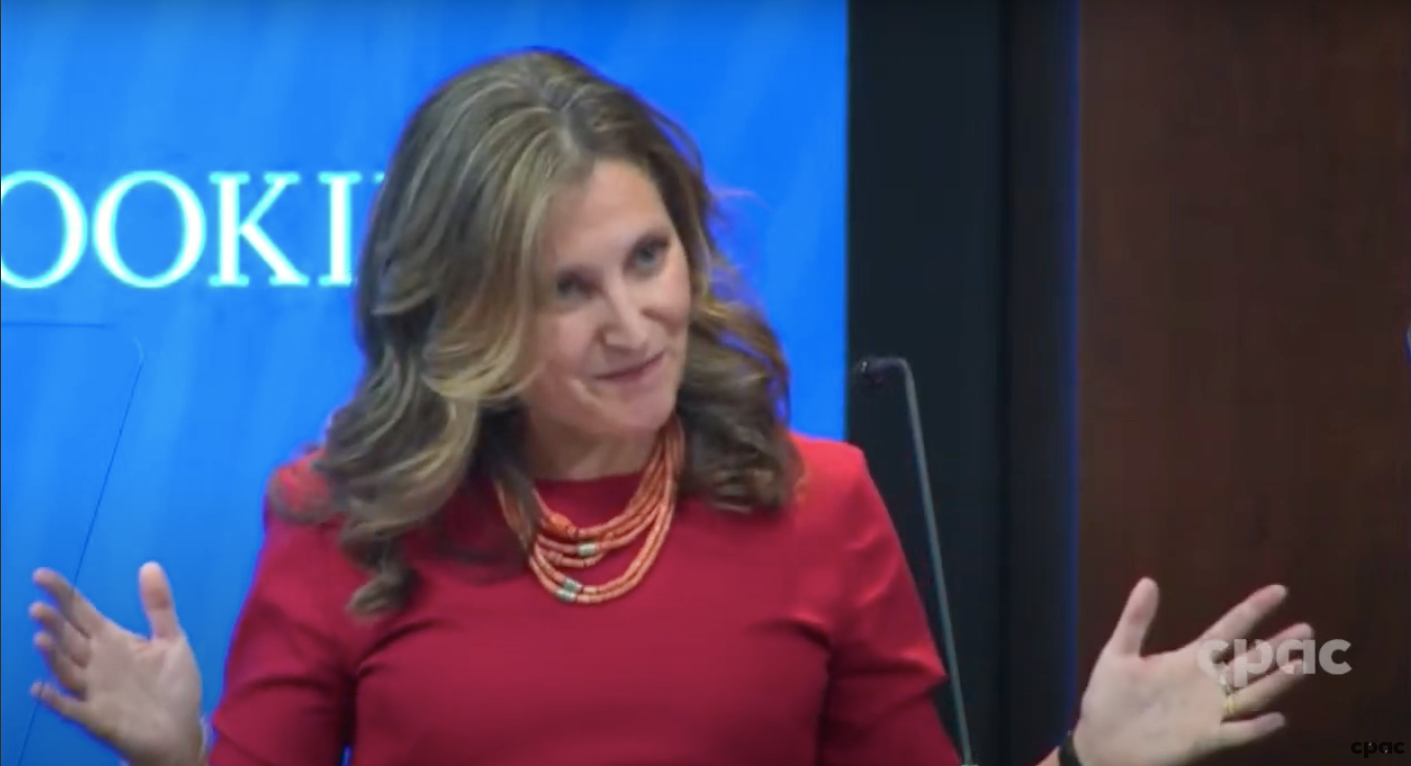
Canada’s vassalage to the U.S. intensifies the harmful effects of this situation. Once Canada surrendered its British character and integrated itself into the American empire, it became part of the continental system of elite overproduction. Ambitious Canadians seeking the top-tier education that will gain them elite status quickly discover that Canada’s universities are, as one professor once told me, “frustratingly above-average”. The most talented young Canadians therefore tend to jump ship and move to the U.S. The sine qua non for their success is mastering the American empire’s language, which is the language of liberalism. Every ambitious Canadian learns that to ascend, you must talk like American liberal elites. The Canadians who become fluent succeed: They get a top-tier U.S. degree and join the prestigious American networks. By and large, these people do not then want to move back to the imperial backwater. The few who do — such as former Liberal party leader Michael Ignatieff, who taught at Harvard, and the current Deputy Prime Minister Chrystia Freeland, who studied at Harvard and married a New York Times reporter — return home confident that they will be the big fish in the small pond. Hence Canada suffers a protracted brain drain to the U.S.
Nathan Pinkoski, “What Led To Canada’s Crisis”, First Things, 2022-02-24.
May 27, 2022
QotD: Elite overproduction and Canada’s managerial class
May 8, 2022
“It’s like these guys watched Anne Hathaway on WeCrashed and convinced themselves they can ‘elevate the world’s consciousness’ through arts grants. “
In the latest SHuSH newsletter, Kenneth Whyte brings us up to date on the latest adventures of the Canada Council for the Arts:
The Canada Council for the Arts held its annual public meeting March 30 and a video of it is now up on YouTube where, as of Thursday night, 321 people had tuned in to see CEO Simon Brault’s new shoelaces.
It’s not time for another deep dive into the ameliorative ambitions of Canada’s leading arts funding agency. We’ll just note that everything I observed in SHuSH 139 is on abundant display in this video, from the exhaustive land grant acknowledgment to non-stop discussion of equity, climate change, and Ukraine to a (mercifully short) speech by council chairman Jesse Wente, most of it dedicated to his usual one-note Indigenous activism (you’re supposed to rep all artists, Jesse).
Cheque-mailer-in-chief Brault, who obviously finds the real work of his position boring as fuck, says his immediate and long-term priorities (at a time when most of the nation’s artists and arts organizations have been economically devastated by the pandemic) are “elimination of racism and discrimination … and focusing on decolonization in people’s minds, in systems, and in institutions.”
Every square on the bureaucratic buzzword bingo card is covered: “intentionality”, “innovation”, “risk-taking”, “sustainability”, “inclusivity”, etc.
It’s like these guys watched Anne Hathaway on WeCrashed and convinced themselves they can “elevate the world’s consciousness” through arts grants.
Will they succeed? Given that they can’t match the production values of local cable despite a half-billion budget, odds are long.
Anyway, their not-quite-viral symphony of sanctimony is an experience. Give it a watch.
March 29, 2022
Giving up vegetables for Lent
Felipe Fernández-Armesto on updating the traditional Christian observance of Lent for our virtue-signalling, social media age:

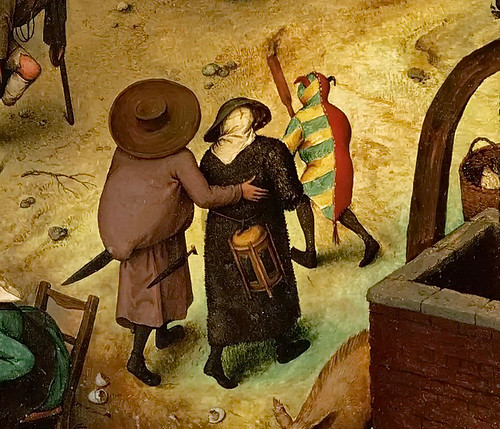
“Bruegel the Elder, Fight between Carnival and Lent, detail 6” by f_snarfel is licensed under CC BY-NC 2.0
For Lent, I am abstaining from vegetables. It may seem counter-intuitive, because “Carnival” or “Carni Vale” — which the English in their glum way call “Shrove Tuesday” and the French, more cheerfully, call “Mardi Gras” — means “Goodbye to Meat”.
The worldly, historic purpose of Lent is to eke out deficient livestock, doomed, unless slaughtered, to die, emaciated and inedible, on sparse or frozen pastures. Nowadays, however, vegetables seem a sacrifice both reasonable and pious.
If I wanted to be lampooned in Private Eye, I’d say that vegetables are the new meat: marketed as dietetically superior, and flattering to a moral form of snobbery.
Like meat in the old days, they are the preferred food of people who want to look down on the rest of us. Flesh and fish are now humbling meals, consumed in self-abasement. “Veganuary” and “Dry January” — wicked, secularist attempts to subvert the sanctity of Lent — repel me from conventional kinds of penance.
I want to defy the absurd propaganda of meat-haters, who try to shame the ill-informed into vegetarianism with mendacious allegations about the environmental cost of carnivorism. Scientifically, they’re on a par with Pythagoras’s denunciation of “passion proteins” and the meat-phobic campaigns of the nineteenth-century evangelists who hawked joyless, overpriced breakfast cereals.
I also want to expose the folly of people who, in flight from the butcher’s shop, grab textured soy concentrate from supermarket shelves: theirs is the idiocy of the ersatz. If you want something like meat, have meat. If you don’t want meat, have something unlike it. My sacrifice would be greater, of course, if I disliked rare steaks and juicy roasts. But I like vegetables, too. So that’s all right.
March 12, 2022
So much for all that “end of history” hopefulness
I admit I never bothered to read Fukuyama’s The End of History and the Last Man, because I strongly disagreed with the notion — whether advanced by the author or imputed by critics and reviewers — that there ever could be an “end” to history, as long as there are still human beings around. Russia’s latest invasion of Ukraine seems to have also broken the spell for many other westerners, as Jen Gerson points out:
[After recounting the tale of the very first McDonald’s to open in Moscow in 1990] by all accounts, Russians went wild for McDonald’s — as did much of the world — and hundreds have since opened, including one within walking distance of the Red Square. Nothing could better symbolize the end of the bad, old Soviet era than this. A Russia that is peaceful, prosperous and at least a little open to the West was one in which a worker from the Kremlin could grab an American hamburger at lunch.
At least, they once could.
McDonald’s this week was one of several Western companies to announce that it was temporarily halting operations in Russia in response to its invasion of Ukraine. Coca-Cola, Starbucks, KFC, Pizza Hut, Ikea, Shell, BP, Exxon, credit card companies, accounting firms, even airline companies are cutting Russia off, to greater or lesser extents.
I pick on McDonald’s because that chain became so ubiquitous that it has served as a kind of foreign policy truism: For a generation, it was said that no two countries that possessed a McDonald’s had ever gone to war. And so, it was assumed, this would likely remain the case. We’re not talking about skirmishes or civil wars, or local incursions or proxy wars, mind you. But the general theory largely held: as economies globalized and became more interdependent, the costs of one country truly going to war with another would grow so insurmountable that it would soon be unthinkable. Shared prosperity would reduce the need for wars of resources; meanwhile, the more economically interdependent nations became, the more self-defeating and even suicidal the prospect would grow. Economic liberalization and globalization would therefore undoubtedly bolster the long peace. For a generation this has, mostly, held true.
It is this same logic that has underpinned Europe’s growing dependence on Russia’s oil market, for example. After all, no one would risk — well — what Russia is now risking. It is certainly not in that country’s best interest to retreat into a hermit kingdom, to suffer incredible privations, and to revert to a quality of life akin to what its people knew in the ’50s. And for what? Glory? Honour? Territorial expansion? What, does Russia need more land?
This is why the war in Ukraine has caught Westerners off guard, and shook countries that once existed in the Soviet sphere of influence.
History was supposed to be over, when the Western democracies reached their ideal end-state of civilizational evolution. War — true, grand, civilizational war — was far too costly to seriously contemplate. So we allowed our military capacity to atrophy and our strategic dependencies on hostile nations grew.
With hindsight we can see the glaring flaw in the logic adopted by some of the world’s most powerful people. Those wingnuts and lunatics who warned about the danger of making ourselves more dependent on Putin proved correct. Note how quickly Canada’s safe, reliable, democratic oil supply is enjoying a rebrand. Shared prosperity is no panacea to war.
February 8, 2022
Neil Young and the rebellion of “the Grumpy Old Woke Bros”
Julie Burchill on the (one hopes) last opportunity for elderly, wrinkly 60s and 70s rock stars to virtue signal their protests to a rapidly diminishing body of fans:

For a while now the generation gap has been making a comeback in politics in a way not seen since the youthquake of the 1960s. “Don’t trust anyone over 30” has become “OK Boomer”. Oldsters have been demonised for everything from Brexit to Covid. Personally, at 62, looking at the lives today’s teenagers can expect, I thank my lucky stars that I was young in the 1970s and 80s, when you could say what you liked and go where you wanted. But this dwindling of fun and freedom has as much to do with the stifling nature of woke culture as it does with the other virus.
So I wouldn’t blame teenagers if they were cross. But those doing the most to promote the alienation of young and old aren’t hot-blooded bright young things. They are old men who appear to identify as young, despite sharing the same unsavoury grey whiskers. Of course, if someone with a penis can be a woman, a greybeard can be a teenager. They’re the Grumpy Old Woke Bros.
We can trace this unhappy breed from the then 68-years-young Ian McEwan spluttering at an anti-Brexit rally in 2017: “A gang of angry old men, irritable even in victory, are shaping the future of the country against the inclinations of its youth. By 2019 the country could be in a receptive mood: 2.5million over-18-year-olds, freshly franchised and mostly Remainers; 1.5 million oldsters, mostly Brexiters, freshly in their graves.” Since then the likes of Alexei Sayle, Billy Bragg and Stewart Lee have joined in from the monstrous regiment of woke entertainers, adding Damon Albarn (a youthful 53 – and an OBE, the rebel!) to their rankled ranks last week when he said of Taylor Swift “She doesn’t write her own songs”. (This isn’t the first time Albarn has had beef with young female pop stars. He said of Adele in 2015: “She’s very insecure”, to which she replied “It ended up being one of those ‘Don’t meet your idol’ moments … I was such a big Blur fan growing up. But it was sad, and I regret hanging out with him.”)
Though we think of grumpiness as being an English trait, let’s not forget Neil Young (76) who spat his dummy out last week over sharing Spotify with Joe Rogan. Young is a latecomer to the wonderful world of wokeness, whose welcome to the spotless ranks was somewhat marred by the emergence of a 1985 interview in which he backed Ronald Reagan’s gun control policy and added for good measure, AIDS having recently been discovered, “You go to a supermarket and you see a faggot behind the cash register – you don’t want him to handle your potatoes”.
January 23, 2022
January 4, 2022
QotD: Status signalling
The second thing they have wrong, and what I urge you to realize as soon as you can: They are not the “oppressed.” No, I don’t mean by that that there is no oppression in our society. Any human society has people with more power than others. It’s just that the groups and ideas that the left and their violent lap-wolves Antifa have cast as victims aren’t the victims.
In fact, their philosophy — the Marxist ideology they propound and the craziness behind it — has been in control of society, on top, since at least the seventies.
Being a leftist is a mark of being “good” and also well educated. The same way that in Elizabethan England poor mad Christopher Marlowe wrote his stage directions in Latin, to show that he had had an excellent education and deserved respect, so too the leftists of today pepper their works, from movies to TV to books to art, with odes to the oppressed and paeans to the coming revolution. It’s how you show you’re high-class and exquisitely educated.
All the old families, all the rich, all the captains of industry and power brokers signal left as hard as they can, because that’s where the power is — and in my field, the awards, the professorships, and the acclaim. Heck, remember what Trump signaled just to be allowed to do business.
And that’s why I’ve been watching in amusement the left going through the motions of kabuki theater revolution against a society … they control.
Sarah Hoyt, “We’re Seeing the Death Rattle of the Revolution, Not Its Birth”, PJ Media, 2020-07-28.
December 31, 2021
QotD: Justin Trudeau … “virtue-signalling made flesh”
Are there any photos of Canadian PM Justin Trudeau where he isn’t in blackface? I’m struggling to remember the last time I saw one. There he was again yesterday, this wokest of world leaders, this darling of centrist Twitter, covered in black facepaint and sticking his tongue out. You know, like those dark-skinned foreigners do. The pic is from an Arabian Nights fancy-dress party – man, the bourgeoisie are weird – that Trudeau attended in 2001, when he was 29. Twenty-nine. If you’re on the cusp of 30, at the dawn of this new millennium, and you still don’t know it’s wrong to don blackface, there’s something wrong with you.
This is only the latest in a long line of Trudeau blackface scandals, of course. The man appears to have spent a significant chunk of his younger years blacked up. There are three blackface incidents that we know of. There could be more. As one headline put it: “Trudeau says he can’t recall how many times he wore blackface make-up.” Imagine blacking up so often you can’t remember all the times you did it. Trudeau’s defenders say it was youthful daftness. Really? I don’t know a single person who has ever blacked up. I know people who have done daft things, of course. But not that.
Trudeau’s penchant for blackface is very odd. He puts it down to the fact that he has always been “more enthusiastic about costumes than is sometimes appropriate“. Riiight. It is mostly a matter for Mr Trudeau and his conscience, of course, as to why he was black-painting his face – and, in one incident, his tongue too – well into his twenties. But it’s a matter for all of us who inhabit the online world as to why Trudeau has never been cancelled, or even seriously threatened with cancellation, for doing something that would be ferociously denounced as racist if anyone else on earth had done it.
Brendan O’Neill, “The never-ending ridiculousness of Justin Trudeau”, Spiked, 2021-09-21.
December 12, 2021
“[T]oday’s antiracism paradoxically requires the crudest of racist categories to justify and explain itself”
Andrew Sullivan on the racism of modern “anti-racist” movements and his hope that Hispanic Americans may provide a way out of the current political deadlock:
Of all the acronyms, euphemisms and sophisms pioneered by critical theory, one of the most revealing is the term “black and brown people”. You hear it all the time now. Whether it’s about “the lack of Black and brown representation in Hollywood”, vaccine hesitancy in “Black and brown neighborhoods in large cities”, the right to vote for “Black and brown people”, or “allyship between Black and brown people”, the “B&b” formula is now yet another ubiquitous media virtue-signal. It’s subtler than some others. It doesn’t shriek woke like “BIPOC”; it isn’t as instantly risible as “2SLGBTQIA+”; it gives “Black” a Capital Letter, and “brown” feels a bit like a lower-case add-on — but at least it uses actual English words, and doesn’t end in an X.
Still: what does it tell you that a staggering and brilliant array of totally different ethnicities, races, religions, histories and cultures can now routinely be reduced to just two drab colors?
I think it speaks to two things. The first is that today’s antiracism paradoxically requires the crudest of racist categories to justify and explain itself. A whole kaleidoscope of immigrant difference — from Kurds and Mexicans and Somalis to Dominicans, Chileans, Nigerians, and Pakistanis — has now been turned into one monochrome racial “brown” — just to fit into an oppressor/oppressed, white/black narrative.
Equally, a diverse African diaspora — ranging from Nigerian immigrants to descendants of Southern slaves to biracial men and women with mainly European ancestry who go back to this country’s miscegenated origins — is now just “Black”. And this new racial unit has one politics: left-Democrat. Individuals disappear; diversity of opinion within groups evaporate; all that matters is a single skin color and oppression.
The second aspect of critical theory that “B&b” helps reveal is that the crude binary of “black” and “white” simply has less salience with every passing day, as more and more races, ethnicities and cultures complicate and enrich our society, and render it structurally, demographically and culturally unrecognizable from even the recent past. To give one example: 60 years ago, four percent of Americans approved of inter-racial marriage; today, it’s 94 percent. Or check out the rapid decline in the “white Christian” share of the population — from 80 percent in 1996 1976 to 44 percent today. Look around you and you’ll see how the crude rubric of “white supremacy” is, in fact, wildly out of date.
This is why so many of the most passionately woke are so obsessed with history in America, and the further back the better, as the 1619 Project shows. The past is a world they are much more comfortable in than the present, a place where the racial divide was infinitely simpler, and racial inequality both brutal and actively enforced by the government. Before the Civil Rights Act in 1964, before mass non-white immigration began in 1965, before mass non-white illegal immigration since the 1990s, the “white supremacy” rubric had some lingering traction.
But in the 21st Century, it’s been hopelessly compounded by layer upon layer of mass immigration from every conceivable corner of the planet. The Latino population in the US is now larger than the African-American one; and Asians, of many different varieties, are now immigrating in higher numbers than Latinos. Before too long, the black/white dynamic may disappear into the multi-colored, multi-hued background entirely.
November 7, 2021
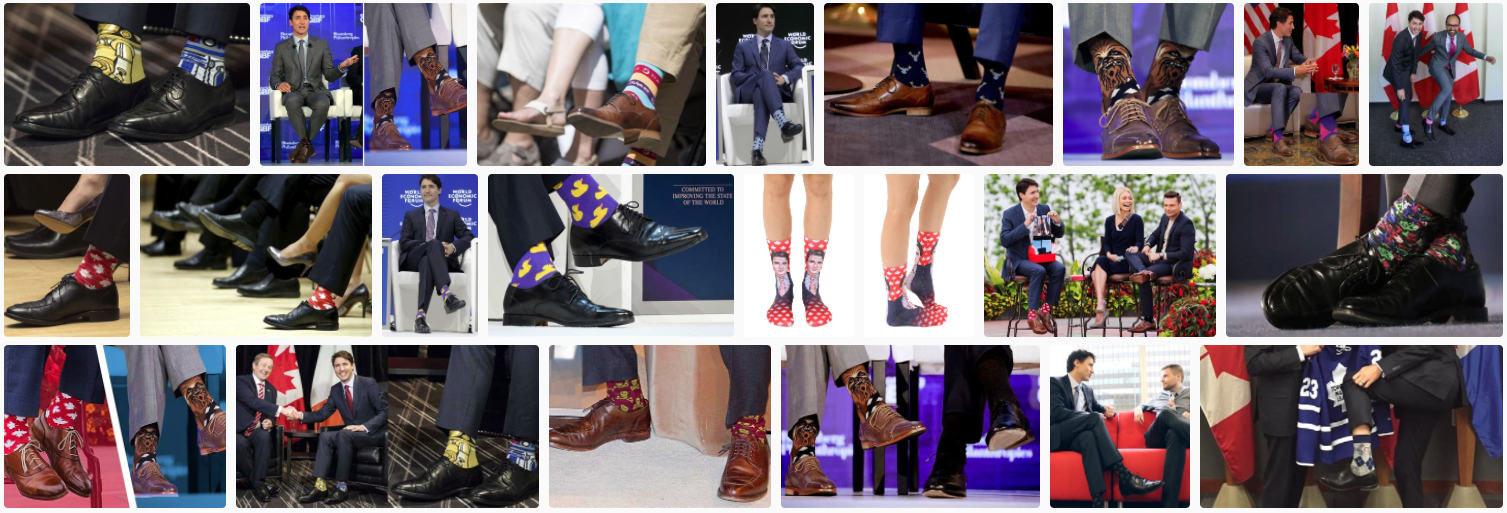
Prime Minister Look-at-my-socks loves the limelight at COP26
Jen Gerson on Canada’s fundamentally unserious Prime Minister Photo-Op grandstanding at the climate love-in in Glasgow:
In a rare moment of unity, both Alberta Premier Jason Kenney and NDP opposition leader Rachel Notley objected to Trudeau’s announcements.
“I don’t know why they would make an announcement like this without consulting with the province that actually owns the overwhelming majority of Canada’s oil and gas reserve,” said Kenney.
I mean, yeah. He’s right.
When asked for actual details about this brave new plan at COP26, Environment Minister Steven Guilbeault didn’t have much to share … because the plan doesn’t exist yet. It’s a plan to make a plan.
“We will need to be developing this, and that’s exactly what we will be doing in the coming months,” Guilbeault said, according to the CBC. Both he and Natural Resources Minister Jonathan Wilkinson have asked the net-zero advisory board to help them come up with a plan. “Specifically, we seek your advice on key guiding principles to inform the development of quantitative five-year targets,” they said in a letter sent on Monday.
There’s no path, here. There’s been no discussion; no consultation, nothing. There’s not even a draft of an idea.
So why is Trudeau getting on a stage in front of the world’s leaders half-cocked with ambitious promises for an emissions cap before he’s worked out the details at home?
To quote Line co-founder Matt Gurney during our weekly meeting: “To ask that question is to answer it.”
Trudeau is signalling what he cares about and what he doesn’t. He’s more concerned with how the audience abroad perceives him than he is about the finer points of governing. It’s about getting back-pats by the Davos set, not actually running our embarrassing, open-pit G7 backwater.
It was hard to avoid the sense during the last election that Trudeau didn’t have his heart in the fight; that he’s more invested in acting the part of prime minister than being it.
I put little stock in rumours that the Liberal leader will soon leave his role — if you’re going to act a part, after all, there are few better. And what a great platform it provides for a launch to better things. But I do wonder: If someone offered him a ranking job at the UN or the WEF or something else with a suitably impressive acronym and a travel expense account, how long would he stick around?
November 6, 2021
Canadian flag shenanigans still not resolved, kinda
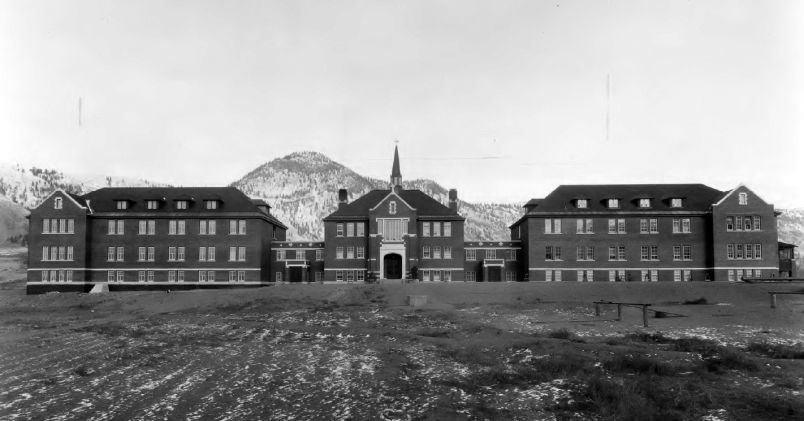
For non-Canadian readers (which last time I bothered to check were the absolute majority of readers), it’s perhaps not clear why flying of the Canadian national flag is an ongoing issue here in the dysfunctional Dominion. In short, Prime Minister Trudeau ordered the flag to be flown at half-staff at federal government and military sites after the publicization of unmarked graves of First Nations children who died during their stay at various residential schools across the country. (I must note that this wasn’t actually unknown beforehand … it just got enough media attention that PM Look-at-my-socks Photo-op decided it was a good idea to ostentatiously pretend that this was previously unknown and (to some) provided further evidence of the “ongoing genocide” of Canada’s problematic relations with First Nations people. The flag-lowering was ordered in May and no end date was specified to the observance. Like ritualistic “land acknowledgements” this did absolutely nothing to actually improve the living conditions of any members of First Nations bands, but was balm to the soul of virtue-signallers across the country. In Friday’s NP Platformed newsletter, Colby Cosh updates us on the state of play:
This morning the Assembly of First Nations (AFN) made its much-anticipated move in the chess game that has developed over the display of the Canadian flag on federal government buildings. As you will recall, the flags on all these buildings, including those abroad, were lowered to half-mast in May, when unmarked graves were discovered on the site of a former residential school in Kamloops, B.C., and have stayed there ever since. The prime minister said then that, although the lowering of the flags is his exclusive responsibility, he wouldn’t allow them to be flown normally again until “Indigenous communities and leadership” agreed that they could go back up.
Was this elliptical, confounding phrase intended to refer to the AFN? We wondered at the time who was capable of giving the necessary permission, if not the AFN: it appears, quite naturally, to have accepted the position, which is bound to be controversial if made explicit, that it is the exclusive political instrument for Indigenous communities.
In any case the AFN announced its solution to the stalemate this morning. Its executive committee, after consulting with elders, suggests raising the Maple Leaf on Sunday alongside an orange “Every Child Matters” banner. Both flags would go to half-mast on Monday, Nov. 8, this being Indigenous Veterans Day. The flags then go back up, and the Canadian one comes down again on Nov. 11, according to the usual tradition. From then on, both flags fly until “all of our children are recovered, named and symbolically or physically returned to their homelands with proper ceremony.”
There are Canadians who have no use for a national flag; some, no doubt, dream of carrying national self-abnegation to the point of having a fully transparent flag. But even these progressives would have to admit that it is hard to imagine a sequence of events allowing some future prime minister and some future AFN executive to get together and say, “Great job, everybody, the orange one can come down now.” This is a proposed permanent adoption of two national flags (and who is to say it won’t catch on among private citizens?). Yet it could still be argued that the AFN is letting the prime minister off the hook lightly, in exchange for a symbolic political victory of its own.
With the approach of Remembrance Day, the flag flying at half-mast was becoming a symbol, not of Canadian remorse, but of one politician’s daft impulsiveness and inability to act with even the immediate future in mind. As much as some approved of the original gesture, the prime minister should never have been allowed to treat the flag as personal property or as a subject for political negotiation.
In what other country would this be contemplated? Where else could a head of government do something like this without being warned or grimaced at or, outside the pages of the National Post, castigated very much? Indeed, how was this particular power of jerking the flag up and down on government buildings ever assigned to a prime minister in the first place? It is a little anomalous that this file doesn’t belong to the Governor General, who wrangles other flag-like symbols like medals and heraldry.
September 21, 2021
QotD: Canadian international virtue signalling is not a new thing
[I]n January, after the tsunami hit, [Canadian prime minister Paul Martin] flew into Sri Lanka to pledge millions and millions and millions in aid. Not like that heartless George W. Bush back at the ranch in Texas. Why, Prime Minister Martin walked along the ravaged coast of Kalumnai and was, reported Canada’s CTV network, “visibly shaken.” President Bush might well have been shaken, but he wasn’t visible, and in the international compassion league, that’s what counts. So Martin boldly committed Canada to giving $425 million to tsunami relief. “Mr. Paul Martin Has Set A Great Example For The Rest Of The World Leaders!” raved the LankaWeb news service.
You know how much of that $425 million has been spent so far? Fifty thousand dollars — Canadian. That’s about 40 grand in U.S. dollars. The rest isn’t tied up in [Sri Lankan] bureaucracy, it’s back in Ottawa. But, unlike horrible “unilateralist” America, Canada enjoys a reputation as the perfect global citizen, renowned for its commitment to the U.N. and multilateralism. And on the beaches of Sri Lanka, that and a buck’ll get you a strawberry daiquiri. Canada’s contribution to tsunami relief is objectively useless and rhetorically fraudulent.
Mark Steyn, “Bolton’s sin is telling truth about system”, Chicago Sun-Times, 2005-05-15.
September 11, 2021
QotD: Racism, anti-racism, and cognitive dissonance
In a little while, our chattering classes are going to have a field day roasting Charles Murray over a spit for his next book, which will openly argue that it has been scientifically proven that black people are, on the average, not as cognitively nimble as other people. For about a month, the usual suspects will jostle for space condemning the very address of this subject as racism incarnate.
Okay – but any public discussion that both reviles the idea that black people are less intelligent than others while also lustily demanding that it’s “racist” to submit black people to cognitive challenges is hopelessly incoherent. We disparage rape culture, diet culture – this exemption culture is premised on a basic assumption that it’s unsavory to require serious challenge of black students Because Racism.
No. You don’t get past racism by creating new forms of it. Scrapping traditional challenges should only be on the table after black kids have mastered the challenge anyway. Zora Neale Hurston gets the final word:
It seems to me that if I say a whole system must be upset for me to win, I am saying that I cannot sit in the game, and that safer rules must be made to give me a chance. I repudiate that. If others are in there, deal me a hand and let me see what I can make of it, even though I know some in there are dealing from the bottom and cheating like hell in other ways.
The current “woke” consensus is that Hurston was wrong on this, that she was expecting too much. I would just love to see one of today’s Elect in a room with Hurston trying to tell her where she was going wrong.
John McWhorter, “Revisiting Classics at Princeton”, It Bears Mentioning, 2021-06-09.
August 28, 2021
Flagging enthusiasm
In Friday’s NP Platformed newsletter, Colby Cosh considers the suddenly politically relevant position of the Canadian flag:
The other day, Conservative Leader Erin O’Toole made mention of the fact that the Canadian flag atop the Peace tower in Ottawa has been flying at half-staff for almost three months and that as prime minister he would put it back up — countermanding the specific order Justin Trudeau gave on May 30. O’Toole’s remark was a brief one dropped in at the end of a longer statement, but he did say we should be proud of our flag, which some people still think of as a Liberal contrivance, and he made the point that being proud of Canada goes hand in hand with wishing to improve it.
I saw this the other day and commented on social media that “I expect the Canadian dying media to be All. Over. This. — Conservative leader Erin O’Toole just called for the Canadian flag to be raised (they’ve been at half-staff officially since the end of May). If the media have their way, this will guarantee a huge majority government for their crush, Justin Trudeau.”
I admit, this was a bit glib, and not all the Canadian media are in the tank for Justin, but (as the old joke about lawyers had it) the 90% give the other 10% a bad name.
First of all, if sticking up for the proper display of the flag counts as wrapping oneself in it, doesn’t using it for gestures of regret (or the dreaded “virtue signalling”) really qualify as the mirror image of this? Trudeau made a point of making sure we knew the lowering of the flag was his own initiative. Liberals have spent a couple of generations working their asses off to constantly remind us that it’s a Liberal flag, which is precisely why conservatives in Ontario towns starting with “B” love the Red Ensign. It is natural to wonder whether, given the apparent Liberal sensitivity about our blood-soaked banner, we won’t get a third national flag before everyone’s finished adapting to the second one. […]
Canada is a place where literal Conservatives can’t “wrap themselves” too tightly in the literal flag: this isn’t the United States, where the positioning and context of the flag in ads or on stage will let you know instantly whether you’re at a Republican or a Democratic event. (The presence of an eagle is always a good clue.) Yet our Liberals have manoeuvred themselves into a position, somehow, in which it is awkward to fly the flag too high.
Can Trudeau now set a date for the raising of the flag to its position of respect and dignity, having plumb forgotten to do so in the first place? And if he is the renewed choice of the Canadian people as prime minister, will he be able to hoist the thing back up? Will this happen the day after the election? The first week? After prolonged consultations with First Nations, perhaps involving a royal commission?
You see, there is an aspect to this that goes beyond politicians battering at one another with flagpoles and other national paraphernalia. O’Toole’s comment didn’t just remind us that we’re Canadians and we should like our flag. It reminded us that we have a government that often seems to have a big problem thinking 30 seconds ahead, let alone six months.
July 19, 2021
Talk is cheap, as a pizza chain CEO demonstrates brilliantly
John Miltimore examines the claims of the CEO of the &pizza chain in the Washington DC area that his stores have no problem getting staff because he pays them a “living wage”:
As far as PR goes, Lastoria gets an A+. He was profiled by Business Insider, CBS News, and other media outlets. His economics grade, however, is another story.
First, the notion that &pizza’s wages are uniquely generous is wrong. The minimum wage in the nation’s capital, after all, is $15.20. Considering that Washington, DC has one of the highest costs of living in the US, it’s not unreasonable to assume that &pizza is paying workers what amounts to the market wage of their labor (i.e. the price they’d get in the absence of a wage floor). This is a stark contrast to other parts of the United States. Fifteen dollars in DC translates to roughly $24 in Florida, $25 in Alabama and Tennessee, $26 in New Mexico, and $27 in Louisiana.
Second, Lastoria decries the alleged “shortage of business owners willing to pay a living wage.” But it should be pointed out that &pizza is one of those businesses.
While there is no objective standard to determine what a living wage actually is, MIT has a Living Wage Calculator that allows readers to compute living wages based on the formula created by Dr. Amy K. Glasmeier.
To say that &pizza doesn’t pay its employees a “living wage” is an understatement. The living wage for a single mom with one child is $38.48 in Washington DC. For a single mother with two children, it’s $47.89. Indeed, even for a married couple with just one child, the living wage is $20.69 — nearly $5 an hour more than the average pay of Lastoria’s workers. (It’s unclear why Lastoria is having fewer problems hiring workers than other businesses, but it’s most likely attributable to local factors, such as the fact that he’s servicing nine of the twenty wealthiest counties in America.)
Finally, Lastoria’s claim that higher wages increase productivity enough to improve a company’s bottom line — the efficiency wage hypothesis — has problems logically and empirically. First, it implies that companies not currently paying an efficiency wage are willing to take less profit simply to make workers poorer. Moreover, efficiency wages have been shown to reduce employment, similar to minimum wage laws.
Lastoria might see the $16 an hour average wage as exceedingly generous — especially when he compares it to lower nominal wages paid in other parts of the country — but it’s a far cry from a “living wage”, according to the model used by living wage advocates.
I asked Lastoria how he’d respond to those who say restaurants like his should be required to pay each worker a living wage. He didn’t respond.