A few years ago, an eminent British criminologist said, or admitted, that criminology was a century-old conspiracy to deny that punishment had any effect whatever on criminal behavior.
And certainly, no intellectual ever earned kudos from his peers by arguing that punishment was necessary, let alone that current punishments were too lenient. In general, the more lenient he was in theory, and the more willing to forgive wrongs done to others, the better person he was thought by his peers to be.
In a way, this was understandable. The history of punishment is so sown with sadism and cruelty that it is hardly surprising that decent people don’t want to be associated with it.
Often, horrific punishments were carried out in public, half as deterrence and half as entertainment. Clearly, they failed to result in a law-abiding society, from which it was concluded that what counted in the deterrence of crime was not severity of punishment but the swiftness and certainty of detection.
While the latter are important, however, they are obviously not sufficient. It is not the prospect of detection that causes people to refrain from parking in prohibited places, but that of the fine after detection.
This is so obvious that it would not be worth mentioning, had not so much intellectual effort gone into the denial of the efficacy of punishment as such. Despite this effort, I doubt whether anyone, in his innermost being, has ever really doubted the efficacy of, or necessity for, punishment.
In Britain, leniency has co-existed with a very large prison population. This is not as contradictory as it sounds: for the fact is that something must eventually be done with repeat offenders, who do not take previous leniency as a sign of mercy and an invitation to reform but as a sign of weakness and an invitation to recidivism. Instead of nipping growth in the bud, the British system fertilises the plant.
Theodore Dalrymple, “Our Leniency, and the Necessity of Punishing Crime”, The Iconoclast, 2021-11-29.
March 14, 2022
QotD: Crime and (lenient) punishment
March 6, 2022
February 9, 2022
QotD: Paper or plastic?
In his Nobel Lecture, The Pretence of Knowledge, Friedrich Hayek told us that it was never going to be possible to centrally plan an economy for economies are big, complex, even chaotic, things. That centre can never gain enough information in real time to be able to make decisions which bear much relation to reality. We can also run his logic backwards, if we do insist upon planning then we can only have a simple economy – all the knowledge we have allows us to plan – and simple economies are poor ones with poor people in them. Planning and poverty or market chaos and wealth: take your pick.
This point is illustrated in microcosm by those trying to get rid of single use plastic bags. The 5p charge for plastic bags has meant the sale of billions of so-called bags for life, which use twice as much plastic as the cheaper alternative. All those bags for life mean we use more plastic than we started with and even, possibly, more bags themselves. This was something that was warned about before the plastic bag charge was introduced, with some observing that even “single use” bags did tend to get used more than once.
So far, then, we have learnt that the planning deployed to reduce plastic has had the opposite effect. That, however, has not stopped the central planners from redoubling their efforts. The necessary charge for a bag is to double, the system is to be expanded to the tens of thousands of small shops that don’t currently have to charge. “It doesn’t work, let’s have more of it”, the cry of bureaucracies through the ages.
But this is the blending of government planning with the fashionable nostrums of our day so of course it gets worse. It’s not even true that the bags for life – and especially not the cotton ones, even less so the organic cotton – are more environmentally friendly than the single use ones. Even recycled ones use more resources than single-use ones – for yes, recycling is an industrial activity using energy and other resources.
We can even construct a little spectrum here. How many times do we need to reuse a bag for it to have as little resource use – and thus environmental effect – as just the one use of those thin single use plastic ones? Obviously enough, the single use that we’re told not to use has a value of one here. The bag for life must be reused 35 times. A bag for life from recycled plastic 84 times. A paper bag must be reused 43 times – yes, paper. A cotton bag 7,100 times and an organic cotton? 20,000.
Which is the environmentally friendly option here? Clearly and obviously the one that everyone insists we must not use. So much for fashionable nostrums then.
Tim Worstall, “Plastic bags and the problem with central planning”, CapX, 2019-01-02.
February 2, 2022
Neil Young revives the PMRC
Jim Treacher invites you on a trip down memory lane to a time when musicians like Neil Young were [gasp!] against censorship:
If you’re Generation X or older, you might be getting flashbacks over this whole “Neil Young vs. Joe Rogan & Spotify” contretemps. On one side, we’ve got a popular public figure who’s expressing his thoughts and opinions, just as America’s Founding Fathers told us we get to do. On the other side, we’ve got a bunch of miserable old fuddy-duddies who want to shut down free speech because they believe it hurts people.
In other words, Neil Young just revived the PMRC.
If you don’t know what the PMRC was and you’re too lazy to google it, here’s the short version:
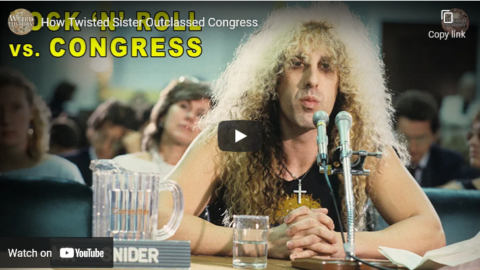
Back in the ’80s, a senator’s wife named Tipper Gore got sick of her kids listening to music she didn’t like, so she started an organization called the Parents Music Resource Center. The PMRC compiled a list of songs they found unacceptable, including “Darling Nikki” by Prince, “We’re Not Gonna Take It” by Twisted Sister, and “She Bop” by Cyndi Lauper. Then Tipper used her political connections to convince the Senate to hold hearings about this supposedly dangerous music.
A lot of Americans decided they liked what popular entertainers were saying, and a handful of busybodies tried to put a stop to it. “If we don’t want to listen to it, nobody should get to listen to it. We need to protect the helpless unwashed masses from themselves!”
Sound familiar?
But then this happened:
If you’ve got a half-hour to spare, you can watch Dee Snider’s entire Senate testimony here. By the time he was done, the PMRC had been exposed for the meddling, hypocritical clowns they were. Their brief moment of relevance was over, at the hands of a guy who looked like Bette Midler transitioning into a Wookie.
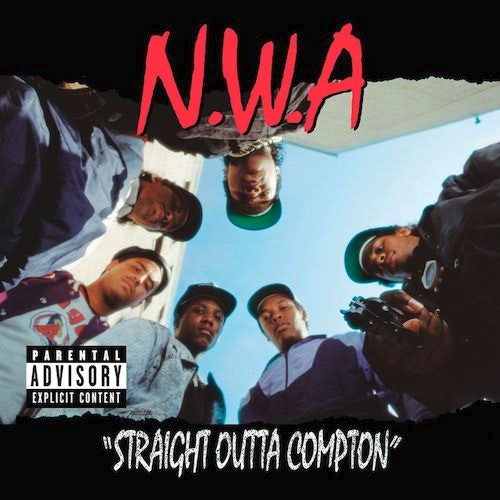
The PMRC did get a consolation prize, though: the “PARENTAL ADVISORY” sticker you can find on a lot of cassettes and CDs from the era. Y’know, the sticker that made kids want to listen to what was inside because their parents wouldn’t like it.
Over the next couple of decades, the PMRC ended up helping a lot of artists sell a lot of records. Like this one:
I remember seeing that CD cover for the first time and thinking, “Damn … this must be awesome.” And it was! If not for Tipper Gore, NWA might not have become superstars and Dr. Dre probably wouldn’t be a near-billionaire now.
November 4, 2021
October 27, 2021
September 9, 2021
When you mess around in a software testing environment … make sure it actually is a test
A British local government found out the hard way that they need to isolate their software testing from their live server:
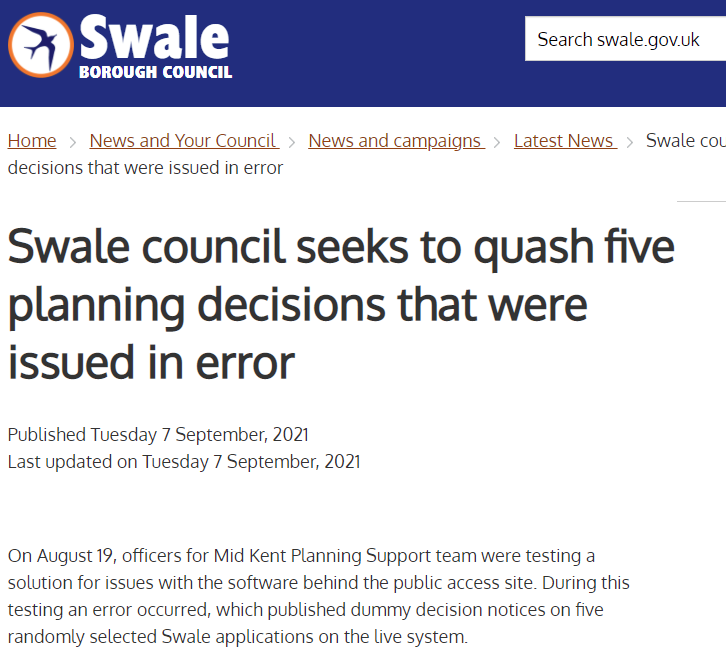
A borough council in the English county of Kent is fuming after a software test on the council’s website led to five nonsensical dummy planning application documents being mistakenly published as legally binding decisions.
According to a statement from Swale Borough Council, staff from the Mid Kent Planning Support Team had been testing the software when “a junior officer with no knowledge of any of the applications” accidentally pressed the button on five randomly selected Swale documents, causing them to go live on the Swale website.
After learning what had happened, the council moved to remove the erroneous decisions from public display, but according to the statement: “Legal advice has subsequently confirmed they are legally binding and must be overturned before the correct decisions are made.”
Publishing randomly generated planning decisions is obviously bad enough, but the problems got worse for Swale when it was discovered that the “junior officer” who made the mistake had also added their own comments to the notices in the manner of somebody “who believed they were working solely in a test environment and that the comments would never be published,” as the council diplomatically described it.
So it was that despite scores of supportive messages from residents, the splendidly named Happy Pants Ranch animal sanctuary had its retrospective application for a change of land use controversially refused, on the grounds that “Your proposal is whack. No mate, proper whack,” while an application to change the use of a building in Chaucer Road, Sittingbourne, from a butchers to a fast-food takeaway was similarly denied with the warning: “Just don’t. No.”
The blissfully unaware office junior continued their cheerful subversion of Kent’s planning bureaucracy by approving an application to change the use of a barn in the village of Tunstall, but only on condition of the numbers 1 to 20 in ascending order. They also approved the partial demolition of the Wheatsheaf pub in Sittingbourne and the construction of a number of new flats on the site, but only as long as the project is completed within three years and “Incy Wincy Spider.”
Finally, Mid Kent’s anonymous planning hero granted permission for the demolition of the Old House at Home pub in Sheerness, but in doing so paused to ponder the enormous responsibility which had unexpectedly been heaped upon them, commenting: “Why am I doing this? Am I the chosen one?”
For their part, Swale Borough Council’s elected representatives were less than impressed by the work of their colleagues at the Mid Kent Planning Support Team and wasted no time in resolutely throwing them under the bus.
“These errors will have to be rectified but this will cause totally unnecessary concern to applicants,” thundered Swale councillors Roger Truelove, Leader and Cabinet Member for Finance, and Mike Baldock, Deputy Leader and Cabinet Member for Planning in a shared statement. “This is not the first serious problem following the transfer of our planning administration to Mid Kent shared services. We will wait for the outcome of a proper investigation and then consider our appropriate response as a council.”
August 29, 2021
Justin Trudeau discovers for himself the truth of Harold Macmillan’s dictum on the most difficult thing about being Prime Minister
Former British Prime Minister Harold Macmillan was asked what was the most difficult thing about his job and is reported to have said, “Events, my dear boy, events.” Justin Trudeau had everything he wanted in the Canadian political situation in early August so he put his early election plans into action … and along came those unpredictable events:

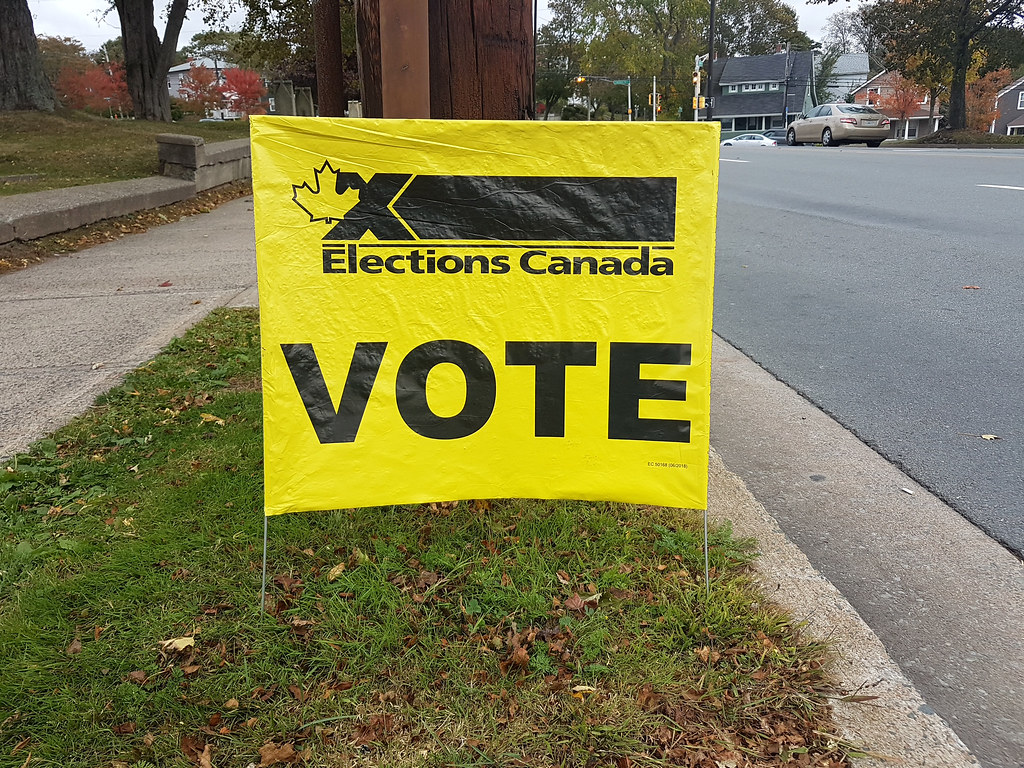
“2019 Canadian federal election – VOTE” by Indrid__Cold is licensed under CC BY-SA 2.0
What would have happened in the election of 2021 if Afghanistan hadn’t fallen? If the writ had been drawn up just a few weeks before, or a few weeks after August 15, the day Kabul fell to the Taliban?
This is the sort of question political science nerds will debate over weak beer for decades to come. It’s no great mystery why the Liberals went forward with the election even as armed fighters began to stream into the capital city of a country in which Canadians have sacrificed so much time, blood and treasure.
But I can picture the scene in the war room now and the logic is inescapable. The meeting with the governor general had been set, the news leaked, the campaign messaging laid out, the suits pressed and the planes booked. Besides, as we all know: “nobody cares about foreign affairs.” That old cant, repeated, like a charm.
Most of the time, it’s true.
Canadians hadn’t thought about Afghanistan for a decade. We’d all stopped paying any mind to some poor nation on the dark side of the world, that disputed chunk of mountain and desert besieged by misery and war since the time of Alexander the Great.
Nobody cares about such things. Until they do.
And what’s the difference between a foreign affair that we care about, and one that we do not? The answer is not flattering. We are selfish and solipsistic creatures. We care about current events abroad when what’s happening has some connection to ourselves or our interests — or when the news reflects something about ourselves.
I would not be the first pundit to point out the parallel between the fall of Kabul and the death of Alan Kurdi, the three-year old Syrian refugee boy whose body washed ashore after drowning in the Mediterranean Sea in September of 2015, in the midst of the federal election that brought Justin Trudeau to power. That child’s doll-like body, face-down on a beach, destroyed us, and the tragedy was made more pointed with the discovery that his family had been trying to reach Canada. And that his asylum application had been rejected by officials in Stephen Harper’s government.
In our own bureaucratic nightmare, and Harper’s dispassionate response, we saw reflected our own lack of compassion.
What we are confronting now in Kabul is our lack of competence.
August 14, 2021
Great Moments in Unintended Consequences (Vol. 3)
ReasonTV
Published 7 May 2021Good intentions, bad results.
——————
Follow us on Twitter: https://twitter.com/reasonReason is the planet’s leading source of news, politics, and culture from a libertarian perspective. Go to reason.com for a point of view you won’t get from legacy media and old left-right opinion magazines.
—————-Window Wealth
The Year: 1696
The Problem: Britain needs money.The Solution: Tax windows! A residence’s number of windows increases with relative wealth and is easily observed and verified from afar. A perfect revenue generator is born!
Sounds like a great idea! With the best of intentions. What could possibly go wrong?
To avoid higher taxes, houses were built with fewer windows, and existing windows were bricked up. Tenements were charged as single dwellings, putting them in a higher tax bracket, which then led to rising rents or windowless apartments. The lack of ventilation and sunlight led to greater disease prevalence, stunted growth, and one rather irate Charles Dickens.
It took more than 150 years for politicians to see the error of their ways — perhaps because their view was blocked by bricks.
Loonie Ladies
The Year: 1992
The Problem: Nude dancing is degrading to women and ruining the moral fabric of Alberta, Canada.The Solution: Establish a one-meter buffer zone between patrons and dancers.
Sounds like total buzzkill! With puritanical intentions. What could possibly go wrong?
It turns out that dancers earn most of their money in the form of tips, and dollar bills don’t fly through the air very well. Thus, the measure designed to protect dancers from degrading treatment resulted in “the loonie toss” — a creepy ritual where naked women are pelted with Canadian one-dollar coins, which are known as loonies.
Way to make the ladies feel special, Alberta.
Gallant Grocers
The Year: 2021
The Problem: Local bureaucrats need to look like they care.The Solution: Mandate that grocery stores provide “hero pay” to their workers.
Sounds like a great idea! With the best of intentions. What could possibly go wrong?
Besides the fact that these ordinances may preempt federal labor and equal protection laws, a 28 percent pay raise for employees can be catastrophic to grocery stores that traditionally operate on razor-thin margins. As a result, many underperforming stores closed, resulting in a “hero pay” of sudden unemployment.
Don’t spend it all in one place!
Written and produced by Meredith and Austin Bragg; narrated by Austin Bragg
August 10, 2021
QotD: Government workplace regulations still envision the unionized 1930s factory as “normal”
Regulation can be sortof kindof tolerable in stable, predictable, and unchanging markets. But what markets act like that? In the labor regulation world, for example, regulatory authorities are doing everything they can to kill a wave of innovation in labor markets. As I tell everyone I discuss this with — regulators picture workers as punching a time clock in a Pittsburg mill with their supervisor right there and present every moment, with an on-site HR department, and a cafeteria with huge walls for posting acres of labor posters. Try to have any other relationship with your employees, and it will be like pounding a round peg into a square regulatory hole. Even something as staggeringly beneficial to worker agency like letting remote workers schedule themselves tends to run afoul of the shift scheduling laws that are sweeping through progressive jurisdictions.
Warren Meyer, “When Regulation Hammers Those It is Supposed to Benefit — A Real Example in California”, Coyote Blog, 2021-05-06.
July 30, 2021
The British government reaches deep into the bag of “nudge” tricks yet again
Britain’s public health boffins have got the government agitated enough to try major incentives to encourage British shoppers to buy healthier, lower-calorie foods. Tim Worstall explains that, because those shoppers are human beings, this suite of incentives won’t do at all what Nanny expects them to do:
Now consider how it has to work. You go shopping, you present your DimbleCard and gain points for the healthiness of that shopping basket. Lettuce and carrots galore, super, free ticket to London on the choo choo.
So, where are the chocco biccies? If you buy them when presenting your card then no choo choo for you. What happens?
The lettuce and the carrots are bought on the card, the chocco biccies are not. Everyone simply does two transactions, with DimbleCard and sans. Lots of free choo choo and no change, whatsoever, in diet.
Yes, of course people will do this. For that’s what people do. Survey the landscape of incentives in front of them then maximise their utility, the outcome, in the face of them. It’s a restricted rationality, restricted by knowledge, but it is there. Everyone will fiddle the system because that’s what it is to be human. Collecting the fire from the lightning strike is fiddling the universe, that’s just what we do.
This being why so many clever schemes to encourage or deter this or that just don’t work. This being why those detailed plans for men, if not mice, gang aft into idiocy. Because we out here, hom sap, will play whatever system there is to our benefit.
No, this will not work out like supermarket loyalty cards. Yes, it’s true, most of us do use them. But the incentive is for us to do so. The more we do use them then the more discounts we gain, the better off we are, even at the cost of that data. How does this new government one work? The less we buy of certain things the better off we are. So, less of those things will be bought using the cards.
It is not possible to insist that people must use the card to buy things. Well, not unless we’re about to descend into the dystopia desired by Caroline Lucas it’s not. There might be a card reader at the point of purchase but the supermarkets will not demand that a sale can only happen when a card is read.
Therefore there will be those sales which gain points which make prizes. There will also be those DimbleCardless sales which do not gain points, or even demerits, and are done without their being registered in the system.
April 14, 2021
Schrödinger’s photo ID requirements
Mark Steyn notes the odd inconsistency of US authorities insisting on or ignoring the need for photo ID for different demographics. So much for equal treatment in the United States.

“TSA Checkpoint” by phidauex is licensed under CC BY-NC-SA 2.0
Whenever you fly anywhere in America, you require picture ID — so that, when you get to the head of the great endless security line, the TSA agent can get out his jeweler’s loupe and examine how the ink lies on the paper. And, when he’s finished doing that, he can fish out his UV light to study the watermark on your ID.
Which is all bollocks even by the standards of American security-state bureaucracy. Why bother going to all the tedious trouble of fake ID when real ID is so easy to acquire? On September 11th 2001, four of the terrorists boarded the flight with genuine, valid picture ID issued by the state of Virginia and obtained through the illegal-immigrant day-workers’ network run out of the parking lot of the 7-Eleven in Falls Church.
If that didn’t get Americans mad about the cosseting of the undocumented, I doubt they’ll care a fig about this latest privilege. But I thought it worth mentioning anyway: While you’re stuck with the Loupe & Light guy poring over your ID, the federal government announced last week that migrants crossing the southern border will be permitted to fly within the United States without any valid ID. You’re on orange alert now and forever, they’re in the express check-in.
This is where selective enforcement of the laws always leads — to a broader contempt for all law, and an end to equality before the law. In 2021 no developed nation needs mass unskilled immigration. Some have it for historical reasons — a hangover of empire, as in Britain and France; some have it for sentimentalist pseudo-humanitarian reasons, as in Sweden and Norway. But neither of these rationales account for what the laughably misnamed Department of Homeland Security is doing at America’s southern border.
January 30, 2021
Obey your technocratic elites, peasant!
Scott Alexander considers some historical (and current) examples of you peasants being steamrolled by the powers of the government at the behest of the technological elites of the day:
I am not defending technocracy.
Nobody ever defends technocracy. It’s like “elitism” or “statism”. There is no Statist Party. Nobody holds rallies demanding more statism. There is no Citizens for Statism Facebook page with thousands of likes and followers.
[…] it worries me that everyone analyzes the exact same three examples of the failures of top-down planning: Soviet collective farms, Brasilia, and Robert Moses. I’d like to propose some other case studies:
1. Mandatory vaccinations: Technocrats used complicated mathematical models to determine that mass vaccination would create a “herd immunity” to disease. Certain that their models were “objectively” correct and so could not possibly be flawed, these elites decided to force vaccines on a hostile population. Despite popular protest (did you know that in 1800s England, anti-smallpox-vaccine rallies attracted tens of thousands of demonstrators?), these technocrats continued to want to “arrogantly remake the world in their image,” and pushed ahead with their plan, ignoring normal citizens’ warnings that their policies might have unintended consequences, like causing autism.
2. School desegregation: Nine unelected experts with Harvard and Yale degrees, using a bunch of Latin terms like a certiori and de facto that ordinary people could not understand let alone criticize, decided to completely upend the traditional education system of thousands of small communities to make it better conform to some rules written in a two-hundred-year-old document. The communities themselves opposed it strongly enough to offer violent resistance, but the technocrats steamrolled over all objections and sent in the National Guard to enforce their orders.
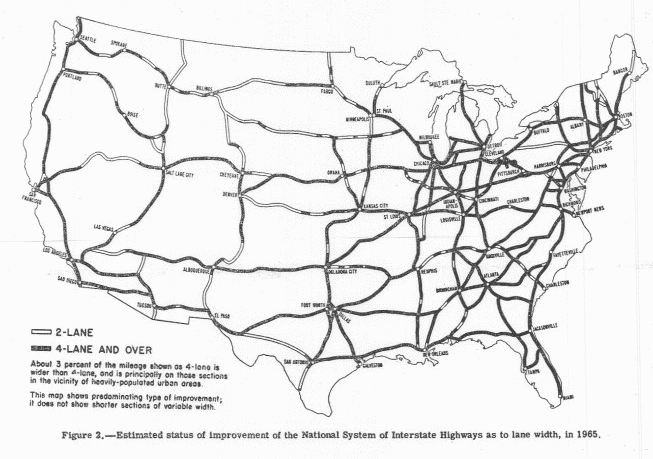
US Highway System needs in 1965 from “Needs of the Highway Systems 1955-1984”, a letter from the Secretary of Commerce to the House Committee on Public Works, approved May 6, 1954.
US Government Printing Office via Wikimedia Commons.3. The interstate highway system: 1950s army bureaucrats with a Prussia fetish decided America needed its own equivalent of the Reichsautobahn. The federal government came up with a Robert-Moses-like plan to spend $114 billion over several decades to build a rectangular grid of numbered giant roads all up and down the country, literally paving over whatever was there before, all according to pre-agreed federal standards. The public had so little say in the process that they started hundreds of freeway revolts trying to organize to prevent freeways from being built through their cities; the government crushed these when it could, and relocated the freeways to less politically influential areas when it couldn’t.
4. Climate change: In the second half of the 20th century, scientists determined that carbon dioxide emissions were raising global temperatures, with potentially catastrophic consequences. Climatologists created complicated formal models to determine how quickly global temperatures might rise, and economists designed clever from-first-principle mechanisms that could reduce emissions, like cap-and-trade systems and carbon taxes. But these people were members of the elite toying with equations that could not possibly include all the relevant factors, and who were vulnerable to their elite biases. So the United States decided to leave the decision up to democratic mechanisms, which allowed people to contribute “outside-the-system” insights like “Actually global warming is fake and it’s all a Chinese plot”.
5. Coronavirus lockdowns: The government appointed a set of supposedly infallible scientist-priests to determine when people were or weren’t allowed to engage in normal economic activity. The scientist-priests, who knew nothing about the complex set of factors that make one person decide to go to a rock festival and another to a bar, decided that vast swathes of economic activity they didn’t understand must stop. The ordinary people affected tried to engage in the usual mechanisms of democracy, like complaining, holding protests, and plotting to kidnap their governors – but the scientist-priests, certain that their analyses were “objective” and “fact-based”, thought ordinary people couldn’t possibly be smart enough to challenge them, and so refused to budge.
Nobody uses the word “technocrat” except when they’re criticizing something. So “technocracy” accretes this entire language around it – unintended consequences, the perils of supposed “objectivity”, the biases inherent in elite paradigms. And then when you describe something using this language, it’s like “Oh, of course that’s going to fail – everything like that has always failed before!”
But if you accept that “technocracy” describes things other than Soviet farming, Brasilia, and Robert Moses, the trick stops working. You notice a lot of things you could describe using the same vocabulary were good decisions that went well. Then you have to ask yourself: is Seeing Like A State the definitive proof that technocratic schemes never work? Or is it a compendium of rare man-bites-dog style cases, interesting precisely because of how unusual they are?
I want to make it really clear that I’m not saying that technocracy is good and democracy is bad. I’m saying that this is actually a hard problem. It’s not a morality play, where you tell ghost stories about scary High Modernists, point vaguely in the direction of Brasilia, say some platitudes about how no system can ever be truly unbiased, and then your work is done. There are actually a bunch of complicated reasons why formal expertise might be more useful in some situations, and local knowledge might be more useful in others.
“The only thing ‘dangerous’ about a gang of Reddit investors blowing up hedge funds is that some of us reading about it might die of laughter”
Matt Taibbi says “Suck it, Wall Street!”
The press conveyed panic and moral disgust. “I didn’t realize it was this cultlike,” said short-seller Andrew Left of Citron Research, without irony denouncing the campaign against firms like his as “just a get rich quick scheme.” Massachusetts Secretary of State Bill Galvin said the Redditor campaign had “no basis in reality,” while Dr. Michael Burry, the hedge funder whose bets against subprime mortgages were lionized in The Big Short, called the amateur squeeze “unnatural, insane, and dangerous.”
The episode prompted calls to regulate Reddit and, finally, halt action on the disputed stocks. As I write this, word has come out that platforms like Robinhood and TD Ameritrade are curbing trading in GameStop and several other companies, including Nokia and AMC Entertainment holdings.
Meaning: just like 2008, trading was shut down to save the hides of erstwhile high priests of “creative destruction.” Also just like 2008, there are calls for the government to investigate the people deemed responsible for unapproved market losses.
The acting head of the SEC said the agency was “monitoring” the situation, while the former head of its office of Internet enforcement, John Stark, said, “I can’t imagine there isn’t an open investigation and probably a formal order to find out who’s on these message boards.” Georgetown finance professor James Angel lamented, “it’s going to be hard for the SEC to find blatant manipulation,” but they “owe it to look.” The Washington Post elaborated:
To establish manipulation that runs afoul of securities laws, Angel said regulators would need to prove traders engaged in “an intentional act to push a price away from its fundamental value to seek a profit.” In market parlance, this is typically known as a pump-and-dump scheme …
Even Nancy Pelosi, when asked about “manipulation” and “what’s going on on Wall Street right now,” said “we’ll all be reviewing it,” as if it were the business of congress to worry about a bunch of day traders cashing in for once.
The only thing “dangerous” about a gang of Reddit investors blowing up hedge funds is that some of us reading about it might die of laughter. That bit about investigating this as a “pump and dump scheme” to push prices away from their “fundamental value” is particularly hilarious. What does the Washington Post think the entire stock market is, in the bailout age?
H/T to Larry Correia for the link.
January 28, 2021
GameStop in a very different kind of game
In the NP Platformed newsletter, Colby Cosh looks at the fascinating gyrations of GameStop’s share price in the grip of an unexpected group of players in the market:

“GameStop” by JeepersMedia is licensed under CC BY 2.0
GameStop has long been seen by institutional investors as following down the road of Blockbuster Video: it’s a bricks-and-mortar retailer whose main product is downloadable from your sofa. For that reason, it is heavily shorted by professional funds who normally eschew short-selling, which does have the risky feature of potentially infinite negative downside.
Enter Reddit, the website for special-interest user forums of all kinds. A Reddit “Wall Street bets” board uncovered evidence in regulatory filings that some hedge funds had legitimately dangerous large short positions representing bets against GameStop’s flaccid share price. A few hobby investors began to buy GameStop out of a sense of adventure and perhaps nostalgic loyalty. More importantly, they began to preach the gospel to others.
This is explicit “market manipulation,” but done in the open; it is surely as legal as any other conversation. GameStop’s price (NYSE symbol: GME) surged upward as word spread amongst day traders and other amateur investors. And as the random-looking rise in price got noticed, the whole scheme, itself rather reminiscent of a video game, went viral.
As of Jan. 12, GME was below $20, which is about where most analysts thought it belonged on merit, or lack thereof. The price as I type this particular sentence is $328.81. The backs of some funds with heavy short positions have been broken.
High finance seems somewhat terrified, as amateur investing websites — ones pioneered by the financial industry itself — begin to throw roadblocks in front of late-arriving GME buyers. For itself, Wall Street will invest billions replacing copper wire with fiber optics to gain microsecond arbitrage advantages in the market; for you and I, the good old portfolio can get conveniently 404ed for an afternoon.
This suggests that Wall Street may not have reckoned with the full possibilities of a world of proletarian shareholders. The stock market has proverbially been a playground of “animal spirits” since long before John Maynard Keynes used that phrase in 1936. What happens to an ecosystem when new animals show up? One can surely count on at least a minimum of chaos; maybe the surprise is that it took so long to take this game-like, combative form.