I saw from the start that some of Nikole [Hannah-Jones]’s 1619 rubbish merely exposed her utter ignorance of her subject. The blacks whom the Virginians bought from a Portuguese slave trader in 1619 were treated like whites – that is, they were treated as indentured servants who after 10 years were freed, given some farm tools, pointed at a plot of land and left to get on with it. (Some of them got on so well that before mid-century they were buying white and black indentured servants themselves to work their expanding acreages.)
One could justly say these early-arriving blacks were not treated exactly like poor English whites who – unless convicted of a crime – had always chosen to sign their ten-year indenture, to pay for transport across the Atlantic and survival while they found their feet. The closer analogy is to some Scottish whites. More than one clan chief sold some clansmen on indentures across the Atlantic when funds were low, and in 1707 a leading Scottish parliamentarian informed his peers that there was no need for them to fix the disastrous financial situation by accepting the English payment and voting their own abolition – Scotland’s elite could keep their separate parliament and avoid national bankruptcy by selling enough poor Scots to the Americas instead.
When the Portuguese offered to sell black slaves, those 1619 Virginians could only buy them as ten-year-indentured servants. They were still wholly under English common law and Lord Mansfield’s 1770s ruling merely echoed a two-centuries earlier ruling of Elizabethan judges that English common law knew no such state as slavery. It took the Virginians decades to start even questioning this and almost a century to unlearn it fully. As late as the 1690s, a black man who petitioned the Virginia council that his white master had made him serve not for ten years but for twelve “contrarie to all right and justice“, was freed by their order. If Nikole had called it the 1705 project, I’d have thought she at least knew something about the actual faults of the country whose history she was travestying. Only positive statute law can override English common law’s aversion to slavery, said Lord Mansfield – and 1705 was the year the Virginia legislature completed providing it. I knew from the start that Nikole was not just lying about all that, not just indifferent to the truth of all that – she was also pretty clueless about it.
Niall Kilmartin, “Critical Race Theorist literally knows nothing”, Samizdata, 2021-07-16.
October 19, 2021
QotD: Slaves and indentured servants in early Virginia
October 11, 2021
QotD: Columbus Day
But when Columbus landed on the Caribbean Island of San Salvador in the Bahamas, he set off a wave of exploration and colonization which the previous discoveries had not. The Viking and Chinese settlements did not last, but the post-Columbian ones did. And that is an incredibly significant historical event, no matter how you view history.
In the 1970s it became popular on the left to consider Columbus a monster, a villain who gave the innocent and peaceful natives diseases, enslaved them, wiped out their culture, and destroyed all that was good. This theory teaches that the American natives were all good and peaceful and wonderful and just and true and righteous. They all ate free trade non-GMO gluten free food and were perfectly multicultural and non-judgmental, free of war and with perfect gender equality. Columbus, an evil white European showed up and ruined it all. In short, Columbus he infected the Eden-like paradise of the Americas with his Euro-masculinity.
And the origin of this theory is that of the Noble Savage. There were people living outside the evil corrupting influence of White European Males, and Columbus found them and ruined everything. That’s why when you hear someone talking about this, they never mention the nearly-constant wars, cannibalism, human sacrifice, rape, pillaging, genocide, disease, poverty, and incredible lack of technical and scientific, artistic, and literary knowledge of the native peoples of America.
Columbus was a man of his time, and a particularly greedy one at that. He ripped off his own people, acting as the King’s supreme representative and authority in the Americas (which at the time was not known to be as vast as it is). He took credit for what others did, he took over what they developed, he took the riches they found, and so on. And yes, he and his men enslaved the local natives, and because of their culture of “free love” spread European venereal diseases among the natives they were not exposed to before. Entire tribes were wiped out by the infections they had no resistances to.
Of course, the natives spread disease among the Europeans they hadn’t been exposed to, either, such as Typhus and Syphilis, and the natives were murderous and killed Europeans but those are details that modern revisionist historians either ignore, gloss over, or present as a rough sort of justice: they had it coming for daring to set foot in the Eden of the Americas.
Objectively, neither side was particularly admirable, as one would expect if you understand innate and original sin. If what’s bad comes from within us rather than outside influences, then its spread evenly throughout all humanity without regard to creed, culture, race, or location. The natives were bad because people are bad. The Spaniards and Columbus (who was Italian) was bad, because people are bad.
Christopher Taylor, “Eden Ruined By Italian”, Word Around the Net, 2018-10-09.
October 2, 2021
This Is Sparta: The Material Remains of a Warrior Polis
Thersites the Historian
Published 1 Oct 2021A video about the material remains to be found at Sparta, or perhaps more precisely, why there isn’t more to see given the obvious importance of Sparta.
Patreon link: https://www.patreon.com/thersites
PayPal link: paypal.me/thersites
Discord: https://discord.gg/QCaXXFr
Brave Browser: https://brave.com/noa557
Twitter link: https://twitter.com/ThersitesAthens
Minds.com link: https://www.minds.com/ThersitestheHis…
Steemit/dtube link: https://steemit.com/@thersites/feed
BitChute: https://www.bitchute.com/channel/jbyg…
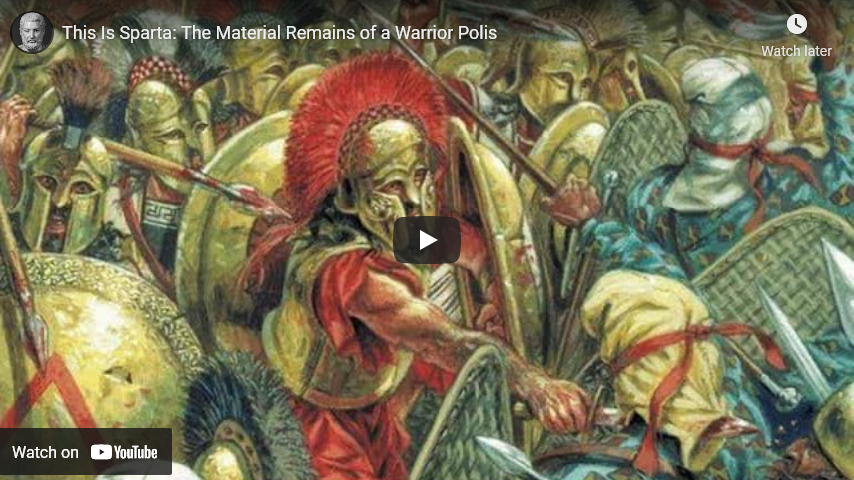
I was unaware that Sparta, after its final military defeat by Roman forces in 192 BC, was effectively turned into a full-time “Living History” theme park for the benefit of tourists … subsidized by the Roman state.
September 12, 2021
QotD: The US Supreme Court’s Dred Scott decision of 1857
The Scott decision is now considered an important contributing cause of the U.S. Civil War, which began four years later. It proved, beyond anyone’s doubt, President Abraham Lincoln’s maxim that a sovereign nation could not survive half-slave and half-free. Northern states might be capable of abolishing slavery locally, but this “abolition” would never apply to imported slaves from elsewhere considered as property. One cannot fully understand U.S. history, never mind the progress of its law, without studying and appreciating Taney’s cruel language.
And, indeed, for the world at large, Dred Scott is an unsurpassed reminder of the distinction between law and justice, and of the limitations of a highly reverenced written constitution. Taney not only accepted the (irrefutable) argument that the constitution explicitly countenanced slavery: he wrote fawningly of the Founding Fathers as great men, “high in their sense of honour,” who could never have upheld absolute equality before the law on one hand while hypocritically denying it to Blacks in practice. The Declaration of Independence’s claim that “all men are created equal,” the ex-slaveowner Taney wrote, was never understood by anyone to include inferior races.
Abolitionists of the time saw the innate hypocrisy: the contemporary newspaper editor William Lloyd Garrison risked his life by calling the constitution “a league with hell.” But [University of Buffalo law professor Matthew] Steilen thinks it is better not to expose Black students to the details of that debate. Reading Taney’s “gratuitously insulting and demeaning” words and arguments, he tweeted, is likely to, and there is no other way to put this, injure their feelings. To inquire too deeply into the detail of slavery, and of the law that shielded it, would require Black students to “relive the humiliation” of Dred Scott.
Colby Cosh, “Another Day in a Feelings-First World”, NP Platformed, 2021-06-09.
September 10, 2021
The German Slave Economy – WW2 Special
World War Two
Published 9 Sep 2021To fuel the German war economy, the Nazis force millions of Prisoners of War, Concentration Camp inmates and civilians from all over Europe to work for in their factories and on their farms as slave laborers under harsh circumstances.
(more…)
September 3, 2021
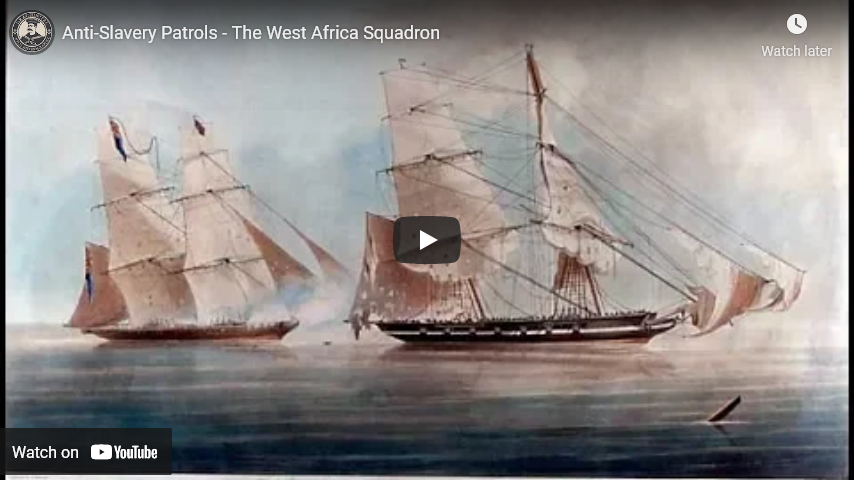
Anti-Slavery Patrols – The West Africa Squadron
Drachinifel
Published 1 Dec 2018Title says it all really, we look at something that was definitely worth doing, which really should have been done much sooner.
July 24, 2021
Fighting for Freedom: The Weapons and Strategies of the 1811 Slave Revolt (feat. InRangeTV)
Atun-Shei Films
Published 22 Jul 2021I highly recommend visiting the 1811 Kid Ory Historic House during your next trip to the New Orleans area! https://www.1811kidoryhistorichouse.com/
Karl from @InRangeTV was recently in town, and we visited the plantation house where the 1811 Slave Revolt began. In this video, we examine the uprising primarily from a military perspective, discussing the weaponry the enslaved army used, the tactics they employed, and the likelihood of the rebels’ long-term success if their battle with the local planter militia had gone a little bit differently.
The 1811 Revolt, despite being the largest rebellion of enslaved people in American history, has not been the subject of much scholarship, and in many ways is still poorly understood. Regardless, we were surprised how much our visit forced us to rethink the conventional historical narrative. In Karl’s companion video, we discuss alternative perspectives of the revolt and speculate about what truths may have been lost to history. Watch Karl’s video [embedded below].
Support Atun-Shei Films on Patreon ► https://www.patreon.com/atunsheifilms
Leave a Tip via Paypal ► https://www.paypal.me/atunsheifilms
Buy Merch ► teespring.com/stores/atun-shei-films
#GermanCoast #Louisiana #AmericanHistory
Original Music by Dillon DeRosa ► http://dillonderosa.com/
Reddit ► https://www.reddit.com/r/atunsheifilms
Twitter ► https://twitter.com/atun_shei~FURTHER READING/VIEWING~
Daniel Rasmussen. American Uprising: The Untold Story of America’s Largest Slave Revolt (2011). Harper Perennial
“Freedom or Death: The Louisiana Slave Revolt of 1811” (2019). Atun-Shei Films https://youtu.be/1zUPNtP3Yn0
“Creoles, Kaintucks, and the Culture War of Early New Orleans” (2020). Atun-Shei Films https://youtu.be/i0mDwK47Qq0
1811 Slave Revolt – An Alternative Perspective (feat. Atun-Shei)
InRangeTV
Published 22 Jul 2021InRange is entirely viewer supported:
https://www.patreon.com/inrangetvFirst off, I must give very special thanks to John McCusker for his gracious hospitality for allowing us to film, as well as for his research and candid approach to the history, and the social ramifications of this topic that resonate still to this day.
If you’re in New Orleans, or visiting, make sure you take time to go see the 1811 Kid Ory House and say hi to John from InRange & Atun-Shei:
https://www.1811kidoryhistorichouse.com/On one of my more recent trips to New Orleans, I got together with Atun-Shei and we visited the Andry plantation house where the 1811 Slave Revolt began. In this video, we re-examine the uprising with fresh perspectives on what actually may have happened and contrast it to the relatively tiny amount of academic research done in relation to the actual significance of this important American revolt for freedom.
The 1811 Revolt, despite being the largest rebellion of enslaved people in American history, has not been the source of much scholarship, and in many ways is still poorly understood. Regardless, we were surprised how much our visit forced us to rethink the conventional historical narrative. In Atun-Shei’s companion video, we examine the uprising primarily from a military perspective, discussing the weaponry the rebels used, the tactics they employed, and the likelihood of the rebels’ long-term success if their battle with the local planter militia had gone a little bit differently.
~FURTHER READING/VIEWING~
Daniel Rasmussen.
American Uprising: The Untold Story of America’s Largest Slave Revolt (2011). Harper Perennial
July 15, 2021
Haitian independence was bought with blood … a lot of blood
Theodore Dalrymple recently read a book by Sherbrooke University professor Jean-Pierre Le Glaunec on the Battle of Vertières which ended Napoleon’s attempt to recapture the island and re-enslave the population:

Haiti is one of those countries that you can leave after a visit, but that never quite leaves you. Its history is so heroic and so tragic, its present condition often so appalling, its culture so fascinating and its people so attractive, that even if it does not become the main focus of your intellectual attention, you never quite lose your interest in it, or in its history.
That is why, recently in a Parisian bookshop, I bought a book about the Battle of Vertières, the last gasp of the expedition sent out by Napoleon to Haiti, or Saint-Domingue as it was still known (“The Pearl of the Antilles” by those who profited from it), to return it to the condition of a vast slave plantation. General Leclerc, Napoleon’s brother-in-law, commanded, and 50,000 French soldiers, including Leclerc, lost their lives in this ill-fated and, from our current moral standpoint, malign expedition. Six weeks after its final defeat at the hands of the former slaves, Haiti, or Hayti — under the first of its many dictators, Jean-Jacques Dessalines, who made himself emperor and was assassinated two years later — declared its independence from France.
The book, titled L’Armée indigène, “The Native Army”, was by a French historian, Jean-Pierre Le Glaunec, who now teaches at Sherbrooke University in Quebec. The book recounts not only the history of the battle itself, which took place on 18 November 1803, but how it has been remembered, or forgotten (especially in France), in the subsequent two centuries, and the purposes to which the memory has been put.
The author is a specialist in Haitian and American history. His fundamental historical outlook is very different from mine, but that did not reduce my pleasure in his book, for he writes well and marshals much interesting evidence, the fruit of diligent original research in primary sources. And it seems to me that no one can fail to be moved by the heroism and determination of the former slaves to defend their newfound freedom from the attempt to return them to servitude. The slave colony of Saint-Domingue had been among the cruellest ever known; the methods of Napoleon’s expeditionary army grew more and more vicious as it suffered repeated decimations. That history has its ironies — it is possible that, had the slave revolution failed, Haiti would now be more prosperous than it is, like Guadeloupe or Martinique — does not detract from the righteousness of the cause of the former slaves. They could not be expected to foresee the two centuries of failure, poverty, and oppression to come. Besides, the dignity conferred by the victory cannot be simply set against its deleterious long-term material consequences: Man does not live by GDP alone.
The rest of the article delves into Professor Le Glaunec’s other recent book on George Floyd’s death and fails to show the same intellectual honesty and willingness to face unpleasant facts that his Haitian history demonstrates.
In other words, Professor Le Glaunec, who makes much of his dispassionate resort to historical evidence by contrast with his opponent, reveals himself to be at least as parti pris as that opponent. He displays a lack of curiosity about George Floyd that surely derives from his political standpoint. As for the dedication to the memory of George Floyd, it is morally obtuse: for a man does not become good by being wrongfully killed. A mother loves her son because he is her son, not because he is good, and therefore the grief of his family is understandable and easily sympathised with; but for others to turn him into what he was not, a martyr to a cause, is to display at once a moral and an intellectual defect.
The connection between historical explanation and individual morality is nowhere more complex than in Haiti. The victor of Vertières, the former slave Dessalines, was declared dictator for life, with the right to choose his successor, in the very document that announced the independence of Haiti and the freedom of its population. Dessalines then undertook a policy that today would be called genocide: he ordered that every white settler, man, woman, and child killed (about 6000 in all) who remained in the country after the last of the French troops should be killed, and his orders were carried out. The truly atrocious conduct of the French explained this genocide no doubt, but did it justify it? To answer in the affirmative is to claim that there are good, or justified, genocides; to answer no is to be accused of a lack of psychological insight into the righteous anger of Dessalines and others, or of a lack of sympathy for the state of mind of the victims of slavery.
The death of George Floyd was similarly wrong; but that does not mean that the reaction to it was right.
July 5, 2021
Did the CONFEDERACY Have BETTER GENERALS?!?!?!
Atun-Shei Films
Published 4 Jul 2021Checkmate, Lincolnites! Debunking Lost Cause myths – as well as more benign common misconceptions – about the military leadership of the Civil War. Did the South really have all the best battlefield talent? Was the key to Union victory a simple strategy of overwhelming the Confederate army with numbers and resources? Who was better at their job, Ulysses S. Grant or Robert E. Lee?
I’d say watch and find out, but the answer is obviously Grant.
Support Atun-Shei Films on Patreon ► https://www.patreon.com/atunsheifilms
Leave a Tip via Paypal ► https://www.paypal.me/atunsheifilms
Buy Merch ► teespring.com/stores/atun-shei-films
#CheckmateLincolnites #CivilWar #MilitaryHistory
Original Music by Dillon DeRosa ► http://dillonderosa.com/
Reddit ► https://www.reddit.com/r/atunsheifilms
Twitter ► https://twitter.com/atun_shei~REFERENCES~
[1] Andy Hall. “With One Hand Tied Behind its Back” (2013). Dead Confederates Blog https://deadconfederates.com/2013/11/…
[2] G.S. Boritt. Why the Confederacy Lost (1992). Oxford University Press, Page 39-40
[3] Richard E. Beringer. Why the South Lost the Civil War (1986). University of Georgia Press, Page 8-24
[4] Borritt, Page 24-30
[5] Charles Royster. The Destructive War: William Tecumseh Sherman, Stonewall Jackson, and the Americans (1991). Vintage Civil War Library, Page 76
[6] “Lincoln’s Unsent Letter to General Meade”. American Battlefield Trust https://www.battlefields.org/learn/pr…
[7] Eric J. Wittenberg. “A Civil War Witch Hunt: George Gordon Meade, The Retreat from Gettysburg, and the Joint Committee on the Conduct of the War” (2015). Emerging Civil War Blog http://emergingcivilwar.com/2015/07/0…
[8] Report of the Joint Select Committee Appointed to Inquire into the Condition of Affairs in the Late Insurrectionary States, so Far as Regards the Execution of Laws, and the Safety of the Lives and Property of the Citizens of the United States and Testimony Taken (1872). https://quod.lib.umich.edu/m/moa/ACA4…
[9] Andy Hall. “Nathan Bedford Forrest Joins the Kl@n” (2011). Dead Confederates Blog https://deadconfederates.com/2011/12/…
[10] Andy Hall. “Confederate Veterans on Forrest: ‘Unworthy of a Southern Gentleman'” (2013). Dead Confederates Blog https://deadconfederates.com/2013/08/…
[11] Edward Bonekemper. Ulysses S. Grant: A Victor, Not a Butcher (2004). Regnery History, Page 89-92
[12] Mary Boykin Chestnut. A Diary of Dixie (1905). D. Appleton and Company, Page 350
[13] Ernest B. Ferguson. “Catching Up With ‘Old Slow Trot'” (2007). Smithsonian Magazine https://www.smithsonianmag.com/histor…
[14] Bonekemper, Page xii
[15] Bonekemper, Page 308-309
[16] Bonekemper, Page 192-193
[17] Bonekemper, Page 201-203
[18] Justin D. Murphy. American Civil War: Interpreting Conflict Through Primary Documents, Vol. II (2019). ABC-CLIO, Page 331
[19] Bonekemper, Page 121 & 243-245
[20] Elizabeth Brown Pryor. Reading the Man: A Portrait of Robert E. Lee Through his Private Letters (2008) Penguin Books, Page 335
[21] Sean Kane. “Myths and Misunderstandings: Grant as a Slaveholder” (2017). The American Civil War Museum https://acwm.org/blog/myths-misunders…
[22] “Letter from Robert E. Lee to Mary Randolph Custis Lee (December 27, 1856).” Encylopedia Virginia https://encyclopediavirginia.org/entr…
[23] Pryor, Page 144-150
[24] “Ulysses S. Grant and General Orders No. 11”, National Park Service https://www.nps.gov/articles/000/ulys…

June 19, 2021
The context for Confederate general Patrick Cleburne’s proposal to arm slaves to fight the Union
On YouTube, Andy of Atun-Shei Films responds to a social media post that presented Cleburne’s proposal without context, which appears to show Cleburne as an anti-slavery advocate:
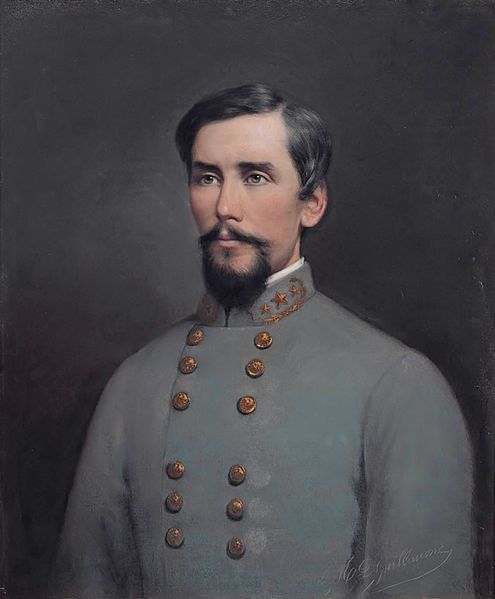
Confederate army Major General Patrick Cleburne.
Painting by M.D. Guillaume (1816-1892) via Wikimedia Commons.
I recently came across a pro-Confederate Facebook post featuring this quote from Confederate major general Patrick Cleburne, written on January 2, 1864:
It is said slavery is all we are fighting for, and if we give it up we give up all. Even if this were true, which we deny, slavery is not all our enemies are fighting for. It is merely the pretense to establish sectional superiority and a more centralized form of government, and to deprive us of our rights and liberties.
Now, I’m not going to share the post itself, as that would inevitably lead to doxxing and bullying. However, this is a teachable moment, a classic example of the beloved Lost Causer past-time of divorcing quotes from their important contexts.
You need to keep a couple things in mind when considering a historical quote. Who is the speaker? Who are they talking to? Do they have an objective in mind? What events surrounding this person, if any, have inspired them to say this particular thing at this particular time?
Quotes by themselves are useless in historical education and can often be misleading. I see y’all making this mistake with the Cornerstone Speech [Wiki] all the time – it’s not the mic drop you think it is. You can’t just shove it in someone’s face and call it a day. If you really want to change minds, you need to present it in its proper context and alongside other evidence. Only then can you craft a complete and compelling argument.
Now as it happens, Alexander Stephens was totally sincere when he called late 18th century notions of racial equality “wrong,” and he spoke for the overwhelming majority of Confederate true believers in the Spring of 1861 when he said that “our new government is founded on exactly the opposite ideas; its foundations are laid, its cornerstone rests, upon the great truth that the [black man] is not equal to the white man; that slavery, subordination to the superior race, is his natural and normal condition.” But without context, how would I know that? When making an argument, the onus of proof is on you.
This particular pro-Confederate post presented the Cleburne quote by itself in meme format without any context whatsoever, so allow me to provide one. At first glance, it seems like Cleburne is espousing anti-authoritarian values. It seems like he is declaring, clearly and definitively, that the Southern states did not secede to preserve slavery, but rather to uphold their regional self-determination.
This quote is from a letter Cleburne wrote to Joseph E. Johnston, his commanding officer in the Army of Tennessee, proposing that the Confederate government emancipate and arm the South’s enslaved men to bolster the thinning ranks of the army. As you may remember from Checkmate Lincolnites, this proposal was met with shock and horror from the Confederate leadership, who quickly rejected it.
But Cleburne saw further than them. He believed – correctly – that unless something drastic was done, the Confederacy was doomed to destruction. As he writes in the proposal, “Instead of standing defiantly on the borders of our territory or harassing those of the enemy, we are hemmed in to-day into less than two-thirds of it, and still the enemy menacingly confronts us at every point with superior forces.”
“If this state continues much longer we must be subjugated,” he continues, arguing that achieving victory would require immense sacrifice, including “the loss of all we now hold most sacred — slaves and all other personal property, lands, homesteads, liberty, justice, safety, pride, manhood.”
June 18, 2021
Innovation was minimal in the Roman Empire, because slave societies think they don’t need new inventions
Mark Koyama writes for the Foundation for Economic Education on the similarities and differences of the economy of the Roman Empire at its second-century peak and the booming European economies of the 17th and early 18th centuries:
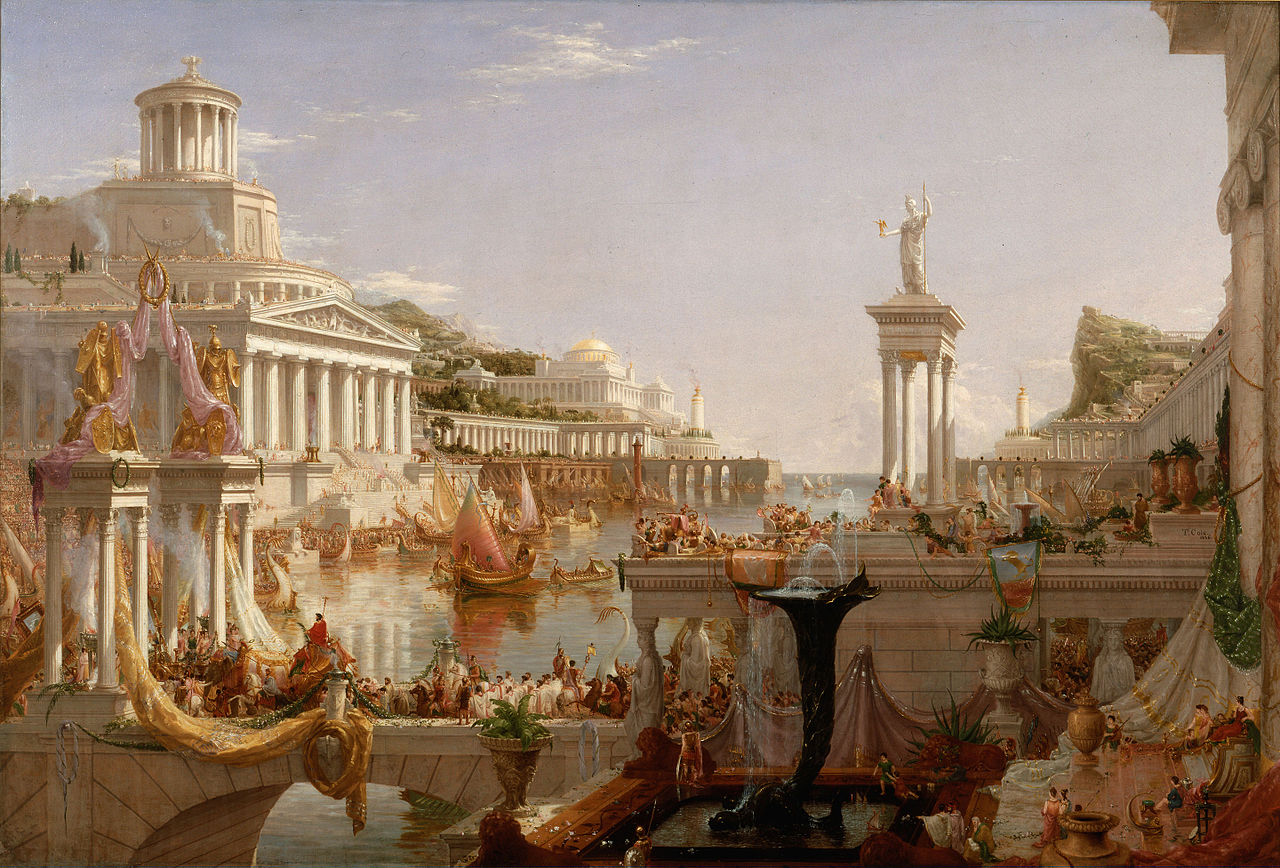
“The Consummation of Empire” from the painting series “The Course of the Empire” by Thomas Cole (1801-1848).
New York HIstorical Society collection via Wikimedia Commons.
The most obvious institutional difference between the ancient world and the modern was slavery. Recently historians have tried to elevate slavery and labor coercion as a crucial causal mechanism in explaining the industrial revolution. These attempts are unconvincing […] but slavery certainly did dominate the ancient economy.
In its attempt to draw together the various strands through which slavery permeated the ancient economy, [Aldo] Schiavone’s chapter “Slaves, Nature, Machines” [in The End of the Past] is a tour de force. At once he captures the ubiquity of slavery in the ancient economy, its unremitting brutality — for instance, private firms that specialized in branding, retrieving, and punishing runaway slaves — and, at the same time, touches the central economic questions raised by ancient slavery: to what extent was slavery crucial to the economic expansion of the period between 200 BCE and 150 AD? And did the prevalence of slavery impede innovation?
It is impossible to do justice to the argument in a single post. Suffice to say that after much discussion, and many fascinating interludes, Schiavone suggests that ultimately the economic stagnation of the ancient world was due to a peculiar equilibrium that centered around slavery.
One can think of this equilibrium as resting on two legs. The first is the observation that the apparent modernity of the ancient economy — its manufacturing, trade, and commerce rested largely on slave labor. The expansion of trade and commerce in the Mediterranean after 200 BC both rested on and drove the expansion of slavery. Here Schiavone notes that the ancient reliance on slaves as human automatons — machines with souls — removed or at least weakened, the incentive to develop machines for productive purposes.
The existence of slavery, however, was not the only reason for the neglect of productive innovation. There was also a specific cultural attitude that formed the second leg of the equilibrium:
None of the great engineers and architects, none of the incomparable builders of bridges, roads, and aqueducts, none of the experts in the employment of the apparatus of war, and none of their customers, either in the public administration or in the large landowning families, understood that the most advantageous arena for the use and improvement of machines — devices that were either already in use or easily created by association, or that could be designed to meet existing needs — would have been farms and workshops
The relevance of slavery colored ancient attitudes towards almost all forms of manual work or craftsmanship. The dominant cultural meme was as follows: since such work was usually done by the unfree, it must be lowly, dirty and demeaning:
technology, cooperative production, the various kinds of manual labor that were different from the solitary exertion of the peasants on his land — could not but end up socially and intellectually abandoned to the lowliest members of the community, in direct contact with the exploitation of the slaves, for whom the necessity and demand increased out of all proportion … the labor of slaves was in symmetry with and concealed behind (so to speak) the freedom of the aristocratic thought, while this in turn was in symmetry with the flight from a mechanical and quantitative vision of nature
Thus this attitude also manifests itself in the disdain the ancients had for practical mechanics:
Similar condescension was shown to small businessmen and to most trade (only truly large-scale trade was free from this taint). The ancient world does not seem to have produced self-reproducing mercantile elites. Plausible this was in part because of the cultural dominance of the landowning aristocracy.
The phenomenon coined by Fernand Braudel, the “Betrayal of the Bourgeois”, was particularly powerful in ancient Rome. Great merchants flourished, but “in order to be truly valued, they eventually had to become rentiers, as Cicero affirmed without hesitation: ‘Nay, it even seems to deserve the highest respect, if those who are engaged in it [trade], satiated, or rather, I should say, satisfied with the fortunes they have made, make their way from port to a country estate, as they have often made it from the sea into port. But of all the occupations by which gain is secured, none is better than agriculture, none more delightful, none more becoming to a freeman'” (Schiavone, 2000, 103).
Such a cultural argument fits perfectly with Deirdre McCloskey’s claim in her recent trilogy that it was the adoption of bourgeois cultural norms and specifically bourgeois rhetoric that distinguished and caused the rise of north-western Europe after 1650.
June 5, 2021
The morality of collective intergenerational responsibility
Arthur Chrenkoff believes that the responsibility to compensate people for historical wrongs ends when the individuals who were harmed have died:
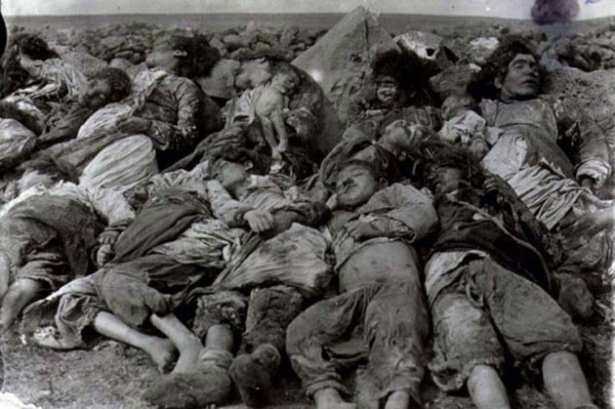
Victims of genocide
Photo by Cantetik2 via Wikimedia Commons.
What I was querying was the practicality and the morality of reparations being paid today: “If great-great-grandchildren of perpetrators have to pay great-great-grandchildren of survivors, is there any limit on historical liability? 200 years? 500 years?”
Before we get any further into the discussion, let me restate here my position, which has not changed at all in light of the subsequent online exchanges and name-calling: I do not believe in collective intergenerational responsibility. Far from modern and enlightened, it strikes me as a primitive, ancient principle, in line with the Old Testament’s “an eye for an eye” mentality. Thought to call it Old Testament might be unkind to Old Testament, since already by the time the Book of Ezekiel was being compiled during the Babylonian Exile, mid-first millennium BC, the Judaic theology had morally evolved beyond the belief that the sins of the fathers are visited on their children. We are each a moral agent, enjoying free will and exercising own judgments and actions, and for all that we are rightly held responsible and accountable. But it is unjust to blame (and, at the other end of the spectrum, absurd to praise) us for what our literal and metaphorical ancestors had done or failed to do at one point or another in the past, or what they have collectively achieved.
And so, to the comment that genocide has no statute of limitation, I say: it should, and it should be right about the time that all those who were alive at the time and affected by it have passed away.
The concept of reparations for historical wrongs is increasingly in the news. In the United States, the question revolves around the evil of slavery, but it’s hardly an American-centric debate. In many Western European countries there is talk of reparations for colonialism. Then there is the agitation in Poland, long supported by the ruling Law and Justice party, that Germany should pay Poland reparations for death and destruction caused during the Second World War. While the quantum has sometimes been calculated upward of US$15 trillion, the official suggestions have hovered around the more “modest” €850 billion (1947 estimates in today’s currency).
[…]
Not just genocide – everything that has ever happened, both bad and good, ripples across time and shapes the present. This is what history is about. Each event has an infinite number of causes and an infinite number of consequences. Hence, conceptual problems start popping up once you try to unscramble the egg and make simple adjudications about complex past situations. It’s one thing to make moral judgments about what had happened, it’s another to apply judicial standards used in disputes between contemporaries to met out sanctions and punishment in relations to historical wrongs, which might have occurred centuries ago. For starters, the collective approach to situations where each individual was affected it their own unique way might simplify things but it surely does not paint an accurate picture or deliver real justice. This goes for both the victims and the perpetrators. (At the extreme, for example, potentially forcing the descendants of German pacifists to compensate the descendants of Polish collaborators. In fairness, there were few of either at the time, but most other historical events are significantly more complicated than the black and white story of Nazi aggression and crimes against humanity.)
Which brings me to the second problem: the supposed intergenerational nature of responsibility and punishment. Not only are we talking about entire nations or ethnic (or social or religious or other) groups as monoliths for legal purposes, somewhat akin to a corporation, but also monoliths in time, across an unlimited number of generations. I find it morally odious, but you may well say “well, it’s not about moral blame per se, but whether you have, intentionally or not, benefitted at the expense of past others as a consequence of the evil actions of your ancestors” – in other words, it’s not a punitive but a restorative justice. Putting aside, again, the fact that no two individuals are ever affected in exactly the same way, the past is much more complex than your simplistic unicausal, zero-sum calculations allow and so, consequently, simple justice in theory is simply unjust in practice. Take Germany for example; if you think that Germany and Germans as a collective had benefitted from their rapacious actions during the war, you clearly have little idea what happened to them between, say, 1943 and 1946. You might think, as many did particularly in the immediate aftermath of the war, that this was still not a (collective) punishment enough considering the extent and the gravity of crimes committed (including the Holocaust) but if there was a time to tip the scales even more it was contemporaneously. The point I’m making is that any short-term German gains have been wiped out by the deliberate actions (military or otherwise) of the Allies, who in so doing destroyed much of the native German wealth as well as the wealth stolen by Germany from the occupied territories. That Germany is rich today is despite, not because of the Second World War. And while it’s true that Poland, for example, and at least some of its people are poorer today than they would have been had there been no war, I return back to my original position: how is it just and fair for a 25-year old from Bremen to compensate Poland as a whole (or the Polish government to be exact) for the “ripples” set off six decades before they were even born?
May 17, 2021
An older BBC dramatization on the slave trade that seems to have gone down the memory hole
At Samizdata, Niall Kilmartin wondered why the BBC hadn’t gotten around to showing a 1970s historical series through the year-and-more of the pandemic lockdowns. He doesn’t mention the name of the series, and an unusually unhelpful BBC site search didn’t turn up a name but IMDB suggests it was 1975 and the series was called The Fight Against Slavery:

Fifty years ago, the BBC screened a dramatised documentary series about the fight to abolish the slave trade. Even a year of the virus limiting new series, at a time of great BBC eagerness to talk about racism, has not made them screen it again.
– I see one reason why they have not: the series displayed sleazy white slave traders and abusive white slave owners prominently, but it also showed white people eager to end the slave trade and (much worse) black people eager to continue it. It included the king of Dahomey’s threat: “if you do not allow me to sell you my slaves, their fate will be a great deal worse” (a very brief scene of the Dahomey murder spectacle lent meaning to his remark). After abolition was voted, it showed a white slave trader assuring the Dahomans, as a drug dealer might his suppliers, “It is one thing for parliament to pass a law …”, hinting at the Royal Navy’s long and hard campaign to enforce it.
– Only recently did I spot another reason why they would not want to show it again – the scene in which a corrupt old white slave trader warns his young colleague that “it’s more than your life’s worth” to doubt the ability of their slave-selling hosts to count very accurately the quantity of trade goods being handed over in exchange, and to assess their quality knowledgeably. The traders well knew that Africans counted two plus two as four, just as they did. Any trader who imagined that black ability to add diverged enough from white to enable an attempt to short-change them had learned otherwise long before the 1780s.
– The southern Confederacy thought the same. Until its death throes, it forbade enlisting a southern black as a Confederate soldier because, as one Confederate senator put it, “If blacks can make good soldiers then our whole theory of slavery is wrong.” (Perhaps also because even southern white Democrats realised that southern black desire to fight against blacks being freed was likely to be a very minority taste.) But there was one exception. Every regiment had its regimental band, which played to set the pace at the start and end of marches, used trumpets to signal commands in battle – and fought when other duties did not supervene. From its start to its end, Confederate law said any black could enlist as bandsman, with the same pay and perquisites as a white – a very rare example of formal legal equality. (Playing music requires the ability to count time. For the woke, “dismantling the legacy of the Confederacy” apparently includes dismantling its realisation – shared by the Victorian composer Dvorak – that blacks often excelled in music so much as to overcome prejudice against black ability. Today, it’s “racist” to value instrumental skill.)
“Politically correct” has meant “actually wrong” ever since the first commissar explained to the first party comrade that it was neither socialist nor prudent to notice a factual error in the party line. “Structurally racist” is PC’s modern companion. No longer are the woke content merely to imply (“mathematics is racist”, “punctuality is racist”, “politeness is racist”) that blacks can’t count, can’t tell the time and can only behave crudely. They’re starting to say it in words of fewer syllables.
If I’d scrolled down to the comments, I’d have discovered that Natalie Solent had also dug up the name of the series:
Natalie Solent (Essex)
May 10, 2021 at 4:30 pm
Outstanding post, Niall. Was the BBC series you mentioned “The Fight Against Slavery“, written and narrated by Evan Jones? I have not seen it – given that I was ten or eleven in 1975 my parents probably thought I was too young too see it.However someone called “InternetPilgrim” has put up three videos of the series on YouTube. There is a link to Part I here, Part II here and Part III here, so I will try to remedy that lack soon.
History Summarized: Africa
Overly Sarcastic Productions
Published 7 Jul 2017THE DANGER OF A SINGLE STORY: https://youtu.be/D9Ihs241zeg
It’s been brought to my attention that I made two mistakes: 1) Yes, I disappear at 18:26. Not sure how that happened. 2) At 12:25 I use a map of Africa that with some weird borders. That’s my bad. But if you look at a legit map of Africa, you’ll see the same straight lines in the places that I marked them.
(Remember: making mistakes is ok, so long as we learn from them)The Epic of Mwindo sure was cool, huh? This video is here to show you all about the lovely continent that it came from: Africa! And BOY are there a lot of misconceptions about it.
This video was produced with assistance from the Boston University Undergraduate Research Opportunities Program.
PATREON: www.patreon.com/user?u=4664797
MERCH LINKS:
Shirts – https://overlysarcasticproducts.threa…
All the other stuff – http://www.cafepress.com/OverlySarcas…Find us on Twitter @OSPYouTube!

May 13, 2021
Were There Really BLACK CONFEDERATES???!!!
Atun-Shei Films
Published 24 Dec 2020Checkmate, Lincolnites! Debunking the Lost Cause myth that tens of thousands of black men served as soldiers in the Confederate army during the American Civil War.
Support Atun-Shei Films on Patreon ► https://www.patreon.com/atunsheifilms
Leave a Tip via Paypal ► https://www.paypal.me/atunsheifilms
Buy Merch ► teespring.com/stores/atun-shei-films
#CheckmateLincolnites #CivilWar #AmericanHistory
Original Music by Dillon DeRosa ► http://dillonderosa.com/
Reddit ► https://www.reddit.com/r/atunsheifilms
Twitter ► https://twitter.com/atun_shei~REFERENCES~
[1] “Black Confederate Movement ‘Demented'” (2014). AmericanForum https://youtu.be/fYFIWlGJhjM
[2] Sam Smith. “Black Confederates: Myth and Legend.” American Battlefield Trust https://www.battlefields.org/learn/ar…
[3] “25th USCT: The Sable Sons of Uncle Abe.” National Park Service https://www.nps.gov/articles/25-usct.htm
[4] Justin A. Nystrom. New Orleans After the Civil War (2010). Johns Hopkins Press, Page 20-27
[5] Kevin M. Levin. Searching for Black Confederates (2019). University of North Carolina Press, Page 45
[6] James Parton. General Butler in New Orleans (1864). Mason & Hamlin, Page 516-517
[7] Levin, Page 12-15
[8] Levin, Page 34-35
[9] Myra Chandler Sampson & Kevin M. Levin. “The Loyalty of ‘Heroic Black Confederate’ Silas Chandler” (2012). HistoryNet https://www.historynet.com/loyalty-si…
[10] Levin, Page 82-83
[11] James G. Hollandsworth, Jr. “Looking for Bob: Black Confederate Pensioners After the Civil War” (2007). The Journal of Mississippi History, Vol. LXVIX, Page 304-306
[12] Lewis H. Steiner. An Account of the Operations of the U.S. Sanitary Commission During the Campaign in Maryland, September 1862 (1862). Anson D. F. Randolph, Page 19-20
[13] Levin, Page 32-33
[14] Charles Augustus Stevens. Berdan’s United States Sharpshooters in the Army of the Potomac (1892). Price-McGill Company, Page 54-55
[15] Levin, Page 44
[16] Andy Hall. “Frederick Douglass and the ‘N*gro Regiment’ at First Manassas” (2011). Dead Confederates Blog https://deadconfederates.com/2011/07/…
[17] Jaime Amanda Martinez. “Black Confederates” (2018). Encyclopedia Virginia https://www.encyclopediavirginia.org/…
[18] Levin, Page 58-61
[19] Levin, Page 39
[20] Levin, Page 46