
There is no doubt, if you read history, that people in the past treated other people very badly. We still do, too, but I guess it’s much more awful when society is not quite so affluent and when being on the bottom can mean starving to death. It is impossible to read history, particularly primary sources, and not to be horrified.
But part of that is that we’re imposing our values on the past. Look, history is looked at backwards, while we live forward. Take slavery (I don’t want it.) Yes, it was a horrible institution. It was also pervasive in human history, and as far as we can tell pre-history, world without end. Hell, still is as well, considerably less of the world than it was, but in Africa it’s pretty much still a thing, and not just in Arab countries.
Romans had complex rules to deal with it, and lived in fear of slave revolts.
It required mental gymnastics, because it was obvious to anyone that slaves were as human as their masters, and so a complex set of rules and philosophical separations were instituted and once any idea of the equality of man (or that man ought to be equal before the law (and G-d) the whole thing was doomed, sooner or later.
Americans tend to have a bizarre idea that slavery was always by race. I blame public school. I don’t know if it’s deliberately obscured, to emphasize the specialness of racial victimhood, or just because race and slavery are so associated in American history that it overshadows everything else. (Yes, again, is it malice or stupidity? Perhaps we should formulate an axiom that sufficiently advanced stupidity is indistinguishable from malice.)
Men and women of all colors were enslaved throughout history. Heck, in the peninsula, in the long centuries in which it was a frontier between Christian and Moor, the slaving went on both ways. […]
Roman slaves were often blond, and the citizens often of African origin. But even there, it wasn’t tied to race. (Though celts were apparently in general fairly cheap, from what I can figure.)
So. All of us have slave ancestors. ALL OF US. All of us have slave owners in our ancestry.
Even in the US — though rare — there were black slave owners. And if you’re going to parse quadroons and octaroons who might very well be slaves, you’re going to assume race is one-drop but only for non-white races.
Sarah Hoyt, “I Am Myself Alone”, According to Hoyt, 2019-02-25.
May 17, 2022
QotD: Slavery
May 6, 2022
QotD: “… the Spartiates were quite possibly the least productive people to ever exist”
Bret Devereaux, “Collections: This. Isn’t. Sparta. Part II: Spartan Equality”, A Collection of Unmitigated Pedantry, 2019-08-23.
April 30, 2022
QotD: The position of helots in Spartan society
We are very poorly informed about the helots. Our snobbish sources … are, for the most part, singularly uninterested in them, so we’re left putting together a patchwork of information. That in turn leads into situations where students of ancient Greece can can up with the wrong impression if they don’t have all of the sources in mind (we’ll see this is a common trend with Sparta – reading just Xenophon or just Plutarch can be deeply misleading).
First, let us dispense with the argument, sometimes offered, that the helots were more like medieval serfs than slaves as we understand the ideas and thus not really slaves – this is nonsense. Helots seem to have been able to own moveable property (money, clothing etc), but in fact this is true of many ancient slaves, including Roman ones (the Romans called this quasi-property peculium, which also applied to the property of children and even many women who were under the legal power (potestas) of another). Owning small amounts of moveable property was not rare among ancient non-free individuals (or, for that matter, other forms of slavery).
No, what legally separated helots from douloi (chattel slaves in most Greek societies) was that they were slaves of the Spartan state rather than of individual Spartans – this had nothing to do with any sense of greater freedom they might have had. Indeed, Plutarch relates the saying that “in Sparta the free man is more free than anywhere else in the world, and the slave more a slave” (Plut. Lyc. 28.5). He can only be referring to the helots here. Indeed, Plutarch’s statement is telling – the helots were treated poorly by the standards of ancient chattel slavery, which is, I must stress, an incredibly low bar. Ancient societies treated enslaved people absolutely horribly and yet somehow the helot lot was commonly thought worse.
But the final word on if we should consider the helots fully non-free is in their sanctity of person: they had none, at all, whatsoever. Every year, in autumn by ritual, the five Spartan magistrates known as the ephors declared war between Sparta and the helots – Sparta essentially declares war on part of itself – so that any spartiate might kill any helot without legal or religious repercussions (Plut. Lyc. 28.4; note also Hdt. 4.146.2). Isocrates – admittedly a decidedly anti-Spartan voice – notes that it was a religious, if not legal, infraction to kill slaves everywhere in Greece except Sparta (Isoc. 12.181). As a matter of Athenian law, killing a slave was still murder (the same is true in Roman law). One assumes these rules were often ignored by slave-holders of course – we know that many such laws in the American South were routinely flouted. Slavery is, after all, a brutal and inhuman institution by its very nature. The absence of any taboo – legal or religious – against the killing of helots marks the institution as uncommonly brutal not merely by Greek standards, but by world-historical standards.
We may safely conclude that the helots were not only enslaved persons, but that of all slaves, they had some of the fewest protections – effectively none, not even protections in-name-only.
But what do the helots do?
The answer is mostly “they farm” but getting more specific than that get sticky fast. But we may try to keep this brief: helots were enslaved agricultural laborers. Helots were owned not by individual spartiates, but by the Spartan state, where they were assigned – through whatever method we do not know – to work the plots of land (kleroi, see above) assigned to the spartiates who, as noted above, were forbidden from engaging in any kind of productive labor. The helots seem to have lived in their own villages and settlements – no great surprise, as the Messenian helots seem to have been far more numerous than the Laconian ones and the spartiates themselves did not live in Messenia in any great numbers. It does seem that the Messenian helots were gathered in a smaller number of nucleated villages rather than split up as farmsteads, probably to make it easier for the small number of spartiates stationed there to keep watch on them. And they seemed to have produced not only simple cereal staples, but the full range of agricultural products: wheat (Xen Lac. 5.3 – we’ll come back to this), barley, grapes and wine, figs, olives and olive oil, cheese, textiles (wool) and animal products, including meat and fish.
Bret Devereaux, “Collections: This. Isn’t. Sparta. Part II: Spartan Equality”, A Collection of Unmitigated Pedantry, 2019-08-23.
April 16, 2022
QotD: The Edict of Diocletian
Who is … so devoid of human feeling as not to see that immoderate prices are widespread in the markets of our cities, and that the passion for gain is lessened neither by plentiful supplies nor by fruitful years? — so that … evil men reckon it their loss if abundance comes. There are men whose aim it is to restrain general prosperity … to seek usurious and ruinous returns. … Avarice rages throughout the world. … Wherever our armies are compelled to go for the common safety, profiteers extort prices not merely four or eight times the normal, but beyond any words to describe. Sometimes the soldier must exhaust his salary and his bonus in one purchase, so that the contributions of the whole world to support the armies fall to the abominable profits of thieves.
The Edict was, until our time, the most famous example of an attempt to replace economic laws by governmental decrees. Its failure was rapid and complete. Tradesmen concealed their commodities, scarcities became more acute than before, Diocletian himself was accused of conniving at a rise in prices, riots occurred, and the Edict had to be relaxed to restore production and distribution. It was finally revoked by Constantine.
The weakness of this managed economy lay in its administrative cost. The required bureaucracy was so extensive that Lactantius, doubtless with political license, estimated it at half the population. The bureaucrats found their task too great for human integrity, their surveillance too sporadic for the evasive ingenuity of men. To support the bureaucracy, the court, the army, the building program, and the dole, taxation rose to unprecedented peaks of ubiquitous continuity.
As the state had not yet discovered the plan of public borrowing to conceal its wastefulness and postpone its reckoning, the cost of each year’s operations had to be met from each year’s revenue. To avoid returns in depreciating currencies, Diocletian directed that, where possible, taxes should be collected in kind: taxpayers were required to transport their tax quotas to governmental warehouses, and a laborious organization was built up to get the goods thence to their final destination. In each municipality, the decuriones, or municipal officials, were held financially responsible for any shortage in the payment of the taxes assessed upon their communities.
Since every taxpayer sought to evade taxes, the state organized a special force of revenue police to examine every man’s property and income; torture was used upon wives, children, and slaves to make them reveal the hidden wealth or earnings of the household; and severe penalties were enacted for evasion. Towards the end of the 3rd century, and still more in the 4th, flight from taxes became almost epidemic in the Empire. The well-to-do concealed their riches, local aristocrats had themselves reclassified as humiliores to escape election to municipal office, artisans deserted their trades, peasant proprietors left their overtaxed holdings to become hired men, many villages and some towns (e.g., Tiberias in Palestine) were abandoned because of high assessments; at last, in the 4th century, thousands of citizens fled over the border to seek refuge among the barbarians.
It was probably to check this costly mobility, to ensure a proper flow of food to armies and cities, and of taxes to the state, that Diocletian resorted to measures that, in effect, established serfdom in fields, factories, and guilds. Having made the landowner responsible through tax quotas in kind for the productivity of his tenants, the government ruled that a tenant must remain on his land till his arrears of debt or tithes should be paid.
We do not know the date of this historic decree; but in 332, a law of Constantine assumed and confirmed it, and made the tenant adscriptitius, “bound in writing”, to the soil he tilled; he could not leave it without the consent of the owner; and when it was sold, he and his household were sold with it. He made no protest that has come down to us; perhaps the law was presented to him as a guarantee of security, as in Germany today. In this and other ways, agriculture passed in the 3rd century from slavery through freedom to serfdom and entered the Middle Ages.
Similar means of compelling stability were used in industry. Labor was “frozen” to its job, forbidden to pass from one shop to another without governmental consent. Each collegium or guild was bound to its trade and its assigned task, and no man might leave the guild in which he had been enrolled. Membership in one guild or another was made compulsory on all persons engaged in commerce and industry, and the son was required to follow the trade of his father. When any man wished to leave his place or occupation for another, the state reminded him that Italy was in a state of siege by the barbarians and that every man must stay at his post.
Will Durant, The Story of Civilization, Volume 3: Caesar and Christ, 1944.
April 4, 2022
The Congress of Vienna (Part 2) (1814 to 1815)
Historia Civilis
Published 2 Apr 2022Patreon | http://historiacivilis.com/patreon
Donate | http://historiacivilis.com/donate
Merch | historiacivilis.com/merch
Mailing List | http://historiacivilis.com/mailinglist
Twitter | http://historiacivilis.com/twitter
Website | http://historiacivilis.comSources:
Eric Hobsbawm, The Age of Revolution, 1789-1848
Adam Zamoyski, Rites of Peace: The Fall of Napoleon and the Congress of Vienna
Richard J. Evans, The Pursuit of Power: Europe 1815-1914
Wolfram Siemann, Metternich: Strategist and Visionary
A. Wess Mitchell, The Grand Strategy of the Habsburg Empire
Robert K. Massie, Dreadnought: Britain, Germany, and the Coming of the Great War
Adam Hochschild, Bury the Chains: Prophets and Rebels in the Fight to Free an Empire’s Slaves
Harry Dickinson, Public Opinion and the Abolition of the Slave Trade | https://bit.ly/2XRMLJC
The History of Parliament: The 5th Parliament of the United Kingdom | https://www.historyofparliamentonline…Music:
“Past,” by Nctrnm
“While She Sleeps (Morning Edit),” by The Lights Galaxia
“Mell’s Parade,” by Broke For Free
“Day Bird,” by Broke For Free
“Thomas Neutrality,” by Enrique Molano
“Infados,” by Kevin MacLeod
“The House Glows (With Almost No Help),” by Chris Zabriskie
“Hallon,” by Christian Bjoerklund

March 14, 2022
Roman Republic to Empire 04 Slavery in the Roman Republic and Empire
seangabb
Published 5 Feb 2021[Update 2023-03-02 – Dr. Gabb took down the original posts and re-uploaded them.]
Here is the fourth lecture, which discusses the nature and extent of slavery in the Roman Empire. It begins with legal definitions and the attempted justifications by philosophers, then proceeds, via the use of slaves as workers in all occupations, including as sex objects, to the great slave revolts of the Late Republic. There is also a section on the valuation of slaves.
In this series, Sean Gabb will explain how the Roman Constitution was transformed, in just over a century, from an oligarchical republic with strong elements of democracy to a divine right military dictatorship.
(more…)
February 18, 2022
QotD: Historical legal context of marriage
John Stuart Mill, The Subjection of Women, 1869.
February 16, 2022
Roman Republic to Empire 02 The Carthaginian Curse
seangabb
Published 5 Feb 2021[Update 2023-03-02 – Dr. Gabb took down the original posts and re-uploaded them.]
Here is the second lecture, which describes the vindictive treatment of Hannibal and Carthage, and explains this in terms of how the Second Punic War destabilised both Italy and the Roman Constutition. Between January and March 2021, Sean Gabb explored this transformation with his students. Here is one of his lectures. All student contributions have been removed.
(more…)
January 28, 2022
Spartan glossary
As part of a multi-post series at A Collection of Unmitigated Pedantry on explaining (and debunking) the modern day mythology of classic-era Sparta, Bret Devereaux compiled a useful glossary of terms that will be of use as I’ll be excerpting several sections of his series for today’s and several future QotD entries. I’ve added a few entries that seem necessary and expanded some others, but these are enclosed in square brackets “[ ]” to show they’re not directly from Bret’s original post.
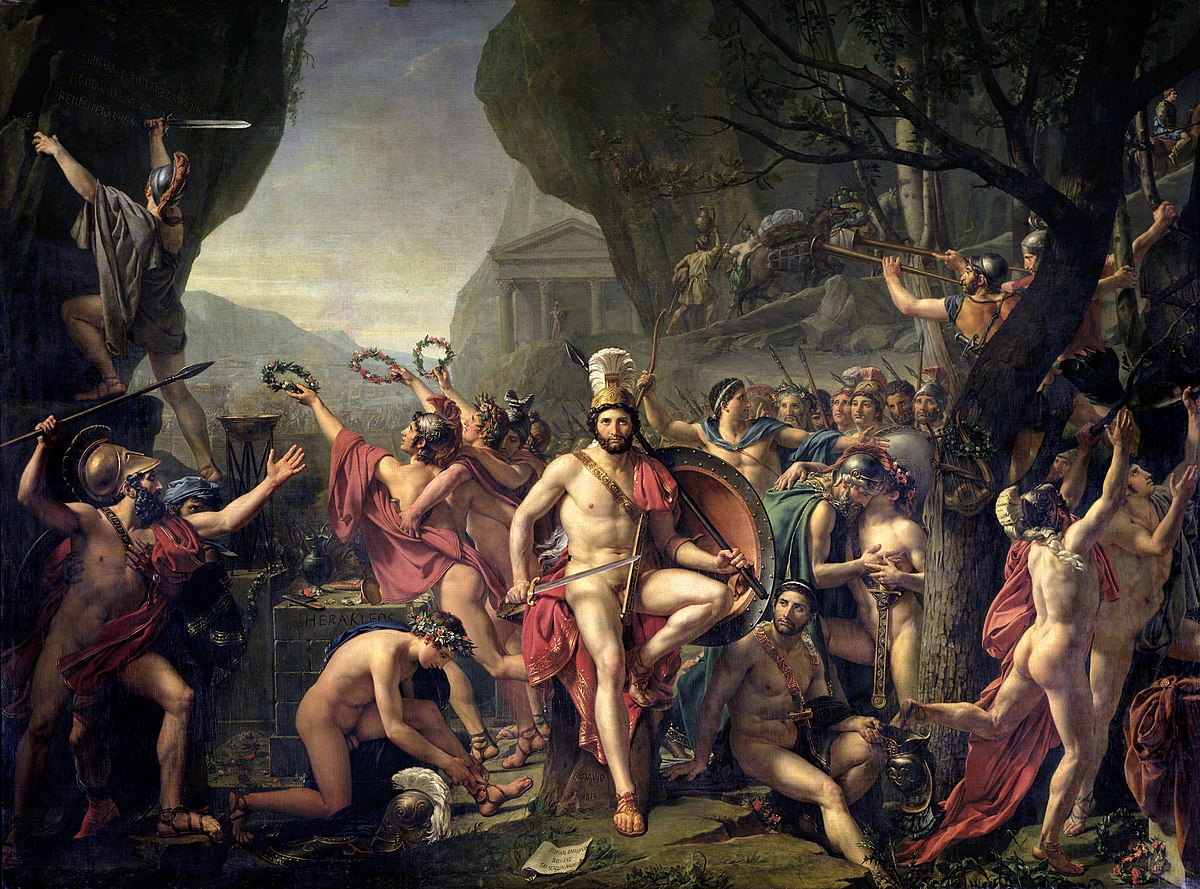
Leonidas at Thermopylae by Jacques-Louis David, 1814.
Wikimedia Commons.
Acclamation. A vote held by acclamation (sometimes called a “voice vote”) is a vote where, instead of getting an exact count of yes and no votes, the outcome is judged by the volume of people calling out yes or no. Obviously it would be very hard to tell who had really won a close vote. This is used in modern democracies only for very lopsided (typically unanimous) votes; in Classical Sparta, this was the only voting system, votes were never counted.
[Agoge. The Spartan education system for boys (ἀγωγή, pronounced ah-go-GAY). “Spartan boys were, at age seven, removed from their families and grouped into herds (agelai) under the supervision of a single adult male Spartan – except for the heirs to the two hereditary kings, who were exempt. Order was kept by allowing the older boys to beat and whip the younger boys (Xen. Lac. 2.2). The boys were intentionally underfed (Plut. Lyc. 17.4; Xen. Lac. 2.5-6). They were thus encouraged to steal in order to make up the difference, but severely beaten if caught (Plut. Lyc. 17.3-4; Xen. Lac. 2.6-9). … We are not told, but it seems unavoidable that in a system that intentionally under-feeds groups of boys to force them to steal, that the weakest and smallest boys will end up in a failure spiral where the lack of food leads to further weakness and further victimization at the hands of other boys. I should note that while ancient parenting and schooling was certainly more violent than what we do now – the Spartan system was recognized as abnormally violent towards these boys, even by the standards of the time.”]
Apella. The Apella was the popular assembly of Sparta, consisting of all adult male Spartiates over the age of thirty. The Apella was presided over by the Ephors and all votes were by acclamation. The Apella did not engage in debate, but could only vote “yes” or “no”. The Gerousia had the power to ignore the decisions of the Apella. [In most other Greek poleis the equivalent body would be called the ekklesia.]
Ephor. The Ephors were a board of five officials in Sparta, elected annually by the Apella (technically plus the two kings). The Ephors oversaw the two hereditary Spartan kings and could even bring a king up on charges before the Gerousia. In practice, the Ephors – not the kings – wielded the most political power in Sparta. The Ephors were also responsible for ritually declaring war on the helots every year. The institution as a whole is sometimes collectively referred to as the Ephorate.
Gerousia. The Gerousia – literally a council of old men (the members were “Gerontes” – literally “old men”) which consisted of thirty members, 28 elected (by acclamation in the Apella) plus the two hereditary kings. The elected members all had to be over the age of 60. Gerontes were elected for life. The Gerousia decided what motions could be voted on by the Apella and had the power to cancel any decision of the Apella. It also functioned as a court, with the power to try Spartiates and even the kings. In practice, with the Ephors, the Gerousia wielded the real political power in Sparta.
Helot. The subjugated slave class of Sparta, which made up the overwhelming majority of its residents, the Helots did the agricultural labor which kept the Spartan state running. Helots can be further subdivided into the Laconian helots (those living in Sparta proper) and the Messenian helots (the populace of Messenia which had been reduced to helotry after being conquered by Sparta in the 7th century B.C.). Helots often fought in Sparta’s armies, apparently as screening light-infantry forces (and also as camp followers and servants).
Homoioi. See: Spartiates.
Hoplite. Hoplites were Greek heavy infantry soldiers who fought with a heavy round shield (sometimes called a “hoplon” but more correctly an “aspis“) and a spear, typically in armor.
Hypomeiones. One of several sub-citizen underclasses in Sparta, the Hypomeiones (literally “the inferiors”) were former Spartiates who had fallen off the bottom of the Spartan social system, either through cowardice or (more likely) being unable to pay the contribution to the Syssitia. Though free, they had no role in government.
[Kings. Sparta had two royal lines and two kings at all times. The kings were drawn from the Agaids and the Eurypontid families. In theory, both kings had the same set of powers. The kings’ wealth was derived from lands allocated from territory taken from the perioikoi, and the eldest son of the current king in each line was the presumptive heir. On this basis, the kings were almost always the two wealthiest men in Sparta.]
[Kleroi (sing. kleros). The (theoretically) equal plots of land allocated to each Spartiate, worked on his behalf by Helots to generate the contributions to the individual Spartiate‘s Syssitia. Up to half of the production of the kleros had to be paid to the Spartiate by the Helots who worked that land. At some point, the kleroi became inheritable property, which facilitated the accumulation of wealth in fewer and fewer hands, contributing to the demographic collapse of the Spartiate class.]
Lycurgus. [The name of the (almost certainly) mythical founder figure of Sparta.] Lycurgus had been the younger brother of one of Sparta’s two kings, but had left Sparta to travel when his brother died, so that he would be no threat to his young nephew. After a time, the Spartans begged Lycurgus to come back and reorganize society, and Lycurgus – with the blessing of the Oracle at Delphi – radically remade Spartan society into the form it would have for the next 400 years. He did not merely change the government, but legislated every facet of life, from child-rearing to marriage, to the structure of households, the economic structure, everything. Once he had accomplished that, Lycurgus went back to Delphi, but before he left he made all the Spartans promise not to change his laws until he returned. Once the Oracle told him his laws were good, he committed suicide, so that he would never return to Sparta, thus preventing his laws from ever being over turned. So the Spartans never changed Lycurgus’ laws, which had been declared perfect by Apollo himself. Subsequently, the Spartans accorded Lycurgus divine honors, and within Sparta he was worshiped as a god.
Mothax. One of several sub-citizen underclasses in Sparta, the Mothakes were non-citizen men, generally thought to have been the children of Spartiate fathers and helot mothers, brought up alongside their full-citizen half-siblings. Mothakes fought in the Spartan army alongside spartiates, but had no role in government. A surprising number of innovative Spartan commanders – Gylippus and Lysander in particular – came from this class.
Neodamodes. One of several sub-citizen underclasses in Sparta, the Neodamodes were freed helots, granted disputed land on the border with Elis. Though they served in the Spartan army, the Neodamodes lacked any role in government. We might consider the helots who served in Brasidas’ army, the Brasideioi as a type of the Neodamodes (they did settle in the same place).
Peers: See: Spartiates.
Perioikoi (sing. Perioikos). The perioikoi (literally the “dwellers around”) were one of several sub-citizen underclasses in Sparta. The perioikoi were residents of communities which were subjected to the Spartan state, but not reduced to helotry. They lived in their own settlements under the control of the Spartan state, but with limited internal autonomy. The perioikoi seem to have included Sparta’s artisans, producing weapons, armor and tools; they were also made to fight in Sparta’s armies as hoplites.
Polis (pl. poleis). A complicated and effectively untranslatable term, polis most nearly means “community” and is often translated as “city-state”. However, there were poleis in Greece without cities (Sparta being one – a fact often concealed by translators rendering polis as city). Instead a polis consists of a body of citizens, their state, and the territory it controls (including smaller villages but not other subjugated poleis), usually but not always centered on a single urban center. Poleis are almost by definition independent and self-governing (that is, they have eleutheria and autonomia).
Skiritai. The Skiritai were one of several sub-citizen underclasses in Sparta. Dwellers in Skiritis, the mountains between Laconia and Arcadia, they were mostly rural people who were free, but subject to the Spartan state, similar to the perioikoi. The main difference between the two was that the Skiritai – perhaps because of their mountainous homes – served not as hoplites, but as an elite corps of light infantry in the Spartan army.
Spartiates, also called peers or homoioi. The citizen class at Sparta, the Spartiates were a closed ethnic aristocracy. Membership required both a Spartiate father and a Spartiate mother, as well as successful completion of the Agoge and membership in a Syssitia. Spartiate males over thirty were the only individuals in Sparta who could participate in government, although the political power of the average Spartiate was extremely limited.
Syssitia (sing. syssition). The Syssitia were the common mess-groups into which all adult Spartiates were divided. Each member of the Syssitia contributed a portion of the mess-group’s food; the contribution was a condition of citizenship. Spartiates who could not make the contribution lost citizenship and became Hypomeiones.
QotD: The Myth of Spartan Equality
Where does this idea come from? Well, it comes from the same pro-Spartan sources we discussed last time. Plutarch claims that Lycurgus‘ decision to banish money from Sparta essentially removed greed by making all of the Spartans equal (Plut. Lyc. 9.1-4) – or equally poor – though we should note that Plutarch is writing 900 years after Lycurgus (again, probably not a real person) was supposed to have lived. Xenophon notes approvingly that Lycurgus forbade the Spartans from engaging in productive business of any kind, making them thus unable to accumulate wealth (Xen. Lac. 7.1-6). Land was supposed to be distributed equally to each full Spartan citizen – the spartiates or homoioi (we’ll define these terms in a second) in equal plots called kleroi.
This idea – the Myth of Spartan Equality – is perhaps the single “biggest idea” in the conception of the Spartan state, rivaled only by the myth of Spartan military excellence (don’t worry, we’ll get there!). There is something deeply appealing, at a bedrock emotional level, to the idea of a perfectly equal society like that. And that myth of equality has prompted all sorts of thinkers from all sorts of eras (Rousseau, most famously) – including our own – to be willing to look past Sparta’s many, many failings.
And on the face of it, it does sound like a very equal society – practically a collectivist utopia. It is a pleasant vision. Unfortunately, it is also a lie.
[…] every Greek polis had a three-level layer-cake of status: the citizen body, free non-citizens (like foreigners), and non-free persons (slaves). You could – and the Greeks did – divide that top group by wealth and birth and so on, but we’ll get to that a bit later in this post and the next. For now, let’s stick with the three-level layer cake. Sparta follows this scheme neatly.
At the top were the Spartiates, the full-citizen male Spartans. According to Herodotus there were once 8,000 of these (Hdt. 7.234.2); supposedly 9,000 based on the initial number of equal land plots (kleroi) handed out (Plut. Lyc. 8.3 – or rather than saying “handed out” we might say “seized”). Of course these are tallies of Spartiate males, but women could be of citizen stock (but not citizens themselves) and we ought to imagine an equal number of spartiate women at any given time. For a child to be born into the citizen class (and thus eligible for the agoge and future full citizenship), he had to have a citizen father and a citizen mother. We’ll deal with the bastards a bit further down. Also, the spartiates were often also called the homoioi, sometimes translated as “peers” but literally meaning something like “the equals”. As we’ll see, that equality is notional at best, but this ideal of citizen equality was something Sparta advertised about itself.
[…]
But the final word on if we should consider the helots fully non-free is in their sanctity of person: they had none, at all, whatsoever. Every year, in autumn by ritual, the five Spartan magistrates known as the ephors declared war between Sparta and the helots – Sparta essentially declares war on part of itself – so that any spartiate might kill any helot without legal or religious repercussions (Plut. Lyc. 28.4; note also Hdt. 4.146.2). Isocrates – admittedly a decidedly anti-Spartan voice – notes that it was a religious, if not legal, infraction to kill slaves everywhere in Greece except Sparta (Isoc. 12.181). As a matter of Athenian law, killing a slave was still murder (the same is true in Roman law). One assumes these rules were often ignored by slave-holders of course – we know that many such laws in the American South were routinely flouted. Slavery is, after all, a brutal and inhuman institution by its very nature. The absence of any taboo – legal or religious – against the killing of helots marks the institution as uncommonly brutal not merely by Greek standards, but by world-historical standards.
We may safely conclude that the helots were not only enslaved persons, but that of all slaves, they had some of the fewest protections – effectively none, not even protections in-name-only.
Bret Devereaux, “Collections: This. Isn’t. Sparta. Part II: Spartan Equality”, A Collection of Unmitigated Pedantry, 2019-08-23.
January 16, 2022
QotD: Once “discovered”, colonization of the Americas was inevitable
This is not a joke. Political reality has a way of crashing in on the pipe dreams of liberal academics. The reality is, if the English had not colonised, then the French or the Dutch would have. If the Spanish had not colonised, the Portuguese would have. This would have shifted the balance of power at home, and any European country which had not colonised, would have been relegated to secondary status. And it is easy to overestimate the amount of control that European governments actually had. As soon as the New World was discovered, many fisherman and traders sailed across the Atlantic on their own, in hopes of circumventing tax authorities and scoring a fortune. Long before colonies were established in most regions, the New World was crawling with Europeans whose superior technology gave them an edge in combat. Nonetheless, it was extremely dangerous for Europeans to provoke fights with Native Americans, and most of them tried to avoid this when possible. In retrospect, one could in theory be impressed that so many European governments showed a genuine concern to rein in the worst excesses of their subjects, with an express eye to protecting the Indians from depredation. The logic was simple: they attempted to protect their subjects at home, in order to secure good order and a better tax base. So they would do the same to their subjects in the New World. For a long time, few Europeans harboured any master plan of pushing the Native Americans out of their own lands. In more densely populated regions such as Mexico, such an idea must have seemed an absurdity. Reality tends to occur ad hoc. Boundaries often took generations to move, and would have seemed fixed at the time. For several centuries, many Europeans assumed that they would long be a minority on the North American continent. In Mexico and Peru, they always have been.
Population density mattered, a lot, when it came to pre-modern global migrations. China and India were “safe” from excessive European colonisation because they had the densest populations in the world, and they were likewise largely immune to any diseases brought by Europeans. SubSaharan Africa had a lower population density depleted by slave raiding, but they still outnumbered European colonists by a large margin throughout the colonial era — again because European contact did not decimate their numbers through disease the way it did in the Americas. It is worth noting that no one claims that Europeans committed genocide in India, Asia or even Africa, although their technological advantages gave them every opportunity had they actually been of a genocidal mindset (as were for example the Mongols). In fact, the European track record shows them to be almost shockingly un-genocidal, given their clear technological advantages over the rest of the world for a period of several centuries. Few other civilisations, given similar power over so much of the world’s people, would have behaved in a less reprehensible manner. This is not to give Europeans a pat on the back. Rather it is to point out that Europeans are regularly painted as the very worst society on Earth, when in fact they had the power to do far, far more evil than they actually did. Let us at least acknowledge this fact.
Jeff Fynn-Paul, “The myth of the ‘stolen century'”, Spectator Magazine, 2020-09-26.
December 27, 2021
Celebrating Saturnalia with Cato’s Globi
Tasting History with Max Miller
Published 15 Dec 2020Help Support the Channel with Patreon: https://www.patreon.com/tastinghistory
Tasting History Merchandise: crowdmade.com/collections/tastinghistoryFollow Tasting History here:
Instagram: https://www.instagram.com/tastinghist…
Twitter: https://twitter.com/TastingHistory1
Reddit: r/TastingHistory
Discord: https://discord.gg/d7nbEpyLINKS TO INGREDIENTS & EQUIPMENT**
Canon EOS M50 Camera: https://amzn.to/3amjvwu
Canon EF 50mm Lens: https://amzn.to/3iCrkB8
Safflower Oil: https://amzn.to/39Lcsiz
Spelt Flour: https://amzn.to/3ggzPBO
Poppy Seeds: https://amzn.to/37DyG3q
Pokemon plushie: www.pokemoncenter.comLINKS TO SOURCES**
De Agricultura by Cato the Elder: https://amzn.to/3qxL5P5
Saturnalia by Macrobius: https://amzn.to/39N6Pkb
The Twelve Ceasars by Seutonius: https://amzn.to/39MQBat
**Amazon offers a small commission on products sold through their affiliate links, so each purchase made from this link, whether this product or another, will help to support this channel with no additional cost to you.Subtitles: Jose Mendoza
GLOBI
ORIGINAL 2ND CENTURY BC RECIPE (From De Agricultura by Cato the Elder)
Globi to be made thus: Mix the cheese and spelt in the same way. Make as many as desired. Pour fat into a hot copper vessel, and fry one or two at a time, turning them frequently with two sticks, and remove when done. Coat with honey, sprinkle with poppy-seeds, and serve.MODERN RECIPE
INGREDIENTS
– 1 Cup (240g) Ricotta Cheese
– 1 Cup and 1 tablespoon (120g) Spelt, Durum or other whole grain flour
– 1 Quart (1 L) of fat or oil
– 1/3 Cup (80ml) Honey
– Poppy SeedsMETHOD
1. Mix the cheese and flour in a large bowl, then form it into balls about 1 inch across. This recipe should make 12-15 balls.
2. Heat the oil over a high heat until it reaches 350°F (175°C). Turn heat to medium and fry two to three balls at a time, turning every 10 to 15 seconds with tongs. At 60 seconds, begin to check the color; once they are a golden brown (60-90 seconds) take them out and set them on a wire rack over paper towels to drain. Repeat until all of the globi are fried.
3. Dip the dried globi in honey (heating the honey can help if it is too thick). Then sprinkle with poppy seeds and serve.PHOTO CREDITS
Saturn: By inconnu – User:Jean-Pol GRANDMONT (2011), CC BY 3.0, https://bit.ly/39OKgLF
A Statue of Chronos: By Rufus46 – Own work, CC BY-SA 3.0, https://bit.ly/3giv9eH
Pileus: By Marie-Lan Nguyen (2009), CC BY 2.5, https://bit.ly/3osYo1l
Roman Collared Slaves: Ashmolean Museum, CC BY-SA 2.0 https://bit.ly/36OoIgz
Candles Oberflacht: Landesmuseum Württemberg, CC BY-SA 3.0 https://bit.ly/2Lf9yZp
Roman Figurines: Carole Raddato from FRANKFURT, Germany, CC BY-SA 2.0 https://creativecommons.org/licenses/…#tastinghistory #saturnalia #globi #romancooking
December 18, 2021
Saturnalia
Historia Civilis
Published 17 Dec 2016Io, Saturnalia!
Patreon | http://historiacivilis.com/patreon
Donate | http://historiacivilis.com/donate
Merch | http://historiacivilis.com/merch
Mailing List | http://historiacivilis.com/mailinglist
Twitter | http://historiacivilis.com/twitter
Website | http://historiacivilis.comMusic is:
“I //\\ I,” by Discount Fireworks

December 10, 2021
History Summarized: Britain and the Empire
Overly Sarcastic Productions
Published 20 Aug 2021How is it that the history of some islands off the northern coast of Europe balloons into a worldwide history? Empire is how! Let’s dig into the history of Britain since Union of the Crowns of England and Scotland in 1603, and follow that narrative through the monumental rise and precipitous fall of the British Empire.
Special thanks to the community members on Discord who assisted me with my script: Corvin the Crow, Johnny, Jdedredhed, Joud, Jéuname, Klieg, RileyTheProcrastinator, The Missing Link, and thesleepingmeerkat
SOURCES & Further Reading: The Great Courses Lecture series Foundations of Western Civilization II: A History of the Modern Western World by Robert Buchols lectures 11, 12, 13, 14, 15, 18, 19, 20, 21, 22, 30, The History Of England volumes 3 Rebellion, 4 Revolution & 5 Dominion by Peter Ackroyd, Scotland: A Concise History by Fitzroy MacLean, The Great Cities in History by John Julius Norwich, A Concise History of Wales by Geraint H. Jenkins, Sea Power: The History and Geopolitics of the World’s Oceans by James Stavridis.
Our content is intended for teenage audiences and up.
PATREON: https://www.Patreon.com/OSP
PODCAST: https://overlysarcasticpodcast.transi…
DISCORD: https://discord.gg/osp
MERCH LINKS: http://rdbl.co/osp
OUR WEBSITE: https://www.OverlySarcasticProductions.com
Find us on Twitter https://www.Twitter.com/OSPYouTube
Find us on Reddit https://www.Reddit.com/r/OSP/
November 26, 2021
The Germans Learn to Love Their Slaves – WAH 047 – November 1942, Pt. 2
World War Two
Published 25 Nov 2021In November 1942 the resistance fight in many parts of Europe becomes a part of the regular military war. In Germany, the Germans discover humanity while the German mass murders see no end.
(more…)


