
Atun-Shei Films
Published 11 Aug 2020Checkmate, Lincolnites! Debunking the Lost Cause myths surrounding William Tecumseh Sherman during the American Civil War, including the Atlanta Campaign, the March to the Sea, and the burning of Columbia — and tackling the “slavery would have gone away on its own” thing while we’re at it. Surprisingly, Johnny Reb gets in one or two really solid points.
[Updated 8 Feb 2023: Vlogging Through History’s reaction video to Atun-Shei’s interpretation is here – https://youtu.be/CTVr4YgB5VI]
(more…)
April 26, 2021
Was GENERAL SHERMAN a WAR CRIMINAL?!?!?!?!
Comments Off on Was GENERAL SHERMAN a WAR CRIMINAL?!?!?!?!
April 13, 2021
Was it REALLY the WAR of NORTHERN AGGRESSION?!?!?!
Atun-Shei Films
Published 28 Apr 2020Checkmate, Lincolnites! Debunking the Lost Cause myths that Abraham Lincoln was a tyrant, that nobody in the North cared about slavery or abolitionism, and that the warmongering Union invaded the South without provocation or just cause during the Civil War. Featuring some special guest appearances from your favorite kooky historical characters!
[Update, 8 Feb, 2023: Here’s a Vlogging Through History reaction video that amplifies several of the points Atun-Shei makes – https://www.youtube.com/watch?v=rTQzXG15QsU]
(more…)
Comments Off on Was it REALLY the WAR of NORTHERN AGGRESSION?!?!?!
April 12, 2021
The Constitution of the Spartans
Historia Civilis
Published 11 Sep 2017Patreon | http://historiacivilis.com/patreon
Donate | http://historiacivilis.com/donate
Merch | http://historiacivilis.com/merch
Mailing List | http://historiacivilis.com/mailinglist
Twitter | http://historiacivilis.com/twitter
Website | http://historiacivilis.comSources:
The Constitution of the Spartans, by Xenophon: http://amzn.to/2j7JXTB
The Moralia, by Plutarch: http://amzn.to/2gNMYHU
Parallel Lives: The Life of Lycurgus, by Plutarch: http://amzn.to/2xS29nI
Politics, by Aristotle: http://amzn.to/2wMq5ss
Rhetoric, by Aristotle: http://amzn.to/2xS3niO
Laws, by Plato: http://amzn.to/2wLpsiN
On the Republic, by Cicero: http://amzn.to/2j7Flgg
The Histories, by Herodotus: http://amzn.to/2xdH4a7
The Spartan Regime, by Paul A. Rahe: http://amzn.to/2vPmRqS
Property and Wealth in Classical Sparta, by Stephen Hodkinson: http://amzn.to/2xdV7MS
The Rise of Athens, by Anthony Everitt: http://amzn.to/2j69uMS
Persian Fire, by Tom Holland: http://amzn.to/2vPyCxEWe are a participant in the Amazon Services LLC Associates Program, an affiliate advertising program designed to provide a means for us to earn fees by linking to Amazon.com and affiliated sites.
Music:
“Air Hockey Saloon,” by Chris Zabriskie
“Candlepower,” by Chris Zabriskie
“CGI Snake,” by Chris Zabriskie
“Heliograph,” by Chris Zabriskie
“Hallon,” by Christian Bjoerklund
From the comments:
Temporary Fakename
3 years ago
You know, i thought the Roman political system was pretty odd and arcane. But the Spartans have a dual monarchy that has absolute power, except when it doesn’t, an elected Senate that is chosen partially randomly that can pass whatever the hell they want with a public assembly and punish kings, except when an all-male aristocracy decided no, a female aristocracy that is overwhelmingly rich but can’t vote, and a population so terrified of its own slaves that it ritually committed atrocities against them. Compared to that Roman politics look simple and elegant.
I found the presentation quite interesting and informative, but I felt that some discussion of the differences between the terrible plight of the Helots and the not-quite-free status of the Perioikoi was merited. I also felt that the final segment on the eventual decline of Sparta missed a major factor — Spartan military defeats in the Battle of Leuctra in 371 BC and the Battle of Mantinea in 362 BC — but reading down in the comments, I saw someone else had already brought this up:
xelena
2 years ago (edited)
This is a good video, but is missing a super important point at the end: The cause for the decline of Spartan power was its defeat by Epaminondas of Thebes and his freeing of Messenia (the land of the Helots). He also founded Messene in Messenia and Megalopolis in Arcadia for the Helots, which became a powerful check to Sparta. Spartan power never recovered from this death blow to its slave economy and continued to wither away into the nothingness you describe.Epaminondas is mostly forgotten today, but he was one of the greatest men of antiquity. It was him and Pelopidas who put to bed the myth of Spartan invincibility and freed an entire people who had been enslaved for centuries. So in a way, the crippling blow did come from other Greeks, and the Helots did participate in it.
Comments Off on The Constitution of the Spartans
March 20, 2021
Iron cannon, improved celestial navigation techniques, and “race-built” galleons
In the latest Age of Invention newsletter, Anton Howes considers some of the technological innovations which helped English sailors to overcome powerful adversaries of the Spanish and Portuguese navies in the late 1500s and early 1600s:
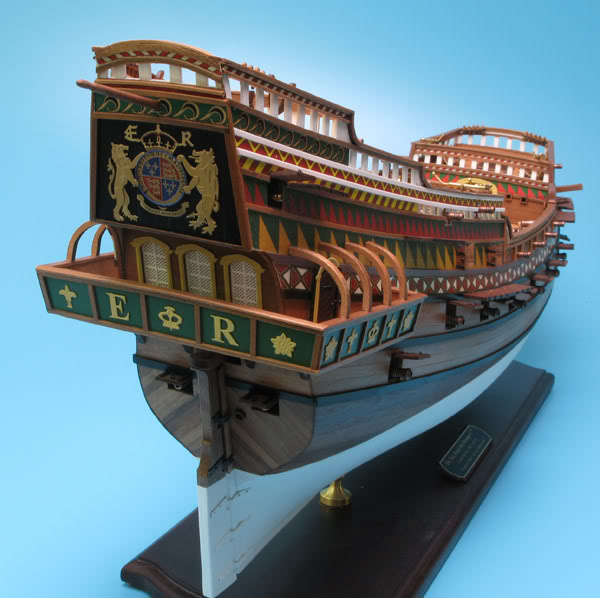
Stern view of a model of the Revenge as an example of a race-built galleon, 1577.
Image from modellmarine.de
Apart from the adoption and refinement of celestial navigation techniques, however, English seafaring capabilities also benefited from some more obvious, physical changes. In 1588, for example, on the eve of the Spanish Armada, a senior Spanish officer believed that the English had “many more long-range guns”. By the 1540s, medieval ironmaking techniques involving the blast furnace had gradually spread from Germany, to Normandy, and thence to the Weald of Sussex and Kent. Whereas in the first half of the sixteenth century England had typically imported three quarters of its iron from Spain, by 1590 it had not only quintupled its consumption of iron but was also almost entirely self-sufficient. And by allowing England to exploit its plentiful domestic deposits of iron, the blast furnace resulted in it producing many more cheap cannon.
Iron guns were in many ways worse for ships than those of bronze. They were heavier, prone to corrosion, and more likely to explode without warning. Bronze guns, by contrast, would first bulge and then split, but in any case tended to last. When the British captured Gorée off the coast of Senegal in 1758, they found a working English-made bronze cannon that dated from 1582. Yet iron was only 10-20% the price of bronze. Although the Royal Navy for decades continued to prefer bronze, cheap, medium-sized cannon of iron proliferated, becoming affordable to merchants, pirates, and privateers — a situation that was unique to England.
English ships were thus especially well-armed, allowing them to access new markets even when they sailed into hostile waters. They were soon some of the only merchants able to hold their own against the latest Mediterranean apex predator, whether it be the Spanish navy, Algeria-based corsairs, or Ottoman galleys. And they were able to insert themselves, sometimes violently, into the inter-oceanic trades — all despite the armed resistance of the Spanish and Portuguese, who had long monopolised those routes. In the 1560s, John Hawkins tried a few times to muscle in on the transatlantic Portuguese and Spanish trade in slaves. With backing from the monarch and her ministers, he captured Portuguese slave ships, raided and traded along the African coastline himself, and then sold slaves in the Spanish colonies of the Americas, sometimes having to attack those colonies before the local governor would allow them to trade. (The attempt was ultimately unsuccessful, as Hawkins’s privateering fleet was all but destroyed in 1568 and the English were not involved in the slave trade again for almost a century.)
The English hold over the hostile markets was only threatened during times of peace on the continent, when their ships’ defensiveness no longer gave them a special advantage. The Dutch usurped English dominance of the trade with Iberia and the Mediterranean, for example, during the Dutch Republic’s truce with Spain 1609-21. Their more efficient ships, especially for bulk commodities — the fluyt invented at Hoorn in the late 1580s — were cheaper to build, required fewer sailors, and were easier to handle. But these advantages only made them competitive when the risk of attack was low, as they were hardly armed. When wars resumed, the English had a chance to regain their position.
Finally, the English acquired a few further advantages when it came to ship design. Thanks to the shipwright Matthew Baker, who had been on the trial voyage Cabot dispatched to the Mediterranean, England experienced a revolution in using mathematics to design ships. Baker’s methods, seemingly developed in the 1560s, allowed him to more cheaply experiment with new forms, and by the 1570s these began to bear fruit. The old ocean-going carracks and galleons, with their high forecastles and aftercastles, became substantially sleeker. Taking inspiration from nature, Baker designed a streamlined, elongated hull modelled below the waterline upon a cod’s head with a mackerel tail. Above the waterline, too, he lowered the forecastle and set it further back, as well as flattening the aftercastle.
Starting in 1570 with his prototype the Foresight, and more fully developed in 1575-77 with the Revenge, these razed or “race-built” galleons gave the English some significant advantages. Drake even chose the Revenge as his flagship to battle the Spanish Armada in 1588, and to lead an ill-fated reprisal invasion of Portugal the following year. The higher castles of carracks and old-style galleons were suited to clearing an enemy’s decks with arrows and gunfire, as well as to defend against boarders. They were designed for combat at close quarters, in which height was an advantage. They were floating fortresses, their imposing height known to inspire terror. The race-built galleons, by contrast, by making the ship less top-heavy, could have longer and lower gundecks, with more of the ship’s displacement devoted to ordnance — especially useful when taking advantage of the cheaper but heavier cannon made of iron. Rather than killing an enemy ship’s sailors and soldiers, the race-built galleons were optimised for blasting through its hull. What they lost in “majesty and terror”, they made up for with overwhelming firepower. They aimed to sink.
Comments Off on Iron cannon, improved celestial navigation techniques, and “race-built” galleons
March 13, 2021
Confederate Soldiers DIDN’T Fight for SLAVERY!! (Or Did They?)
Atun-Shei Films
Published 20 Sep 2019Checkmate, Lincolnites! Debunking the Lost Cause myth that Johnny Reb, the common Confederate soldier, didn’t fight to preserve the institution of slavery.
Support Atun-Shei Films on Patreon ► https://www.patreon.com/atunsheifilms
Leave a Tip via Paypal ► https://www.paypal.me/atunsheifilms (All donations made here will go toward the production of The Sudbury Devil, our historical feature film)
Buy Merch ► teespring.com/stores/atun-shei-films
#CheckmateLincolnites #CivilWar #AmericanHistory
Reddit ► https://www.reddit.com/r/atunsheifilms
Twitter ► https://twitter.com/atun_shei
Comments Off on Confederate Soldiers DIDN’T Fight for SLAVERY!! (Or Did They?)
February 27, 2021
Q&A: Shooting the $ɦ!☦ with InRangeTV
Atun-Shei Films
Published 26 Feb 2021See the rest of our conversation over on Karl’s channel ► https://youtu.be/3sgc0BckrB8
Atun-Shei and InRange finally got together for a chat! In this video we answer questions from our generous patrons, discussing New Orleans culture, Creole food, the gunfight at the OK Corral, urban life in the ancient world, Confederate monuments, historical justifications for slavery, Louisiana Voodoo, Cajun French, Ron Maxwell movies, and the importance of compassion and empathy.
Support Atun-Shei Films on Patreon ► https://www.patreon.com/atunsheifilms
Leave a Tip via Paypal ► https://www.paypal.me/atunsheifilmsBuy Merch ► teespring.com/stores/atun-shei-films
#AtunSheiFilms #InRangeTV #History
Original Music by Dillon DeRosa ► http://dillonderosa.com/
Reddit ► https://www.reddit.com/r/atunsheifilms
Twitter ► https://twitter.com/atun_shei

Comments Off on Q&A: Shooting the $ɦ!☦ with InRangeTV
January 26, 2021
QotD: “A world organized around institutional mass slavery”
An example: We’ve discussed all the cool steampunk shit the Greeks could’ve had, if only Archimedes had … well, that’s just the thing, isn’t it? We look at the aeolipile and see a prototype steam engine; they looked at it and saw, as best we can tell, a party trick. Back when, I suggested, Marxist-style, that labor costs were a sufficient explanation for why nobody took the obvious-to-us next step of hooking the thing up to something productive and kicking off the Industrial Revolution. Machines are labor-saving devices; the ancient world had a gross excess of labor. Calling the aeolipile a steam engine, then, is a category error.
New hypothesis: It’s a category error, all right, but not because they didn’t think in terms of labor costs. It’s because they couldn’t think in terms of labor costs.
A world organized around institutional mass slavery is, in a very real sense, a timeless world. Herodotus (I think) actually says somewhere that nothing worth mentioning happened before him, and you can see echoes of this attitude even as late as the Antebellum South. You see their attitude described as “conservative,” but since that’s egghead shorthand for “evil” you can ignore it. They weren’t consciously backward-looking; rather, they were deeply rooted to their place and station. To the outsider, it looked like they were trying to hold time back, but to the insider, time — clock time, industrial time, the time of the Protestant work ethic — barely existed at all.
So with the Classical World. The Romans, for instance, are endlessly frustrating to their admirers (of which I am an ardent one). Their only economic fix, for instance, was debasing the currency, i.e. a primitive form of inflation. You guys could figure out how to hew an artificial harbor out of some desert rocks — a trick we’d have a hard time pulling off today — but you couldn’t figure out fiat currency? Or a better political system than the tetrarchy? Or that the forts-and-legions paradigm just isn’t cutting it? Or … etc.
Stuff like that is why Spengler said classical, Apollonian culture was fundamentally different from, and incompatible with, our Faustian culture. According to Spengler, the master metaphor for the Apollonian is the human body, which is beautiful but changeless (emphasis mine, not Spengler’s). You can improve your body somewhat, but only within certain tight limits, and the body’s fundamental form is always the same (we could time warp Julius Caesar into the Current Year and still recognize him as a fellow homo sap., no matter how different his mind might be).
The Faustian, though — that would be us — organizes his worldview around space, infinite space. Practically speaking, this results in our attitude of innovation-for-innovation’s sake. We send a man to the moon because we can, but such an idea would never occur to the Romans, for the same reason they didn’t apply all their awesome engineering knowledge to the problems of governance. Hacking a harbor out of the desert is a tremendous feat, but it’s a local feat — a one-shot deal, a very specific response to a very specific local problem, with no broader applications.
This, I suggest, is because the timeless world of institutional mass slavery naturally selects for the kind of man who is at home in the world of institutional mass slavery. It’s a world of very low future time orientation, because “time” hardly exists at all. Forget machinery for a sec; the Roman world was full of enormous problems that had teeny-tiny, head-slappingly obvious fixes. Julius Caesar, for instance, was considered some kind of prodigy because he could sight-read books. Which really was a noteworthy feat, because Romans didn’t even put spaces between their words, much less use any sort of punctuation marks. And they were radical innovators compared to the Ancient Egyptians, since at least Roman writing all ran left-to-right; hieroglyphics can be read in any direction, including vertically, and I’m pretty sure there are examples of them changing text orientations in the middle of the same inscription. It’s not hard to imagine some legion commander actually losing a battle because he had to stop and sound out an important communique from a subordinate …
… and yet the Romans, for all their technical skill, never even figured that tiny change out. See also: The Chinese doing fuck-all with movable type, vs. (Faustian) Europeans using it to conquer the world. China, too, was a timeless society. As Derb says somewhere, Classical Chinese isn’t even really writing; it’s more of an aide-memoire — designed to remind readers of stuff they already know, not to communicate new information.
Your post-Roman European, by contrast, lived in a world where high future time orientation was an absolute must. You don’t need hypotheses like the famous “lead in the drinking water pipes” to explain the seemingly bizarre things the Romans did, or didn’t do; all you need is time orientation, a fundamental attitude of “this is a variation on an old problem” vs. “this is an entirely new situation that requires a new response.” Life in the post-Roman world was solitary, poor, nasty, brutish, and short — every man for himself; think through the consequences of your actions very carefully before you do them, or die horribly. Those who failed to do so died. Bake that into the genetic cake for a few generations, and you get Renaissance Man, who’d see a million possible applications for the aeolipile.
Severian, “Bio-Marxism”, Rotten Chestnuts, 2020-09-24.
Comments Off on QotD: “A world organized around institutional mass slavery”
January 23, 2021
History Summarized: Atlantic Exploration
Overly Sarcastic Productions
Published 22 Jan 2021So you just conquered Iberia, and you’re wondering where to go from here? It’s a more common conundrum than you might think. Consider: a big wooden floaty house that goes splish-splash in the Atlantic Ocean. Anyway, this is a video about Portuguese and Spanish (erm, Castilian) exploration in the Atlantic during the 1400s. Please note my deliberate decision to Nope on out at the turn of the 1500s.
This topic was requested by our longtime patron Antonio Juarez! Thank you Antonio for supporting our work and helping to provide entertaining educational content.
SOURCES & Further Reading: Ornament of the World by Maria Rosa Menocal; lectures from Great Courses Plus “1571: Spain, Portugal Encircle the Globe” by Donald J. Harreld, “Renaissance and Exploration: New Horizons” by Jennifer McNabb, “Portugal’s Great Leap Forward” by “Vejas Gabriel Liulevicius”
TRACKLIST: “Scheming Weasel (faster version),” “Monkeys Spinning Monkeys”, “Local Forecast – Elevator” Kevin MacLeod (incompetech.com)
Licensed under Creative Commons: By Attribution 4.0 License
http://creativecommons.org/licenses/b…Our content is intended for teenage audiences and up.
PATREON: https://www.Patreon.com/OSP
PODCAST: https://overlysarcasticpodcast.transi…
DISCORD: https://discord.gg/osp
MERCH LINKS: http://rdbl.co/osp
OUR WEBSITE: https://www.OverlySarcasticProductions.com
Find us on Twitter https://www.Twitter.com/OSPYouTube
Find us on Reddit https://www.Reddit.com/r/OSP/

Comments Off on History Summarized: Atlantic Exploration
January 16, 2021
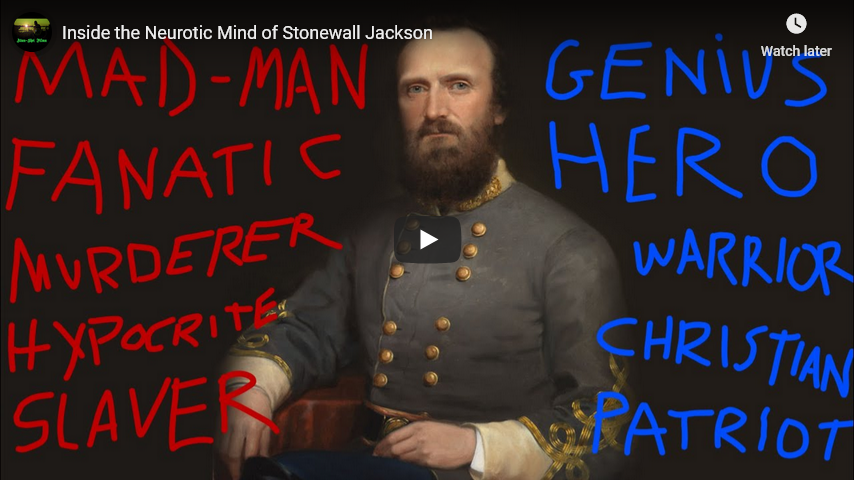
Inside the Neurotic Mind of Stonewall Jackson
Atun-Shei Films
Published 15 Jan 2021Let’s gossip about a man who’s been dead for 158 years.
Support Atun-Shei Films on Patreon ► https://www.patreon.com/atunsheifilms
Leave a Tip via Paypal ► https://www.paypal.me/atunsheifilms
Buy Merch ► teespring.com/stores/atun-shei-films
#ThomasJJackson #CivilWar #AmericanHistory
Original Music by Dillon DeRosa ► http://dillonderosa.com/
Reddit ► https://www.reddit.com/r/atunsheifilms
Twitter ► https://twitter.com/atun_shei
~REFERENCES~[1] Wallace Hettle. Inventing Stonewall Jackson: A Civil War Hero in History and Memory (2011). LSU Press, Page 3-9
[2] Hettle, Page 13-17
[3] Charles Royster. The Destructive War: William Tecumseh Sherman, Stonewall Jackson, and the Americans (1991). Vintage Books, Page 41-46
[4] Royster, Page 52-53
[5] Hettle, Page 20-21
[6] Royster, Page 65-67
[7] Chris Graham. “Myths and Misunderstandings: Stonewall Jackson’s Sunday School” (2017). The American Civil War Museum https://acwm.org/blog/myths-misunders…
[8] Royster, Page 63-65
[9] Royster, Page 60
[10] Royster, Page 49-51
[11] Mary Anna Jackson. Memoirs of Stonewall Jackson by his Widow, Marry Anna Jackson (1895). Prentice Press, Page 108
[12] Jackson, Page 120-121
[13] Hettle, Page 13-15
[14] Royster, Page 202
Comments Off on Inside the Neurotic Mind of Stonewall Jackson
December 11, 2020
QotD: Airbrushing out the worst parts of “Lost Cause” mythology
Looking back, we can see that between 1865 and around 1914 the Union and the former South negotiated an imperfect but workable peace. The first step in that negotiation took place at Appomattox, when the Union troops accepting General Robert E. Lee’s surrender saluted the defeated and allowed them to retain their arms, treating them with the most punctilious military courtesy due to honorable foes.
Over the next few years, the Union Army reintegrated the Confederate military into itself. Confederate officers not charged with war crimes were generally able to retain rank and seniority; many served in the frontier wars of the next 35 years. Elements of Confederate uniform were adopted for Western service.
The political leaders of the revolt were not executed. Instead, they were spared to urge reconciliation, and generally did. By all historical precedent they were treated with shocking leniency. This paid off.
Of course, not all went smoothly. The Reconstruction of the South between 1863 and 1877 was badly bungled, creating resentments that linger to this day and – in the folk memory of Southerners – often overshadow the harms of the war itself. The condition of emancipated blacks remained dire.
But overall, the reintegration of the South went far better than it could have. Confederate nationalism was successfully reabsorbed into American nationalism. One of the prices of this adjustment was that Confederate heroes had to become American heroes. An early and continuing example of this was the reverence paid to Robert E. Lee by Unionists after the war; his qualities as a military leader were extolled and his opposition to full civil rights for black freedmen memory-holed.
Lee’s heroism and ascribed saintliness would layer become a central prop in “Lost Cause” romanticism, which portrayed the revolt as an honorable struggle for a Southern way of life while mostly airbrushing out – but sometimes, unforgiveably, defending – the institution of slavery. Even today, the “soft” airbrushing version of Lost Cause retains a significant hold on Southerners who would never dream of defending slavery.
Eric S. Raymond, “Unlearning history”, Armed and Dangerous, 2017-09-22.
Comments Off on QotD: Airbrushing out the worst parts of “Lost Cause” mythology
October 27, 2020
America’s “brutal system of slavery [was] unlike anything that had existed in the world before”
I missed this article by Kay S. Hymowitz when it was published by City Journal a couple of weeks back:
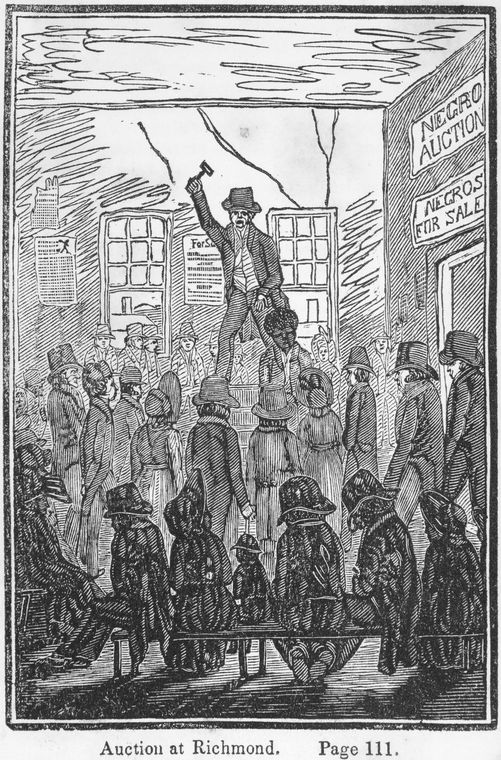
Auction at Richmond. (1834)
“Five hundred thousand strokes for freedom ; a series of anti-slavery tracts, of which half a million are now first issued by the friends of the Negro.” by Armistead, Wilson, 1819?-1868 and “Picture of slavery in the United States of America. ” by Bourne, George, 1780-1845
New York Public Library via Wikimedia Commons.
… slavery was a mundane fact in most human civilizations, neither questioned nor much thought about. It appeared in the earliest settlements of Sumer, Babylonia, China, and Egypt, and it continues in many parts of the world to this day. Far from grappling with whether slavery should be legal, the code of Hammurabi, civilization’s first known legal text, simply defines appropriate punishments for recalcitrant slaves (cutting off their ears) or those who help them escape (death). Both the Hebrew Bible and the New Testament take for granted the existence of slaves. Slavery was so firmly established in ancient Greece that Plato could not imagine his ideal Republic without them, though he rejected the idea of individual ownership in favor of state control. As for Rome, well, Spartacus, anyone?
In the ancient world, slaves were almost always captives from the era’s endless wars of conquest. They were forced to do all the heavy labor required for building and sustaining cities and towns: clearing forests; building roads, temples, and palaces; digging and transporting stone; hoeing fields; rowing galley ships; and marching to almost-certain death in the front line of battle. Women (and often enough boy) slaves had the task of servicing the sexual appetites of their masters. None of that changed with the arrival of a new millennium. Gaelic tribes took advantage of the fall of the Roman Empire to raid the west coast of England and Wales for strong bodies; one belonged to a 16-year-old later anointed St. Patrick, patron saint of Ireland. “In the slavery business, no tribe was fiercer or more feared than the Irish,” writes Thomas Cahill in How the Irish Saved Civilization.
Today, of course, the immorality of slave-owning is as clear as day. But in the premodern world, no neat division existed between evil slaveowners and their innocent victims. Once the Vikings arrived in their longboats in the 700s, the Irish enslavers found themselves the enslaved. Slavery became the commanding height of the Viking economy; Norsemen raided coastal villages across Europe and brought their captives to Dublin, which became one of the largest slave markets of the time. The Vikings thought of their slaves as more like cattle than people; the unlucky victims had to sleep alongside the domestic animals, according to the National Museum of Denmark in Copenhagen. Norsemen rounded up captured Irish men and women to settle the desolate landscape of Iceland; scientists have found Irish DNA in present-day Icelanders, a legacy of that time. The Slavic tribes in Eastern Europe were an especially fertile supplier for Viking slave traders as well as for Muslim dealers from Spain: their Latin name gave us the word slave. Slavs were evidently not deterred by the misery they must have suffered; when Viking power waned by the twelfth century, the Slavs turned around and enslaved Vikings as well as Greeks.
Slavery was a normal state of affairs well beyond the territory we now call Europe. The Mayans had slaves; the Aztecs harnessed the labor of captives to build their temples and then serve as human sacrifices at the altars they had helped construct. The ancient Near East and Asia Minor were chockfull of slaves, mostly from East Africa. According to eminent slavery scholar Orlando Patterson, East Africa was plundered for human chattel as far back as 1580 BC. Muhammad called for compassion for the enslaved, but that didn’t stop his followers from expanding their search for chattel beyond the east coast into the interior of Africa, where the trade flourished for many centuries before those first West Africans arrived in Jamestown. Throughout that time, African kings and merchants grew rich from capturing and selling the millions of African slaves sent through the Persian Gulf and Indian Ocean to Persians and Ottomans.
From the fifteenth to the eighteenth centuries, the North African Barbary coast was a hub for “white slavery.” This episode was relatively short-lived in the global history of slavery, but one with overlooked impact on Western culture. Around 1619, just as the first Africans were being sailed from the African coast to Jamestown, Algerian and Tunisian pirates, or “corsairs” as they were known, were using their boats to raid seaside villages on the Mediterranean and Atlantic for slaves who happened in this case to be white. In 1631, Ottoman pirates sacked Baltimore on the southern coast of Ireland, capturing and enslaving the villagers. Around the same time, Iceland was raided by Barbary corsairs who took hundreds of prisoners, selling them into lifetime bondage.
Comments Off on America’s “brutal system of slavery [was] unlike anything that had existed in the world before”
October 25, 2020
The Crimes of Madame Delphine LaLaurie: The Truth Behind the Legends
Atun-Shei Films
Published 16 Dec 2019Madame Delphine LaLaurie, New Orleans’ most reviled serial killer, has become world famous thanks to American Horror Story and the wildly popular French Quarter ghost tour industry. The story of this deranged socialite who tortured, mutilated, and murdered her slaves has lost none of its horrifying bite, and the supposedly haunted mansion where her home once stood has become a major tourist attraction. Despite its popularity (or perhaps because of it), this story is steeped in legend and folklore. Most online sources about LaLaurie’s crimes are outdated, wrong, or both. In this video I attempt to separate the truth from the myth, and tell a purely historical account of the crimes of Delphine LaLaurie.
Support Atun-Shei Films on Patreon ► https://www.patreon.com/atunsheifilms
#MadameLaLaurie #NewOrleans #History
Watch our film ALIEN, BABY! free with Prime ► http://a.co/d/3QjqOWv
Reddit ► https://www.reddit.com/r/atunsheifilms
Twitter ► https://twitter.com/atun_shei
Instagram ► https://www.instagram.com/atunsheifilms
Merch ► https://atun-sheifilms.bandcamp.com
Comments Off on The Crimes of Madame Delphine LaLaurie: The Truth Behind the Legends
October 24, 2020
The LaLaurie Mansion: A New Orleans Ghost Story
Atun-Shei Films
Published 25 Mar 2019Thought I’d try something different with this video. This is the story of famous serial killer Delphine LaLaurie and her allegedly haunted mansion.
Sorry for the background noises… such are the pitfalls of filming in the French Quarter.
Support Atun-Shei Films on Patreon ► https://www.patreon.com/atunsheifilms
#NewOrleans #GhostStory #History #AmericanHistory #MadameLaLaurie
Watch our film ALIEN, BABY! free with Prime ► http://a.co/d/3QjqOWv
Reddit ► https://www.reddit.com/r/atunsheifilms
Twitter ► https://twitter.com/alienbabymovie
Instagram ► https://www.instagram.com/atunsheifilms
Merch ► https://atun-sheifilms.bandcamp.com

Comments Off on The LaLaurie Mansion: A New Orleans Ghost Story
September 27, 2020
CHECKMATE, LINCOLNITES! Confederate DESTROYS Yankee with FACTS and LOGIC
Atun-Shei Films
Published 23 May 2019Checkmate, Lincolnites! Debunking the three or four arguments Neo-Confederates always make when they talk about the Civil War.
Support Atun-Shei Films on Patreon ► https://www.patreon.com/atunsheifilms
#CheckmateLincolnites #CivilWar #AmericanHistory
Watch our film ALIEN, BABY! free with Prime ► http://a.co/d/3QjqOWv
Reddit ► https://www.reddit.com/r/atunsheifilms
Twitter ► https://twitter.com/alienbabymovie
Instagram ► https://www.instagram.com/atunsheifilms
Merch ► https://atun-sheifilms.bandcamp.com

Comments Off on CHECKMATE, LINCOLNITES! Confederate DESTROYS Yankee with FACTS and LOGIC
September 26, 2020
“… debate is an imperialist capitalist white supremacist cis heteropatriarchal technique that transforms a potential exchange of knowledge into a tool of exclusion & oppression”
Andrew Sullivan‘s latest look at the ultrawoke:
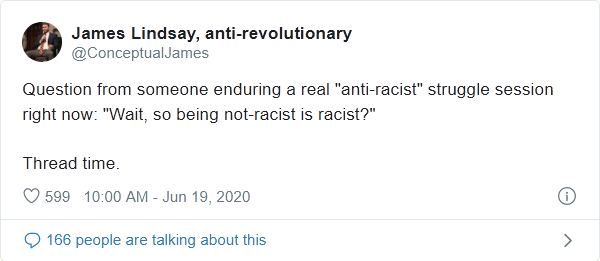
If you’ve ever wondered why critical theorists and their popularizers never seem to actually expose themselves to direct criticism, this quote might help:
I get regular invites to debate on various platforms. I always say no. Because debate is an imperialist capitalist white supremacist cis heteropatriarchal technique that transforms a potential exchange of knowledge into a tool of exclusion & oppression.
And also perhaps because debate is one of the most effective tools in rooting out ideological bullshit. Speaking of which, here’s an interview with Judith Butler, the patron saint of wokeness, in which she can actually say, with a straight face: “I am not aware that terf is used as a slur.” “Terf” is short for “Trans-Exclusionary Radical Feminist.” It’s yelled routinely at any dissenter from critical queer and gender theory. Of course it’s used as a slur.
Meanwhile, the 1619 Project has begun finally to implode. Its core argument – that America’s true founding was in 1619 not 1776, because America is in its DNA a slavocracy built on “white supremacy” and not a democracy rooted in the unrealized principle of human equality — has been withdrawn by the editor. Here’s the best summary of the rank dishonesty of the entire thing, from the preternaturally reasonable Conor Friedersdorf. He attempted to engage Nikole Hannah-Jones in good faith, a concept she simply doesn’t comprehend.
I think it’s clear by now that a completely defensible — even important — airing of new scholarship about the evil of slavery, and its profound impact on America, became hijacked at the NYT by the ideology that insists that the United States is inherently white supremacist, that this explains everything about the country, that this has never changed, that no white people were involved in perfecting the union, and that liberal democracy is a front for racism and should be dismantled. Given the extremist politics and unethical behavior of Nikole Hannah-Jones, this is unsurprising. But that this confused, half-baked rant won a Pulitzer and is being used to indoctrinate school kids in critical race theory is a staggering indictment of how corrupted by left-racism American elite journalism now is. In my view, the Pulitzer Board needs to rescind its prize. Fat chance, of course.
But there is hope. There are still reporters at the NYT interested in the truth about woke culture and politics. Nellie Bowles’ dispatch from Portland is a must-read. It’s a glimpse into the totalitarian impulses behind so many on the far left. Chilling.
Comments Off on “… debate is an imperialist capitalist white supremacist cis heteropatriarchal technique that transforms a potential exchange of knowledge into a tool of exclusion & oppression”


