
The single-party state has a PR problem, and one solution to it is a more postmodern form of managed democracy, the “surface democracy”.
Surface democracies are wildly, raucously competitive. Two or more parties wage an all-out cinematic slugfest over hot-button issues with big, beautiful ratings. There may be a kaleidoscopic cast of quixotic minor parties with unusual obsessions filling the role of comic relief, usually only lasting for a season or two of the hit show Democracy. The spectacle is gripping, everybody is awed by how high the stakes are and agonizes over how to cast their precious vote. Meanwhile, in a bland gray building far away from the action, all of the real decisions are being made by some entirely separate organ of government that rolls onwards largely unaffected by the show.
Losers and haters are perpetually accusing the United States of being a surface democracy. Enemies of the state ranging from Ralph Nader to Vladimir Putin are constantly banging on about it, but this is a Patriotic Substack and we would obviously never countenance such insinuations about our noble republic. So there’s absolutely no chance it’s even the slightest bit true of the US, but … what about Japan?
Well, awkwardly enough, it turns out that the central drama of preindustrial Japanese history was the growing power of unofficial rulers (the shoguns) who ran the country in reality while the official rulers (the emperors) gradually devolved into puppets and figureheads. A “surface monarchy”, if you will. Of course that all ended with the Meiji Restoration of 1868 (c’mon, it says “restoration” right there in the name) which returned the emperor to being fully in charge … which is why when the Japanese declared war on America in 1941, neither the Emperor Hirohito nor the parliament was even consulted. Hang on a minute!
In fact, yes, prewar Japan may have been reigned over by a monarch, but it was ruled by the deep state — especially the career military general staff and the economic planning bureaucracies. I know it’s hard to believe that drab agencies regulating coal and steel production were able to go toe-to-toe with General Tojo, but just imagine that they were all being staffed by fanatical clans of demobilized samurai or something crazy like that. When MacArthur rolled in with the occupation forces, he had a goal of creating total discontinuity with Japan’s past and utterly bulldozing the government. But a guy needs to pick his battles, and so he obviously focused on getting rid of all those nasty generals and admirals he’d just spent years fighting. The harmless paper-pushers, on the other hand, how much trouble could they be? Maybe they could even help organize the place.
The chapter about the post-war occupation is one of the deadpan funniest in Johnson’s book. The American occupiers are genuinely trying to create a liberal democracy out of the ashes, but have no idea that the friendly, helpful bureaucrats they’ve enlisted in this quest were the secret rulers of the regime they’d just conquered. The stats bear this out — of all the officials who controlled Japan’s wartime industry, only a few dozen were ever purged by the Americans. The most striking example of continuity has to be Nobusuke Kishi,1 but there were countless others like him. These were the men charged with translating the occupiers’ desires into policy, reconstructing Japanese society, and finally drafting a new constitution. Then eventually the Americans sailed off, and the bureaucrats smiled and waved, and went back to ruling as they’d done for hundreds of years, behind the scenes.
John Psmith, “REVIEW: MITI and the Japanese Miracle by Chalmers Johnson”, Mr. and Mrs. Psmith’s Bookshelf, 2023-04-03.
1 Briefly: Kishi was a descendant of samurai (of course) who became an economic planning bureaucrat (of course) and then the dictator of the Japanese puppet state in Manchuria in the 1930s. During his reign he tried out a lot of the industrial policy ideas that would later fuel the Japanese postwar boom … and also brutalized the population to such an extent that even other Imperial Japanese colonial administrators thought he was excessive. Later he signed the declaration of war against the United States (he was an economic planning bureaucrat, after all), and was briefly imprisoned as a war criminal after the Japanese surrender. Within a few years, however, he was back out, and running the country as prime minister. His brother was also prime minister. Oh … and his grandson was a guy you might have heard of, a guy named “Shinzo Abe”.
March 16, 2024
QotD: “Surface democracies” and “surface monarchies” — how the deep state pretends to be something else
March 13, 2024
QotD: Filthy coal
So, standing in my coal-fired kitchen for the first time, I was feeling confident. Surely, I thought, the Victorian regime would be somewhere halfway between the Tudor and the modern. Dirt was just dirt, after all, and sweeping was just sweeping, even if the style of brushes had changed a little in the course of five hundred years. Washing-up with soap was not so very different from washing-up with liquid detergent, and adding soap and hot water to the old laundry method of bashing the living daylights out of clothes must, I imagined, make it a little easier, dissolving dirt and stains all the more quickly. How wrong could I have been.
Well, it turned out that the methods and technologies necessary for cleaning a coal-burning home were fundamentally different from those for a wood-burning one. Foremost, the volume of work — and the intensity of that work — were much, much greater.
The fundamental problem is that coal soot is greasy. Unlike wood soot, which is easily swept away, it sticks: industrial cities of the Victorian era were famously covered in the residue of coal fires, and with anything but the most efficient of chimney designs (not perfected until the early twentieth century), the same thing also happens to your interior. Imagine the sort of sticky film that settles on everything if you fry on the stove without a sufficient vent hood, then make it black and use it to heat not just your food but your entire house; I’m shuddering just thinking about it. A 1661 pamphlet lamented coal smoke’s “superinducing a sooty Crust or Furr upon all that it lights, spoyling the moveables, tarnishing the Plate, Gildings and Furniture, and corroding the very Iron-bars and hardest Stones with those piercing and acrimonious Spirits which accompany its Sulphure.” To clean up from coal smoke, you need soap.
“Coal needs soap?” you may say, suspiciously. “Did they … not use soap before?” But no, they (mostly) didn’t, a fact that (like the famous “Queen Elizabeth bathed once a month whether she needed it or not” line) has led to the medieval and early modern eras’ entirely undeserved reputation for dirtiness. They didn’t use soap, but that doesn’t mean they didn’t clean; instead, they mostly swept ash, dust, and dirt from their houses with a variety of brushes and brooms (often made of broom) and scoured their dishes with sand. Sand-scouring is very simple: you simply dampen a cloth, dip it in a little sand, and use it to scrub your dish before rinsing the dirty sand away. The process does an excellent job of removing any burnt-on residue, and has the added advantage of removed a micro-layer of your material to reveal a new sterile surface. It’s probably better than soap at cleaning the grain of wood, which is what most serving and eating dishes were made of at the time, and it’s also very effective at removing the poisonous verdigris that can build up on pots made from copper alloys like brass or bronze when they’re exposed to acids like vinegar. Perhaps more importantly, in an era where every joule of energy is labor-intensive to obtain, it works very well with cold water.
The sand can also absorb grease, though a bit of grease can actually be good for wood or iron (I wash my wooden cutting boards and my cast-iron skillet with soap and water,1 but I also regularly oil them). Still, too much grease is unsanitary and, frankly, gross, which premodern people recognized as much as we do, and particularly greasy dishes, like dirty clothes, might also be cleaned with wood ash. Depending on the kind of wood you’ve been burning, your ashes will contain up to 10% potassium hydroxide (KOH), better known as lye, which reacts with your grease to create a soap. (The word potassium actually derives from “pot ash,” the ash from under your pot.) Literally all you have to do to clean this way is dump a handful of ashes and some water into your greasy pot and swoosh it around a bit with a cloth; the conversion to soap is very inefficient (though if you warm it a little over the fire it works better), but if your household runs on wood you’ll never be short of ashes. As wood-burning vanished, though, it made more sense to buy soap produced industrially through essentially the same process (though with slightly more refined ingredients for greater efficiency) and to use it for everything.
Washing greasy dishes with soap rather than ash was a matter of what supplies were available; cleaning your house with soap rather than a brush was an unavoidable fact of coal smoke. Goodman explains that “wood ash also flies up and out into the room, but it is not sticky and tends to fall out of the air and settle quickly. It is easy to dust and sweep away. A brush or broom can deal with the dirt of a wood fire in a fairly quick and simple operation. If you try the same method with coal smuts, you will do little more than smear the stuff about.” This simple fact changed interior decoration for good: gone were the untreated wood trims and elaborate wall-hangings — “[a] tapestry that might have been expected to last generations with a simple routine of brushing could be utterly ruined in just a decade around coal fires” — and anything else that couldn’t withstand regular scrubbing with soap and water. In their place were oil-based paints and wallpaper, both of which persist in our model of “traditional” home decor, as indeed do the blue and white Chinese-inspired glazed ceramics that became popular in the 17th century and are still going strong (at least in my house). They’re beautiful, but they would never have taken off in the era of scouring with sand; it would destroy the finish.
But more important than what and how you were cleaning was the sheer volume of the cleaning. “I believe,” Goodman writes towards the end of the book, “there is vastly more domestic work involved in running a coal home in comparison to running a wood one.” The example of laundry is particularly dramatic, and her account is extensive enough that I’ll just tell you to read the book, but it goes well beyond that:
It is not merely that the smuts and dust of coal are dirty in themselves. Coal smuts weld themselves to all other forms of dirt. Flies and other insects get entrapped in it, as does fluff from clothing and hair from people and animals. to thoroughly clear a room of cobwebs, fluff, dust, hair and mud in a simply furnished wood-burning home is the work of half an hour; to do so in a coal-burning home — and achieve a similar standard of cleanliness — takes twice as long, even when armed with soap, flannels and mops.
And here, really, is why Ruth Goodman is the only person who could have written this book: she may be the only person who has done any substantial amount of domestic labor under both systems who could write. Like, at all. Not that there weren’t intelligent and educated women (and it was women doing all this) in early modern London, but female literacy was typically confined to classes where the women weren’t doing their own housework, and by the time writing about keeping house was commonplace, the labor-intensive regime of coal and soap was so thoroughly established that no one had a basis for comparison.
Jane Psmith, “REVIEW: The Domestic Revolution by Ruth Goodman”, Mr. and Mrs. Psmith’s Bookshelf, 2023-05-22.
1. Yeah, I know they tell you not to do this because it will destroy the seasoning. They’re wrong. Don’t use oven cleaner; anything you’d use to wash your hands in a pinch isn’t going to hurt long-chain polymers chemically bonded to cast iron.
February 17, 2024
QotD: Lessons for today from the decline of the Western Roman Empire
Luttwak has a charmingly racist bit about how some client states have the IQ and sophistication to understand the true nature of the arrangement, while others are too dumb or barbaric to remember who’s boss without having their faces regularly rubbed in it. In the Roman case, the former camp contained the various Hellenistic kingdoms in Asia Minor and the Levant, who didn’t need legionaries standing around and supervising them, because they could imagine the existence of those legionaries and what they would do to them if provoked. The latter camp included many of the Germanic tribes, who tended to forget their place if the legions weren’t garrisoned within eyeshot, and even then would rise up in fruitless rebellion every couple of generations. We can make this marginally less racist by positing something more like a spectrum of how tolerable the client arrangement was, and consequently a spectrum of how coercive it had to be. The Greeks were relatively compatible culturally with the Romans, and the warrior spirit of their ancestors had been sufficiently sanded down that they didn’t mind being told what to do. The Germans were more foreign, and also retained the barbarian’s yearning for freedom, so a careful eye had to be kept on them.
A true cynic might think that there was something similar going on with America’s imperial dependencies … sorry, with America’s “allies”. There are no American garrisons in Canada, because the Canadians are culturally-compatible, and also because they’ve been thoroughly cowed and do not dream of an independent national destiny. But look overseas, for instance at some of our Middle Eastern “allies”, and you will see a situation more analogous to the Germanic tribes. What a coincidence that these same “allies” host a much heavier American military presence! Even here, however, the situation isn’t strictly coercive, and insofar as it is, the coercion is mostly outsourced to local elites. Those elites, in turn, can mostly be handled with carrots: the imperial power subsidizes their trade and security arrangements, not to mention keeps them in charge of their respective countries! The Romans commonly rewarded loyal clients with citizenship and a cushy sinecure for a job well done. It would be rude of us to do otherwise.
Maybe this was already obvious to everyone else, but reading the “rules-based international order”1 as a concealed hegemon/client system feels a bit like having the skeleton key to understanding current events. Like why do European countries so often act in ways contrary to their own economic or geopolitical self-interest, but consonant with America’s interest? How do the political and business elites of these countries maintain such an impressive unified front in the face of popular discontent? Why do the rulers of all these very different countries have seemingly identical tastes, worldviews, and mannerisms? What is the meaning of “populism,” and why do people treat it like it’s a single, consistent thing, despite the fact that “populist” parties in different countries often seek diametrically opposite policies?
Just pretend, imagine with me, that these European “allies” are client kingdoms. They are permitted a certain amount of latitude, but when the chips are down they do not have an independent foreign policy. Their ruling classes are client rulers that administer certain territories, and there is tacit agreement with the imperial overlord on what they may and may not do. Over time, the client rulers identify less and less with their countrymen, more and more with their counterparts in other client states, and most of all with the distant metropole, whose social approval they desperately desire. The “populists” are simply the anti-imperial party, in whatever country. The thing the “populists” have in common is a desire to be free of the suffocating imperial embrace,2 but they all have a thousand different stupid ideas about what to do with that freedom. This includes the “populists” in the United States itself, by the way. The American Empire is called that because it started here, but it has long-since burst free of the host in which it incubated, and the rot of our own political institutions can be understood as our transformation into the biggest client kingdom of them all.
None of what I’ve said above is meant to be a value judgment. I think many people resist the notion that America is an empire because empires are “bad” and we’re obviously the good guys. But others, including myself not too long ago, resist it because we have an overly-simplistic notion of what an empire looks like, especially what it looks like from the inside. Empires exist on a spectrum — America’s subjects certainly have more ability to act independently than Rome’s did. But many empires also go to some lengths to conceal their true nature. Around the time of the birth of Christ, the official story in many of the lands ruled by Rome was that Rome was merely their largest trading partner and a staunch military ally. Some of them might even have believed it.
John Psmith, “REVIEW: The Grand Strategy of the Roman Empire by Edward Luttwak”, Mr. and Mrs. Psmith’s Bookshelf, 2023-11-13.
1. The rules-based international order which has no rules, isn’t based, and opposes order.
2. They may also have in common the payments made to their bank accounts by the empire’s enemies.
February 7, 2024
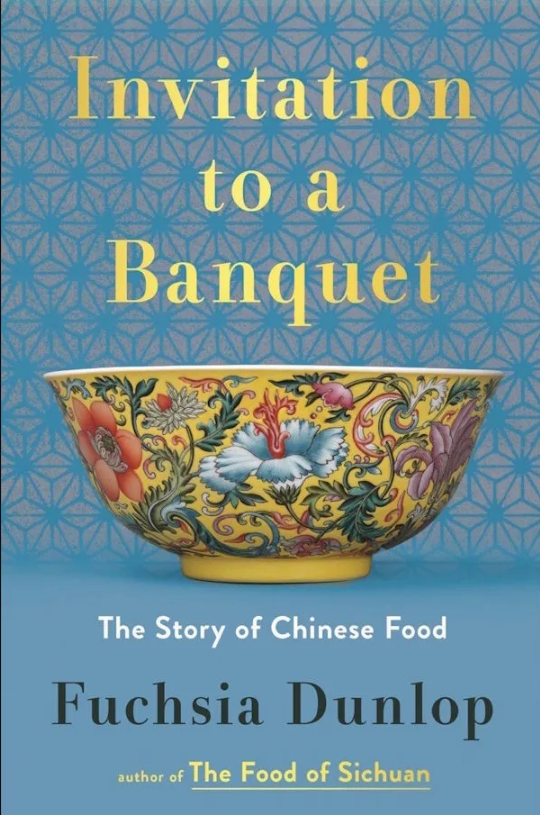
“China is a food-obsessed society”
If your initial reaction to the headline is to assume this is because of the amazingly unsettled history of mainland China over the last several hundred years and the totally understandable fear of famines, I’m with you, but we’d both be wrong, as John Psmith explains:
One sunny December morning years ago, Jane and I were on holiday in the South of China. Far from the city, a little temple had been hewn out of a seaside grotto so that it partially flooded when the tide came in. We stood inside and gazed up at a statue of 觀音, “Guan Yin”, the lady to whom the temple was dedicated. Her legend originated in India, where she was known as the bodhisattva Avalokitasvara, but she’d been absorbed and appropriated by Chinese folk religion many centuries ago, and in this statue there was no trace to be found of her South Asian origins. A minute or two into our reverie, a local came over to us and, seeing that we looked out of place, helpfully explained in unaccented English, “This is one of the most important Christian goddesses.”
The Chinese are almost as bad as the Romans were about pilfering the deities of their neighbors, so you really can’t blame them when they occasionally get confused about who they stole them from. As with goddesses, so with food: earlier that day a different helpful local had steered us towards a restaurant specializing in “Western cuisine”. The menu listed steaks “French style”, “German style”, and “Barbecue style”. Soup options included minestrone and borscht, both of them with the surprise addition of prawns. Their pride and joy, however, was their breakfast menu which included roughly seventy different varieties of toast. The chef told me that there were restaurants in Europe and America that did not have so many kinds of toast, and beamed with pride when I nodded gravely. One of the diners, delighted to see real living and breathing Westerners in her local Western restaurant, told me: “The thing I love about this place is that it’s so authentic.”
This “Western” restaurant may sound ridiculous to you, but it’s only as ridiculous as most of the “Chinese” restaurants you’ve encountered in the West. First of all, there’s no such thing as “Chinese” food. China is a country, but it’s the size of a continent, and it boasts a culinary diversity which exceeds that of many actual continents. Second, the dishes you encounter in the average Chinese restaurant over here bear about as much resemblance to real Chinese food as the seventy varieties of toast and the barbecue steaks do to French cuisine. “American Chinese food” is an interesting topic in its own right, and there are some good books about it, but now that I’m through the mandatory throat-clearing you have to do when writing about Chinese cuisine for a Western audience, I’m never going to mention it again.
China is a food-obsessed society. People are always talking about their next meal. People talk about it incessantly. The Chinese equivalent of talking about the weather, a way of making polite chitchat with strangers, is to mention a restaurant that you like, or a meal that you’re looking forward to. A standard way of saying “hello” in Mandarin is “你吃饭了吗?” In Cantonese it’s “你食咗飯未呀?” Both of them literally translate as something like “have you eaten yet?” and produce a natural conversational opening to begin immediately discussing food. Perhaps most uncanny to foreigners, Chinese people will sometimes discuss their next meal while they are in the middle of eating a fancy dinner. Dozens of gorgeous little dishes spread around them, chomping or slurping away at exquisite cuisine, and happily chattering about what they plan to eat tomorrow.
None of this is remotely new. If anything, between the Revolution and the famines, Chinese food culture is actually tamer than it used to be.1 We know this from literary and historical accounts, from archeological evidence (China had fancy restaurants about a thousand years before France did), and from the structure of the language itself. They say the Eskimos have an improbable number of words for snow,2 but the Chinese actually do have a zillion words for obscure cooking techniques. What’s more, many of the words are completely different from region to region, which is hardly surprising since the food itself is bewilderingly different from one side of the country to the other.
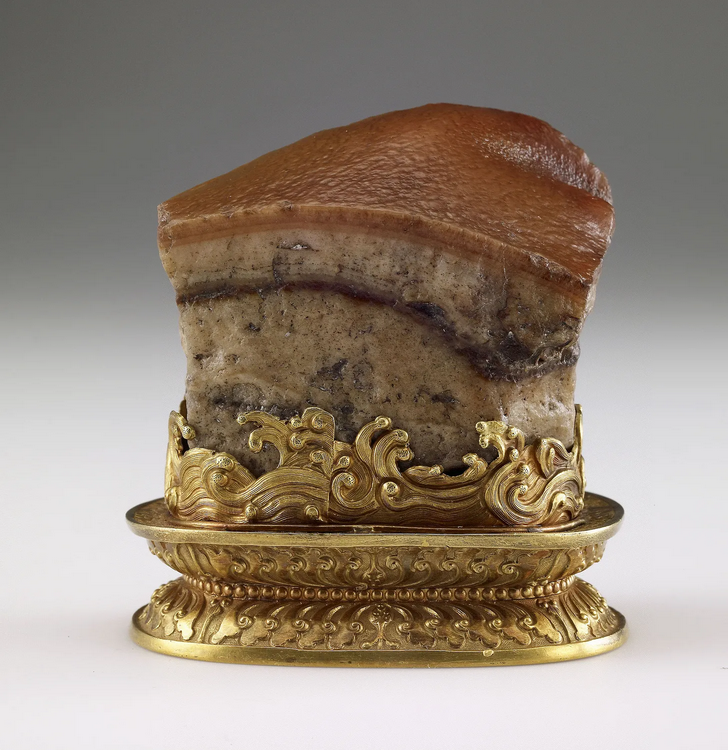
How food-obsessed are the Chinese? One of the most priceless artifacts belonging to the imperial family, the one thing the fleeing Nationalists made sure to grab as communist artillery leveled Beijing, now the most highly-valued object in the National Palace Museum in Taipei is … The Meat-Shaped Stone.3 A single piece of jasper carved into a lifelike hunk of luscious pork belly, complete with crispy skin and layers of subcutaneous fat and meat. Feast your eyes upon it.
1. Ferran Adrià, the legendary chef of El Bulli, once said that Mao was the most consequential figure in the history of cooking because: “[Spain, France, Italy and California] are only competing for the top spot because Mao destroyed the pre-eminence of Chinese cooking by sending China’s chefs to work in the fields and factories. If he hadn’t done this, all the other countries and all the other chefs, myself included, would still be chasing the Chinese dragon.”
2. I once tried searching Google to find out whether Eskimos really have a lot of words for snow. The top results were all places like BuzzFeed and the Atlantic denouncing this as an outmoded racist stereotype … followed by a Wikipedia article patiently explaining that no it’s actually true.
3. The Meat-Shaped Stone is not some weird aberration. The runner-up most valuable items in the museum are a piece of jadeite carved to look like a cabbage and a very fancy cooking vessel.
January 24, 2024
The father of the “Green Revolution”
In the latest review at Mr. and Mrs. Psmith’s Bookshelf, Jane Psmith reviews The Wizard and the Prophet by Charles C. Mann:
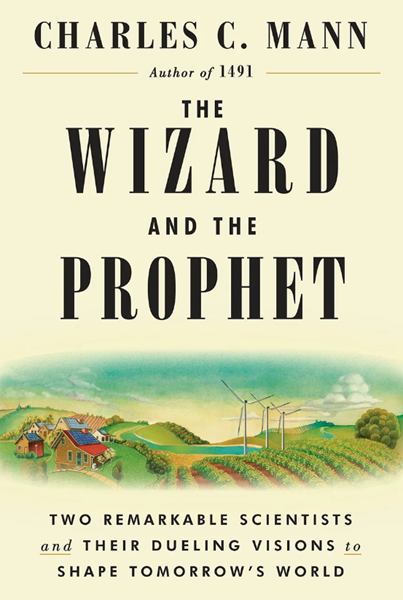
Norman Borlaug is generally estimated to have saved the lives of about a billion people who would otherwise have starved to death.
Yet despite all this — and Borlaug’s is a great story, which Charles Mann tells better and in far more detail than I do above — his book isn’t really a biography of Borlaug or of its other framing figure, early environmentalist William Vogt.1 Rather, it’s a compellingly-written and frankly fascinating overview of various environmental issues facing humanity, and of two different sorts of approaches one can take to addressing them. Mann opens by introducing the two men, but as soon as he’s done that they function mostly as symbols, examples and stand-ins, for these two schools of thought about the world and its problems.
Borlaug is the Wizard of the title, the avatar of techno-optimism: with hard work and clever application of scientific knowledge, we can innovate our way out of our problems. Vogt is the Prophet, the advocate of caution: he points to our limitations, all the things we don’t know and the complex systems we shouldn’t disturb, warning that our constraints are inescapable — but also, quietly, that they are in some sense good.
It’s not hard to identify the Wizards all around us. Inventors and innovators, transhumanists and e/acc, self-driving cars and self-healing concrete … every new device or technique for solving some human problem — insulin pumps! heck, synthetic insulin at all! — is a Wizardly project.
It’s a little more difficult to pin down what exactly the Prophets believe, in part because they spend so much time criticizing Wizardly schemes as dangerous or impractical that it’s easy to take them for small-souled enemies of human achievement.2 That isn’t fair, though — there’s a there there, a holistic vision of the world as an integral organic unity that we disturb at our peril, because the constraints are inextricably linked to the good stuff.
If that seems too abstract, here’s an example. Imagine for a moment (or maybe you don’t have to imagine) that you have a friend who subsists entirely on Soylent. It’s faster and easier than cooking, he says, and cheaper than eating out. He’s getting all his caloric needs met. And he’s freed up so much time for everything else! Now, anyone might express concern for his physical health: does Soylent actually have the right balance of macronutrients to nourish him? Is he missing some important vitamins or other micronutrients that a normal diet might provide? Is the lack of chewing going to make his jaw muscles atrophy? And those are all reasonable concerns about your friend’s plan, but they all have possible Wizardly solutions. (A multivitamin and some gum would be a start.)
If you’re a Prophet sort, on the other hand, you’re probably going to start talking about everything else your friend is missing out on. There’s the taste of food, for one, but also the pleasures of color and texture and scent, the connection to the natural world, the role of community and tradition in shared meals, the way cooking focuses thought and attention on incarnate reality. You might throw around words like “lame” and “artificial” and “sterile” and “inhuman”. Your friend’s Soylent-only plan assumes that the whole point of food is to consume an appropriate number of calories as quickly and easily as possible, hopefully in a way that doesn’t meaningfully degrade his health, but a Prophet rejects his premise entirely. Instead, a Prophet argues that your friend’s food “problem” is actually part of the richly textured beauty of Creation. Yes, feeding yourself and your loved ones delicious, healthful, and economical meals takes time and effort, but that’s simply part of being human.5 You should consider that a challenge to be met rather than a threat to be avoided.
Unfortunately, Mann does the Prophets a disservice by choosing William Vogt as their exemplar. Yes, he was an important figure in the history of the modern environmental movement. Yes, he wrote a very influential book.4 And yes, his careful attention to the integrity of the ecosystems he studied was quintessentially Prophet. But he saw human beings mostly as disruptions to the integrity of those ecosystems, and pretty much every one of his specific predictions — not to mention the predictions of his many followers, most famously Paul Erlich in The Population Bomb5 — have simply failed to come true. Compared to Borlaug’s obvious successes, Vogt’s dire warnings that humanity will soon exhaust the Earth’s capacity and doom ourselves to extinction (unless we abort and contracept our way there first; his second act was as director of Planned Parenthood) seem laughable. Reading about his life can leave you with the impression that Prophets are just people who are more worried about a spotted owl than a starving child, and frankly who cares what those people think?
1. They were roughly contemporaries, but this is emphatically not the story of a pair of rivals; they encountered each other in person only once, in passing, after which Vogt wrote an angry letter to the Rockefeller Foundation demanding they cease Borlaug’s Mexican project at once.
2. And, to be fair, a lot of the language and arguments pioneered by Prophets does get employed by a sclerotic managerial class opposed to anything they can’t fit neatly into their systems and processes and domain-agnostic expertise. But more on that later.
3. Incidentally, this is more or less the argument between the Wizards and the Prophets when it comes to soil. Wizards are delighted with the Haber-Bosch process and artificial fertilizers; Prophets decry the “NPK mentality” that sees the soil as a passive reservoir of chemicals and instead laud composting, manure, and other techniques that encourage the complex interactions between soil organisms, plant roots, and the physical characteristics of humus. This is the origin of the fad for “organic”, a label that doesn’t mean much when applied to industrial-scale food production and is often more trouble than it’s worth for small-time farmers and ranchers. Still, Mann’s story of the movement’s birth is interesting.
4. You’ve probably never heard of it, but it was influential!
5. Apparently out of print! Good.
January 10, 2024
The problem of engaging with “the great classical works”
The first book review for 2024 at Mr. and Mrs. Psmith’s Bookshelf is a look at Xenophon’s Education of Cyrus by John Psmith:
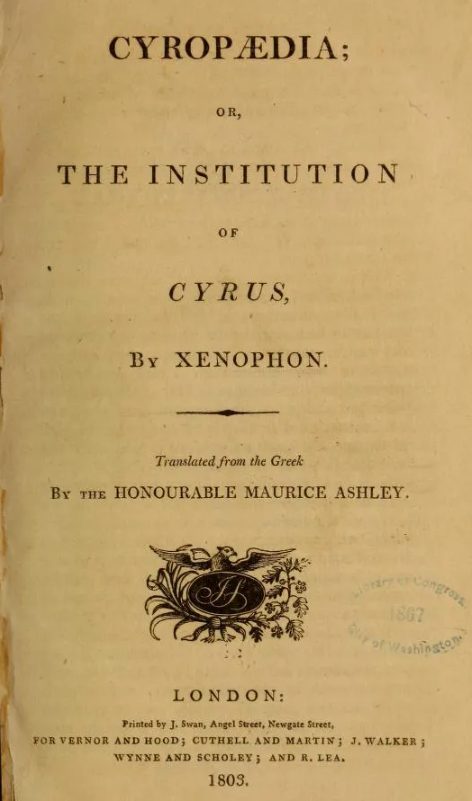
It is easier, given his nature, for a human being to rule all the other kinds of animals than to rule human beings. But when we reflected that there was Cyrus, a Persian, who acquired very many people, very many cities, and very many nations, all obedient to himself, we were thus compelled to change our mind to the view that ruling human beings does not belong among those tasks that are impossible … We know that Cyrus, at any rate, was willingly obeyed by some, even though they were distant from him by a journey of many days; by others, distant by a journey even of months; by others, who had never yet seen him; and by others, who knew quite well that they would never see him. Nevertheless, they were willing to submit to him.
I am not well-read in the classics. My excuse ultimately boils down to the same argument that all the classicists give for why you should be well-read in the classics: reading a book that has been widely admired for a very long time isn’t just reading a book, it’s entering into a “great conversation” taking place across the aeons. I feel awkward reading a book like that without knowing something about the commentaries on the book, all the people it has influenced, all the people who influenced it, the commentaries on the commentaries, and so on. It’s exhausting and overwhelming, and when I ignore all that and plunge ahead, I often don’t enjoy the book and then I feel dumb. A “great conversation” sounds nice, but only if you’re one of the participants and you actually get the inside jokes and references. Otherwise it’s as alienating and isolating as showing up to a party where you don’t know anybody, and where everybody else has already been chatting for a few thousand years.
I don’t remember who recommended Xenophon’s Cyropaedia to me or how it wound up on my reading list, but when it finally made its way to the top of my stack, I saw it and shuddered. How could I possibly appreciate this semi-fictionalized biography of the founder of the Persian Empire without first being familiar with Xenophon’s work as a mercenary for one of Cyrus the Great’s distant descendants? Or with all the ways he was riffing on and responding to the political philosophy of his frenemy Socrates? Or with the complicated politics of the Peloponnesian War, and the way that Xenophon, an Athenian exile and the original Sparta-boo, was actually writing PR for King Agesilaus II, but concealing it within a story about the exotic Persians?1 Or with how this book led to the creation of an entire major genre of books in the Middle Ages? Or with the most famous and subversive instance of that genre, Machiavelli’s The Prince, and with all the hundreds of subsequent works reacting and responding to that one?
You see the problem? One could very easily conclude that it would be impossible for me to appreciate this book. Fortunately, I ignored all that and read it anyway. No doubt I missed all kinds of subtle layers of meaning and nuance, but even read on a totally superficial level by an ignoramus, this book rocks.
The title has the word “education” in it, but the book covers Cyrus’s entire life and reign, and only the first section concerns his education in the literal sense. That first section is very important to what comes next, though, so I’m going to dwell on it a bit. Cyrus, along with the other Persian boys of his social class, is being trained to lead. And so their education is centered around having lots of opportunities to judge, instruct, and coerce others; but also opportunities to serve and obey. If you’re old enough, you might remember when the education of the American leadership class worked this way too, but even those of you who are younger have seen vestiges of it in the bizarrely disproportionate weight given to extracurriculars in US college admissions.
1. If you’re an American, then you’re already familiar with this trick. Most of our debates about the virtues and vices of other nations are just thinly-veiled attempts to “own” domestic political opponents.
December 8, 2023
The development of the American suburb
In the latest book review from Mr. and Mrs. Psmith’s Bookshelf, Jane Psmith discusses A Field Guide to American Houses (Revised): The Definitive Guide to Identifying and Understanding America’s Domestic Architecture, by Virginia Savage McAlester. In particular, she looks at McAlester’s coverage of how suburbs developed:
After some brief but interesting discussion of cities,1 most of the page count is devoted to the suburbs. It’s a sensible choice: suburbs have by far the most varied types of house groupings, and more than half of Americans live in one. But what exactly is a “suburb”? It’s a wildly imprecise word, referring to anything that is neither truly rural nor the central urban core, and suburbs vary tremendously in character. As a working definition, though, a suburb is marked by free-standing houses on relatively larger lots. (If you can think of a counter-example that qualifies but is “urban”, I’ll bet you $5 it started out as a suburb before the city ate it.)
This means that building a suburb has a few obvious technological prerequisites, which McAlester lists as follows: First, balloon-frame construction, which enabled not just corners but quick and inexpensive construction generally and removed much of the incentive for the shared walls that were so common in the early cityscape. Second, the proliferation of gas and electric utilities in the late nineteenth century meant that the less energy-efficient free-standing homes could still be heated relatively inexpensively. Third, the spread of telephone service after 1880 meant that it was much easier to stay in touch with friends whose front doors weren’t literally ten feet away from yours.2 But by far the most important technological advances came in the field of transportation, which is obviously necessary if you’re going to live in the country (or a reasonable facsimile thereof) and work in the city.
The first of these transportation advances was the railroad. In fact “railroad suburb” is a bit of a misnomer, because most of the collections of houses that grew up around the new rail stops were fully functional towns that had their own agricultural or manufacturing industries. The most famous railroad suburbs, however, were indeed planned as residential communities serving those wealthy enough to pay the steep daily rail fare into the city. Llewellyn Park near New York City, Riverside near Chicago, and the Main Line near Philadelphia are all examples of railroad suburbs that have maintained their tony atmosphere and high property values.
The next and more dramatic change was the advent of the electric trolley or streetcar, first introduced in 1887 but popular until about 1930. (That’s what all the books say, but come on, it’s probably October 1929, right?) Unlike steam locomotives, which take quite a long time to build up speed or to slow down again, and so usually had their stations placed at least a mile apart, streetcars could start and stop far more easily and feature many more, and more densely-placed, stops. Developers typically built a streetcar line from the city veering off into the thinly-inhabited countryside, ending at an attraction like a park or fairground if possible. If they were smart, they’d bought up the land along the streetcar beforehand and could sell it off for houses,3 but either way the new streetcar line added value to the land and the development of the land made the streetcar more valuable.
You can easily spot railroad towns and streetcar suburbs in any real estate app if you filter by the date of construction (for railroad suburbs try before 1910, for streetcar before 1930) and know what shapes to look for. Railroad towns are typically farther out from the urban center and are built in clusters around their stations, which are a few miles from one another. Streetcar suburbs, by contrast, tend to be continuous but narrow, because the appeal of the location dropped off rapidly with distance from the streetcar line. (Lots are narrow for the same reason — to shorten the pedestrian commute.) They expand from the urban center like the spokes of a wheel.
And then came the automobile and, later, the federal government. The car brought a number of changes — paved streets, longer blocks, wider lots (you weren’t walking home, after all, so it was all right if you had to go a little farther) — but nothing like the way the Federal Housing Authority restructured neighborhoods.
The FHA was created by the National Housing Act of 1934 with the broad mandate to “improve nationwide housing standard, provide employment and stimulate industry, improve conditions with respect to mortgage financing, and realize a greater degree of stability in residential construction”. It was a big job, and the FHA set out to accomplish it in a typical New Deal fashion: providing federal insurance for private construction and mortgage loans, but only for houses and neighborhoods that met its approval. This has entered general consciousness as “redlining”, after the color of the lines drawn around uninsurable areas (typically old, urban housing stock),4 but the green, blue, and yellow lines — in order of declining insurability — were just as influential on the fabric of contemporary America.
A slow economy through the 1930s and a prohibition on nonessential construction during the war meant that FHA didn’t have much to do until 1945, but as soon as the GIs began to come home and take advantage of their new mortgage subsidies, there was a massive construction boom. With the FHA insuring both the builders’ construction loans and the homeowners’ mortgages, nearly all the new neighborhoods were built to the FHA’s exacting specifications.
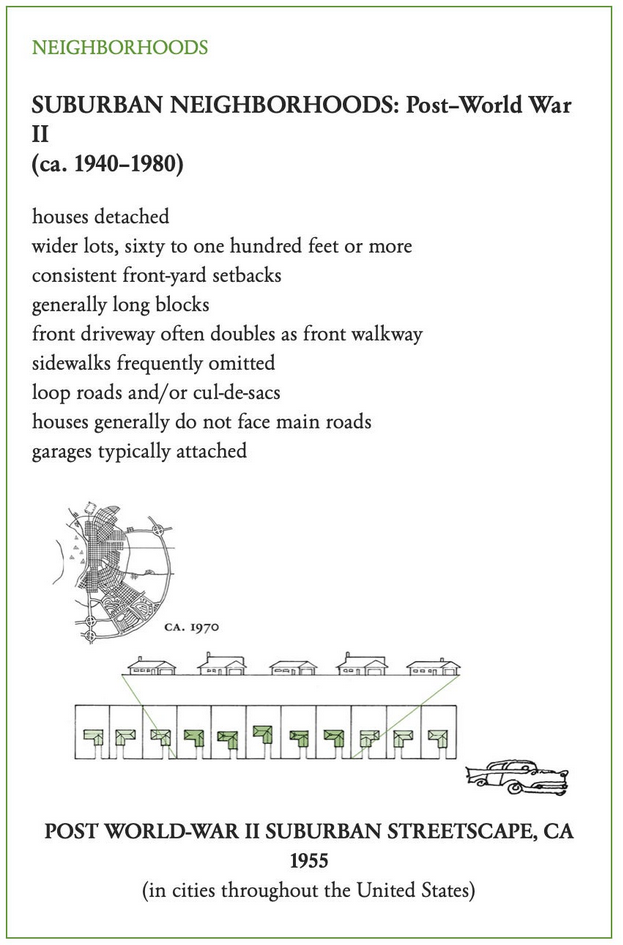
One of the FHA’s major concern was avoiding direct through-traffic in neighborhoods. Many post-World War II developments were built out near the new federally-subsidized highways on the outskirts of the cities, so the FHA was eager to protect new subdivisions from heavy traffic on the interstates and the major arterial roads. Neighborhoods were meant to be near the arterials, but with only a few entrances to the neighborhood and many curved roads and culs-de-sac within it. Unlike the streetcar suburbs or the early automobile suburbs that filled in between the “spokes” of the streetcar lines, where retail had clustered near the streetcar stops, the residents of the post-World War II suburbs found their closest retail establishments outside the neighborhood on the major arterial roads. Lots became wider, blocks longer, and sidewalks less frequent; houses were encouraged to stay small by FHA caps on the size of loans. And although we tend to assume they were purely residential areas, the FHA encouraged the inclusion of schools, churches, parks, libraries, and community centers within the neighborhood.


1. America doesn’t have many urban neighborhoods that predate 1750, and even fewer that persist in their original layout, but if you’ve ever visited one it’s amazing how compact everything feels even in comparison to the rowhouses of the following century.
2. McAlester’s footnote for the paragraph that contains all this reads: “These three essentials were highlighted in an essay the author has read but has not been successful in locating for this footnote.”
3. This is still, I am told, how some of the more sensibly-governed parts of the world run their transit systems: whatever company has the right to build subways buys up the land around a planned (but not announced) subway line through shell corporations, builds the subway, then sells or develops the newly-valuable property. Far more efficient as a funding mechanism than fares!
4. This 2020 NBER working paper points out that redlined areas were 85% white (though they did include many of the black people living in Northern cities) and suggests that race played very little role in where the red lines were drawn; rather, black people were already living in the worst neighborhoods.
November 28, 2023
“This was a document from a parallel universe with familiar-sounding people and places, but a totally bizarre worldview and culture”
In the latest addition to Mr. and Mrs. Psmith’s Bookshelf, John Psmith reviews The Man Who Rode the Thunder, by William H. Rankin:
Like many little boys, I loved learning lists of things. One day it was clouds. How could I not love them? The names were fluffy and Latinate, delicate little words like “cumulus” and “cirrus” that sounded like they might float away on a puff of wind. But there was also a structure to the words, intimations and hints of taxonomy. Was the relationship of an altocumulus to an altostratus the same as that of a cirrocumulus to a cirrostratus? I wasn’t sure, but it seemed likely! So here I had not just a heap of words, but something more like a map to making sense of a new part of the world.
So I learned the names of all the clouds, but I quickly got bored of most of them. Only one of them held my attention, but it made up for the rest by becoming an obsession. Yes, it was the mighty cumulonimbus, the towering, violent monster that heralds the approach of a thunderstorm. By then I had already met plenty of them — one of my earliest memories is of huddling with my mother in the room of our house that was farthest from any exterior walls, while lightning struck again and again and again, the echoes of the previous thunderclap still reverberating off the landscape when the next one began. What, I wondered, would it be like to be inside one?
There’s one man who knows. His name is Colonel William H. Rankin, and he fell through a thunderstorm and lived to tell the tale. After his ordeal Rankin published a memoir that was a bestseller in the early ’60s, but is out of print today. If you click the Amazon link at the top of this page, you will see that secondhand copies of the paperback edition go for about $150. If that’s too steep for you, I’m told that
Good Samaritanscommunists have uploaded high-quality scans of the book to various nefarious and America-hating websites, but this is a patriotic Substack and we would never condone that sort of behavior. Be warned!I sought out and read Rankin’s memoir for the part where he falls through a cloud, so I was planning on skimming and/or skipping the hundred or so pages where he narrates his life and career up to that point. When I actually cracked open the
They say you should read books to broaden yourself, to learn about foreign peoples and about cultures not your own. I was unprepared for late 1950s America being as foreign as it turned out to be. There’s a whole genre comprised of parodying the supposed mid-century American combo of sunny faith in scientific progress, squeaky-clean public morality, and blithe indifference to the horrors of industrial warfare. In my own reading and watching, I had only ever encountered the parodies, never the genuine article, until I read this book. Rankin’s memoir exudes gee-whiz enthusiasm from every pore. He is patriotic without a trace of irony, giddy as a schoolboy about advances in jet propulsion, and then uses a totally unchanged tone of giddiness and enthusiasm to describe melting hundreds of Korean peasants with napalm.
Reading this stuff fills me with the same feeling of vertigo that I get reading about Bronze Age Greek warriors — here is a human being just like me, but inhabiting a cultural, spiritual, and memetic universe so different from mine. Are we the same species? If we were to meet each other would we even be able to communicate? Or perhaps every age has had people like him and people like me, and all that’s changed is that the dominant mode of social interaction shifted from favoring one of us to the other. After all, I know people today who are incapable of irony or reflection. For instance, TSA agents. Was 1950s America an entire society of TSA agents? And if so, what am I to make of the fact that in so many ways it seems to have been more functional than America today?
November 22, 2023
Another look at the “Great Divergence”
The latest book review from Mr. and Mrs. Psmith’s Bookshelf features Patrick Wyman’s The Verge: Reformation, Renaissance, and Forty Years that Shook the World:
This is a weird Substack featuring an eclectic selection of books, but one of our recurring interests is the Great Divergence: why and how did the otherwise perfectly normal people living in the northwestern corner of Eurasia managed to become overwhelmingly wealthier and more powerful than any other group in human history? We’ve covered a few theories about what’s behind it — not marrying your cousins, coal, the analytic mindset (twice) — but there are lots of others we’ve never touched, including geographic and thus political fragmentation, proximity to the New World, and even the Black Death. So this is also a book about the Great Divergence, but unlike many of the others it doesn’t offer One Weird Trick to explain things. Instead, Wyman approaches the period between 1490 and 1530 through nine people, each of whom exemplifies one of the many shifts in European society, and so paints a portrait of a changing world.
Of course, he does point to a common thread woven through many of the changes: culture. Or, more specifically, the institutions1 surrounding money and credit that Europeans had spent the last few hundred years developing. But these weren’t themselves dispositive: after all, lots of people in lots of place at lots of times have been able to mobilize capital, and most of them don’t produce graphs that look like this. Really, the secret ingredient was — as Harold Macmillan said of the greatest challenge to his government — “events, dear boy, events”.2 Europe between 1490 to 1530 saw an unusually large number of innovations and opportunities for large-scale, capital-intensive undertakings, and already had the economic institutions in place to take advantage of them. One disruption fed on the next in a mutually-reinforcing process of social, political, religious, economic, and technological change that (Wyman argues) set Europe on the path towards global dominance.
Some of Wyman’s characters — Columbus, Martin Luther, Holy Roman Emperor Charles V — are intensely familiar, but he presents them with verve, as interested in giving you a feel for the individual and their world as in conveying biographical detail. (This is an underrated goal in the writing of history, but really invaluable; the “Cross Section: View from …” chapters were always my favorite part of Jacques Barzun’s idiosyncratic doorstopper From Dawn to Decadence.) This is particularly welcome when it comes to the chapters featuring some lesser-known figures: you may have heard of Jakob Fugger, but unless you’re a Wimsey-level fan of incunabula you’re probably unfamiliar with Aldus Manutius. One-handed man-at-arms Götz von Berlichingen becomes our lens for the chapter about the Military Revolution not because he played a particularly significant role but because he wrote a memoir, and small-time English wool merchant John Heritage is notable pretty much solely because his account book happened to survive into the present. But even with the stories “everyone knows”, Wyman takes several large steps back in order to contextualize that common knowledge: for example, were you aware that while before 1492 Columbus didn’t take any particularly unusual voyages, he did take an unparalleled number and variety of them, making him one of the best-travelled Atlantic sailors of his day? Did you know that Isabella’s inheritance of the Castilian throne was far from certain?3
As the book continues, Wyman can reference the cultural and technological shifts he described in earlier chapters. For instance, much of the Fuggers’ wealth came in the form of silver from deep new mines in the Tyrol. Building the mines required substantial capital — for their new, deeper tunnels and the expensive pumps to drain them, as well as for the furnaces and workshops to separate the copper from the silver via the relatively inefficient liquation process — and while everyone knew all along that the metals were there, it took the combination of a continent-wide bullion shortage and a rising demand for copper to cast bronze cannon (look back to the chapters on state formation and the military!) to make it worth anyone’s while to get them out. But it wasn’t only the Fuggers who made their money in these new mines: the money for Martin Luther’s education came from his father’s small-scale copper mining concern in eastern Germany. Grammar school in his hometown, a parish school nearby, and then four years at university cost Luther pater enough that he couldn’t follow it up for his younger sons (and from his point of view the was probably squandered when Martin became a monk instead of the intended lawyer who would be an asset in the frequent mining disputes), but such an education for even one son would have been out of reach if not for the printed texts on grammar, philosophy and law that made it all far more affordable.
Of course, the relationship between Luther and printing goes both ways. While Luther’s very existence as an educated man was enabled by the printing press, it was the intellectual and religious ferment he would kick off that made printing work.
1. Wyman glosses the term as “a shared understanding of the rules of a particular game … the systems, beliefs, norms and organizations that drive people to behave in particular way”, but it’s more or less what I’ve elsewhere called bundles of social technologies.
2. Apparently he may not have said this, but he should have so print the legend.
3. Isabella’s opponent, her half-niece Joanna, was married to King Afonso V of Portugal, so perhaps some degree of Iberian unification might still have followed. On the other hand, Afonso already had an adult son (King João II, widely admired as “the Perfect Prince” — Isabella always referred to him simply as el Hombre, “the Man”) who would have had no personal claim to Castile. Joanna and Afonso’s marriage was annulled on the perfectly true grounds of consanguinity — he was her uncle — after they lost the war, so they never had children, but if she had won perhaps João (who died without legitimate issue) could have been succeeded by a much younger half-Castilian half-brother. Certainly an Isabella relegated to Queen-Consort of Aragon would still have been a force to be reckoned with, but losing the knock-on effects of her reign (Columbus, Granada, the fate of the Sephardim, not to mention the eventual unification of most of Europe under Ferdinand and Isabella’s Habsburg grandson) makes all this a pretty good setup for an alternate history!
Even more fun: before she married Ferdinand of Aragon, there was discussion of Isabella’s betrothal to Richard, Duke of Gloucester. Yeah, that one.
November 14, 2023
“Like all Luttwak stories, this is probably false but totally believable”
In the latest book review from Mr. and Mrs. Psmith’s Bookshelf, John Psmith considers Edward Luttwak’s fascinating and controversial The Grand Strategy of the Roman Empire, a book I quite enjoyed reading although I think his much later The Grand Strategy of the Byzantine Empire one of his best books.
In one of the dozens of notorious interviews of Edward Luttwak that float around the internet, he’s asked how he chose the topic for his PhD dissertation. His answer is that one day at university he had a humiliating social encounter. Immediately afterwards, somebody pounced on him and asked what his dissertation was about anyway. He hadn’t even started thinking about what his topic would be, but he obviously couldn’t say that, and so instead he puffed himself up and made something up on the spot, and he did so by saying the most grandiloquent series of words one at a time like a large language model feverishly choosing the next token to maximize self importance: “The … GRAND … Strategy … … OF THE ROMAN EMPIRE!!” His interlocutor was sufficiently awed and impressed, but then he had to write the damn thing. Like all Luttwak stories, this is probably false but totally believable.1
But I’m very glad he wrote that thesis, because it was later turned into the wonderful book I’m reviewing. Now, one of the ways that the Psmiths subvert traditional gender roles is that it’s Jane, not I, who thinks about the Roman Empire every day. But this is only pretending to be a book about the Roman Empire. It’s really a book about “grand strategy” — how states can efficiently allocate scarce military, diplomatic, and financial resources to counter a variety of internal and external threats. It’s true that the examples are mainly drawn from four centuries of Roman history — starting with the Julio-Claudian dynasty and ending with the Empire losing control of Italy and Western Europe — but the analysis, and the lessons, are abstract enough that they transcend that particular context.
Luttwak believes that the state is a kind of machine for turning arable land into military power via taxation and conscription. A state that wants to maximize its survival odds can do so in three ways: (1) it can increase its “inputs”, by bringing a larger quantity of arable land under its control (so long as it avoids a commensurate increase in the threats it faces); (2) It can increase the efficiency of the machine, by extracting more grain and more labor from the people it rules, or by undertaking internal reforms to reduce the amount of potential that’s bled away by corruption and decadence; or (3) It can use its military as effectively as possible, doing more with less, killing many birds with one stone or setting up situations where a small allocation of force can tie down much larger opponents.
This third option is more or less what Luttwak means by “grand strategy,” and I think it may be the key that ties together all of Luttwak’s writing and thought. What do a book about the ancient world and a book about Cold War era coups have in common? They’re both about doing more with less, economizing force by wielding it with overwhelming brutality and efficiency. Luttwak’s coldly arithmetic view of the state is reminiscent of nothing so much as James C. Scott’s view of the world,2 but Luttwak is on the opposite team. Scott is an anarchist, Luttwak is a hard-boiled realist, and moreover he’s one with a deep aesthetic appreciation for power and violence, especially when used elegantly, like a scalpel, such that they have effects far out of proportion with their quantity.3
The history of Rome that Luttwak wants to tell is not the history of its cultural or civilizational achievements, but rather the history of how these people were so incredibly good at economizing on violence that they were able to waste a huge portion of their military and economic potential on civil wars, but still keep the lights on and the barbarians at bay. “Grand strategy” is how they accomplished that, but the strategy changed as the threats evolved and as the internal condition of the empire deteriorated. Luttwak delineates three distinct epochs — the founding of the empire under the Julio-Claudian dynasty, the rationalization of frontiers under the Antonine emperors, and the Crisis of the Third Century — and argues that each of the three featured a fundamentally different overall strategic posture on the part of Rome.
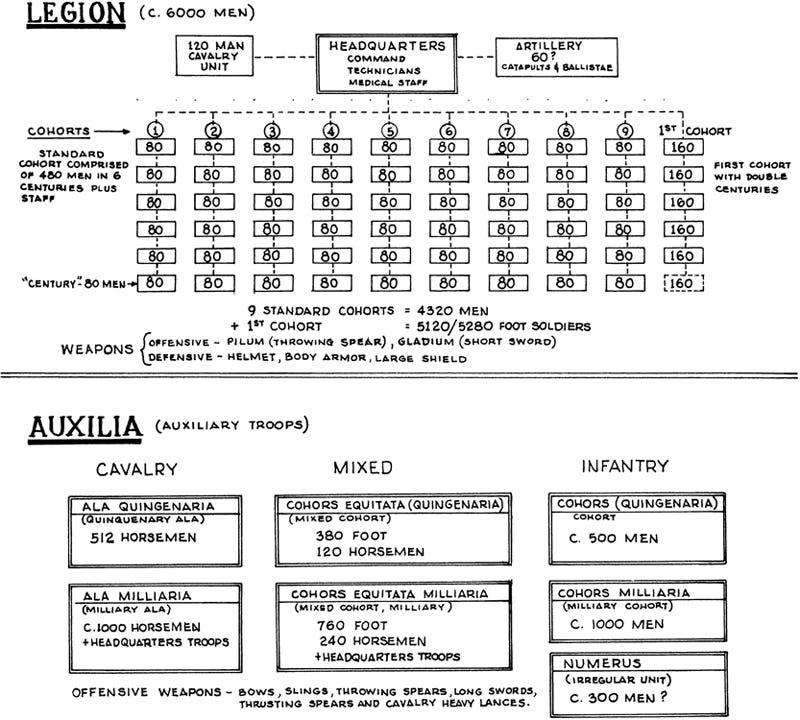
But before we get into all of that, I suppose we ought to talk about the legions. When people think of Roman military power, they usually think of the heavily-armed guys with red cloaks and horsehair plumes on their helmets. But of course they only made up a small fraction of the Roman military. We know that this has to be true because ancient armies, as much as modern armies, relied on combined-arms for their success. A legionary was a very scary kind of soldier, combining the roles of heavy infantry and combat engineer, but an army made up entirely of heavy infantry would be shredded by an opposing force of horse archers, for instance. So the Romans brought many other kinds of troops to bear: skirmishers, slingers, archers, light infantry, cavalry of their own (including mounted archers, light cavalry, and lancers with primitive barding that are a clear precursor of Medieval knights). And … almost to a man, all of these other forces were non-Roman.4 They were either mercenaries, or allied barbarians, or auxiliaries. As a kid in ancient history class I just accepted this as a fact, but reflect on it for a second and it seems very weird. This whole arrangement caused the Romans no end of trouble, so why did they do it that way?
Take the Luttwak pill and it all becomes clear: the Romans went all-in on legionaries as a way of economizing on force. The only people Rome could absolutely rely on were her citizens. The definition of a “real” Roman changed over time — at first it was only inhabitants of the city of Rome itself, later it was expanded to the surrounding countryside, and finally to all of Italy. But at every point it was a tiny fraction of the total population of the empire. Of that tiny fraction, some even smaller fraction are available to be trained as soldiers and to bear arms. What do you want those guys to be doing? The Roman answer is that you want them to be legionaries, because legionaries are not general-purpose soldiers, they’re specialists, and their specialties are: (1) besieging enemy cities, and (2) battles of attrition and annihilation.
1. Evidence that it’s false, he tells a completely different story in a different interview!
“I chose the subject because no theme in contemporary strategy was anywhere as interesting as the simple question of how Rome defended its territories (and added to them, now and then). Also, I did not want to waste my days reading the stultified & chaotically duplicative literature of ‘political science’ in which Strategy is imprisoned, when I could read instead in the often elegant, multi-lingual literature of Roman imperial studies.”
2. The zoomed-out, autistic alien robot anthropologist nature of this analysis also reminds me a bit of Vaclav Smil.
3. Wouldn’t the most elegant use of power be its deployment in such a way that it doesn’t really have to be used at all? In fact this is the main theme of Luttwak’s most recent book, The Grand Strategy of the Byzantine Empire, a sort of sequel to this one. In the same interview as in the first footnote, Luttwak summarizes the argument of that book: Byzantine strategy was based on:
“a single, paradoxical, principle: do everything possible to raise, equip and train the best possible army and navy, and then … do everything possible to use them as little as possible … every alternative was to be tried to avoid, or at least minimize the destructive ‘attrition’ combat of main forces. Instead, potential enemies were to be dissuaded, bribed, subverted, weakened by getting others to attack them, sidetracked into other ventures; if enemy forces attacked nonetheless, they were to be contained and delayed by skirmishing, feints and demonstrations while the search went on for other powers near or far willing to attack or at least threaten the enemy power; if enemy attacks persisted nonetheless, they were to be met by countering maneuvers designed to exhaust them rather than the destructive combat of main forces, the very last resort. It was not only the precious trained manpower of the empire that this strategy wanted to conserve, but also the enemy’s … because today’s enemy could become tomorrow’s ally.
4. This isn’t quite true in every period. For instance during the Punic Wars, the Romans fielded “equites“, native Roman cavalry of their own, but it fell out of fashion pretty quickly thereafter.
November 8, 2023
Sampling the alternate history field
Jane Psmith confesses a weakness for a certain kind of speculative fiction and recommends some works in that field. The three here are also among my favourites, so I can comfortably agree with the choices:
As I’ve written before, I am an absolute sucker for alternate history. Unfortunately, though, most of it is not very good, even by the standards of genre fiction’s transparent prose. Its attraction is really the idea, with all its surprising facets, and means the best examples are typically the ones where the idea is so good — the unexpected ramifications so startling at the moment but so obvious in retrospect — that you can forgive the cardboard characters and lackluster prose.
But, what the heck, I’m feeling self-indulgent, so here are some of my favorites.
- Island in the Sea of Time et seq., by S.M. Stirling: This is my very favorite. The premise is quite simple: the island of Nantucket is inexplicably sent back in time to 1250 BC. Luckily, a Coast Guard sailing ship happens to be visiting, so they’re able to sail to Britain and trade for grain to survive the winter while they bootstrap industrial civilization on the thinly-inhabited coast of North America. Of course, it’s not that simple: the inhabitants of the Bronze Age have obvious and remarkably plausible reactions to the sudden appearance of strangers with superior technology, a renegade sailor steals one of the Nantucketers’ ships and sets off to carve his own empire from the past, and the Americans are thrust into Bronze Age geopolitics as they attempt to thwart him. The “good guys” are frankly pretty boring, in a late 90s multicultural neoliberal kind of way — the captain of the Coast Guard ship is a black lesbian and you can practically see Stirling clapping himself on the back for Representation — but the villainous Coast Guardsmen and (especially) the natives of 1250 BC get a far more complex and interesting portrayal.1 Two of them are particularly well-drawn: a fictional trader of the thinly attested Iberian city-state of Tartessos, and an Achaean nobleman named Odikweos, both of whom are thoroughly understandable and sympathetic while remaining distinctly unmodern. The Nantucketers, with their technological innovations and American values, provide plenty of contrast, but Stirling is really at his best in using them to highlight the alien past.
- Lest Darkness Fall, by L. Sprague de Camp: An absolute classic of the genre. I may not love what de Camp did with Conan, but the man could write! One of the great things about old books (this one is from 1939) is that they don’t waste time on technobabble to justify the silly parts: about two pages into the story, American archaeologist Martin Padway is struck by lightning while visiting Rome and transported back in time to 535 AD. How? Shut up, that’s how, and instead pay attention as Padway introduces distilled liquor, double-entry bookkeeping, yellow journalism, and the telegraph before taking advantage of his encyclopedic knowledge of Procopius’s De Bello Gothico to stabilize and defend the Italo-Gothic kingdom, wrest Belisarius’s loyalty away from Justinian, and entirely forestall the Dark Ages. If this sounds an awful lot like the imaginary book I described in my review of The Knowledge: yes. The combination of high agency history rerouting and total worldview disconnect — there’s a very funny barfight about Christology early on, and later some severe culture clash that interferes with a royal marriage — is charming. Also, this was the book that inspired Harry Turtledove not only to become an alt-history writer but to get a Ph.D. in Byzantine history.
[…]
- Ruled Britannia, by Harry Turtledove: Turtledove is by far the most famous and successful alternate history author out there, with lots of short pieces and novels ranging from “Byzantine intrigue in a world where Islam never existed” (Agent of Byzantium) to “time-travelling neo-Nazis bring AK-47s to the Confederacy” (The Guns of the South), but this is the only one of his books I’ve ever been tempted to re-read. The jumping-off point, “the Spanish Armada succeeded”, is fairly common for the genre2 — the pretty good Times Without Number and the lousy Pavane (hey, did you know the Church hates and fears technology?!) both start from there — but Turtledove fasts forward only a decade to show us William Shakespeare at the fulcrum of history. A loyalist faction (starring real life Elizabethan intriguers like Nicholas Skeres) wants him to write a play about Boudicca to inflame the population to free Queen Elizabeth from her imprisonment in the Tower of London, while the Spanish authorities (represented, hilariously, by playwright manqué Lope de Vega) want him to write one glorifying the late Philip II and the conquest of England. Turtledove does a surprisingly good job inventing new Shakespeare plays from snippets of real ones and from John Fletcher’s 1613 Bonduca, but of course I’m most taken by his rendition of the Tudor world. Maybe I should check out some of his straight historical fiction …
1. Well, except for the peaceful matriarchal Marija Gimbutas-y “Earth People” being displaced from Britain by the invading Proto-Celts; they’re also “good guys” and therefore, sadly, boring.
2. Not as common as “the Nazis won”, obviously.
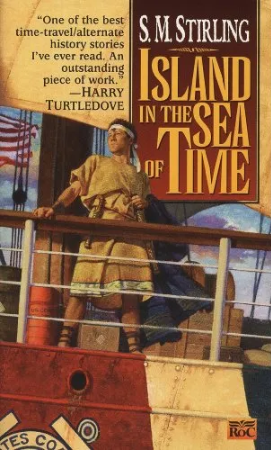
I agree with Jane about Island in the Sea of Time, but my son and daughter-in-law strongly preferred the other series Stirling wrote from the same start point: what happened to the world left behind when Nantucket Island got scooped out of our timeline and dumped back into the pre-collapse Bronze Age. Whereas ISOT has minimal supernatural elements to the story, the “Emberverse” series beginning with Dies the Fire went on for many, many more books and had much more witchy woo-woo stuff front-and-centre rather than marginal and de-emphasized.
While I quite enjoyed Ruled Britannia, it was the first Turtledove series I encountered that I’ve gone back to re-read: The Lost Legion … well, the first four books, anyway. He wrote several more books in that same world, but having wrapped up the storyline for the Legion’s main characters, I didn’t find the others as interesting.
October 24, 2023
The English language, who did what to it and when
The latest book review from Mr. and Mrs. Psmith’s Bookshelf is John McWhorter’s Our Magnificent Bastard Tongue: The Untold History of English. I’m afraid I often find myself feeling cut adrift in discussions of the evolution of languages, as if I’m floating out of control in a maelstrom of what was, what is, and what might be, linguistically speaking. It’s an uncomfortable feeling and in retrospect explains why I did so poorly in formal grammar classes. When Jane Psmith gets around to discussing actual historical dates, I find my metaphorical feet again:
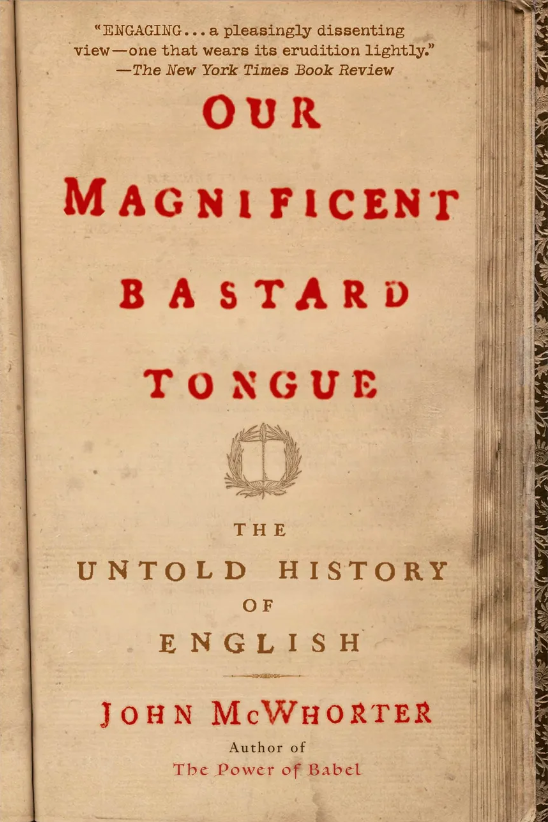
Shakespeare wrote about five hundred years ago, and even aside from the frequency of meaningless “do” in normal sentences, it’s clear that our language has changed since his day. But it hasn’t changed that much. Much less, for example, than English changed between Beowulf (probably written in the 890s AD)1 and The Canterbury Tales (completed by 1400), another five hundred year gap. Just compare this:
Hwæt. We Gardena in geardagum, þeodcyninga, þrym gefrunon, hu ða æþelingas ellen fremedon.2
to this:
Whan that Aprille with his shoures soote,
The droghte of March hath perced to the roote,
And bathed every veyne in swich licóur
Of which vertú engendred is the flour…3That’s a huge change! That’s way more than some extraneous verbs, the loss of a second person singular pronoun (thou knowest what I’m talking about), or a shift in some words’ definition.4 That’s practically unrecognizable! Why did English change so much between Beowulf and Chaucer, and so little between Shakespeare and me?
There’s a two part answer to this, and I’ll get to the real one in a minute (the changes between Old English and Middle English really are very interesting), but actually I must first confess that it was a trick question, because my dates are way off: even if people wrote lovely, fancy, highly-inflected Old English in the late 9th century, there’s no real reason to think that’s how they spoke.
On one level we know this must be true: after all, there were four dialects of Old English (Northumbrian, Mercian, Kentish, and West Saxon) and almost all our written sources are in West Saxon, even the ones from regions where that can’t have been the lingua franca.5 But it goes well beyond that: in societies where literacy is not widespread, written language tends to be highly conservative, formal, and ritualized. Take, for example, the pre-Reformation West, where all educated people used Latin for elite pursuits like philosophical disputatio or composing treatises on political theory but spoke French or Italian or German or English in their daily lives. It wasn’t quite Cicero’s Latin (though really whose is), but it was intentionally constructed so that it could have been intelligible to a Roman. Similarly, until quite recently Sanskrit was the written language of India even though it hadn’t been spoken for centuries. This happens in more modern and broadly literate societies as well: before the 1976 linguistic reforms, Greeks were deeply divided over “the language question” of whether to use the vernacular (dimotiki) or the elevated literary language (Katharevousa).6 And modern Arabic-speaking countries have an especially dramatic case of this: the written language is kept as close to the language of the Quran as possible, but the spoken language has diverged to the point that Moroccan Arabic and Saudi Arabic are mutually unintelligible.
Linguists call this phenomenon “diglossia”. It can seem counter-intuitive to English speakers, because we’ve had an unusually long tradition of literature in the vernacular, but even for those of us who use only “standard” English there are still notable differences between the way we speak and the way we write: McWhorter points out, for example, that if all you had was the corpus of Time magazine, you would never know people say “whole nother”. Obviously the situation is far more pronounced for people who speak non-standard dialects, whether AAVE or Hawaiian Pidgin (actually a creole) or Cajun English. (Even a hundred years ago, the English-speaking world had many more local dialects than it does today, so the experience of diglossia would have been far more widespread.)7
Anyway, McWhorter suggests that Old English seems to have changed very little because all we have is the writing, and the way you wrote wasn’t supposed to change. That’s why it’s so hard to date Beowulf from linguistic features: the written language of 600 is very similar to the written language of 1000! But despite all those centuries that the written language remained the perfectly normal Germanic language the Anglo-Saxons had brought to Britain, the spoken language was changing behind the scenes. As an increasing number of wealhs adopted it (because we now have the aDNA proof that the Anglo-Saxons didn’t displace the Celts), English gradually accumulated all sorts of Celtic-style “do” and “-ing” … which, obviously, no one would bother writing down, any more than the New York Times would publish an article written the way a TikTok rapper talks.
And then the Normans showed up.
The Norman Conquest had remarkably little impact on the grammar of modern English (though it brought a great deal of new vocabulary),8 but the replacement of the Anglo-Saxon ruling class more or less destroyed English literary culture. All of a sudden anything important enough to be written down in the first place was put into Latin or French, and by the time people began writing in English again two centuries later nothing remained of the traditional education in the conservative “high” Old English register. There was no one left who could teach you to write like the Beowulf poet; the only way to write English was “as she is spoke“, which was Chaucer’s Middle English.
So that’s one reason we don’t see the Celtic influence, with all its “do” and “-ing”, until nearly a thousand years after the Anglo-Saxons encountered the Celts. But there are a whole lot of other differences between Old English and Middle English, too, which are harder to lay at the Celtic languages’ door, and for those we have to look to another set of Germanic-speaking newcomers to the British Isles: the Vikings.
Grammatically, English is by far the simplest of the Germanic languages. It’s the only Indo-European language in Europe where nouns don’t get a gender — la table vs. le banc, for instance — and unlike many other languages it has very few endings. It’s most obvious with verbs: in English everyone except he/she/it (who gets an S) has a perfectly bare verb to deal with. None of this amō, amās, amat rigamarole: I, you, we, youse guys, and they all just “love”. (In the past, even he/she/it loses all distinction and we simply “loved”.) In many languages, too, you indicate a word’s role in the sentence by changing its form, which linguists call case. Modern English really only does this with our possessive (the word‘s role) and our pronouns,9 (“I see him” vs. “he sees me”); we generally indicate grammatical function with word order and helpful little words like “to” and “for”. But anyone learning Latin, or German, or Russian — probably the languages with case markings most commonly studied by English-speakers — has to contend with a handful of grammatical cases. And then, of course, there’s Hungarian.
As I keep saying, Old English was once a bog-standard Germanic language: it had grammatical gender, inflected verbs, and five cases (the familiar nominative, genitive, dative, and accusative, plus an instrumental case), each indicated by suffixes. Now it has none. Then, too, in many European languages, and all the other Germanic ones, when I do something that concerns only me — typically verbs concerning moving and feeling — I do it to myself. When I think about the past, I remember myself. If I err in German, I mistake myself. When I am ashamed in Frisian, I shame me, and if I go somewhere in Dutch I move myself. English preserves this in a few archaic constructions (I pride myself on the fact that my children can behave themselves in public, though I now run the risk of having perjured myself by saying so …), but Old English used it all the time, as in Beseah he hine to anum his manna (“Besaw he himself to one of his men”).
Another notable loss is in our direction words: in modern English we talk about “here”, “there”, or “where”, but not so long ago we could also discuss someone coming hither (“to here”) or ask whence (“from where”) they had gone. Every other Germanic language still has its full complement of directional adverbs. And most have a useful impersonal pronoun, like the German or Swedish man: Hier spricht man Deutsch.10 We could translate that as “one speaks German here” if we’re feeling pretentious, or perhaps employ the parental “we” (as in “we don’t put our feet in our mouths”), but English mostly forces this role on poor overused “you” (as in “you can’t be too careful”) because, again, we’ve lost our Old English man.
In many languages — including, again, all the other Germanic languages — you use the verb “be” to form the past perfect for words having to do with state or movement: “I had heard you speak”, but “I was come downstairs”. (This is the bane of many a beginning French student who has to memorize whether each verb uses avoir or être in the passé composée.) Once again, Old English did this, Middle English was dropping it, and modern English does it not at all. And there’s more, but I am taken pity on you …
1. This is extremely contentious. The poem is known to us from only one manuscript, which was produced sometime near the turn of the tenth/eleventh century, and scholars disagree vehemently both about whether its composition was contemporary with the manuscript or much earlier and about whether it was passed down through oral tradition before being written. J.R.R. Tolkien (who also had a day job, in his case as a scholar of Old English — the Rohirrim are more or less the Anglo-Saxons) was a strong proponent of the 8th century view. Personally I don’t have a strong opinion; my rhetorical point here could be just as clearly made with an Old English document of unimpeachably eleventh century composition, but Beowulf is more fun.
2. Old English orthography is not always obvious to a modern reader, so you can find a nice video of this being read aloud here. It’s a little more recognizable out loud, but not very.
3. Here‘s the corresponding video for Middle English, which I think is actually harder to understand out loud.
4. Of course words shift their meanings all the time. I’m presently reading Mansfield Park and giggling every time Fanny gets “knocked up” by a long walk.
5. Curiously, modern English derives much more from Mercian and Northumbrian (collectively referred to as “Anglian”) than from the West Saxon dialect that was politically dominant in the Anglo-Saxon period. Meanwhile Scots (the Germanic language, not to be confused with the Celtic language of Scots Gaelic or whatever thing that kid wrote Wikipedia in) has its roots in the Northumbrian dialect.
6. This is a more interesting and complicated case, because when the Greeks were beginning to emerge from under the Ottoman yoke it seemed obvious that they needed their own language (do you even nationalism, bro?) but spoken Greek was full of borrowings from Italian and Latin and Turkish, as well as degenerate vocabulary like ψάρι for “fish” when the perfectly good ιχθύς was right there. Many educated Greeks wanted to return to the ancient language but recognized that it was impractical, so Katharevousa (lit. “purifying”, from the same Greek root as “Cathar”) was invented as a compromise between dimotiki and “proper” Ancient Greek. Among other things, it was once envisioned as a political tool to entice the newly independent country’s Orthodox neighbors, who used Greek for their liturgies, to sign on to the Megali Idea. It didn’t work.
The word ψάρι, by the way, derives from the Ancient Greek ὀψάριον, meaning any sort of little dish eaten with your bread but often containing fish; see Courtesans and Fishcakes: The Consuming Passions of Classical Athens for more. Most of the places modern Greek uses different vocabulary than the ancient tongue have equally fascinating etymologies. I think my favorite is άλογο, which replaced ίππος as the word for horse. See here for more.
7. Diglossia is such a big deal in so many societies that I’ve always thought it would be fun to include in my favorite genre, fantasy fiction, but it would be hard to represent in English. Anyone who’s bounced off Dickon’s dialogue in The Secret Garden or Edgar’s West Country English in King Lear knows how difficult it is to understand most of the actually-existing nonstandard dialects; probably the only one that’s sufficiently familiar to enough readers would be AAVE — but that would produce a very specific impression, and probably not the one you want. So I think the best alternative would be to render the “low” dialect in Anglish, a constructed vocabulary that uses Germanic roots in place of English’s many borrowings from Latin and French. (“So I think the best other way would be to give over the ‘low’ street-talk in Anglish, a built wordhoard that uses Germanic roots in spot of English’s many borrowings …”) It turns out Poul Anderson did something similar, because of course he did.
8. My favorite is food, because of course it is: our words for kinds of meat all derive from the French name for the animal (beef is boeuf, pork is porc, mutton is mouton) while our words for the animal itself have a good Germanic roots: cow, pig, sheep. Why? Well, think about who was raising the animal and who was eating it …
9. And even this is endangered; how many people do you know, besides me, who say “whom” aloud?
10. Yes, this is where Heidegger gets das Man.
October 19, 2023
QotD: Revolutionary terrorism in Tsarist Russia
Country estates were burnt down and businesses were extorted or blown up. Bombs were tossed at random into railroad carriages, restaurants, and theaters. Far from regretting the death and maiming of innocent bystanders, terrorists boasted of killing as many as possible, either because the victims were likely bourgeois or because any murder helped bring down the old order. A group of anarchocommunists threw bombs laced with nails into a café bustling with two hundred customers in order “to see how the foul bourgeois will squirm in death agony”.
Instead of the pendulum’s swinging back — a metaphor of inevitability that excuses people from taking a stand — the killing grew and grew, both in numbers and in cruelty. Sadism replaced simple killing. As Geifman explains, “The need to inflict pain was transformed from an abnormal irrational compulsion experienced only by unbalanced personalities into a formally verbalized obligation for all committed revolutionaries”. One group threw “traitors” into vats of boiling water. Others were still more inventive. Women torturers were especially admired.
What do you think was the response of “moderate” Russians to all of this? Academics and journalists and liberal politicians and forward-thinking businessmen, that sort of people. If your guess is that it horrified them and caused them to grudgingly support the forces of order, you would be … wrong. In fact, quite the opposite: making excuses for terrorism became trendy. Lawyers and teachers and doctors and engineers held fundraisers for terrorists, donated to charities that supported insurrectionary behavior, and turned their offices into safe houses. Apparently chaos and death were one thing, but it was much, much scarier for your friends and neighbors to think you might be a reactionary. Naturally this same class of people were the first to be herded into the camps, or into the cork-lined cellars in the basement of the Lubyanka. Despite all my boundless cynicism about human nature, I still can’t quite believe that this all actually happened.
Dostoevsky predicted it 50 years beforehand.
John Psmith, “REVIEW: Demons, by Fyodor Dostoevsky”, Mr. and Mrs. Psmith’s Bookshelf, 2023-07-17.
October 18, 2023
The greatest sin of Twit-, er, I mean “X” is that it allowed us hoi polloi to peek behind the curtains of governments, universities, and major corporations
The latest book review at Mr. and Mrs. Psmith’s Bookshelf begins with a brilliant explanation for the coming fall of western civilization at the hands of Twit-, er, I mean “X”:

The greatest gift bestowed by admittance to elite institutions is that you stop being overawed by them. For instance, there was a time when upon hearing “so-and-so is a Rhodes Scholar”, I would have assumed that so-and-so was a very impressive person indeed. Nowadays I know quite a lot of former Rhodes Scholars, and have seen firsthand that some of them are extremely mediocre individuals, so meeting a new one doesn’t phase me much. My own cursus honorum through America’s centers of prestige has been slow and circuitous, which means I’ve gotten to enjoy progressive disenchantment with the centers of power. Trust me, you folks aren’t missing much.
I have a theory that this is why Twitter has been so destabilizing to so many societies, and why it may yet be the end of ours. Twitter offers a peek behind the curtain — not just to a lucky few,1 but to everybody. We’re used to elected officials acting like buffoons, but on Twitter you can see our real rulers humiliating themselves. Tech moguls, four-star generals, cultural tastemakers, foundation trustees, former heads of spy agencies, all of them behaving like insane idiots, posting their most vapid thoughts, and getting in petty fights with “VapeGroyper420.” There’s a reason most monarchies have made lèse-majesté a crime, there’s a level at which no regime can survive unless everybody pretends that the rulers are demigods. To have the kings be revealed as mere men who bleed, panic, and have tawdry love affairs is to rock the monarchic regime at its foundations. But Twitter is worse than that, it’s like a hidden camera in the king’s bedroom, but they do it to themselves. Moreover it seems likely that regimes like ours which legitimate themselves with a meritocratic justification are especially fragile to this form of disenchantment.
This is also why the COVID pandemic was so damaging to our government’s legitimacy. I’ve been inside elite institutions of many different sorts, and discovered the horrible truth that most of the people in them are just ordinary people making it up as they go along, but one place I hadn’t quite made it yet was the top of our disease control agencies.2 So in a bit of naïveté analogous to Gell-Mann amnesia, I just assumed that there was some secret wing of the Centers for Disease Control which housed men-in-black who would rappel out of helicopters and summarily execute everybody in Wuhan who had ever touched a bat. And I was genuinely a little bit surprised and disappointed when instead they were caught with their pants down, and a bunch of weirdos on the internet turned out to be the real experts (the silver lining to this is that now we all get to be amateur scientists).
So much for public health. But if there’s one institution which still manages to shroud itself in mystery while secretly pulling all the strings, surely it’s the Federal Reserve. You can tell people take it seriously because of all the conspiracy theories that surround it (conspiracy theories are the highest form of flattery). And there’s a lot to get conspiratorial about — the Fed manages to combine two things that rarely go together but which both impress people: technocratic mastery and arcane ritual. The Fed employs a research staff of thousands which meticulously gather and analyze data about every aspect of the economy, and they have an Open Market Committee whose meeting minutes are laden with nuanced double-meanings that would make a Ming dynasty courtier blush, and which are accordingly parsed with an attention to detail once reserved for Politburo speeches.
And they also control all of our money! Is it any wonder that people go a little bit crazy whenever they think about the Fed? I can’t think of a more natural target for the recurring cycles of ineffectual populist ire that characterize American politics. So it is with great regret that I’m here to report that they, too, are making it all up as they go along.
1. And that lucky few have much to gain by maintaining the charade. A stable ruling class is one that has much to offer potential class traitors, so they don’t get any ideas. It’s when the goodies dry up, whether due to elite overproduction or to a real reduction in the spoils available, that things fall apart.
2. That’s not quite true: I did once attend an invite-only conference at the United States Army Medical Research Institute of Infectious Diseases. The food was awful, and I wasn’t even able to find the lab where they created crack cocaine, HIV, and Lyme disease.
October 5, 2023
From Hilaire Belloc’s sailboat to your nearest international airport terminal
The most recent review at Mr. and Mrs. Psmith’s Bookshelf considers Hilaire Belloc’s The Cruise of the “Nona”:
Late in the May of 1925, around midnight, Hilaire Belloc climbed into a tiny boat and put out to sea so that he would have some time to think. The sea gives ample time to think, especially if like Belloc you disdain the use of a motor. Some wag once jested that sailing is like being at war: long stretches of boredom punctuated by moments of abject terror. I suppose in some sense that’s correct, but give me the boredom of the sailboat any day over the boredom of the trench, the boredom of the cubicle, the boredom of endless doomscrolling.
Sailing is productive boredom, and seems unusually well calibrated for causing the mind to wander in interesting or delightful or just plain ridiculous directions. Maybe it’s the stimulating effects of the wind in your face and the smell of salt in the air, or maybe it’s the weird altered state of consciousness that comes from staring at the ocean. I think it’s because sailing is the human condition in miniature. It places you perfectly-balanced on a knife’s edge between agency and helplessness, and in so doing it both spurs the mind to activity and gives it space to relax and reflect.1
[…]
Anybody who’s travelled extensively in the third world has seen the modern version of this. There’s nothing intrinsic to being a reformer or a liberalizer that makes you an agent of American power, and yet … there’s a better than even chance that you are. After a while these people all blend together — the idealistic students, the LGBT activists, the NGO staffers, the embassy employees recruited from amongst the locals. They come from a hundred nations, from every conceivable race and religion, and yet something invisibly and inexorably molds them all into the same shape, like iron filings lining themselves up in the presence of a powerful magnet.
Soon they have American souls, and divided loyalties to match. The local regime panics and views them as an internal enemy, which only furthers their alienation from their motherland and their flight into the bosom of Global America. Most empires rule primarily though influence, not coercion, and this class of people is one of America’s most powerful weapons for maintaining and extending its hegemony.
A related phenomenon is the awful sameness that is slowly taking over the whole world. Perhaps your cruise ship docks at a dozen ports over the course of its journey, and every one of them looks exactly the same — the same tiki bar with the same sign, the same shops selling the same ornamental kitsch probably all made in the same factory. You aren’t visiting a place, you’re visiting a psychic manifestation of the Buffetverse, another outpost of Margaritaville, a Potemkin seaport with frozen daiquiris. You all know what I’m talking about. We make fun of it all the time, because cruise ships are for chuds. But it doesn’t just happen with cruise ships.
The cancer usually starts in an international airport. Form follows function, so it’s superficially reasonable that every airport on earth should look and feel exactly the same. But the real reason is that it follows in the wake of the kinds of people who fly into those airports, praising the broadening effects of foreign travel whilst terraforming everything they touch until it resembles the “arts district” of a midsize American city, replete with distressed wood finishes, gravid with craft beers. Real foreignness would cause these people to recoil in shock, or to demand a peacekeeping intervention. It’s not unusual for the imperial functionary class to be parochial, but what’s surreal about ours is how they combine the blinkered innocence of a farm boy with an ideology of weary cosmopolitanism.
None of this was as far along when Belloc took his little cruise, but the seeds had been planted, and he could feel in his bones that something horrible lay across the horizon. So he fights it the only way he knows how — by noticing and celebrating everything distinctive and local and weird about every place he visits. No island is too small for him to mention by name and recall a ghost story or two associated with it. No village is too commonplace for him to remark on the habits, physiognomy, and vices of the people who live in it. It’s the same spirit as that which animates Chesterton’s essay on cheese, but applied to a hundred hamlets and fishing ports, a paean to the regional diversity and distinctiveness that was already slipping away.
1. Oh hey, it’s the focused-mode and diffuse-mode of cognition! The best way to think deeply about anything is to toggle between them.


