Quotulatiousness

December 15, 2019

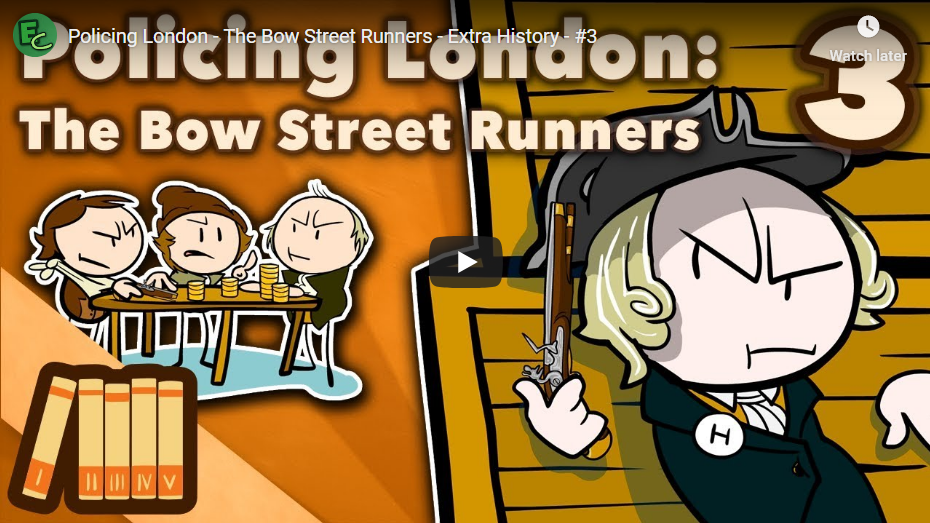
Policing London – The Bow Street Runners – Extra History – #3

Filed under: Britain, Government, History, Law — Tags: , , , , — Nicholas @ 06:00

Extra Credits
Published 14 Dec 2019

Henry Fielding was a dangerous man … with a pen. He had a razor-sharp wit and created the page-turner novel, but that’s not what we want to focus on here. Because Henry Fielding is also responsible for assembling London’s first organized police force. The Bow Street Runners were inspired by Wilde’s operation just … not corrupt. But Fielding quickly found that in London’s justice system, corruption was the assumed default, not the exception. He certainly had his work cut out for him!

Henry Fielding – Everything Wilde did but you know… without the whole… being morally bankrupt bit.

Join us on Patreon! http://bit.ly/EHPatreon

October 3, 2019

Toronto’s gun problem

Filed under: Cancon, Law, Media, Politics, Weapons — Tags: , , , , — Nicholas @ 03:00

The city of Toronto has a gun problem, and politicians are lining up to offer variations of the same idea as the solution. You see, unlike every other city in North America, all of the gun crime in Toronto is committed by legal owners of AR-15 and AK-47 “assault weapons”. They’re all fully registered with the federal government, and have taken all the required training courses and keep their weapons under the strict storage and transportation rules, never taking them anywhere but to the legally designated shooting range and always on the permitted route to and from that range (and they’re all life-members of the NRA, of course). This is why, unlike every other city in North America, a ban on “assault weapons” will eliminate 100% of the gun-related crime in Toronto.

In the real-world version of Toronto, however, the proposed ban will have almost no impact on the crime rates, because almost none of the gun-related crimes committed in Toronto involves any kind of “assault weapon”, most being turf disputes involving illegal handguns between drug dealers and personal grudges among “young aspiring rappers who are just about to turn their lives around”:

Colt Canada’s model SA20, a commercial version of the Canadian C7A2 rifle.
Image from the Colt Canada website.

If Liberals are re-elected to a second term in government, their plan to tackle gun violence includes a ban on high-velocity, semi-automatic rifles like the AR-15, and gun marketing bans that evoke America’s favourite action figure.

“There are sometimes advertisements and videos that appear (on social media) … to imply that we can be GI Joe on our main street,” Public Safety Minister Ralph Goodale said about the Liberal platform’s vague reference to “limit the glorification of violence by changing the way firearms are advertised marketed and sold in Canada.”

During a Q&A with reporters in Ottawa on Sunday, where Goodale fielded questions about their incumbent government’s election promises, the minister attempted to qualify freedom of expression implications with the types of promotional material that could be targeted.

“(It) depicts a kind of behaviour that is simply inappropriate and some people would find it quite threatening … and it leads to the impression of military assault weapons is something you just do, every day,” explained Goodale.

I’m not a big consumer of advertising, but I can’t recall the last time I saw any kind of ad for firearms in Canada that wasn’t in a gun magazine (and there are not many of those sold in typical corner stores). Scary black guns in Hollywood movie ads, sure … they’re everywhere … but that’s not in any way related to the advertising, sale, or use of guns in Canada.

September 17, 2019

“How did staging dinner-theatre raids to seize eleven grand’s worth of knock-off NFL merchandise become an ICE priority?”

Filed under: Football, Law, Media, USA — Tags: , , , , , , — Nicholas @ 05:00

Mark Steyn on a recent you’ve-got-to-be-kidding-me raid by ICE:

Because AOC and the open-borders left want to abolish ICE (US Immigration and Customs Enforcement), the right is obliged to defend it. This is a pity, because ICE is a deeply weird agency with, to put it mildly, increasingly curious and eccentric priorities.

Last week, for example, under crack agent Tatum King, ICE’s Homeland Security Investigations unit staged (that seems the appropriate word) a raid in Oakland of the Oakland Raiders game:

    ICE targeted vendors of unauthorized T-shirts, hats, caps and bandannas. The agency said the raid was done in partnership with NFL brand security representatives and state and local law enforcement. The Oakland Police Department said it was not involved.

    Officials said they seized about $11,000 worth of illegal swag — undoubtedly, most of it silver and black — during the ‘Monday Night Football’ game and its pre- and postgame tailgate parties.

    Tatum King, special agent in charge of the San Francisco Homeland Security Investigations unit, said about 400 pieces of merchandise were seized but no one was arrested. NFL brand officials issued warning letters and may be pursuing civil action, he said.

As they should — and in small claims court, if eleven grand is the best a no-expense-spared federal-state-local raid with everyone in the full Robocop can come up with.

But what business is it of ICE’s “Homeland Security Investigations” division? This arrest-less “raid” and its attendant publicity ballyhoo undoubtedly cost US taxpayers more than the barely five figures’ worth of Oakland Raiders swag they’re now passing round the office.

Like ICE, HSI was created post-9/11 — to enforce four hundred laws “combating terrorism and enhancing national security”. How did staging dinner-theatre raids to seize eleven grand’s worth of knock-off NFL merchandise become an ICE priority? Which it undoubtedly is:

    King said the agency is committed to ensuring the public purchases ‘legitimate products’ instead of cheaper knockoffs often sold outside stadiums like the Coliseum.

[…]

Tatum King appears to be the usual showboating tosspot in this regard. The picture above shows him after a previous raid netted him some Golden State Warriors merchandise. Agent King can’t keep actual MS-13 warriors out of the Golden State, but he can crack down on underpriced baseball caps and sweatshirts.

The President has declared, repeatedly, that there is an emergency at the southern border. I agree with that. He has also said that, therefore, he needs more resources. That’s harder to agree with when a rogue bureaucracy refuses to act as if there’s an emergency and deploy its existing resources accordingly.

In fact, I’m not sure the left’s alleged war on ICE isn’t just their usual sly deflection, intended to provide a bit of useful cover for a subversive immigration bureaucracy to carry on doing as it’s done for a generation now and refuse to enforce existing immigration law — at least for anything that matters.

August 25, 2019

QotD: Bipartisan authoritarianism

Hey, remember how Bill Clinton doubled down on the War on Drugs, perfecting Reagan’s haphazard and shoddily made race-war into a well-oiled incarceration machine that turned America into the world’s greatest incarcerator, a nation that imprisoned black people at a rate that exceeded Apartheid-era South Africa?

Some Democrats want to double down on their party’s shameful Drug War history. Massachusetts Rep. Stephan Hay [D-Fitchfield] has introduced House Bill 1266, which treats the existence of “a hidden compartment” in a vehicle as “prima facie evidence that the conveyance was used intended for use in and for the business of unlawfully manufacturing, dispensing, or distributing controlled substances.”

This means that if a cop stops you and finds no drugs or other contraband, but decides that part of your car is a “hidden compartment,” that cop can subject your car to civil asset forfeiture — that is, they can steal it, and force you to sue them to get it back.

The role of the Democratic Party is often to take the Republicans’ stupidest, red-meat-for-the-base policies, sloppily designed and doomed to collapse under their own weight, and operationalize them, putting them on the kind of sound bureaucratic footing that they need to have real staying power. Exhibit A is the drug war, but see also Obama’s perfection of GWB’s mess of a mass-surveillance apparatus, turning it into an immortal and pluripotent weapon that Donald Trump now gets to wield.

Cory Doctorow, “Proposed Massachusetts law would let cops steal your car if it had a ‘hidden compartment'”, Boing Boing, 2017-07-16.

August 14, 2019

Hong Kong’s struggle with the Chinese government

Filed under: China, Government, Law, Liberty — Tags: , , , , — Nicholas @ 03:00

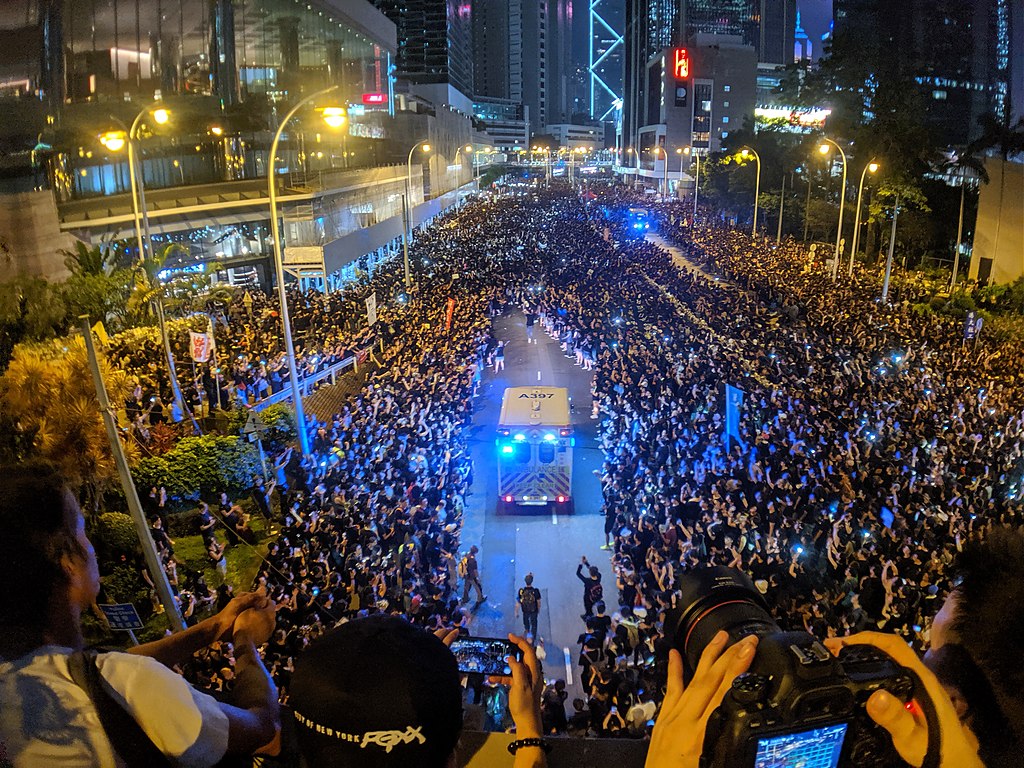
Andrew Coyne on the desperate situation of the Hong Kong protests:

2019 Hong Kong anti-extradition law protest on 16 June, captured by Studio Incendo from Flickr.
Photo via Wikimedia Commons

A sickening pall of inevitability hangs over the protests in Hong Kong, now in their tenth week. Neither side can afford to back down – the protesters, because their way of life, indeed their very lives, are at stake; the Beijing-backed government, for the precedent it would set, and the hope it would inspire.

As the violence mounts — most of it, to date, on the part of the police, or in some cases the Triad gangs hired to beat and intimidate the protesters — so does the likelihood of mass bloodshed, a reprise of the Tienanmen massacre of 30 years ago. Some of the protesters may indeed hope to tempt Beijing into such an appalling overstep; however horrific the prospect, or improbable their chances, it is difficult to blame them.

For as the people of the world’s freest city fend off being swallowed by one of the world’s most repressive dictatorships, they do so largely alone. Fifty-six years ago, when West Berlin faced a similar threat from the Eastern Bloc, the democratic world rallied to its cause – because its cause, they knew, was their cause. President John F. Kennedy went to Berlin to give his great, moving “ich bin ein Berliner” speech, declaring before the world that “all free men, wherever they may live, are citizens of Berlin.” These were not just words — it was NATO policy to defend the city with arms, if necessary.

And today? The president of the United States refers to the protesters as “rioters,” the Beijing-approved term. Should President Xi Jinping decide to suppress the unrest in Hong Kong by force, he seems to be signalling, he would be willing to look the other way — perhaps for reasons of state (what are a few hundred or even thousand lives if it helps close a trade deal?), or perhaps just out of his habitual admiration for dictators. But the government of Canada — 300,000 of whose citizens, let us remember, live in the city — has been scarcely more robust in their defence; neither have most western governments.

July 24, 2019

Wait, you mean there might be a downside to cannabis legalization?

Filed under: Cancon, Health, Law, Liberty, USA — Tags: , , , , — Nicholas @ 05:00

As a libertarian of long standing, I’m on the record as being in favour of legalizing cannabis since long before it was cool (geeky and perpetually uncool libertarians probably helped keep it from being cool for at least a few years longer). I’m not enthused to hear that we may have been undersold on the risks of cannabis use … not that the government didn’t try telling is it was deadly, deadly poison (they did, repeatedly, and at great length), but they institutionalized the role of the boy who cried wolf, and every illegal narcotic got basically the same description. I’m actually not kidding here: the first health class I got in middle school included a lecture and a pamphlet on the dangers of pot; the second class covered the dangers of cocaine; the third warned against LSD; and so on … but they used a copy/paste to discuss the physical and mental risks of the different drugs, and they all read the same way. All those evil drugs are evil, bad, and rot your brain. Knowing that the pothead (“Hi, Gary!”) at the back of the class hadn’t suddenly had a psychotic break and tried to fly off the top of the school was the first hint that we were being oversold on the real world risks of (some) illegal drug use. The declared fact that some illegal narcotics actually are deadly, deadly poison ran up against the observed fact that a significant majority of people over the age of fifteen had tried cannabis and found it somewhat less scary than advertised.

Along with the beginnings of doubt that the government was being honest with us, and the clear understanding that even if using drugs wasn’t as dangerous as we were told, we shared a growing awareness that being caught with drugs by the police was significantly more dangerous and possibly deadly. Officer Friendly would shoot you down like a mad dog if he thought you were one’o’them drug-crazed hippies. It certainly changed the social dynamics of any interaction with Officer Friendly’s fellow heavily armed co-workers…

In the National Post, Barbara Kay suggests that not all the dangers of cannabis use were mere government propaganda:

Some years ago, in conversation with his wife, a forensic psychiatrist specializing in mentally ill criminals, former New York Times reporter Alex Berenson observed that the perpetrator of a recent violent crime had been high at the time, and had smoked pot regularly all his life. Her response — “Yeah, they all do” — jolted him. The result was his book, Tell Your Children: The Truth About Marijuana, Mental Illness and Violence.

Much of the referenced material in Berenson’s book had not yet been published a decade ago. But more recent studies only confirm what a few intrepid researchers were already warning about then.

Indeed, as I noted in a 2008 column, the head of the Medical research Council in the U.K., Professor Colin Blakemore, who in 1997 had been the moral authority behind a pot-legalization campaign, unequivocally reversed his pot-friendly stance in 2007, stating: “The link between cannabis and psychosis is quite clear now; it wasn’t 10 years ago.”

If you haven’t energy for a whole book, but would invest in 16 pages on the subject, you will be well rewarded by Steven Malanga’s in-depth article, “The Marijuana Delusion,” in City Journal‘s June issue. Here you will find debunked the blithe claim, still received as gospel by progressives and libertarians, that pot is virtually harmless and even therapeutic.

Unlike marijuana, real medications are deeply researched before coming on the market, and may attest to proven benefits, but are obligated to admit potential harms. Is pot a medicinal drug or a placebo? Nobody really knows. One may argue “who cares, as long as it works” (anecdotally I hear that pot works, and also that it doesn’t work), but that isn’t the point, since the legalization movement made medical claims for pot in order to bring the public onside politically. There was no will on the movement’s side to discover even radically fortified pot’s downsides.

The knowledge was out there for those interested. In 1987 a study of nearly 50,000 Swedish military conscripts followed for drug use over 15 years found that frequent pot use in teenhood was linked to a six-fold risk of schizophrenia as compared with non-usage. A 2004 meta-analysis of studies on pot use came to a similar conclusion. These studies, and others, are suggestive that heavy marijuana consumption, particularly in youth, may cause serious mental health problems. Yes, it is possible that the link isn’t entirely causal; people with mental health issues may be more likely to use marijuana heavily. But at the very least, this ought to be an issue of ongoing concern, particularly now that marijuana is legal in Canada and in an increasing number of U.S. states.

July 13, 2019

Piling on the charges to encourage plea bargaining – modern policing at work

Filed under: Cancon, Law, Liberty, USA — Tags: , , , , , — Nicholas @ 03:00

A recent local crime story included the following laundry list of charges for one of the accused:

Shaquille Lovell, 21, of Ritson Road South in Oshawa is charged with careless carry of a prohibited firearm, contravention of storage regulations, unauthorized possession of a firearm, possession of a firearm knowing its possession is unauthorized, possession of a loaded prohibited firearm, and possession of a controlled substance for the purpose of trafficking (cocaine).

He was found to be carrying a prohibited weapon (a handgun) and a controlled substance (cocaine). Those two offences should be more than enough to prosecute with strong chance of conviction. All the rest of the bafflegab charges appear to be piled on to encourage plea bargaining, because they’re literally peripheral to the main criminal activity the accused has been charged with.

Lawyers, especially legal aid lawyers, will encourage the accused to “bargain down” the charges — one of the reasons for so many separate charges being applied — to avoid the cost and delay of a full trial … and the risk of facing the full potential sentence. Even relatively well-to-do middle class people will be more likely to want to avoid a long, drawn-out legal battle because it might well cost them everything they own. Poor people don’t even have that much of an option.

Canadian law enforcement is continuing to follow down the path of the United States, where a 90% conviction rate is considered low. According to Statistics Canada, “In 2013/2014, 63% of all cases completed in adult criminal court resulted in a finding of guilt”, but also “The extent to which plea negotiations are utilized in Canada currently remains unknown.”

July 8, 2019

Ottawa defends intrusive impaired driving rules against Maxime Bernier’s criticism

Filed under: Cancon, Law, Liberty — Tags: , , , , , — Nicholas @ 05:00

Ali Taghva reports on the contretemps over federal impaired driving rules that PPC leader Maxime Bernier slagged on Twitter:

Earlier today the official Twitter account for the Department of Justice had to issue a clarification after Maxime Bernier, the leader of the People’s Party of Canada, called the organization out for posting a worrying public announcement in both English and French.

In their original announcement, the Justice Canada account clearly stated that you could be arrested if you were to enjoy a drink after driving. The statement seemed to include summer time drinking on your own patio, noting that “It’s summertime and the living is easy! Whether you’re sitting on a patio or having a backyard #BBQ, remember it’s against the #law to have a blood alcohol concentration over prohibited levels within two hours of driving.”

The clarification posted since then pointed to a section in the law that prohibits conviction for those who decide to drink after arriving home safely.

I’d laugh at the awkward tweets if the actual law and the potential repercussions weren’t so damn serious.

While Justice Canada has issued a clarification, their mistake only highlights the tip of the iceberg when it comes to problems with the recent legal changes brought forward through the adoption of Bill C-46 and its cousin C-45.

June 21, 2019

Lies, damned lies, and hate crime statistics

Filed under: Britain, Law, Media — Tags: , , , , , , — Nicholas @ 03:00

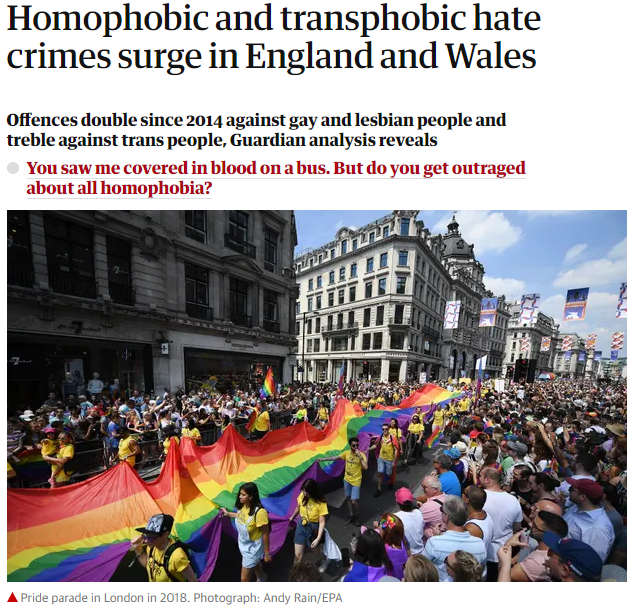
Fraser Myers explains why the much-remarked-upon British crime statistics showing huge increases in hate crimes are much more a statistical artifact than a true reflection of the state of British society:

Allegedly, England and Wales are in the grip of a “surge” in homophobic and transphobic hate crime. “The rate of LGBT hate crime per capita rose by 144 per cent between 2013-14 and 2017-18”, it reports. Hate-crime hotspots like South Yorkshire and Hampshire experienced even larger surges, it claims, with police-recorded crimes rising by 376 per cent and 189 per cent in the same period, respectively.

To make matters worse, according to LBGT campaigners, this rise in hate crime doesn’t even capture the true extent of the hatred out there. Taz Edwards-White, alliance manager at equalities and diversity organisation Metro, told the Guardian that the hate-crime figures were likely to be “the tip of the iceberg”. She and other campaigners say this rise could be down to the rise of right-wing populism.

The truth is rather different. Every year for the past five years, the release of police-recorded data on hate crime has been accompanied by panicked media reports of a hate-crime surge. But as last year’s Home Office report made abundantly clear, large increases “are due to the improvements made by the police in their identification and recording of hate-crime offences and more people coming forward to report these crimes rather than a genuine increase” (emphasis mine).

What’s more, there is a good reason why the “surge” identified by the Guardian takes off in 2013-2014. 2014 was the year the College of Policing released its Hate Crime Operational Guidance [PDF], which is still used to this day. This guidance actually demands that the numbers increase. “Targets that see success as reducing hate crime are not appropriate”, it says. As part of the drive to record more crime, there has been a slew of public-information campaigns and regular exhortations from police for the public to report hateful incidents, particularly in the wake of major political events like the EU referendum and the 2017 terror attacks.

Police-recorded data has other problems, too. Police are obliged to record not only criminal actions but also all non-crime hate incidents. A non-crime hate incident is literally any event that is perceived by the victim or any other person to be motivated by hostility towards a so-called protected characteristic. The key word here is perceived. As the Operational Guidance makes clear: “The victim does not have to justify or provide evidence of their belief, and police officers or staff should not directly challenge this perception. Evidence of the hostility is not required for an incident or crime to be recorded as a hate crime or hate incidents.”

June 1, 2019

Viper MkI: A Simplified Steampunk Sten

Forgotten Weapons
Published on 26 Apr 2019

http://www.patreon.com/ForgottenWeapons

Cool Forgotten Weapons merch! http://shop.bbtv.com/collections/forg…

The Viper Mk I was an experimental submachine gun developed in the UK for use by military policemen in post-WW2 occupation West Germany. It was a simplified Sten gun (full-auto only, without the semiauto option normally included in the Sten trigger mechanism) put into a wooden housing. It was intended to be carried slung over one shouldered [and] fired under the arm with just one hand. To this end, it had neither sights nor trigger guard. The whole concept seems pretty questionable, and while multiple different Viper submachine guns were designed to fill this role, none were ever adopted.

Many thanks to the Royal Armouries for allowing me to film and disassemble this very rare weapon! The NFC collection there – perhaps the best military small arms collection in Western Europe – is available by appointment to researchers:

https://royalarmouries.org/research/n…

You can browse the various Armouries collections online here:

https://royalarmouries.org/collection/

Contact:
Forgotten Weapons
PO Box 87647
Tucson, AZ 85754

Experimental screen capture for social media thumbnailing purposes:

April 19, 2019

QotD: The revolution will be YouTubed, which might snuff it out before it gets underway

Filed under: Media, Politics, Quotations, USA — Tags: , , , , — Nicholas @ 01:00

I think that a number of factors will ultimately tamp it down [campus protests/riots]. The ability of people to record videos of police has been a tremendous spur to calls for reform. But police are not the only people who can be filmed in public; so can protesters. I suspect that as people discover what can happen when future employers google up videos of you shouting “[expletive deleted] the police” or screaming at professors and speakers, the costs of this sort of protest will rise, and there will be less of it. Moreover, I suspect that both alumni and state funding for schools where this sort of thing happens a lot will often decline, putting pressure on administrators to curb it.

Megan McArdle, “Ask Me Anything”, Reddit, 2017-04-10.

February 21, 2019

“Excessive fines can be used … to retaliate against or chill the speech of political enemies”

The US Supreme Court delivered a unanimous body blow to excessive use of asset forfeiture by state and local police:

Timbs challenged that seizure, arguing that taking his vehicle amounted to an additional fine on top of the sentence he had already received. The Indiana Supreme Court rejected that argument, solely because the U.S. Supreme Court had never explicitly stated that the Eighth Amendment applied to the states.

On Wednesday, the high court did exactly that.

“For good reason, the protection against excessive fines has been a constant shield throughout Anglo-American history,” wrote Justice Ruth Bader Ginsburg in the opinion. “Excessive fines can be used, for example, to retaliate against or chill the speech of political enemies,” she wrote, or can become sources of revenue disconnected from the criminal justice system.

Indeed, some local governments do use fines and fees as a means to raise revenue, and that has created a perverse incentive to target residents. After the 2014 shooting of Michael Brown in Ferguson, Missouri, a federal investigation into the city government found that 20 percent of its general fund came from criminal fines. And Ferguson is not alone in relying heavily on revenue from fines. Making clear that the Eighth Amendment applies to the states will make it far easier to challenge unreasonable fines and fees — including not just asset forfeiture cases, but also situations where local governments hit homeowners with massive civil penalties for offenses such as unapproved paint jobs or Halloween decorations.

Some of those cases are already getting teed up. As C.J. Ciaramella wrote in this month’s issue of Reason, a federal class action civil rights lawsuit challenging the aggressive asset forfeiture program in Wayne County, Michigan, that was filed in December argues that the county’s seizure of a 2015 Kia Soul after the owner was caught with $10 of marijuana should be deemed an excessive fine.

January 19, 2019

Stopper 37mm: A Simple South African Riot Control Gun

Filed under: Africa, History, Technology, Weapons — Tags: , , , , , — Nicholas @ 02:00

Forgotten Weapons
Published on 29 Dec 2018

http://www.patreon.com/ForgottenWeapons

Cool Forgotten Weapons merch! http://shop.bbtv.com/collections/forg…

The Stopper is a simple 37mm single shot riot control gun designed by Andries Piek in 1980. The South African police services were at that time using 37mm guns made by Federal Labs in the US, dating back to the 1930s, and the international embargo on South Africa made it impossible to get parts and do basic maintenance on those arms. So Piek (whose other work included the BXP carbine/SMG and design improvements to the LDP/Kommando) whipped out the Stopper in all of two weeks to provide a new domestic-production 37mm weapon for the police.

The Stopper is a simple break-action gun, with a manually cocked, single action, hammer-fired trigger mechanism. Two versions were made, one with the front grip and one without, and all were fitted with collapsing stocks. Production began in 1982 and ran until 1999, by Mitco Special Products under the Milkor name.

As an interesting postscript, Piek was inspired by seeing Christopher Walken using a Mannville 25mm revolving gas gun in the movie Dogs of War to make something similar in 37mm or 40mm. The gun he designed to this end became the Milkor MGL, adopted by South Africa in 1983 and by the US Marine Corps in 2005.

Contact:
Forgotten Weapons
PO Box 87647
Tucson, AZ 85754

January 11, 2019

“It is profoundly stupid, so most people assume it can’t be. But that’s what the law is now”

Filed under: Cancon, Government, Law, Liberty — Tags: , , , , , — Nicholas @ 03:00

Apparently the federal government believes that drinking and driving is such a huge, intractable problem that they’ve decided it’s worth sacrificing your right to privacy in order to combat this scourge:

It may sound unbelievable, but Canada’s revised laws on impaired driving could see police demand breath samples from people in bars, restaurants, or even at home. And if you say no, you could be arrested, face a criminal record, ordered to pay a fine, and subjected to a driving suspension.

You could be in violation of the impaired driving laws even two hours after you’ve been driving. Now, the onus is on drivers to prove they weren’t impaired when they were on the road.

This isn’t a simple change of rules, it’s a wholesale abandonment of common sense.

“If you start to drink after you get home, the police show up at your door, they can arrest you, detain you, take you back to the (police station) and you can be convicted because your blood alcohol concentration was over 80 milligrams (per 100 millilitres of blood) in the two hours after you drove.”

Changes to Section 253 of the Criminal Code of Canada took effect in December giving police greater powers to seek breath samples from drivers who might be driving while impaired.

Under the new law, police officers no longer need to have a “reasonable suspicion” the driver had consumed alcohol. Now, an officer can demand a sample from drivers for any reason at any time.

But there’s no possible way this could be abused, right?

“It’s a serious erosion of civil liberties,” said Toronto criminal defence lawyer Michael Engel, whose practice focuses almost exclusively on impaired driving cases.

Engel said someone could be unjustly prosecuted. If a disgruntled business associate or spouse called police with a complaint and an officer went to investigate at the persons’ home or place of business, police could demand a breath sample.

“Husbands or wives in the course of separations would drop the dime on their partner,” Engel said, describing the potential for the law’s abuse by those calling police out of spite, for example.

January 6, 2019

“Carding” is an infringement of rights that does nothing to reduce crime

Filed under: Cancon, Law, Liberty — Tags: , , , , — Nicholas @ 03:00

Chris Selley wonders why the blatantly unconstitutional practice of “carding” people without even a hint of suspicion that they’ve done anything wrong was instituted in the first place:

… it’s far easier to make a case that carding has no effect at all on serious crime than that it has a huge one. But even if previous carding practice had “worked,” even if the new regulation had stopped it from working, it barely even amounts to a defence. As [Justice Michael] Tulloch notes, “the regulation simply gives effect to the existing law that people do not have to provide their identification when there are no reasonable grounds to believe the person has committed an offence.”

If carding “worked,” in other words, it relied on citizens not knowing or caring about their already-existing right to be left alone whilst minding their own business, or being too intimidated to exercise that right — as well they might be. Politely refusing an armed man or woman’s request to identify yourself is no small thing, all the more so if you have “nothing to hide.”

The problems inherent in such a situation are myriad. There are quantifiable harms: People were denied jobs and security clearances, and in at least one case menaced by child services, thanks to information stored in police databases that implicated them in nothing other than being included in a police database. And there are more existential harms. Imagine growing up with a squeaky-clean nose yet constantly feeling like a person of police interest. It’s profoundly alienating, especially when targets quite logically conclude, based on well-documented statistics if not their own intuition, that they’re being harassed because of their race, skin colour or some other innate characteristic. It’s no less insidious if the bias is unconscious; it might even be more so.

Nothing good can come from it, and plenty bad. It hinders police in solving crimes, for one thing: “When a segment of society believes that it has been unfairly targeted by the police,” Tulloch writes, “it will delegitimize the police in their eyes.” All those desperate calls for witnesses to come forward will be met more skeptically. Tulloch cites research showing “inappropriate interaction with police” can even “desensitize young people from guilt regarding potential acts of crime.”

« Newer PostsOlder Posts »

Powered by WordPress