Quotulatiousness

May 10, 2020

London’s Metropolitan Police live down to expectations … and then some

Filed under: Britain, Health, Law, Liberty — Tags: , , , , , — Nicholas @ 06:00

Brendan O’Neill observes the latest sweep by the Metropolitan Police, relentlessly cracking down on scofflaws and evil-doers who … were walking peacefully in the sunshine?

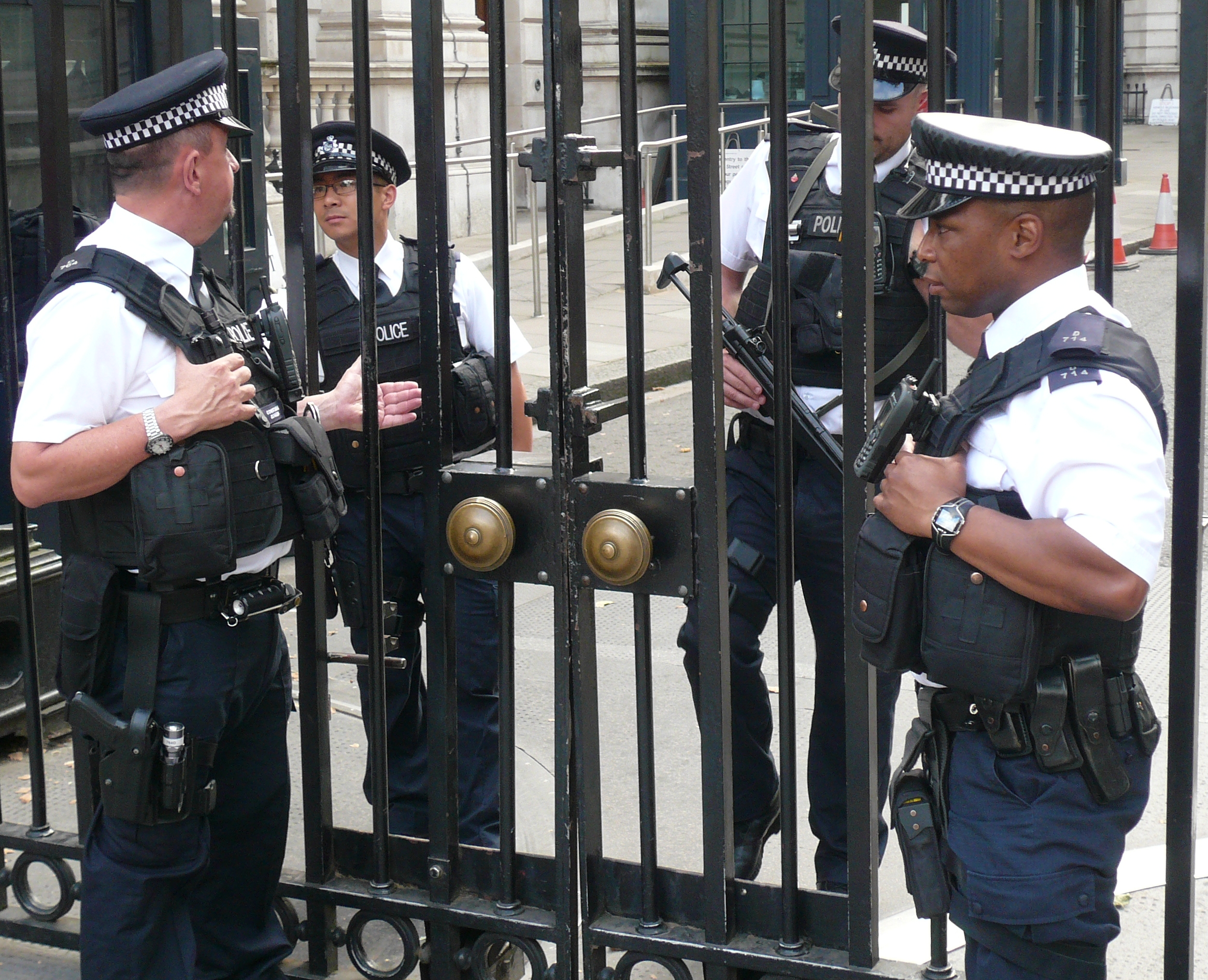
Armed Metropolitan Police near Downing Street in London.
Photo by Stanislav Kozlovskiy via Wikimedia Commons.

You heard them before you saw them. It sounded like a platoon of soldiers. The one in charge was barking orders to “move forward!” and then came the trudge of their boots. Scores of them, making military manoeuvres, marching in a long, thin line through one of Britain’s prettiest parks: St James’s Park in London. This was the Metropolitan Police today, enforcing the lockdown, sweeping through parks and streets and issuing the same warning to everyone they came across, from young lovers to dads playing football with their kids to homeless people with nowhere else to go: “Move on.” It’s one of the most disturbing things I’ve ever seen the police do.

Watching them stream through St James’s Park, looking for all the world like a line of soldiers conquering a small town, you’d think they were on their way to confront some serious organised crime. But of course their targets were sunbathers, those apparently selfish people demeaned in the media and now harassed by the cops. And a dad playing football with his toddler. “Aren’t we allowed to exercise?”, the dad asked. “For one hour”, came the reply. “How long have you been out?” And young lovers and friends. I saw a copper on horseback shouting down at two young men as if they were in the process of committing some awful crime. I guess they were in the eyes of the lockdown fanatics: they were sitting under a tree.

A young Muslim mum sitting down and watching her two kids play with little tennis bats was confused, too. Can’t kids play outside? She was told she couldn’t sit still. She had to walk. “How about walking your kids around the park?”, said the spectacularly patronising cop. They even threw out homeless people. I saw them tell four individual homeless people (ie, not a group of homeless people) to move on. Where to? Must they also walk and walk, forever, and never sit down anywhere? The most despicable thing I saw was a policeman telling an elderly homeless gentleman to move on. Inarticulately, the man explained he had nowhere else to go. I stepped in and explained to the cop that there is no home for him to go to, and he has to be able to sit down somewhere on a hot day. “I don’t make the rules”, came the snivelling, officious reply.

The police’s reputation will have taken a severe beating in London today. Anyone who argued back — as two young women did, patiently explaining that they are from the same household and that they were metres away from everyone else — was patronised or even insulted. “You’re putting other people’s lives at risk”, the women were told, which is completely untrue — being outside and socially distanced on a very warm day carries virtually zero threat of infection. I heard an officer call someone an idiot. Another officer made fun of someone who asked about his right to be outside. It was staggeringly rude and even repugnant behaviour. A politician, or someone, needs to get a grip on these people.

May 1, 2020

Theodore Dalrymple on the authoritarian innovations we’ve so meekly accepted thanks to the Wuhan Coronavirus epidemic

Filed under: Britain, Government, Health, Law, Liberty — Tags: , , , , , — Nicholas @ 03:00

Getting back to “normal” is going to be much more difficult now that the powers-that-be know for certain that we’re all quite comfortable tugging the forelock and bending the knee given the right kind of orders:

Armed Metropolitan Police near Downing Street in London.
Photo by Stanislav Kozlovskiy via Wikimedia Commons.

As for the collective or political lessons of the epidemic, I fear them more than rejoice in them. They seem to me likely to reinforce a tendency to authoritarianism, and to embolden bureaucrats with totalitarian leanings. One of the surprising things (or perhaps I should say the things that surprised me) was how meekly the population accepted regulations so drastic that they might have made Stalin envious, all on the say-so of technocrats whose opinions were not completely unopposed by those of other technocrats. There was, as far as I can tell, no popular demand for the evidence that supposedly justified the severe limitations on freedom that were imposed on the population. I suppose an encouraging interpretation of this readiness of the population to do as it was told is that it demonstrated that, all the froth and foam of opposition to political leaders notwithstanding, fundamentally the authorities were trusted by the population to do the right thing. Much as we lament, therefore, the intellectual and moral level of our political class, there are limits to how much we despise it. In other words, we believe that our institutions still work even when guided or controlled by nullities.

A less optimistic interpretation, as usual, is possible. Our population is now so used to being administered, supposedly for its own good, under a regime of bread and circuses, that it is no longer capable of independent thought or action. We have become what Tocqueville thought the Americans would become under their democratic regime, namely a herd of docile animals. Only at the margins — for example, the drug-dealers of banlieues of Paris — would the refractory actually rebel against the regulations, and that not for intellectual reasons or in the name of freedom, but because they wanted to carry on their business as usual. (I should perhaps mention here that I number myself among the sheep.)

In Britain, at any rate, the epidemic revealed how quickly the police could be transformed from a civilian force that protects the population as it goes about its business into a semi-militarised army of quasi-occupation. This transformation is not entirely new, alas; it has been a long time since the policeman was the decent citizen’s friend. Under various pressures, not the least of them emanating from intellectuals, he has become instead a bullying but ineffectual keeper of discipline, whom only the law-abiding truly fear.

I first sensed this development many years ago this when a traffic policeman asked to see my licence. “Well, Theodore …” he started, calling me by my first name when a few years before he would have called me “Sir.” This change was significant. I had gone from being his superior, as a member of the public in whose name he exercised his authority, to being a kind of minor, whom it was his transcendent right to call to order. He was now the boss, and I was now the underling.

The change in uniform, too, has worked in the same direction. Traditionally, since the time of Sir Robert Peel, the uniform of the British policeman was unthreatening, deliberately so, his authority moral rather than physical. Now, he is festooned with the apparatus of repression, if not of oppression, though in effect he represses very little of what ought to be repressed in case it fights back. The modern police intimidate only those who do not need deterring; those who do need it know that they have nothing much to fear from these whited sepulchres, these empty vessels. Incidentally, the French police have undergone a similar deterioration in appearance: gone is the reassuring képi in favour of the moron’s baseball cap, and some of them now dress in jeans with a black shirt with the word POLICE across its back, which is not difficult to imitate and makes it impossible to know whether a policeman really is a policeman or a lout in disguise.

French Gendarmerie at the Eurockéennes of 2007.
Photo by Rama via Wikimedia Commons.

The Covid-19 epidemic has come as a great boon to the British police. Increasingly criticised for their concentration on pseudo-crimes such as hate speech at the expense of neglecting real crimes such as assault and burglary, to say nothing of organised sexual abuse of young girls by gangs of men of Pakistani origin, they could now bully the population to their heart’s content and imagine that in doing so they were performing a valuable public service, preserving the law and public health at the same time. Thus they transformed their previous moral and physical cowardice into a virtue.

Of course, in bullying the average citizen who was very unlikely to retaliate they took no risks, unlike with genuine wrongdoers and law-breakers, who tend to be dangerous; but the fact remains that most individual policemen joined the force motivated by some kind of idealism, a desire to do society some service, though they soon had these naïve fantasies knocked out of them by the morally corrupt or bankrupt leadership of the hierarchy which owes its ascendency to its willingness to comply with the latest nostrums of political correctness. The faint embers of the policeman’s initial idealism were no doubt rekindled by the opportunity to prevent the spread of the virus, as they supposed that they were doing, but some of them, at least, far exceeded even their flexible and vaguely-defined authority and began to inspect citizens’ shopping bags to determine whether they were hoarding goods that might be in short supply. This was a step too far, and at last there were protests; the police desisted.

April 30, 2020

CITIZENS! Report any non-socially-distanced deviationist behaviour to this number immediately!

Filed under: Cancon, Government, Health, Liberty — Tags: , , , , , — Nicholas @ 03:00

In Maclean’s, Jen Gerson admits that she has not (yet) reported any of her neighbours for their failure to obediently follow the rules of social distancing. She must be reported to the appropriate state authorities!

Commemorative badges of the German Democratic Republic’s Ministry of State Security (Stasi).
Wikimedia Commons.

Look, I know I’m going to get flak for this, but someone needs to say it: think twice before you narc on your neighbours.

Snitching may work, but the downsides to citizen-policing are grim — to say nothing of the historical antecedents.

Firstly, “you can play havoc with somebody just by snitching on them with an anonymous snitch line,” noted Sharon Polsky, the president of the Privacy and Access Council of Canada. In addition to the risk of malicious reports, if people of colour aren’t disproportionately subject to snitching, I’d be shocked.

Totalitarian states turned neighbour against neighbour and family against family, in order to maintain the illusion of social cohesion.

Authoritarians use this tactic because there are never enough police or soldiers to force compliance upon an entire population, not unless everyone consents to become an agent of his or her own mutual oppression.

The term “fascism” has an innocent history. It comes from the Roman term “fasces,” which means a bundle of sticks bound together. One stick breaks, but the fasces remains strong. It’s another term for unity. That’s what makes it so seductive, especially in times of uncertainty and mortal dread. We’re all in this together. Nary a stick shall stray.

“We are now living amid the very tactics that the West [once] criticized,” Polsky added. “With state controls on commerce, industry, speech, and media.”

The federal government, for example, is already considering legislation that would bar the spreading of misinformation about COVID-19 online.

“Extraordinary times require extraordinary measures and it is about protecting the public,” Privy Council President Dominic LeBlanc told reporters with a line that should give any student of history the creeps.

“This is not a question of freedom of speech. This is a question of people who are actually actively working to spread disinformation, whether it’s through troll bot farms, whether [it’s] state operators or whether it’s really conspiracy theorist cranks who seem to get their kicks out of creating havoc.”

No doubt LeBlanc et al are operating under the noblest of intentions. But repressive measures buy conformity at a terrible price. Snitch lines turn us against one another. They teach us to fear the people we need to survive, thus making us more dependent on the apparatus of the state.

April 17, 2020

Chris Selley – “… if John Q. Bylaw is hassling you just for taking a walk, for heaven’s sake get your smart phone out and make a righteous stink”

Our proto-surveillance society is moving rapidly toward all-surveillance, all the time and the current justification is to fight the Wuhan Coronavirus epidemic:

For civil libertarians, these are alarming times — but less alarming than they might be. During a pandemic, when everyone agrees life cannot go on as normal, people who place maximum value on individual freedom are liable to look rather selfish. “Trust our leaders” types get a big boost.

But if Canadian officialdom has not botched its response to this crisis, neither has it excelled. Theresa Tam’s defenders are right that official advice will naturally change over the course of a pandemic — but nothing justifies her proactive downplaying of the COVID-19 risk at a time when several Canadian governments were, we now know, woefully unprepared. The pandemic doesn’t care that Prime Minister Justin Trudeau went to Harrington Lake, against advice from three governments including his own to stay away from any second homes — but it would have been so bloody easy for him not to go, to set an example. It’s equally inconsequential that Andrew Scheer added six more human beings than necessary to a government charter flight from Regina to Ottawa — and it would have been equally easy for him not to bring his family along.

Meanwhile, certain big Canadian cities have so obviously overstepped the mark, by cracking down on perfectly safe behaviours — walking in parks, notably — as to highlight the value of some don’t-tread-on-me pushback. An unscientific survey of social media suggests not a single real human being supports the City of Ottawa’s latest ridiculousness: Days after its bylaw officers threatened a father and son for kicking a ball around [noted here], fined a man $880 for walking his dog, and allegedly assaulted a man questioning his eviction from a park — none of which seems to be supported by the provincial emergency act they were ostensibly enforcing — a public health official now advises against exchanging properly distanced outdoor pleasantries with one’s neighbours lest it “turn into a parking lot or backyard party.” (Don’t laugh: Studio 54 was a cozy little jazz bar before Mick Jagger and Debbie Harry showed up one night with some records and a pound of blow.)

For civil libertarians who remember life before smart phones, meanwhile, the plan Google and Apple are working on to help governments control COVID-19 might as well be custom-designed to induce heebie-jeebies. The basic idea is that your phone’s operating system would reach out to other phones via Bluetooth and record the date, time, duration and location of the meeting. No personal information need be attached to those data points, just the identity of the device. When someone reports a COVID-19 diagnosis on an app, using a code provided by their public health department, devices that had been nearby would receive a warning that their owners might have been exposed, and should take such measures as local authorities advise.

It could be the stuff of dystopian sci-fi. You can just see the guy with the giant translucent computer screen shouting “magnify! Enhance!” Really, though, this comes down to a simple question: Whom do you least distrust? A co-production between Google, which is not at all known for respecting users’ privacy, and Apple, which at least seems to make an effort? Or governments?

April 9, 2020

You know you’re entering a police state when the police can just make up new “laws” to enforce

Filed under: Cancon, Health, Law, Liberty — Tags: , , , , , — Nicholas @ 03:00

I was surprised to see the name of someone I used to work with pop up in a story about over-enthusiastic enforcement of imaginary “laws” in the Ottawa area:

On Tuesday, the City of Ottawa’s bylaw enforcement team tweeted out an important clarification to a recent news report: An Orléans man had not been and would not be issued a $700 ticket for “playing soccer with his son in an empty field.” Rather, the city maintains, he had only been issued a “verbal warning” for playing soccer with his son in an empty field.

One can understand the Orléans man’s confusion. As David Martinek told it to the Ottawa Citizen, he was kicking around a ball with his four-year-old son William, who has autism and “more energy than needed to power the City of Ottawa,” when a bylaw officer arrived, took note of his licence plate and mentioned the $700 figure. He quite logically expected a summons in the mail.

The good news, such as it is, is that Martinek is no poorer to the tune of $700 (though he could have crowdfunded that in about 90 seconds). The remarkable thing about the city’s clarification, however, is that it actually paints a more offensive picture. A ticket is something you can fight — and such a ticket would deserve to be fought unto its demise, because Martinek doesn’t seem to have been doing anything illegal. As such, the “verbal warning” serves only as intimidation against a harmless, indeed beneficial activity.

The City of Ottawa’s website lays out the “rules and restrictions” in force due to COVID-19. It notes that bylaw officers have been empowered to enforce Ontario’s Emergency Management and Civil Protection Act. Regulation 104/20, made under said act, orders the closure of “outdoor recreational amenities that are intended for use by more than one family.”

It defines “outdoor recreational amenities” as off-leash dog parks, community and allotment gardens, “all portions of park and recreational areas containing outdoor fitness equipment,” “all outdoor playgrounds, play structures and equipment,” “all outdoor picnic sites, benches and shelters in park and recreational areas,” and “all outdoor sports facilities and multi-use fields, including baseball diamonds; soccer fields; frisbee golf locations; tennis, platform tennis, table tennis and pickleball courts; basketball courts; BMX parks; and skate parks.”

Considerable thought went into those very thorough prohibitions, you will agree. Yet they conspicuously do not prohibit two members of the same household kicking a ball around. Martinek says he questioned the bylaw officer as to whether they were on city parkland, but there’s nothing in the act prohibiting intra-household kick-arounds in parks or anywhere else. “Nothing in this order precludes individuals from walking through or using portions of park and recreational areas that are not otherwise closed and that do not contain an outdoor recreational amenity described,” the regulation reads.

March 17, 2020

When the state renounces enforcing the law, there are two alternatives

Filed under: Britain, Government, Law, USA — Tags: , , , — Nicholas @ 03:00

Yesterday, David Thompson linked to a post by Natalie Solent about how the police in London failed to do anything about a blatant theft at a Boots pharmacy because it was considered a “civil matter”. The accused thief was prosecuted privately by the parent corporation, which is apparently the first time this has happened in England. As Natalie says, this is the “nice” option when the government fails to enforce the law of the land — or enforces it only sporadically and unevenly.

In the latest edition of the Libertarian Enterprise, Eric Oppen provides an example from the US in the post-Civil War era that shows the other option for private law enforcement:

Many of the victims of the kind of small-time crime committed by vagrants and the “homeless” are, themselves, far from rich. Repeated thefts can drive a small, struggling business under, and loss of, for example, a bicycle can represent a catastrophic blow to a poor person’s finances. This doesn’t address the sense of violation felt by those victimized by crime.

The original San Francisco Committees of Vigilance formed because the “forces of law and order” either were not doing their jobs, or were actively in league with the very criminals they were supposed to be suppressing. Many police were incompetent or lazy, while others were often corrupt on a scale that would shock Boss Hogg.

Do-it-yourself justice was far from uncommon in nineteenth-century America, including in the “civilized” East. In upstate New York, after decades of unpunished crime, the Loomis family gang received an epic comeuppance in 1865. Fifteen years earlier, their outraged neighbors had tried staging a raid on the Loomis farm, but uncertainty about who owned the stolen goods they found prevented any Loomis from being convicted. In 1865, many of their neighbors were returned Civil War combat veterans. They had become inured to violence, and they were tired of the Loomis’ thefts, arsons and intimidation. They killed George “Wash” Loomis, the leader of the gang, nearly lynched one of his brothers, and burned down the family’s home. After that, the Loomis family’s power was broken and their reign of crime was pretty much over.

These things happened because there was no other way to deal with these situations. Law enforcement, in those days, was primitive, especially outside of the major cities. Large corporations often had their own private police simply because of this fact.

The “social contract” is supposed to read something like “renounce personally avenging your wrongs, and society will do it for you.” But what can one do, when society is visibly abrogating the contract? Take it to court?

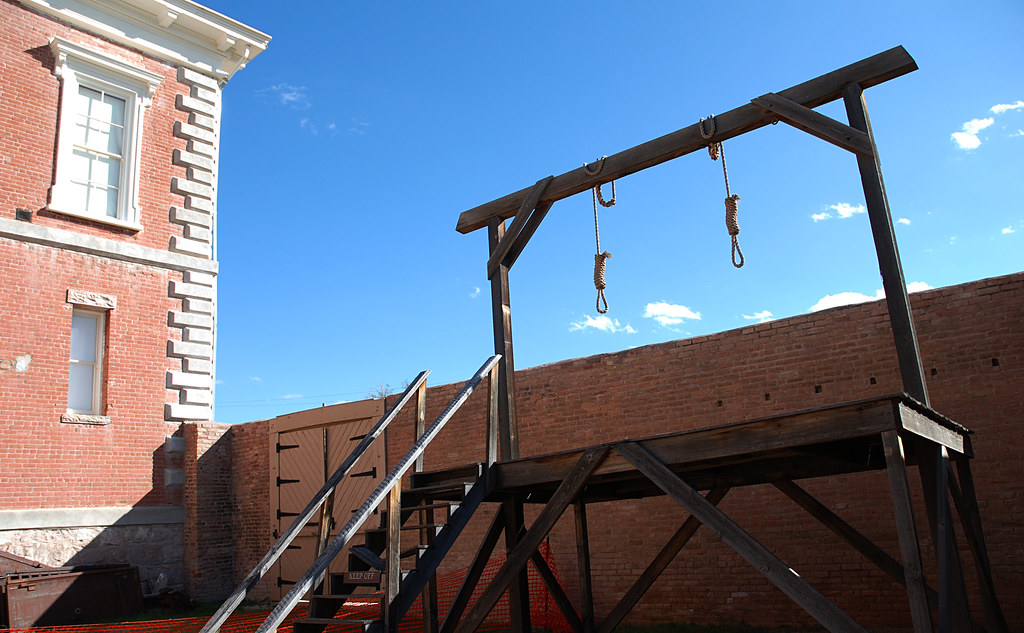
Vigilantism is not unknown even in Canada.

“Tombstone Courthouse State Historic Park” by August Rode is licensed under CC BY-NC-SA 2.0

March 15, 2020

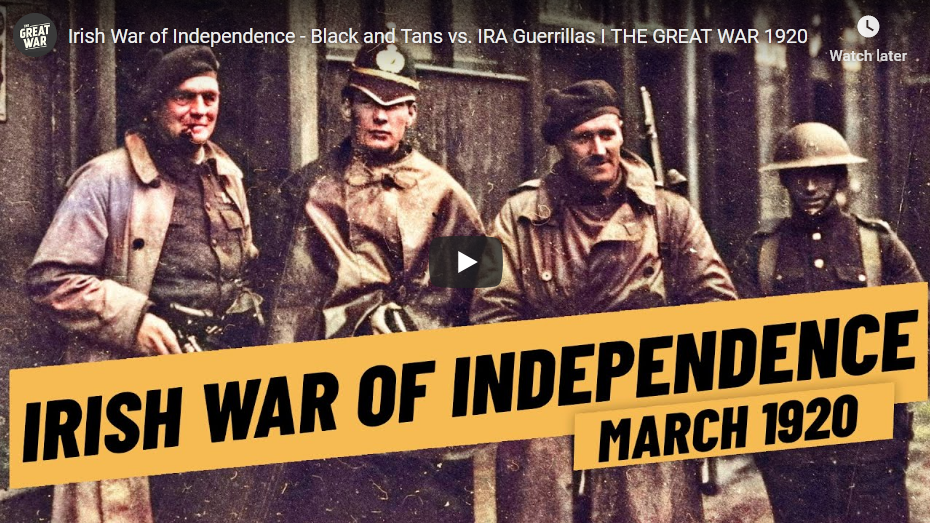
Irish War of Independence – Black and Tans vs. IRA Guerrillas I THE GREAT WAR 1920

Filed under: Britain, History, Military — Tags: , , , , , — Nicholas @ 04:00

The Great War
Published 14 Mar 2020

Sign up for Curiosity Stream and Nebula: https://curiositystream.com/thegreatwar

The movement for more Irish self determination had turned into a full out revolutionary movement by 1919. The British Empire was losing control over Ireland and by early 1920 was in a full out guerrilla war against the Irish Republican Army (IRA). To regain control more police forces were recruited with wide ranging authorities – and a lack of actual police training. With their mismatched equipment made from war supplies, they soon got the nickname “Black and Tans”.

» SUPPORT THE CHANNEL
Patreon: https://www.patreon.com/thegreatwar
Merchandise: https://shop.spreadshirt.de/thegreatwar/

» SOURCES

Bowen, Tom, “The Irish Underground and the War of Independence 1919-21” Journal of Contemporary History Vol. 8, No. 2 (Apr., 1973), pp. 3-23

Hopkinson, Michael, The Irish War of Independence, (Montreal & Kingston : McGill-Queen’s University Press, 2002)

Leeson, David, The Black and Tans: British Police and Auxiliaries in the Irish War of Independence, 1920-1921, (Oxford : Oxford University Press, 2011)

Lowe, W.J., “Who Were the Black-and-Tans”, History Ireland (Autumn 2004)

Townshend, Charles, The Republic: The Fight for Irish Independence 1918-1923, (London : Penguin Books, 2013)

» SOCIAL MEDIA
Instagram: https://instagram.com/the_great_war
Twitter: https://twitter.com/WW1_Series
Reddit: https://reddit.com/r/TheGreatWarChannel

»CREDITS
Presented by: Jesse Alexander
Written by: Mark Newton, Jesse Alexander
Director: Toni Steller & Florian Wittig
Director of Photography: Toni Steller
Sound: Toni Steller
Editing: Jose Gamez, Toni Steller
Mixing, Mastering & Sound Design: http://above-zero.com
Maps: Daniel Kogosov (https://www.patreon.com/Zalezsky)
Research by: Mark Newton
Fact checking: Florian Wittig

Channel Design: Alexander Clark
Original Logo: David van Stephold

A Mediakraft Networks Original Channel

Contains licensed material by getty images
All rights reserved – Real Time History GmbH 2020

February 29, 2020

“And then, somewhat astonishingly, the Ontario Provincial Police actually upheld the law”

Filed under: Cancon, Government, Law, Politics, Railways — Tags: , , , — Nicholas @ 05:00

Chris Selley calls for some answers in the still-not-fully resolved railway disruptions by First Nations and climate activists and the calling-it-spineless-is-a-compliment reactions of various levels of government to widespread contempt for the law:

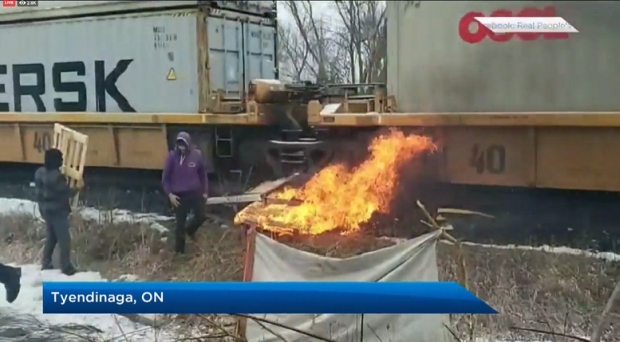
Screencap from a TV report on Mohawk Warriors attempting to set a freight car on fire along the Canadian National mainline through Tyendinaga near Belleville, Ontario.

When Canada’s ongoing spate of rail blockades finally peters out, this country has some work to do. A parliamentary committee might be up to the job, but even a full-on independent inquiry might not be excessive. A small group of Mohawks in Tyendinaga, Ont., in solidarity with an even smaller group of hereditary Wet’suwet’en chiefs, managed to blockade the Canadian National Railway for two weeks, not just holding hostage a chunk of the country’s economy, productivity and mobility, but demanding as ransom the cancellation of a liquefied natural gas pipelines that all First Nations affected by it, and it seems a comfortable majority of their residents, support.

It’s not a national disaster or anything. But as Prime Minister Justin Trudeau belatedly realized, it’s simply not an acceptable outcome in a democracy operating under the rule of law. And there is every reason to believe it could happen again — especially because we don’t really know how or why it ended when it did.

Operating at peak obnoxiousness, Trudeau had scolded those who demanded enforcement of a court order against the Tyendinaga blockade as boors, violence-mongers and idiots: “We are not the kind of country where politicians get to tell the police what to do,” he huffed. And then, frustrated by a lack of Sunny Ways among the federal government’s negotiating partners, he suddenly told the police what to do — or at the very least what he thought should happen.

[…]

The relatively undramatic end to the Tyendinaga blockade, after two weeks of dire warnings about Oka and Ipperwash reruns, raises another key question: Is there any reason we should believe it was safer to enforce the injunction on Day 14, as opposed to Day One or Two or Six?

Attempting negotiations was a perfectly sensible approach, even though it was very difficult to discern any room for compromise when one of the blockaders’ demands was so simple, blunt and inconceivable: shutting down the Coastal GasLink pipeline project. But the government is likely to face similarly unbending demands from future blockaders: Shutting down the Trans Mountain pipeline project, for example. Surely we can’t establish “two weeks of futility and then enforcement” as a policy moving forward. (Some might argue it was already established by a 13-day blockade of CN tracks near Sarnia, Ont., in 2013 — but that wasn’t nearly as crippling a blow to the railway’s operations.)

Police in Quebec were perfectly happy to enforce an injunction against a blockade on Montreal’s South Shore, which ended swiftly and without incident. Another on Mohawk territory in Kahnawake remains in place, and Premier François Legault has been excoriated for suggesting police face a heavily armed populace there — but at least it’s an attempt at an explanation. When it comes to the OPP’s inaction, we have none. For that matter, we probably deserve some insight into how protesters were able to set a roaring bonfire next to a moving train in Tyendinaga, wholly unmolested, just a couple of days after the blockade came down.

February 24, 2020

Bidding farewell to the rule of law in Canada?

Filed under: Cancon, Government, Law, Politics, Railways — Tags: , , , — Nicholas @ 03:00

John Carpay on the importance of the rule of law in civil society and why we’re at risk of losing it here in Canada:

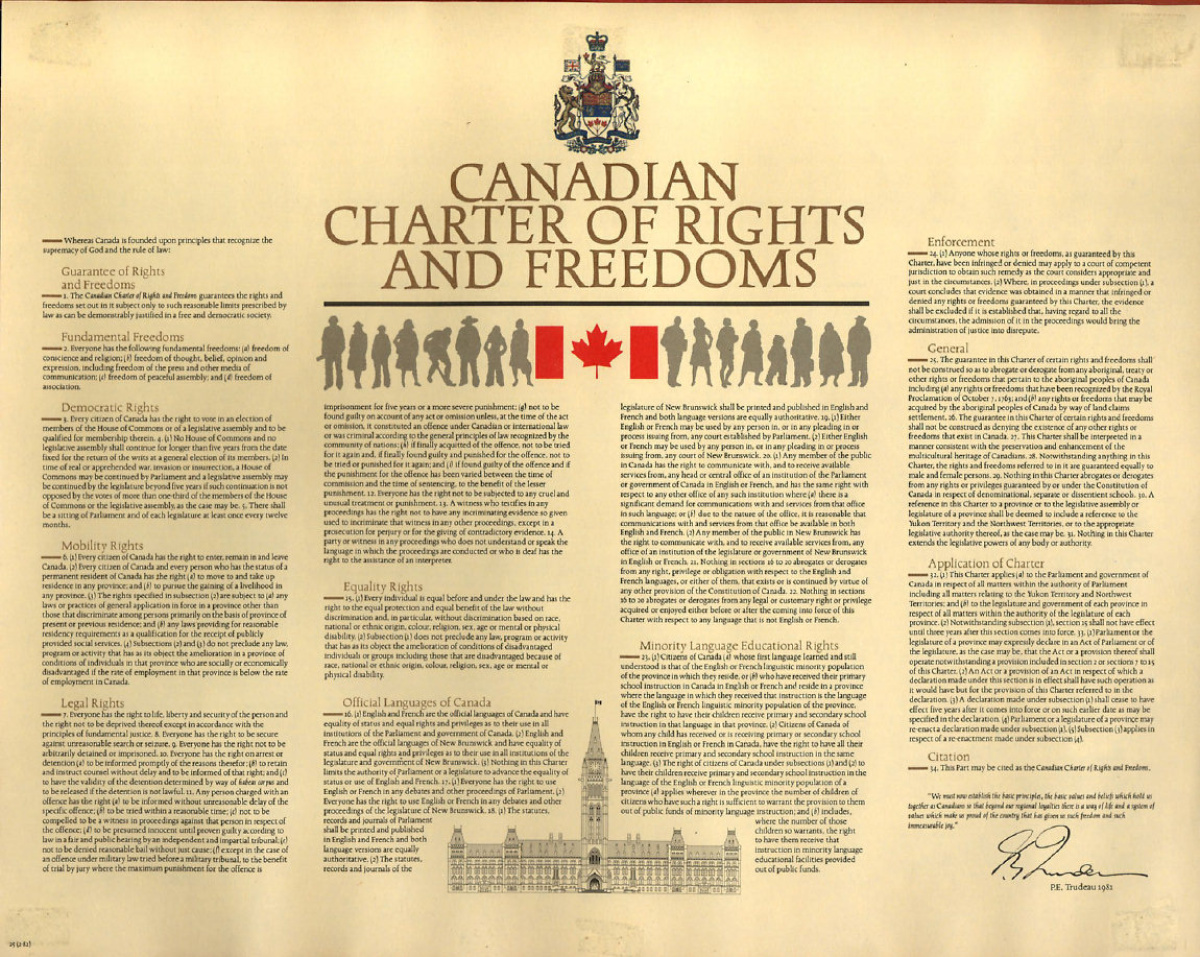
The rule of law is one of the most important legal principles on which Canada is based. Along with the supremacy of God, it is mentioned in the very first words of the Canadian Charter of Rights and Freedoms: “Whereas Canada is founded upon principles that recognize the supremacy of God and the rule of law.”

The rule of law means that we are ruled by laws, not by the whims of a King, or the clamouring of a mob. The rule of law also means that the law applies to everyone, even the King; there can be no exemptions for the King or his favourites.

Countries which practice and uphold the rule of law tend to thrive economically, socially, politically and culturally. Countries which uphold the rule of law become wealthy because people can work, buy, sell and trade in the knowledge that their property and their person are protected by law. Economies thrive when people know that the law will be enforced, and that the law will be applied to everyone, even to the King and his favourites. The rule of law provides investors, foreign and domestic, with confidence to invest their money in business projects.

Conversely, when a country condones law-breaking, investors will put their money elsewhere, and quickly. The world’s poorest and most violent countries are those where politicians are above the law, and the law is not applied equally to all.

The decisions of Canada’s politicians and police to condone – for three weeks or longer – the blockading of railway lines by aggrieved protesters violate the rule of law in at least two ways.

First, our politicians are effectively stating that individuals with strongly held political opinions are entitled to engage in illegal activities, in this case shutting down railway lines. Second, law-breaking is permitted because Prime Minister Justin Trudeau and other politicians sympathize with the protesters’ ideology and demands: the law does not apply to the King’s favourites.

February 17, 2020

“The rails to hell are laid with good intentions”

In the National Post, Jonathan Kay explains how Canadian governments find themselves in the situation where the basic laws of the land can be flouted at will by a small extremist faction and the police are unwilling to do more than bare peacekeeping duties:

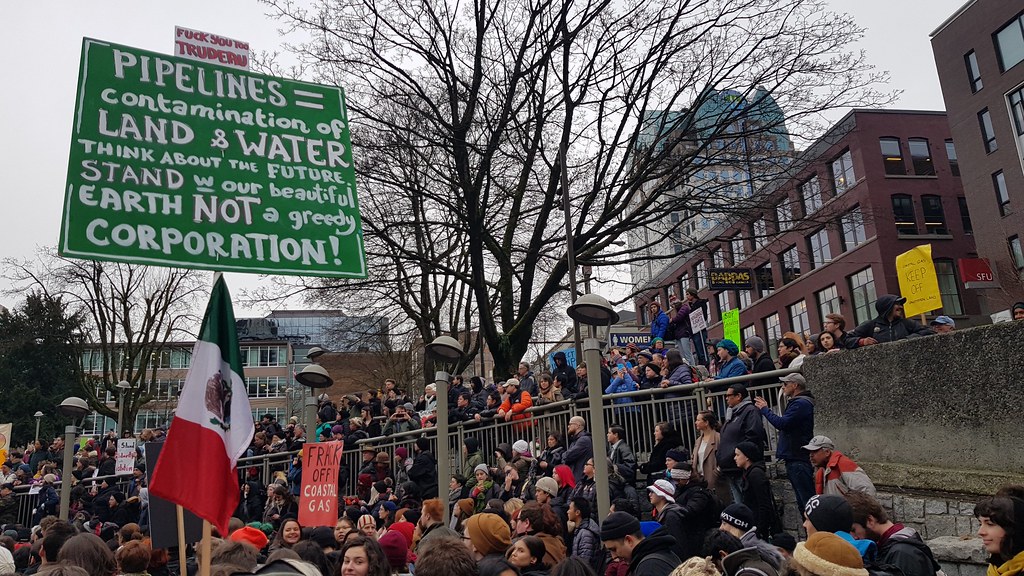
“Vancouver Solidarity with Wet’suwet’en” by jencastrotakespictures is licensed under CC BY-NC-SA 2.0

If you find yourself astounded by the current situation in Canada, whereby protesters have been allowed to shut down a rail network that remains a backbone of passenger travel and industrial transport (and whose coast-to-coast completion in 1885 became a symbol of national unity), it’s useful to revisit the accumulation of symbolic gestures that have steadily destroyed the moral authority of our governments to push back at any assertion of Indigenous rights and grievances. For years, our leaders offered reflexive acquiescence to increasingly expansive claims that Canada remains a white supremacist dystopia, culminating in last year’s campaign to convince us not only that modern Canada is a “genocide” state, but that even the act of expressing disagreement with this description makes you a sort of metaphorical train conductor on the rails to Canadian Dachau. Having publicly tattooed their guilty settler souls with every imaginable hashtag, our leaders now apparently find themselves stopped from restoring the rule of law.

The rails to hell are laid with good intentions. And there is nothing that now signals goodness in Canadian public life more than the land acknowledgment. Certainly, no one can argue with the historical truth that Indigenous peoples populated Canada for thousands of years before the arrival of Europeans. But words have meaning. And the well-understood meaning of these acknowledgments is that Indigenous peoples exercise a sort of broad, vaguely defined moral sovereignty over lands “owned” by Canadian governments, corporations and private citizens — including the lands on which we have constructed roads, rails, ports and legislatures. And since this sovereignty apparently now may be asserted at any time, for pretty much any reason, we have effectively lost the ability to enforce the systematic organization of property rights on which every functional society, Indigenous or non-Indigenous, depends.

The push to recognize Indigenous sovereignty over ancestral lands stretches back generations, an effort rooted in very real constitutional and treaty rights. But what I am describing here is not this formally bounded legal campaign, but rather the more general insistence that the entire country remains stained by original sin, and so must be purified by an open-ended, quasi-spiritual process of “decolonization.” This project began in earnest in 2017 as a counter-reaction to the perceived jingoism of the Canada 150 celebrations. Within the rarified corners of the literary and arts milieus (in which I found myself embedded at the time), decolonization quickly became a sort of state religion, complete with decolonization-themed sensitivity training and confession rituals.

[…]

The people doing the protesting are led by dissidents within one of the affected Indigenous communities, amplified by a critical mass of white environmentalists who are perfectly happy to cherry-pick Indigenous causes based on how well they line up with their own Anti-Racism/Critical Studies term-project requirements. Indeed, there is a certain type of very self-satisfied white Canadian leftist who sees himself as a real-life Lorax. Drawing on antiquated noble-savage stereotypes from the past, these decolonization super-allies cast Indigenous people as their little bar-ba-loot bears. And it just ruins their day when Indigenous leaders refuse to grab their tummies, moan for the CBC cameras, or read their bar-ba-loot scripts.

There is a larger hypocrisy at play here, too. Justin Trudeau and his entourage — currently on world tour, hoping to convince African and Caribbean leaders to hand him the shiny trophy of a UN Security Council seat — don’t take the train much. They fly. So, too, do the provincial politicians passing the buck in equal measure, not to mention the national broadcast journalists offering maudlin profiles of the demonstrators. Forcing ordinary travellers to bear the burden of upholding officially sanctioned upper-middle-class social-justice pieties isn’t “progressive.” It’s reactionary, snobbish elitism with a progressive façade.

February 16, 2020

The Canadian economy taken hostage while the PM swans around the world schmoozing for a temporary Security Council seat

Chris Selley on the state of play in the stand-off between (some) First Nations protesters and their temporary fellow travellers of the various permanent protest class:

“DSC02285” by Bengt 1955 is licensed under CC BY-NC 2.0

The majority of Wet’suwet’en First Nation members support the Coastal GasLink natural gas pipeline project, and they are in an objectively peculiar situation. On the one hand, the RCMP is doing its best to clear away the protesters and let construction proceed. On the other hand, anti-pipeline protesters claiming solidarity with the Wet’suwet’en have created chaos in their name — most notably the total shutdown of CN Rail’s eastern Canadian network, the cancellation of nearly every Canadian passenger train, and the layoffs and untold economic costs that go with that.

If protesters acknowledge the diversity of opinion among the Wet’suwet’en at all, they will defer to the authority of five hereditary chiefs who oppose the project, or observe that the five elected Wet’suwet’en band councils — all of which have signed community benefits agreements — represent a form of settler democracy imposed by the Indian Act.

[…]

Clearly the Wet’suwet’en are a divided community, including on the most basic questions of how they should be governed. It’s a mess. Mind you, look at the state of Canada as a whole.

Just as the RCMP have court authorization to clear protesters and encampments along the pipeline route, the Ontario Provincial Police have court authorization to clear the Mohawk rail blockade near Belleville, Ont. Unlike the RCMP, the OPP refuses to exercise its authority. And we just have to live with that. Conservative politicians are barking at Justin Trudeau to “enforce the law,” but he doesn’t give orders to the OPP, and neither does Ontario Premier Doug Ford, and nor should we want them to.

Still, you might expect senior ministers to have moderately stern words for folks illegally causing economic harm. You might expect the prime minister, at minimum, to be in the country. Instead, Trudeau spent the week swanning around Africa drumming up support for the UN Security Council seat with which he remains unaccountably obsessed, then decamped for the Munich Security Conference, where he was photographed warmly embracing Iranian foreign affairs minister Mohammad Javad Zarif, five weeks after Iran blew an airliner full of Canadians out of the sky over Tehran.

The Little Potato is probably doubly happy to have a valid (in his own mind) excuse for not being in the country at this particular time. He loves being the centre of attention … as long as that attention is friendly. He doesn’t handle situations well if the tempers are higher and the hostility is rising … like much of Canada right now.

The pipeline is a provincial project, not a federal one, but if the OPP won’t end the blockade and the feds aren’t willing to take truly extraordinary measures, then at some point in the foreseeable future it may well make short-term economic sense to give in to their demands. Maybe the feds can buy the pipeline from Coastal GasLink and shut it down.

And what if the Mohawks do lose interest, or are somehow induced to stand down? That now counts as the best-case scenario, and it will have involved shutting down the CN railway for at least a week — maybe two, maybe three — with enormous consequences for people’s livelihoods and the economy as a whole, all in the name of killing a project supported by the vast majority of Indigenous people affected by it. And it will happen again, as many times as any group wants it to, on whatever issue they want it to, for as long as they want it to. Unless someone in power does something unusually bold and concrete in the very near future – and it’s not even clear what that thing would be — we are well on the road as a country to being terminally screwed. In the meantime, we certainly have no lessons on accountable government to give the Wet’suwet’en.

February 14, 2020

The reaction to the Mohawk blockade near Belleville shows that VIA Rail isn’t a serious company

Mohawk protesters began blocking the main CN and VIA line between Toronto and Montreal near Belleville nearly a week ago. The police, having learned so often that the government and the courts won’t back them up, did little to try to get the blockade lifted other than to prevent active confrontations with the First Nations activists. Canadian National announced that they were being forced to park trains all over Eastern Canada as a result of the blockade and that deliveries of goods would be snarled for quite some time even after service is allowed to resume. VIA rail, on the other hand, seems to care not a bit about the thousands of travellers who have been stranded mid-journey and made no apparent efforts to bring in buses or any other arrangements. Chris Selley says this proves that VIA is not an essential service even in their own minds:

“The 6424” by Stephen Downes is licensed under CC BY-NC-SA 2.0

Of all the bad news to befall VIA Rail this week, with the cancellation of all its trains between Toronto and Ottawa and Toronto and Montreal — that’s roughly 50 per cent of its ridership and 60 per cent of its revenues — the worst news might be just how little news it has made. Mostly, the Mohawk blockade of the CN main line near Belleville, Ont., has been treated as a side story to the anti-pipeline protests and arrests in the British Columbia interior.

That’s what it is in the grand scheme of things: The battle between Wet’suwet’en members and chiefs and the federal government speaks to much larger, existential questions about the future of the Canadian economy, about the Liberal government’s reconciliation agenda, about the very nature of the Canadian federation and the rule of law. This blockade, launched in the name of solidarity with the Wet’suwet’en, just means people have to take the bus, or fly, instead of the train.

But that’s no small inconvenience, no small expense. Canadians in general are not quick to anger, but very few of the VIA refugees interviewed by various news outlets sounded even slightly furious, which they had every right to be. When protesters from the same First Nation blockaded the same set of tracks six years ago, VIA properly exhibited some concern with getting their customers to their destinations and put on replacement buses.

This time around, no buses. No suggestions. No response to media inquiries asking why there are no buses. Just a cancellation notice on the website and a fare-thee-well. At a time when VIA is seeking untold billions from the federal government to build a new Toronto-Ottawa-Montreal route and run vastly more trains, this does not bespeak a company that takes itself very seriously.

[…]

And never mind VIA, what sort of country lets a few people close down a key piece of national infrastructure, in violation of a court injunction — not for an hour or a day, but literally indefinitely? For a time it wasn’t even clear whose job it was to enforce the injunction: On Sunday an Ontario Provincial Police spokesperson told Global News it was up to the CN Police Service. On Tuesday, a CN spokesperson told the National Post it was up to the OPP, and indeed, late Tuesday OPP officers warned protesters to leave or they would be forced out. Perhaps the threat of massive economic disruption finally lit a fire under them: earlier in the day, CN had said it was considering shutting down huge parts of its freight network across the country. Had it just been rail passengers, though, the idea of this side-protest dragging on for weeks or even months seems absurdly plausible.

VIA Rail 918, a General Electric model P42DC locomotive, at Belleville, Ontario on 23 December 2008.
Photo by Martin Cathrae via Wikimedia Commons.

While VIA may not be serious, others are extremely serious:

Left-wing blogs have been offering instructions and maps during the #ShutDownCanada protests on how to blockade and destroy train tracks and other pieces of Canada’s infrastructure, according to True North.

Two websites in particular, these being North Shore and Warrior Up, have instructed demonstrators how to damage Canada’s pipelines, roads and railways.

In some of North Shore’s posts, for instance, they told their readers to stand in solidarity with the Wet’suwet’en tribe by destroying train tracks. In this article, the author makes it perfectly clear that he wants to damage Canada’s economy at large.

More absurdly, however, the article then went on to instruct the reader on how to compose a chemical mixture that destroys steel rail tracks — taking particular care to describe how not to leaving fingerprint or DNA evidence.

Thursday evening, VIA Rail announced their whole passenger network would be shut down until further notice: Service cancellation notice.

February 3, 2020

Royal NW Mounted Police Ross MkI Carbine & MkII Rifle

Filed under: Cancon, History, Weapons — Tags: , , , , , — Nicholas @ 04:00

Forgotten Weapons
Published 31 Jan 2020

http://www.patreon.com/ForgottenWeapons

https://www.floatplane.com/channel/Fo…

Cool Forgotten Weapons merch! http://shop.bbtv.com/collections/forg…

One of the very early clients of the Ross Rifle Company was the Royal North West Mounted Police (later merged with the Dominion Police to form the RCMP). The Mounties purchased 500 Ross MkI carbines, which were actually the only factory-made Ross carbines ever produced. The guns were made in 1904 and delivered in 1905 — and quickly began to show problems. In particular, the bolt stops were unreliable and many springs had poor temper and lost strength. The RNWMP complained to Ross, who agreed to replace the carbines with new MkII Ross rifles.

Those new rifles did not arrive until 1909, and in the intervening years the police went back to issuing their old Lee Metford carbines. When they did finally get new rifles, the police commissioner was leery of their quality, and chose to hold them in storage at Regina headquarters and used for training and marksmanship competition only until he was confident that they were suitable for issue to his troopers. Before that confidence could be gained, however, a fire in the Regina warehouse destroyed all but 34 of them. Ultimately, the force was able to purchase Lee Enfield carbines from the British government in 1914, and never did successfully issue a Ross.

Many thanks to the collector who provided these original RNWMP guns for me to show you!

Contact:
Forgotten Weapons
6281 N. Oracle #36270
Tucson, AZ 85740

February 1, 2020

QotD: Justifying tyranny

Filed under: Government, Liberty, Quotations — Tags: , , , — Nicholas @ 01:00

In [Adam] Smith’s time, and now again in the regulatory state, few believed that a masterless society would be possible. The haunting fear by governing elites supported by worried citizens stirred up by an antitrade clerisy was then, and still is, that ordinary people will do bad things if left alone. Unless overawed by the threat of state violence in police or planning or regulation, ordinary people, especially the lower classes, will spurn priests, stop paying their rents and taxes, not save enough for old age, kill each other, not buy enough insurance, speak against the government, appear with hair uncovered, refuse military service, drink to excess, commit unnatural acts, use naughty words, chew gum, smoke marihuana – committing in sum, as Bill Murray put it in Ghostbusters, “human sacrifice, dogs and cats living together, mass hysteria.” A progressive or a conservative program of heavy regulation is a first-night-in-Ferguson-Missouri notion of keeping order. It is the justification of all tyranny, hard or soft.

Deirdre McCloskey, Bourgeois Equality, 2016.

December 23, 2019

Policing London – His Majesty King Mob – Extra History – #4

Filed under: Britain, History, Law — Tags: , , , — Nicholas @ 04:00

Extra Credits
Published 22 Dec 2019

John Fielding, Henry Fielding’s brother, took over the Bow Street Runners after his brother’s death. He was well known as a man who could identify over 3,000 criminals by voice alone. After all, he was blind. But his real contribution to policing was his organizational skills. He created the first Central Database of stolen goods and suspect descriptions and published papers that included not only London criminals but also descriptions of criminals wanted by other prisons in the country. And while the courts may have loved him, the public was much more skeptical. These were times marked by distrust in authority and having a criminal database seemed like an intrusion on personal liberty. What was required to change public opinion?

Join us on Patreon! http://bit.ly/EHPatreon

« Newer PostsOlder Posts »

Powered by WordPress