Quotulatiousness

September 22, 2020

QotD: City dwellers and the state

Filed under: Politics, Quotations, USA — Tags: , , , — Nicholas @ 01:00

If one wants to understand why city dwellers have a peculiarly statist politics, spend time in a big city subway system. For the people in the city, government services are essential for living. They depend on the subway, the trash collection and the police department. The city depends upon this organic relationship between the state and the citizens. That does not exist in the suburbs or the country. There’s a comfort that comes from the daily interaction with the state. Anyone who questions that relationship is suspect.

The Z Man, “Never Newark Nights”, The Z Blog, 2018-06-06.

September 13, 2020

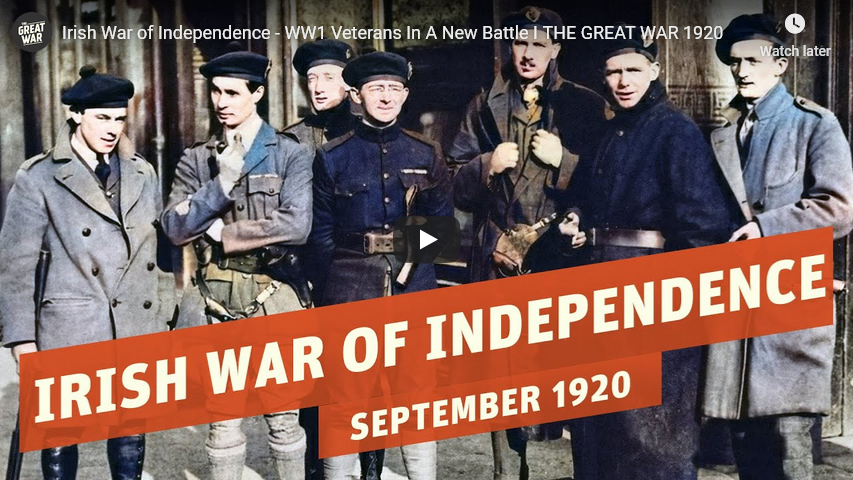
Irish War of Independence – WW1 Veterans In A New Battle I THE GREAT WAR 1920

The Great War
Published 12 Sep 2020

Sign up for Curiosity Stream and get Nebula bundled in: https://curiositystream.com/thegreatwar

The conflict between the Irish independence movement and the UK government had been heating up since 1919. The summer of 1920 brought a new level of escalation with the arrival of the the Auxiliary Division of the Royal Irish Constabulary. Former veterans of the First World War were brought in to quell the rebellion and get hold of the strongholds controlled by the IRA.

» SUPPORT THE CHANNEL
Patreon: https://www.patreon.com/thegreatwar

» OUR PODCAST
https://realtimehistory.net/podcast – interviews with World War 1 historians and background info for the show.

» BUY OUR SOURCES IN OUR AMAZON STORES
https://realtimehistory.net/amazon *
*Buying via this link supports The Great War (Affiliate-Link)

» SOURCES
Hart, Peter: The IRA and Its Enemies (Oxford: Oxford University Press, 1998)

Harvey, A.D: “Who Were the Auxiliaries?” The Historical Journal, Vol. 35, No. 3 (Sep. 1992)

Hopkinson, Michael: The Irish War of Independence (Montreal & Kingston: McGill-Queen’s University Press, 2002)

Leeson, David: The Black and Tans: British Police and Auxiliaries in the Irish War of Independence, 1920-1921 (Oxford: Oxford University Press, 2011)

McMahon, Sean: The War of Independence (Cork: Mercier Press, 2019)

O’Brien, Paul: Havoc: The Auxiliaries in Ireland’s War of Independence (Cork: Collins Press, 2017)

Riddell, George: Lord Riddell’s Intimate Diary of the Peace Conference and After: 1918-1923 (London: Victor Gollancz Ltd, 1933)

Roxbourgh, Ian: “The Military: The Mutual Determination of Strategy in Ireland, 1912-1921” in Duyvendak, Jan Willem & Jasper, James M. (eds) Breaking Down the State: Protesters Engaged (Amsterdam: Amsterdam University Press, 2015)

Townshend, Charles: The Republic: The Fight for Irish Independence 1918-1923 (London: Penguin Books, 2014)

“Tubbercurry”, Manchester Guardian, 4 October 1920.

Hugh Martin: “‘Black and Tan’ Force a Failure”, Daily News, 4 October 1920.

» MORE THE GREAT WAR
Website: https://realtimehistory.net
Instagram: https://instagram.com/the_great_war
Twitter: https://twitter.com/WW1_Series
Reddit: https://reddit.com/r/TheGreatWarChannel

»CREDITS
Presented by: Jesse Alexander
Written by: Jesse Alexander
Director: Toni Steller & Florian Wittig
Director of Photography: Toni Steller
Sound: Toni Steller
Editing: Toni Steller
Motion Design: Philipp Appelt
Mixing, Mastering & Sound Design: http://above-zero.com
Maps: Daniel Kogosov (https://www.patreon.com/Zalezsky)
Research by: Jesse Alexander
Fact checking: Florian Wittig

Channel Design: Alexander Clark
Original Logo: David van Stephold

Contains licensed material by getty images
All rights reserved – Real Time History GmbH 2020

July 29, 2020

Some fascinating and disturbing information on the Nova Scotia murders

Filed under: Cancon, Law — Tags: , , , , — Nicholas @ 05:00

Once again, the Halifax Examiner provides information on the mass murder case in Nova Scotia that seems to be mystifyingly of little to no interest to the mainstream media outlets:

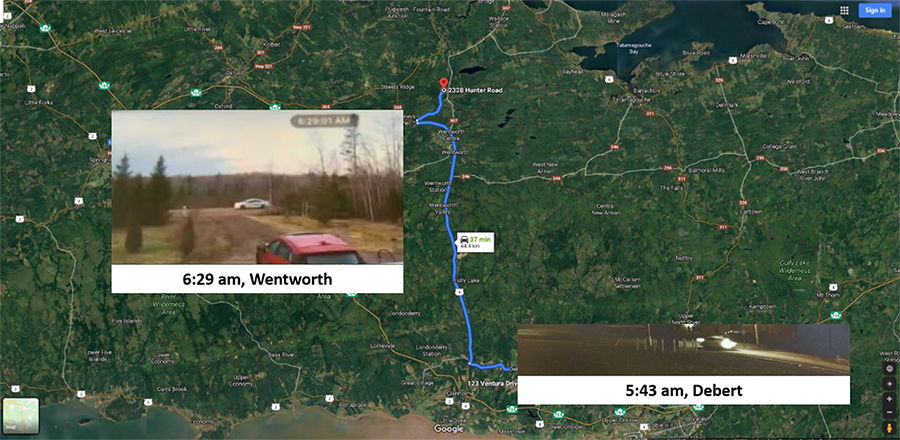
An annotated RCMP map shows the killer’s route from 123 Ventura Drive in Debert to 2328 Hunter Road in Wentworth. Insets of still images taken from different videos show the killer’s replica police car at 5:43am in Debert and passing a driveway on Hunter Road in Wentworth at 6:29am.

The most stunning revelation comes from one person who spoke with Halifax police. That person told police that the murderer, who the Examiner refers to as GW, “builds fires and burns bodies, is a sexual predator, and supplies drugs in Portapique and Economy, Nova Scotia.”

Moreover, the person said that GW “had smuggled guns and drugs from Maine for years and had a stockpile of guns” and GW “had a bag of 10,000 oxy-contin and 15,000 dilaudid from a reservation in New Brunswick.”

Another person who spoke with the RCMP gave information about GW’s properties, relating that it was known that there were secret hiding places at the properties. The person said GW had shown another person (whose name remains redacted) a “hidden compartment in the garage” [presumably in Portapique], which was under a workbench, and GW kept a “high powered rifle” in the space.

The person who spoke with the RCMP said that there was a “false wall” at GW’s Dartmouth residence. That information was echoed by another person who spoke with Halifax police on April 19, who said that “there is a secret room in the clinic in Dartmouth.”

Other information that is newly un-redacted confirms information that was widely known before.

July 20, 2020

The “epic failure” of the RCMP during the Nova Scotia killing spree

Filed under: Cancon, Law — Tags: , , , , , — Nicholas @ 03:00

In the Halifax Examiner, Paul Palango reconstructs the (known) series of events during the April pursuit of the killer at large in Nova Scotia:

The RCMP has claimed it did its best in trying to deal with the Nova Scotia mass killer on the weekend of April 18 and 19, but a reconstruction of events by the Halifax Examiner strongly suggests that the police force made no attempt to save lives by confronting the gunman or stopping his spree at any point.

“Public safety and preservation of life are the primary duties of any peace officer,” said a former high ranking RCMP executive officer who asked for anonymity out of fear of retaliation by current and former law enforcement officials who are vigilant about any criticism of policing by those in the field. “As far as I can tell, the RCMP did nothing in Nova Scotia to save a life. They weren’t ready. It is embarrassing to me. The entire thing was an epic failure.”

Based upon interviews with other current and former police officers, witnesses, and law enforcement, and on emergency services transcripts, it seems clear that there was a collapse of the policing function on that weekend.

At no point in the two-day rampage did the RCMP get in front of the killer, who the Examiner identifies as GW. It also seems apparent that some Mounties, many of whom were called in from distant locales, were stunningly unaware of the geography and landmarks in the general area as the RCMP tried to keep up with GW.

Sources within the RCMP say a major problem was that communications between various RCMP units was never co-ordinated. “Everyone was on their own channels,” the source said. “Nothing was synchronized. They could have gone to a single channel and brought in the municipal cops as well, but for some reason they didn’t. It was like no one was in charge.”

This incident is revealing:

Several RCMP and law enforcement sources say that a corporal from a nearby detachment who was the initial supervisor on the scene froze in place to the distress of other Mounties. The corporal later ran into nearby woods and turned off their flashlight and hid. That officer continues to be off work on stress leave.

Some veteran Mounties say that there were likely a number of factors which caused the first Mounties on the scene to hesitate.

“It could have been inexperience. Maybe there was no backup. And then there’s always that Canada Labour Code thing,” said one long time Mountie.

The “Canada Labour Code thing” is an interesting insight, although it doesn’t excuse the RCMP’s disorganization and lack of effective leadership over the two days.

An annotated RCMP map shows the killer’s route from 123 Ventura Drive in Debert to 2328 Hunter Road in Wentworth. Insets of still images taken from different videos show the killer’s replica police car at 5:43am in Debert and passing a driveway on Hunter Road in Wentworth at 6:29am.

As they say, “read the whole thing“, as the events unfold with what seems like an endless series of missed opportunities on the part of the RCMP to stop the killings.

H/T to Colby Cosh for the link.

July 12, 2020

Reforming the police

Filed under: Australia, Britain, Government, History, Law, USA — Tags: , , — Nicholas @ 05:00

A guest editorial at Catallaxy Files from former Australian senator David Leyonhjelm discusses the original civilian police force, the London Metropolitan Police, and the rules that governed their actions. Contrasting the origins of modern policing, he then discusses the ways police organizations have changed:

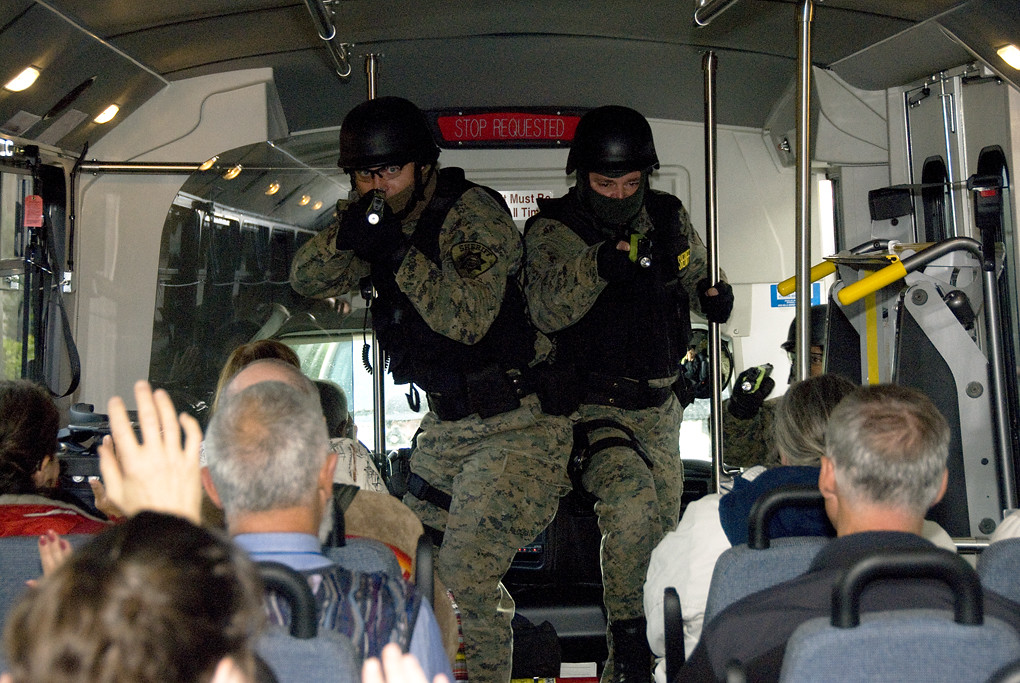
“On the bus” by OregonDOT is licensed under CC BY 2.0

One issue is the steady militarisation of the police. This ranges from references to the public as civilians and assertions that the police place their lives on the line every day, to black uniforms, military assault rifles and equipment such as armoured personnel carriers. This is a bigger concern in America, where a lot of military surplus equipment is sold to police and the emphasis on armed conflict is more pronounced, but the trend is the same here.

When they see themselves as soldiers in a war, it is not surprising that some police have no regard for public welfare. The negligence leading to the death of Miss Dhu in police custody in [Western Australia], and of course the notorious deaths in America, are obvious examples of where that leads.

Peel’s principles also stipulate that police should only use physical force when persuasion, advice and warning are insufficient, to use only the minimum force necessary, and that the cooperation of the public diminishes proportionately with the necessity of the use of physical force and compulsion.

Yet how often do we see police resort to violence when making an arrest? People are tackled, forced to the ground with knees on their back and neck amid blows, kicks and the vindictive use of Tasers, simply to apply handcuffs. Being “non-compliant” or raising verbal objections is enough to prompt this, and some have died as a result.

Moreover, when the victims of such treatment are not convicted or imprisoned, such rough handling amounts to a form of punishment. That is also in conflict with Peel’s Principles, which require the police to avoid usurping the powers of the judiciary by authoritatively judging guilt and punishing the guilty.

Enforcement of the Covid rules, including the authoritarian decrees and fines imposed by state premiers, provide further examples: petty closing of cafes, prosecutions for reading in a park, chasing individuals along a closed beach, stopping fishing from a pier the day after 10,000 have gathered in a demonstration, and even a Police Commissioner who denounces the cruise industry as criminal, are among them. The Australian public are never likely to accept the police as one of them while those sorts of things occur.

Change is necessary. Corrupt and thuggish police must be rooted out and the enforcement of laws that the public does not support, including political and victimless crimes, should never have priority. Moreover, arresting people seldom solves problems that originate in drug use, alcoholism, mental illness and poverty.

The fundamental responsibility of governments is to protect life, liberty and property. If the police were to focus on these while upholding Peel’s Principles, Australians might even come to their aid.

July 5, 2020

With Christianity on its last legs, westerners seem to be looking for secular replacement beliefs

In Reason, John McWhorter discusses the pseudo-religious trappings of modern day Social Justice devotions:

Over the past several years, a social justice philosophy has arisen that is less a political program than a religion in all but name. Where Christianity calls for people to display their moral worth through faith in Jesus, modern Third-Wave Antiracism (henceforth TWA) calls for people to display their moral worth through opposition to racism. In the wake of the murder of George Floyd, this vision has increasingly been expressed through procedures, routines, and phraseology directly patterned on Abrahamic religion.

America certainly has work to do on race. For one, while racism does not explain why cops kill more black than white people — poverty makes all people more likely to be killed by the cops, hundreds of poor whites are killed annually, but more black people are poor — they harass and abuse black people more than white people, and the real-life impact of this is in its way just as pernicious as the disparity in killings would be. If the tension between black people and the cops were resolved, America’s race problem would quickly begin dissolving faster than it ever has. But making this happen will require work, as will ending the war on drugs, improving educational opportunities for all disadvantaged black children, and other efforts such as steering more black teenagers to vocational programs training them for solid careers without four years of college.

These are real things, upon which we must behold scenes like in Bethesda, where protesters kneeled on the pavement in droves, chanting allegiance with upraised hands to a series of anti-white privilege tenets incanted by what a naïve anthropologist would recognize as a flock’s pastor. On a similar occasion, white protesters bowed down in front of black people standing in attendance. In Cary, North Carolina, whites washed black protesters’ feet as a symbol of subservience and sympathy. Elsewhere, when a group of white activists painted whip scars upon themselves in sympathy with black America’s past, many black protesters found it a bit much.

Such rituals of subservience and self-mortification parallel devout Christianity in an especially graphic way, but other episodes tell the same story. Many conventional religious institutions are now rejecting actual Christianity where it conflicts with TWA teachings. At the Massachusetts Institute of Technology, a chaplain was forced to resign after writing a note exploring the contradiction between roasting the police as racist and the Christian call for love of all souls. Unitarianism has been all but taken over in many places by modern antiracist theology, forcing the resignation of various ministers and other figures.

The new faith also manifests itself in objections to what its adherents process as dissent. A friend wrote on Facebook that they agreed with Black Lives Matter, only to have another person — a white one, for the record — post this reply: “Wait a minute! You ‘agree’ with them? That implies you get to disagree with them! That’s like saying you ‘agree’ with the law of gravity! You as a white person don’t get to ‘agree’ OR ‘disagree’ when black people assert something! Saying you ‘agree’ with them is every bit as arrogant as disputing them! This isn’t an intellectual exercise! This is their lives on the line!”

This objection seems studiously hostile until we compare it to how a devout Christian might feel about someone opining that he “agrees” with Jesus’ teachings, as if the custom were to think one’s way through the liturgy in logical fashion and decide what parts of it makes sense, rather than to suspend logic and have faith.

The religious analogies pile higher by the week.

July 1, 2020

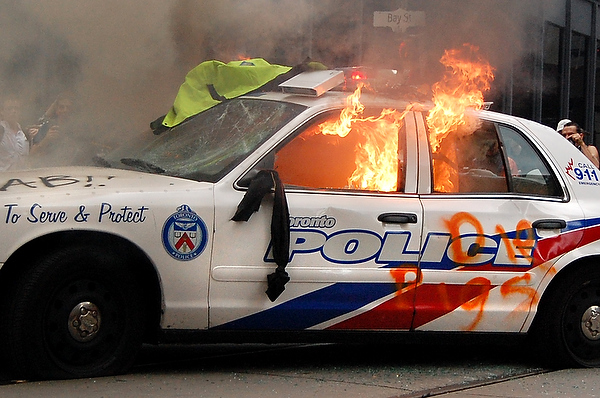
Toronto Police won’t be facing a 10% budget cut after city council votes down proposal

Filed under: Cancon, Government, Law — Tags: , , — Nicholas @ 03:00

Chris Selley on the vote by Toronto city councillors to retain the existing budget for the city’s police force at $1.22 billion:

On Monday, Toronto City Council debated and passed a variety of proposed police reforms, the newsiest of which had been asking the department to table a 10-per-cent budget cut for 2021. That idea was voted down 16-8. Further proposed changes included asking the Toronto Police Service for a line-item budget, and subjecting police to the municipal auditor-general’s oversight — utterly revolutionary concepts, you will agree. (Both passed.)

The budget cut might at least have been a useful exercise: It would be interesting to know what the police would and wouldn’t do with $1.1 billion instead of $1.22 billion. If I had been a consensus-seeking councillor on the virtual floor, I might have moved a motion asking the police to table line-item budgets for both — and maybe push for 20 or 30 per cent, too. But the question of the budget sucked up too much oxygen.

That’s certainly understandable. The “defund the police” movement in all its permutations is having a moment. There are North American police departments and police unions that might as well be begging to be disbanded, as much with their banal and petulant misbehaviour as with their needless use of lethal force. A few might even get their wish.

Canadian departments haven’t been begging quite as hard, however, and too many Canadians take false solace in that. When it comes to police-involved fatalities, we fare quite poorly against Western nations other than the one next door. Our accountability mechanisms are, generally speaking, a sick joke; indeed, it seems considerably easier to fire flamboyantly terrible cops in the United States than it does here.

James Forcillo, the Toronto officer who was caught on tape fatally unloading nine shots at 18-year-old Sammy Yatim for no good reason, was on the payroll for two-and-a-half years until his criminal conviction. He was at least suspended. Simon Seguin, the Alberta RCMP officer caught on camera in March rugby-tackling, punching and choking Athabasca Chipewyan First Nation Chief Allan Adam in a dispute over an expired vehicle registration, was at the time awaiting trial for assault!

June 23, 2020

The “Battle of Dijon”

Filed under: France, Law, Military — Tags: , , , — Nicholas @ 05:00

I post a lot of accounts of ancient and modern wars and battles, but the “Battle of Dijon” actually took place earlier this month and has been widely mischaracterized in the media, as John Lichfield recounts:

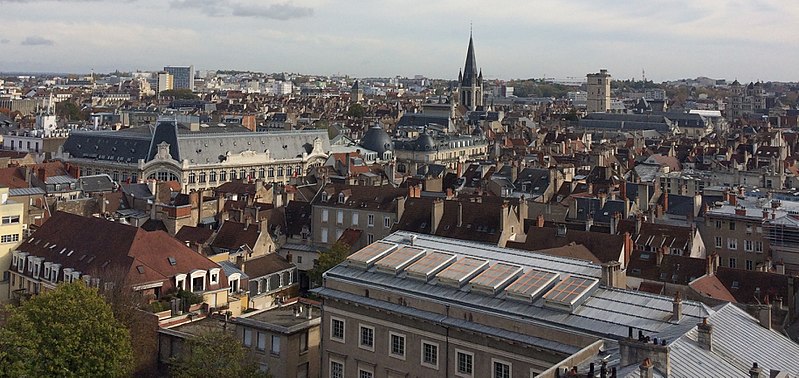
Dijon viewed from Saint-Bénigne Cathedral with the Palace of the States of Burgundy, the Notre-Dame and Saint-Michel churches, the Saint-Nicolas tower, the former Saint-Bénigne abbey palace (ENSA), The Lafayette galleries, the old department stores at Le Pauvre Diable and la Ménagère.
Photo by Twibo2 via Wikimedia Commons (caption translated by Google Translate).

Dijon, the capital of Burgundy, rarely attracts the world’s attention. There is Dijon mustard of course. There is Dijon blackcurrant liqueur (Cassis de Dijon). There are many beautiful, old Burgundian streets and buildings. But of all the medium to large cities in France, Dijon (population: 159,000) is surely the least talked about.

Then, abruptly, last weekend Dijon had the great misfortune to become newsworthy. War broke out, we were told, between “Chechen gangs” and “Arab gangs”. The dispute was, some French media reported, about the right to traffic drugs. The Daily Mail announced that the French army had been sent in to restore order. Marine Le Pen compared Dijon to Beirut. Similar “wars between migrant communities” now threatened, she said, all over France.

All these reports were, I believe, wrong or deeply misleading. What did happen in Dijon over four days the other weekend was surreal and disturbing. But the incidents defy simple explanation or political point-scoring. They say, perhaps, more about Chechnya, and the values — good and bad — of exiled Chechens, than they do about the wider racial issues of France. The severity of the violence probably owed something to the frustrations of France’s recent nine weeks of Covid lockdown. The political and media reaction was skewed by the fact that the events occurred while France was in the midst of a debate about race and policing – in the wake of the George Floyd killing in the United States.

On Sunday evening, on the third night of violence in Dijon, President Emmanuel Macron happened to be addressing the nation on TV. He said, among many other things, that he would resist all pressure to splinter France into ethnic communities.

So what had happened over four days in Dijon? There are several conflicting accounts. Here, briefly, are the facts that I have been able to establish.

On 9th June a 15-year-old (some say 16-year-old) boy of Chechen origin was badly beaten up outside a chicha (hookah) bar in central Dijon. His attackers were local men in their 30s of African and North African origin. According to the Chechen version of events, the men were drug-dealers. The injured boy apparently had no connection with drugs. The dealers attacked him because local Chechens were known to be hostile to drug-trafficking. They put a gun in the boy’s mouth and said: “We hate Chechens. We’re going to let you live so you can tell the other Chechens what’s going to happen to them.”

Three days later a convoy of cars arrived in Dijon packed with Chechen men from several other parts of France, as well as Belgium and Germany. Local media and police say that there were 100 of them; the Chechens say that there were only 15. They smashed up the chicha bar, assaulted its owner and then rampaged through the multi-racial Les Grésilles area of council estates just north-east of central Dijon.

June 9, 2020

How we are supposed to view the rioting protests in major US cities

Filed under: Media, Politics, USA — Tags: , , , , , — Nicholas @ 03:00

David Thompson shares the essential parts of a Vice article, telling us insufficiently woke dullards how to think about the ongoing civil unrest in many American cities after the death of a man at the hands (well, technically the knees) of Minneapolis police:

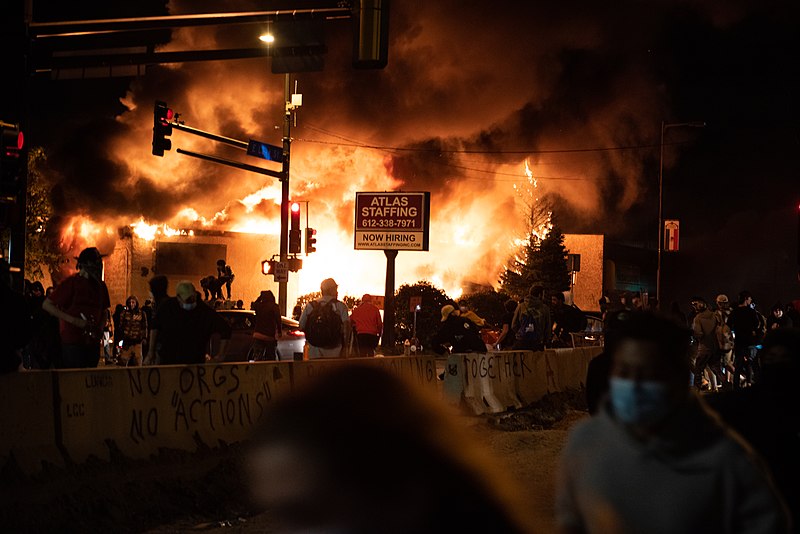
A building burning in Minneapolis following the death of George Floyd.
Photo by Hungryogrephotos via Wikipedia.

In the pages of Vice, a moral lecture, delivered from on high:

    How to Talk to Relatives Who Care More About Looting Than Black Lives.

As an exercise in question-begging and dense, self-satisfied presumption, it’s quite a thing, that headline. It’s very now.

Among those of us deemed insufficiently woke and therefore suspect, questions may arise. For instance, in what way will those “black lives” be improved by the destruction of local infrastructure, local businesses, and the subsequent, perhaps dramatic, reduction in trust and goodwill? And what if the stores and homes in question — the ones being smashed, stripped of their contents and set ablaze — are owned by people who happen to be black, as has often been the case? What if the places being looted and vandalised with abandon, indeed exultation, are depended on by people who also happen to be black, whether as customers or employees? Given the levels of material, social and economic destruction, should these people be content, indeed pleased, to be former employees? Unemployed people who now have no local grocer, or garage, or pharmacy?

Alas, such considerations appear to have eluded the keen mental processes of the article’s author, Ms Rachel Miller, a young woman who dutifully declares her pronouns and boasts of being a “Buzzfeed alum.”

    If you’re not Black but want to support BLM, having fraught conversations with your kinda (or definitely) racist loved ones will likely not be fun, but it’s a very worthy undertaking.

Right from the off we’re informed, firmly, that any perceptible reservations about looting and rioting, or reservations about the Black Lives Matter movement — say, regarding its demented far-left agenda, its racial tribalism, and the stated goal of abolishing capitalism, prisons and the police — must be taken as an indicator of being “kinda (or definitely) racist.” Wokeness is not, it seems, a recipe for cognitive subtlety. “Some people,” we’re told, “appear to be far more worried about the fate of a Nordstrom or Target store than that of the actual human lives of protesters.” Again, one might deduce that only those protesting with, shall we say, physical enthusiasm have “actual human lives,” unlike their victims, whose hopes and livelihoods can be gleefully destroyed as an act of righteous liberation. From local amenities.

June 2, 2020

Antifa

Filed under: Government, Law, Politics, USA — Tags: , , , , , — Nicholas @ 03:00

Arthur Chrenkoff welcomes the move to designate the Antifa movement as domestic terrorists:

“antifa 8973ag” by cantfightthetendies is licensed under CC BY 2.0

President Trump’s decision to designate Antifa as a terrorist organisation is long overdue.

Whether you call them a terrorist organisation or a criminal organisation – or both – the underlying facts are the same: Antifa is a network of groups committed to a violent revolution to overthrow the democratic system of government and replace it with some sort of a communist “dictatorship of proletariat”, whoever the current proletariat is supposed to be (which does not in the end matter very much, because it’s all about the party organisation rather than “the masses”). To effect such revolution, Antifa uses tactics of violence against people it considers enemies as well as destruction of property. Remember, these people are not Scandinavian social democrats or even Bernie and AOC-style “democratic socialists” who advocate and follow a democratic and peaceful path of transformation to achieve their objectives of building what they consider a better and more just society. Antifa are thugs who desire to tear down and destroy the current political and economic order and erect their utopia on its ashes. They want to abolish democracy, capitalism, liberalism and all the other existing institutions in favour of a Marxist-Leninist state — or just for the fun of it if they are more of an anarchist rather than communist frame of mind. Groups whose the entire modus operandi is based on breaking law and criminal activity have no legitimate place in a democratic society. Antifa are the political organised crime.

The label Antifa has been used and abused too long to muddy the waters and confuse people — many of whom, granted, want to be confused. Because fascism is objectively bad (and considers so by an overwhelming majority of people), calling themselves “anti-fascist”, Antifa seeks to claim the moral high ground and the role of the good guys who stand up to white supremacists, neo-Nazis and other extreme element. But you cannot simply judge people by who their enemies are, or who they say their enemies are — you also have to judge them by their intentions, actions and aims. In the Second World War, the United States and the United Kingdom and their Western allies were anti-fascist, but so was the Soviet Union. Stalin hated fascists (except for a period of two years in 1939-41 when he collaborated with them). This did not make him a good guy, even if for the Allies at the time it made him the lesser of the two evils. Coincidentally, for Stalin the label “fascist” was a very broad one, applying not just to German Nazis and their sympathisers but to anyone opposed to communism and the Soviet Union and so in turn opposed by them, including at times even social democrats and other non-revolutionary socialists {“social fascists” in the Stalinist nomenclature). And so it is for Antifa — we are all fascists, from the few skinheads at the political fringes to all the mainstream parties and ideologies of both the right and the left. Just as in Russia in 1917 onward and all the other communist countries in history, your position on the democratic political spectrum can never give you an ultimate immunity, it only determines the order in which you will be shot (left-wingers and anarchists last, because they can be used the longest by the forces of revolution).

June 1, 2020

QotD: The right to keep and bear arms

Filed under: Law, Liberty, Quotations, USA — Tags: , , , , — Nicholas @ 01:00

The bureaucrat who commands an army of over forty-nine thousand armed men and women (the largest police force in the world, slightly more than three Army divisions) in its century-old struggle against the Bill of Rights, has loftily decreed on 60 Minutes, the famous CBS newsish show, that it is “insanity” to “allow” national concealed carry reciprocity for law-abiding citizens. This according to an article that appeared this week on the Breitbart website, written by their distinguished Second Amendment specialist, A.W.R. Hawkins.

The bureaucrat in question is New York Police Department Commissioner James O’Neill, an individual who clearly believes that his thirty-five years spent plodding unspectacularly up the NYPD chain of command equips him better to tell you what your rights are, and what they are not, than the Founding Fathers of this country and the Framers of its unique social contract.

Well I’ve got news for you, Jimmy, there is no “allow”.

“Every man, woman, and responsible child has an unalienable individual, civil, Constitutional, and human right to obtain, own, and carry, openly or concealed, any weapon — rifle, shotgun, handgun, machine-gun, anything — any time, any place, without asking anyone’s permission.”* That’s the essential freight of the Second Amendment to the United States Constitution, the highest law of the land, which you and yours have been illegally suppressing since passage of the 1911 Sullivan Act, named for Tammany Hall’s Timothy Sullivan, perhaps the most corrupt, bigoted politician ever to occupy office in New York.

Since the ability to own and carry weapons unmolested by the State is a fundamental right, there can be no thought of any unit of that state “allowing” it or not “allowing” it. Any government employee who attempts to interfere with that right deserves a long stay in prison among those whose rights he’s violated. Note that I am not saying that peace and civil order are a bad thing, just that it has to be achieved within Constitutional parameters. The Founders put them there for a reason; they had seen the rule of law abused too often by arrogant and brutish British authorities.

* “The Atlanta Declaration”, L. Neil Smith, 1987

L Neil Smith, “There Is No ‘Allow’, Jimmy”, Libertarian Enterprise, 2018-02-18.

May 31, 2020

On “spontaneous” riots

Filed under: Law, Media, Politics, USA — Tags: , , , , — Nicholas @ 03:00

David Warren had a brush with a riot as a youngster — not as a participant, but as a near-victim — so the psychology of riots has a personal edge:

To a trained observer, the organizers of the riot stand out. They are dressed distinctly, they are giving orders; they are directing the attacks. They will usually be wearing expensive communications equipment. A drama coach would notice that their harangues are premeditated and rehearsed, to stir violence. That anger in the crowd was available to them, as their raw material, goes without saying; their art consists of “weaponizing” it.

Fascists — the real ones, in pre-war Italy and Germany — were masters of this art. So were the Communists with whom they had streetfights. The blackshirts today, a near-monopoly of the Left, descend from this rich tradition. When Antifa and other leftist scum shut down public discussions in universities and elsewhere, they may use the latest technology, but to old-fashioned ends.

What is alarming is not that these people exist — radical evil is a fact in human nature — but that they are given permission to act lawlessly. Rather than arrest and prosecute them, the liberal authorities agree to silence the legitimate speaker. They are trying to avoid confrontation, with people who sought confrontation, and will seek a larger confrontation next time. The prestige of these devils in human flesh is increased by their victories.

An injustice, such as the apparent murder of George Flynn by a vicious cop, while three more stood and watched, was the pretext for the riots. It was convenient for aggravating racial tensions, by which the Democrat party hopes to retrieve black votes that had been getting away from them. I would not wish to omit this dimension of the permission they grant to rioters. Politics are a cynical business.

But note, the mostly white folk in Antifa, prefer black neighbourhoods to start race riots, for that is where resentments will be easiest to exploit. (Masks help to conceal their whiteness.) This means that the victims of the riots, whose property and businesses are gutted, will also be mostly black. The media elide this aspect of the lawlessness, because they want Republicans to be defeated, too.

The moral stench is overpowering.

May 23, 2020

“If you want to advance your cause, make friends with the Ontario Mohawks. They pretty much run the country.”

Filed under: Cancon, Government, Railways — Tags: , , , , — Nicholas @ 03:00

Chris Selley on the utter, abject defeat of the Canadian and British Columbian governments in their “negotiations” with the hereditary leadership of the Wet’suwet’en:

“Vancouver Solidarity with Wet’suwet’en” by jencastrotakespictures is licensed under CC BY-NC-SA 2.0

“We’re not understanding what is the rush here,” elected chief Maureen Luggi told CBC — a sentiment Naziel echoed. “We sat here for 30 years already, waiting and talking about it,” Naziel said. “We can wait another year or two. It’s not going to hurt anything.”

Indeed, from the average Wet’suwet’en member’s point of view, there is no hurry at all. The logical thing would be to fix the governance structure, heal the wounds that need healing, and then undertake these monumental negotiations.

But for the governments involved, this wasn’t about offering the Wet’suwet’en a better future. It was about putting out a fire: A group of Mohawks thousands of kilometres away in eastern Ontario had blockaded CN’s main line in solidarity with the hereditary chiefs; and the Ontario Provincial Police, armed with an injunction demanding the blockade end, refused to lift a finger.

Something had to give. Somebody had to get screwed, and it was the rank-and-file Wet’suwet’en. For no good reason whatsoever, the hereditary chiefs now hold all the keys to their future. It’s an appalling and appallingly predictable result.

“I don’t see why the government gave them this, because this has got nothing to do with what the protests across Canada started from,” chief Dan George of Ts’il Kaz Koh First Nation told CBC. “Those issues are not resolved. They can set up roadblocks again and do it again, and that’s what I’m worried about.”

If negotiations don’t go well, that might well prove to be a prescient remark. But for now, the hereditary chiefs’ victory is total: They have every reason to stay the course. The message to other groups, however, is clear: If you want to advance your cause, make friends with the Ontario Mohawks. They pretty much run the country.

Screencap from a TV report on Mohawk Warriors attempting to set a freight car on fire along the Canadian National mainline through Tyendinaga near Belleville, Ontario in February, 2020.

May 16, 2020

Remy: “Surfin’ USA” (Beach Boys Lockdown Parody)

Filed under: Government, Health, Humour, Law, Liberty, USA — Tags: , , , , , , — Nicholas @ 04:00

ReasonTV
Published 15 May 2020

Remy discovers the dangers of exercising alone.

Written and performed by Remy. Music tracks, mastering, and background vocals by Ben Karlstrom. Video produced by Meredith and Austin Bragg.

LYRICS:
If you go out on the ocean
Across the USA
And you’re wearing a swim shirt
‘Cuz of your scrawny weight (it’s for the sun, I swear)

Well, uh, you just might notice
The police in your wake
Cuz it’s illegal to be surfing
In the USA

They’re catching them out paddle boarding
Letting their children play
While they’re releasing this guy
A logical checkmate

You’re out in nature alone now
No one in six-foot range?
Well it’s illegal to be surfing
In the USA

If only you had flashed some children
It’d be your release date!
But you’re going to jail for surfing
In the USA

You’ve been distancing for months now
To keep the spread rate down
The only places you’ve been going
Are where there are no crowds

You’re making sacrifices
For your community
Now put your hands on your head because you are surfing
In the USA

He’s helping the flattening the curve now
He’s exercising alone
Rocking a super baggy swim shirt
To hide his muscle tone (I said it’s for the sun)

If only you had flashed some children
It’d be your release date!
But you’re going to jail for surfing
In the USA

The Wuhan Coronavirus, the excuse for an emergency without end

Mark Steyn on the seven-hundred-and-fifty-third day of our captivity:

Emergency without end is the staple of almost every futuristic dystopia — and that’s true for real life, too. So Americans shuffle shoeless through the airports for twenty years while their governments negotiate with the very organization that enabled those attacks — the Taliban — to restore them to power. Is a culture that cannot see off goatherds with fertilizer really going to rouse itself to decouple from a global superpower that supplies everything from its crappy “These Colors Don’t Run” T-shirts to its surgical masks and pharmacy medications?

~For my own part, I have been reading ancient accounts from Occupied France and Vichy for tips on finding workarounds for restraints on the citizenry. As wily and innovative as the French Resistance were, I wonder if their efforts would even be possible in an age when cheap Chinese-made drones can hover unseen and monitor every conversation.

[…]

Even without governors terrorizing those tavern-keepers or hairdressers who defy them, the lockdown has exaggerated the contradictions: The state wants open borders for “migrants” but a security perimeter around the homes of its citizens. Maybe the absurdities become so obvious that there is widespread rejection of them. Or maybe, one by one, the poor put-upon over-surveilled citizenry take a cue from their undocumented non-brethren. Perhaps I should just mug an illegal immigrant and steal his fake ID…

~The emergency is already feeling permanent. It starts with the social norms: Dr Fauci tells us the handshake is gone for good. That’s not a small loss. I don’t care for the suggested replacements, like the lame-o hand-on-heart gesture. I bow from the neck to the Queen — and just last year I did so to her Canadian vicereine, Mme Payette. Her Excellency then stepped forward and gave me a hug. But I don’t suppose she’s doing that anymore…

People ask me why I haven’t been on TV lately. Well, I mainly like going on TV to behave like a person who’s on TV. So, if you notice, on the “Fox & Friends” live-audience shows, I come bounding in like Tigger and do a lot of gladhanding with those on the aisle (including the odd hug), and then I give Steve and Brian manly handshakes and do a little light kissy-kissy with Ainsley. And all that — the basic language of telly for seventy years — is gone, apparently forever.

[…]

The WHO, the Beijing public relations firm whose pronouncements the BBC, The New York Times et al insist on taking as gospel, now says Covid-19 is here to stay — like HIV. With HIV, it wasn’t that difficult to avoid catching it, because it required the exchange of bodily fluids, which is a fairly intense and specific degree of intimacy. With Covid, we are rolling a protective condom down over every routine social intercourse.

A contributor at the Continental Telegraph explains why he no longer supports the lockdown:

First, it turns out that the drastic steps we were taking were based on one model. That no one outside the team using it was allowed to review. We were even told that we couldn’t check the coding because it was so old & patched together that it’s too hard to follow. That’s like saying you can’t check the brakes because you won’t be able to see all the duct tape and Velcro we’re using. Further, we’re told that this software doesn’t provide the same results from one run to the next.

Next, I heard about Dr. Ferguson’s history of wildly overestimating the fatalities from mad cow disease and bird flu (50k compared to <200, 200 million versus <500 respectively). Also, the CDC’s estimate of Ebola deaths in Sierra Leone (1.4 million compared to 8k). And let’s not forget the U.S. Public Health Service’s overshoot on the number of AIDS infections in 1993 (450k versus 17k). At this point I gave more thought to the issue of modeling – prior to retiring I was an actuary and modeling was what I did for a living. A few points about how modeling works: The more complex a system is, the more difficult it is to build a good model. And, more importantly, the more difficult it becomes to test your model and confirm that it accurately mirrors the real world. And this looks like one of the most complex systems to model I’ve ever heard of. How can you test this against reality? I don’t think you can. You can run simulations and confirm it looks like you expected, but that doesn’t mean the virus behaves like your model. Another point about modeling is that the results are extremely dependent on the assumptions you’re using. And in this case two critical assumptions are how infectious the virus is and how lethal it is. We still have a poor understanding of these variables months after we started Lockdown. Then a lot of us noticed that the goal shifted from “flattening the curve” to avoid a catastrophic overflow at hospitals to Lockdown until “fill in the blank” (in some states a vaccine, in others no deaths for 14 days, etc.). And the lockdown rules are inconsistent and illogical – in Michigan you can’t buy plant seeds but you can buy lottery tickets. To add insult to injury, many of the people with their foot on our necks violate the rules (the mayors of Chicago and New York, Dr. Ferguson, etc.). I’m stunned and angry at how little attention the human costs of the Lockdown receive. We know that this will lead to increased suicides, homicides and drug overdoses. Let’s not forget more child abuse, domestic violence, depression, drug and alcohol abuse, the list of miseries goes on a very, very long way (I may write up an article just on this, the Lockdown harpies should have to admit to all the harm they’re so enthusiastically spreading).

« Newer PostsOlder Posts »

Powered by WordPress