Getting up on the curmudgeonly side of the bed, Patrick Reusse explains why he does not understand the modern Viking fan with an optimistic viewpoint:
The age for sincere emotional involvement with a sports team is 12. Anyone whining over the result of a game before that is a crybaby destined to grow up with few friends.
Which means, if you were 12 on Jan. 11, 1970, the last cheery moment you had about the eventual fate of the Vikings came before that afternoon’s kickoff of the fourth-ever Super Bowl.
Minnesotans as a whole were never more certain of anything than that the Vikings’ magnificent defense would stifle the Kansas City Chiefs and provide a pro football championship in only the third season of Bud Grant’s coaching tenure.
The final was Kansas City 23, Vikings 7. A couple of months later, NFL Films released a highlight tape from the game, complete with Chiefs coach Hank Stram cackling and ridiculing the Vikings throughout his team’s decisive upset.
It was a wound that never healed for Vikings fans that were at least 12 that day, and are now 54, older, or dead.
Comments Off on Patrick Reusse: Stop being optimistic, Vikings fans
In what must be the worst kind of news for Minnesota Vikings fans, star running back Adrian Peterson was arrested early Saturday morning for … resisting arrest. ProFootballTalk has the report:
A source with knowledge of the situation tells PFT that the incident culminating in Peterson’s arrest was captured by one or more surveillance cameras. Multiple persons also witnessed the event.
According to the source, Peterson, his girlfriend, and some family members were at a nightclub in Houston. At closing time, a group of police officers entered the club, and they began instructing the remaining patrons to leave.
Peterson wanted to get some water before he left, but an officer told Peterson that he needed to leave. Some words apparently were exchanged, but Peterson eventually walked to the exit with one of the club’s bouncers.
It’s believed that one of the officers then jumped on Peterson’s back from behind and tried to take him down. (Key word: “tried.”) Other officers then joined the fray and completed the arrest.
Peterson was charged with resisting arrest, which implies he was being arrested for something else. He is charged for now with no other crime.
I was under the vague impression that to be charged with “resisting arrest” you’d have to already be wanted by the police for doing something that warranted arrest. Based on the initial reports, it doesn’t sound like Peterson did anything before he was arrested to justify arresting him … unless it’s a case of a police officer deciding that he’d been disrespected. We’ll have to wait until more of the information becomes available.
Update: Contrasting with the initial report, Dan Zinski of The Viking Age says Peterson was “heavily intoxicated” at the time:
More on Adrian’s incident, and this isn’t flattering. The general manager of the club where Adrian Peterson was arrested after allegedly pushing an off-duty cop has told website TMZ that the running back was “heavily intoxicated” at the time of the incident. A police report says Peterson became belligerent after he and his companions were told the leave the bar, and ended up being subdued by three officers.
Live at Bayou Place general manager Daniel Maher says Peterson tried to order one last drink after being told to leave, and after being denied, tried to intimidate the bartender into giving him the drink anyway. It was at this point that Maher himself intervened, but Peterson refused to listen to him. The off-duty cop then broke in and was shoved by Peterson, leading to the Viking being hauled in for a misdemeanor A count of resisting arrest.
Update the second: At Viking Update, John Holler provides a bit of background (which may or may not be relevant to this particular case, but is interesting anyway):
The interesting aspect of the Peterson incident is that the only charge he was hit with was resisting arrest. He wasn’t charged with assaulting an officer. Had he actually shoved a policeman to the point that he “stumbled,” it would seem logical that charges of assaulting of an officer would also have been leveled. Therein lies the need to hear both sides of the story.
I come from a different perspective than most on this type of subject. I have been involved with “bouncer dust-ups” on the wrong side. Yet, three of my best friends are or were cops. I could accurately be accused of being “cop-friendly.” Of the numbers saved in my phone, a half-dozen of them are cops. When they’re “moonlighting,” it’s a night off for them. The odds of them getting shot as the result of a meth-addled domestic abuse call are out of the question. In those situations, they are truly “in charge.” And they like it that way.
When a bouncer (cop or otherwise) is working “his turf,” he can be aggressive. Very aggressive. As tenuous as life is in the NFL, the reality is that “hired muscle” at a nightclub can’t lose if he gets in a dust-up with a drunken patron. Whether an off-duty policeman, a local college football player or just a big guy who casts an imposing shadow, “security” at a big-time nightclub is expected to quell all problems — exceptions not allowed.
In order to do so, off-duty cops (trust me when I tell you that they’re never truly off-duty) aren’t going to take any guff from anyone. They have the experience. They have the sobriety advantage.
If the Peterson matter actually goes to court — the smart money would say that only a hard-core prosecutor would push the case — it will be destroyed by competent legal representation on Peterson’s behalf.
Comments Off on Apparently in Texas you can be arrested merely for “resisting arrest”
It’s never a good thing when one of your best young players starts dropping hints to the local media that he’s unhappy about his contract, or his role on the team, or some other unspecified issue. Percy Harvin is the unhappy player right now, and John Holler does the introductions:
If an old-timey big microphone was going to drop from the rafters down for a bald, silky monotone-voiced guy to make the fight introductions between Percy Harvin and the Vikings, it might go something like this:
“In this corner, weighing in at 185 pounds. He hails from Virginia Beach, Virginia. He is 24 years of age. If his four years in the NFL, he has re- written the Minnesota record books like a modern day Paul Bunyan. One of the most explosive playmakers in franchise history-y-y-y, he is the Threat Who’s Owed A Debt, The Grenade Who’s Underpaid. Ladies and gentlemen, put your hands together for Percyy-y-y-y Har-r-r-r-r-vin!”
Michael Buffer, eat your heart out. As the applause subsides, the other introduction is made.
“In this corner, weighing in at significantly more. They have been part of the NFL wars for more than half-century. In 1970, they won the NFL championship of the wor-r-r-r-ld. They have three more NFC title belts to their credit. They have sent 10 of their representatives to the prestigious Pro Football Hall of Fame. Over the last eight years, they have paid more than $1 bil-l-l-l-l-l-l-lion dollars to players. They are the Scandinavian Scourge, The Tower of Power, The House That Wilf Built. Put your hands together for the Minneso-o-o-o-ta-a-a-a Vi-i-i-i-i-i-kings!”
The introductions have been made, thanks in part to Harvin “calling out” the organization. His announcement of unhappiness came out of nowhere. It was planned. It was effective. Now the question is whether Harvin is ready to go the extra mile to make his point
Rick Spielman, general manager of the Vikings, has said he has no intention of trading Harvin, but Harvin doesn’t want to attend training camp unless his (unspecified) issues are dealt with.
Harvin is a great player, and I don’t want to see him either leave the team or hold out, but given the Vikings’ history he wouldn’t be offered a contract extension until late this year and the team probably doesn’t want to create a precedent even for someone as important to the team’s fortunes as Harvin.
Update, 22 June: Harvin is apparently surprised at the concern:
I know it’s still very much the off-season, but I thought this analysis of last season’s week 6 game between the Vikings and the Chicago Bears was very interesting. It starts off with the end of the Donovan McNabb experiment:
We all suspected that McNabb was done after he flatlined in Washington with the Redskins, but how little he had left in the tank was, frankly, shocking. By this time it was like watching an extraordinarily slow train wreck.
In the first five games, he averaged 169 yards a game. In his first game he threw for 39 yards. I actually had to go back and double check the stats on that game to make sure I had that right.
[. . .]
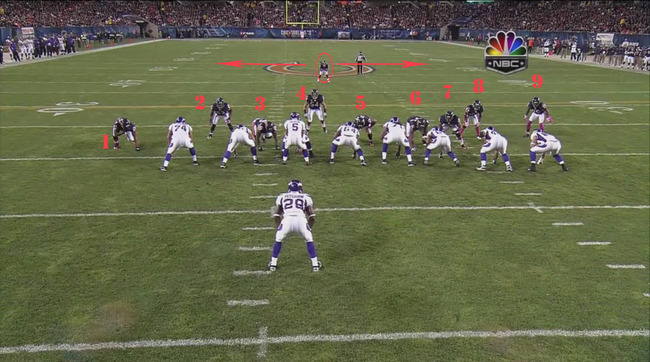
Even early on, McNabb was inconsistent and off. The Bears came in with absolutely zero respect for him, choosing instead to focus on shutting down Adrian Peterson.
The Bears’ Defense stacks the line vs an obvious run, with one safety deep just in case (footage courtesy NBC)
You can see in the attached screen caps that safety Major Wright isn’t even pretending to back into coverage — very clearly he’s coming for Peterson.
Eventually, after three quarters of futility, McNabb is pulled from the game and rookie Christian Ponder is sent in to replace him:
So you’re a rookie, being thrown into the fire against one of the better defenses in the league (and playing like it for once) with minimal snaps because you were a backup.
Christian Ponder, welcome to the NFL.
In one quarter, Ponder amassed more than half the yards McNabb threw for in three.
[. . .]
This allowed Ponder to do one thing McNabb was definitely not capable of anymore — scramble. Ponder broke off several good runs, one a bootleg and one a collapsed pocket.
Then he started completing passes and the defense started backing off the run and stacking the line. They fell into more of a basic base set, dropping players into coverage and rushing four or five guys most of the time.
Unlike McNabb, Ponder was able to find some open seams and complete some passes.
While people hack on Ponder for some of his accuracy issues, he actually did a fair job on short notice, of getting the ball where it needed to be for his receivers.
While it’s become cliché, the Vikings are tied to Ponder’s development for the 2012 season and beyond. Now that they’ve drafted Matt Kalil as their left tackle for the next ten years, and restaffed the receiving corps, they have to hope that Ponder will continue to improve from the brief flashes he was able to show in the catastrophe that was the Vikings’ 2011 season.
Comments Off on Looking back at the start of the Christian Ponder era
Years ago, long before Google came to the salvation of lazy football writers who couldn’t be bothered with microfiche searches, the term ‘unsupport’ was coined in the football magazine, When Saturday Comes.
It meant, as the name suggests, the exact opposite of supporting a team. You wished defeat on another team, hated that team with a passion. So, for example, in the last day of the Premiership season, many neutrals wanted Manchester City to win the title. This was not through any great love for the oil-rich upstarts in blue, but because they were unsupporting Manchester United. In the Premiership era, Manchester United are simultaneously the best supported and, at the same time, the most unsupported club in the land. Unsupporting is the football equivalent of Newton’s third law of motion: all the time United are successful, hatred of the side occurs as an equal and opposite reaction.
You can tell a lot about people by the team they hate. Take Manchester United unsupporters. They assume two forms. In the blue half of Manchester or on Merseyside, the Anyone But United (ABU) sentiment is an expression of bitter local rivalry. But throughout the rest of the country, ABU represents an increasing disenchantment with modern football. Manchester United is essentially a proxy for the gentrification and commercialisation of the game. When fans sing ‘Stand up if you hate Man U’, it’s not simply green-eyed envy of United’s success, it’s also a howl of protest against the corporate takeover of football. United embodies everything the traditionalists hate about the Premier League: the hype, the desecration of 3pm kick-offs, the relentless merchandising, the prawn-sandwich munching ‘plastic fans’, and the absentee foreign owners
The constant appearance of Manchester United and Chelsea at or near the top of the English Premier League have always seemed to me to be a good argument in favour of a salary cap in the NFL style: otherwise richer clubs will always be able to buy their way to a higher season finish than poorer teams.
On the other hand, the NFL could learn from the EPL with their promotion/relegation system (I say that in full knowledge that my beloved Vikings would have been relegated after the 2011 season if such a scheme was implemented). Of course, structurally the NFL and EPL have many differences preventing the adoption of the other sport’s practices, but as (I think) Gregg Easterbrook pointed out, Ohio State … sorry, The Ohio State University’s football team could have beaten both of Ohio’s professional teams for much of the last decade.
Comments Off on Unsupport your unfavourite Premier League team
After much politicking, the Minnesota Vikings finally got the state to provide some funding toward a new football stadium. While I’m pleased that the team will stay in Minnesota, I’m always against governments using tax money to subsidize private organizations like professional football teams (see this post from last month, for example).
Long drawn-out political drama like the (literally) decade-long campaign for a new stadium can bring out the very worst in politicians, as Christian Peterson reports:
My first observation is that, apparently, being well-educated about an issue is not a prerequisite for being elected and, ultimately, casting a legislative vote. That may be harsh, but I was struck by the sheer idiocy of many of the arguments, both for and against, the proposed stadium. I understand that much of the posturing and the bringing forth of ludicrous proposed amendments is a political tactic employed by legislators on both sides of the issue, but some of it most certainly isn’t. It’s both frightening and shocking to see how ill-informed some of the legislators were on the issue at hand.
For example, here are just a few of the absurdities that occurred during the initial debates in the House and Senate on Tuesday and Wednesday:
One congresswoman stood up and declared her desire to add an amendment that would require that every Vikings game be carried on television for free for every citizen of Minnesota. The NFL’s blackout rules and the television networks be damned, by law we were going to force every game to be on free T.V. for everyone! During her argument, she made vague reference to “rumors” about the NFL starting their own network. Hate to break it to you, ma’am, but the NFL Network debuted in 2003.
A legislator made reference to “Zygi Wolf.”
Another railed against the expansion of gambling one minute, only to subsequently propose an amendment that would have created an online lottery.
There was an attempt to make the Vikings a publicly-owned entity, like the Green Bay Packers. NFL rules no longer permit public ownership of their franchises – it’s been disallowed since the 1980s.
Late on Wednesday night, a legislator stood up and confused the investment banking firm Goldman Sachs with Saks 5th Avenue.
Within a span of a few hours, the Senate added a requirement for a Minneapolis referendum to approve the stadium plan, only to revoke it, then they passed an amendment that would have dramatically increased the amount of user fees in the bill, only to have the same amendment voted down on a re-vote only moments after it had been approved.
One of the main proponents of the bill held up a sign saying “Help!” as one of his colleagues proposed yet another hare-brained amendment. In a refreshingly candid revelation, a representative stood up late in the House debates on Tuesday and said, “People are watching, and see how stupid we look.” Amen, brother.
And that’s just a tiny fraction of the shenanigans that occurred during the combined 20-plus hours of debate on the stadium bill in both houses of the Minnesota legislature. Eventually, it got to the point where it wouldn’t have been a surprise if someone had raised an amendment proposing that the Vikings be allowed to play with 15 players on the field, or another forcing the Packers to trade Aaron Rodgers to the Vikings. Many of these legislators evidently believe they can do just about anything they want.
To be fair, there were more than a few very intelligent and well-spoken people arguing on both sides of the debate. But generally speaking, it’s nothing short of astonishing that these are the people who are making decisions on not only the stadium, but on far more important issues. I can only hope that they are less ignorant when it comes to things like health care and education.
Comments Off on Vikings get public support for a new stadium
This Wall Street Journal piece by Buzz Bissinger is guaranteed to stir up controversy:
In more than 20 years I’ve spent studying the issue, I have yet to hear a convincing argument that college football has anything do with what is presumably the primary purpose of higher education: academics.
That’s because college football has no academic purpose. Which is why it needs to be banned. A radical solution, yes. But necessary in today’s times.
[. . .]
Who truly benefits from college football? Alumni who absurdly judge the quality of their alma mater based on the quality of the football team. Coaches such as Nick Saban of the University of Alabama and Bob Stoops of the University of Oklahoma who make obscene millions. The players themselves don’t benefit, exploited by a system in which they don’t receive a dime of compensation. The average student doesn’t benefit, particularly when football programs remain sacrosanct while tuition costs show no signs of abating as many governors are slashing budgets to the bone.
If the vast majority of major college football programs made money, the argument to ban football might be a more precarious one. But too many of them don’t—to the detriment of academic budgets at all too many schools. According to the NCAA, 43% of the 120 schools in the Football Bowl Subdivision lost money on their programs.
The other big beneficiaries of the college football system is, of course, the NFL. Unlike baseball or NHL teams, it doesn’t have to maintain a “farm team” league or leagues to provide training and play opportunities for would-be professional football players. This burden, instead, is carried by the taxpayer as part of their share of higher education.
Jim Souhan’s column in the Minneapolis Star Tribune shows the risks players are taking may be greater than they expect:
The problems faced by today’s NFL makes the notion of ballplayers inflating their muscles in an attempt to hit baseballs far almost charming.
Authorities said Seau apparently took his own life with a shot to the chest. Former Bear Dave Duerson also killed himself with a shot to his chest, and left a note asking that his brain be studied to increase awareness of how head injuries affect football players. Duerson believed hits to his head left him mentally impaired.
The NFL never has been more popular, or more endangered. Every year what was once suspected moves closer to universally accepted fact: Human beings shouldn’t play tackle football, at least at the level of violence required by professional coaches.
Malicious hits have become such an important part of the NFL that players, for the Saints and other teams, have defended the bounty system as nothing more than a bureaucratic form of violence as usual. Every NFL defender knows he should knock opponents out of the game, or just out; the Saints were the rare team arrogant enough to systemize their goals.
If Seau indeed committed suicide, and if he indeed shot himself in the chest so his brain could be studied, we will have another reminder of the NFL’s punitive laws of physics: Current NFL players are so explosive that allowing them to smash into each other at will is criminal.
Gregg Easterbrook’s annual post-draft column spends a bit of time excoriating the NCAA for its massively misplaced ethical priorities:
The draft had been in progress more than a day when the Sinners finally chose, having traded their first choice and lost their second in Sinnersgate. New Orleans’s first selection was Akiem Hicks, who played eight-game seasons at the University of Regina in Saskatchewan, going there after the NCAA blackballed him for recruiting violations. Nakia Hogan of the New Orleans Times-Picayune describes the deeply shocking abuses of which Hicks was guilty:
“In 2009, Hicks transferred to LSU from Sacramento City Community College. … But Hicks was mired in a minor recruiting violation and never got to play at LSU. The school discovered potential violations associated with impermissible telephone calls to Hicks in the recruitment process, impermissible transportation before and after his arrival at LSU, impermissible housing and reduced-rent at an apartment complex in Baton Rouge in the three months before his enrollment at LSU, and the purchase of one meal by a football office student worker.”
Impermissible telephone calls! Three months of help with rent money! One free meal! Lock him up and throw away the key!
The description of Hicks’ blackballing sums up everything offensive about NCAA hypocrisy. Not only is it theater of the absurd that the NCAA punishes telephone calls. Not only do college kids always need help with the rent — if a kid from an upper-class family who was applying to LSU got trust fund money for his rent and meals, no one would blink. The real scandal is that the NCAA punishes phone calls but could not care less about graduation rates.
In the year Hicks tried to enter LSU, the federal graduation rate for the LSU football program was 42 percent, compared to 56 percent for the school as a whole. (Find any Division I sport program’s graduation statistics here.) The NCAA took no action on that.
College football players are creating hundreds of millions of dollars of value that goes to fund luxury living by coaches, college administrators and NCAA staff, but are not getting educations in return. Each passing day brings more evidence of the Taylor Branch “new plantation” analysis of big-college sports. As big-college coaches and NCAA administrators dine at four-star restaurants, one hungry kid gets one free meal — that must be punished! The horror, the horror!
Comments Off on The real NCAA scandal is how they treat the student athletes
As I always have said, I don’t follow college football in the slightest, so I can’t make any pontifications about the specific players chosen in the draft. I depend on folks like Jim Souhan of the Minneapolis Star Tribune to keep me up to date on who got drafted and why:
This was Spielman’s first draft as the Vikings’ unquestioned personnel boss, and we can divide it into two phases:
He seemed to do well with his first four picks.
He, like everybody else who does his job, was playing Lotto after that.
Spielman landed the best offensive lineman in the draft (Kalil) after trading down a spot to pick up three extra draft choices. He traded into the first round to land the second-best safety in the draft in Notre Dame’s Harrison Smith, who by default instantly became the Vikings’ best safety since Darren Sharper arrived in 2005.
He took speedy cornerback Josh Robinson in the third round, and flashy-if-small Arkansas receiver Julius Wright with his first fourth-round pick.
So with his first four choices, Spielman appeared to draft for both quality and need. After that, he was either displaying a keen appreciation for hidden talent, or he was throwing bent darts at a moving bull’s-eye.
As I said after the first day’s selections, Spielman made the right decisions as far as covering the positions at which the Vikings were glaringly poor last season. After that, though, my guesses weren’t as close as I’d thought they’d be. My thoughts were that a tall, speedy wide receiver was the next most urgent requirement, and they did select a receiver, but Julius Wright seems more like another Percy Harvin — not that there’d be anything wrong with cloning Harvin, but slot receiver was not a notable requirement.
I’d mentioned drafting another running back for depth would be a sensible move, and with the news today that Caleb King has been arrested on an assault charge, that need was probably greater than I’d thought. With Adrian Peterson still rehabbing from his ACL injury in December, Toby Gerhart will need someone behind him for change-of-pace and the odd breathing spell.
1. (4) Matt Kalil, LT, Southern California
1. (29) Harrison Smith, S, Notre Dame
3. (66) Josh Robinson, CB, Central Florida
4. (118) Jarius Wright, WR, Arkansas
4. (128) Rhett Ellison, TE, Southern California
4. (134) Greg Childs, WR, Arkansas
5. (139) Robert Blanton Jr., CB, Notre Dame
6. (175) Blair Walsh, K, Georgia
7. (210) Audie Cole, LB, North Carolina State
7. (219) Trevor Guyton, DE, California
Once the draft was over, the team signed 15 undrafted free agents. The first time all the rookies will be on the training field together will be this coming Friday at the Vikings’ rookie mini-camp.
Here are two exhausted ESPN 1500 guys, Tom Pelissero and Judd Zulgad, discussing the Vikings’ draft picks on the last day:
Comments Off on Wrapping up the Vikings’ draft selections
This was a bit of a surprise, as the Vikings had signed a couple of free agent corners in the last few weeks before the draft: all the media folks were expecting the Vikings to select a wide receiver today. Instead, they added Josh Robinson of Central Florida as their only pick of the day (#66 overall):
Vikings General Manager Rick Spielman expressed about a dozen reasons why he picked Central Florida cornerback Josh Robinson with the Vikings lone pick on Day 2 of the NFL draft. But two words probably sum it up best:
“He’s fast,” Spielman said of the team’s third-round pick and the draft’s 66th overall selection.
Make that really fast.
Officially, Robinson ran the fastest 40-yard dash at the scouting combine in February. The listed time was 4.33, but some scouts reportedly clocked the 5-10, 199-pounder at 4.29.
So, coming up on the third day of the NFL draft for 2012, the Vikings have a top-notch offensive tackle, a potential starting safety, and another cornerback. With their remaining nine picks, the team has to address several positions: wide receiver (probably the most urgent need), middle linebacker, defensive line, and another running back (for change-of-pace and 3rd down situations).
Comments Off on Vikings select cornerback Josh Robinson in 2nd day of NFL draft
As I mention every year, I don’t follow college football, so the draft is something I don’t have particularly strong opinions on — I have opinions on which positions the Vikings should be drafting, but not on the specific players who could fill those roles. I depend on the sports writers at the Star Tribune, the Pioneer Press, and 1500 ESPN to do the legwork for me, and the Vikings fan bloggers, like the Daily Norsemen to opinionate.
The Vikings came into the first round of the NFL 2012 draft with ten picks over the three day draft. At the end of the evening, having selected the top prospect at left guard tackle and a safety, they still have ten picks in the subsequent rounds. New boss Rick Spielman got great value from trading the #3 pick to Cleveland for the #4 pick plus extra picks in the 4th, 5th, and 7th rounds (that’d be #118 overall, #139 overall, and #211 overall). A nifty bit of trading.
Spielman followed up that trade by selecting Matt Kalil from USC (who was the overwhelming favourite pick of both the Minnesota sports media and the fan blogs). Toward the end of the first round, Spielman then swapped Minnesota’s 2nd and 3rd round picks with Baltimore for their 1st round pick (#29 overall), using that pick to select Harrison Smith of Notre Dame.
Here’s Christopher Gates of the Daily Norseman to summarize the first day of the draft from the Vikings’ point of view:
Minnesota selected USC offensive tackle Matt Kalil, a guy that said that he could really envision himself being in Minnesota after the time he spent with the Vikings. When he met with the team a few weeks ago, he told them that if the Vikings took him, they wouldn’t have to worry about a left offensive tackle for the next decade, and apparently the Vikings agreed. His acquisition will officially put Charlie Johnson into the left guard spot vacated with Steve Hutchinson’s release. . .something you knew if you listened to Eric’s audio from Rick Spielman’s press conferenceafter the pick. . .and solidify two spots on a Minnesota offensive line that was overmatched for the majority of last season. I said for weeks that Matt Kalil was really the “duh” pick for the Vikings, and I’m happy that the team not only made the correct decision, but did so while acquiring three more selections.
The trade gave the Vikings thirteen total picks, and they used some of that ammunition to move back into the first round at number 29 overall. In order to make that jump, they sent the Baltimore Ravens the #35 and #98 overall selections. The Vikings took Notre Dame safety Harrison Smith with that selection, as they try to solidify another unit that was disastrous in 2011, the defensive secondary. Smith projects as more of an “in the box” type of safety at this point, as he’s willing to come up in run support and in generally a very sure tackler. However, he has shown enough athleticism to be able to be solid in coverage as well. The pick was a bit of a surprise. . .I thought the Vikings would go with a receiver like Stephen Hill after they jumped back into the first round. . .but Smith is a pretty solid pick and should be able to immediately contribute.
Matt Kalil had a hunch he was going to end up with the Minnesota Vikings.
Well, more than a hunch.
Not only did Kalil believe the Vikings would select him in the first round of the NFL Draft, the left tackle out of Southern California said on Thursday night he was “really relieved” when he saw a Minnesota number on his cell phone while they were on the clock after trading back to No. 4.
“I think that I had an idea that’s where I might end up,” Kalil said. “But the way the draft works, and especially right now, all these trades going down and everything, I was trying to keep open-minded.”
He was scheduled to arrive in the Twin Cities early Friday and meet with reporters at 1:30 p.m., along with fellow first-round pick Harrison Smith.
Mark Craig (from whom I stole the “Trader Rick” nickname for my headline) has a brief entry on Harrison Smith:
Smith, a 6-2, 213-pounder, had been considered a second-rounder who might climb into the bottom of the first round, which he did. He also fills a huge need for a Vikings team that had only three safeties on the roster, including Eric Frampton, who’s strictly a special teams guy.
Smith will likely start immediately alongside Mistral Raymond. Considering the lack of depth at the position, don’t rule out possibly re-signing Husain Abdullah. The Vikings had an offer on the table for Abdullah.
Comments Off on “Trader Rick” Spielman gets unexpected value for trades
The U.S. Attorney’s Office in the Eastern District of Louisiana was told Friday that New Orleans Saints general manager Mickey Loomis had an electronic device in his Superdome suite that had been secretly re-wired to enable him to eavesdrop on visiting coaching staffs for nearly three NFL seasons, “Outside the Lines” has learned.
Sources familiar with Saints game-day operations told “Outside the Lines” that Loomis, who faces an eight-game suspension from the NFL for his role in the recent bounty scandal, had the ability to secretly listen for most of the 2002 season, his first as general manager of the Saints, and all of the 2003 and 2004 seasons. The sources spoke with “Outside the Lines” under the condition of anonymity because of fear of reprisals from members of the Saints organization.
[. . .]
Under Article No. 9 of the Constitution and Bylaws of the NFL, which lists “Prohibited Conduct,” the league specifically bans the use of “…videotape machines, telephone tapping or bugging devices, or any other form of electronic device that might aid a team during the playing of a game.”
“That would be a stupendous advantage if you had that,” said Rick Venturi, who was the team’s defensive coordinator during the period the sources said Loomis could eavesdrop on opposing coaches.
“That’s shocking,” Venturi said, when told of the allegations. “I can tell you if we did it, nobody told me about it. … Nobody ever helped me during a game.”
Comments Off on Yet another New Orleans Saints scandal