In China, The Communist Party’s Latest, Unlikely Target: Young Marxists. “Young people who belong to Marxist groups have recently become the unlikely targets of a state crackdown due to their zeal to help educate and mobilize China’s working class to fight for their rights. The conflict has exposed a paradox between a party founded on Marxist principles and the very young people it has tasked with carrying those principles out.”
It’s not really a paradox. Communism is just a con. When the true believers get in the way of the con, they have to be shut up.
The old Soviet joke went like this: General Secretary Brezhnev shows his mother his palatial apartment in Moscow, his fancy dacha in the countryside, his chauffer-driven limousine, his personal helicopter, etc. and says “See mom, I’ve really made it. Aren’t you proud?”
“Very much so,” she says. “But I’m worried, too.”
“What are you worried about?” asks Brezhnev.
“Well, Leonid — what if the communists come back?”
Glenn Reynolds, “This Reminds Me Of The Old Soviet Joke About Leonid Brezhnev And His Mother”, Instapundit, 2018-11-24.
August 9, 2021
QotD: Leonid Brezhnev and his mother
July 23, 2021
QotD: Cultural Marxism includes a form of reverse Nazism
While the neo-Marxism (or cultural Marxism, as some call it) is same shit, different assholes, it also represents a sort of a reverse Nazism. Where under the original Nazism, the Aryans were the master race of supermen, with all the other races inferior, and some (like Jews) not only inferior but positively dangerous and evil, now it’s the “whiteness” that is irredeemably tainted and the source of everything that is wrong with the world. If that sort of a Manichean world-view filled with hateful racialist (and increasingly eliminationist) rhetoric worries you, there is no need to – after all, the people who hold such opinions are “anti-fascists”.
There is nothing new under the sun, just the same old zombie ideas that refuse to die. Whether the old or new Marxism, the activists have the same simplistic, blinkered view of life and the same radical solutions. The irony in both cases is that their ideology reaches its peak popularity after the genuine grievances that gave rise to it in the first place have by and large been confronted and addressed. No matter. In the twentieth century, Marxists failed to replace liberal capitalist democracy with their utopia; in the twenty-first, they are trying their luck again. This time it will be “real” socialism, rainbows and unicorns and happily ever after. This time it will be different.
Arthur Chrenkoff, “Why everything is racist”, Daily Chrenk, 2021-04-13.
July 12, 2021
QotD: Führerprinzip
All revolutions bring out the weirdos, of course, and go through purity spirals, and the rest, but the English, American, French, and Bolshevik revolutionaries had a clear, universalizing ideology — a coherent worldview, a real body of doctrine, hashed out in hard debates among serious thinkers. The Nazis were a lot more intellectual, and more ideological, than they’re given credit for, but they were unique in their ideological commitment to Führerprinzip, the “leader principle.” Such that while, say, Communism in practice ended up being “whatever Comrade Lenin says it is,” Nazism started out that way.
Because of this, it was easy to “project” onto Hitler. It was one of the keys of his appeal. When he talked about “international finance capital,” for instance, he often meant “Jews” … but often he didn’t, and even when he did, you could fairly easily convince yourself that he didn’t. Same with his other big bugbear, “Jewish Bolshevism.” Was he primarily an anti-Semite, or an anti-Communist? You could convince yourself either way — that the part you didn’t like was just a personal psychological quirk of Hitler’s, while the part you did like was “true Nazism.”
Unlike the Bolshies, then, or the French or even American and English revolutionaries, you really didn’t know what Hitler and the boys would do once they were in power. You knew it wasn’t going to be sunshine and roses for the folks in tiny hats, of course, but you could very easily convince yourself that stuff was only a small part of Hitler’s program. So much really depended on one man’s psychology.
Which fed into the other big ideological pillar of Nazism, Social Darwinism. The Nazis weren’t the hyper-organized, hyper-efficient monsters of popular imagination. Their org charts looked like plates of spaghetti, by design. Indeed it was often hard to tell who, exactly, was in charge of what — again, by design. Just to take one prominent example, Heinrich Himmler was, in his capacity as head of the German Police, nominally subordinate to the interior minister, Wilhelm Frick … but as head of the SS he controlled a much more powerful organization, and he used it to split the police into several bureaus (Orpo, Kripo, etc., for the specialists), which were then amalgamated into the Reich Main Security Office. Plus, guys in the various police organizations also held SS rank…
All of this, again, was explicitly ideological. As Social Darwinists, the Nazis wanted the various groups to fight it out, letting the most talented (and, needless to say, ruthless) guys rise to the top. Power was wielded by whomever seized it, in whatever capacity. Again, you had Adolf Eichmann running the entire Reich’s transport network in the darkest, most desperate part of the war … and he was a lieutenant-colonel. Not even an Army LTC; he only held rank in the SD, the secret police.
In practice, then, you had little islands of authority. The guys in charge were all freelancers, advancing The Cause however they saw fit, with whatever tools they had to hand. SA guys (brownshirts, “storm troopers”) and SS guys were always locked in conflict with each other; inside the SS, the “general SS” lost out to the SD, all of whom were backstabbing each other. The Wehrmacht and the Waffen-SS were always stomping on each other in the field, constantly squabbling over equipment, manpower, areas of responsibility … even the occupation governments were a mess, with some functions falling to the Army, some to the HSSPF (the parallel SS/SD adminstration), some to the Waffen-SS, some to the Einsatztruppen, and all with the approval of the head honchos, which is why e.g. Poland (the “General Government“) was such a mess … and why such comprehensively awful shit happened there (when you’ve got SOBs on the order of Hans Frank and Odilo Globocnik competing to out-asshole each other, it’s really, really bad).
Severian, “AMA Response: Revolutions”, Rotten Chestnuts, 2021-02-10.
June 6, 2021
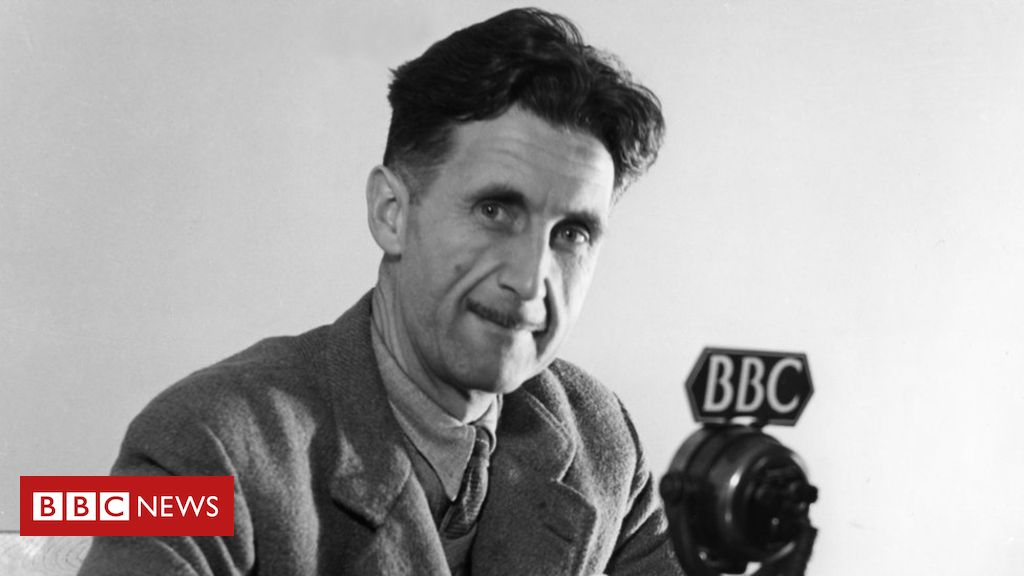
George Orwell’s “Politics And The English Language” remains the best guide to writing non-fiction
Despite pulling most of his writing behind a paywall, I still get the occasional “Weekly Dish” post excerpt from Andrew Sullivan, including his homage to the still-relevant Orwell essay “Politics and the English Language”:
From time to time, I make sure to re-read George Orwell’s classic essay, “Politics And The English Language“. It remains the best guide to writing non-fiction, and it usually prompts a wave of self-loathing even more piercing than my habitual kind. What it shows so brilliantly is how language itself is central to politics, that clarity is as hard as it is vital, and that blather is as lazy as it is dangerous. It’s dangerous because the relationship between our words and our politics goes both ways: “[The English language] becomes ugly and inaccurate because our thoughts are foolish, but the slovenliness of our language makes it easier for us to have foolish thoughts”. We create language and language creates us. If the language is corrupted, so are we.
Near the end of the essay, Orwell lists a few rules to keep writing clear, accessible and meaningful:
i. Never use a metaphor, simile or other figure of speech which you are used to seeing in print.
ii. Never use a long word where a short one will do.
iii. If it is possible to cut a word out, always cut it out.
iv. Never use the passive where you can use the active.
v. Never use a foreign phrase, a scientific word or a jargon word if you can think of an everyday English equivalent.
vi. Break any of these rules sooner than say anything outright barbarous.
Originality, simplicity, brevity, active verbs, everyday language, decency: as simple as it is very, very hard. It’s a relief in a way to recall that Orwell thought things were pretty damn shitty in his day as well, but the more you read broadly across most elite media platforms these days, the more similar it all sounds. To reverse Orwell’s virtues: so much of it is repetition, complexity, length, passive verbs, endless jargon, barbarism.
I was just reading about the panic that occurred in the American Medical Association, when their journal’s deputy editor argued on a podcast that socio-economic factors were more significant in poor outcomes for non-whites than “structural racism”. As you might imagine, any kind of questioning of this orthodoxy required the defenestration of the deputy editor and the resignation of the editor-in-chief. The episode was withdrawn from public viewing, and the top editor replaced it with a Maoist apology/confession before he accepted his own fate.
But I was most struck by the statement put out in response by a group called “The Institute for Antiracism in Medicine”. Here it is:
The podcast and associated promotional message are extremely problematic for minoritized members of our medical community. Racism was created with intention and must therefore be undone with intention. Structural racism has deeply permeated the field of medicine and must be actively dissolved through proper antiracist education and purposeful equitable policy creation. The delivery of messages suggesting that racism is non-existent and therefore non-problematic within the medical field is harmful to both our underrepresented minoritized physicians and the marginalized communities served in this country.
Consider the language for a moment. I don’t want to single out this group — they are merely representative of countless others, all engaged in the recitation of certain doctrines, and I just want an example. But I do want to say that this paragraph is effectively dead, drained of almost any meaning, nailed to the perch of pious pabulum. It is prose, in Orwell’s words, that “consists less and less of words chosen for the sake of their meaning, and more and more of phrases tacked together like the sections of a prefabricated hen-house.”
It is chock-full of long, compounded nouns and adjectives, riddled with the passive voice, lurching and leaning, like a passenger walking the aisle on a moving train, on pre-packaged phrases to keep itself going.
Notice the unnecessary longevity: a tweet becomes an “associated promotional message”. Notice the deadness of the neologisms: “minoritized”, “marginalized”, “non-problematic”. As Orwell noted: “the normal way of coining a new word is to use a Latin or Greek root with the appropriate affix and, where necessary, the -ize formation. It is often easier to make up words of this kind (deregionalize, impermissible, extramarital, non-fragmentatory and so forth) than to think up the English words that will cover one’s meaning.” Go back and see if you can put the words “minoritized” or “non-problematic” into everyday English.
Part of the goal of this is political, of course. The more you repeat words like “proper antiracist education” or “systemic racism” or “racial inequity” or “lived experience” or “heteronormativity”, the more they become part of the landscape of words, designed to dull one’s curiosity about what on earth any of them can possible mean. A mass of ideological abstractions, in Orwell’s words, “falls upon the facts like soft snow, blurring the outlines and covering up all the details.”
Then this: “Racism was created with intention.” Abstract noun, passive voice, vague meaning. Who “created” it? What was the intention exactly? Hasn’t racist tribalism been a feature of human society for tens of thousands of years? They never say. Or this phrase: “purposeful equitable policy creation”. Again: what are they talking about? It is as vague as “doing the work” — and as deliberate as the use of a highly contested term like “structural racism” to define objective reality. These are phrases not designed to say anything real. They are phrases designed to send a message of orthodoxy, and, as Orwell also noted, “orthodoxy, of whatever colour, seems to demand a lifeless, imitative style”. Try reading Slate or Vox or the Huffington Post: the tedium you feel is the tedium of a language rendered lifeless by ideology.
April 16, 2021
March 10, 2021
How wide is the gap between extreme partisanship and sectarian violence?
Sarah Hoyt says she really didn’t want to write this post, and I completely understand why she feels that way:
The next American Civil War will be fought in a lot of places, in sudden flare ups and unexpected bursts of rage. But where most casualties will occur is in the home.
America’s civil war will be fougnt many places, but mostly in living rooms: siblings against each other, parents against children, children against parents, husband against wife, wife against husband.
If you live with a convinced leftist, how safe is your life, should the balloon go up?
And before you say “The first civil war was also between brothers!”
Sure, it was. There were mixed families. Mostly upper crust mixed families. But the war was largely a regional war, the country riven on regional lines.
Now? Bah. Now it’s a war of ideology. A war of beliefs.
And a lot of people are sleeping with the enemy, hanging out on weekends with the enemy. Visiting the enemy. Having lunch with the enemy.
At this moment a lot of you are sitting back there and going “My wife/husband/elementary school friend is not an enemy. Sure, he/she/it drank the Marxist koolaid from a hose but in every day life, in our normal interactions, in non-political things, we are very close, the best of friends.”
And maybe you are. Maybe you can trust them with your life.
But I will remind you we live in a nation where the capital is surrounded with razor wire to defend themselves from people who voted for the guy. I will remind you there are troops occupying our capital and that our secret services have so far been corrupted they keep inventing internet conspiracies (or probably referring to their very own black ops) to justify it.
I will remind you that your favorite progressive has allowed himself to be moved from “strong welfare net” to “we need full on communism, with favored races” within the last 12 years (or was indoctrinated into that state in schools.) I will remind you — and the conversations related back to me don’t help me think otherwise — that your favorite leftist thinks you’re racist/homophobic/evil. NO MATTER HOW MANY indications to the contrary.
And I can hear you sniffling: “But I love him/her/it/fuzzy.” Well, yes, and ten years ago that would have been me. I had very good friends I just classed as political idiots. I don’t wish the last 10 years on anyone, but at least they’re not living with me, 90% of them don’t know where I live. And I’ll be out of here in hopefully no more than 4 but maybe ten months, and maybe we have that long. Also, most of my close friends/acquaintances aren’t likely to cause any damage, being … not the type. On the other hand two dozen of them (easy) are friends with people who WILL.
Now to be clear: do I expect all of you in mixed political families to be in danger?
No. Any number of your spouses, relatives and friends are leftist because that’s “what good people are.” And they will turn on a dime, too, if half the crap about what the left has been doing for the last couple of decades comes out unvarnished and unspun. (The left knows it too. They’re perhaps more scared of these people than they are of us.)
Others are leftist and might hate your guts if things go hot, but simply don’t have it in them to hurt anyone. These are the “slippery” ones, because if you had asked me, even two years ago, if the media and the left (BIRM) could spin these people into wishing death on someone for not wearing a mask, when the person is not sick; there’s no proof of asymptomatic transmission (there’s reports from China but NOWHERE ELSE); and the actual disease (it’s not hard to find) might be a little more lethal than the flu but only at ages past about 80, I’d have said “no. They’re politically insane, but not stupid.” However they are “group oriented.” Turns out the type of gaslighting we’ve been enduring works really well on people who live for others’ opinions. (Which explains whey Southern Europe is still mired in the fricking crazy. Uniformly. And why women in general are more susceptible to the completely irrational gaslighting than men.) And they already believe a bunch of crazy crap. The reason that they think QANON is right main stream, it’s because it’s the mirror image of their actual main stream.
Are you sure they’ll remain inoffensive if the ballon goes up and the gaslighting switches to “If you know a Trump voter, he/she is dangerous?” How about “Turn them in, so they can be sent somewhere nice for their own protection?”
Look, guys, I hope none of this is ever needed. I still have friends on the other side, I’m just not in touch and we work on the very long finger. And there are people I no longer consider friends but whom I like very much who are buying into the entire insane bull excreta of “attempted coup” and evil “white nationalists.”
But like Peter Grant, I think we’re way past the ballot box, and just waiting for a precipitating incident.
I desperately hope she’s wrong about this, because an actual shooting war in the United States would be a disaster for western civilization.
Update: It’s apparently time to Immanentize the Eschaton!
I’m of the firm opinion that the Progressive Left believed that once Obama won his second term they were set. The eschaton night not be immanent, but it was imminent. Hillary was going to be another “great leap forward” towards the heaven on Earth promised by Karl Marx. […]
“Politics” it is said, “is the art of compromise.” “War,” said von Clausewitz, “is politics by other means.” I have repeated and repeated the observation that has made itself manifest in the nearly 18 years I’ve been writing this blog: Charles Krauthammer noted in 2002 that “To understand the workings of American politics you have to understand this fundamental law: Conservatives think liberals are stupid. Liberals think conservatives are evil.”
You don’t debate with evil. You don’t negotiate with evil. You don’t compromise with evil. You don’t tolerate evil. You DESTROY evil. You pat it on the head until you can find a rock big enough to bash its skull in.
And control of the culture, education, and the government makes for a big damned rock.
Here’s the tinfoil yarmulke part of this essay: The preparations are underway. When debate and compromise are no longer possible, then force is the only thing left. They know it, and they’re projecting it on their enemy, us.
The Progressive Left has created and exercised its Sturmabteilung (yes, I know I risk Godwinization, and they loathe such comparisons, but this one’s apt. Their outfits are black instead of brown, but the actions are the same.) They’ve been set loose in the Pacific Northwest and some other cities and have been allowed to riot, commit arson, loot and occasionally murder with little to no legal consequence (violence, after all, being free speech you know.) Andy Ngo has studied Antifa, itself with roots in radical Socialism, in depth, and says that they are preparing for war, generously supported by the more mainstream Progressive Left. Black Lives Matter, an organization founded by two open Marxists, is also part of the preparations, but these are in my opinion just the Progressive Left’s “useful idiot” shock troops – the first to go against the wall after the Revolution.
February 24, 2021
Solzhenitsyn was far from the first to warn about the evils of Soviet rule
Theodore Dalrymple had a discussion recently with a Marxist professor:

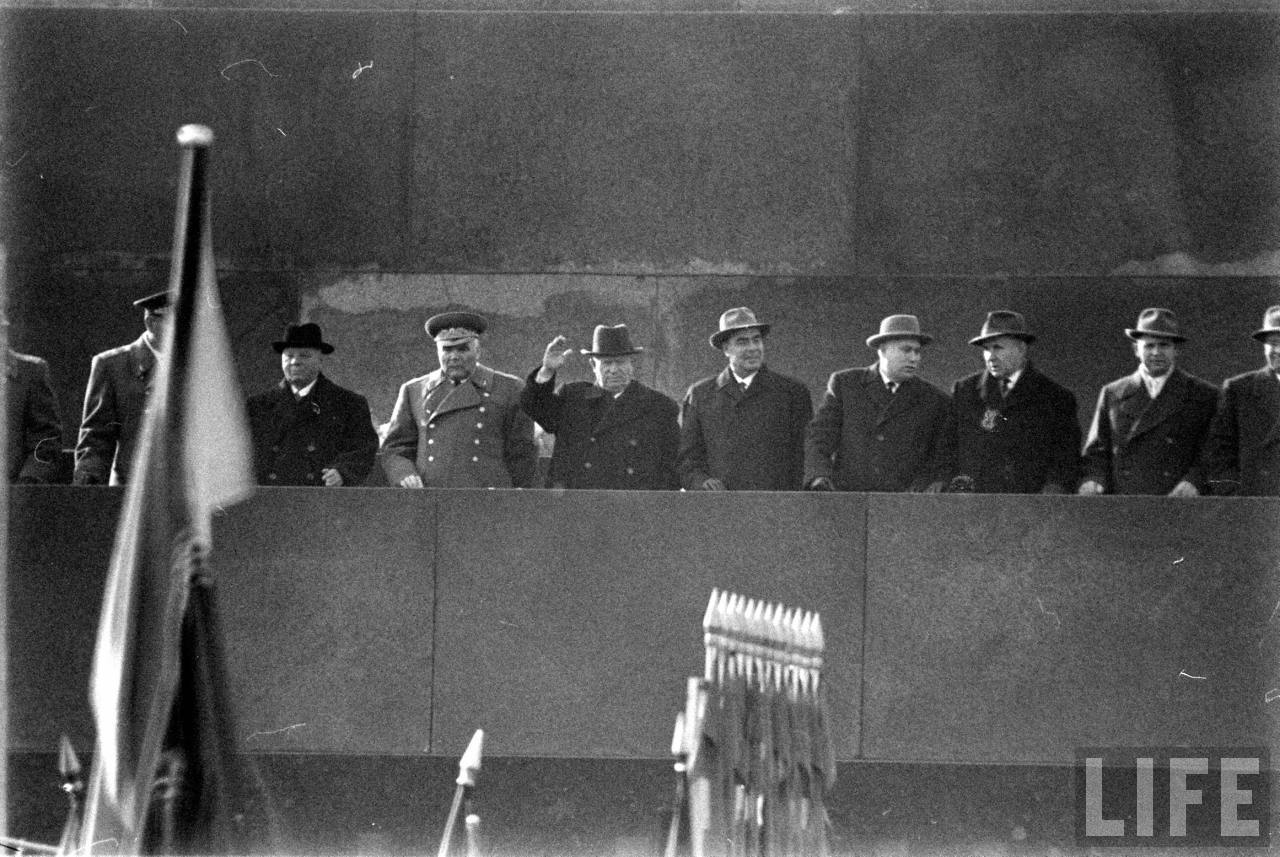
Krushchev, Brezhnev and other Soviet leaders review the Revolution parade in Red Square, 1962.
LIFE magazine photo by Stan Wayman.
The professor was an intelligent man, and probably cultivated too. How was it possible, in the Year of Our Lord 2021, for such a person still to believe that, until the advent of Stalin, the Russian revolution was a good thing, to be emulated or repeated elsewhere?
How could anyone of his intelligence fail to realise that, though as ever there was much wrong with the world, attempts to put everything right at once by the implementation of petty intellectual schemes are fraught with danger, and have a history of mass slaughter behind them?
I think the answer must lie in the psychology of religion: when religious faith is replaced by a philosophy that prides itself on its rationality, it soon turns religious in the worst possible sense. it becomes an atheist theocracy.
Everything was known about the Soviet Union from the first. It is simply not true that Solzhenitsyn revealed anything to the West that, in essence, was not, or could not have been, known before.
I have, in desultory fashion for a number of decades, been collecting books about Russia and the Soviet Union from just before the Revolution until the Second World War, and while it is true that many of them are laudatory, with titles that now seem hilarious to us such as The Soviet Union Fights Neurosis, a very large number books of various genres, from essays to histories to memoirs to novels and short stories, were published that exposed the viciousness of Bolshevism from the very first — a viciousness that anyone with any imagination could have anticipated from Lenin’s literary style alone.
Leninist viciousness was viciousness of a new and more thoroughgoing type that acted on the mind as a virus acts on a computer (viciousness, both actual and potential, is, alas, a constant of human history because of our flawed nature).
Solzhenitsyn was right about the difference between Macbeth, who from personal ambition killed people, but only a few, and the ideologically-motivated mass-killings of the Soviet Union and elsewhere — the difference being precisely in the effect of ideology.
But what was really different about Solzhenitsyn, apart from his literary talent, was that Western intellectuals were now prepared to believe what he said, whereas shortly before they had rejected as mere propaganda evidence of a very similar nature produced by others.It was so startling to meet someone who still believed that a “pure” revolution could take place, and that such a person was teaching history of all things, in a reputable, or at any rate reputed, university, that, like Karl Kraus confronted by Hitler, I could think of nothing to say.
I had no idea whether he still taught undergraduates, or whether in doing so he suppressed at least some of his views (as a judge is supposed to suppress his own private opinions): but I confess that the charge against Socrates, that of corrupting youth, came into my mind.
January 29, 2021
Ancient Aryans: The History of Crackpot N@zi Archaeology
Atun-Shei Films
Published 22 Nov 2019Thanks to Indiana Jones, everybody knows that German archaeologists in the 1930s were searching for occult ancient artifacts … but that’s just the tip of the iceberg. In this educational video, I explore how the N@zis turned the discipline of prehistoric archaeology into a cog in their propaganda machine, and how their crazy conspiracy theories about lost civilizations continue to haunt us to this day.
Support Atun-Shei Films on Patreon ► https://www.patreon.com/atunsheifilms
Leave a Tip via Paypal ► https://www.paypal.me/atunsheifilms (All donations made here will go toward the production of The Sudbury Devil, our historical feature film)
Buy Merch ► teespring.com/stores/atun-shei-films
#WW2 #Archaeology #History
Reddit ► https://www.reddit.com/r/atunsheifilms
Twitter ► https://twitter.com/atun_shei
January 3, 2021
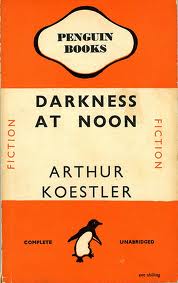
Arthur Koestler’s Darkness at Noon ranks with Orwell’s Nineteen Eighty-Four
James E. Hartley on why Koestler’s 1941 novel should be seen as a prescient guide to modern-day “wokeness”:
The puzzling thing about wokeness is not that it is fashionable among a small subset of the Campus Left. One should never be surprised by what is fashionable among college faculty and students. The curious question is how these ideas broke out of the academic asylum and met acquiescence among a large group of people who should have known better.
The answer is found in a book which should have never fallen off the radar: Arthur Koestler’s Darkness at Noon. First published in 1941, it was — along with 1984 — one of the great books about totalitarianism written in the 1940s. Widely praised when it was published, the book was enormously influential in fostering the consensus view of post-war anti-communism. In 1998, Modern Library published a list of the 100 best English novels of the 20th century; Darkness at Noon was ranked eighth, five places above 1984.
The plot of the novel itself is fairly simple. The story begins with the imprisonment of Nicholas Rubashov, one of the heroes of the communist revolution in a country which is clearly the Soviet Union. Decades after the revolution, Number 1 (read: Stalin) has assumed power. Rubashov is imprisoned on the absurdly false charges of plotting to kill Number 1. The entire novel takes place in prison, as Rubashov is interrogated and eventually comes to voluntarily confess at a public trial to crimes he did not commit. He is then shot.
The novel explores the philosophical puzzle of why Rubashov would join with what has obviously become a murderous cult run by a totalitarian who is solely interested in amassing enough power to stamp his will upon the whole country. Rubashov, a devoted communist to the end, abandons his principles and bit by bit comes to accede to demands of the new generation who are seeking scapegoats and ritualistic confessions of guilt.
What is the nature of the new generation? One of the Party officials interrogating Rubashov explains:
There are only two conceptions of human ethics, and they are at opposite poles. One of them is Christian and humane, declares the individual to be sacrosanct, and asserts that the rules of arithmetic are not to be applied to human units. The other starts from the basic principle that a collective aim justifies all means, and not only allows, but demands, that the individual should in every way be subordinated and sacrificed to the community — which may dispose of it as an experimentation rabbit or a sacrificial lamb.
The individual does not matter. The group matters. What is good for the group is by definition good, regardless of whether it is good for the individual. As the interrogators make abundantly clear, no individual has the right to stand in the way of the group. The Party represents the group, and thus no individual has the right to oppose the Party.
November 30, 2020
November 14, 2020
QotD: “Modern” liberalism
All of this became “dated,” as I grew older. My first shocking discovery about the “modern” liberal is, that while he might give lip-service still to some “antiquated” ideals, and gratuitously pose as virtuous, his first instinct when faced with serious responsibility was to cut and run.
My second was to find that he was now brainwashed by ideologies and slogans; that it was impossible to argue with him from reason or fact; that faced with any difficulty he would present himself as the helpless victim of forces he would not even try to define coherently.
My third was the discovery that he was now, instinctively, on the side of the criminal; that he identified with the lawless; that he admired “the transgressive,” trespass, violation. Without acknowledging it to himself, he now had a conception of “human rights” which consistently excused the wrongdoer, and consistently ignored the consequences to those who had done nothing wrong.
This “modern” liberalism, I came to understand, was the development — not over months and years but over centuries — of a mortal flaw in the “classical” liberal worldview. It was avoiding God. The liberal mind was persuaded that humans must “make their own beds.” Its great strength was that it took responsibility; its great weakness was that it had no reason to do so. Faith and reason are mutually dependent; when one goes the other eventually goes, too.
Or put this another way: the Devil gets in when we make room for him.
David Warren, “Crime without punishment”, Essays in idleness, 2018-08-03.
November 8, 2020
“… participants in men’s sport, on average, out-perform participants in women’s sports, current science is unable to isolate why this is the case”
Barbara Kay is not in favour of clearly misogynistic sports policies:
No hormone treatment is required, says the EWG, because being male or female is not dependent on biology but on one’s feelings: “(It) is recognized that transfemales are not males who become females. Rather these are people who have always been psychologically female.” Furthermore, these individuals must be allowed to participate in “the gender with which they feel most comfortable and safe, which may not be the same in each sport or consistent in subsequent seasons.” Your eyes do not deceive you. First they justified trans women competing with women because they had “always” felt they were female. Then they say the “always” female trans athlete might “be” male for certain sports or at different times.
It gets worse.
They say that although “participants in men’s sport, on average, out-perform participants in women’s sports, current science is unable to isolate why this is the case.” This is nonsense on two counts. First, there is no “on average” about it. Virtually all high-performance male athletes out-perform all high-performance female athletes. And second, even in 2014, abundant scientific data “to isolate why this is the case” was readily, even effortlessly (#Google!) available.
Data or no data, a statement in the document itself makes clear that the ideological fix was in from the get-go: “The Expert Working Group held strongly to the principle that the inclusion of all athletes, based on the fundamental human right of gender self-determination overrides any consideration of potential competitive advantage.”
Needless to say, but it must be said anyway: Male athletes have nothing whatsoever to fear in competing with trans male athletes. This is a problem for female athletes only, which seems not to trouble the CCES at all. I’m not a feminist, but I know a misogynistic sport policy when I see it. Quis custodiet ipsos custodes?
September 15, 2020
Critical Race Theory
Dan Sanchez, Tyler Brandt, and Brad Polumbo discuss President Trump’s recent Executive Memo banning the use of federal government funds for Critical Race Theory training:
Critical Race Theory is a branch of Critical Theory, which began as an academic movement in the 1930s. Critical Theory emphasizes the “critique of society and culture in order to reveal and challenge power structures,” as Wikipedia states. Critical Race Theory does the same, with a focus on racial power structures, especially white supremacy and the oppression of people of color.
The “power structure” prism stems largely from Critical Theory’s own roots in Marxism — Critical Theory was developed by members of the Marxist “Frankfurt School.” Traditional Marxism emphasized economic power structures, especially the supremacy of capital over labor under capitalism. Marxism interpreted most of human history as a zero-sum class war for economic power.
“According to the Marxian view,” wrote the economist Ludwig von Mises, “human society is organized into classes whose interests stand in irreconcilable opposition.”
Mises called this view a “conflict doctrine,” which opposed the “harmony doctrine” of classical liberalism. According to the classical liberals, in a free market economy, capitalists and workers were natural allies, not enemies. Indeed, in a free society all rights-respecting individuals were natural allies.
Classical Race Theory arose as a distinct movement in law schools in the late 1980s. CRT inherited many of its premises and perspectives from its Marxist ancestry.
The pre-CRT Civil Rights Movement had emphasized equal rights and treating people as individuals, as opposed to as members of a racial collective. “I look to a day when people will not be judged by the color of their skin, but by the content of their character,” Martin Luther King famously said.
In contrast, CRT dwells on inequalities of outcome, which it generally attributes to racial power structures. And, as we’ve seen from the government training curricula, modern CRT forthrightly judges white people by the color of their skin, prejudging them as racist by virtue of their race. This race-based “pre-trial guilty verdict” of racism is itself, by definition, racist.
The classical liberal “harmony doctrine” was deeply influential in the movements to abolish all forms of inequality under the law: from feudal serfdom, to race-based slavery, to Jim Crow.
But, with the rise of Critical Race Theory, the cause of racial justice became more influenced by the fixations on conflict, discord, and domination that CRT inherited from Marxism.
Social life was predominantly cast as a zero-sum struggle between collectives: capital vs. labor for Marxism, whites vs. people of color for CRT.
September 13, 2020
“Systemic racism” in Canada
At The Line, a useful examination of what is meant in the Canadian context by the term “systemic racism”:
Can we go back one step? “Systemic racism.” Let’s start there: which system? The legal system? Our social welfare system? The policing system? The media? Our corporations? All of human society? Are we talking about Canadian society, or North American society as whole? Are there geographic limits to the systems we’re talking about? Is China systemically racist?
Let’s break this down further: what definition of “racism” are we using? Are we using the old definition whereby any bigotry based on skin colour is “racist”? Or are we engaging the new definition, where “racism” is an expression of structural power — and, therefore, only white people can be racist because only they hold structural power?
It’s impossible to fix a problem if we can’t come to a common understanding about plain meanings of the terms we are using. Vague in, vague out.
There are many statements of “systemic racism” that we, at The Line, would have no qualms agreeing with, i.e.; “The Indian Act is a clear example of systemic racism in Canadian law.” That isn’t a controversial position — but it also isn’t an unclear one. Asserting a belief in “systemic racism” sounds like a broadly agreeable thing to do, but the term is loaded with meaning and ideological baggage that is not immediately apparent.
Take, for example, a claim that Canadian society is systemically racist because it is structured at all levels to favour white dominance — and that any disparity of outcome between racial groups is proof of that fact. Well, that’s a much more all-encompassing ideological position, isn’t it? There’s a perfectly legitimate framework for critique in here, but there’s also a lot to unpack.
It’s easy to find legitimate examples of systemic racism while leaving the actual meaning and implications of the term both vague and tautological. But if we’re going to use statement of belief in “systemic racism” as some kind of litmus test for political acceptability, the clear meaning of the term matters.
In the absence of that clarity, using it as a gotcha question and backing people in public life into reciting this stuff as if it were some kind of statement of faith comes off as not a little creepy.
August 16, 2020
QotD: Labour is now the “party of government” even when they’re not in power
Labour, it seems to me and to many others I’m sure, has mutated from once upon a time being the party speaking for the poor, often against the government, to being the party of government, even when they aren’t the politicians in titular charge of that government. These people are now “supportive of the state”, to quote Hartley, even when they’re not personally in charge of it. It’s the process of government, whoever is doing it, whatever it is doing, that they now seem to worship. It is, as similar people in earlier times used to say, the principle of the thing, the principle being that they’re in charge. Many decades ago, Labour spoke for, well, Labour. The workers, the toiling masses. Now they represent most determinedly only those who labour away only in Civil Service offices or their allies in the media, in academia, and in the bureaucratised top end of big business.
Anyone official and highly educated sounding who challenges whatever happens to be the prevailing supposed wisdom of this governing class, on Coronavirus or on anything else, must be scolded into irrelevance and preferably silenced. The governors must be obeyed, even if they’re wrong. In fact especially if they’re wrong, just as the soldiers of the past were expected to obey their orders, no matter what they thought of the orders or of the aristocratic asses who often gave them. Whether they were good orders was an argument that those giving orders could have amongst themselves, but that orders must be obeyed was a given. “Capitalism” isn’t worth dying for, but this new dispensation is, right or wrong.
Our new class of entitled asses, together with all those who have placed their bets for life on carrying out their orders or trying to profit from them, seems now to be the limit of the Labour Party’s electoral ambition. And who knows? The awful thing is that this class and its hangers-on could be enough, in the not too distant future, to get them back into direct command of the governmental process that they so adore.
Brian Micklethwait, “Mick Hartley on the politics of the Lockdown”, Samizdata, 2020-05-15.