Quotulatiousness

June 26, 2020

Progressive hate for nuclear power

In Quillette, Michael Shellenberger discusses the demands of some climate activists who also reject the best solutions to the problems they foresee:
For the last decade I have been obsessed with a question: Why are the people who are the most alarmist about environmental issues also opposed to all of the obvious solutions?

Those who raise the alarm about food shortages oppose expanding the use of chemical fertilizers, tractors, and GMOs. Those who raise the alarm about Amazon deforestation promote policies that fragment the forest. And those who raise the alarm about climate change oppose nuclear energy, the largest source of zero-emissions energy in developed nations. Why is that?

It is not an academic question for me. I have been a climate activist for 20 years and an energy expert for 10 of them. I was adamantly against nuclear energy until about a decade ago when it became clear renewables couldn’t replace fossil fuels. After educating myself about the facts, I came to support the technology.

Over the last five years, I have campaigned, as founder and president of my small and independent nonprofit research organization, Environmental Progress, to expand the use of nuclear energy. During that time our main opponents have not been climate skeptics or even the fossil fuel industry but rather other climate activists.

This is the case around the world. It is climate alarmist Democrats and Greens who are seeking to shut down nuclear plants in the US and Europe. Greta Thunberg last year condemned the technology as “extremely dangerous, expensive, & time-consuming,” which is false. And Green New Deal architect Rep. Alexandria Ocasio-Cortez (AOC) has advocated closing the Indian Point nuclear plant in New York, which is now being replaced with natural gas.

In nearly every situation around the world, support for nuclear energy from climate activists like Thunberg and AOC would make the difference between nuclear plants staying open or closing, and being built or not being built. Had Thunberg spoken out in defense of nuclear power she likely could have prevented two reactors in her home nation of Sweden from being closed. Had AOC advocated for Indian Point rather than condemned it as dangerous, it could likely keep operating, for at least 40 years longer.

That’s because the main problem facing nuclear energy is that it’s unpopular — and far more among progressives than conservatives, and far more among women than men. There are no good technical or economic reasons that nations from the US and Japan to Sweden and Germany are closing their nuclear plants. Center-left governments are closing them early in response to the demands of progressives and Greens — the very same people who are claiming climate change will kill billions of people.
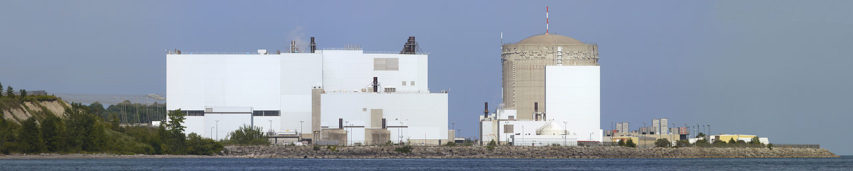
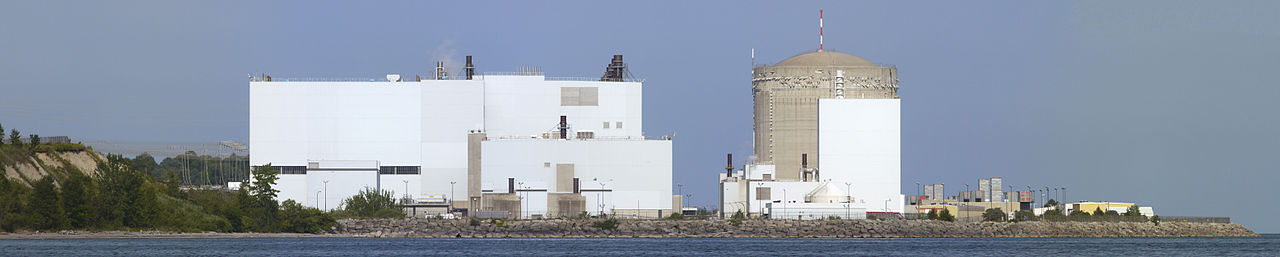
Darlington Nuclear Generating Station in Clarington, Ontario.
Photo by Óðinn via Wikimedia Commons.

Some prominent environmental groups have a pecuniary interest in replacing existing nuclear generating stations with natural gas and “renewable” energy sources, but money isn’t the only reason for the widespread opposition to nuclear power:

Sierra Club, NRDC, and EDF have worked to shut down nuclear plants and replace them with fossil fuels and a smattering of renewables since the 1970s. They have created detailed reports for policymakers, journalists, and the public purporting to show that neither nuclear plants nor fossil fuels are needed to meet electricity demand, thanks to energy efficiency and renewables. And yet, as we have seen, almost everywhere nuclear plants are closed, or not built, fossil fuels are burned instead.
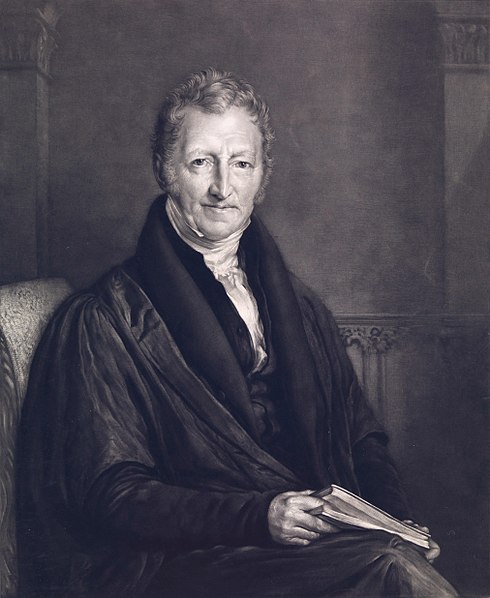
Thomas Malthus.
Portrait by John Linnell, 1834, via Wikimedia Commons

But it’s not just about money. It’s also about ideology. Anti-nuclear groups have long had a deeply ideological motivation to kill off nuclear energy.

Policymakers, journalists, conservationists, and other educated elites in the ’50s and ’60s knew that nuclear was unlimited energy and that unlimited energy meant unlimited food and water.

We could use desalination to convert ocean water into freshwater. We could create fertilizer without fossil fuels, by harvesting nitrogen from the air, and hydrogen from water, and combining them. We could create transportation fuels without fossil fuels, by taking carbon dioxide out of the atmosphere to make artificial hydrocarbons, or by splitting water to make pure hydrogen gas.

Nuclear energy thus created a serious problem for Malthusians — followers of widely-debunked 18th-century economist, Thomas Robert Malthus — who argued that the world was on the brink of ecological collapse and resource scarcity. Nuclear energy not only meant infinite fertilizer, freshwater, and food but also zero pollution and a radically reduced environmental footprint.

In reaction, Malthusians attacked nuclear energy as dangerous, mostly by suggesting that it would lead to nuclear war, but also by spreading misinformation about nuclear “waste” — the tiny quantity of used fuel rods — and the rapidly decaying radiation that escapes from nuclear plants during their worst accidents.

There is a pattern: Malthusians raise the alarm about resource depletion or environmental problems and then attack the obvious technical solutions. In the late 1700s, Thomas Malthus had to reject birth control to predict overpopulation. In the 1960s, Malthusians had to claim fossil fuels were scarce to oppose the extension of fertilizers and industrial agriculture to poor nations and to raise the alarm over famine. And today, climate activists reject nuclear energy in order to declare a coming climate apocalypse.

June 16, 2020

Andrew Sullivan on Puritanism in the Current Year

Filed under: History, Liberty, Politics, USA — Tags: , , , — Nicholas @ 03:00

Andrew Sullivan wonders if there’s any room for debate any more:

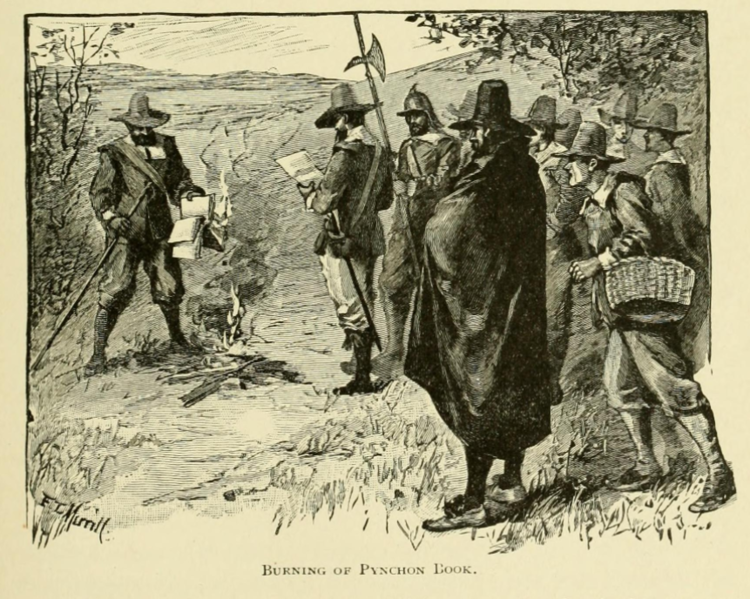
Portrayal of the burning of copies of William Pynchon’s book The Meritous Price of Our Redemption by early colonists of the Massachusetts Bay Colony, who saw his book as heresy; it was the first-ever banned book in the New World and only 4 original copies are known to survive today.
Engraving by F.T. Merrill in The History of Springfield for the Young by Charles Barrows, 1921.

In the last couple of weeks, as the purges of alleged racists have intensified in every sphere, and as so many corporations, associations, and all manner of civic institutions have openly pledged allegiance to anti-racism, with all the workshops, books, and lectures that come with it, I’m reminded of a Václav Havel essay, “The Power of the Powerless.”

It’s about the dilemma of living in a world where adherence to a particular ideology becomes mandatory. In Communist Czechoslovakia, this orthodoxy, with its tired slogans, and abuse of language, had to be enforced brutally by the state, its spies, and its informers. In America, of course, with the First Amendment, this is impossible. But perhaps for that very reason, Americans have always been good at policing uniformity by and among themselves. The puritanical streak of shaming and stigmatizing and threatening runs deep. This is the country of extraordinary political and cultural freedom, but it is also the country of religious fanaticism, moral panics, and crusades against vice. It’s the country of The Scarlet Letter and Prohibition and the Hollywood blacklist and the Lavender Scare. The kind of stifling, suffocating, and nerve-racking atmosphere that Havel evokes is chillingly recognizable in American history and increasingly in the American present.

The new orthodoxy — what the writer Wesley Yang has described as the “successor ideology” to liberalism — seems to be rooted in what journalist Wesley Lowery calls “moral clarity.” He told Times media columnist Ben Smith this week that journalism needs to be rebuilt around that moral clarity, which means ending its attempt to see all sides of a story, when there is only one, and dropping even an attempt at objectivity (however unattainable that ideal might be). And what is the foundational belief of such moral clarity? That America is systemically racist, and a white-supremacist project from the start, that, as Lowery put it in The Atlantic, “the justice system — in fact, the entire American experiment — was from its inception designed to perpetuate racial inequality.” (Wesley Lowery objected to this characterization of his beliefs — read his Twitter thread about it here.)

This is an argument that deserves to be aired openly in a liberal society, especially one with such racial terror and darkness in its past and inequality in the present. But it is an argument that equally deserves to be engaged, challenged, questioned, interrogated. There is truth in it, truth that it’s incumbent on us to understand more deeply and empathize with more thoroughly. But there is also an awful amount of truth it ignores or elides or simply denies.

It sees America as in its essence not about freedom but oppression. It argues, in fact, that all the ideals about individual liberty, religious freedom, limited government, and the equality of all human beings were always a falsehood to cover for and justify and entrench the enslavement of human beings under the fiction of race. It wasn’t that these values competed with the poison of slavery, and eventually overcame it, in an epic, bloody civil war whose casualties were overwhelmingly white. It’s that the liberal system is itself a form of white supremacy — which is why racial inequality endures and why liberalism’s core values and institutions cannot be reformed and can only be dismantled.

This view of the world certainly has “moral clarity.” What it lacks is moral complexity. No country can be so reduced to one single prism and damned because of it. American society has far more complexity and history has far more contingency than can be jammed into this rubric. No racial group is homogeneous, and every individual has agency. No one is entirely a victim or entirely privileged. And we are not defined by black and white any longer; we are home to every race and ethnicity, from Asia through Africa to Europe and South America.

June 11, 2020

Current year Iconoclasm

Filed under: History, Politics, USA — Tags: , , , , — Nicholas @ 03:00

In an Areo article from last year, Alexander Adams discusses the phenomenon of iconoclasm:

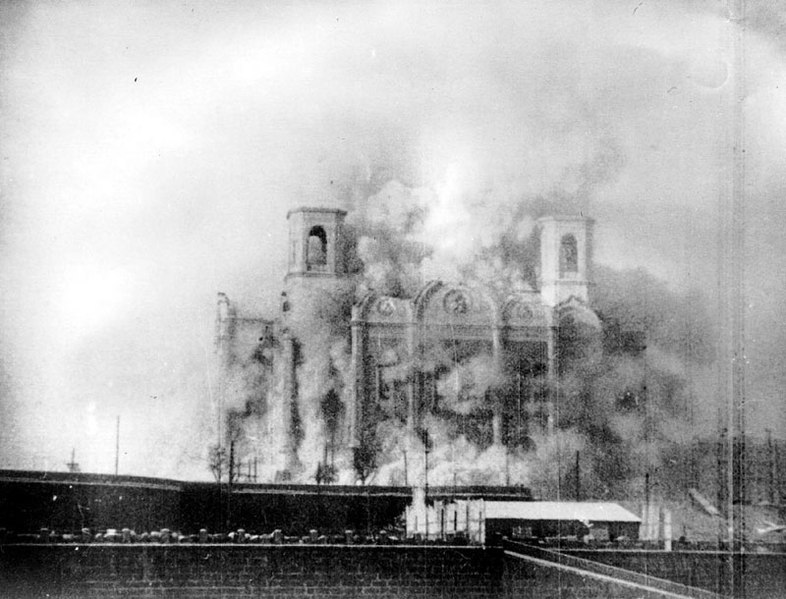
The 1931 demolition of the Cathedral of Christ the Saviour in Moscow.
Public domain image via Wikimedia Commons.

Behind any campaign is the campaigner: the activist convinced of his own righteousness.

The political activist reserves to himself the right to retrospectively edit our history for his satisfaction by removing monuments, those fixtures of civic life, embedded in the memories of generations. The activist often knows almost nothing about the object of his hatred — merely a garbled caricature of a person caught up in the conditions of her age — but the activist acts as if he were not also caught up in the conditions of his own age.

Iconoclasm is an expression of domination and a demonstration of willingness to act — illegally and unethically — to impose the will of one group over an entire population. It asserts control over all aspects of society. It sets a challenge that will elicit a strong reaction. Iconoclasm is a warning that the protection of law and social conventions no longer applies and that the cause will be promoted through physical force if necessary.

The campaigner argues that public art, accumulated piecemeal over 1,000 years of history, must reflect our society and values today — even if that means altering or erasing stories of the values our past society expressed via its monuments, or suppressing evidence of how we arrived at our current situation. The left-wing activist wants to celebrate current-day multiculturalism, but mostly he wants to erase evidence of the historic monoculturalism that preceded it.

Our willingness to live with historical relics we feel ambivalence towards is a demonstration of our toleration of dissent. Likewise, an openness to imagining ourselves in past times — constrained by the conventions and laws of a different era — forces us to question common assumptions about the completeness of our knowledge and our moral certainty. If we can make this leap of empathy, we can free ourselves of ideological possession. We have the ability to empathize with both slave and slave owner. Empathy makes it harder to justify destruction of the cultural relics of an older age or silence the voices of individuals, who might share insights into life.

The toleration we extend towards symbols of former regimes and proponents of ideas with which we disagree shows our willingness to be honest about our nations’ pasts. To accept our flaws as a necessary part of our development is to display the maturity, restraint and empathy that define the confident yet self-critical nation. For if we cannot stand the sight of a dead political opponent carved in stone, how can we restrain ourselves in the face of a living political opponent who speaks against us?

June 10, 2020

QotD: “God is Dead”

Filed under: History, Quotations, Religion — Tags: , , , , — Nicholas @ 01:00

We have this articulated space that we can all discuss. Outside of that we have something that’s more akin to a dream that we’re embedded in. It’s an emotional dream that we’re embedded in, and that’s based, at least in part, on our actions. […] What’s outside of that is what we don’t know anything about at all. The dream is where the mystics and artists live. They’re the mediators between the absolutely unknown and the things we know for sure. What that means is that what we know is established on a form of knowledge that we don’t really understand. If those two things are out of sync — if our articulated knowledge is out of sync with our dream — then we become dissociated internally. We think things we don’t act out and we act out things we don’t dream. That produces a kind of sickness of the spirit. Its cure is something like an integrated system of belief and representation.

People turn to things like ideologies, which I regard as parasites on an underlying religious substructure, to try to organize their thinking. That’s a catastrophe and what Nietzsche foresaw. He knew that, when we knocked the slats out of the base of Western civilization by destroying this representation, this God ideal, we would destabilize and move back and forth violently between nihilism and the extremes of ideology. He was particularly concerned about radical left ideology and believed — and predicted this in the late 1800s, which is really an absolute intellectual tour de force of staggering magnitude — that in the 20th century hundreds of millions of people would die because of the replacement of these underlying dream-like structures with this rational, but deeply incorrect, representation of the world. We’ve been oscillating back and forth between left and right ever since, with some good sprinkling of nihilism and despair. In some sense, that’s the situation of the modern Western person, and increasingly of people in general.

Jordan B. Peterson, “Biblical Series I: Introduction to the Idea of God” {transcript], jordanbpeterson.com, 2018-03-12.

June 9, 2020

QotD: Groupthink

Filed under: Politics, Quotations — Tags: , — Nicholas @ 01:00

[Groupthink author Irving] Janis’s first rule is that a group of people come to share a particular way of looking at the world which may seem hugely important to them but which turns out not to have been based on looking properly at all the evidence. It is therefore just a shared, untested belief.

Rule two is that, because they have shut their minds to any evidence which might contradict their belief, they like to insist that it is supported by a “consensus.” The one thing those caught up in groupthink cannot tolerate is that anyone should question it.

This leads on to the third rule, which is that they cannot properly debate the matter with those who disagree with their belief. Anyone holding a contrary view must simply be ignored, ridiculed, and dismissed as not worth listening to.

Christopher Booker, “Groupthink on Climate Change Ignores Inconvenient Facts”, Foundation for Economic Education, 2018-02-24.

May 18, 2020

QotD: Science, evidence and “cognitive creationism”

I wrote about this problem in one of my Scientific American monthly columns recently, noting that both the Right and the Left distort science in the service of their ideology. On the Right we see the denial of evolution, vaccinations, stem cell research, and global warming. On the Left we see the distortion or denial of GMOs, nuclear power, genetic engineering, and evolutionary psychology, the latter of which I have called “cognitive creationism” for its endorsement of a blank slate model of the mind in which natural selection only operated on humans from the neck down.

What can we do about this problem? First, we must acknowledge that for most issues most conservatives and liberals are pro-science. Recent surveys show that over 90 percent of both Republicans and Democrats in the U.S., for example, agreed that “science and technology give more opportunities” and that “science makes our lives better.” In other words, anti-science attitudes are formed in very narrow cognitive windows — those in which science appears to oppose certain political or religious views. Knowledge of a subject helps a little. For example, those who know more about climate science are slightly more likely to accept that global warming is real and human-caused than those who know less on the subject. But that modest effect is not only erased when political ideology is factored in, it has an opposite effect on one end of the political spectrum. For Republicans, the more knowledge they have about climate science the less likely they are to accept the theory of anthropogenic global warming (while Democrats’ confidence goes up).

In another Scientific American column I wrote about this “backfire” effect, in which the more information you give someone that contradicts a cherished belief, the less likely they are to change their mind; in fact, they double-down on the belief. But this only applies to important political, religious, or ideological beliefs.

If you don’t have a dog in the fight then the facts can change your mind. But the cognitive dissonance created by facts counter to beliefs by which you define yourself will almost always be resolved by spin-doctoring the facts, not by changing your mind. Thus, when I engage in debate or conversation with creationists, for example, I don’t give them the choice between Darwin and Jesus, because I know who’s going to lose that one. Instead, I try to convince them that evolution was God’s way of creation, just like people in Newton’s time and after came to believe that gravity was God’s way of creating solar systems. I don’t believe that myself, of course, but the point is to get people to embrace science, not to win an argument. With climate deniers, I know from research and personal experience that when they hear “global warming” they think “anti-capitalism,” “anti-freedom,” “anti-American way of life.” So I take that off the table by showing them how investing in green technology is going to be one of the most lucrative enterprises in the history of capitalism. I call this the Elon Musk Model.

Michael Shermer, interviewed by Claire Lehmann, “The Skeptical Optimist: Interview with Michael Shermer”, Quillette, 2018-02-24.

April 14, 2020

Socialism and the environment

Filed under: Environment, History, Russia — Tags: , , , , — Nicholas @ 05:00

Luke Warren on the vast gulf between the “environmental consciousness” of fans of the socialist worldview and the real-world environmental impact of socialist policies:

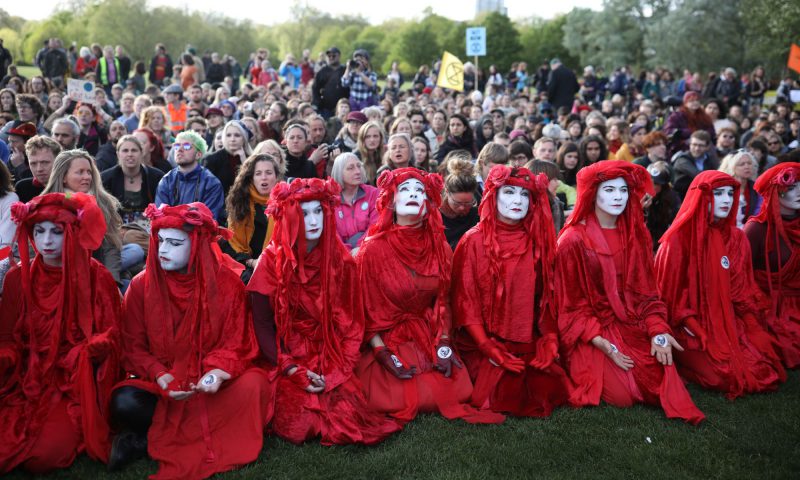
Modern environmentalists often identify as socialists. Members of Extinction Rebellion, for example, often advocate tearing down capitalism and supplanting it with “eco-socialism”. Go to any “climate strike” or similar type of event, and you will see more hammer and sickle flags, raised fist symbols and Socialist Workers party posters than you can count.

Indeed, socialism and environmentalism are perceived by many as two sides of the same coin, and the idea that climate change is a “crisis of capitalism” has become conventional wisdom. It is now seemingly a contradiction to be both a capitalist and an environmentalist. This is not just a matter of rhetoric, but it is also reflected in the policy prescriptions of both environmentalists and socialists. Look at proposals for a “green new deal”, calls for large-scale nationalisation in the name of the environment.

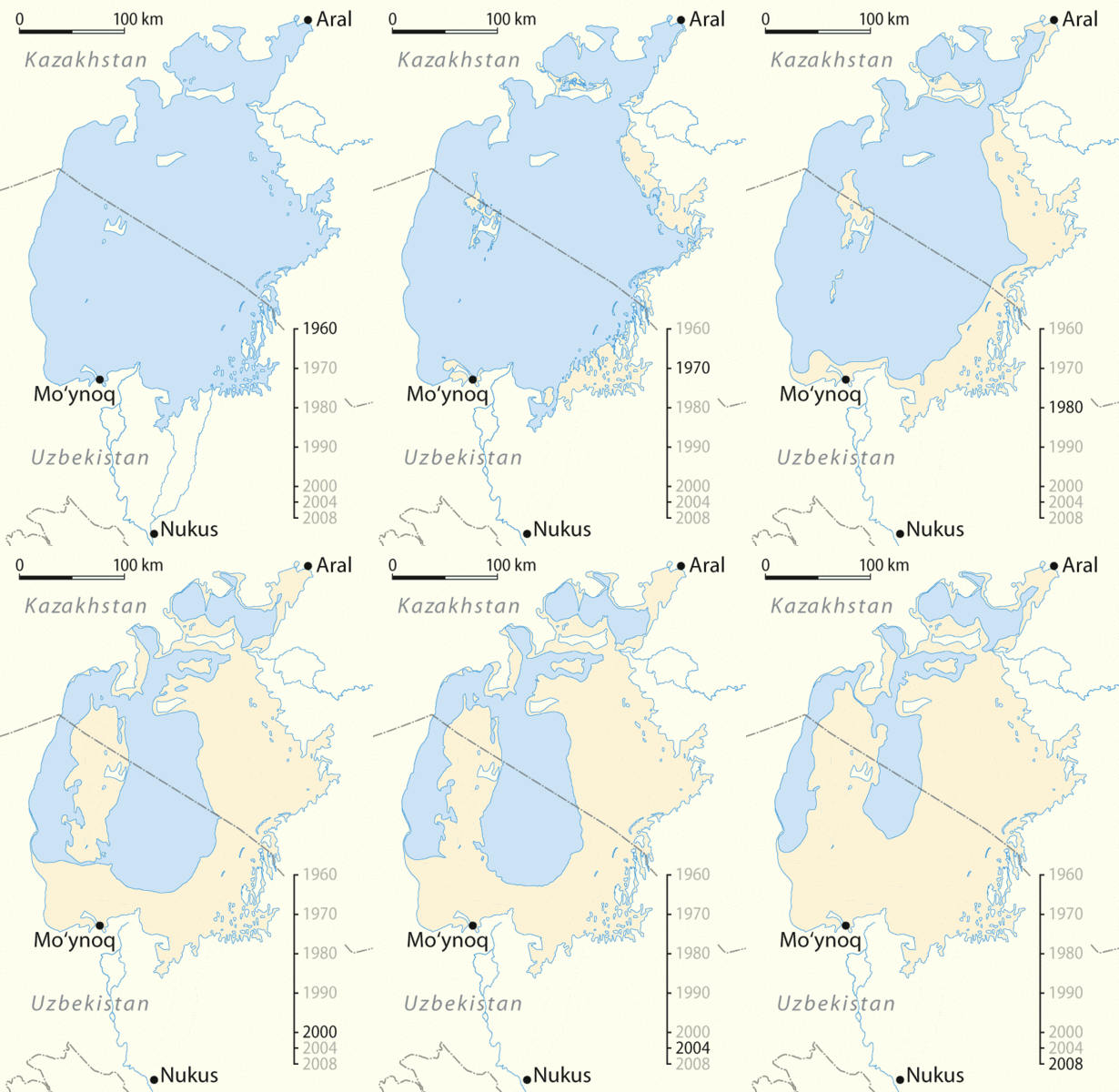
Animated map of the shrinking of the Aral Sea between 1960 and 2008 (via Wikipedia)

But what is the story of socialism and environmentalism?

One only has to look back at the failed experiments of socialism to see just how environmentally catastrophic it has been. As the Soviet Union collapsed and the iron curtain was torn down, the rest of the world finally saw the environmental damage caused by socialist command economies. Economist Jeffrey Sachs stated that the socialist states had “some of the worst environmental problems on the entire globe” All of this, it is worth noting, occurred against a backdrop of a wide array of environmental laws and regulations that supposedly protected the public interest.

Air pollution provides an excellent example. Total greenhouse gas emissions in the USSR in 1988 equated to 79 per cent of the US total. However, the Soviet Union’s gross national product (GNP) was only 54 per cent of the USA’s, according to one very generous estimate (it was, in all likelihood, far less than that). This means that the USSR generated at least one and a half times as much pollution as the USA per unit of GNP (and again, in all likelihood, far more than that).

Accounts of those who travelled across the Soviet Union post-collapse recall swathes of the country where smog clung to the air. An article from Multinational Monitor in 1990 highlighted that 40 per cent of the Soviet people lived in areas where air pollutants, such as carbon dioxide, sulphur dioxide and nickel dioxide, were three to four times the maximum allowable levels.

The destruction of the Aral Sea, perhaps one of the worst environmental disasters, can be directly blamed on the process of socialist planning. In an attempt to make the USSR self-sufficient in cotton production, vast amounts of water were diverted to arid areas for irrigation. Much of the Aral Sea dried up, leaving port cities, Muynak for example, and fishing villages marooned miles from the shore. Worse, the exposure of the salty sea bed and extensive use of pesticides had catastrophic impacts on the health of the local population. Respiratory problems and lung diseases became widespread as people inhaled pollutants.

The Aral Sea in 2000 on the left and 2014 on the right. Photograph: Atlas Photo Archive/NASA

November 24, 2019

QotD: The persistence of culture

Filed under: Education, History, Politics, Quotations — Tags: , , , — Nicholas @ 01:00

The trick to this is not only to give [the people] a fake history. Every tinpot dictator does that. The trick is to give them a fake history starting in kindergarten, that is painted in primary hues and comic-book complexity. There are good guys (the oligarchs who would design society to be more fair) and bad guys (usually capitalists and greedy, they want to “exploit” everyone, which only works if you believe in fixed pie economics and that everyone gets a share at birth, an economic idea so stupid you have to be indoctrinated from birth to believe it.) And everything is explained by “laws” and top down action. Though this history talks about mass movements, and “the people” they don’t actually take THE PEOPLE into account, not with any depth and complexity. The people in this narrative, the entire culture, in fact, is moldable, like butter to the sculpting knife of the powerful.

Societies don’t work that way. Culture doesn’t work that way. In fact culture is so persistent, so stubborn, it leads people to think it’s genetic. (It’s not. A baby taken at birth to another culture will not behave as his culture of origin.) It changes, sure, through invasions and take overs, but so slowly that bits of older cultures and ideas stay embedded in the new culture. It has been noted that the communist rulers of Russia partook a good bit of the Tsarist regime, because the culture of the people was the same and that came through. (They just dialed up the atrocities and lowered the functionality because their ideology was dysfunctional. They blame their failure on Russia itself, but considering how communism does around the world, I’ll say to the extent countries survive it’s because of the underlying culture.)

Sarah Hoyt, “A Generation With No Past”, According to Hoyt, 2017-10-19.

November 17, 2019

QotD: Socialist beliefs about “capitalism”

Filed under: Business, Economics, Government, Politics, Quotations — Tags: , , , , — Nicholas @ 01:00

The poor understanding of economic and political institution that Marx did so much to promote remains widespread today. “Progressive” and hard-left opponents of markets hold mistaken – or, at the very least, questionable – presumptions about reality, which include:

  • Wealth is either fixed in amount, or, while it might be destroyed or diminished by certain human activities (such as war), if wealth grows this growth occurs largely independently of human ideas, choices, actions, and institutions;
  • trade and commerce, therefore, are largely zero-sum – that is, each exchange situation pits a party who will win against one who will lose;
  • trade and commerce, in turn, involve activities are thus, at best, suspect; trade and commerce too often reward greediness and duplicity while penalizing generosity and honesty;
  • the “distribution” of wealth – whether conceived as financial flows or assets, or as access to real goods and services – is determined largely by power;
  • prices set on markets are largely arbitrary; prices seldom play any role beyond determining how much one party “wins” from trade and how much the other party “loses.”
  • each of a handful of large groups of people, mostly as conceptualized by intellectuals with no understanding of economics, has its own “interests” – interests that are shared by all members of the group and that are at odds with the interests of other groups; for example, “labor” has interests that are are shared by all workers and that are at odds with the interests of “employers”;
  • while the state can be captured by ill-intentioned people, the state – especially under unlimited majoritarian rule – is also the only possible savior of the powerless against the predations and frauds of the powerful;
  • absent vigorous state intervention, ordinary people – people whose main asset is the value of their own labor – lack both the power to get their fair share of society’s wealth and the intelligence or self-discipline to use wisely whatever share of wealth they do manage to secure;
  • social progress is achieved by the powerless grabbing power under the leadership of men and women of singular vision, intelligence, and courage; “the People” will be led to the Promised Land – can be led to the Promised Land – only if they faithfully follow their caring messiahs;
  • those who argue in favor of free markets are either soulless mercenary cronies for the powerful propertied class or they are ideologically blinded dupes for this class; no intelligent and decent person could possibly deny the enormous benefits available to “the People” when the state is empowered to work on their behalf against the propertied few.

Don Boudreaux, “Some Links”, Café Hayek, 2017-10-08.

November 13, 2019

QotD: Western culture’s mortal wound

Filed under: Europe, History, Politics, Quotations, WW1 — Tags: , , , — Nicholas @ 01:00

Just about every king tried to do it [explain “where we come from” and “what are we here for”], and there was a serious rewrite of history associated with events like Henry VIII’s break from Rome.

None of those attempts were as total or as successful as the 20th century ones, due to several things. The first was that nations hadn’t had their spirits broken as thoroughly as WWI broke them, so people weren’t willing to lend credence to things spouted from on high with that much eagerness, and things leaked through. HOWEVER the most important thing that the twentieth century had in hand to try to remake culture was this: public education, mass media, mass news reporting.

Did it succeed? No. The only result of trying to mold human beings into the utopian version of the man who would live happily under communism was 100 million graves, and a Europe that is dying of senescence and lack of reproduction.

However it succeeded brilliantly in not only separating, now, I suppose two or three generations from their roots, but also convincing them that they are superior to their actual learned ancestors, and somehow, yet, the product of the worst civilization of human history.

Western culture is dying of WWI partly because the “cure” imposed by state education apparatus, corrupted by Soviet agitprop and continued by “intellectuals” who know nothing except that they’re superior to everyone else, more enlightened, kinder, and that they should design society and the world to “improve” it.

Sarah Hoyt, “A Generation With No Past”, According to Hoyt, 2017-10-19.

October 26, 2019

The Frankfurt School and you

Filed under: History, Politics — Tags: , , , — Nicholas @ 05:00

At Rotten Chestnuts, Severian suggests we consider the origins of a large part of modern progressive thoughts:

Notable members of the Frankfurt School in Heidelberg, April 1964 at the Max Weber-Soziologentag. Max Horkheimer is front left, Theodor W. Adorno front right, and Jürgen Habermas is in the background, right, running his hand through his hair. Siegfried Landshut is in the background left.
Photograph by Jeremy J. Shapiro via Wikimedia Commons.

It occurs to me that Our Thing ought to take a long, hard look at the Frankfurt School.

Those were the guys, of course, who pioneered the notion that their political opponents must be mentally ill. Given that

  • all sane people are good; and
  • good people only want good things; and
  • Socialism is a good thing;

then

  • anyone who doesn’t want Socialism wants a bad thing;
  • therefore is a bad person;
  • therefore is insane.

Anyone with the common sense God gave little catfish recognizes this as begging the question. And not particularly subtle question-begging, either, which is why it took over 1,000 pages (!) of ponderous Teutonic prose to disguise it. It’s science, comrades. Only Socialism, or a .38 to the back of the neck, will cure us …

… assuming, of course, that we want to be cured.

The Frankfurt Schoolers assumed this, of course, as did all those freelance critical theorists running the NKVD’s torture chambers. But that was then. The Frankfurt Schoolers were shockingly bourgeois on so many things. They thought homosexuality was a mental illness, if you can believe it, and I doubt even Herbert Marcuse would’ve signed off on “drag queen story hour,” let alone the state-mandated chemical castration of 6 year old boys. Only the peerless enlightenment of the Current Year recognizes this, comrades.

September 9, 2019

QotD: War

Filed under: History, Military, Quotations, USA — Tags: , , , — Nicholas @ 01:00

The object of warfare is to dominate a portion of the earth, with its peoples, for causes either just or unjust. It is not to destroy the land and people, unless you have gone wholly mad.

Pushbotton war has its place. There is another kind of conflict — crusade, jihad, holy war, call it what you choose. It has been loosed before, with attendant horror but indecisive results. In the past, there were never means enough to exterminate all the unholy, whether Christian, Moslem, Protestant, Papist, or Communist. If jihad is preached again, undoubtedly the modern age will do much better.

Americans, denying from moral grounds that war can ever be a part of politics, inevitably tend to think in terms of holy war — against militarism, against fascism, against bolshevism. In the postwar age, uneasy, disliking and fearing the unholiness of Communism, they have prepared for jihad. If their leaders blow the trumpet, or if their homeland is attacked, their millions are agreed to be better dead than Red.

Any kind of war short of jihad was, is, and will be unpopular with the people. Because such wars are fought with legions, and Americans, even when they are proud of them, do not like their legions. They do not like to serve in them, nor even to allow them to be what they must.

For legions have no ideological or spiritual home in the liberal society. The liberal society has no use or need for legions — as its prophets have long proclaimed.

Except that in this world are tigers.

T.R. Fehrenbach, This Kind of War: A Study in Unpreparedness, 1963.

July 12, 2019

QotD: Warmongers, propaganda, and the intelligentsia

Filed under: Europe, History, Military, Quotations — Tags: , , , , , , — Nicholas @ 01:00

Orwell’s press card portrait, 1943

Our memories are short nowadays, but look back a bit, dig out the files of New Masses or the Daily Worker, and just have a look at the romantic warmongering muck that our left-wingers were spilling at that time. All the stale old phrases! And the unimaginative callousness of it! The sang-froid with which London faced the bombing of Madrid! Here I am not bothering about the counter-propagandists of the Right […]; they go without saying. But here were the very people who for twenty years had hooted and jeered at the “glory” of war, at atrocity stories, at patriotism, even at physical courage, coming out with stuff that with the alteration of a few names would have fitted into the Daily Mail of 1918. If there was one thing that the British intelligentsia were committed to, it was the debunking version of war, the theory that war is all corpses and latrines and never leads to any good result. Well, the same people who in 1933 sniggered pityingly if you said that in certain circumstances you would fight for your country, in 1937 were denouncing you as a Trotsky-Fascist if you suggested that the stories in New Masses about freshly wounded men clamouring to get back into the fighting might be exaggerated. And the Left intelligentsia made their swing-over from “War is hell” to “War is glorious” not only with no sense of incongruity but almost without any intervening stage. Later the bulk of them were to make other transitions equally violent. There must be a quite large number of people, a sort of central core of the intelligentsia, who approved the “King and Country” declaration in 1935, shouted for a “firm line against Germany” in 1937, supported the People’s Convention in 1940, and are demanding a Second Front now.

As far as the mass of the people go, the extraordinary swings of opinion which occur nowadays, the emotions which can be turned on and off like a tap, are the result of newspaper and radio hypnosis. In the intelligentsia I should say they result rather from money and mere physical safety. At a given moment they may be “pro-war” or “anti-war”, but in either case they have no realistic picture of war in their minds. When they enthused over the Spanish war they knew, of course, that people were being killed and that to be killed is unpleasant, but they did feel that for a soldier in the Spanish Republican army the experience of war was somehow not degrading. Somehow the latrines stank less, discipline was less irksome. You have only to glance at the New Statesman to see that they believed that; exactly similar blah is being written about the Red Army at this moment. We have become too civilized to grasp the obvious. For the truth is very simple. To survive you often have to fight, and to fight you have to dirty yourself. War is evil, and it is often the lesser evil. Those who take the sword perish by the sword, and those who don’t take the sword perish by smelly diseases. The fact that such a platitude is worth writing down shows what the years of rentier capitalism have done to us.

George Orwell, “Looking back on the Spanish War”, New Road, 1943 (republished in England, Your England and Other Essays, 1953).

July 5, 2019

QotD: The paradox of tolerance

Filed under: Books, Liberty, Politics, Quotations — Tags: , , — Nicholas @ 01:00

In 1945, the philosopher Karl Popper wrote in his book, The Open Society and Its Enemies that “in order to maintain a tolerant society, the society must be tolerant of intolerance.”

This is now referred to as “the paradox of tolerance.”

Popper argues that unlimited tolerance is self-defeating. If a tolerant society is tolerant of the intolerant, the intolerant will defeat the tolerant. Therefore, tolerance is all well and good, but to defend itself, it must maintain a certain degree of intolerance towards the intolerant.

It it this defense of intolerance that radicals use to justify violence against their political opponents.

If one dares to question the legitimacy of “direct action” from communist groups against their political opponents, these groups will quickly cite this paradox of tolerance. When fascists are shooting up mosques and synagogues, it’s difficult to defend them against mere milkshakes.

Which is why the paradox of tolerance is constantly brought up to defend violence: It’s hard to argue against. Only the most strict pacifist will argue against violence in (the name of) self-defense. Karl Popper was right to point out that a tolerant society that is tolerant toward its enemies will be destroyed.

Nathan Kreider, “Misconceptions of the Paradox of Tolerance”, Being Libertarian, 2019-05-31.

June 24, 2019

QotD: Political dishonesty

Filed under: Politics, Quotations — Tags: , — Nicholas @ 01:00

The thing that strikes me more and more — and it strikes a lot of other people, too — is the extraordinary viciousness and dishonesty of political controversy in our time. I don’t mean merely that controversies are acrimonious. They ought to be that when they are on serious subjects. I mean that almost nobody seems to feel that an opponent deserves a fair hearing or that the objective truth matters as long as you can score a neat debating point.

George Orwell, “As I Please”, Tribune, 1944-12-08.

« Newer PostsOlder Posts »

Powered by WordPress