
The trick to this is not only to give [the people] a fake history. Every tinpot dictator does that. The trick is to give them a fake history starting in kindergarten, that is painted in primary hues and comic-book complexity. There are good guys (the oligarchs who would design society to be more fair) and bad guys (usually capitalists and greedy, they want to “exploit” everyone, which only works if you believe in fixed pie economics and that everyone gets a share at birth, an economic idea so stupid you have to be indoctrinated from birth to believe it.) And everything is explained by “laws” and top down action. Though this history talks about mass movements, and “the people” they don’t actually take THE PEOPLE into account, not with any depth and complexity. The people in this narrative, the entire culture, in fact, is moldable, like butter to the sculpting knife of the powerful.
Societies don’t work that way. Culture doesn’t work that way. In fact culture is so persistent, so stubborn, it leads people to think it’s genetic. (It’s not. A baby taken at birth to another culture will not behave as his culture of origin.) It changes, sure, through invasions and take overs, but so slowly that bits of older cultures and ideas stay embedded in the new culture. It has been noted that the communist rulers of Russia partook a good bit of the Tsarist regime, because the culture of the people was the same and that came through. (They just dialed up the atrocities and lowered the functionality because their ideology was dysfunctional. They blame their failure on Russia itself, but considering how communism does around the world, I’ll say to the extent countries survive it’s because of the underlying culture.)
Sarah Hoyt, “A Generation With No Past”, According to Hoyt, 2017-10-19.
November 24, 2019
QotD: The persistence of culture
November 17, 2019
QotD: Socialist beliefs about “capitalism”
- Wealth is either fixed in amount, or, while it might be destroyed or diminished by certain human activities (such as war), if wealth grows this growth occurs largely independently of human ideas, choices, actions, and institutions;
- trade and commerce, therefore, are largely zero-sum – that is, each exchange situation pits a party who will win against one who will lose;
- trade and commerce, in turn, involve activities are thus, at best, suspect; trade and commerce too often reward greediness and duplicity while penalizing generosity and honesty;
- the “distribution” of wealth – whether conceived as financial flows or assets, or as access to real goods and services – is determined largely by power;
- prices set on markets are largely arbitrary; prices seldom play any role beyond determining how much one party “wins” from trade and how much the other party “loses.”
- each of a handful of large groups of people, mostly as conceptualized by intellectuals with no understanding of economics, has its own “interests” – interests that are shared by all members of the group and that are at odds with the interests of other groups; for example, “labor” has interests that are are shared by all workers and that are at odds with the interests of “employers”;
- while the state can be captured by ill-intentioned people, the state – especially under unlimited majoritarian rule – is also the only possible savior of the powerless against the predations and frauds of the powerful;
- absent vigorous state intervention, ordinary people – people whose main asset is the value of their own labor – lack both the power to get their fair share of society’s wealth and the intelligence or self-discipline to use wisely whatever share of wealth they do manage to secure;
- social progress is achieved by the powerless grabbing power under the leadership of men and women of singular vision, intelligence, and courage; “the People” will be led to the Promised Land – can be led to the Promised Land – only if they faithfully follow their caring messiahs;
- those who argue in favor of free markets are either soulless mercenary cronies for the powerful propertied class or they are ideologically blinded dupes for this class; no intelligent and decent person could possibly deny the enormous benefits available to “the People” when the state is empowered to work on their behalf against the propertied few.
Don Boudreaux, “Some Links”, Café Hayek, 2017-10-08.
November 13, 2019
QotD: Western culture’s mortal wound
None of those attempts were as total or as successful as the 20th century ones, due to several things. The first was that nations hadn’t had their spirits broken as thoroughly as WWI broke them, so people weren’t willing to lend credence to things spouted from on high with that much eagerness, and things leaked through. HOWEVER the most important thing that the twentieth century had in hand to try to remake culture was this: public education, mass media, mass news reporting.
Did it succeed? No. The only result of trying to mold human beings into the utopian version of the man who would live happily under communism was 100 million graves, and a Europe that is dying of senescence and lack of reproduction.
However it succeeded brilliantly in not only separating, now, I suppose two or three generations from their roots, but also convincing them that they are superior to their actual learned ancestors, and somehow, yet, the product of the worst civilization of human history.
Western culture is dying of WWI partly because the “cure” imposed by state education apparatus, corrupted by Soviet agitprop and continued by “intellectuals” who know nothing except that they’re superior to everyone else, more enlightened, kinder, and that they should design society and the world to “improve” it.
Sarah Hoyt, “A Generation With No Past”, According to Hoyt, 2017-10-19.
October 26, 2019
The Frankfurt School and you
At Rotten Chestnuts, Severian suggests we consider the origins of a large part of modern progressive thoughts:
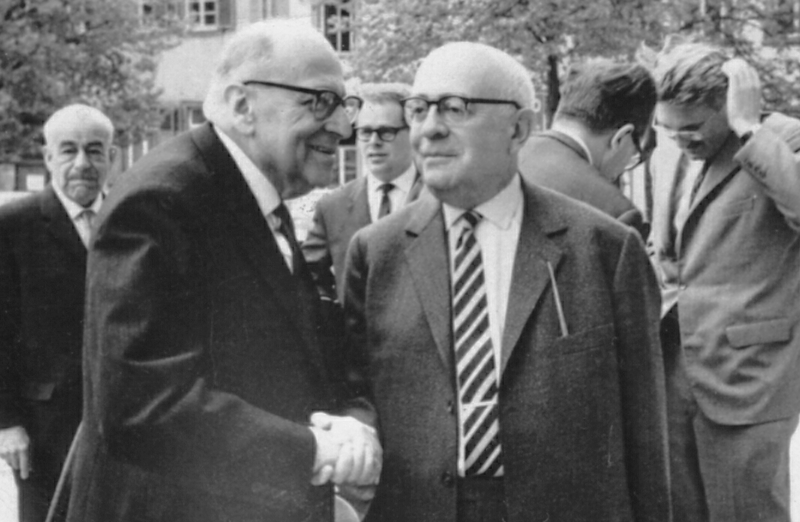
Notable members of the Frankfurt School in Heidelberg, April 1964 at the Max Weber-Soziologentag. Max Horkheimer is front left, Theodor W. Adorno front right, and Jürgen Habermas is in the background, right, running his hand through his hair. Siegfried Landshut is in the background left.
Photograph by Jeremy J. Shapiro via Wikimedia Commons.
It occurs to me that Our Thing ought to take a long, hard look at the Frankfurt School.
Those were the guys, of course, who pioneered the notion that their political opponents must be mentally ill. Given that
- all sane people are good; and
- good people only want good things; and
- Socialism is a good thing;
then
- anyone who doesn’t want Socialism wants a bad thing;
- therefore is a bad person;
- therefore is insane.
Anyone with the common sense God gave little catfish recognizes this as begging the question. And not particularly subtle question-begging, either, which is why it took over 1,000 pages (!) of ponderous Teutonic prose to disguise it. It’s science, comrades. Only Socialism, or a .38 to the back of the neck, will cure us …
… assuming, of course, that we want to be cured.
The Frankfurt Schoolers assumed this, of course, as did all those freelance critical theorists running the NKVD’s torture chambers. But that was then. The Frankfurt Schoolers were shockingly bourgeois on so many things. They thought homosexuality was a mental illness, if you can believe it, and I doubt even Herbert Marcuse would’ve signed off on “drag queen story hour,” let alone the state-mandated chemical castration of 6 year old boys. Only the peerless enlightenment of the Current Year recognizes this, comrades.
September 9, 2019
QotD: War
Pushbotton war has its place. There is another kind of conflict — crusade, jihad, holy war, call it what you choose. It has been loosed before, with attendant horror but indecisive results. In the past, there were never means enough to exterminate all the unholy, whether Christian, Moslem, Protestant, Papist, or Communist. If jihad is preached again, undoubtedly the modern age will do much better.
Americans, denying from moral grounds that war can ever be a part of politics, inevitably tend to think in terms of holy war — against militarism, against fascism, against bolshevism. In the postwar age, uneasy, disliking and fearing the unholiness of Communism, they have prepared for jihad. If their leaders blow the trumpet, or if their homeland is attacked, their millions are agreed to be better dead than Red.
Any kind of war short of jihad was, is, and will be unpopular with the people. Because such wars are fought with legions, and Americans, even when they are proud of them, do not like their legions. They do not like to serve in them, nor even to allow them to be what they must.
For legions have no ideological or spiritual home in the liberal society. The liberal society has no use or need for legions — as its prophets have long proclaimed.
Except that in this world are tigers.
T.R. Fehrenbach, This Kind of War: A Study in Unpreparedness, 1963.
July 12, 2019
QotD: Warmongers, propaganda, and the intelligentsia
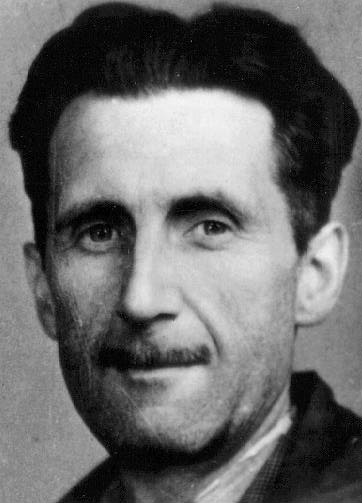
Orwell’s press card portrait, 1943
Our memories are short nowadays, but look back a bit, dig out the files of New Masses or the Daily Worker, and just have a look at the romantic warmongering muck that our left-wingers were spilling at that time. All the stale old phrases! And the unimaginative callousness of it! The sang-froid with which London faced the bombing of Madrid! Here I am not bothering about the counter-propagandists of the Right […]; they go without saying. But here were the very people who for twenty years had hooted and jeered at the “glory” of war, at atrocity stories, at patriotism, even at physical courage, coming out with stuff that with the alteration of a few names would have fitted into the Daily Mail of 1918. If there was one thing that the British intelligentsia were committed to, it was the debunking version of war, the theory that war is all corpses and latrines and never leads to any good result. Well, the same people who in 1933 sniggered pityingly if you said that in certain circumstances you would fight for your country, in 1937 were denouncing you as a Trotsky-Fascist if you suggested that the stories in New Masses about freshly wounded men clamouring to get back into the fighting might be exaggerated. And the Left intelligentsia made their swing-over from “War is hell” to “War is glorious” not only with no sense of incongruity but almost without any intervening stage. Later the bulk of them were to make other transitions equally violent. There must be a quite large number of people, a sort of central core of the intelligentsia, who approved the “King and Country” declaration in 1935, shouted for a “firm line against Germany” in 1937, supported the People’s Convention in 1940, and are demanding a Second Front now.
As far as the mass of the people go, the extraordinary swings of opinion which occur nowadays, the emotions which can be turned on and off like a tap, are the result of newspaper and radio hypnosis. In the intelligentsia I should say they result rather from money and mere physical safety. At a given moment they may be “pro-war” or “anti-war”, but in either case they have no realistic picture of war in their minds. When they enthused over the Spanish war they knew, of course, that people were being killed and that to be killed is unpleasant, but they did feel that for a soldier in the Spanish Republican army the experience of war was somehow not degrading. Somehow the latrines stank less, discipline was less irksome. You have only to glance at the New Statesman to see that they believed that; exactly similar blah is being written about the Red Army at this moment. We have become too civilized to grasp the obvious. For the truth is very simple. To survive you often have to fight, and to fight you have to dirty yourself. War is evil, and it is often the lesser evil. Those who take the sword perish by the sword, and those who don’t take the sword perish by smelly diseases. The fact that such a platitude is worth writing down shows what the years of rentier capitalism have done to us.
George Orwell, “Looking back on the Spanish War”, New Road, 1943 (republished in England, Your England and Other Essays, 1953).
July 5, 2019
QotD: The paradox of tolerance
This is now referred to as “the paradox of tolerance.”
Popper argues that unlimited tolerance is self-defeating. If a tolerant society is tolerant of the intolerant, the intolerant will defeat the tolerant. Therefore, tolerance is all well and good, but to defend itself, it must maintain a certain degree of intolerance towards the intolerant.
It it this defense of intolerance that radicals use to justify violence against their political opponents.
If one dares to question the legitimacy of “direct action” from communist groups against their political opponents, these groups will quickly cite this paradox of tolerance. When fascists are shooting up mosques and synagogues, it’s difficult to defend them against mere milkshakes.
Which is why the paradox of tolerance is constantly brought up to defend violence: It’s hard to argue against. Only the most strict pacifist will argue against violence in (the name of) self-defense. Karl Popper was right to point out that a tolerant society that is tolerant toward its enemies will be destroyed.
Nathan Kreider, “Misconceptions of the Paradox of Tolerance”, Being Libertarian, 2019-05-31.
June 24, 2019
QotD: Political dishonesty
George Orwell, “As I Please”, Tribune, 1944-12-08.
May 11, 2019
Jonathan Haidt – Social media has altered a fundamental constant of the universe
Katie Herzog attended the first Heterodox Academy conference and reports on Haidt, the academy’s founder, and other attendees at the event:
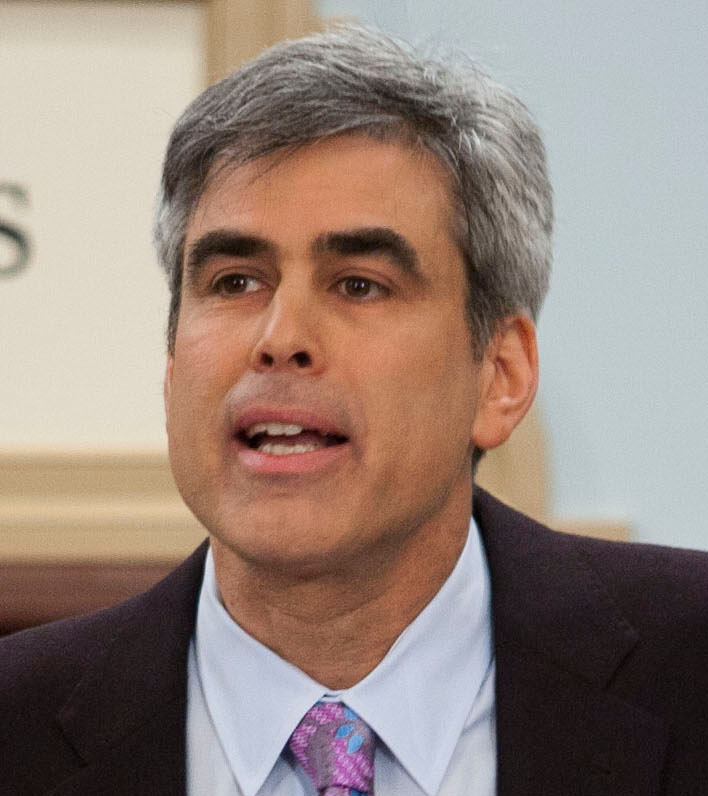
Jonathan Haidt at the Miller Center of Public Affairs in Charlottesville, Virginia on 19 March, 2012.
Photo via Wikimedia Commons.
I told three people that Jonathan Haidt will be speaking in Seattle this week. One is a left-leaning university professor, another is an apolitical meditation teacher, and the last is a conservative talk radio host. Despite the chasm between their personal politics, they were all equally enthusiastic to hear Haidt speak. He seems to have that effect on people, and is one of the rare political thinkers who manages to both appeal to (and occasionally enrage) people across the political spectrum.
A professor of social psychology at NYU’s Stern School of Business, Haidt is also the author of best-selling book, The Coddling of the American Mind, which he published with First Amendment lawyer Greg Lukianoff last year. That book grew out of an article of the same name that the duo first published in the Atlantic in 2015. As anyone who was paying attention back then may recall, the article made quite a splash, and it brought some emerging trends at university campuses into the public consciousness, including the rise of trigger warnings, deplatforming speakers, and university administrators’ attempts to protect students from any perceived harm. The article, and the subsequent book, didn’t exactly make Haidt popular in some hyper-left circles, and Haidt is occasionally accused of being a conservative in disguise. What he actually is, is a centrist, which gives him a perspective outside the typically left/right binary, and much of his recent work is about tribalism and division in the U.S. It’s a trend he thinks is getting worse.
[…]
“If you are in a university that puts you into interaction with diverse ideas, that makes you smarter,” Haidt says. “You can solve more problems. You become a more critical thinker. The more you hang out with people who think like you, especially if they enforce orthodoxy, the lower your IQ gets.”
In other words, only engaging with ideas you already support can actually make you dumber. It can also damage your cause. As an example, Haidt sites student attempts to deplatform both outside speakers and faculty on campuses over the last few years. Video of protests at schools like Evergreen State were widely shared on conservative networks, and while the students may have seen themselves as warriors in the fight for social justice, those who don’t already support their ideals were more likely to see hysterical students screaming at befuddled adults. The backlash was inevitable. “The antics on campus did a lot, I think, to elect Donald Trump,” Haidt says. “Most people on the left have not seen those videos but most people on the right have seen them. And so even if you think it’s virtuous to always be fighting, in the long run, you are harming your own side.”
In an effort to reverse the trend of ideological homogeneity on campus, Haidt founded the Heterodox Academy, an organization that advocates for universities to embrace viewpoint diversity (even, yes, when those viewpoints are conservative). Last year, they hosted the first Heterodox Academy Open Minds Conference in New York, which I attended. (Full disclosure: I moderated a panel, for which I was compensated.)
The conference was remarkable: Everyone I spoke to seemed to have some story about what made them first see that the world isn’t cleanly broken up into good versus evil, from professors who’d been the subject of protests to journalists who’d been canceled. Still, this was a conference mostly made up of academics and writers, and I doubt there was a single stereotypical Trump voter or social justice warrior in attendance. For the sake of viewpoint diversity this is probably a failure, but the organization still managed to bring together a crowd that included conservatives like Bret Stephens and liberals like Alice Dreger and libertarians like Kmele Foster all in one space. There were heated discussions, to be sure, but no one called for anyone else to be fired. This, I am sure, would be appalling to a certain subset of leftist Twitter, but as Haidt reminded me, social media may be loud, but it’s not representative. “We have to distinguish between the average and the visible anecdote,” he said. “This is another thing social media has done to us: We used to have a sense of the mood in a room or the mood in our social network, and now we have no idea.”
Still, he’s not optimistic that we’ll work our way out of these divisions, at least without significant disruption in the process. “Things feel so strange to me,” he said. “It feels as though a fundamental constant of the universe has been altered. I think social media has done that.”
March 21, 2019
Theodore Dalrymple reviews a new Jeremy Corbyn biography
It certainly doesn’t paint a pleasant picture of the man:

Jeremy Corbyn, Leader of the Labour Party speaking at a Rally in Hayfield, Peak District, UK on 25th July 2018 in support of Ruth George MP.
Photo by Sophie Brown via Wikimedia Commons.
In normal circumstances, no one would dream of writing a biography of so dreary a man as Jeremy Corbyn; but political correctness has so eviscerated the exercise of wit that dreariness is no obstacle to political advancement and may even be of advantage to it. The dreary, alas, are inheriting the earth.
Tom Bower is a biographer of eminent living persons whose books tend to emphasise the discreditable — of which he usually finds more than enough to satisfy most people’s taste for salacity. His books are not well-written but they are readable; one sometimes dislikes oneself for enjoying them. So Bower’s latest book Dangerous Hero: Corbyn’s Ruthless Plot for Power, is a bit of a surprise.
Jeremy Corbyn is not a natural subject for Bower because he, Corbyn, is not at all flamboyant and has even managed to make his private life, which has been far from straightforward, uninteresting. Corbyn, indeed, could make murder dull; his voice is flat and his diction poor, he possesses no eloquence, he dresses badly, he has no wit or even humour, he cannot think on his feet, and in general has negative charisma. His main assets are his tolerable good looks, attractiveness to women, and an ability to hold his temper, though he seems to be growing somewhat more irritable with age.
Bower has written a book that is very much a case for the prosecution. If he has discovered in Corbyn no great propensity to vice as it is normally understood, neither has he discovered any great propensity to virtue as it is normally understood, for example personal kindness. His concern for others has a strongly, even chillingly abstract or ideological flavour to it; he is the Mrs. Jellyby de nos jours, but with the granite hardness of the ideologue added to Mrs. Jellyby’s insouciance and incompetence.
[…]
His probity, cruelty or stupidity, might appeal to monomaniacs, but it presages terrible suffering for millions if ever he were to achieve real power: for no merely empirical evidence, no quantity of suffering, would ever be able to persuade him that a policy was wrong or misguided if it were in accord with his abstract principle. This explains his continued loyalty to the memory of Hugo Chavez and to his successor. What happens to Venezuelans in practice is of no interest to him whatsoever, any more than the fate of Mrs. Jellyby’s children were of no interest to her. For Corbyn, the purity of his ideals are all-in-all and their consequences of no consequence.
From a relatively privileged background, he formed his opinions early and has never allowed any personal experience or historical reading to affect them. On any case, according to Bower, he reads not at all: in this respect, he is a kind of Trump of the left. He has remained what he was from an early age, a late 1960s and 70s student radical of the third rank.
His outlook on life is narrow, joyless and dreary. He is the kind of man who looks at beauty and sees injustice. He has no interests other than politics: not in art, literature, science, music, the theatre, cinema — not even in food or drink. For him, indeed, food is but fuel: the fuel necessary to keep him going while he endlessly attends Cuban, Venezuelan, or Palestinian solidarity meetings. He is one of those who thinks that, because he is virtuous, there shall be no more cakes and ale.
March 8, 2019
Education schools and the bloat of university administration
Remember the old joke:
Those who can, do.
Those who can’t, teach.
Those who can’t teach, teach gym educational studies.
As far as higher education is concerned, the joke is on us:
Though I didn’t realize it at the time, those were my first encounters with an alternate curriculum that was being promoted on many campuses, a curriculum whose guiding principles seemed to be: 1) anything that could be construed as bigotry and hatred should be construed as bigotry and hatred; and 2) any such instance of bigotry and hatred should be considered part of an epidemic. These principles were being advanced primarily, though not exclusively, by college administrators, whose ranks had grown so remarkably since the early 1990s.
Everyone knows about the kudzu-like growth of the administrative bureaucracy in higher education over the past three decades. What most don’t know is that at many colleges, the majority of administrators directly involved in the lives of students — in dorms, conduct hearings, bias-response teams, freshmen “orientation” programs, and the like — got their graduate degrees from education schools.
Ed schools, such as Teachers College at Columbia, or Penn’s Graduate School of Education, have trained and certified most of the nation’s public-school teachers and administrators for the past half-century. But in the past 20 years especially, ed schools have been offering advanced degrees in things like “educational leadership,” “higher education management,” and just “higher education” to aspiring college administrators. And this influx of ed school trained bureaucrats has played a decisive role in pushing an already left-leaning academy so far in the direction of ideological fundamentalism that even liberal progressives are sounding the alarm.
To anyone acquainted with the history and quality of American ed schools, this should come as no surprise. Education schools have long been notorious for two mutually reinforcing characteristics: ideological orthodoxy and low academic standards. As early as 1969, Theodore Sizer and Walter Powell hoped that “ruthless honesty” would do some good when they complained that at far too many ed schools, the prevailing climate was “hardly conducive to open inquiry.” “Study, reflection, debate, careful reading, even, yes, serious thinking, is often conspicuous by its absence,” they continued. “Un-intellectualism — not anti-intellectualism, as this assumes malice — is all too prevalent.” Sizer and Powell ought to have known: At the time they were dean and associate dean, respectively, of the Harvard Graduate School of Education.
More than three decades later, a comprehensive, four-year study of ed schools headed by a former president of Teachers College, Arthur Levine, found that the majority of educational-administration programs “range from inadequate to appalling, even at some of the country’s leading universities.” Though there were notable exceptions, programs for teaching were described as being, in the main, weak and mediocre. Education researchers seemed unable to achieve even “minimum agreement” about “acceptable research practice,” with the result that there are “no base standards and no quality floor.” Even among ed school faculty members and deans, the study found a broad and despairing recognition that ed school training was frequently “subjective, obscure, faddish, … inbred, and politically correct.”
January 16, 2019
QotD: Patriotism
Patriotism is the primal love of your country which pre-exists any particular notion about how its political affairs should be arranged. You can espouse a single-payer health care program (or smaller government) as a loyal citizen of Denmark. You cannot, however, be an an American patriot in that same position, though you may be a most excellent Dane. True patriotism does not require us to choose between the many constituent identities that every individual has. But it does require you to decide where your first loyalties lie.
Your patriotism may indeed lead you to advocate various changes in the government, in the belief that this will make it a better place, just as your love of your spouse may cause you to urge them to give up their soul-sucking job in corporate law and pursue the nonprofit career they’ve always dreamed of. But your love of your spouse does not, one hopes, consist primarily of plans for their future or hopes for their improvement. (If it does, you aren’t their spouse; you’re their agent). Patriotism is similar. It can survive substantial disagreement about the reasons for that love, or the sacrifices that love should entail. It can’t survive one half of the partnership declaring that they will only start loving their country after it has perfected itself. As in a marriage, that would be a very long wait.
But shouldn’t we scorn patriotism, which drives us to war and so many other awful things? No more than we should scorn the progressive ideals that have led to so much good social change, and also so much human suffering under various left-wing regimes. Ideals are dangerous things with a tendency to run amok, but no society can live without them. And I submit that no nation can live long without a pretty healthy patriotism — a powerful symbolic identity that transcends the frictions and disagreements which otherwise make it impossible to unite for any common purpose.
Megan McArdle, “In Defense of Trump’s ‘Day of Patriotic Devotion'”, Bloomberg View, 2017-01-26.
January 12, 2019
QotD: Cosmopolitanism and “world citizens”
… as I’ve noted before, the idea of being a “citizen of the world” is nonsense. If you get into trouble in a foreign country, it’s the U.S. embassy that’s required to swoop in to bail you out, not “the world.” Don’t get me wrong; there are many fine people abroad, and many of them may help you. But the U.S. government is the only one that has to, and that makes all the difference.
This should be obvious at a time when that cosmopolitan ideology is failing everywhere. Elites somehow got the idea that national loyalties would fade away and be replaced by a gentle globalism. And indeed, some of the old loyalties did fade away. But it turned out that the alternative to nationalism was not globalism, but particularism — the fracturing of polities into angry tribes that passionately loathe each other. And many in those tribes now demand to know why they should let cosmopolitan elites run things, when those elites declare, as a matter of pride, that they feel no greater loyalty to their fellow citizens than they do to strangers far away.
Megan McArdle, “In Defense of Trump’s ‘Day of Patriotic Devotion'”, Bloomberg View, 2017-01-26.
January 8, 2019
QotD: RINOs and other soft conservatives
The RINOs you complain about are RINOs now but they weren’t always. I don’t know how many of you remember the seventies. The right here was kind of like the right in Europe. It assumed that in the end communism would not only win, but DESERVED to win, and what the right disagreed with was the way to get there. It is useful to remember this was a time when William Buckley’s dictum that conservatism was “Standing astride History yelling stop” found deep resonance. Unpack that phrase. It assumes history comes with an arrow, that it’s not going our way, and that at best we can get it to pause.
Those RINOs who, by the way, took immense flack back then were as conservative as anyone dared to be. Because everyone knew in the end the reds won.
Then the wall fell down and we knew what true horrors lurked on the other side.
Individuals process these things fast enough. Well, my generation, at any rate, awakened by Reagan and shown that the win of the dark side was not inevitable, was more pro-freedom than people ten years older than us.
But when we saw the wall fall down, it pushed many of us further into the liberty side of the isle. Not only wasn’t a communist win inevitable, but their vaunted “strengths” like superior planning and better minority integration didn’t exist unless you really wanted to plan for three million size thirty boots for the left foot only, and integration meant grinding the minorities very fine and spreading them in the soil.
However cultures aren’t individuals. Cultures re-orient and process startling events very slowly.
Yeah, those older Republicans are still with us, and they were over 45 when the wall fell, which means they couldn’t reorient anymore. (Studies have been done.)
Sarah Hoyt, “The Long March”, According to Hoyt, 2015-12-20.
December 18, 2018
Conflicts & Wars In The Aftermath of WW1 I THE GREAT WAR Epilogue
The Great War
Published on 17 Dec 2018In our last epilogue special we outline the wars and conflicts that followed World War 1, some of them immediately and some of them with only a brief period of peace. Even in 1919 it was already clear that “the war to end all wars” didn’t in fact do that and that the new world order would be shaped by violence.
—
hey guys and girls, with this last video, our epilogue series is over and this was the very last episode featuring Indy. Again, this was more meant as an appetizer for the future of the show now. When we filmed this, we didn’t know, yet that we could continue working on the show. We will make an announcement about what to expect next year this week. Cheers Flo
—
– CREDITS –
Presented by: Indiana Neidell
Written by: Indiana Neidell
Director: Toni Steller & Florian Wittig
Director of Photography: Toni Steller
Sound: Toni Steller
Mixing, Mastering & Sound Design: www.above-zero.com
Editing: Toni Steller, Julian Zahn
Motion Design: Christian Graef
Research by: Indiana Neidell
Fact checking: Markus LinkeThe Great War Theme composed by Karim Theilgaard: http://bit.ly/karimyt
A Mediakraft Networks Original Channel
Based on a concept by Spartacus Olsson
Author: Indiana Neidell
Visual Concept: David van Stephold
Producer: Toni Steller & Florian Wittig
Social Media Manager: Florian WittigContains licenced Material by British Pathé
All rights reserved – © Mediakraft Networks GmbH, 2018


