
The intensity with which they are held does not prevent nationalist loyalties from being transferable. To begin with, […] they can be and often are fastened up on some foreign country. One quite commonly finds that great national leaders, or the founders of nationalist movements, do not even belong to the country they have glorified. Sometimes they are outright foreigners, or more often they come from peripheral areas where nationality is doubtful. Examples are Stalin, Hitler, Napoleon, de Valera, Disraeli, Poincare, Beaverbrook. The Pan-German movement was in part the creation of an Englishman, Houston Chamberlain. For the past fifty or a hundred years, transferred nationalism has been a common phenomenon among literary intellectuals. With Lafcadio Hearne the transference was to Japan, with Carlyle and many others of his time to Germany, and in our own age it is usually to Russia. But the peculiarly interesting fact is that re-transference is also possible. A country or other unit which has been worshipped for years may suddenly become detestable, and some other object of affection may take its place with almost no interval. In the first version of H. G. Wells’s Outline of History, and others of his writings about that time, one finds the United States praised almost as extravagantly as Russia is praised by Communists today: yet within a few years this uncritical admiration had turned into hostility. The bigoted Communist who changes in a space of weeks, or even days, into an equally bigoted Trotskyist is a common spectacle. In continental Europe Fascist movements were largely recruited from among Communists, and the opposite process may well happen within the next few years. What remains constant in the nationalist is his state of mind: the object of his feelings is changeable, and may be imaginary.
But for an intellectual, transference has an important function […]. It makes it possible for him to be much more nationalistic — more vulgar, more silly, more malignant, more dishonest — that he could ever be on behalf of his native country, or any unit of which he had real knowledge. When one sees the slavish or boastful rubbish that is written about Stalin, the Red Army, etc. by fairly intelligent and sensitive people, one realises that this is only possible because some kind of dislocation has taken place. In societies such as ours, it is unusual for anyone describable as an intellectual to feel a very deep attachment to his own country. Public opinion — that is, the section of public opinion of which he as an intellectual is aware — will not allow him to do so. Most of the people surrounding him are sceptical and disaffected, and he may adopt the same attitude from imitativeness or sheer cowardice: in that case he will have abandoned the form of nationalism that lies nearest to hand without getting any closer to a genuinely internationalist outlook. He still feels the need for a Fatherland, and it is natural to look for one somewhere abroad. Having found it, he can wallow unrestrainedly in exactly those emotions from which he believes that he has emancipated himself. God, the King, the Empire, the Union Jack — all the overthrown idols can reappear under different names, and because they are not recognised for what they are they can be worshipped with a good conscience. Transferred nationalism, like the use of scapegoats, is a way of attaining salvation without altering one’s conduct.
George Orwell, “Notes on Nationalism”, Polemic, 1945-05.
December 16, 2018
QotD: Transferring nationalist passions
December 11, 2018
Criticizing the left, from the left
In Quillette, Matt Johnson discusses the phenomenon of devoted leftists being willing to criticize their own “side”, and includes a section on George Orwell’s willingness to critique leftists while still being a fully dedicated leftist himself:
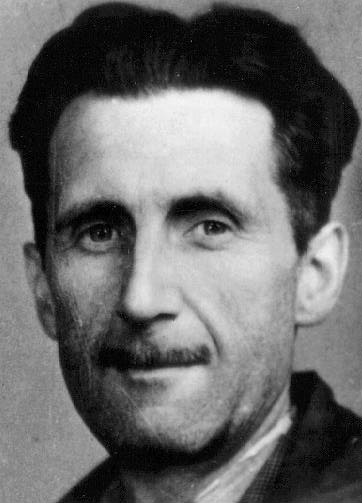
Orwell’s press card portrait, 1943
Bruckner’s remark about “Stalinist blackmail” calls to mind a writer whose commitment to both left-wing politics and anti-totalitarianism never wavered in the face of threats and coercion from the Left.
In the summer of 2003, the BBC aired George Orwell: A Life in Pictures. About halfway through the documentary, Orwell (played by Chris Langham) says, “Every line of serious work that I have written since 1936 has been written, directly or indirectly, against totalitarianism.” This is a line from one of Orwell’s best-known essays, published in 1946, “Why I Write.” But astute viewers may have noticed that something was missing from the reference — eight words that the producers decided to leave out.
Here’s the original sentence: “Every line of serious work that I have written since 1936 has been written, directly or indirectly, against totalitarianism and for democratic socialism, as I understand it.” After the sentence abruptly ends with the word “totalitarianism” in the documentary, Langham takes a long drag on his cigarette before jumping to a different passage of the essay. It was almost as if the producers wanted to accentuate the omission, taunting viewers with their own version of Orwell — one who didn’t have the courage to disclose his true beliefs.
There’s something simultaneously fitting and perverse about the manipulation of Orwell’s words more than half a century after his death (by the BBC, no less). Orwell’s anxiety about the falsification of history is one of the major themes of Nineteen Eighty-Four — as well as much of his other writing and later correspondence — and this is what the producers of the documentary were guilty of doing when they amputated one of his firmest ideological declarations and turned it into a much more palatable and anodyne comment on totalitarianism. No matter how badly some people want Orwell to be a polished and uncontroversial product for mass consumption, he was still the man who wrote these words as he speculated about the possibility of violent revolution in England: “I dare say the London gutters will have to run with blood. All right, let them, if it is necessary.”
Even when Orwell wasn’t in a mood that had him impatiently looking forward to the day “when the red militias are billeted in the Ritz,” he was always honest about his political beliefs. On November 13, 1945, Katharine Stewart-Murray, the Duchess of Atholl, wrote to Orwell asking if he would speak on behalf of an anti-communist organization called the League for European Freedom. This was a month after the publication of Animal Farm — a time when Orwell was worried that the book would be misinterpreted as a broadside against socialism instead of a narrower attack on Stalinism.
Given this context, it isn’t surprising that Orwell declined the duchess’s offer: “Certainly what is said on your platforms is more truthful than the lying propaganda to be found in most of the press, but I cannot associate myself with an essentially Conservative body which claims to defend democracy in Europe but has nothing to say about British imperialism.” Even though Orwell was a staunch anti-communist, his essential political convictions remained immovable: “I belong to the Left and must work inside it, much as I hate Russian totalitarianism and its poisonous influence in this country.”
Orwell was a socialist until the end of his life. For many people, this complicates his legacy and detracts from his pristine image as the twentieth century’s foremost foe of totalitarianism — an image that has been appropriated again and again over the past 70 years.
[…]
But as Orwell was at pains to demonstrate (especially after the publication of Animal Farm), he would have firmly rejected the Right’s attempts to appropriate his legacy. While Orwell is rightly celebrated for his refusal to accept the dogmas of the Left when he was under tremendous pressure to do so, his independence of mind is only one of the reasons why he remains so relevant today. His ability to maintain that independence without sacrificing his most fundamental principles may be even more important.
November 21, 2018
Statistics Canada’s instrumentalist philosophy
In the Financial Post, Bruce Pardy discusses the motivation behind Statistics Canada’s recently revealed demand for the private financial records of half a million Canadians:

Recently it was revealed that Statistics Canada sought to obtain the private banking information of half a million Canadians without their knowledge or consent. Jennifer Robson, professor of political management at Carleton University, in an interview with the CBC, justified the data sweep on the grounds that governments need this information to make good policy. But don’t be concerned, she said, it is not for ideological purposes, since Statistics Canada is ideologically neutral. That made me laugh. The very idea of policy based on data reflects an instrumentalist belief that governments should solve social problems by political means. That requires an ideological confidence in the administrative state, to which the agency is a handmaiden.
Ideology is not a dirty word. An ideology is merely a worldview, a lens through which to perceive society. Political parties, by definition, each have one (and sometimes extra ones for special occasions). But it is another thing for a public agency to act independently in furtherance of its own ideology while pretending to be neutral.
Statistics Canada’s deep dive into banking records — presently on hold while federal privacy commissioner Daniel Therrien investigates its legality — appears not to have been directed by government officials but was undertaken on its own initiative. The agency’s decision is consistent with a conviction that the more personal data available to government, the better off we will be; that governments are benevolent; that private financial matters call for public policy management; and that a bigger government is a better government. A commitment to social policy, wrote Milton Friedman “involves the acceptance of the socialist view that political mechanisms, not market mechanisms, are the appropriate way to determine the allocation of scare resources to alternative uses.”
October 14, 2018
Brendan O’Neill: The Tyrannical Idea of “HATE SPEECH”
PhilosophyInsights
Published on 27 Aug 2017Brendan O’Neill is the editor of Spiked Online and a columnist for The Australian and The Big Issue. This is part of a discussion of hate speech at spiked‘s campus-censorship conference, The New Intolerance on Campus.
You can check out the platform of spiked here: http://www.spiked-online.com/
—
This channel aims at extracting central points of presentations into short clips. The topics cover the problems of leftist ideology and the consequences for society. The aim is to move free speech advocates forward and fight against the culture of SJWs.If you like the content, subscribe to the channel!
September 2, 2018
QotD: Coyote’s first rule of government authority
Never support any government power you would not want your ideological enemy wielding.
Warren Meyer, “Regulatory Deception”, Coyote Blog, 2014-11-12.
July 8, 2018
QotD: Marx on how to run a true communist state
What really clinched this for me was the discussion of Marx’s (lack of) description of how to run a communist state. I’d always heard that Marx was long on condemnations of capitalism and short on blueprints for communism, and the couple of Marx’s works I read in college confirmed he really didn’t talk about that very much. It seemed like a pretty big gap.
[…]
I figured that Marx had just fallen into a similar trap. He’d probably made a few vague plans, like “Oh, decisions will be made by a committee of workers,” and “Property will be held in common and consensus democracy will choose who gets what,” and felt like the rest was just details. That’s the sort of error I could at least sympathize with, despite its horrendous consequences.
But in fact Marx was philosophically opposed, as a matter of principle, to any planning about the structure of communist governments or economies. He would come out and say “It is irresponsible to talk about how communist governments and economies will work.” He believed it was a scientific law, analogous to the laws of physics, that once capitalism was removed, a perfect communist government would form of its own accord. There might be some very light planning, a couple of discussions, but these would just be epiphenomena of the governing historical laws working themselves out. Just as, a dam having been removed, a river will eventually reach the sea somehow, so capitalism having been removed society will eventually reach a perfect state of freedom and cooperation.
Singer blames Hegel. Hegel viewed all human history as the World-Spirit trying to recognize and incarnate itself. As it overcomes its various confusions and false dichotomies, it advances into forms that more completely incarnate the World-Spirit and then moves onto the next problem. Finally, it ends with the World-Spirit completely incarnated – possibly in the form of early 19th century Prussia – and everything is great forever.
Marx famously exports Hegel’s mysticism into a materialistic version where the World-Spirit operates upon class relations rather than the interconnectedness of all things, and where you don’t come out and call it the World-Spirit – but he basically keeps the system intact. So once the World-Spirit resolves the dichotomy between Capitalist and Proletariat, then it can more completely incarnate itself and move on to the next problem. Except that this is the final problem (the proof of this is trivial and is left as exercise for the reader) so the World-Spirit becomes fully incarnate and everything is great forever. And you want to plan for how that should happen? Are you saying you know better than the World-Spirit, Comrade?
I am starting to think I was previously a little too charitable toward Marx. My objections were of the sort “You didn’t really consider the idea of welfare capitalism with a social safety net” or “communist society is very difficult to implement in principle,” whereas they should have looked more like “You are basically just telling us to destroy all of the institutions that sustain human civilization and trust that what is baaaasically a giant planet-sized ghost will make sure everything works out.”
Scott Alexander, “Book Review: Singer on Marx”, Slate Star Codex, 2014-09-13.
March 28, 2018
Ideological Possession
Robin Koerner offers some information on how to diagnose and treat the widespread scourge of ideological possession:
As someone who has long been writing about the threat posed by this all too prevalent epistemic disease, I am delighted to see the attention that is now being paid to it.
Ideological possession is to healthy political discourse as scientism is to science.
The most important thing to know about diagnosing ideological possession is that you can’t do it by looking at the content of the possessing ideology.
As I have said elsewhere, it’s not the content of your belief that makes you dangerous, it’s the way you believe it.
Any ideology has the potential to be deadly when advanced by those who are so sure of their own knowledge and moral outlook that they would impose it against the protestations of those affected by it. To the ideologically possessed, the imposition can always be justified because “it’s the right thing to do,” “it will start working if we keep at it,” “the complaints are coming from bad people,” and so on. (Yes. The logic is as circular as it seems.)
[…]
To protect oneself from the terrible epistemic disease of ideological possession, epistemic nutrition and exercise are extremely effective.
With respect to the former, the regular consumption of great thinkers like J.S. Mill (“He who knows only his own side of the case knows little of that”), George Orwell (“To see what is in front of one’s nose needs a constant struggle”), and Dostoevsky (“Nothing is easier than to denounce the evildoer. Nothing is more difficult than to understand him”) will keep you in good epistemic health. Supplement these basics with a more varied diet of thinkers with whom you disagree on things that matter, and you’ll be in even better shape.
With respect to the latter, a comfortable regime of epistemic exercise — which takes a little time and effort but is immediately rewarding — involves maintaining real friendships with people who have very different assumptions, experiences, and declared moral and political priorities from your own.
The good news is, if you’re chasing Truth hard enough, it is very unlikely that this particular disease will ever catch up with you.
March 8, 2018
Trump’s ideology is more like psychology
Jonah Goldberg on how Trump’s instincts are far more significant to his behaviour than any residual attachment to an ideology:
On the left, there’s an enormous investment in the idea that Trump isn’t a break with conservatism but the apotheosis of it. This is a defensible, or at least understandable, claim if you believe conservatism has always been an intellectually vacuous bundle of racial and cultural resentments. But if that were the case, Commentary magazine’s Noah Rothman recently noted, you would not see so many mainstream and consistent conservatives objecting to Trump’s behavior.
Intellectuals and ideologically committed journalists on the left and right have a natural tendency to see events through the prism of ideas. Trump presents an insurmountable challenge to such approaches because, by his own admission, he doesn’t consult any serious and coherent body of ideas for his decisions. He trusts his instincts.
Trump has said countless times that he thinks his gut is a better guide than the brains of his advisers. He routinely argues that the presidents and policymakers who came before him were all fools and weaklings. That’s narcissism, not ideology, talking.
Even the “ideas” that he has championed consistently — despite countervailing evidence and expertise — are grounded not in arguments but in instincts. He dislikes regulations because, as a businessman, they got in his way. He dislikes trade because he has a childish, narrow understanding of what “winning” means. Foreigners are ripping us off. Other countries are laughing at us. He doesn’t actually care about, let alone understand, the arguments suggesting that protectionism can work. Indeed, he reportedly issued his recent diktat on steel tariffs in a fit of pique over negative media coverage and the investigation into Russian election interference. His administration was wholly unprepared for the announcement.
News emanating from the White House is always more understandable once you accept that Trumpist policy is downstream of Trump’s personality.
March 3, 2018
QotD: Elite incompetence
Most people, most of the time, are perfectly happy to let elites run the country. After all, it seems to make the elites happy to run run things, and as long as they’re reasonably competent at it, and do it reasonably unobtrusively, no one much seems to care. But when elite competence is compromised by faulty ideology and cronyism, people become unhappy. And when the elite response to complaints is dismissal or insult, political problems begin to bloom. People begin to think about politics. They begin to do things. It is no coincidence, as our Soviet friends used to say, that the last decade has seen the rise of the TEA Party, the Occupy Movement, and the Trump phenomenon. People of all political stripes are becoming unhappy.
I think we’re about to watch the elites start paying a price for their incompetence, inattention and contempt. Euroskepticism is on the rise elsewhere in Europe. If EU membership were put to a popular vote in the Netherlands, Spain, or Sweden, there is a good chance that Leave would win there, too. Indeed, it’s possible that a vote to leave the EU might even win in France, the nation for whom creating and strengthening the EU has been the primary policy goal for 60 years.
Perhaps the “Vote Remain, you virulent racist!” PR campaign for staying in the EU needs a bit more thought.
Dale Franks, “Vote Properly, You Virulent Racist!”, Questions and Observations, 2016-06-28.
January 29, 2018
“… those I know in the alt-right crowd dislike [Jordan Peterson] more than the honest progressives I know”
Zachary Slayback tries to discover why so many intellectuals dislike Canadian psychologist Jordan B. Peterson:
I’ve spent the last few years thinking about how to upend higher education and have worked with some leading entrepreneurs and thinkers in this space. Continually, we come back to the question of liberal arts education and its value (remember, I studied philosophy!). Some people are too quick to dismiss liberal arts education as useless and not worth the time. Instead, they insist on purely vocational education. Yet many of the most successful and happiest individuals I know are widely read (rarely because of their college courses), can discuss ideas from Aristotle to Jung to Jacobs with you, and love the idea of entertaining big ideas.
I visited Peterson’s lectures and found them to be nuanced, intricate, and to jump well between clinical experience, psychological research (most of which was well-validated, hard to do in psychology), and Jungian myth interpretation. When he released his Bible lecture series, I found myself, for the first time since I was a child, intimately listening about the ideas that go into religion and how these ideas surface elsewhere in the culture. More than a decade of skepticism towards religious texts due to their shallow readings and uses for the Joel Osteens of the world melted away.
His lectures rarely touch on politics in any capacity. When it gets brought up, he’s quick to note that he does not oppose calling trans individuals by their pronouns but that he opposes having his language dictated by a central political committee. This seems commonsensical to me. Part of what made the American and Canadian traditions so egalitarian is their rejection of forced speech and titles.
And for those who listen to Peterson, he bridges any kind of ideological gap (in fact, those I know in the alt-right crowd dislike him more than the honest progressives I know). Peterson’s worldview is a classical liberal rejection of collectivism (an ideology that killed more than 50 million people in the 20th century alone) while simultaneously not falling into an atomized view of the individual relative to his culture.
Just last week, I met with an acquaintance in San Francisco, the Mecca of American political correctness, who described herself as a “liberal democrat type,” who had listened to and met Peterson at a company event. She admitted that she couldn’t read into his politics and found his talk compelling about the nature of the world, men in it today, and why people like Peterson must appeal to so many people outside the San Francisco and Washington DC bubbles. She was explicit in saying that she was neither a libertarian nor a conservative and still Peterson motivated her to introspect, read into Jungian archetypes, and better understand the culture that shapes the world.
She’s not alone. I regularly speak to friends and acquaintances from across the political spectrum who find value in Peterson’s talks. These are people years out of college (or who never went) who now pick up classics like Dostoyevsky, Jung, Neumann, and even the Bible with a critical intellectual lens. Peterson regularly talks about and shares letters from fans who admit that his moralistic talks inspired them to pull themselves together and “sort themselves out” by figuring out what they want from life and pursuing that. r/JordanPeterson (yes, he has his own subreddit) is filled to the brim with stories of people saying how Peterson helped them get control of their lives and navigate the world.
I’ve bought but not yet read Peterson’s recent book, 12 Rules for Life. It’s not the sort of thing I usually read, so I’m not quite sure what to expect (Indigo says it’ll be delivered tomorrow).
January 20, 2018
January 6, 2018
QotD: The teacher as social worker
Here we come to one of the most pernicious aspects of identity politics as it reshaped the American university — the confusion of teaching with social work. The issue of improper advocacy in the classroom has never been adequately addressed by the profession. Teaching and research must strive to remain objective and detached. The teacher as an individual citizen may and should have strong political convictions and activities outside the classroom, but in the classroom, he or she should never take ideological positions without at the same time frankly acknowledging them as opinion to the students and emphasizing that all students are completely free to hold and express their own opinions on any issue, no matter how contested, from abortion, homosexuality, and global warming to the existence of God or the veracity of Darwin’s theory of evolution. Unfortunately, because of the failure of American colleges and universities to seek and support ideological diversity on their campuses, the humanities faculties have trended so far toward liberal Democrats (among whom I number myself) that they often seem naively unaware that any other beliefs are possible or credible.
Camille Paglia, “The Modern Campus Has Declared War on Free Speech”, Heat Street, 2016-05-09.
September 23, 2017
QotD: Political ideology
Ideological principle is the lifesblood of a political party. The more a party focuses on “electability” and “pragmatism”, the more it cuts its own wrists and drains its own blood. Eventually, the point is reached that the party exists for no reason but to profit the party elite, which is understandably not of interest to anyone outside that elite.
What do the Republicans stand for today?
Pragmatism in politics is like cocaine. A little bit goes a long ways. You not only win, but you feel like an all-conquering tiger. But gradually, you start needing more and more to achieve the same affect, until finally, you overdose and your heart stops.
Vox Day, “The impracticality of pragmatism”, Vox Popoli, 2015-10-24.
August 28, 2017
QotD: Gramscian damage
Americans have never really understood ideological warfare. Our gut-level assumption is that everybody in the world really wants the same comfortable material success we have. We use “extremist” as a negative epithet. Even the few fanatics and revolutionary idealists we have, whatever their political flavor, expect everybody else to behave like a bourgeois.
We don’t expect ideas to matter — or, when they do, we expect them to matter only because people have been flipped into a vulnerable mode by repression or poverty. Thus all our divagation about the “root causes” of Islamic terrorism, as if the terrorists’ very clear and very ideological account of their own theory and motivations is somehow not to be believed.
By contrast, ideological and memetic warfare has been a favored tactic for all of America’s three great adversaries of the last hundred years — Nazis, Communists, and Islamists. All three put substantial effort into cultivating American proxies to influence U.S. domestic policy and foreign policy in favorable directions. Yes, the Nazis did this, through organizations like the “German-American Bund” that was outlawed when World War II went hot. Today, the Islamists are having some success at manipulating our politics through fairly transparent front organizations like the Council on American-Islamic Relations.
But it was the Soviet Union, in its day, that was the master of this game. They made dezinformatsiya (disinformation) a central weapon of their war against “the main adversary”, the U.S. They conducted memetic subversion against the U.S. on many levels at a scale that is only now becoming clear as historians burrow through their archives and ex-KGB officers sell their memoirs.
The Soviets had an entire “active measures” department devoted to churning out anti-American dezinformatsiya. A classic example is the rumor that AIDS was the result of research aimed at building a ‘race bomb’ that would selectively kill black people.
On a different level, in the 1930s members of CPUSA (the Communist Party of the USA) got instructions from Moscow to promote non-representational art so that the US’s public spaces would become arid and ugly.
Americans hearing that last one tend to laugh. But the Soviets, following the lead of Marxist theoreticians like Antonio Gramsci, took very seriously the idea that by blighting the U.S.’s intellectual and esthetic life, they could sap Americans’ will to resist Communist ideology and an eventual Communist takeover. The explicit goal was to erode the confidence of America’s ruling class and create an ideological vacuum to be filled by Marxism-Leninism.
Eric S. Raymond, “Gramscian damage”, Armed and Dangerous, 2006-02-11.
July 20, 2017
Deirdre McCloskey defines libertarianism as “Liberalism 1.0”
The introduction to her “Manifesto for a New American Liberalism, or How to Be a Humane Libertarian” [PDF] states:
I make the case for a new and humane American “libertarianism.”
Outside the United States libertarianism is still called plain “liberalism,” as in the usage of the president of France, Emmanuel Macron, with no “neo-” about it. That’s the L-word I’ll use here. The economist Daniel Klein calls it “Liberalism 1.0,” or, channeling the old C. S. Lewis book Mere Christianity on the minimum commitments of faith (1942-44, 1952), “mere Liberalism.” David Boaz of the Cato Institute wrote a lucid guide, Libertarianism — A Primer (1997), reshaped in 2015 as The Libertarian Mind. I wish David had called it The Liberal Mind.
In desperate summary for you Americans, Liberalism 1.0 is Democratic in social policy and Republican in economic policy and non-interventionist in foreign policy. It is in fact mainly against “policy,” which has to be performed, if there is to be a policy at all, through the government’s monopoly of violence. (To confirm this experimentally, try not paying your taxes; then try to escape from prison.) Liberals 1.0 believe that having little or no policy is a good policy.
That does not put the Liberals 1.0 anywhere along the conventional one-dimensional left-right line, stretching from a compelled right-conservative policy to a compelled left-”liberal” policy. The real liberals instead sit happily up on a second dimension, the non-policy apex of a triangle, so to speak, the base of which is the conventional axis of policy by violence. We Liberals 1.0 are neither conservatives nor socialists — both of whom believe, with the legal mind, as the liberal economist and political philosopher Friedrich Hayek put it in 1960, that “order [is] … the result of the continuous attention of authority.” Both conservatives and socialists, in other words, “lack the faith in the spontaneous forces of adjustment which makes the liberal accept changes without apprehension, even though he does not know how the necessary adaptations will be brought about.”
Liberals 1.0 don’t like violence. They are friends of the voluntary market order, as against the policy-heavy feudal order or bureaucratic order or military-industrial order. They are, as Hayek declared, “the party of life, the party that favors free growth and spontaneous evolution,” against the various parties of left and right which wish “to impose [by violence] upon the world a preconceived rational pattern.”
At root, then, Liberals 1.0 believe that people should not push other people around. As Boaz says at the outset of The Libertarian Mind, “In a sense, there have always been but two political philosophies: liberty and power.” Real, humane Liberals 1.0 […] believe that people should of course help and protect other people when we can. That is, humane liberals are very far from being against poor people. Nor are they ungenerous, or lacking in pity. Nor are they strictly pacifist, willing to surrender in the face of an invasion. But they believe that in achieving such goods as charity and security the polity should not turn carelessly to violence, at home or abroad, whether for leftish or rightish purposes, whether to help the poor or to police the world. We should depend chiefly on voluntary agreements, such as exchange-tested betterment, or treaties, or civil conversation, or the gift of grace, or a majority voting constrained by civil rights for the minority.
To use a surprising word, we liberals, whether plain 1.0 or humane, rely chiefly on a much-misunderstood “rhetoric,” despised by the hard men of the seventeenth century such as Bacon and Hobbes and Spinoza, but a practice anciently fitted to a democratic society. Liberalism is deeply rhetorical, the exploration (as Aristotle said) of the available means of non-violent persuasion. For example, it’s what I’m doing for you now. For you, understand, not to you. It’s a gift, not an imposition. (You’re welcome.)


