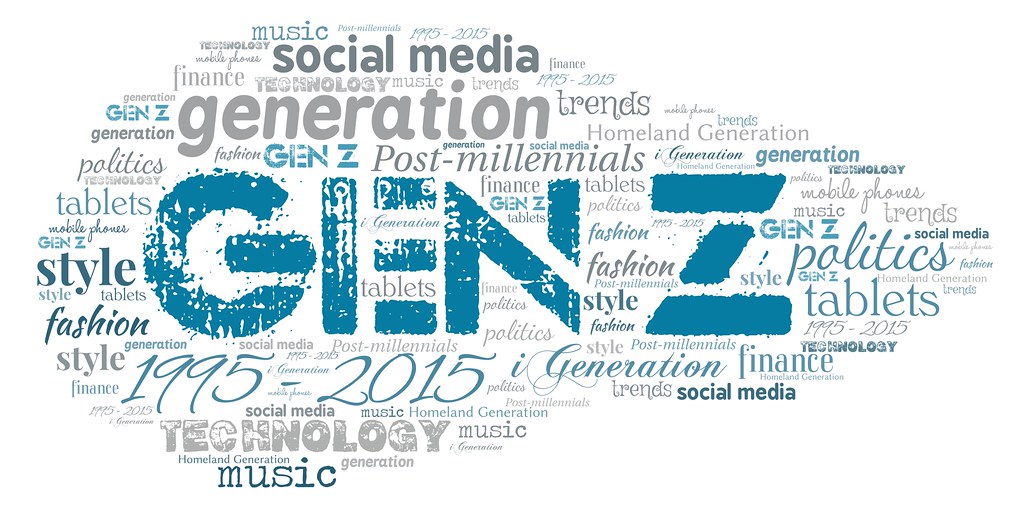
Those born after 1998 are currently (and quite unimaginatively) being called Generation Z. And, by Pew’s math, the eldest members of this nascent generation are turning 18 this year [2017].
Welcome to adulthood, Gen Z!
As one of the oldest members of your immediate ancestors in American youth, I’d like to officially transfer the think-piece mantle your way. As millennials’ misadventures in youthful entitlement and narcissism dwindle, may your place as a scapegoat for societal fears about sex, technology, and general change shine bright. May Gen X prove as much a collective nemesis for you as boomers have so generously done for my generation. And, perhaps most importantly, may you please be patient in a few years when you’re trying to explain to us how to upload a hologram snap to Mind Twitter.
Also, for what it’s worth, millennials may have spawned Facebook, but don’t blame us if Americans are more politically polarized these days. According to another recent generational study, it’s the oldest Americans who have grown the most polarized within their own generation in recent decades. While many people attribute political polarization to social media or the internet more broadly, the study’s authors found that, between 1996 and 2012, the increase in polarization was “largest among the groups least likely to use the internet and social media.” On a nine-point measure of different sorts of polarization, the gap grew by 0.38 index points for respondents ages 75 and older, but just 0.05 index points for adults ages 39 and below.
Lastly, don’t get too comfortable, kids — your generational predecessors are already arriving. Going by Pew’s parameters, the typical generation spans about 17 years … which means that the last of Gen Z babies were likely born in 2016. A new generation starts being born this year.
Welcome to the world, post-Gen Z generation! What a weird, absurdist time to be starting your lives. May we course correct a bit here before you hit adulthood. (Alternately, tell your kids to give President Ivanka’s reanimated corpse and V.P. Chelsea Clinton’s cryogenically frozen head my love, and sorry about the Kardashians. That one really is our fault.)
Elizabeth Nolan Brown, “Welcome to Adulthood, Gen Z: The post-millennial generation starts turning 18 this year, while the eldest members of the post-Gen Z cohort are starting to be born.”, Reason, 2017-03-22.
February 7, 2019
QotD: Generation Z begins to hit adulthood
February 1, 2019
April 13, 2018
The free speech views of “Gen Z”
Sean Stevens and Jonathan Haidt argue that despite many nay-sayers, there really is a freedom of speech crisis on university campuses:
In our first post responding to the skeptics, we showed that the skeptics support their skepticism primarily by relying on data about the Millennial generation (those born 1982-1994). The skeptics are correct that Millennials are not much different than previous generations when asked about free speech issues. We also argued that this debate has nothing to do with Millennials; it is about CURRENT college students, who are not Millennials. By the fall of 2015, most college students (especially at elite four year schools) were members of iGen, the “Internet generation” (sometimes called “Gen Z”), which begins around birth year 1995, and which first arrived at college around 2013.
We noted that the new attitudes about speech — including the idea that speech can be violence (even when it includes no threat), and corresponding requests for safe spaces and trigger warnings — only began to appear on select campuses around 2013 or 2014, and we noted that these ideas only became widely known after the wave of student protests that began at the tail end of 2015. Therefore, we pointed out, it is unlikely that nationally representative samples, drawing on students in America’s 4,700 institutions of higher education, could have picked up any changes before 2015, when colleges were still full of Millennials who had never heard of trigger warnings and microaggressions. We proposed that the best way to evaluate whether or not things have changed on campus is to examine data collected on current college students in 2016 or later, and compare it to data on current college students from 2014 and before.
When we performed such comparisons, we found some evidence that in fact things are changing. There is not yet much data available to make direct comparisons, but the GSS does show a change for the little bit of iGen data that it has (see figure 1 in post 1), and the larger Knight study showed a change just from 2016 to 2017. In this post we do a much deeper dive. We present far more data on current college students and we assess whether the campus climate has changed in the last few years with regard to speaking up and sharing one’s views.
The key question is this: are students and professors today more reluctant than they were a few years ago to share their views or to question dominant views? If so, then there is a climate or culture problem on campuses where that change has occurred. We note that the overall climate can change rapidly even if there has been no change in average attitudes about speech. All that needs to happen is that a small group of students begins imposing social costs on those who say things they don’t like, while at the same time college administrators do nothing to stop them. (For a fuller explanation, see this essay by Lee Jussim, or this one by Nassim Taleb, whose title explains the key point: The most intolerant wins: The dictatorship of the small minority.) If college students are more likely to report the feeling of “walking on eggshells” in the years after 2015 than they did in the years before 2015, then there has been a change in the campus culture, even if the average student’s support for free speech has not changed.