Quotulatiousness

May 21, 2014

Society, socialism, and statism

Filed under: Cancon, Media, Politics — Tags: , , , — Nicholas @ 10:07

At Gods of the Copybook Headings, Richard Anderson refutes the imported “you didn’t build that” notion being pushed by Kathleen Wynne on the campaign trail the other day:

… individual men, women and families are society. So are NGO, private corporations, small businesses and local community groups. All combined are a society. It was the height of intellectual impertinence by the Left to adopt the word socialism. The Left doesn’t believe in society, it believes in the State. It is Statism not Socialism that is their true creed. If you believe in strengthening society then you should believe in freedom because it is freedom that makes a society possible. True socialists are believers in free markets, free minds and free association. Statism is the enemy of society.

Too often the argument is made that either we must be rugged individualists or harmonious collectivists. This is a false dichotomy. One can be perfectly individualistic living in a family and in a community. Individualism is not the same thing as being aloof or standoffish. An individualist can work in a soup kitchen, a corporate office or mowing a lawn. It depends on what values that individual chooses to hold and the abilities he possesses.

By way of contrast there is nothing so inharmonious as collectivism. By denying man’s basic individuality it creates a never ending civil war of all against all. This is why the most collectivist societies are the most violent and repressive. They are fighting a war against human nature and losing all the while. The most peaceful societies are the most individualistic. In these societies individuals choose their partners, employers and friends. Violence is largely unnecessary in a society built on consent. It is necessary only against those who reject the principle of consent.

It’s true that no one makes it completely on their own. That doesn’t diminish their accomplishment, their essential independence or the conceit of those seeking to profit from their success. An individual may live in a society, but that does not make him a slave of the state.

Update: Kevin Williamson hits some of the same notes in this article:

It seems to me that Nozick, like some conservatives and most thinkers on the left, errs by conflating “society” and “state.” He is correct about our obligations to society: We have a positive moral duty to, among other things, care for those who cannot care for themselves. But this tells us very little — and maybe nothing at all — about our relationship to the state. The state is not society, and society is not the state. Society is much larger than the state, much richer, much more complex, much more intelligent, much more humane, and much older. Society, like trade, precedes the state. Government is a piece, but so are individuals, families, churches, businesses, professional associations, newspapers — even Kim Kardashian’s Twitter following plays its role.

[…]

Where those who see the world the way Nozick eventually did go wrong is in failing to appreciate that, absent official coercion, we do not have to take turns expressing those items of importance: The pope can think as he likes about this or that, Stephen Hawking can agree or disagree, and all are free to choose their own adventure. It is only in matters of politics that one set of preferences becomes mandatory.

But mandatoriness seems to be the attraction for many. The most enthusiastic support for the Affordable Care Act, to take one obvious example, never came from those whose main concern was its policy architecture; well-informed and intellectually honest critics left and right both knew that it was a mess. People supported the ACA as an expression of our national priorities, that we were coming to regard health insurance as something akin to a right, that we were becoming more like the European welfare states that our remarkably illiberal so-called liberals admire, that we regarded insurance companies and insurance-company profits as a nastiness to be scrubbed away or at least disinfected. The policy has been revealed as a mess, but the same people support it for the same reason. Similarly, prosecuting as civil-rights criminals those who do not wish to bake cakes for gay weddings is mainly an act of communication, that one is no longer free to hold certain opinions about homosexuals. The new enlightenment is mandatory.

[…]

The mysticism surrounding the state — its near-deification — is a source of corruption, to say nothing of boneheadedness. If the state is to be an instrument for expressing our deepest longings, values, and moral sentiments, then there can be no peace — our values are, as Nozick noted, frequently irreconcilable, and only a philosopher could believe that we can take turns when it comes to abortion or wealth confiscation. That is not how things work. If, on the other hand, the state is a machine for protecting property — from thieves, invaders, and possibly the more energetic members of the American Bar Association — then we can have peace, at least a measure of it. Outside of certain very well-defined parameters, nobody’s values need be mandatory.

May 16, 2014

Narendra Modi wins in a landslide

Filed under: India, Politics — Tags: , — Nicholas @ 08:08

The Economist reports on the first election in India to produce a single-party majority since 1984:

“INDIA has won” tweeted Narendra Modi, on May 16th, his first public comment after official counting from India’s general election made it clear that he, and his Bharatiya Janata Party, had delivered a landslide victory beyond the expectations of almost everyone. The scale of the BJP win was remarkable. It swept entire states, including Rajasthan, Delhi, Gujarat, Himachal Pradesh, Uttarakhand. More importantly it made enormous strides in two crucial, and massive, northern states, Uttar Pradesh and Bihar. There not only did Congress do disastrously, regional parties were also badly walloped. As of lunch time, it appeared that the BJP and its closest allies (known as the NDA) would have 324 seats of the 543 parliament, with the BJP alone getting 275. BJP spokesmen called that, rightly, a “tectonic shift in the polity of India”. It is the first time since 1984 that a single party has enough seats to rule alone.

Much is made is the importance of Mr Modi as a leader, who inspired great enthusiasm among the voters, especially youngsters. Clearly, too, there is demand for a stronger economy and more development. So strong is his victory, it might be no other party has enough seats to serve automatically as the opposition, since to lead it in parliament you need at least 10% of the seats, and Congress’s total haul might include even fewer than that. The array of ministers and prominent figures in Congress who have lost their seats is impressive. Mr Modi will give speeches and enjoy victory parades, first in Gujarat (where he has already visited his mother to get her blessings), then on May 17th in Varanasi. He may be sworn in as prime minister on May 21st, though obviously he hardly need wait to start forming a government and picking his ministers.

So lopsided is the outcome that enormous expectations will now rest on the BJP and Mr Modi to start delivering changes quickly. The vote share claimed by the BJP, some 35% nationally, is enormous by Indian standards. Combined with an historically high turnout, at 64%, it gives Mr Modi a huge mandate for his rule. Nor does it seem that any other party can offer any serious opposition to him. Congress is in tatters and its leaders must think seriously about its future role in politics. Rahul Gandhi, despite early signs that he was behind in his own constituency, at least appeared able to hold on there. But his margin of victory appeared to be hugely reduced. The Aam Aadmi Party, born of an anti-corruption movement, has at least claimed one MP (and perhaps several) in Punjab.

Update: Dave Weigel reminds us about Rahul Gandhi’s “total implosion in the worst interview ever”.

The debut of John Oliver’s Last Week Tonight, an exciting moment for the Slate demo, spent a good while shaming American media for ignoring India’s election. This was just, and right, and true — lots of things are more interesting than Hillary Clinton’s set speeches at charity events, not least the fate of the world’s largest democracy. And Oliver got the gist of the election, which was that the charismatic Narendra Modi would lead a right-wing coalition into power over the ruling Congress Party. That happened.

My only quibble with Oliver was how he described Rahul Gandhi, the man who led Congress to defeat. To be fair, the party was doomed by corruption and slowing economic growth, and Gandhi was given… I was about to write “a poisoned chalice,” but that seems like a gauche analogy for a man whose father and grandmother were assassinated in office. But Oliver quickly described Rahul as an “Indian Han Solo” and a man with the “total political package.”

This was not the whole story. Gandhi was sort of a disaster, a groomed yet unprepared candidate who never recovered from a nightmare interview with TV host Arnab Goswami. The whole gruesome thing is online, and the transcript is here. Both offer their own flavors of cringe comedy, from the start, when Gandhi struggles to explain why he’s doing his first-ever TV interview after 10 years in office.

May 11, 2014

Ontario politics: “Insular, petty and involves a cast of characters you wouldn’t want to meet wandering down a dark alley”

Filed under: Cancon, Politics — Tags: , , , , — Nicholas @ 10:02

It’s election season once again in Ontario, and Richard Anderson looks at the current state of play:

I know most of you can’t stand Ontario politics.

Especially those of us who live here…

It’s insular, petty and involves a cast of characters you wouldn’t want to meet wandering down a dark alley. Still it’s the largest province in Confederation so attention must be paid, however grudgingly.

The last decade of provincial politics has revolved around the astonishing acrobatics of the McGuinty-Wynne Liberals. They have lied, overspent and borrowed to an extent without precedent in English speaking Canada. Those of us who remember the Bob Rae years had assumed that they had seen the worst. Apparently it wasn’t. After a brief house cleaning under Harris-Eves we were returned to spendthrift form. The provincial debt has doubled in ten years. Nothing else in Ontario has grown anywhere near as fast.

A political party that was this incompetent, this obviously corrupt, would you think be headed for certain defeat at the polls. Transforming the engine of the Canadian economy into its busted leg took some doing. A treasure trove of natural resources, close proximity to the largest American markets and a highly skilled workforce. Ontario has, what seemed until recently, to be nearly indestructible advantages. A pack of Gibbonese monkeys could be running the show at Queen’s Park and the economy, somehow, would still keep moving along.

But no one saw Dalton McGuinty coming. How could they? With the personality of a mediocre non-entity and the political cunning of a dishonest child, he won two majority governments and narrowly missed a third. How has been something of a mystery. The Dalt had certain inborn advantages. His sheer nebbishness made him seem unthreatening. Yet here we stand at the bottom of a deep hole he himself dug. There were, of course, his weak and bungling rivals. Ernie Eves looked and sounded like an unenthusiatic version of Gordon Gekko. John Tory’s ability to self-destruct is near legend. Tim Hudak isn’t a real boy at all.

Yet the greatest advantage that Dalton McGuinty had, and which Kathleen Wynne retains, is the electorate. There is no greater advantage to a scheming and incompetent politician than a disengaged and misinformed electorate. That describes the voters of Ontario almost perfectly. This might seem a tad puzzling to some. Generations of Canadian voters have been been able to hold their governments to rough account. Semi-literate frontier farmers were able to follow the twists and turns of the Pacific Scandal and send John A, temporarily, packing. Today the ordinary voter sees greater crimes and follies with nary a batted eye.

April 27, 2014

Gerrymandering

Filed under: Books, Politics, USA — Tags: , , , , — Nicholas @ 09:49

Former US Supreme Court Justice John Paul Stevens has published a book in which he calls for certain amendments to the constitution, one of which is quite appealing:

1. Requiring that congressional and state legislative districts be “compact and composed of contiguous territory” to stop both parties from carving out safe seats.

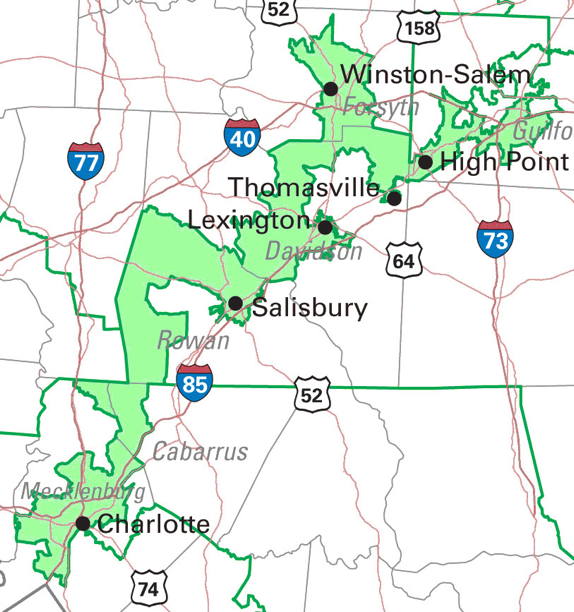
US electoral districts can be particularly odd creatures. In a post from 2010, Zombie looks at the “top ten” gerrymandered districts … and they’re hard to believe. Here’s North Carolina-12, number 10 on the list:

This is what most people imagine when they think of a gerrymandered district — what I call “Gerrymander Classic.” NC-12 looks very much like the gerrymandered districts of the 19th century, but taken to extremes. As bad as it is, NC-12 at least looks like a congressional district, with meandering lines, consistent width, and hand-drawn appearance. As we’ll soon see, modern gerrymandering is often another animal altogether, with jarring shapes and artificial boundaries that are not just offensive to the eye but somehow feel like an insult to rationality.

This is what most people imagine when they think of a gerrymandered district — what I call “Gerrymander Classic.” NC-12 looks very much like the gerrymandered districts of the 19th century, but taken to extremes. As bad as it is, NC-12 at least looks like a congressional district, with meandering lines, consistent width, and hand-drawn appearance. As we’ll soon see, modern gerrymandering is often another animal altogether, with jarring shapes and artificial boundaries that are not just offensive to the eye but somehow feel like an insult to rationality.

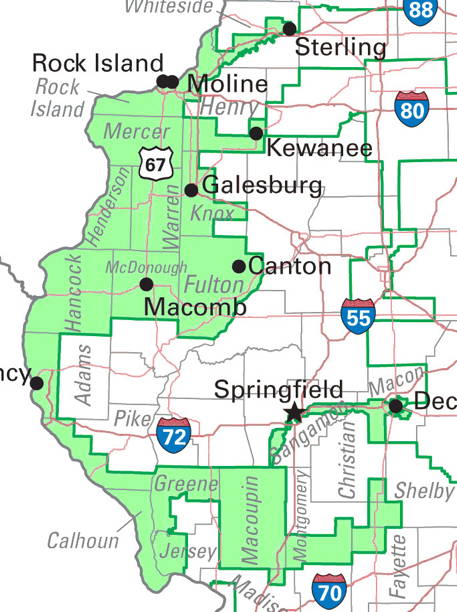
Coming in at number 5, it’s Illinois-17:

Political scientists love to cite IL-17 as the prototypical gerrymandered district, and you are likely to see IL-17 used as the illustration in many academic treatises about redistricting. And we can see why here. Its shape has often been described as “a rabbit on a skateboard,” though to me it looks more like an embryonic ichneumon wasp with a pancreatic cyst. We saw above how PA-12 was a gerrymandering blunder by the Republicans; IL-17 is the opposite, a gerrymandered district created by Democrats to ensure themselves a seat in western Illinois — but which this year was snatched from their grasp by Tea Party candidate and now congressman-elect Bobby Schilling. Ooops! The Democrats went out on a limb when drawing IL-17 — several limbs, by the looks of it — but the wave election of 2010 changed the electoral landscape. Let me repeat my warning to over-confident redistricters next year: THINGS CHANGE. Gerrymander at your own risk.

Political scientists love to cite IL-17 as the prototypical gerrymandered district, and you are likely to see IL-17 used as the illustration in many academic treatises about redistricting. And we can see why here. Its shape has often been described as “a rabbit on a skateboard,” though to me it looks more like an embryonic ichneumon wasp with a pancreatic cyst. We saw above how PA-12 was a gerrymandering blunder by the Republicans; IL-17 is the opposite, a gerrymandered district created by Democrats to ensure themselves a seat in western Illinois — but which this year was snatched from their grasp by Tea Party candidate and now congressman-elect Bobby Schilling. Ooops! The Democrats went out on a limb when drawing IL-17 — several limbs, by the looks of it — but the wave election of 2010 changed the electoral landscape. Let me repeat my warning to over-confident redistricters next year: THINGS CHANGE. Gerrymander at your own risk.

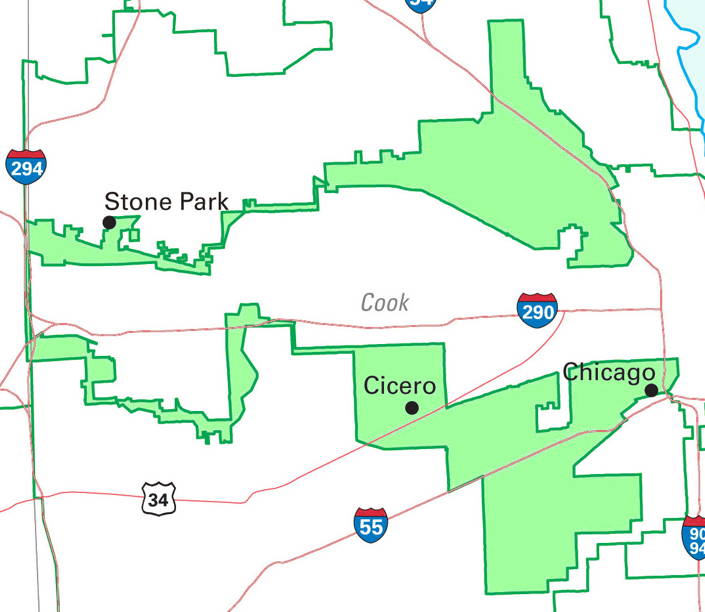
And finally, the circa 2010 winner of the most gerrymandered district in the United States award, Illinois-4:

Here it is: The most ridiculous congressional district in the entire country. No, you’re not looking at two districts; IL-4 has two absurdly gerrymandered halves held together by a thin strip of land at its western edge that is nothing more than the median strip along Interstate Highway 294. The end result is a gerrymandered gerrymander, a complete mockery of what congressional representation is even supposed to be. As with AZ-2, the intention behind IL-4 was to create an ethnic enclave, in this case an Hispanic-majority district within an otherwise overwhelmingly non-Hispanic Chicago. Problem is, Chicago has two completely distinct and geographically separate Hispanic neighborhoods — one Puerto Rican, the other Mexican — but neither is large enough to constitute a district majority on its own. Solution? Lump all Hispanics together into a supposedly coherent cultural grouping, and then carefully draw a line surrounding every single Hispanic household in Chicago, linking the two distant neighborhoods by means of an uninhabited highway margin. Voila! One Hispanic congressperson, by design. And as a side-effect, the most preposterous congressional district in the United States.

Here it is: The most ridiculous congressional district in the entire country. No, you’re not looking at two districts; IL-4 has two absurdly gerrymandered halves held together by a thin strip of land at its western edge that is nothing more than the median strip along Interstate Highway 294. The end result is a gerrymandered gerrymander, a complete mockery of what congressional representation is even supposed to be. As with AZ-2, the intention behind IL-4 was to create an ethnic enclave, in this case an Hispanic-majority district within an otherwise overwhelmingly non-Hispanic Chicago. Problem is, Chicago has two completely distinct and geographically separate Hispanic neighborhoods — one Puerto Rican, the other Mexican — but neither is large enough to constitute a district majority on its own. Solution? Lump all Hispanics together into a supposedly coherent cultural grouping, and then carefully draw a line surrounding every single Hispanic household in Chicago, linking the two distant neighborhoods by means of an uninhabited highway margin. Voila! One Hispanic congressperson, by design. And as a side-effect, the most preposterous congressional district in the United States.

The kicker? Those ten are at least legal in that they’re contiguous. Zombie goes on to show some even more outrageous examples where that requirement is blatantly ignored.

April 24, 2014

UKIP’s Nigel Farage as the Tories want you to see him

Filed under: Britain, Humour, Politics — Tags: , , , — Nicholas @ 09:25

The Torygraph‘s Tom Chivers has unearthed a photo that will shake the very foundations of the British political scene!

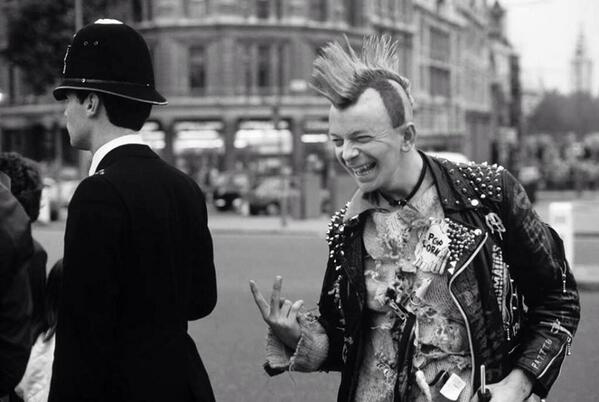
Prepare to be AMAZED. The photo of Nigel Farage that the Ukip ESTABLISHMENT didn’t want you to see:

Nigel Farage as a punk

It’s not so much the fact that he’s such an awful rebel, with no respect for the great British institution of the police, that’s embarrassing for the Ukip leader. The real problem is that this photo was apparently taken in 1983 and Mr Farage still looks about 40.

Of course, it’s not just this damning and clearly not at all Photoshopped photo, which has been doing the rounds on Twitter because of its obvious veracity. There are dozens of equally upsetting Farage photos which his party apparatchiks have been desperately trying to ban.

April 15, 2014

“You want to go into politics to fix public finances and put things in order? Fine. But to pump your fist and say you want a country? Tabarnac

Filed under: Cancon, Politics — Tags: , , , — Nicholas @ 07:30

In Maclean’s, Martin Patriquin reflects on the disaster for the separatist cause that was the Quebec election:

Sovereignty isn’t dead. It is impossible, sovereignists themselves often say, to kill a dream shared by a rock-ribbed 30 per cent of the population. Rather, Quebec’s sovereignty movement goes through fits and starts, peaks and valleys, a sleeping giant that can wake up and roar at a moment’s notice.

[…]

In this respect, the mortal enemy of the sovereignty movement isn’t the Liberal Party of Quebec, the Trudeau family, the federal government, Quebec’s immigrant population or any of the other central casting nightmares conjured up by the sovereignist movement over the years. No, the real enemy is the march of time.

As such, the sovereignty movement was pushed that much closer to obsolescence with the recent election. This Liberal win, like all Liberal wins past, means no serious talk of referendum, sovereignty or separation for four years at least. Decimated and leaderless, the PQ ranks will likely have to suffer through a wrenching leadership campaign before turning its sights on Philippe Couillard’s Liberals. PQ strategists will have to explain the party’s rudderless, error-prone election campaign that tanked its relative popularity in the space of a month. In the longer term, the PQ MNAs will have to answer for the party’s so-called Quebec values charter, which many feel targeted Quebec’s religious minorities­—and in all likelihood hurt the party’s chances of moving beyond its white, francophone base. All of this will take time, which isn’t on the PQ’s side.

It wasn’t supposed to be like this. Buoyed by a jump in the polls and a listless showing by Liberal Leader Couillard, Marois confidently called an election on March 5 with every expectation of getting a majority government. Instead, she (and the province) got a quick and nasty campaign dominated by referendum chatter and the short-term economic tremors it inevitably causes. The mere mention of an election last fall caused Montreal’s real estate market to dip.

Without a doubt, the turning point in the campaign was the press conference to introduce superstar PQ candidate Pierre Karl Péladeau:

The smart political strategist would do the following: put Péladeau on a stage and make him talk strictly about how he transformed Videotron from a Podunk cable company beset by labour troubles into the province’s leading cable and wireless concern. In the vacuum of a month-long election campaign, Péladeau the businessman could easily hide the red-ink-stained legacy of the PQ’s 18 months in power.

Instead, we got Péladeau the Quebec separatist. On a chilly Monday morning three days into the campaign, Péladeau took the stage with Pauline Marois and, after a 13-minute speech vaunting his economic record and the beauty of his riding of St-Jérôme, he uttered 30 words that would overshadow his campaign and that of his newly adopted party. “Finally, I end by telling you that my membership in the Parti Québécois is in line with my most profound and intimate values,” he said in French. “That is to say, make Quebec a country!”

[…]

In the immediate aftermath of Péladeau’s declaration, Marois mused that citizens of a separate Quebec would have their own Quebec passport; people and goods would flow freely over the open and undefended borders with Canada. Quebec would use the Canadian dollar, and lobby for a seat with the Bank of Canada. Her strategists quietly put an end to Marois’s flights of fancy within 48 hours, but the damage was already done. And it was irreversible.

In Quebec City, Péladeau’s candidacy should have hearkened a return of the PQ in what has been a bastion for the right-of-centre Action Démocratique du Quebec party and its successor, the CAQ, led by former PQ minister François Legault. Yet Péladeau seemingly did himself in with those 30 words in this surprisingly conservative and federalist region and beyond. “I’m so disappointed in the guy it’s ridiculous,” says Mario Roy, an insurance broker and sometimes radio DJ, who in 2010 worked on a campaign with Péladeau to bring an NHL team to Quebec City. “You want to go into politics to fix public finances and put things in order? Fine. But to pump your fist and say you want a country? Tabarnac.”

April 12, 2014

Charles Stross solves the GOP’s 2016 candidate dilemma

Filed under: Humour, Politics, Russia, USA — Tags: , , — Nicholas @ 09:40

No really:

Now, it occurs to me that the Republican Party over in the USA have a bit of a problem coming up in 2016, namely who to run against Barack Obama’s successor. Whoever they are. (Hilary is looking a little old and Al’s cardboard has mildew.) But the RNC isn’t in good shape. They don’t have anybody out front with the charisma of the Gipper (dead or alive), or the good ole’ boy appeal of George W. Bush: just a bunch of old white guys in dark suits who’re obsessed with the size of their wallets and the contents of every woman’s uterus, or vice versa. Guys who make Karl Rove look like Johnny Depp.

And so it occurred to me (after my fifth pint of IPA) to spin my speculative political satire around the fact that there is only one man on the global political scene today who has what it takes to be a plausible Republican candidate for President Of The United States at the next presidential election.

This man:

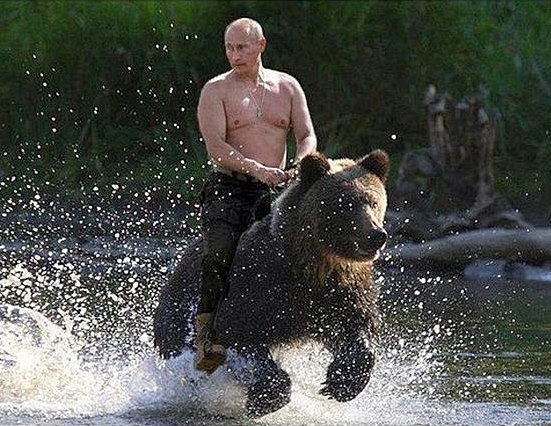
Vladimir Putin riding a bear

Vladimir Vladimirovitch Putin.

Let me enumerate the ways in which this man makes sense as a candidate. He’s only 62 years old—not as youthful as Barack Obama, but still well within the age range for POTUS. He has proven experience of leading an aggressive, declining, former military superpower bristling with nuclear weapons and suffering from eating disorders and a tendency to binge on breakaway republics when nobody is looking. As a former KGB Colonel he understands the needs of the security state like no US president before him, except possibly George H. W. Bush (a former Director of the CIA); he’s exactly the right man to be in charge of the NSA, post-Snowden. As a Russian he clearly likes his tea, so he’ll go down well with that wing of the party. Nobody can accuse him of being soft on terrorism, or communism, or gay rights. Nobody can question his virile, macho manhood either, not with his state-run press agency circulating photographs of him bareback-riding a bear. He’s an instinctive authoritarian, a daddy figure, totally in love with god, guts, and guns — and if anyone says otherwise he’ll put powdered Polonium in their soup.

Oh, but it gets better

April 10, 2014

New poll shows PCs leading Liberals in Ontario

Filed under: Cancon, Media, Politics — Tags: , , , , , , — Nicholas @ 08:46

As always with polls, take a big pinch of salt before you take them too seriously:

A new poll suggests Ontario’s Progressive Conservatives have taken the lead in popular support over the Liberals in the wake of the gas plant scandal, according to a published report.

A Forum Research poll conducted for the Toronto Star suggests Tim Hudak’s Tories have 38 per cent of support, versus 31 per cent for the Liberals. Andrea Howarth’s New Democrats are at 23 per cent.

Two weeks ago, Premier Kathleen Wynne’s Liberals led with 35 per cent of support, while the Tories were at 32 per cent and the NDP at 25 per cent.

The surge is attributed mainly to the simmering gas plants scandal.

“It’s almost all due to the scandal over the deletion of those emails concerning the gas plants,” Forum president Lorne Bozinoff told 680News.

The poll also reveals that 45 per cent of those surveyed believe Wynne knew about the alleged deleting of emails related to the gas plants.

It also found that 47 per cent believe she ordered deletions.

“We did ask was the premier aware — a lot of people believe the premier was aware,” Bozinoff said.

“We also asked if people think a crime has been committed and a lot of people also think a crime has been committed.”

Of course, as long as Horwath’s NDP continue to prop up the Liberals, there won’t be a provincial election … and I doubt Horwath sees much chance of improvement over the current poll numbers. The only way the Ontario NDP will topple the government is if the scandal gets worse: the NDP can get more of their agenda passed by the Liberals than they could in a Conservative legislature, but the NDP can’t afford to look as though they’re in any way complicit in covering up wrongdoing — that would offend their base even more than it would offend undecided voters.

Update: This is one of the reasons you need to take poll numbers with a degree of skepticism:

April 8, 2014

“It’s important to understand the scale of the calamity that has befallen the Parti Québécois”

Filed under: Cancon, Politics — Tags: , , , — Nicholas @ 07:02

Paul Wells on the electoral catastrophe for the PQ in yesterday’s provincial election:

Its share of the popular vote, as I write this, is solidly below the 28% the party won in 2007 when André Boisclair was its leader. This is, in fact, the PQ’s worst election result, in share of popular vote, in 44 years. The only time it ever did worse was in 1970, the first campaign the party ever fought.

Philippe Couillard did not have a flawless campaign but he has a full majority term to get the hang of premiering. And Quebec usually re-elects incumbent governments once. In fact, Pauline Marois becomes the first Quebec premier to fail to be re-elected since the 1920s.

But these are garden-variety problems. The PQ’s woes go much deeper still. It is now 15 years since the party won more than 40% of the popular vote; the Liberals did so in 2008 and again tonight. This is because the PQ sits on a policy it cannot sell: secession from Canada. But now it has added a second unsellable policy to its kit bag: a plan to fire librarians and emergency-room physicians if it is possible to tell by looking at them which religious faith they practice.

[…]

On all three policies — secession, coercive state atheism, and university tuition — the PQ is stuck between an electorate that doesn’t agree, and a party base that will not retreat. Compounding the near-guarantee of further PQ grief still further is its insufferable belief in its own infallible mind meld with the Québécois collective conscience. The PQ knows better than anyone on sovereignty, secularism and higher education. Or so its members tell themselves. So it will not abandon policies the broader Quebec population, including much of the francophone majority, finds risible.

The PQ is in clear danger of becoming Quebec’s Tea Party: a fringe movement in thrall to esoteric mail-order theorists and proud of it, ensuring continued defeat and resistant to any attempts to fix it. I won’t be predicting the death of separatism; that’s a cliché. But I do predict an extended purgatory for a PQ that will wonder, for a very long time to come, why everyone points and giggles when its leaders proclaim the things they believe most profoundly.

I’m not sure the Tea Party Wells refers to exists in any form other than media stereotype (although there are lots of individual Tea Party activists who fit the bill), but the rest of the piece strikes me as being pretty accurate.

April 7, 2014

Nick Gillespie on the politics of exhaustion

Filed under: Politics, USA — Tags: , , — Nicholas @ 08:13

Writing in the Daily Beast, Nick Gillespie looks at the terrifying prospect of a 2016 presidential contest between yet another Bush and yet another Clinton:

For partisan and media elites, ‘the past is never dead. It’s not even past,’ which means with these two candidates likely to lead the race in 2016, the future doesn’t look so different.

As if we need it, here’s extra proof that contemporary politics is more thoroughly exhausted than adult actress Lisa Sparkxxx must have been at the end of her record-setting roll in the hay at the 2004 “Eroticon” in Warsaw, Poland.

The Washington Post reports, “Many of the Republican Party’s most powerful insiders and financiers have begun a behind-the-scenes campaign to draft former Florida governor Jeb Bush into the 2016 presidential race, courting him and his intimates and starting talks on fundraising strategy.” For once, I found myself agreeing with Jesse Jackson. Can’t we just “stay out the Bushes” this one time at least?

On the other side of the aisle, it’s a given that Hillary Clinton is not only the presumptive Democratic nominee, but the only possible Democratic nominee anyone can name with a straight face (sorry, Joe Biden, but this just ain’t your century any more than the 20th was). “There was a Bush or a Clinton in the White House and cabinet for 32 years straight,” notes Maureen Dowd at The New York Times, whose headline writer adds, “Brace Yourself for Hillary and Jeb.” As it was, it shall always be. About the only cause for optimism is that there’s no Kennedy in the mix.

At least Lisa Sparkxxx participated voluntarily in her own screwing. For the large and growing plurality of Americans who identify as independent, there’s seemingly no way to opt out of the compulsive-repetitive disorder among legacy media types and partisan string-pullers. What is it that Faulkner said in Requiem for a Nun (1950)? “The past is never dead. It’s not even past.” Who knew that he was talking about politics in the goddamned 21st century, not Yoknapatawpha County after the Civil War?

April 3, 2014

Big money in US politics gets bigger

Filed under: Media, Politics, USA — Tags: , — Nicholas @ 07:48

Jonathan Rauch looks at the implications of the McCutcheon decision of the US Supreme Court this week:

The 5-4 ruling along the usual conservative-liberal lines, while not unexpected, has broad implications. Like it or not — and assuredly, progressives do not like it — the era of effective limits on contributions to federal politicians is drawing to a close. Want to write a million-dollar check to support a candidate? Chances are that now, or someday soon, you can.

For four decades, since the campaign finance reforms of the 1970s, limits on big-dollar, direct gifts to politicians have been the beating heart of the progressive paradigm. Before McCutcheon, donors could give only $2,600 to an individual candidate in any one election cycle — and they could only give an aggregate of $48,600 to all campaigns. (Here’s the whole list of contribution limits.) In McCutcheon, the court struck down the aggregate limit, reversing its own prior holding in the seminal 1976 case Buckley v. Valeo.

[…]

A calamity for the 1970s paradigm? Yes. A calamity for progressives? Maybe not. There is a way forward, a potential win for both freedom and political accountability, though it requires progressives to hold their nose and swallow hard: raise contribution limits. A lot. A whole lot. Like, allow contributions of up to $1 million for presidential campaigns and up to $200,000 and $50,000, respectively, for Senate and House campaigns. (In 2012, an average winning Senate campaign spent $10.4 million, and a winning House campaign spent $1.6 million, according to Vital Statistics on Congress.) At the same time, as part of the deal, close the wide gaps in today’s rules requiring the disclosure of donations.

Wait. Allow Senate candidates to hit up victims — sorry, donors — for $200,000 at a time? Legitimize contributions of a size that virtually guarantees special attention from office-holders? Why should progressives conceivably support that? Because the old means no longer serve the desired ends. As of now, the case for low contribution limits has all but evaporated — even if you believe, as I do, that the limits once made sense and that the Buckley court was correct in upholding them.

One of the reasons those of us north of the border are often shocked at US political spending is that Canadian election campaign limits are a tiny fraction of the US numbers. You could run a national political campaign and candidates in every riding (308 in the last election) for less than the cost of seven average US senate races. This may explain the limited success of US campaign tactics (and tacticians) periodically imported from the US.

March 27, 2014

The political divergent … who must be stopped

Filed under: Media, Politics, USA — Tags: , , , , — Nicholas @ 09:07

Nick Gillespie uses the current film Divergent as a springboard to discuss why Rand Paul’s “politically divergent” message is so unwelcome to the mainstream media who cheer for team red or team blue:

It turns out that Divergent isn’t just the top movie in America. It’s also playing out in the run-up to the 2016 presidential race, with Sen. Rand Paul, the Kentucky Republican, in the starring role.

Based on the first volume of a wildly popular young-adult trilogy, Divergent is set in America of the near-future, when all people are irrevocably slotted into one of five “factions” based on temperament and personality type. Those who refuse to go along with the program are marked as divergent — and marked for death! “What Makes You Different, Makes You Dangerous,” reads one of the story’s taglines.

Which pretty much sums up Rand Paul, whose libertarian-leaning politics are gaining adherents among the plurality of Americans fed up with bible-thumping, war-happy, budget-busting Republicans and promise-breaking, drone-dispatching, budget-busting Democrats. Professional cheerleaders for Team Red and Team Blue — also known as journalists — aren’t calling for Paul’s literal dispatching, but they are rushing to explain exactly why the opthalmologist has no future in politics.

A national politician who brings a Berkeley crowd to its feet by attacking NSA surveillance programs and wants to balance the budget yesterday? Who supports the Second Amendment and the Fourth Amendment (not to mention the First and the Tenth)? A Christian Republican who says that the GOP “in order to get bigger, will have to agree to disagree on social issues” and has signaled his willngness to get the federal government out of prohibiting gay marriage and marijuana?

Well, we can’t have that, can we? Forget that Paul is showing strongly in polls about the GOP presidential nomination in 2016. “He is not doing enough to build the political network necessary to mount a viable presidential campaign,” tut-tuts The New York Times, which seems to be breathing one long sigh of relief in its recent profile of Paul. “Rand Paul’s Plan to Save Ukraine is Completely Nuts,” avers amateur psychologist Jonathan Chait at New York.

March 24, 2014

Paul Wells’ Twitter summary of the last 48 hours in Quebec politics

Filed under: Cancon, Media, Politics — Tags: , , — Nicholas @ 14:19

March 20, 2014

Alberta Premier resigns (just ahead of the party lynch mob)

Filed under: Cancon, Government, Politics — Tags: , , , — Nicholas @ 07:36

Colby Cosh on the resignation of Alberta’s Alison Redford:

It was a tearful surrender for Alison Redford Wednesday night as she gave a curiously backward resignation speech, grocery-listing the accomplishments of her government’s two years in power before announcing that she will step aside as Premier of Alberta on Sunday. Among these accomplishments, Redford trumpeted a “fully balanced” 2014 budget, which is “balanced” in an unusual sense of that term meaning “expenditures far exceed revenues, but in a nice way.”

That sort of cynical language was, it must be said, part of her problem with voters. The Alberta budget became more cryptic under Redford, and the usual accounting fictions have been stressed to the breaking point, with revenues assigned hugger-mugger to “operating” and “capital” purposes with no very clear line of demarcation between. If you think Albertans don’t pay attention to that sort of thing, you don’t know us too well.

There will be a temptation to sum up Redford’s ouster by citing her clownishly expensive December trip to South Africa to attend the funeral of Nelson Mandela. Redford, in truth, had almost literally every kind of problem you can imagine a Westminsterian political leader having, all of them chronically. Her relationship with her caucus was dire, as became obvious to the news-reading public in the last fortnight. Any defenders she might have had were keeping pretty quiet, and no one seemed to expend much effort reading from an orchestral score of talking points. Few MLAs ventured beyond muttering “She needs to make some changes.” From some of these, it was pretty obvious that the change they had in mind was the one that happened tonight.

[…]

Redford’s resignation completes the transition of the Alberta Progressive Conservative Party from unstoppable electoral force to the Sick Man of Canadian Politics. Sick men have risen from their deathbeds before, and the opposition Wildrose Party may not be ready to complete a journey to power that is following the Reform Party model. (You will recall that this involved negotiating quite a few twists and turns and a couple of avalanches and volcanos.)

March 19, 2014

Running a Canadian political campaign

Filed under: Cancon, Humour, Politics — Tags: , , — Nicholas @ 09:14

At Gods of the Copybook Headings, Richard Anderson explains the nuts and bolts of setting up and running a federal political campaign (in this particular example, he’s discussing the Liberal Party of Canada):

In order to run a political campaign you need many people. You need a leader, who is the public face of the party and all around political Messiah. You’ll also need lots of overpaid and over credentialed back office strategists. If you’re wondering what a “strategist” does it depends on the individual and the party. Some fetch coffee and others drink that coffee. It’s an open question as to which of these two groups is the least valuable to a political campaign. My bet is on the coffee drinkers.

Beyond the Messiah and his coffee fetching / drinking entourage there are some actual technical people. There are pollsters who know something about math, admittedly just statistics rather than anything with letters and weird Greek looking symbols, but stats is a type of math so we’ll give them a pass. Then there are the IT people who design the website. There are also the communications people. In days gone by these were writers, as in people who loved and respected the English language. Today writers have been replaced by “communications specialists.” This latter group treats the English language the way a sailor treats a Marseilles whore.

The above groups are paid political operatives. Their salaries are quite pricey, since bull shitting is apparently a highly marketable skill set in modern Canada. But to run a big political campaign you need a lot more people. Someone has got to knock on doors, nail in signs, man phone banks and get insulted by angry voters. To pay all these people is beyond the resources of a Canadian political party whose annual budgets are rounding errors in most US Senatorial races. That’s why you need volunteers.

[…]

So why would an otherwise semi-rational person volunteer for a political campaign? Well there are the idealists fighting for a better world. God Bless Them. No one else will. This explains a significant portion of those who volunteer for the Conservatives and the NDP. The Liberal Party hasn’t had any principles since they buried Laurier, both figuratively and literally. A sane person no more joins the Liberal Party out of idealism than a man visits a prostitute in search of true love.

That’s two whore jokes in almost as many paragraphs. That’s quality writing people. Appreciate it.

The Grits are the party of political operatives. There are the actual paid political operatives and then there are the interns, otherwise known as volunteers. You volunteer for the Liberal Party largely because you believe that one day, should the political stars align, you too will have someone else fetch the coffee. Besides it looks good on the law school application.

« Newer PostsOlder Posts »

Powered by WordPress