Quotulatiousness

February 22, 2014

Federal Liberals to switch emphasis to the economy

Filed under: Cancon, Politics — Tags: , , , , — Nicholas @ 10:37

David Akin recounts the last few federal campaigns the Liberal Party ran and the dismal results they achieved:

When the Conservative war room in the 2011 general election first saw video of then-Liberal leader Michael Ignatieff hoarsely exhorting Canadians to “rise up!”, they could hardly believe their good fortune.

As Maclean’s political editor Paul Wells reports in his latest book, The Longer I’m Prime Minister, Conservative operatives at first thought it was a hoax. But, no, there was Ignatieff running around the country, literally calling for a revolutionary overthrow in the midst of the worst recession since the Depression.

“You’ve got Stephen Harper on the one hand saying times are dangerous and we need a stable government and then you got a guy yelling at people to rise up?” a Conservative told Wells.

Canadians, of course, did not rise to Ignatieff’s call to arms, and instead dumped Liberals in record proportions. New Democrats and Conservatives had stuck doggedly to themes that revolved around pocketbook issues and reaped the electoral rewards.

The Liberals ignored pocketbook issues, too, in 2008 focusing instead on Stephane Dion’s “Green Shift”. Dion’s plan could quite easily have been sold as a job creation plan with a huge tax cut but instead was sold as the solution for a problem — climate change — Canadians were not nearly worried about as much their own household economic security.

And in 2006, Paul Martin had a rock-solid economic record that should have helped him glide right by the sponsorship scandal and back to power. Incredibly, he tried to seal the deal in the last weeks of the campaign with a surprise pledge to eliminate the “notwithstanding clause.” Riiiight! Canadians love to vote for parties promising constitutional amendments!

This time, the party appears to have decided to fight the 2015 election campaign on economic grounds, and Justin Trudeau’s video appearance is intended to be the beginning of that new tack. As Akin points out, the Tories and NDP have been occupying that part of the agenda for the last few years, so the Liberals have to find a way to draw the public attention to them and away from the other parties. That may be a key advantage for them in media terms, as Trudeau is far more mediagenic than Harper or Mulcair, so they have a fighting chance to catch attention but still need to work on what to do when they get it. The next election is starting to look more interesting all the time.

Update: Stephen Gordon is attending the Liberal convention and while he applauds them for allowing non-party members to sit in on their economic discussions, he’s not blown away by the quality of the economic arguments and suggestions:

I don’t want to be overly harsh (really!), because the proposals were the result of a lot of work and thought on the part of the people bringing them forward. Engagement on that level is something we need more of. The problem is that they came from people whose views on economics have been largely conditioned by the dirigiste approach that Liberal governments have adopted in the past. I counted no fewer than nine calls for a ‘National Strategy’, a few ‘National Policies’ and countless other ways of spending enormous amounts of money, often for no better reason than ‘it’d be really neat if we had this.’ For example, the “Building a More Competitive Economy” session was chock-a-block with proposals for infrastructure spending, and bereft of anything that would have actually created more competition in the Canadian economy.

The fault lies within the policy process itself. None of the proposals were accompanied with estimates of their costs, and I’m informed that party members are warned against discussing costs when they put their proposals together. (I can only infer that the party would rather avoid controversial stories on proposals that had not been endorsed by the leadership.) This is unfortunate, because cost-benefit analysis is at the heart of economic policy analysis. Virtually all of the policy initiatives proposed here bring some benefits, but the really hard and interesting question is whether or not these benefits outweigh their costs. The problem is that answering this question is the prerogative of the leadership, and not the delegates.

February 19, 2014

Federal Liberals begin to outline their economic agenda

Filed under: Cancon, Economics, Politics — Tags: , , — Nicholas @ 08:46

Stephen Gordon examines what is said (and left unsaid) in Justin Trudeau’s video on the economy.

For example, the video offers a definition for what means to be middle class in all those Liberal talking points:

    the people who live off their incomes, not their assets

This is a bit of a head-scratcher: everyone lives off their incomes. The people who live off their assets have incomes – it’s just that their incomes are generated by their investments and not by working. If Trudeau is referring to people who depend on their earned income, then he’s including most of the one-percenters: the surge in income at the top has been driven by earned income, not their asset holdings. He’s also excluding retirees: their incomes are generated by their asset holdings. (Raising this point gives me an excuse to point people to the CBC Radio series The Invisible Hand, and especially the “Your Grandmother is a Capitalist” episode.) Trudeau probably does not want to include one-percenters in the middle class and almost certainly doesn’t want to ignore retirees, but his definition appears to do just that.

As I said, it’s a head-scratcher.

Later on, Trudeau brings up a compelling point, one that has been raised by many others (including myself):

    I worry that at some point, Canadians will say: “Why should we support a growth agenda if it doesn’t help my family?”

I don’t know how the Liberals intend to answer this challenge, but this is a good and constructive way of framing the problem. It is far more likely to generate a useful answer than putting it in terms of terms of class warfare.

February 17, 2014

There’s a lot of money in US politics

Filed under: Politics, USA — Tags: , , — Nicholas @ 09:42

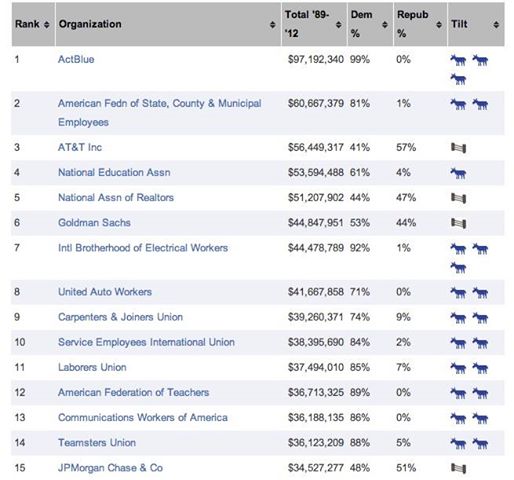
Jim Geraghty included this table in a blog post about the biggest contributors to the two major US political parties, and it’s rather shocking. This is the list of top donators from 1989 to 2014:

US political contributions 1989-2014

Clearly, there’s a need to get big corporations out of the political game. Two of them are in the top ten, and three are in the top 15. Oh, and two of them actually gave more money to the Republicans than the Democrats! When will they reform the system to prevent this kind of distortion to the political process?

January 24, 2014

The “charter of Quebec values” is starting to look like an election winner for Marois

Filed under: Cancon, Politics, Religion — Tags: , , , — Nicholas @ 10:22

Paul Wells initially dismissed the proposed charter of Quebec values as unlikely to appeal to the majority of Quebec voters. He now admits that he may have been wrong, as the minority PQ government has been gaining support since introducing the charter proposal and if the trend continues, we might expect to see Premier Pauline Marois a snap election. He attributes this to a few key elements in Quebec politics and culture:

A secular imperative. I have friends who disagree with the PQ on just about everything — but who applaud the notion that it should be impossible to tell a person’s religion by looking at him or her. These people tend to be atheists who view religion as inevitably backward and retrograde. They tend to keep books by Christopher Hitchens and Richard Dawkins on the nightstand. They’d sooner everyone got over religion altogether. In the meantime they don’t want to have to look at evidence of religion.

[…]

The suggestive power of government. Canadians, including Quebecers, tend to trust and listen to their governments. Governments can lead opinion, and often do. I know all this sounds crazy. And the people least likely to notice the willingness of the public to be led are those who consider themselves full-time opponents of any given party in power. But it’s one reason why highly ideological politicians seek power: not for its own sake, but because it gives leaders the hope of being followed.

Islamic fundamentalism. Does anybody believe the PQ would be on this — what’s the word? — this crusade today, if 9/11 had never happened? Is anyone surprised that so many witnesses at public consultations on the PQ charter focus exclusively on Islam that government officials are left pleading with witnesses to mention other religions at least once in a while?

[…]

The moral collapse of the Quebec Liberal Party. These days you can’t find the Liberals’ new leader, Philippe Couillard, with a dog and a flashlight. I wish this were more of a surprise. The notion that diversity is a strength and that there are different ways of being Québécois is on trial. That notion has animated the Quebec Liberal Party, on its better days, for more than a century. But the Liberals decided 40 years ago that there’s room for only one party with any convictions in Quebec, and that’s the PQ. Couillard represents the third consecutive case — after Daniel Johnson and Jean Charest — where the party chose the most viscerally federalist leadership candidate on offer, then surrounded him with advisers who systematically advise him not to say what he believes. The results are predictable. The PQ sets the debate’s terms, the Liberals hide under the coffee table.

January 23, 2014

Rand Paul as 2016 frontrunner

Filed under: Politics, USA — Tags: , , , , , — Nicholas @ 08:36

It’s probably a case of The Atlantic needing to get extra pageviews, but here is Peter Beinart making a case for Rand Paul being the frontrunner for the 2016 Republican nomination:

To understand the Kentucky senator’s hidden strength, it’s worth remembering this basic fact about the modern GOP: It almost never nominates first-time candidates. Since 1980, George W. Bush is the only first-timer to win a Republican nomination. And since Bush used the political network his father built, he enjoyed many of the benefits of someone who had run before. It’s the same with Paul. In both Iowa and New Hampshire, he begins with an unparalleled infrastructure left over from his father Ron Paul’s 2008 and 2012 campaigns.

Start with Iowa. Last May, Rand Paul gave the keynote speech at the Iowa Republican Party’s annual Lincoln Day Dinner. How did he secure this prize invitation? Because the chairman, co-chairman, and finance chairman of the Iowa Republican Party all supported his father. Rand Paul’s not the only potential 2012 candidate who will inherit a political infrastructure in the Hawkeye State. Rick Santorum and Mike Huckabee also have networks left over from prior runs. But their supporters don’t play as influential a role in the state GOP. “RPI no longer stands for the Republican Party of Iowa,” noted a recent article in Politico, “but for Rand Paul, Inc.”

Because the Iowa GOP will elect new leaders next spring, it’s unlikely “Paulestinians” will so thoroughly dominate the party leadership in 2016. But Craig Robinson, former political director of the Iowa GOP, says that’s actually to Rand Paul’s advantage, since it will free up some of Iowa’s most powerful Republicans to run his 2016 campaign. The Iowa caucuses are, famously, a test of organization. And for that reason, Robinson argues, “Rand Paul has a huge advantage in this state. There’s an organization built that has grown and been able to be maintained for four to six years. That’s a headstart. There’s no other candidate who has something like that.” It’s “almost like having the advantage of having run before.”

Despite his organizational strength, Ron Paul’s libertarian views capped his support in Iowa, preventing him from winning over more traditional conservatives. But in 2016, Rand Paul will be less of an ideological outlier than his father was in 2012. That’s partly because he has avoided some of his father’s edgier views. (He’s more supportive of foreign aid and sanctions against Iran, for instance.) And it’s partly because more Republicans now share his suspicion of the national-security state. Last summer, more than 40 percent of House Republicans voted to curb NSA data collection. “Rand has a much broader appeal than his father,” Robinson says. Polls reflect that: A survey last December for the Des Moines Register found Paul with a lower unfavorability rating among Iowa Republicans than either Christie or Jeb Bush.

If Paul is, arguably, the early leader in Iowa, he may be the early frontrunner in New Hampshire as well. While Ron Paul placed third in Iowa in 2012, he placed second in New Hampshire, losing only to Mitt Romney, the former governor of neighboring Massachusetts and a national frontrunner with a vast financial edge.

January 22, 2014

Thai protests trigger state of emergency declaration

Filed under: Asia, Government, Politics — Tags: , , , , , — Nicholas @ 07:52

BBC News on the Thai government’s attempts to deal with the ongoing protests:

The Thai government has imposed a 60-day state of emergency in the capital, Bangkok, and the surrounding provinces, from Wednesday, to cope with unrest.

The decree gives the government wide-ranging powers to deal with disorder.

Anti-government protesters have been blocking parts of the capital to try to force PM Yingluck Shinawatra to resign.

They accuse the government of being run by exiled former leader Thaksin Shinawatra, the brother of the current prime minister.

Ms Yingluck has refused to resign and has called an election on 2 February to pacify the protesters.

The state of emergency was announced after a cabinet meeting on Tuesday and comes after a spate of attacks with explosives and firearms on the anti-government protesters blockading central Bangkok for which the government and the protesters blame each other.

On Sunday, 28 people were injured when grenades were thrown at one of several protest sites set up at major road sections in the city.

“The cabinet decided to invoke the emergency decree to take care of the situation and to enforce the law,” Deputy Prime Minister Surapong Tovichakchaikul said.

The emergency decree gives the government power to censor the media, ban public gatherings and detain suspects without charge.

George Talusan, a friend and former co-worker of mine was on vacation in Thailand recently and posted some brilliant photos to his Facebook feed. I’ve asked his permission to include a few of them here:

IMG_1983.jpg
A protester stops his motorcycle and holds up a handmade sign near Lumpini Park (Jan 13)

IMG_2225.jpg
PDRC protesters wave flags at Victory Monument (Jan 14)

IMG_1035.jpg
Suthep Thaugsuban delivers a speech at Asok BTS (Jan 15)

IMG_2710.jpg
PDRC protesters are offered water during a sit-in at Royal Thai Police HQ (Jan 15)

IMG_4964.jpg
PDRC security guard poses outside Royal Thai Police HQ which had been vandalized after a sit-in (Jan 19)

January 16, 2014

A political speech you’ll never hear

Filed under: Government, Humour, Politics, USA — Tags: , , — Nicholas @ 13:19

Jim Geraghty‘s congressman is retiring, so some have suggested that he should run to replace him. Here’s the speech he’ll never give:

I have been asked what I am willing to do to earn the great responsibility and honor of representing you in the House of Representatives. My answer is simple and direct: Absolutely nothing.

(Nervous laughter from crowd.)

My fellow Virginians, if you elect me to Congress, I promise that I will not lift a finger for the special interests, the corporate interests, the lobbyists, Big Oil, Big Business, Big Papi, the Big Ten, the Notorious B.I.G., or The Big Bang Theory. I won’t answer to them or any other one of our public discourse’s designated villains of the week.

(Cheering)

I can make this promise with confidence because I’m pretty sure I won’t do much of anything for you, either.

(Cheering stops)

This is an area where my principled commitment to limited government and my deep disinterest in dealing with your problems will align perfectly.

Do you want a deduction or tax credit written into the tax code to benefit your business? Well, tough, because you’re not getting it. Your business is supposed to thrive because it provides quality goods and services, not because it gets some special help from the IRS.

(Murmurs of discontent.)

[…]

Have you ever considered that maybe the reason Congress is so awful is you, dear voters? I mean, you elected these clowns. But even beyond that, most of the time when members of Congress interact with the public, they’re being asked for favors. The mail they get, the phone calls they get, most of the people who show up at their town halls – everybody’s asking them for something. Get more funding for this! Help us get money to do that! Make sure this agency spends more on this local project! Look, your congressman is not Santa Claus! […] Through your behavior and expectations, you’ve conditioned our elected leaders to think of themselves as walking ATMs.

Ask not what your country can do for you … because I’m sick and tired of your whining. Do it yourself.

(The crowd is silent and not happy.)

What do you say, Virginia? Are you ready for a congressman who has nothing to offer you but … well, basically nothing to offer you?

Crowd: BOOOOOOOOOO!

Guy in crowd: Hey, doesn’t Mary Katharine Ham live in this district, too?

Another guy in crowd: Let’s nominate her!

The crowd moves on.

January 13, 2014

Chris Christie discovers that there are no allies in politics

Filed under: Media, Politics, USA — Tags: , , , , , — Nicholas @ 08:34

L. Neil Smith thinks that the national media have abandoned New Jersey governor Chris Christie as the political equivalent of the Washington Generals (that is, the preferred token Republican to lose against the presumptive Democratic presidential candidate):

By now, I’m confident you’ve all heard, seen, or smelled the story about New Jersey’s RINO Governor Chris Christie, whose administration allegedly closed down several lanes on the George Washington Bridge as political retribution of some kind against Fort Lee’s Mayor Mark Sokolich.

“RINO” stands for “Republican In Name Only”. Before the bridge incident, Rush Limbaugh was predicting that Christie would go over to the Democrats day after tomorrow. Now I doubt they’d let him in the clubhouse.

[…]

Of all Christie’s dubious accomplishments, and they are many, the one he’s most proud of and famous for is his moderation. In practice, this means that he has absolutely no discernable philosophy. Those are his principles, by God, and if you don’t like them … he’ll change them. Which enables him, he would tell you, to reach out to the “other side of the aisle”, and make compromises with them, so stuff can get done.

Even when it shouldn’t.

Now you would think, when their moderate Republican buddy came under attack, that some of these Democrats he’s been reaching out to all these years might have something to say in his defense: “Let’s give him the benefit of the doubt,” or something. But listen to the crickets.

Instead, they’re already calling for a Congressional investigation which, translated into Russian and translated back again, means “show trial”.

Also, there are other Republican moderates who share whatever serves Christie for values. You might expect them to stand up with him.

Nope … more crickets.

Finally, there are the media (plural noun again) who have been pimping Christie for so long, not only as an ideal politician, but the very fellow who ought to get the Grand Old Party’s next available nomination for President. They were the first to start snapping at his heels. They never really wanted him as President, They wanted him to be a losing Republican candidate for President, the GOP equivalent of Hubert Humphrey, George McGovern, Walter Mondale, and Michael Dukakis.

But now he’s no longer useful to them, even for that.

January 9, 2014

Selling Ontario wine at a farmer’s market? Must be a by-election in wine country coming up

Filed under: Business, Cancon, Wine — Tags: , , , , — Nicholas @ 10:34

Michael Pinkus on the Ontario government’s latest cynical ploy to shore up electoral support in a wine-producing riding just in time for a by-election:

There was a certain amount of optimism over the holidays coming out of the wineries of Ontario as the Wynne Liberals, who lead this province, announced a new initiative to get Ontario wines into the hands of more Ontarians … or at least that’s how they are selling it.

In case you missed it, Kathleen Wynne and the Corrupt Liberals (sounds like a great 90’s band) have released their latest McGuffin on the land, an announcement that Ontario VQA wine is to be sold at farmer’s markets throughout the province. It’s all part of their 75 million dollar plan to support the local wineries and help them grow. The timing couldn’t be better, for them anyway; this announcement comes just before a soon-to-be scheduled by-election in Niagara. Funny, how it is only now the Premier and her troops have decided to finally help the wineries of Ontario … seems rather convenient. I starting to experience a little déjà vu about this though; didn’t they use this same technique to grab a couple of seats in the last election?

Now, before you accuse me of being anti-Liberal, I’m not. Before this government completely let me down I would have counted myself among them, but my personal politics aside, I’m not anti-Liberal, I’m pro-Ontario Winery — and anything that can help these hard working, passionate folks get their wines into more hands of the Ontario populace, the happier I am.

[…]

If they truly want to help the wine industry in this province stop handcuffing them as to where they can sell their wines. Give them actual retail space like the Wine Shoppes and Wine Rack stores that Peller and Vincor hold onto like gold (because they are). Let them sell their wines not just at Farmers’ Markets but at festivals and events where you can sample the wine before you buy. Nothing makes attendees of festivals more annoyed than our prohibition era laws, that keep them from buying bottles of their favourite wines tasted at expos, festivals or events. It’s mind boggling and baffling to any who have attended wine shows in other countries. Let wineries actually sell their wines at these events … I promise, no one is going to open the bottle in their car on the way home; no more so than they would after purchasing it at an LCBO store.

And so that it’s not just my voice of dissension you hear, allow me to bring winery owner Daniel Lenko into the conversation, as he posted his thoughts on Facebook: “Ok, this could get long winded. I think in general wine producers in Niagara are supportive of this olive branch being offered. Why not? This is the start of something, and anything is better than nothing. Here are the pitfalls: 1) You can’t sample wine before 11am legally, and farmers markets primarily occur in the early morning hours. 2) Can I have a stand-alone store in the “PATH” and call it “The Farmers Market”. I will offer produce as well. Or is this too civil? 3) I can’t warehouse anything offsite so that means that I must drive pallets of wine back and forth daily to Niagara, how environmentally irresponsible. 4) And hold on a second … Why is it that [Cellared in Canada] wines can be sold ANYWHERE in private stores and wines grown and vinified in Ontario can only now, 25 years later, be available at farmers markets. It really feels like I am a second class citizen here”.

October 28, 2013

Nothing fails as big as Big Government

Filed under: Bureaucracy, Government, Technology, USA — Tags: , , , — Nicholas @ 09:05

In USA Today, Glenn Reynolds points out that even Obama detractors can’t say he didn’t do a good job in his last election campaign, but that the size and structure of government prevent him from being as successful with Obamacare:

Unlike Norris Dam, [opened within three years of the TVA Act passing congress] the Olmsted Dam and Locks on the Ohio River were authorized by Congress in 1988, but a quarter-century later the project is only half-done. It has also overrun its budget by a factor of four.

Meanwhile, most of the interesting stuff being done in outer space are being done by private companies. (In fact, President Obama’s space policy approach, which emphasizes private enterprise, is one of his greatest policy successes.)

As it’s gotten bigger the federal government appears to have gotten less competent. Apollo was a success on its own terms, but the big government policies that followed — the War On Poverty, the War On Drugs, the War On Cancer — have all been pretty much failures, sometimes disastrous ones.

Even Obama himself is evidence of this problem. His 2012 presidential campaign was famous for its mastery of technology, building up an electronic campaign infrastructure in just a few months that helped him win the election. But, of course, it wasn’t a government operation. Obama without the government — a technological success. Obama within the government — a technological embarrassment. The difference between success and failure here, as even Obama-haters will have to admit, wasn’t Obama. It’s more likely that a political campaign has clear goals, and lots of freedom to improvise, while a federal program is much more encumbered by law and bureaucracy.

Whatever the cause, it remains indisputable that the federal government isn’t very good at delivering on big projects. The obvious response is to not entrust the federal government with big projects on which it can’t deliver. Instead, they should be left to those who can.

October 6, 2013

QotD: The corrupting influence of the political system

Filed under: Politics, Quotations, USA — Tags: , , , — Nicholas @ 00:01

The underlying problem is that people do not yet widely understand that the higher the political office, the more likely it is that the electoral contest is between two sociopathic con men.

Indeed, the US Presidential election is a sort of quadrennial Olympics for con men. The odds of of a randomly selected untrained amateur winning the Olympic 500m race are poor when hundreds or thousands of professionals train for years for the event. The probability of a decent human being winning the White House when competing against hordes of amoral grifters whose skills are honed to a razor’s edge by years of competition are even lower.

Worse, people do not understand that even if a decent human being by some astounding accident wins high political office, they are almost inevitably both thwarted and corrupted. The system is built to derail reform, not to enable it, and it holds temptations that few normal people can resist. One is faced with (to name but a few things) the powerful financial interests of the Military-Industrial Complex, blackmail by the intelligence community, lobbyists more numerous than locusts, fellow politicians who do not want their sustenance to end, a press almost as interested in preserving the status quo as the pigs at the trough, Sir Humphrey Appleby‘s spiritual kin, constant luxuries from banquets to private jets to soften one’s moral resistance, and an endless series of instances where one might bend the rules just this once, for the common good.

Perry Metzger, “On Politics”, Samizdata, 2013-08-19

September 28, 2013

This is what democracy looks like – Indian voters can now vote “None of the above”

Filed under: Government, India — Tags: , , , — Nicholas @ 11:40

Alex Tabarrok links to a Wall Street Journal article (paywalled, unfortunately) about the Indian court decision that will allow Indian voters to cast their ballots against all the candidates on offer:

Excellent news. Bear in mind:

    Nearly a third of the members of the lower house of Parliament are facing criminal charges, according to the Association for Democratic Reforms, a New Delhi-based advocacy group for transparency in governance.

Even if that were not the case, however, one of the problems of democracy is that there is too little feedback and information transmission, due both to rational ignorance and the bundle nature of politics. Allowing for “none of the above” provides, not a panacea, but a little bit more feedback. Many people vote but have to hold their noses to do so. Many others don’t vote but do they not vote because they are satisfied or dissatisfied? None of the above gives the dissatisfied a chance to reveal their views and in so doing it may encourage more and better candidates.

At present, voting none of the above is just informational, i.e. none of the above is never “elected” even if it gets a majority, although the option to vote NOTA may change the outcome of the election. In the future a NOTA majority might signal a new election.

There have been a few elections here in Ontario I’d love to have had the option of voting “None of the above”.

September 23, 2013

Merkel’s victory

Filed under: Economics, Europe, Germany, Politics — Tags: , — Nicholas @ 11:06

German Chancellor Angela Merkel’s conservatives won re-election yesterday, but their Free Democrat coalition partners did not earn enough votes to retain their seats in the Bundestag, so a new coalition will may have to be formed. The Economist has more:

Angela Merkel, chancellor of Germany for eight years, seems likely to stay in office for a few more. She has won for her party, the Christian Democratic Union (CDU), a sparkling election result, with about 42% of the vote when including its Bavarian sister party, the CSU, according to exit polls and estimates. Depending on how the smaller parties fare, that may even suffice for an absolute majority of seats in parliament, allowing Mrs Merkel to govern without a coalition partner as only Konrad Adenauer, also of the CDU, did in the 1950s.

But as of the evening of this election day, September 22nd, other outcomes were still possible. For one, voters delivered a stinging rebuke to Mrs Merkel’s current coalition partner, the liberal Free Democrats (FDP). Having been thrown out of the Bavarian state parliament a week ago, and the state parliament of Hesse today, the FDP seemed likely to be ejected from the federal parliament as well. Its leadership will have to go, its message will have to be renewed, if it is to have any future in German politics.

The greatest unknown on this Sunday evening is the fate of the newest party in German politics, the euro-sceptic (as in: sceptic about the euro, not necessarily the European Union) Alternative for Germany. At 4.9% in the exit polls, it teeters on the edge of the 5% threshold necessary to get into parliament.

Earlier this year, I linked to a Zero Hedge piece which predicted if not the end of the world, the end of stability in Europe following this particular electoral outcome:

There will be nothing but lying until September 22, 2013 which is the date of the German elections. This is the drop dead date that I have been asked about for so long. Then, as soon as the celebration is over that Ms. Merkel is to remain in power, the world will turn on its axis. The status quo will disappear and there will be a “shock and horror” campaign as the Southern nations of Europe demand more help and Germany squirms and then refuses to provide it because it does not have the assets to do so.

Spain, France, Portugal, Greece, Cyprus, and even Italy are all going to line up at the trough only to discover that the promise of water was just that, a promise, and does not exist. A Biblical drought will be upon the Continent and from the political battles will emerge new alliances and new screams calling the traitors by name. The twin towers upon which the markets rest, money from nothing and fairy tale financials, will decompose in the light of this new sun and our old friend, Fear, will return to haunt us.

Let us cast our eyes toward Berlin and see whether this is prophecy or mere doom-mongering.

September 21, 2013

Michael Ignatieff on the aftermath of electoral defeat

Filed under: Books, Cancon, Media, Politics — Tags: , , , — Nicholas @ 10:13

The Toronto Star has an excerpt from Michael Ignatieff’s new book, Fire and Ashes:Success and Failure in Politics:

Zsuzsanna and I returned to Stornoway and disconsolately packed up our things. I remembered a photograph I’d seen of men in overalls carting belongings into a moving van at the back of 10 Downing Street after Margaret Thatcher defeated James Callaghan in 1979.

The arrival of the moving van is as momentous a symbol of the sovereignty of the people as the moment when a leader takes the oath of office. Now the moving vans were at our back door. The people had told us to pack our bags.

In an emptying house that had once felt like home, I pulled my books off the library shelves as the portrait of Laurier, our greatest prime minister, seemed to follow me with its eyes. Every leader of the party but two had become prime minister. Now I had become the third leader to fail.

The day before I’d had an airplane, a security detail, a staff of 100, a car and driver, a chef and housekeeper to welcome us home, and, most valuable of all, a political future. The day after, that future had vanished. I was unemployed and five and half months short of eligibility for the pension that usually goes with six years of service as an MP.

I was filling boxes while making phone calls to find myself a job. Rob Prichard, a friend of 30 years, came to the rescue, and after he’d made a few calls to John Fraser, master of Massey College, David Naylor, the president of the University of Toronto, and Janice Gross Stein, director of the Munk School of Global Affairs, I was back in my old life, teaching human rights and politics once again. Finding a new start was much harder for many of my defeated colleagues.

‘Defeated, disconsolate, forlorn’

I hadn’t driven for five years, and so I went to renew my licence the day after the defeat. The photograph they took that day shows a person I now barely recognize: defeated, disconsolate and forlorn. The eyes — my eyes — don’t focus.

September 9, 2013

New South Wales “accidentally elects” libertarian senator

Filed under: Australia, Liberty, Politics — Tags: , — Nicholas @ 09:17

Australia makes it a legal requirement to vote in elections, which pretty much guarantees that a fairly high proportion of voters know little or nothing about the people they cast their mandatory votes for. Add in the fact that (at least in some jurisdictions) the order on the ballot isn’t in either alphabetical or party affiliation order. In New South Wales, this meant a Liberal Democratic candidate got votes that may have been intended to go to the Liberal party’s candidate:

The man elected to take one of six Senate seats in New South Wales says allowing the general public to carry weapons is one way of curbing gun crime in western Sydney.

Voters in New South Wales have chosen Liberal Democrat David Leyonhjelm for the Senate after the party appeared in the top left hand corner of ballot papers.

The seldom-mentioned party gained 8.89 per cent of the initial vote allocation, ahead of the Greens’ 7.77 per cent.

The party, which believes in social libertarianism, a free market economy and small government now joins a key group of minor party and independent senators set to hold the balance of power after July next year.

[…]

Mr Leyonhjelm accepts his party probably gained votes in error, with voters thinking they were choosing the Liberals.

The name has been raised as an issue before — in 2007 the Liberal Party objected and they ran as the Liberty and Democracy Party.

Mr Leyonhjelm admits the massively-long NSW Senate ballot paper may also have pushed votes to the Liberal Democrats.

“Oh yeah, we think there are three reasons why our vote was as high as it was,” he said.

“There are some people who voted for us because of our policies and they like what we stand for and we would like to think that that was all of them, but I don’t think that is the case.

“There would be some people who voted for us because we were first on the ballot paper — there is always a sizeable number of people who don’t care and vote for the first one on the paper, and with such a big ballot paper that was probably a factor.

“Then there are some people who mistook us for the Liberals, probably the Liberals, but they could also have mistaken us for the Christian Democrats or even the ordinary Democrats.”

In the 1980’s, we nearly had this happen in an Ontario election: the official Liberal Party candidate was disqualified after the deadline for submitting candidate names to get on the ballot, so the Libertarian candidate got a lot of votes that clearly were from people who thought they were voting Liberal … but not enough to win that riding.

« Newer PostsOlder Posts »

Powered by WordPress