Quotulatiousness

June 10, 2014

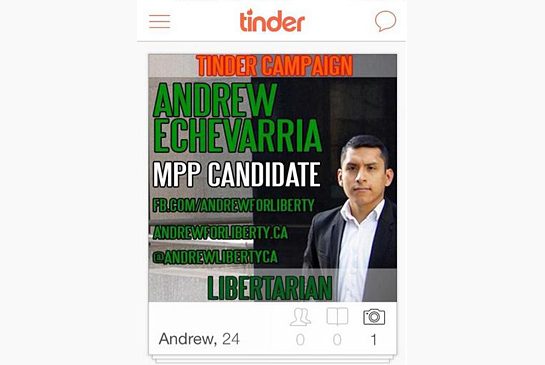
Andrew Echevarria uses Tinder to connect with Trinity-Spadina voters

Filed under: Cancon, Liberty, Media — Tags: , , , , — Nicholas @ 06:45

Liam asked if I’d covered the innovative voter reach-out campaign being conducted by Libertarian candidate Andrew Echevarria in the Trinity-Spadina riding:

Andrew Echevarria Libertarian Tinder postMuch like love, wooing voters sometimes requires dabbling in the art of seduction.


That’s how MPP hopeful Andrew Echevarria sees it. The Ontario Libertarian Party candidate for Trinity-Spadina is using Tinder to connect with young people in the downtown riding, hoping to score votes the same way others score dates.

“I catch their eye,” said Echevarria, who joined the online dating app recently. “Tinder is a great moment to catch someone when they’re just hanging out.”

Toronto Tinder users may recognize the dark-haired, well-suited Echevarria as they swipe left and right through the app’s GPS-enabled library of potential romances. He set his search limit to the scope of the riding and has already been inundated with love connections.

However, he keeps his intentions up front.

“Tired of dating the same old politicians who lie just to get your ballot? Hook up with Liberty!” he teases, listing his age as 24. Those interested can “swipe right to debate or learn more.”

About 50 people — 60 per cent men, 40 per cent women, Echevarria guesses — have swiped right.

While it might sound like a gimmick, the neuroscience grad from the University of Toronto said he genuinely believes Tinder is an effective way of enticing students and young professionals who are unfamiliar with libertarian politics, which he says are defined by “the protection of individual rights and freedoms.”

June 1, 2014

Getting on the ballot is a major struggle, if you’re not a Democrat or Republican

Filed under: Bureaucracy, Cancon, Government, Politics, USA — Tags: , , — Nicholas @ 09:09

Doug Mataconis gives a few examples of how the two major US political parties have conspired to make it much harder for anyone to get on the ballot without being a nominee of the Democratic or Republican parties:

In theory, the purpose of nominating petitions is supposed to be to ensure some level of ballot integrity by requiring people who want to appear on the ballot for local, state, or national office to demonstrate some minimal level of support for their candidacy. In reality, what ballot access laws in many parts of the country have become are a means by which the two major parties in general, and incumbents specifically, restrict third parties and challengers from getting on the ballot, or at least making it more difficult for them to do so. The Michigan law at issue in this case, which requires Congressional candidates to get just 1,000 signatures to get on the ballot. Given the fact that the population of Conyers’ district is some 700,000 people, and that he got more than 200,000 votes in 2012, one imagines that it wouldn’t be too difficult for Conyers to meet that target. The situation is quite different, though, for independent and minor party candidates. According to Ballotpedia, an independent candidate for Congress must submit at least 3,000, and no more than 6,000, valid signatures of registered voters in order to get on the ballot, three times as many as a candidate from ether of the two major political parties. In other states, the ballot access requirements are even more restrictive. In Virginia for example, a candidate for statewide office must submit at least 10,000 valid signatures, including at least 400 from each of the state’s 11 Congressional Districts. Other states are even more stringent, although there are some standouts. New Jersey, for example seems to be one of the few states where petition requirements for independent and third party candidates are actually lower than those for major parties candidates, at least when it comes to Federal offices. In general, though, even a short perusal of the nominating petition laws of the states leaves when with the inescapable conclusion that they are generally designed to make it harder for candidates to get on the ballot than aimed toward any legitimate goal of “ballot integrity.”

Other restrictions in various states include all sorts of timewasting — and volunteer effort-wasting — requirements for third-party efforts that often don’t apply to incumbents or to the two major parties. Every political party depends on volunteers, and those volunteer hours are used up quickly (and not renewed) when they have to be spent on busywork, rather than activity that helps elect their candidate.

For example, in Ontario, where there’s currently an election underway, it takes only 25 signatures from voters in the constituency to get a nominee’s name on the ballot. If you’re running as a member of a recognized political party, you also need the party leader’s signature on your nomination form (example here [PDF]). That’s an easy enough hurdle that anyone should be able to clear it (yet every election, a few would-be candidates fail to achieve ballot status … and sometimes it’s a major party candidate).

To run as a candidate in a Canadian federal election requires 100 signatures from voters in the riding (but only 50 in lower-population ridings in remote areas of the country). The nomination paper includes several pages for the signatures [PDF]. For more detail on how the signatures are validated, there was an interesting case in the last federal election.

May 29, 2014

The “Pairs Perfectly” campaign

Filed under: Cancon, Wine — Tags: , , , , — Nicholas @ 09:03

Just as the Ontario election writ was dropped, the small wineries of Ontario started pushing the Pairs Perfectly campaign, to move the province toward a more mature wine retailing model (like British Columbia’s). While I’d prefer a full privatization model (like Alberta’s), at least the move to allowing some private wine stores would be an improvement. Despite the quick work to launch the campaign, Michael Pinkus says it’s already being forgotten on the hustings:

Ontario is deep into an election campaign and the best thing done so far is a little initiative from the Wine Council called “Pairs Perfectly”. They’ve backed it with radio and television promos and in truth they make a lot of sense. Ontario is one of the only provinces not to have some sort of private system in place, either along with their provincial monopoly (a la British Columbia) or fully privatized (a la Alberta). This initiative seemed to be already formed and waiting in the wings: no sooner had an election been called than the “Pairs Perfectly” slogan was in my inbox (with its twitter handle @PairsPerfectly, hashtag #PairsPerfectly and website PairsPerfectly.com), articles were written to explain the notion, social media seemed abuzz from wineries to writers to the average-Joe, all were tweeting, re-tweeting, blogging, tumbling, gramming, hooting, hollering, casting, accosting and I initially thought, “Wow, the buzz is really out there, this just might have legs, or at least more legs that that ‘My Wine Shop’ that seemed to go nowhere.”

But 6 weeks is a long time in the political realm, just ask Rob Ford, so much can happen over the course of 6 weeks that can turn the tide on a well-thought-out, well-organized plan of attack. Instead of the Ontario booze media jumping whole hog onto the initiative and writing piece after piece after piece about the benefits of privatization to keep the idea in our collective consciousness, a new issue has come along to polarize: the VQA, which I have repeatedly said is a sham of a system, most notably because of its tasting panel. Now there’s a new horse to ride, a newer and shinier issue to get all worked up about. The VQA is easy pickings because it is so wrong, crushes creativity and stymies’ our winemakers making them think “will this pass VQA”. Every winery has come into conflict with it at least once in its existence and it needs an overhaul (radical? Maybe not, but definitely a big tweak).

[…]

I believe this: Ontario is a mess and is destined to remain that way long after this election season has been put to bed. We already know the Liberals position on privatization of any sort (over their dead body); the NDP seem in lockstep with the Liberals train of thought because it would disrupt union jobs. And the Conservatives, before the campaign the only party willing to talk privatization, have somehow gone mute about the whole issue – as if someone told them not to rock the boat; which makes them the wild card. But if history shows us anything it’s doubtful it’ll get past committee if it ever does come up.

And don’t even get me started on the asinine things happening on the beer side of the ledger. The Beer Store’s cockamamie campaign against corner stores carrying the product that they have a duopoly to sell (with the LCBO), is as misguided and ill-conceived as any I can think of. Does beer not also get sold in corner stores in other provinces? Are all those owners corrupt-minor-sellers? It seems to have galvanized the public against them; especially when people find out they aren’t government controlled; which a vast majority of the province was under the false notion it was. This also took focus away from the larger issue of an open and freer market for all in the alcohol industry (craft brewers, craft winemakers, etc.)

May 28, 2014

Ontario election 2014 – the local front

Filed under: Cancon, Liberty, Politics — Tags: , , — Nicholas @ 09:28

Click to download full-size PDF

Click to download full-size PDF

So far, the local candidates have been almost invisible here in Whitby-Oshawa. Last week, we had a canvasser show up for Progressive Conservative candidate Christine Elliot (the incumbent MPP), but that’s literally it. As far as I know, this is the complete list of registered candidates for the riding:

  • Christine Elliott, Progressive Conservative
  • Ryan Kelly, NDP
  • Ajay Krishnan, Liberal
  • Stacey Leadbetter, Green
  • Douglas Thom, Freedom Party

The Ontario Libertarian Party issued a press release the other day, boasting that they were “in a position to form a majority government”. Which sounds great, but all it really means is they’re finally running enough candidates that, should they all be elected, the OLP would have enough seats to form a majority. A subtle distinction, I’m sure you’d agree.

However, despite the massed ranks of OLP sacrificial lambs candidates, they don’t have one in Whitby-Oshawa. This means that instead of wasting my vote by voting Libertarian, I’ll waste my ballot on Douglas Thom of the Freedom Party (“Splitters!“).

CBC News has a profile of the riding here. For other Ontario ridings, you can look them up here.

Ontario NDP manifesto “reads like it was written at an Annex dinner party that went one bottle of red over the line”

Filed under: Cancon, Politics — Tags: , , , , — Nicholas @ 08:15

The NDP is having some internal ructions during the ongoing Ontario election campaign, as federal NDP supporters are critical of the provincial party’s approach (and leaking that discontent to the media). The Toronto Star‘s Tim Harper reports:

Tom Mulcair and Andrea Horwath will share a stage next week at the provincial party’s spring gala in Toronto.

Publicly, it will be smiles and camaraderie. Privately, some members of the federal leader’s Ontario caucus and his inner circle are looking at the Horwath campaign with anxiety.

While Mulcair has praised Horwath’s “positive, optimistic” vision, there are concerns here about the messaging in the provincial campaign, the decision to force a vote at this time and the landscape the federal party might be traversing in the politically-key southern Ontario ridings in next year’s federal vote.

There are those who believe Horwath brought down the Liberals a year too late and is now not pushing back strongly enough against a budget that is a political document that cannot be delivered. Others wonder why the campaign lacks any big, fresh ideas.

[…]

Specifically, federal New Democrats are watching an attempt by the party to tack toward the middle where the votes lie, while fighting off backbiting from within for allegedly giving up on progressive voters and the causes they hold dear.

Mulcair is expected to steer the party in the same direction next year.

He will go to the polls with the NDP’s best chance for power in its history, campaigning with a mix of “small ball” policies, packaged around expected bold policies on the environment and sustainable development. Federal NDP strategists dismiss the tag of “small ball.” They call issues such as bank fees, gas prices and fees for paper bills “consumer issues” and they believe they engage voters who don’t think of politics in old right-left terms.

They dismiss a critical letter to Horwath from self-described NDP stalwarts — a manifesto that reads like it was written at an Annex dinner party that went one bottle of red over the line — as an attempt to drag the party back to what one called the “Audrey McLaughlin” days, a reference to a campaign two decades ago when the party remained ideologically pure and lost official party status.

QotD: The voters

Filed under: Cancon, Europe, Government, Politics, Quotations — Tags: , , , — Nicholas @ 00:01

There is, so to say, good news and bad news for democratic European Unionists. The good news is that, for the first time, voter turnout actually increased from the previous election to the European Parliament. Just over 43 percent of the eligible bothered to vote, up 1/10th of 1 percent. The bad news is that so many of these voters selected parties devoted to the destruction of as much of the European Union as possible.

We are laughing, up here in the High Doganate. Or rather, no, we are not laughing, it is all a pose. Still, there is a glint of recognition, gleeful in its own way. The voters, especially in England and France — the pioneer “Nation States” from the later Middle Ages — appear to have been motivated by something akin to the feist that came over the municipal electorate in the Greater Parkdale Area, the last time we voted. That was when we chose the notorious drunkard and drug addict, Rob Ford, to be our mayor. As polls since have repeatedly confirmed, we knew what we were doing. We had a task for him. It was to destroy as much of the vast municipal bureaucracy as possible. Our instruction was: “Keep smashing everything you see until they take you away.” Finesse would not be required, and the licker and crack might be an advantage.

One may love “the people,” without being especially impressed by them. They are stupid, but as the stopped clock, there are moments when they are stupidly correct. These are very brief moments, but let us enjoy them while we can.

David Warren, “Hapless Voters”, Essays in Idleness, 2014-05-26.

May 26, 2014

Is the bell tolling for the Liberal Democrats?

Filed under: Britain, Politics — Tags: , , , , — Nicholas @ 08:36

With the EU election results in, the “I told you so” and “Here’s what it really means” brigades are out in force, letting us know what the voters are really saying with their ballots. For example, Here’s Graeme Archer measuring up the Lib-Dems for an early grave:

Since “Europe” (elections about, scandals involving etc) this year is bound up temporally, and hence a little psychologically, with “Eurovision”, which is about as camp an entity as is possible to conceive; since we’re going to talk about the Liberal Democrats’ existential crisis, let’s set the mood music accordingly. Close your eyes and think of Shirley Bassey. Or better still click here and sing along, especially if your name is Nick Clegg, leader of a party which really does have nothing.

I’m not here to gloat, seriously. Anyone who stands for election is worth celebrating, because you don’t fight for something unless you’re prepared to lose. But, OK, I’m a tribal Tory too, so here’s a couple of things that amused me last night. The sight of arch-federalist Lib Dem Edward McMillan Scott, newly defeated, telling the BBC that he’d be back in some other new role, demonstrating perfectly the anti-democratic “hanger-onnery” that infuriates Eurosceptics about the institution (Matthew Woods, an old Hackney Tory mate, coined “hanger-onnery”, and it’s perfect). The other laugh is that the Lib Dem wipeout was secured in part by the wretched Proportional Representation system, whose algorithmic horrors they’re so keen to foist onto every other election. Be careful what you wish for, Fair Voters!

Seriously, though, this is the existential crisis which the Lib Dem construct has spent this parliament pretending it could avoid. Changing the leader won’t help. […]

Now repeat the exercise from the perspective of a “Lib Dem”, which, after last night, isn’t so much a thought experiment as a glance at the newspapers. Remove every elected Lib Dem from the map: what are their voters left with?

Nothing. Utterly nothing. There is a historical tradition of political liberalism in Britain, but as any fule kno, most of it was absorbed by the Conservative Party at key points in the last century. None of that tradition lives on in the “Lib Dem” construct.

What of its emotional disposition, the mirror to my gloomy Toryism? Well: to judge from their record in power, the “Lib Dem” instinct is for greater state intervention, to alleviate the plight of the less well off. So: nothing you can’t get from Labour, then.

“We want to reduce tax [by increasing thresholds]!” Nick Clegg would say, as evidence of the intellectual strand his party represents. Um, so do the vast majority of Conservatives. Again, no need for a “Lib Dem” representative to secure that outcome.

My point is that those Lib Dems who prioritise liberalism — whether about reducing tax, or fighting ID cards and so on — must know in their hearts that they should vote Conservative. Those who prioritise social democracy, similarly, must know that they should vote Labour.

Triumph of the Euro-skeptic parties

Filed under: Britain, Europe, France, Politics — Tags: , , , , , — Nicholas @ 07:53

The Irish Times looks at the Euro election results which have seen big gains for several Euro-skeptic parties:

Among the victors was Ms Le Pen’s National Front party which topped the poll in France with a quarter of the vote, bypassing the conservative UMP party, and leaving François Hollande’s Socialist Party in third place. The party is now in line for 24 seats in Strasbourg.

UKIP was expected to top the poll in Britain, with exit polls last night predicting the party could win 31 per cent of the vote. “Up until now European integration has always seemed inevitable … I think that inevitability will end tonight,” UKIP leader Nigel Farage said last night in a live video link to the European Parliament in Brussels, describing the decision to allow former Soviet countries into the European Union as one of Europe’s “great errors.”

Greece’s main opposition party Syriza topped the polls there, while the far-right Golden Dawn party came third with between 8 and 10 per cent of the vote.

In Germany, support for Alternative for Deutschland (AFD) an anti-EU party formed barely two years ago, reach 6.5 per cent, with the party in the running for six seats.

In Austria, the far-right Freedom party was expected to win 20 per cent of votes, up from 13 per cent in 2009.

However, some extreme anti-EU parties in smaller countries did not poll as well as expected, with the far-right Vlaams Belang in Belgium losing support.

Of course, not all Euro-skeptic parties are the same. UKIP is somewhat nativist and has a vocal anti-immigrant wing. Vlaams Belang has a larger and more vocal anti-immigrant component, while the Greek Golden Dawn are as close to modern day Fascists as you’ll find anywhere; not a party you want to be sharing newspaper space with.

May 24, 2014

A significant factor in UKIP success – all “right thinking” people loathe them

Filed under: Britain, Europe, Politics — Tags: , , , , , — Nicholas @ 10:01

Before the recent elections, Brendan O’Neill explained why the serried ranks of anti-UKIP pundits, politicians, and the “great and the good” may well be helping UKIP rather than hurting them:

Try as I might, I cannot remember a time when Britain’s various elites were as united in fury as they are now over UKIP leader Nigel Farage. In the run-up to this week’s Euro-elections, in which the Eurosceptic UKIP is expected to do well, leaders of every hue, from the true blue to the deep red, and hacks of every persuasion, from the right to the right-on, are as one on the issue of Farage. From Nick Clegg to the Twitterati that normally gets off on mocking Nick Clegg, from David Cameron to radical student leaders who normally hate David Cameron, fury with Farage has united all. It has brought together usually scrapping sections of the political and media classes into a centre-ground mush of contempt for UKIP. Not even Nick Griffin — who is a far nastier character than Farage — attracted such unstinting universal ire. What’s up with this Farage fury?

[…]

The real motor to the anti-Farage outlook, the fuel to this unprecedented fury of the elites, is a powerful feeling that he has connected with the public, or a significant section of it, in a way that mainstream politicians and observers have utterly failed to. The elites see in Farage their own inability to understand the populace or to speak to it in a language it understands. They see in his popularity — his oh-so-stubborn popularity, so notably undented by the daily furious outpourings of the anti-Farage elites — their own failure to swing public attitudes in what they consider to be the ‘right’ direction. That Farage’s popularity in the polls has remained pretty high even as our elites have been attacking him on a daily basis fills them not only with fury but with fear: their arguments seem not to have much traction outside the Westminster bubble, outside of medialand, where despite their best efforts the awkward, annoying little people still remain fairly favourable towards a loudmouth politician who isn’t PC and drinks beer. The fury behind the attacks on Farage is really a fury with the throng, with the masses, whose brains have clearly been made so mushy by UKIP propaganda that even the supposedly enlightened arguments and policies of their betters can now make no impact. It isn’t Farage they hate — it’s ordinary people, and more importantly their own palpable inability to make inroads into those people’s hearts or minds.

In short, the true momentum behind both UKIP’s rise in the polls and the rising temperatures it has provoked in pretty much every elite circle in Britain is not the charms or coherent ideologies of Farage himself. (In fact, many take great pleasure in pointing out that most UKIP supporters don’t know UKIP policy on any issue beyond immigration and the EU.) Rather, it is the political class’s alienation from the public, and its existential insecurities, that have propelled UKIP to the top of the political agenda. The aloofness of the old political machine, its growing distance from and contempt for the voters, its view of the public as a blob to be re-educated and made physically fit rather than as sentient beings to be politically engaged, is what has boosted public support for a party like UKIP that seems willing to speak to, and maybe even for, so-called ordinary people. And it is the out-of-touch political class’s subsequent panic at UKIP’s rise, its fear that the success of this party might spell doom for its safe, samey, middle-ground ilk, which leads it to aim its every ideological, political and media gun at Farage, having the unwitting effect of making him both more widely talked-about and possibly even more popular. It is the political class’s crisis of legitimacy and vision which both created and then inflamed the UKIP phenomenon.

May 21, 2014

Society, socialism, and statism

Filed under: Cancon, Media, Politics — Tags: , , , — Nicholas @ 10:07

At Gods of the Copybook Headings, Richard Anderson refutes the imported “you didn’t build that” notion being pushed by Kathleen Wynne on the campaign trail the other day:

… individual men, women and families are society. So are NGO, private corporations, small businesses and local community groups. All combined are a society. It was the height of intellectual impertinence by the Left to adopt the word socialism. The Left doesn’t believe in society, it believes in the State. It is Statism not Socialism that is their true creed. If you believe in strengthening society then you should believe in freedom because it is freedom that makes a society possible. True socialists are believers in free markets, free minds and free association. Statism is the enemy of society.

Too often the argument is made that either we must be rugged individualists or harmonious collectivists. This is a false dichotomy. One can be perfectly individualistic living in a family and in a community. Individualism is not the same thing as being aloof or standoffish. An individualist can work in a soup kitchen, a corporate office or mowing a lawn. It depends on what values that individual chooses to hold and the abilities he possesses.

By way of contrast there is nothing so inharmonious as collectivism. By denying man’s basic individuality it creates a never ending civil war of all against all. This is why the most collectivist societies are the most violent and repressive. They are fighting a war against human nature and losing all the while. The most peaceful societies are the most individualistic. In these societies individuals choose their partners, employers and friends. Violence is largely unnecessary in a society built on consent. It is necessary only against those who reject the principle of consent.

It’s true that no one makes it completely on their own. That doesn’t diminish their accomplishment, their essential independence or the conceit of those seeking to profit from their success. An individual may live in a society, but that does not make him a slave of the state.

Update: Kevin Williamson hits some of the same notes in this article:

It seems to me that Nozick, like some conservatives and most thinkers on the left, errs by conflating “society” and “state.” He is correct about our obligations to society: We have a positive moral duty to, among other things, care for those who cannot care for themselves. But this tells us very little — and maybe nothing at all — about our relationship to the state. The state is not society, and society is not the state. Society is much larger than the state, much richer, much more complex, much more intelligent, much more humane, and much older. Society, like trade, precedes the state. Government is a piece, but so are individuals, families, churches, businesses, professional associations, newspapers — even Kim Kardashian’s Twitter following plays its role.

[…]

Where those who see the world the way Nozick eventually did go wrong is in failing to appreciate that, absent official coercion, we do not have to take turns expressing those items of importance: The pope can think as he likes about this or that, Stephen Hawking can agree or disagree, and all are free to choose their own adventure. It is only in matters of politics that one set of preferences becomes mandatory.

But mandatoriness seems to be the attraction for many. The most enthusiastic support for the Affordable Care Act, to take one obvious example, never came from those whose main concern was its policy architecture; well-informed and intellectually honest critics left and right both knew that it was a mess. People supported the ACA as an expression of our national priorities, that we were coming to regard health insurance as something akin to a right, that we were becoming more like the European welfare states that our remarkably illiberal so-called liberals admire, that we regarded insurance companies and insurance-company profits as a nastiness to be scrubbed away or at least disinfected. The policy has been revealed as a mess, but the same people support it for the same reason. Similarly, prosecuting as civil-rights criminals those who do not wish to bake cakes for gay weddings is mainly an act of communication, that one is no longer free to hold certain opinions about homosexuals. The new enlightenment is mandatory.

[…]

The mysticism surrounding the state — its near-deification — is a source of corruption, to say nothing of boneheadedness. If the state is to be an instrument for expressing our deepest longings, values, and moral sentiments, then there can be no peace — our values are, as Nozick noted, frequently irreconcilable, and only a philosopher could believe that we can take turns when it comes to abortion or wealth confiscation. That is not how things work. If, on the other hand, the state is a machine for protecting property — from thieves, invaders, and possibly the more energetic members of the American Bar Association — then we can have peace, at least a measure of it. Outside of certain very well-defined parameters, nobody’s values need be mandatory.

May 16, 2014

Narendra Modi wins in a landslide

Filed under: India, Politics — Tags: , — Nicholas @ 08:08

The Economist reports on the first election in India to produce a single-party majority since 1984:

“INDIA has won” tweeted Narendra Modi, on May 16th, his first public comment after official counting from India’s general election made it clear that he, and his Bharatiya Janata Party, had delivered a landslide victory beyond the expectations of almost everyone. The scale of the BJP win was remarkable. It swept entire states, including Rajasthan, Delhi, Gujarat, Himachal Pradesh, Uttarakhand. More importantly it made enormous strides in two crucial, and massive, northern states, Uttar Pradesh and Bihar. There not only did Congress do disastrously, regional parties were also badly walloped. As of lunch time, it appeared that the BJP and its closest allies (known as the NDA) would have 324 seats of the 543 parliament, with the BJP alone getting 275. BJP spokesmen called that, rightly, a “tectonic shift in the polity of India”. It is the first time since 1984 that a single party has enough seats to rule alone.

Much is made is the importance of Mr Modi as a leader, who inspired great enthusiasm among the voters, especially youngsters. Clearly, too, there is demand for a stronger economy and more development. So strong is his victory, it might be no other party has enough seats to serve automatically as the opposition, since to lead it in parliament you need at least 10% of the seats, and Congress’s total haul might include even fewer than that. The array of ministers and prominent figures in Congress who have lost their seats is impressive. Mr Modi will give speeches and enjoy victory parades, first in Gujarat (where he has already visited his mother to get her blessings), then on May 17th in Varanasi. He may be sworn in as prime minister on May 21st, though obviously he hardly need wait to start forming a government and picking his ministers.

So lopsided is the outcome that enormous expectations will now rest on the BJP and Mr Modi to start delivering changes quickly. The vote share claimed by the BJP, some 35% nationally, is enormous by Indian standards. Combined with an historically high turnout, at 64%, it gives Mr Modi a huge mandate for his rule. Nor does it seem that any other party can offer any serious opposition to him. Congress is in tatters and its leaders must think seriously about its future role in politics. Rahul Gandhi, despite early signs that he was behind in his own constituency, at least appeared able to hold on there. But his margin of victory appeared to be hugely reduced. The Aam Aadmi Party, born of an anti-corruption movement, has at least claimed one MP (and perhaps several) in Punjab.

Update: Dave Weigel reminds us about Rahul Gandhi’s “total implosion in the worst interview ever”.

The debut of John Oliver’s Last Week Tonight, an exciting moment for the Slate demo, spent a good while shaming American media for ignoring India’s election. This was just, and right, and true — lots of things are more interesting than Hillary Clinton’s set speeches at charity events, not least the fate of the world’s largest democracy. And Oliver got the gist of the election, which was that the charismatic Narendra Modi would lead a right-wing coalition into power over the ruling Congress Party. That happened.

My only quibble with Oliver was how he described Rahul Gandhi, the man who led Congress to defeat. To be fair, the party was doomed by corruption and slowing economic growth, and Gandhi was given… I was about to write “a poisoned chalice,” but that seems like a gauche analogy for a man whose father and grandmother were assassinated in office. But Oliver quickly described Rahul as an “Indian Han Solo” and a man with the “total political package.”

This was not the whole story. Gandhi was sort of a disaster, a groomed yet unprepared candidate who never recovered from a nightmare interview with TV host Arnab Goswami. The whole gruesome thing is online, and the transcript is here. Both offer their own flavors of cringe comedy, from the start, when Gandhi struggles to explain why he’s doing his first-ever TV interview after 10 years in office.

May 11, 2014

Ontario politics: “Insular, petty and involves a cast of characters you wouldn’t want to meet wandering down a dark alley”

Filed under: Cancon, Politics — Tags: , , , , — Nicholas @ 10:02

It’s election season once again in Ontario, and Richard Anderson looks at the current state of play:

I know most of you can’t stand Ontario politics.

Especially those of us who live here…

It’s insular, petty and involves a cast of characters you wouldn’t want to meet wandering down a dark alley. Still it’s the largest province in Confederation so attention must be paid, however grudgingly.

The last decade of provincial politics has revolved around the astonishing acrobatics of the McGuinty-Wynne Liberals. They have lied, overspent and borrowed to an extent without precedent in English speaking Canada. Those of us who remember the Bob Rae years had assumed that they had seen the worst. Apparently it wasn’t. After a brief house cleaning under Harris-Eves we were returned to spendthrift form. The provincial debt has doubled in ten years. Nothing else in Ontario has grown anywhere near as fast.

A political party that was this incompetent, this obviously corrupt, would you think be headed for certain defeat at the polls. Transforming the engine of the Canadian economy into its busted leg took some doing. A treasure trove of natural resources, close proximity to the largest American markets and a highly skilled workforce. Ontario has, what seemed until recently, to be nearly indestructible advantages. A pack of Gibbonese monkeys could be running the show at Queen’s Park and the economy, somehow, would still keep moving along.

But no one saw Dalton McGuinty coming. How could they? With the personality of a mediocre non-entity and the political cunning of a dishonest child, he won two majority governments and narrowly missed a third. How has been something of a mystery. The Dalt had certain inborn advantages. His sheer nebbishness made him seem unthreatening. Yet here we stand at the bottom of a deep hole he himself dug. There were, of course, his weak and bungling rivals. Ernie Eves looked and sounded like an unenthusiatic version of Gordon Gekko. John Tory’s ability to self-destruct is near legend. Tim Hudak isn’t a real boy at all.

Yet the greatest advantage that Dalton McGuinty had, and which Kathleen Wynne retains, is the electorate. There is no greater advantage to a scheming and incompetent politician than a disengaged and misinformed electorate. That describes the voters of Ontario almost perfectly. This might seem a tad puzzling to some. Generations of Canadian voters have been been able to hold their governments to rough account. Semi-literate frontier farmers were able to follow the twists and turns of the Pacific Scandal and send John A, temporarily, packing. Today the ordinary voter sees greater crimes and follies with nary a batted eye.

April 27, 2014

Gerrymandering

Filed under: Books, Politics, USA — Tags: , , , , — Nicholas @ 09:49

Former US Supreme Court Justice John Paul Stevens has published a book in which he calls for certain amendments to the constitution, one of which is quite appealing:

1. Requiring that congressional and state legislative districts be “compact and composed of contiguous territory” to stop both parties from carving out safe seats.

US electoral districts can be particularly odd creatures. In a post from 2010, Zombie looks at the “top ten” gerrymandered districts … and they’re hard to believe. Here’s North Carolina-12, number 10 on the list:

This is what most people imagine when they think of a gerrymandered district — what I call “Gerrymander Classic.” NC-12 looks very much like the gerrymandered districts of the 19th century, but taken to extremes. As bad as it is, NC-12 at least looks like a congressional district, with meandering lines, consistent width, and hand-drawn appearance. As we’ll soon see, modern gerrymandering is often another animal altogether, with jarring shapes and artificial boundaries that are not just offensive to the eye but somehow feel like an insult to rationality.

This is what most people imagine when they think of a gerrymandered district — what I call “Gerrymander Classic.” NC-12 looks very much like the gerrymandered districts of the 19th century, but taken to extremes. As bad as it is, NC-12 at least looks like a congressional district, with meandering lines, consistent width, and hand-drawn appearance. As we’ll soon see, modern gerrymandering is often another animal altogether, with jarring shapes and artificial boundaries that are not just offensive to the eye but somehow feel like an insult to rationality.

Coming in at number 5, it’s Illinois-17:

Political scientists love to cite IL-17 as the prototypical gerrymandered district, and you are likely to see IL-17 used as the illustration in many academic treatises about redistricting. And we can see why here. Its shape has often been described as “a rabbit on a skateboard,” though to me it looks more like an embryonic ichneumon wasp with a pancreatic cyst. We saw above how PA-12 was a gerrymandering blunder by the Republicans; IL-17 is the opposite, a gerrymandered district created by Democrats to ensure themselves a seat in western Illinois — but which this year was snatched from their grasp by Tea Party candidate and now congressman-elect Bobby Schilling. Ooops! The Democrats went out on a limb when drawing IL-17 — several limbs, by the looks of it — but the wave election of 2010 changed the electoral landscape. Let me repeat my warning to over-confident redistricters next year: THINGS CHANGE. Gerrymander at your own risk.

Political scientists love to cite IL-17 as the prototypical gerrymandered district, and you are likely to see IL-17 used as the illustration in many academic treatises about redistricting. And we can see why here. Its shape has often been described as “a rabbit on a skateboard,” though to me it looks more like an embryonic ichneumon wasp with a pancreatic cyst. We saw above how PA-12 was a gerrymandering blunder by the Republicans; IL-17 is the opposite, a gerrymandered district created by Democrats to ensure themselves a seat in western Illinois — but which this year was snatched from their grasp by Tea Party candidate and now congressman-elect Bobby Schilling. Ooops! The Democrats went out on a limb when drawing IL-17 — several limbs, by the looks of it — but the wave election of 2010 changed the electoral landscape. Let me repeat my warning to over-confident redistricters next year: THINGS CHANGE. Gerrymander at your own risk.

And finally, the circa 2010 winner of the most gerrymandered district in the United States award, Illinois-4:

Here it is: The most ridiculous congressional district in the entire country. No, you’re not looking at two districts; IL-4 has two absurdly gerrymandered halves held together by a thin strip of land at its western edge that is nothing more than the median strip along Interstate Highway 294. The end result is a gerrymandered gerrymander, a complete mockery of what congressional representation is even supposed to be. As with AZ-2, the intention behind IL-4 was to create an ethnic enclave, in this case an Hispanic-majority district within an otherwise overwhelmingly non-Hispanic Chicago. Problem is, Chicago has two completely distinct and geographically separate Hispanic neighborhoods — one Puerto Rican, the other Mexican — but neither is large enough to constitute a district majority on its own. Solution? Lump all Hispanics together into a supposedly coherent cultural grouping, and then carefully draw a line surrounding every single Hispanic household in Chicago, linking the two distant neighborhoods by means of an uninhabited highway margin. Voila! One Hispanic congressperson, by design. And as a side-effect, the most preposterous congressional district in the United States.

Here it is: The most ridiculous congressional district in the entire country. No, you’re not looking at two districts; IL-4 has two absurdly gerrymandered halves held together by a thin strip of land at its western edge that is nothing more than the median strip along Interstate Highway 294. The end result is a gerrymandered gerrymander, a complete mockery of what congressional representation is even supposed to be. As with AZ-2, the intention behind IL-4 was to create an ethnic enclave, in this case an Hispanic-majority district within an otherwise overwhelmingly non-Hispanic Chicago. Problem is, Chicago has two completely distinct and geographically separate Hispanic neighborhoods — one Puerto Rican, the other Mexican — but neither is large enough to constitute a district majority on its own. Solution? Lump all Hispanics together into a supposedly coherent cultural grouping, and then carefully draw a line surrounding every single Hispanic household in Chicago, linking the two distant neighborhoods by means of an uninhabited highway margin. Voila! One Hispanic congressperson, by design. And as a side-effect, the most preposterous congressional district in the United States.

The kicker? Those ten are at least legal in that they’re contiguous. Zombie goes on to show some even more outrageous examples where that requirement is blatantly ignored.

April 24, 2014

UKIP’s Nigel Farage as the Tories want you to see him

Filed under: Britain, Humour, Politics — Tags: , , , — Nicholas @ 09:25

The Torygraph‘s Tom Chivers has unearthed a photo that will shake the very foundations of the British political scene!

Prepare to be AMAZED. The photo of Nigel Farage that the Ukip ESTABLISHMENT didn’t want you to see:

Nigel Farage as a punk

It’s not so much the fact that he’s such an awful rebel, with no respect for the great British institution of the police, that’s embarrassing for the Ukip leader. The real problem is that this photo was apparently taken in 1983 and Mr Farage still looks about 40.

Of course, it’s not just this damning and clearly not at all Photoshopped photo, which has been doing the rounds on Twitter because of its obvious veracity. There are dozens of equally upsetting Farage photos which his party apparatchiks have been desperately trying to ban.

April 15, 2014

“You want to go into politics to fix public finances and put things in order? Fine. But to pump your fist and say you want a country? Tabarnac

Filed under: Cancon, Politics — Tags: , , , — Nicholas @ 07:30

In Maclean’s, Martin Patriquin reflects on the disaster for the separatist cause that was the Quebec election:

Sovereignty isn’t dead. It is impossible, sovereignists themselves often say, to kill a dream shared by a rock-ribbed 30 per cent of the population. Rather, Quebec’s sovereignty movement goes through fits and starts, peaks and valleys, a sleeping giant that can wake up and roar at a moment’s notice.

[…]

In this respect, the mortal enemy of the sovereignty movement isn’t the Liberal Party of Quebec, the Trudeau family, the federal government, Quebec’s immigrant population or any of the other central casting nightmares conjured up by the sovereignist movement over the years. No, the real enemy is the march of time.

As such, the sovereignty movement was pushed that much closer to obsolescence with the recent election. This Liberal win, like all Liberal wins past, means no serious talk of referendum, sovereignty or separation for four years at least. Decimated and leaderless, the PQ ranks will likely have to suffer through a wrenching leadership campaign before turning its sights on Philippe Couillard’s Liberals. PQ strategists will have to explain the party’s rudderless, error-prone election campaign that tanked its relative popularity in the space of a month. In the longer term, the PQ MNAs will have to answer for the party’s so-called Quebec values charter, which many feel targeted Quebec’s religious minorities­—and in all likelihood hurt the party’s chances of moving beyond its white, francophone base. All of this will take time, which isn’t on the PQ’s side.

It wasn’t supposed to be like this. Buoyed by a jump in the polls and a listless showing by Liberal Leader Couillard, Marois confidently called an election on March 5 with every expectation of getting a majority government. Instead, she (and the province) got a quick and nasty campaign dominated by referendum chatter and the short-term economic tremors it inevitably causes. The mere mention of an election last fall caused Montreal’s real estate market to dip.

Without a doubt, the turning point in the campaign was the press conference to introduce superstar PQ candidate Pierre Karl Péladeau:

The smart political strategist would do the following: put Péladeau on a stage and make him talk strictly about how he transformed Videotron from a Podunk cable company beset by labour troubles into the province’s leading cable and wireless concern. In the vacuum of a month-long election campaign, Péladeau the businessman could easily hide the red-ink-stained legacy of the PQ’s 18 months in power.

Instead, we got Péladeau the Quebec separatist. On a chilly Monday morning three days into the campaign, Péladeau took the stage with Pauline Marois and, after a 13-minute speech vaunting his economic record and the beauty of his riding of St-Jérôme, he uttered 30 words that would overshadow his campaign and that of his newly adopted party. “Finally, I end by telling you that my membership in the Parti Québécois is in line with my most profound and intimate values,” he said in French. “That is to say, make Quebec a country!”

[…]

In the immediate aftermath of Péladeau’s declaration, Marois mused that citizens of a separate Quebec would have their own Quebec passport; people and goods would flow freely over the open and undefended borders with Canada. Quebec would use the Canadian dollar, and lobby for a seat with the Bank of Canada. Her strategists quietly put an end to Marois’s flights of fancy within 48 hours, but the damage was already done. And it was irreversible.

In Quebec City, Péladeau’s candidacy should have hearkened a return of the PQ in what has been a bastion for the right-of-centre Action Démocratique du Quebec party and its successor, the CAQ, led by former PQ minister François Legault. Yet Péladeau seemingly did himself in with those 30 words in this surprisingly conservative and federalist region and beyond. “I’m so disappointed in the guy it’s ridiculous,” says Mario Roy, an insurance broker and sometimes radio DJ, who in 2010 worked on a campaign with Péladeau to bring an NHL team to Quebec City. “You want to go into politics to fix public finances and put things in order? Fine. But to pump your fist and say you want a country? Tabarnac.”

« Newer PostsOlder Posts »

Powered by WordPress