Quotulatiousness

December 13, 2022

Egypt’s postwar Nazi military advisors

Filed under: Africa, Books, Germany, History, Middle East, Military, WW2 — Tags: , , , — Nicholas @ 03:00

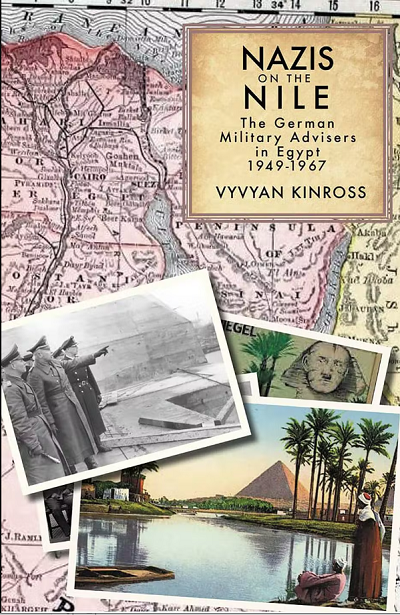
In The Critic, James Barr reviews a book on the roles of former Nazi military and political figures in the Egyptian forces, Nazis on the Nile: The German Military Advisers in Egypt 1949-1967 by Vyvyan Kinross:

One of the paradoxes of the early postwar era is that, after Germany’s defeat, the Nazis were vilified at the same time that their expertise was sought after by both Cold War superpowers. Germans played key roles in both sides’ space programmes. Less infamous is the part they also went on to play in the Egyptian rocket programme, one of the subjects in this fascinating and disturbing book.

After suffering a humiliating defeat in the war that followed the establishment of Israel, the Egyptians wanted revenge. As the British had refused to help them — despite maintaining a deeply unpopular and large presence astride the Suez Canal — Egypt’s sybaritic King Farouq turned to his enemy’s enemy instead. In 1949 he commissioned an Afrika Korps general, Artur Schmitt, to review the Egyptian army.

Having checked in to a Cairo hotel under the name “Herr Goldstein”, Schmitt inspected Egyptian units and went on to Syria to survey Israel from the Golan Heights. The Egyptians’ failure to combine tanks, artillery and infantry effectively, he decided, explained their “inability to take advantage of the early stages of fighting to wipe the State of Israel off the map”.

Schmitt’s forthright conclusions were unwelcome, and he did not stay long. But some younger Egyptian army officers shared his views and, after they had overthrown Farouq in 1952, they picked up where the king had left off. Within days they offered Fritz Voss, the former head of the Skoda arms factory in Pilsen, the job of masterminding the retraining of the army and the establishment of a military industrial base that could produce jet aircraft and missiles.

Voss in turn invited old contacts to join him, including Wilhelm Beisner, an SS officer who had been part of Einsatzkommando Egypt, which would have spearheaded the Holocaust in Palestine had Rommel won at El Alamein. The Germans found Egyptian working conditions challenging. “Here one has to act much more slowly than in Prussia,” complained a German instructor who found “Oriental sloppiness” irritating. Of forty tanks lined up for a parade to celebrate the first anniversary of the coup, just twelve made it past the junta’s rostrum.

The author, Vyvyan Kinross, is a consultant by profession. He has advised Arab governments and clearly understands the fundamental problems. “The battle” for the Germans, he writes, “was always to reconcile finance, resourcing and the expertise required to execute a sophisticated manufacturing process with the challenging conditions and logistics that prevailed in a country that was late to industrialise and financially underpowered.”

December 11, 2022

An Amphibious Landing to take Rome? – 224 – December 10, 1943

World War Two
Published 10 Dec 2022

There are plans afoot to hit the enemy from behind in Italy. Allied leaders are meeting again in Cairo to go over other plans, notably what to do about China and Burma. There is active fighting on two fronts in Italy too, though this week it doesn’t go particularly well for the Allies. Attacks in the USSR are unsuccessful for the Soviets, but do go well for the Germans, and there are Allied attacks by air in the Marshall Islands and over France.
(more…)

November 27, 2022

The Costliest Day in US Marine History – WW2 – 222 – November 26, 1943

World War Two
Published 26 Nov 2022

The Americans attack the Gilbert Islands this week, and though they successfully take Tarawa and Makin Atolls, it is VERY costly in lives, and show that the Japanese are not going to be defeated easily. They also have a naval battle in the Solomons. Fighting continues in the Soviet Union and Italy, and an Allied conference takes place in Cairo, a prelude for a major one in Teheran next week.
(more…)

November 2, 2022

Feeding King Tut

Filed under: Africa, Food, History, Middle East — Tags: , , , , — Nicholas @ 04:00

Tasting History with Max Miller
Published 1 Nov 2022
(more…)

September 9, 2022

The Byzantine Empire: Part 2 – Survival and Growth

seangabb
Published 15 Oct 2021

Between 330 AD and 1453, Constantinople (modern Istanbul) was the capital of the Roman Empire, otherwise known as the Later Roman Empire, the Eastern Roman Empire, the Mediaeval Roman Empire, or The Byzantine Empire. For most of this time, it was the largest and richest city in Christendom. The territories of which it was the central capital enjoyed better protections of life, liberty and property, and a higher standard of living, than any other Christian territory, and usually compared favourably with the neighbouring and rival Islamic empires.

The purpose of this course is to give an overview of Byzantine history, from the refoundation of the City by Constantine the Great to its final capture by the Turks.

Here is a series of lectures given by Sean Gabb in late 2021, in which he discusses and tries to explain the history of Byzantium. For reasons of politeness and data protection, all student contributions have been removed.
(more…)

September 2, 2022

The Paras Last Drop – Gamil Airfield 1956

Filed under: Britain, History, Middle East, Military — Tags: , , — Nicholas @ 02:00

Mark Felton Productions
Published 18 Apr 2020

The last time the Parachute Regiment dropped into combat was during the 1956 Suez Crisis when 3 PARA landed on El Gamil Airfield outside Port Said, Egypt.
(more…)

June 23, 2022

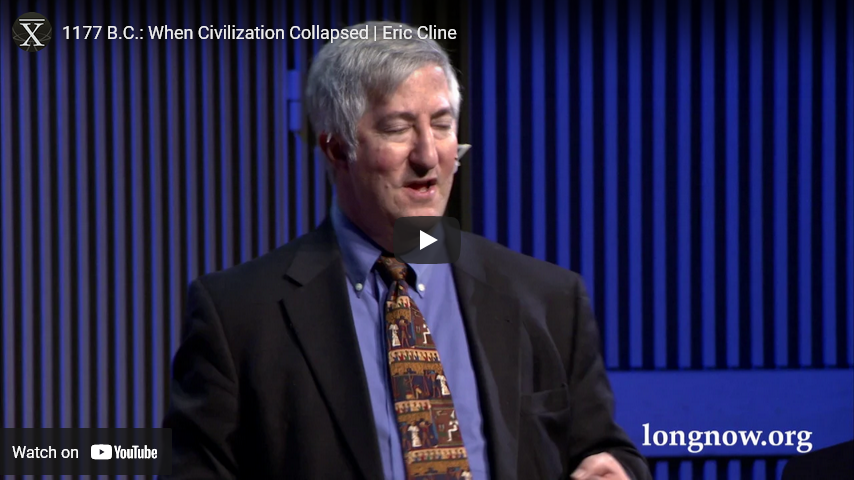
1177 B.C.: When Civilization Collapsed | Eric Cline

Long Now Foundation
Published 19 Apr 2020

Consider this, optimists. All the societies in the world can collapse simultaneously. It has happened before.

In the 12th century BCE the great Bronze Age civilizations of the Mediterranean — all of them — suddenly fell apart. Their empires evaporated, their cities emptied out, their technologies disappeared, and famine ruled. Mycenae, Minos, Assyria, Hittites, Canaan, Cyprus — all gone. Even Egypt fell into a steep decline. The Bronze Age was over.

The event should live in history as one of the great cautionary tales, but it hasn’t because its causes were considered a mystery. How can we know what to be cautious of? Eric Cline has taken on on the mystery. An archaeologist-historian at George Washington University, he is the author of 1177 B.C.: The Year Civilization Collapsed. The failure, he suggests, was systemic. The highly complex, richly interconnected system of the world tipped all at once into chaos.

“1177 B.C.: When Civilization Collapsed” was given on January 11, 2016 as part of Long Now’s Seminar series. The series was started in 2003 to build a compelling body of ideas about long-term thinking from some of the world’s leading thinkers. The Seminars take place in San Francisco and are curated and hosted by Stewart Brand. To follow the talks, you can:

Subscribe to our podcasts: http://longnow.org/seminars/podcast
Explore the full series: http://longnow.org/seminars
More ideas on long-term thinking: http://blog.longnow.org

The Long Now Foundation is a non-profit dedicated to fostering long-term thinking and responsibility. Our projects include a 10,000 Year Clock, endangered language preservation, thousand year+ data storage, and Long Bets, an arena for accountable predictions.

Become a Long Now member to support this series, join our community, and connect with our ongoing work to explore and deepen long-term thinking: http://longnow.org/membership

Follow us on Twitter: https://www.twitter.com/longnow
Subscribe to our channel: https://www.youtube.com/longnow

June 12, 2022

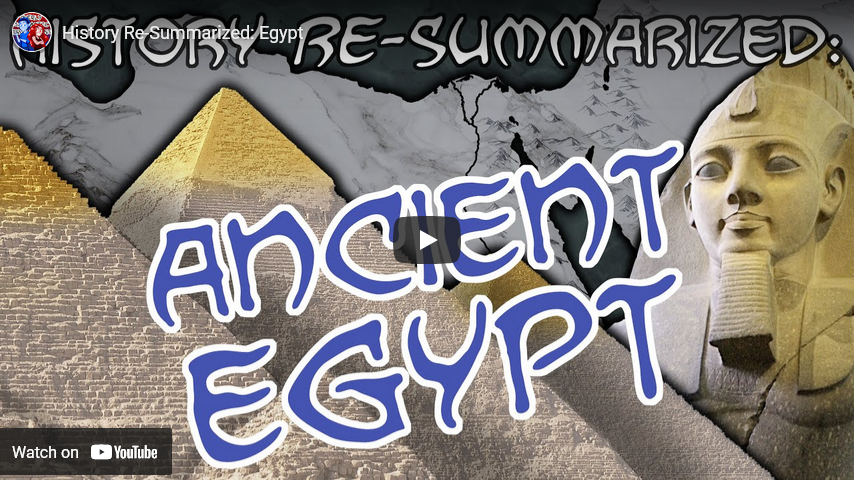
History Re-Summarized: Egypt

Overly Sarcastic Productions
Published 18 Feb 2022

I for one was shocked to learn the Egyptians actually buried their kings in a giant Millennium Puzzle.

We’ve covered Egypt on this channel in previous videos, but this History Re-Summarized is the Definitive Edition, redone from the ground up to present the best possible account — starting at the beginning for a full chronology of Ancient Egypt, from the very first Pharaohs to the Muslim Conquest.

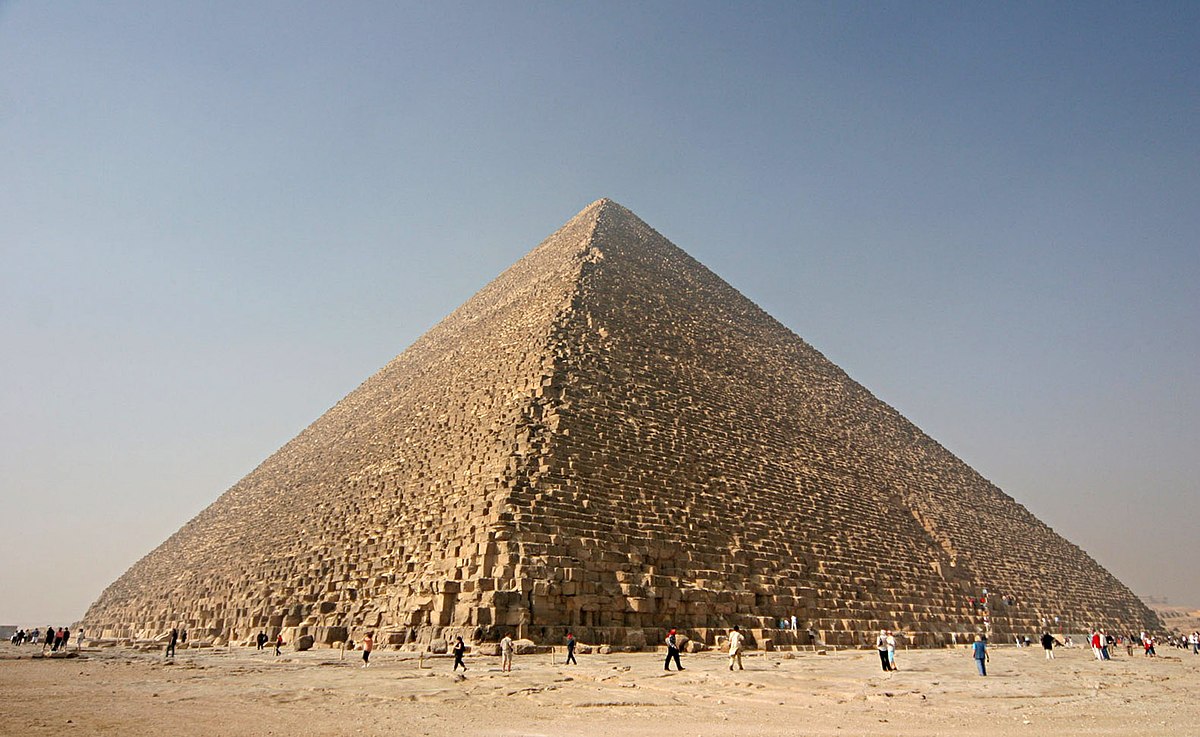
(Observant Egyptologists and D&D players might note the Pyramids are actually D-*Fives*, but technically they’re D-*Nines* since each face is actually two right triangles at a slight angle to each other and not a single flat isosceles triangle, so shhh, we can pretend it’s a D4.)

Sources & Further Reading: The Oxford History of Ancient Egypt & Ancient Egypt: A Very Short Introduction by Ian Shaw, World History Encyclopedia entries on “Ancient Egypt”, “Old Kingdom of Egypt”, “First Intermediate Period of Egypt”, “Middle Kingdom of Egypt”, “Second Intermediate Period of Egypt”, “New Kingdom of Egypt” https://www.worldhistory.org/egypt/, The Great Courses’ lecture series “History of Ancient Egypt” by Bob Brier. Additionally, I have an undergraduate degree in classical studies (re: Persia, Ptolemies and Rome). Extra special thanks to our OSP Discord server moderator & Egyptology connoisseur Billy, for his assistance and guidance for this video!

Our content is intended for teenage audiences and up.

PATREON: https://www.Patreon.com/OSP

PODCAST: https://overlysarcasticpodcast.transi…

DISCORD: https://discord.gg/osp

MERCH LINKS: http://rdbl.co/osp

OUR WEBSITE: https://www.OverlySarcasticProductions.com
Find us on Twitter https://www.Twitter.com/OSPYouTube
Find us on Reddit https://www.Reddit.com/r/OSP/

June 10, 2022

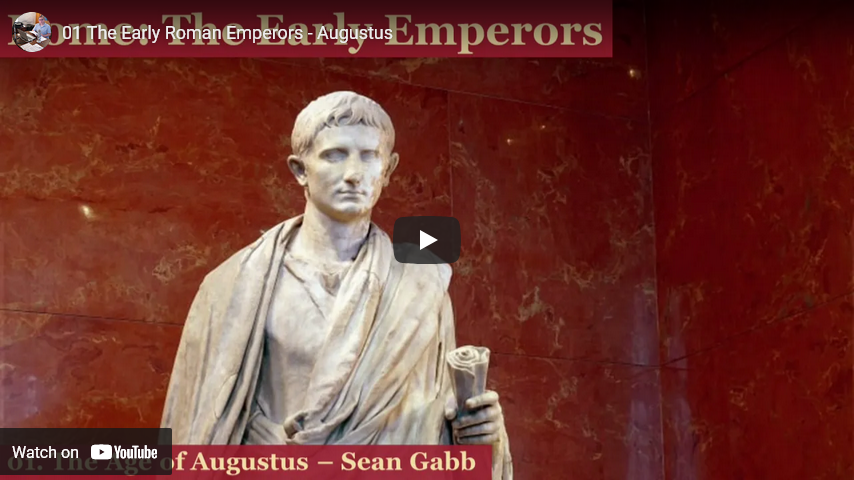
The Early Roman Emperors – Part 1: Augustus

Filed under: Europe, History — Tags: , , , , , , , , — Nicholas @ 04:00

seangabb
Published 26 Sep 2021

The Roman Empire was the last and the greatest of the ancient empires. It is the origin from which springs the history of Western Europe and those nations that descend from the Western Roman Empire. It is the political entity within which the Christian faith was born, and the growth of the Church within the Empire, and its eventual establishment as the sole faith of the Empire, have left an indelible impression on all modern denominations. Its history, together with that of the ancient Greeks and the Jews, is our history. To understand how the Empire emerged from a great though finally dysfunctional republic, and how it was consolidated by its early rulers, is partly how we understand ourselves.

Here is a series of lectures given by Sean Gabb in late 2021, in which he discusses and tries to explain the achievement of the early Emperors. For reasons of politeness and data protection, all student contributions have been removed.

More by Sean Gabb on the Ancient World: https://www.classicstuition.co.uk/

Learn Latin or Greek or both with him: https://www.udemy.com/user/sean-gabb/

His historical novels (under the pen name “Richard Blake”): https://www.amazon.co.uk/Richard-Blak…

June 3, 2022

The Crusades: Part 10 – The End of the Crusader Kingdoms

Filed under: Europe, History, Military, Religion — Tags: , , , , , , , — Nicholas @ 04:00

seangabb
Published 27 Mar 2021

The Crusades are the defining event of the Middle Ages. They brought the very different civilisations of Western Europe, Byzantium and Islam into an extended period of both conflict and peaceful co-existence. Between January and March 2021, Sean Gabb explored this long encounter with his students. Here is one of his lectures. All student contributions have been removed.
(more…)

May 23, 2022

QotD: The adoption of Astrology by the Greeks and Romans

Perhaps the most influential form of divination to arrive in the Roman world from the East was astrology. Systems for divining the will of the gods and the course of the future emerged in both Egypt and Mesopotamia c. 2000 B.C. and were thus both very ancient when Alexander the Great conquered both in the late fourth century. From there, astrology, practiced by professional experts, moved into the Greek and then Roman world, though Roman elites were often deeply ambivalent about this foreign method of divination; both Cato and Cicero express doubts (of course, the Roman practice of haruspicy was also foreign in that it was Etruscan, but this adoption had been sanctified by long use in Roman tradition and was thus mostly beyond reproach). Nevertheless, it is clear that this form of divination become common, with the writer, geographer and astronomer Ptolemy (c. 100-170 A.D.) even producing a long explication of the practice of astrology in his Tetrabiblos.

This portability is not restricted merely to divination. Herodotus’ suspicion that quite a bit of Greek religion might have come from somewhere else has merit, though Anatolia, not Egypt, appears to be the main source (see: M.L. West, The East Face of Helicon (1999); and for the person already writing this comment, yes I am aware of Bernal’s Black Athena and no I am not convinced, nor are many specialists in the field). The Romans were open about importing gods from Greece and make a clear distinction between gods worshiped in traditional Roman manner and those imported from Greece (a quite small number) and thus whose rituals followed ritus graecus – rituals in Greek fashion.

In other cases, the foreign practice was modified to fit the culture it arrived in. The Romans adopted the cult of Cybele, an Anatolian goddess, during the dark days of the Second Punic War (the Senate made that decision based on a consultation with the Sibylline books, a written source of oracular prophecy we can talk about another day). Cybele was called Magna Mater (“Great Mother”) in Rome, and it seems made some modifications to her rituals, in particular possibly limiting the role of the Galli (eunuch priests) whose rituals and style seemed decidedly “unRoman” (though I should note that the scholarship here is contested and the issue and evidence complex).

The normal technical term for this kind of religious borrowing is syncretism, and it is a sort of interweaving of religious traditions that polytheisms both ancient and modern are exceptionally capable of. It is simply not hard to add one more god or one more ritual into a religious system that already assumes the existence of innumerable gods.

Bret Devereaux, “Collections: Practical Polytheism, Part III: Polling the Gods”, A Collection of Unmitigated Pedantry, 2019-11-08.

May 14, 2022

QotD: The farming cycle in pre-modern Mediterranean cultures

As you might imagine, time in agriculture is governed by the seasons. Crops must be planted at particular times, harvested at particular times. In most ancient societies, the keeping of the calendar was a religious obligation, a job for educated priests (either a professional priestly class as in the Near East, or local notables serving as amateurs, as in Greece and Rome).

The seasonal patterns vary a bit depending on the conditions and the sort of wheat being sown. In much of the Mediterranean, where the main concern was preserving a full year’s moisture for the crop, planting was done in autumn (November or October) and the crop was harvested in early summer (typically July or August). In contrast, the Han agricultural calendar for wheat planted in the spring, weeded over the summer and harvested in fall. The Romans generally kept to the autumn-planting schedule, except our sources note that on land which was rich enough (and wet enough) to be continuously cropped year after year (without a fallow), the crop was sown in spring; this might also be done in desperation if the autumn crop had failed. In Egypt, sowing was done as the Nile’s flood waters subsided at the beginning of Peret (in January), with the harvest taking place in Shemu (summer or early fall).

(As an aside on the seasons: we think in terms of four seasons, but many Mediterranean peoples thought in terms of three, presumably because Mediterranean winters are so mild. Thus the Greeks have three goddesses of the seasons initially, the Horae (spring, summer and fall) and Demeter’s grief divides the year into thirds not fourths in the Homeric Hymn to Demeter. In ancient Egypt, there were three seasons: Akhet (Flood); Peret (Emergence [of fertile lands as the waters recede]) and Shemu (Low Water). The perception of the seasons depended on local climate and local cycles of agriculture.)

Bret Devereaux, “Collections: Bread, How Did They Make It? Part I: Farmers!”, A collection of Unmitigated Pedantry, 2020-07-24.

April 19, 2022

Alexander’s Successors (the Diadochi): Series Introduction and Historical Context

Thersites the Historian
Published 24 Nov 2018

This video introduces my series on Alexander’s Successors by talking about what the series will be like and by going through the historical context that the viewer might need to understand the age of the Successors.

Patreon link: https://www.patreon.com/thersites

PayPal link: paypal.me/thersites

Twitter link: https://twitter.com/ThersitesAthens

Minds.com link: https://www.minds.com/ThersitestheHis…

Steemit/dtube link: https://steemit.com/@thersites/feed

Backup Channel: https://www.youtube.com/channel/UCUrD…

April 11, 2022

Republic to Empire: The Ides of March to Actium

seangabb
Published 13 Mar 2021

In 120 BC, Rome was a republic with touches of democracy. A century later, it was a divine right military dictatorship. Between January and March 2021, Sean Gabb explored this transformation with his students. Here is one of his lectures. All student contributions have been removed.
(more…)

April 7, 2022

Republic to Empire: The Triumph of Caesar

Filed under: Europe, History, Italy, Military — Tags: , , , , , , , , — Nicholas @ 06:00

seangabb
Published 5 Mar 2021

In 120 BC, Rome was a republic with touches of democracy. A century later, it was a divine right military dictatorship. Between January and March 2021, Sean Gabb explored this transformation with his students. Here is one of his lectures. All student contributions have been removed.
(more…)

« Newer PostsOlder Posts »

Powered by WordPress