
Forgotten Weapons
Published 13 Dec 2024The Beretta 93R (“Raffica”) was developed in the 1970s by Beretta engineer Paolo Parola at the request of Italian military special forces. It took the basic Beretta 92 pistol design and added a well-thought-out burst mechanism under the right-side grip panel. It does not have a plain full-auto setting, but only semiauto and 3-round burst. To help keep the gun controllable, it has a heavier slide to reduce cyclic rate, a detachable shoulder stock, and a folding front grip to help control the muzzle. It uses extended 20-round magazines and is actually remarkably controllable (or so I am told; I have not had a chance to shoot one myself).
(more…)
April 11, 2025
Beretta 93R: The Best Machine Pistol?
Comments Off on Beretta 93R: The Best Machine Pistol?
April 7, 2025
Dambusters Part 1 – The Battle of the Ruhr
HardThrasher
Published 5 Apr 2025The background to the Dams raid; how it came into being and how it fitted into the assault on Nazi Germany. In which we discuss Banes Wallis, Arthur Harris and a man called Winterbotham.
THESE LINKS ARE ONLY FOR THE SERIOUSLY SEXY
Merch! – https://hardthrasher-shop.fourthwall.com
Patreon – https://www.patreon.com/LordHardThrasherBibliography
James Holland – Dambusters: the Races to Smash the Dams 1943
Max Hastings – Chastise – The Dambusters Story
Alan Cooper – The Battle of the Ruhr
Adam Tooze – The Wages of Destruction
Martin Millbrook and Chris Everett – The Bomber Command War Diaries
Edward Westerman – Flak German Anti Aircraft Defences [sic] 1914-1945
Tami Davis Biddle – Rhetoric and Reality in Air Warfare
Donald A Miller – Masters of the Air
Comments Off on Dambusters Part 1 – The Battle of the Ruhr
Best of American and Europe: the Webley No5 Express New Army
Forgotten Weapons
Published 6 Dec 2024Webley introduced their No5 Express New Army model revolver in 1878. This was essentially a ruggedized and scaled up variation on the No5 RIC revolvers that was very popular with police forces. The RIC was chambered for just the .450 Adams cartridge, and its ejection system in particular was not suitable to serious military campaigning. Hoping for a military contract, Webley took that No5 double-action clockwork and put it into a much bigger frame, capable of handling all patterns of British service cartridge as well as the American .45 Colt powerhouse. It then proceeded to lose the military adoption to the Enfield MkI, a frankly not very good design.
However, British officers had their own choice of sidearms, and many opted for the No5 Army Express, as evidenced by significant sales through the Army & Navy CSL catalog. The model was well liked and popular, but only for a fairly brief span. In 1887 the British adopted the top-break Webley MkI, and the development of new technology like smokeless powder and tip-out cylinders quickly rendered the No5 obsolete. But for about a decade, this was a very compelling choice, offering a reliably double action system with a powerful cartridge.
(more…)
Comments Off on Best of American and Europe: the Webley No5 Express New Army
April 3, 2025
English Electric Lightning – the F-22 of 1958
HardThrasher
Published 14 Jul 2023In which we explore one of the more bonkers aircraft of the Cold War and all the reasons it made no sense whatsoever whilst being awesome in practically every way.
(more…)
Comments Off on English Electric Lightning – the F-22 of 1958
March 31, 2025
Berettas With Bayonets: The Very Early Model 38A SMG
Forgotten Weapons
Published 29 Nov 2024The initial model of the Beretta 38A had a number of features that were dropped rather quickly once wartime production became a priority. Specifically, they included a lockout safety switch for just the rear full-auto trigger. This was in place primarily for police use, in which the guns were intended for semiautomatic use except on dire emergency (and the first batches of 38As in Italy went to the police and the Polizia dell’Africa Italiana). The first version of the 38A also included a bayonet lug to use a version of the folding bayonet also used on the Carcano rifles. This was a folding-blade bayonet, and the model for the 38A replaced the rifle muzzle ring with a special T-lug to attach to the muzzle brake of the SMG. These bayonets are extremely scarce today, as they were only used for a very limited time.
(more…)
Comments Off on Berettas With Bayonets: The Very Early Model 38A SMG
March 28, 2025
The First Sturmgewehr: The MKb42(H)
Forgotten Weapons
Published 27 Nov 2024The first iteration of the iconic German Sturmgewehr was developed by Haenel starting in 1938. It was a select-fire rifle chambered for the short 8x33mm cartridge, developed by the Polte company. It used a long-stroke gas piston and a tilting bolt patterned after the Czech ZB-26 light machine gun. What makes the MKb42(H) stand out from the later Sturmgewehr models is that it was an open-bolt design. The original design spec was concerned about preventing cook-offs, and so it required firing from an open bolt. This means a very simple fire control system, but it also made the rifle difficult to shoot accurately in semiautomatic.
The first MKb42(H) prototype was finished in 1941, with 50 sample guns produced by late March 1942. A major trial was held in April 1942, in which Hitler rejected the design (mostly, he disliked the smaller cartridge). Development was continued anyway, with a move to a closed-bolt system that would become the MP43/1 which was ready for its first testing in November 1942. The open-bolt 42(H) was put into production anyway, as a stopgap measure to provide some much-needed individual firepower to troops on the Eastern front. Serial production began in January 1943, and continued until September 1943. In total, 11,813 of the rifles were manufactured. They saw use in Russia until replaced by newer MP43 models, and represent the first combat use of the assault rifle concept.
(more…)
Comments Off on The First Sturmgewehr: The MKb42(H)
March 19, 2025
Moore Teatfire Revolver
Forgotten Weapons
Published 21 Jun 2015The Moore patent “teatfire” revolver was one of the more (no pun intended) successful workarounds to the Rollin White patent. Designed by Daniel Moore and David Williamson, the gun was a six-shot .32 caliber pocket revolver which used a proprietary type of cartridge. It was loaded from the front, and the rear of the case had a nipple in its center full of priming compound. This allowed the rear of the cylinder to only have a small hole through which the hammer could reach to hit the nipple and fire the round, as opposed to a rimfire design in which the whole rear of the cartridge had to be exposed at the back of the cylinder. Some examples, including this one, included a unique type of extractor for pushing out spent cases.
Comments Off on Moore Teatfire Revolver
March 16, 2025
George Hyde’s First Submachine Gun: The Hyde Model 33
Forgotten Weapons
Published 11 Mar 2018George Hyde was a gun designer who is due substantial credit, but whose name is rarely heard, because he did not end up with his name on an iconic firearm. Hyde was a German immigrant to the United States in 1927 who formed the Hyde Arms Company and started designing submachine guns. His first was the Model 33, which we have here today. This quickly evolved into the Model 35, which was tested by Aberdeen Proving Grounds in the summer of 1939. It was found to have a number of significant advantages over the Thompson, but also some durability problems. The problems could probably have been addressed, but Hyde (who had gone from working as shop foreman at Griffin & Howe to later becoming chief designer for GM’s Inland division during WWII) had already moved on to a better iteration. His next design was actually adopted as the M2 to replace the Thompson, but production problems caused it to be cancelled. The M3 Grease Gun was chosen instead, and Hyde had designed that as well. He was also responsible for the design of the clandestine .45 caliber Liberator pistol.
The Hyde Model 33 is a blowback submachine gun which obviously took significant influence from the Thompson — just look at the front grip, barrel ribs, controls, magazine well, and stock design. However, it was simpler, lighter, and less expensive than the Thompson. It fared better than the Thompson in military mud and dust tests, probably in part because of its unusual charging handle, a long rod mounted in the rear cap of the receiver. This was pulled rearward to cycle the bolt, a bit like the AR15 charging handle. Like the AR15, this setup eliminated the need for an open slot in the receiver. Apparently, however, the handle had a disconcerting habit of bouncing back into the face of the shooter when firing.
Cool Forgotten Weapons merch! http://shop.bbtv.com/collections/forg…
Comments Off on George Hyde’s First Submachine Gun: The Hyde Model 33
March 15, 2025
Canada’s Unique WW2 Rocket Artillery: The Land Mattress
OTD Military History
Published 12 Nov 2022The Land Mattress, officially known as Projector, Rocket 3-inch, No 8 Mk 1, was the Canadian rocket launcher used during World War 2. The last surviving example is on display at the @CanWarMus.
(more…)
Comments Off on Canada’s Unique WW2 Rocket Artillery: The Land Mattress
March 12, 2025
Colt Sidehammer “Root” Dragoon Prototype
Forgotten Weapons
Published 17 Nov 2016During the development of the 1860 Army revolver, Colt did consider mechanical options other than simply scaling up the 1851 Navy pattern. One of these, as evidenced by this Colt prototype, was an enlarged version of the 1855 Pocket, aka “Root”, revolver. That 1855 design used a solid frame and had been the basis for Colt’s revolving rifles and shotguns, and so it would be natural to consider it for use in a .44-caliber Army revolver. How extensive the experimentation was is not known, and I believe this is the only known surviving prototype of a Dragoon-size 1855 pistol. It survives in excellent shape, and is a really neat glimpse at what might have been …
Comments Off on Colt Sidehammer “Root” Dragoon Prototype
March 8, 2025
Joslyn M1862 and M1864 Carbines
Forgotten Weapons
Published 15 Jun 2015While US infantry forces during the Civil War had only limited access to the newest rifle technology, cavalry units adopted a wide variety of new carbines in significant numbers. Among these were a design by Benjamin Joslyn. It first appeared in 1855 designed to use paper cartridges, but by the time the US Army showed an interest Joslyn had updated the weapon to use brass rimfire ammunition. The first version purchased by the government was the 1862 pattern carbine, of which about a thousand were obtained. Many more were ordered, but it took Joslyn a couple years to really get his manufacturing facility and processes worked out. By the time he had this all straightened out, the design had been updated again to the 1864 pattern, addressing several minor problems with the earlier version. Ultimately more than 11,000 of the 1864 pattern carbines were purchased by the Union, chambered for the same .56-.52 cartridge as the Spencer carbines also in service.
Comments Off on Joslyn M1862 and M1864 Carbines
March 7, 2025
Bricking the internet
In The Line, Phil A. McBride explains how the “net giants” have steadily nibbled away at the built-in resilience of the original internet design so that we’re all far more vulnerable to network outages than ever before:
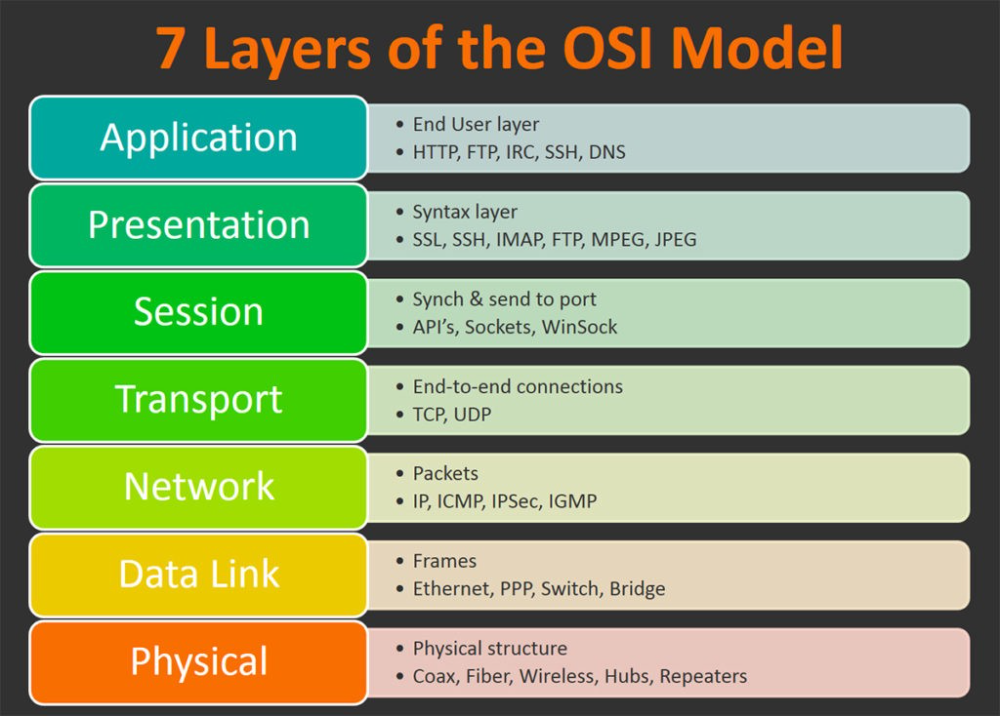
The Internet was originally conceived in the 1960s to be a resilient, disparate and distributed network that didn’t have any single point of failure. This is still true today. While there are large data centres around the world that aggregate traffic, we don’t depend on them. If one were to go offline, things would slow down, but the data would still flow.
The advent of the cloud, though, has completely changed how we use the Internet, especially in the worlds of business, education and government. And the cloud, alas, is not nearly as resilient.
Fifteen years ago, your average small or medium business would have their own servers. Those servers would be used to send/receive email, store files, and run various business or collaborative applications. Some of these servers may have been hosted offsite at a data centre to provide better security or speed of access, but the physical infrastructure belonged to someone — it was something you could touch and, more importantly, account for. Many companies kept their servers on site.
If a company’s server or network went down, it affected that company. They couldn’t send or receive email, they couldn’t open files, collaborate with staff or clients. They were offline.
But only they were offline.
Fast forward to today. Microsoft 365 dominates the corporate productivity services market with an estimated 45-50 per cent market share worldwide, with Google Workspace coming second, with around 30-35 per cent. This means that approximately 80 per cent of businesses are dependent on one of two vendors for their ability to transact business and communicate at even the most basic level.
Government and government-provided services, like education, health care and defence, are just as reliant on these services as the business world.
In today’s world, when Microsoft’s or Google’s services suffer a hiccup, it doesn’t affect one business. Or ten, or a hundred. Tens of thousands of business, and government offices and civil society institutions, all go offline. Simultaneously. Mom-and-pop stores, multi-billion-dollar corporations, elementary schools, hospitals, entire governments, all go out, all at once.
And we haven’t even talked about how Amazon, Microsoft and Google control almost two-thirds of the world’s web/application hosting market share. If one or all of those services go down, most of the websites you go to on a regular basis would suddenly become unreachable.
Kinda-sorta related to the above is Ted Gioia‘s “State of the Culture” post:
So remember the first rule: The culture always changes first. And then everything else adapts to it.
That’s why teens plugged into the most lowbrow culture often grasp the new reality long before elites figure it out. This was true 50 years ago, and it’s still true today.
So that’s our second rule: If you want to understand the emerging culture, look at the lives of teens and twenty-somethings — and especially their digital lives. (In some cases those are their only lives.)
The web has changed a lot in recent years, hasn’t it? Not long ago, the Internet was loose and relaxed. It was free and easy. It was fun. There wasn’t even an app store.
We made our own rules.
The web had removed all obstacles and boundaries. I could reach out to people all over the world.
The Internet, in those primitive days, put me back in touch with classmates from my youth. It reconnected me with friends I’d made during my many trips overseas. It strengthened my ties with relatives near and far. I even made new friends online.
It felt liberating. It felt empowering.
But it also helped my professional life. I had regular exchanges with writers and musicians in various cities and countries—without leaving the comfort of my home.
I made new connections. I opened new doors.
And this didn’t just happen to me. It happened to everybody.
“The world is flat,” declared journalist Thomas Friedman. All the barriers were gone — we were all operating on the same level. It felt like some imaginary Berlin Wall had fallen.
That culture of flatness changed everything. Ideas spread faster. Commerce moved more easily. Every day I encountered something new from some place far away.
But then it changed.
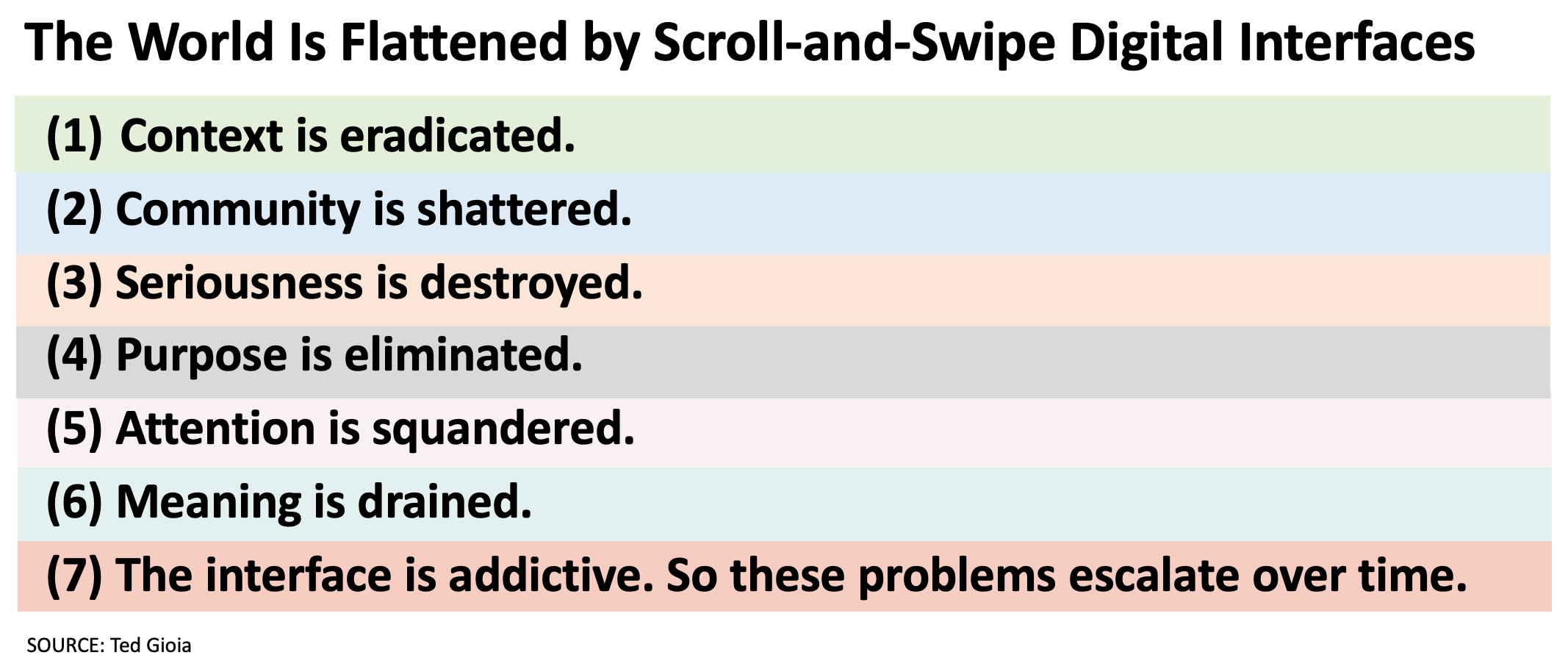
Twenty years ago, the culture was flat. Today it’s flattened.
I still participate in many web platforms — I need to do it for my vocation. (But do I really? I’ve started to wonder.) But now they feel constraining.
Even worse, they now all feel the same.
Instead of connecting with people all over the world, I now get “streaming content” 24/7.
Facebook no longer wants me stay in touch with friends overseas, or former classmates, or distant relatives. Instead it serves up memes and stupid short videos.
And they are the exact same memes and videos playing non-stop on TikTok — and Instagram, Twitter, Threads, Bluesky, YouTube shorts, etc.
Every big web platforms feels the exact same.
That whole rich tapestry of my friends and family and colleagues has been replaced by the most shallow and flattened digital fluff. And this feeling of flattening is intensified by the lack of context or community.
The only ruling principle is the total absence of purpose or seriousness.
The platforms aggravate this problem further by making it difficult to leave. Links are censored. Intelligence is punished by the dictatorship of the algorithms. Every exit is blocked, and all paths lead to the endless scroll.
All this should be illegal. But somehow it isn’t.
February 20, 2025
Enfield MkII: Better Than the MkI, I Guess
Forgotten Weapons
Published 1 Nov 2024The Enfield MkI had only been in service for two years when the MkII was adopted in March 1882 to resolve some of its problems (and reduce its cost). At the same time, a new cartridge was adopted (the MkIII) with a heeled .477” bullet — also in hopes of resolving some of the problems with the Enfield revolver.
The Enfield used a selective ejection system that was intended to dump empty cases but retain unfired live cartridges. It was a bit finicky, with the live rounds often moving during the ejection process and jamming the system up. The larger heeled bullets were hoped to help stop that — and they were also thought to provide better accuracy in the gun’s Henry type rifling.
Simplifications to reduce cost of the gun included:
Unchecked grips
Smooth holster guides
Simplified geometry on the lower frame and top strap
Semicircular front sightFinally, a number of mechanical changes were made. Small elements were added to the clockwork to prevent cylinder rotation when not firing, and to lock the trigger and hammer when the loading gate was open. A second side plate screw was added to ease disassembly, and the grip attachment redesigned to use the lanyard ring as a screw to hold them in place. A fatal accident with an Enfield led to design of a hammer block safety that was intended to be universally retrofitted to guns in service, but many of the guns already sent out to far corners of the planet were never returned for this work.
In total, 13,102 MkII Enfield revolvers were made between 1882 and 1885, plus one gun each in 1886 and 1887. In 1887, the Webley MkI revolver was adopted to replace it, presumably much to the relief of Ordnance officers across the Empire.
(more…)
Comments Off on Enfield MkII: Better Than the MkI, I Guess
February 11, 2025
Mapping the Tube 1863-2023: Treasures of the Tube Map
Jago Hazzard
Published 27 Oct 2024Mapping the Tube: 1863-2023 at The Map House is a captivating selling exhibition showcasing rare maps and materials spanning over 160 years of London’s transport history. It features the largest collection of Harry Beck manuscripts ever offered for sale, alongside early cartographic works and striking posters by 20th-century artists.
(more…)
Comments Off on Mapping the Tube 1863-2023: Treasures of the Tube Map
January 29, 2025
Gewehr 98: The German WWI Standard Rifle
Forgotten Weapons
Published 11 Jun 2016The Gewehr 1898 was the product of a decade of bolt action repeating rifle improvements by the Mauser company, and would be the standard German infantry rifle through both World Wars. Today we are looking at a pre-WWI example (1905 production) that shows all the features of what a German soldier would have taken to war in 1914.
Comments Off on Gewehr 98: The German WWI Standard Rifle


