And so, Foucault tells us, in the fifteenth century there is a sudden emergence of a complex of artistic and philosophical themes linking madmen, the sea, and the terrible mysteries of the world. These culminate in the “Ship Of Fools”:
Renaissance men developed a delightful, yet horrible way of dealing with their mad denizens: they were put on a ship and entrusted to mariners because folly, water, and sea, as everyone then knew, had an affinity for each other. Thus, “Ships of Fools” crisscrossed the seas and canals of Europe with their comic and pathetic cargo of souls. Some of them found pleasure and even a cure in the changing surroundings, in the isolation of being cast off, while others withdrew further, became worse, or died alone and away from their families. The cities and villages which had thus rid themselves of their crazed and crazy, could now take pleasure in watching the exciting sideshow when a ship full of foreign lunatics would dock at their harbors.
This was such a great piece of historical trivia that I was shocked I’d never heard it before. Some quick research revealed the reason: it is completely, 100% false. Apparently Foucault looked at an allegorical painting by Hieronymus Bosch, decided it definitely existed in real life, and concocted the rest from his imagination.
Foucault apologists try to rescue this, say that he was just being poetic in some way. He wasn’t. Page 8 in my copy: “Of all these romantic or satiric vessels, the Narrenschiff [Ship Of Fools] is the only one that had a real existence — for they did exist, these boats that conveyed their insane cargo from town to town.” He really, really doubled down on this point. As far as I can tell, this is just as bad a failing of scholarship as it sounds – and surprising, since everything else about the book gives the impression of Foucault as an incredibly knowledgeable and wide-ranging scholar.
Scott Alexander, “Book review: Madness and Civilization”, Slate Star Codex, 2018-01-04.
April 13, 2020
QotD: Foucault’s “Ship of Fools”
April 11, 2020
QotD: Zhou Enlai’s famous “too early to say” comment on the French Revolution
When Chinese premier Zhou Enlai famously said it was “too early” to assess the implications of the French revolution, he was referring to turmoil in France in 1968 and not — as is commonly thought — to the more distant political upheaval of 1789.
So says a retired American diplomat, Charles W. (Chas) Freeman Jr., who was present when Zhou made the comment during President Richard Nixon’s visit to China in February 1972.
Freeman, who was Nixon’s interpreter during the historic, weeklong trip, made the disclosure last week during a panel discussion in Washington about On China, the latest book by former Secretary of State Henry Kissinger.
The discussion was moderated by Richard McGregor, a journalist and China expert who wrote about Freeman’s comments for the Financial Times of London.
In an interview yesterday, Freeman elaborated on his recollection about Zhou’s comment, the conventional interpretation of which is frequently offered as evidence of China’s sage, patient, and far-sighted ways. Foreign Policy magazine, for example, referred last month to that interpretation, saying the comment was “a cautionary warning of the perils of judgments made in real time.”
The Washington Post‘s recent review of Kissinger’s book likewise referred to the conventional understanding of Zhou’s remark.
Freeman described Zhou’s misconstrued comment as “one of those convenient misunderstandings that never gets corrected.”
He said Zhou’s remark probably was made over lunch or dinner, during a discussion about revolutions that had succeeded and failed. They included, Freeman said, the Prague Spring of 1968 and the Hungarian uprising of 1956, both of which the Soviet Union crushed.
He said it was clear from the context and content of Zhou’s comment that in saying it was “too early to say” the Chinese leader was speaking about the events in France in May 1968, not the years of upheaval that began in 1789.
Freeman acknowledged that the conventional interpretation makes for a better story but added that it was “absolutely clear” from the context of the discussion that Zhou was speaking about 1968.
W. Joseph Campbell, “‘Too early to say’: Zhou was speaking about 1968, not 1789”, Media Myth Alert, 2011-06-14.
April 8, 2020
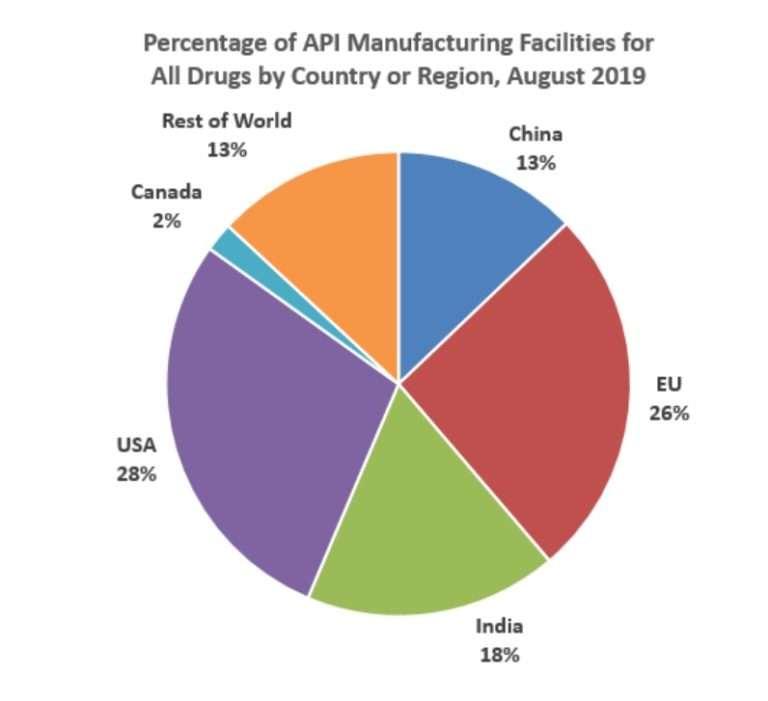
Debunking the claim that “80% of America’s drugs come from China”
Eric Boehm tries to sort out where the startling claim came from … because it’s not true:
While reading about the COVID-19 outbreak, you’ve probably encountered this particularly shocking statistic at one time or another: 80 percent of America’s pharmaceutical drug supply comes from China.
It’s a statistic that has made the rounds in right-wing publications for a while — offered as proof that China-heavy global supply chains are putting Americans at risk — but it has also popped up in mainstream outlets, including in pieces published in Politico and The Atlantic. Wherever it is deployed, the stat carries an unstated implication: What if China decides to cut us off in the middle of a pandemic? Could America face a dramatic shortage of key pharmaceutical drugs at the moment when we are most in need? And that distorted claim that says America has been too reliant on China has been seized by politicians like Sen. Josh Hawley (R–Mo.) as evidence that globalization has undermined America’s pandemic response.
[…]
How much is a lot? “In all, 80 percent of the U.S. supply of antibiotics are made in China,” [Politico contributors Doug Palmer and Finbarr Bermingham] wrote, linking back to a press release from Sen. Chuck Grassley (R–Iowa).
But that’s not what the press release says.
Grassley’s statement was publicizing a letter Grassley sent on August 9 to the Department of Health and Human Services (HHS) and the FDA, asking them to conduct more inspections of foreign drug manufacturing facilities to make sure they meet American standards.
“Unbeknownst to many consumers … 80 percent of Active Pharmaceutical Ingredients are produced abroad, the majority in China and India,” Grassley wrote.
There’s the first bit of context collapse: the authors of the Politico piece merged Grassley’s “80 percent … are produced abroad” into “80 percent … are made in China.”
All of this also raises another question: Where is Grassley getting that information? His letter sources that claim to a 2016 Government Accountability Office report which itself cited FDA data on pharmaceutical manufacturers around the world. And that report makes it clear that the U.S. has a diverse supply chain for drugs that goes well beyond India and China.
“Nearly 40 percent of finished drugs and approximately 80 percent of active pharmaceutical ingredients (API) are manufactured in registered establishments in more than 150 countries,” is how the GAO summed up America’s pharmaceutical supply chain.
In two jumps, we’ve gone from “80 percent of American drugs are manufactured in more than 150 countries around the world” to “80 percent of drugs come from two countries” to “80 percent of drugs come from China.”
Now, a further complication. The FDA only tracks drug manufacturing facilities — not the supply chains of specific drugs.
That “lack of structural transparency and available supply chain data about drugs,” researchers at the University of Minnesota researchers wrote last month, is one of the reasons why making accurate assessments about potential drug shortages is difficult. Indeed, it was this same bit of missing information that Grassley was encouraging the FDA to address back in August.
April 6, 2020
MYTH BUSTED? Laying a hand plane on its side vs. sole
Stumpy Nubs
Published 20 Apr 2019When you use this link to visit our sponsor, you support us►
iGaging Digital Tools: http://www.chipsfly.com/category/L.html
Subscribe (free) to Stumpy Nubs Woodworking Journal e-Magazine► http://www.stumpynubs.com/subscribe.htmlFollow us on social media►
Instagram: https://www.instagram.com/stumpynubs/
Twitter: https://twitter.com/StumpyNubs
March 2, 2020
QotD: The legend of Rommel and the Afrika Korps
There is no more evocative phrase to emerge from World War II than Afrika Korps. The name conjures up a unique theater of war, a hauntingly beautiful empty quarter where armies could roam free, liberated from towns and hills, choke points and blocking positions, and especially those pesky civilians. It calls forth a war of near-absolute mobility, where tanks could operate very much like ships at sea, “sailing” where they wished, setting out on bold voyages hundreds of miles into the deep desert, then looping around the enemy flank and emerging like pirates of old to deal devastating blows to an unsuspecting foe. Finally, it implies a bold hero, in this case Field Marshal Erwin Rommel, a noble commander who fought the good fight, who hated Hitler and everything he stood for, and who couldn’t have been farther away from our stereotyped image of the Nazi fanatic. Everything about him attracts us — the manly poses, the out-of-central-casting good looks, even the goggles perched just so. Placing Rommel and his elite Afrika Korps to the fore allows us to view the desert war as a clean fight against a morally worthy opponent. It was war, yes, but almost uniquely in World War II, it was a “war without hate.”
It’s an attractive image all around, and it is unfortunate that practically all of it is false. The desert was hardly a haven of beauty or romance. It was a pain, and fighting in it was a nightmare for both sides. Far from letting the respective tank fleets roam free, the desert chained them irresistibly to their supply lines, and a single failed supply convoy or a lost column of trucks could stop an entire offensive dead in its tracks. Contrary to the alleged mobility of desert warfare, both sides would spend far more time in static defensive positions, often quite elaborate, then they would launching tank charges.
That leaves us with Rommel. Here, too, we should challenge the mythology. He was hardly apolitical. His entire career had been based on Hitler’s favor, and we might reasonably describe his attitude toward the Führer as worshipful. He was Hitler’s fair-haired boy, a young officer repeatedly promoted over more senior candidates. He was a media creation. Nazi propaganda painted him not only as a garden-variety hero, but as a model National Socialist and Aryan, a man who could overcome stronger enemies through the sheer force of his will. He was not merely a passive bystander to the hype; he was an active accomplice. He loved nothing better than having a camera crew along with him on campaign, and he would regularly order scenes to be reshot if his posture was insufficiently heroic or the lighting had not shown him to best advantage. As is often the case, his relationship to the media was both self-serving and self-destructive. During the years of victory, the German propaganda machine used him as an example to the nation. When things went sour, he became a diversion from the increasingly bad news on other fronts. Finally, when he was no longer useful for any purpose at all, the regime dropped him altogether and eventually killed him.
Robert Citino, “Drive to Nowhere: The Myth of the Afrika Korps, 1941-43″, The National WWII Museum, 2012. (Originally published in MHQ, Summer 2012).
February 28, 2020
The Robin Hood complex – Social banditry theory and myth making
The Cynical Historian
Published 15 Dec 2016There’s one historical theory that people keep deluding themselves with, and it’s about time I pointed it out. Social banditry, or the “Robin Hood theory” is problematic at best and cultural misanthropy at worst.
Social bandit or social crime is a term invented by the Marxist historian Eric Hobsbawm in his 1959 book Primitive Rebels, a study of popular forms of resistance that also incorporate behavior characterized by law as illegal. He further expanded the field in the 1969 study Bandits. Social banditry is a widespread phenomenon that has occurred in many societies throughout recorded history, and forms of social banditry still exist, as evidenced by piracy and organized crime syndicates. Later social scientists have also discussed the term’s applicability to more modern forms of crime, like street gangs and the economy associated with the trade in illegal drugs.
————————————————————
References:
Boessenecker, John. “California Bandidos.” Southern California Quarterly 80, i4 (Dec. 1, 1998), 419-434.Hall-Patton, Joseph. Pacifying Paradise: Violence and Vigilantism in San Luis Obispo. San Luis Obispo: California Polytechnic – San Luis Obispo thesis, 2016. http://www.digitalcommons.calpoly.edu…
Hobsbawm, Eric. Primitive Rebels: Studies in Archaic Forms of Social Movement in the 19th and 20th Centuries. New York: WW Norton & Company, 1965. https://amzn.to/2L6TDY0
Hobsbawm, Eric. Bandits. Rev. ed. New York: The New Press, 2000. https://amzn.to/2L4RagK
Rediker, Marcus. Outlaws of the Atlantic: Sailor, Pirates, and Motley Crews in the Age of Sail. Boston, Mass.: Beacon Press, 2014. https://amzn.to/2OasYf4
Linebaugh, Peter and Marcus Rediker. The Many-Headed Hydra: Sailors, Slaves, Commoners, and the Hidden History of the Revolutionary Atlantic. Boston, Mass.: Beacon Press, 2000. https://amzn.to/2JKq8tN
https://en.wikipedia.org/wiki/Social_…
https://en.wikipedia.org/wiki/Zorro
https://en.wikipedia.org/wiki/Pancho_…
https://en.wikipedia.org/wiki/Joaquin…
https://en.wikipedia.org/wiki/Salomon…
https://en.wikipedia.org/wiki/Black_B…
————————————————————
Patreon:
https://www.patreon.com/CynicalHistorianLET’S CONNECT:
https://twitter.com/Cynical_History
—————————————–
Hashtags: #History #SocialBanditry #PrimitiveRebellion #RobinHood #BillyTheKid
February 19, 2020
QotD: Myths the Greatest Generation believed
In addition to inflating our confidence in overseas interventions, the war era fueled belief that government could be a major force for good at home, capable of solving every domestic problem. Franklin Roosevelt’s superb wartime management boosted the popular opinion of government and encouraged Americans to adopt war as a metaphor for government action in general. The war seemed to fulfill Teddy Roosevelt’s and Woodrow Wilson’s earlier progressive dreams that big government, acting in concert with big business and big labor, could solve any problem that it chose to tackle. Just as warfare was re-envisioned to fit the total-war model of World War II, governing became understood as a matter of trained professionals applying management methods to public policy.
This belief in the military-like efficiency of government inspired the ambitious welfare-state policies of the postwar era, especially Johnson’s War on Poverty. When, in 1972, Richard Nixon declared a War on Drugs, and when, in 1977, Jimmy Carter described the energy crisis as the “moral equivalent of war,” the model they had in mind was, again, World War II. Today, newspapers and scientific journals still proclaim the need for ambitious government action to fix enormously complex problems — for example, calling repeatedly for a “new Manhattan Project” to solve the problem of climate change.
War, as conservatives figured out early on, is a poor metaphor for government doing socially useful things. We can’t fight and win a “war” on poverty, or drugs, or cancer, because these things are nothing like war. The last heroic big-government project run along World War II lines was the Apollo program, which put Americans on the moon. This was a tremendous achievement, but here a military mindset was directly relevant: like the design of war machines a quarter-century earlier, the Saturn rockets were a discrete engineering challenge, one whose basic parameters were well understood.
E. M. Oblomov, “The Greatest Generation and the Greatest Illusion: Success in World War II led Americans to put too much faith in government — and we still do.”, City Journal, 2017-12-28.
February 13, 2020
Here’s a deceptive factoid … time for you to get angry to suit someone’s political agenda
Did you know that “Three Billionaires Have More Wealth Than Half of America”!!!???!!! Are you angry now? You’re supposed to be, because this factoid was concocted specifically to make people irrationally angry. Daniel C. Jensen explains how this sound bite was created:
People between 0 and 24 years of age account for about 32 percent of the United States population of 320 million. Almost all of them are going to be in the bottom half of the wealth distribution for reasons including diaper rash and puberty. That means they account for about 63 percent of the “bottom half of the wealth distribution.” Should it surprise us that some kid fresh out of college does not “hold any stocks or bonds”? Or a kid fresh out of the womb?
Then we must consider people with mental and physical disabilities. They will also tend to be in the bottom half of the wealth distribution because they face greater challenges to building wealth. “About 56.7 million people — 19 percent of the population — had a disability” at last count, according to the United States Census Bureau. But there is overlap between the disabled 19 percent and the young 32 percent of the population. If we assume disabilities are evenly distributed in the population, then young people and non-young disabled people account for 45 percent of the population. So we have now accounted for 90 percent of the “160 million Americans in the bottom half of the wealth distribution.”
Next, we must think about other groups who have had limited wealth-building opportunities. What about the 2.2 million people in jail and prison? What about people in their late twenties who pursued PhDs, law degrees, medical residencies, etc., and are just beginning their careers? Now we are close to accounting for 100 percent of the “bottom half of the wealth distribution.” But this wealth distribution is not what any sensible person would expect it to be.
Maybe the factoid is true. Maybe Jeff Bezos, Bill Gates, and Warren Buffet have more wealth than all of the infants, children, students, handicapped, prisoners, and postgrads combined. But you don’t need a PhD to figure out that’s not useful knowledge. Even if the factoid is true, it’s deceitful. Whoever created it was obviously trying to manipulate people. And we uncovered this deception with nothing but some simple knowledge of the US population.
Next time you encounter an economic factoid, remember that it might be pitting a bunch of newborns against Jeff Bezos, and that hardly seems fair. Thankfully, you can save those babies from certain defeat simply by knowing some basic statistics about your country.
February 12, 2020
Guderian – Myth & Reality
Military History Visualized
Published 24 Apr 2018Heinz Guderian, the father of the German Panzerwaffe, is one of the best known German generals from the Second World War. He is also known for his opposition to the Battle of Kursk (Operation Zitadelle) and the early deployment of the Panzerkampfwagen V Panther, yet some historians noted recently that many of Heinz Guderian’s claims are not backed up by archives. Well, time to take a closer look.
»» SUPPORT MHV ««
» patreon – https://www.patreon.com/join/mhv
» paypal donation – https://www.paypal.com/cgi-bin/webscr…»» MERCHANDISE – SPOILS OF WAR ««
» shop – https://www.redbubble.com/people/mhvi…»» SOCIAL MEDIA ««
» twitter – https://twitter.com/MilHiVisualized
» twitch – https://www.twitch.tv/militaryhistory…
» minds.com – https://www.minds.com/militaryhistory…» SOURCES «
Pöhlmann, Markus: Der Panzer und die Mechanisierung des Krieges: Eine deutsche Geschichte 1890 bis 1945 (Zeitalter der Weltkriege)
Corum, James S.: The Roots of Blitzkrieg. Hans von Seeckt and German Military Reform
Macksey, Kenneth: “Generaloberst Heinz Guderian”; in: Ueberschär (Hrsg.) Gerd R.: Hitlers militärische Elite – 68 Lebensläufe (3. Auflage), S. 351-358
Guderian, Heinz: Panzer Leader (English Version of Erinnerungen eines Soldaten)
Guderian, Heinz: Erinnerungen eines Soldaten
Munzel, Oskar: Die deutschen gepanzerten Truppen bis 1945
Schacter, Daniel L.: The Seven Sins of Memory: How the Mind Forgets and Remembers
Citino, Robert M.: The German Way of War. From the Thirty Years’ War to the Third Reich
Citino, Robert M.: The Wehrmacht Retreats: Fighting a Lost War, 1943
» CREDITS & SPECIAL THX «
Song: Ethan Meixsell – “Demilitarized Zone”#ww2 #panzergeneral #Guderian
February 8, 2020
300 | Based on a True Story
The Cynical Historian
Published 29 Jul 2015Here is another episode of “Based on a True Story”. This time it is 300 and how it is based on the battle of Thermopylae. It is a great film with a great many historically innacurate plot points.
————————————————————
references:
http://www.todayifoundout.com/index.p…http://www.historyvshollywood.com/ree…
https://en.wikipedia.org/wiki/300_(fi…
————————————————————LET’S CONNECT: https://twitter.com/Cynical_History
————————————————————
Wiki:
300 is a 2006 American epic fantasy war film based on the 1998 comic series of the same name by Frank Miller and Lynn Varley. Both are fictionalized retellings of the Battle of Thermopylae within the Persian Wars. The film was directed by Zack Snyder, while Miller served as executive producer and consultant. It was filmed mostly with a super-imposition chroma key technique, to help replicate the imagery of the original comic book.The plot revolves around King Leonidas (Gerard Butler), who leads 300 Spartans into battle against the Persian “god-King” Xerxes (Rodrigo Santoro) and his invading army of more than 300,000 soldiers. As the battle rages, Queen Gorgo (Lena Headey) attempts to rally support in Sparta for her husband. The story is framed by a voice-over narrative by the Spartan soldier Dilios (David Wenham). Through this narrative technique, various fantastical creatures are introduced, placing 300 within the genre of historical fantasy. The events are revealed to be a story told by Delios, the only one of the 300 Spartans to survive the battle.
300 was released in both conventional and IMAX theaters in the United States on March 9, 2007, and on DVD, Blu-ray Disc, and HD DVD on July 31, 2007. The film received mixed reviews, receiving acclaim for its original visuals and style, but criticism for favoring visuals over characterization and its depiction of the ancient Persians in Iran, a characterization which some had deemed racist; however, the film was a box office success, grossing over $450 million, with the film’s opening being the 24th largest in box office history at the time. A sequel, entitled Rise of an Empire, which is based on Miller’s unpublished graphic novel prequel Xerxes, was released on March 7, 2014.
————————————————————
Hashtags: #history #300 #Thermopylae #review #BasedOnATrueStory #Sparta #ThisIsSparta
January 22, 2020
December 19, 2019
Vive la Résistance! well, not really… French Resistance 1940 – WW2 – War Against Humanity 007
World War Two
Published 18 Dec 2019Immediately after France is occupied by the Nazis in 1940, the French are divided about what to do; resist for collaborate? To put it mildly, it’s complicated.
Join us on Patreon: https://www.patreon.com/TimeGhostHistory
Or join The TimeGhost Army directly at: https://timeghost.tvFollow WW2 day by day on Instagram @World_war_two_realtime https://www.instagram.com/world_war_t…
Join our Discord Server: https://discord.gg/D6D2aYN.
Between 2 Wars: https://www.youtube.com/playlist?list…
Source list: http://bit.ly/WW2sourcesWritten and Hosted by: Spartacus Olsson
Produced and Directed by: Spartacus Olsson and Astrid Deinhard
Executive Producers: Bodo Rittenauer, Astrid Deinhard, Indy Neidell, Spartacus Olsson
Creative Producer: Joram Appel
Post-Production Director: Wieke Kapteijns
Research by: Spartacus Olsson and Francis van Berkel
Edited by: Wieke Kapteijns
Map animations: Eastory (https://www.youtube.com/c/eastory)Colorizations by: Julius Jääskeläinen – https://www.facebook.com/JJcolorization/
Sources: Bundesarchiv, Mémorial de la Shoah
Icons via the Noun Project: collaboration by Pause08, protester by Blaise Sewell, Dove by Luis Prado, confused by LlisoleArchive by Screenocean/Reuters https://www.screenocean.com.
A TimeGhost chronological documentary produced by OnLion Entertainment GmbH.
From the comments:
Spartacus Olsson
16 hours ago
In the aftermath of WW2, everyone was probably pretty tired of the whole tragedy, and ready to just move on. Many of the people that I have met that lived through the war didn’t like talking about the war much. But somehow I had the privilege of getting many of the them that I met to open up and talk about it to me. Maybe not so much because of any personal quality I have other than being very persistent and curious — a pain in the neck is another way of putting it.Anyway, we talked about many things, terrible things, great things, sad, and happy stories. But there was one thing I never heard anybody talk about, and that was indecision. Fear and regret, yes — everyone spoke of that, but not indecision. There was always an undertone of manifest destiny or complete meaninglessness.
But, when you think about it, how could you not be indecisive when faced with this kind of calamity? How can you not wonder if this is destiny, or just bad luck? How can you not be shocked into a stupor, at least at first? And even if you’re an ideologically convinced partisan or combatant, how do you know for sure what the right thing to do is? Well, when you start looking into it all, those questions were pretty much what gripped France in 1940 after the sudden, tragic loss of independence.
I think that indecision is not something we want to remember, perhaps we shouldn’t if we want to stay our course, perhaps we’re wired not to, so that we can focus better on what we finally decide. But for others who want to learn from our mistakes, and our successes — it is in the moment of indecision that we display our thinking, our reasoning, the true origin of our cause.
I should also tell you that I grew up in France, so this is in many ways the story of the adults around me when I was a child.
December 18, 2019
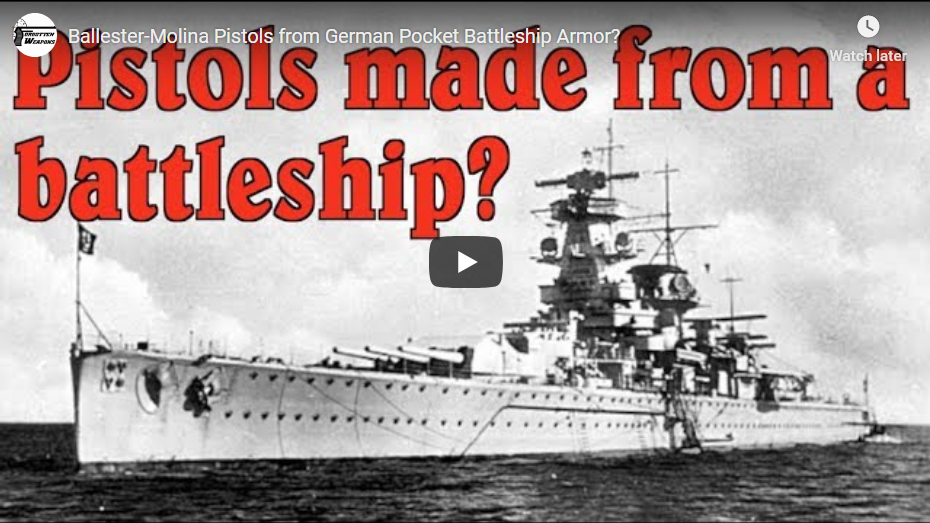
Ballester-Molina Pistols from German Pocket Battleship Armor?
Forgotten Weapons
Published 17 Dec 2019http://www.patreon.com/ForgottenWeapons
Cool Forgotten Weapons merch! http://shop.bbtv.com/collections/forg…
There is an old gun shop tale that Argentine Ballester-Molina pistols were made form the salvaged armor plate of the pocket battleship Admiral Graf Spee. The Graf Spee was scuttled in the Rio de la Plata estuary in December 1939, only a few miles from the HAFDASA factory in Buenos Aires, and Argentina did not have the domestic steel reserves to make enough pistols…
See Michael Parker’s full article on this, including the exact results of his metallurgical analysis, here:
https://www.americanrifleman.org/arti…
Contact:
Forgotten Weapons
6281 N. Oracle #36270
Tucson, AZ 85704
December 12, 2019
The Truth About Legendary Highwayman Dick Turpin
Today I Found Out
Published 8 Feb 2018If you happen to like our videos and have a few bucks to spare to support our efforts, check out our Patreon page where we’ve got a variety of perks for our Patrons, including Simon’s voice on your GPS and the ever requested Simon Whistler whistling package: https://www.patreon.com/TodayIFoundOut
Never run out of things to say at the water cooler with TodayIFoundOut! Brand new videos 7 days a week!
In this video:
Richard Turpin, better known by his nickname, Dick, was a legendary highwayman who stalked the English countryside. A century or so after his death by hanging in 1739, Turpin was idealised as a dashing rogue or gentleman thief type in a multitude of supposedly factual stories purportedly based on his life.
Want the text version?: http://www.todayifoundout.com/index.p…
December 9, 2019
QotD: The Brown M&M’s clause
It was David Lee Roth who ruined personal-appearance contracts for all time with his Brown M&M’s Clause in the ’80s. The story sounds apocryphal but it’s true: Any promoter hiring Van Halen for a concert was required to supply M&M’s in the band’s dressing room but “ABSOLUTELY NO BROWN ONES.”
In later years Roth would claim that this was not an example of spoiled rock star entitlement but a way to make sure that concert promoters read the entire contract and took care of other, more important provisions. I was actually buying this — promoters can be forgetful and dense at all levels of the business — until the Smoking Gun website tracked down the famous M&M’s rider so that we could read the rest of it. In order to “present to your customers the finest in contemporary entertainment,” Van Halen also needed two dozen English muffins, but not just any English muffins — they had to be Thomas brand English muffins — plus two cases of beer delivered precisely at 6 p.m., two more cases (one Budweiser and one Heineken) delivered to the stage manager at 7 p.m., different food menus for even and odd days, and, just to keep you on your toes in the implements department, “all forks must have four prongs.” Backstage the band also needed one case of Budweiser, four cases of Schlitz Malt Liquor (really?), one half case of Tab (perhaps even more shocking than the malt liquor), three fifths of Jack Daniels Black Label, two fifths of Stolichnaya, one pint of Southern Comfort, two bottles of Blue Nun white wine (whoever that was should lose his rock-star cred forever), three packs of Marlboros (these riders are for one day — is that guy dead yet?), and — the mind boggles — “one large tube of KY Jelly.”
The rider ran to eleven pages and is, in fact, ridiculously demanding. (“Any caterer not providing adequate condiments, utensils or ice will be subject to a $100.00 fine.”)
Joe Bob Briggs, “Travel by Luxury Donkey Cart”, Taki’s Magazine, 2019-10-10.