Quotulatiousness

July 21, 2019

Debunking the “common wisdom” about the “Scopes Monkey Trial”

Filed under: Education, History, Law, Media, USA — Tags: , , , , , , — Nicholas @ 05:00

Mark Pulliam explains what really caused the “Scopes Monkey Trial” and what was at stake … which doesn’t match up well at all against what little most people will remember about it today:
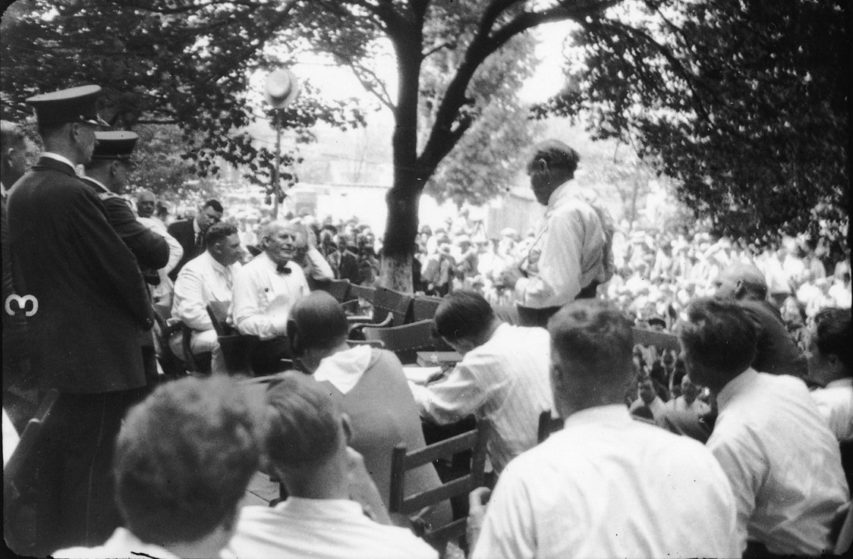
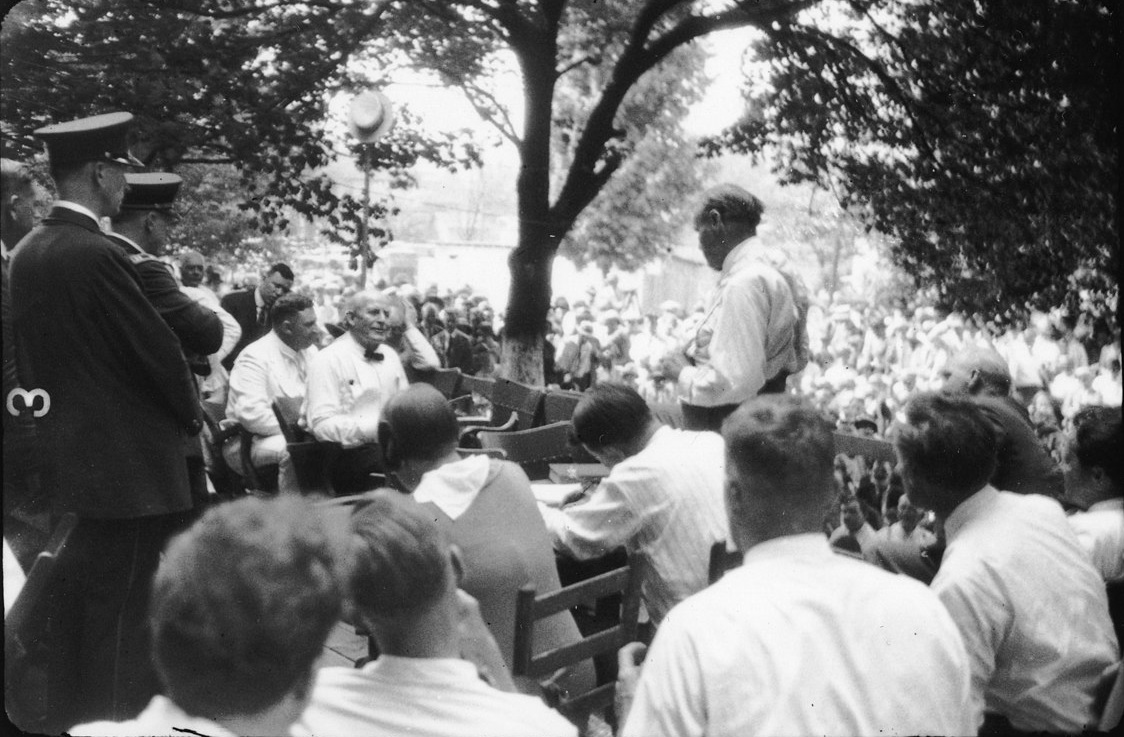
William Jennings Bryan (seated at left) being interrogated by Clarence Darrow, during the trial of the State of Tennessee v. John Thomas Scopes, July 20, 1925. That Monday afternoon, because of the extreme heat, Judge Raulston moved court proceedings outdoors. The session was held on a platform that had been erected at the front of the Rhea County Courthouse to accommodate ministers who wanted to preach during the time of the trial. Defense lawyers for Scopes (John R. Neal, Arthur Garfield Hays, and Dudley Field Malone) are visible seated to the extreme right. One of the men at left, with his back to the photographer, appears to be Scopes. The court reporters are seated at the table.
Photograph by Watson Davis via Wikimedia Commons.

We are again in another contentious period in America where battles over our culture and how we should live together are acrimonious. But there have been many points in our history that indicate we are only re-engaging a form of politics that is quintessentially American. One prominent past episode that occurred in Dayton, Tennessee during the summer of 1925 — the so-called “Scopes Monkey Trial” — has captured the American imagination like few legal proceedings ever have. Noted trial lawyer Clarence Darrow was part of the large legal team representing a 24-year-old substitute high school teacher, John Thomas Scopes, who was accused of violating the state’s Butler Act, which prohibited the teaching of evolution in a state-funded school. The celebrity co-prosecutor was William Jennings Bryan, the three-time Democratic presidential nominee, former Nebraska congressman, and Secretary of State to President Woodrow Wilson. Both Darrow and Bryan were prominent Progressive figures. Bryan, a left-wing evangelical and a fiery orator, is best known for his “Cross of Gold” speech at the 1896 Democratic National Convention.

The trial provided an opportunity for Darrow, whose reputation had been sullied by questionable tactics employed in the defense of radical labor leaders, to vindicate himself before a national audience. Chicago’s WGN radio station broadcast the trial nationwide and hundreds of reporters, some of them from overseas, covered the case. Geoffrey Cowan, author of the exhaustively-researched book The People v. Clarence Darrow, notes that Darrow achieved national notoriety, “won the support of Eastern sophisticates,” and “found new acceptance” as a result of the widely-publicized trial, especially his alleged humiliation of Darrow’s “old hero,” Bryan. This canard, which formed the dramatic crux of the 1960 movie Inherit the Wind, a highly-fictionalized depiction of the trial adapted from the 1955 play written by Jerome Lawrence and Robert E. Lee, is just one aspect of the popular mythology that surrounds the case.

Almost all of the “conventional wisdom” concerning the Scopes trial is false. Contrary to the impression created by Inherit the Wind and other popular accounts (including the sensational reportage of H. L. Mencken of The Baltimore Sun, one of the leading journalists of his day), the trial was not a fundamentalist inquisition, but an ill-conceived publicity stunt by Dayton businessmen who were trying to attract tourists to the small town — to put Dayton on the map. To generate a test case challenging the statute, the American Civil Liberties Union had offered to defend any teacher charged with violating the Butler Act, gratis. Dayton businessmen recruited Scopes to agree to serve as the defendant, even though he was unsure he had actually taught evolution. Nonetheless, Scopes volunteered to be charged. The trial — for a misdemeanor offense — was staged. Celebrity lawyers were solicited to participate for the sole purpose of increasing public interest in the case. The Baltimore Sun paid part of the defense’s expenses because it knew that the spectacle would sell newspapers, and it did. A lot of them.

I think it would be fair to say that H.L. Mencken had a passionate dislike for William Jennings Bryan, even after Bryan’s death a few days later:

It is the national custom to sentimentalize the dead, as it is to sentimentalize men about to be hanged. Perhaps I fall into that weakness here. The Bryan I shall remember is the Bryan of his last weeks on earth — broken, furious, and infinitely pathetic. It was impossible to meet his hatred with hatred to match it. He was winning a battle that would make him forever infamous wherever enlightened men remembered it and him. Even his old enemy, Darrow, was gentle with him at the end. That cross-examination might have been ten times as devastating. It was plain to everyone that the old Berserker Bryan was gone — that all that remained of him was a pair of glaring and horrible eyes.

But what of his life? Did he accomplish any useful thing? Was he, in his day, of any dignity as a man, and of any value to his fellow-men? I doubt it. Bryan, at his best, was simply a magnificent job-seeker. The issues that he bawled about usually meant nothing to him. He was ready to abandon them whenever he could make votes by doing so, and to take up new ones at a moment’s notice. For years he evaded Prohibition as dangerous; then he embraced it as profitable. At the Democratic National Convention last year he was on both sides, and distrusted by both. In his last great battle there was only a baleful and ridiculous malignancy. If he was pathetic, he was also disgusting.

Bryan was a vulgar and common man, a cad undiluted. He was ignorant, bigoted, self-seeking, blatant and dishonest. His career brought him into contact with the first men of his time; he preferred the company of rustic ignoramuses. It was hard to believe, watching him at Dayton, that he had traveled, that he had been received in civilized societies, that he had been a high officer of state. He seemed only a poor clod like those around him, deluded by a childish theology, full of an almost pathological hatred of all learning, all human dignity, all beauty, all fine and noble things. He was a peasant come home to the dung-pile. Imagine a gentleman, and you have imagined everything that he was not.

H/T to “WarEagle82” for the link.

History-Makers: Marco Polo

Filed under: China, Europe, History, Humour — Tags: , , , , , , — Nicholas @ 04:00

Overly Sarcastic Productions
Published on 19 Jul 2019

Go to https://NordVPN.com/overlysarcastic and and use code OVERLYSARCASTIC to get 75% off a 3 year plan and an extra month for free. Protect yourself online today!

On this episode of History-Makers, Blue takes a trip alongside the legendary explorer Marco Polo to figure out how the intrepid Venetian merchant made his way to the Mongol Empire and back, and what that means for his written account of those Travels.

What History-Maker do you want to see next? Leave a comment!

NEW MERCH: “Let’s Do Some History” — https://www.redbubble.com/people/ospy…
NEW STORE: https://www.redbubble.com/people/OSPY…

PATREON: https://www.Patreon.com/OSP

OUR WEBSITE: https://www.OverlySarcasticProductions.com
Find us on Twitter https://www.Twitter.com/OSPYouTube
Find us on Reddit https://www.Reddit.com/r/OSP/

June 12, 2019

The fantastic notion that Donald Trump is “at heart really a free trader”

Filed under: Economics, Government, Politics, USA — Tags: , , , , — Nicholas @ 03:00

Guest-posting at Catallaxy Files, Don Boudreaux explodes the farcical notion that President Trump is using protectionist tools with an eventual free trade goal:

Donald Trump addresses a rally in Nashville, TN in March 2017.
Photo released by the Office of the President of the United States via Wikimedia Commons.

In the case of Donald Trump, the claim that he is at heart really a free trader who raises tariffs today with the aim of bringing about lower tariffs tomorrow — and all because he is committed to achieving free traders’ ideal goal of maximum possible expansion of the international division of labor — is especially preposterous.

Trump has pontificated on trade for decades, and every word out of his mouth clearly reveals a man who knows nothing about the economics of trade and who is as clichéd an economic nationalist as can be imagined.

Behold this line from a 1990 interview he did in Playboy: “The Japanese double-screw the US, a real trick: First they take all our money with their consumer goods, then they put it back in buying all of Manhattan. So either way, we lose.”

Let’s examine this unalloyed gem of economic witlessness.

Overlooking Trump’s outrageous exaggerations, such as his claim that the Japanese buy up “all” of Manhattan, we start by stating an obvious truth: the voluntary purchase of a good is not a transaction in which the buyer is “screwed” or has his or her money “taken.” Instead, the buyer’s money is voluntarily spent. While every person of good sense sees a foreign seller who makes attractive offers to domestic buyers as someone who improves the well-being of each buyer who accepts the offer, Trump sees this seller as a con artist or thief.

And so Trump ignores the value to Americans of the imports we purchase. In typical mercantilist fashion, he believes that the ultimate purpose of trade is to send out as many exports as possible in exchange for as much money as possible — money that in Trump’s ideal world is never spent on imports. His view on this matter is even more bizarre than that of ordinary mercantilists. For Trump, imports are not merely costs that we endure in order to export, they are actual losses. (Although it goes without saying, I’ll say it nevertheless: Trump does not understand that imports are benefits and that exports are costs.)

Furthermore, by describing the money spent on imports as “our money,” Trump reveals his belief that money earned by each American does not belong to that individual but, instead, to the collective.

Also in the fashion of the typical mercantilist, the presumption is that the nation is akin to a gigantic household whose members all share in and collectively own its money. And just as Dad justly superintends little Emma’s and Bobby’s spending to ensure that they don’t dissipate the family’s wealth, Uncle Sam must superintend his subjects’ spending in order to ensure that we don’t dissipate the nation’s wealth.

One other flaw in the above quotation from Trump’s Playboy interview is notable: he believes that foreign investments in America inflict losses on us. He doesn’t pause to consider that when we Americans sell assets to foreigners we regain ownership of some of the dollars that Trump, in his previous sentence, lamented are lost to Americans when we bought imports.

Nor does he ask what the American sellers of these assets do with the sales proceeds. Perhaps we invest some or even all of them. And if so, perhaps these new American investments will prove to be more profitable than are the investments made in America by foreigners. (By the way, contrary to another mercantilist myth, Americans are not made better off when foreigners’ investments in America fail. Quite the contrary.)

An even deeper error infects Trump’s “understanding” of foreign investment: he implicitly — and, once again, like all mercantilists — assumes that the amount of capital in the world is fixed. Only then would it be true that each American sale of assets to foreigners necessarily reduces Americans’ net financial worth (which is presumably what Trump means when he says that “we lose” when the Japanese purchase Manhattan real estate).

May 17, 2019

Was Shakespeare really an illiterate illegal immigrant disabled asexual woman of colour?

Filed under: Britain, History, Media — Tags: , , , — Nicholas @ 03:00

Oliver Kamm discusses the most recent “Was Shakespeare really …?” article, this one published in The Atlantic by Elizabeth Winkler:

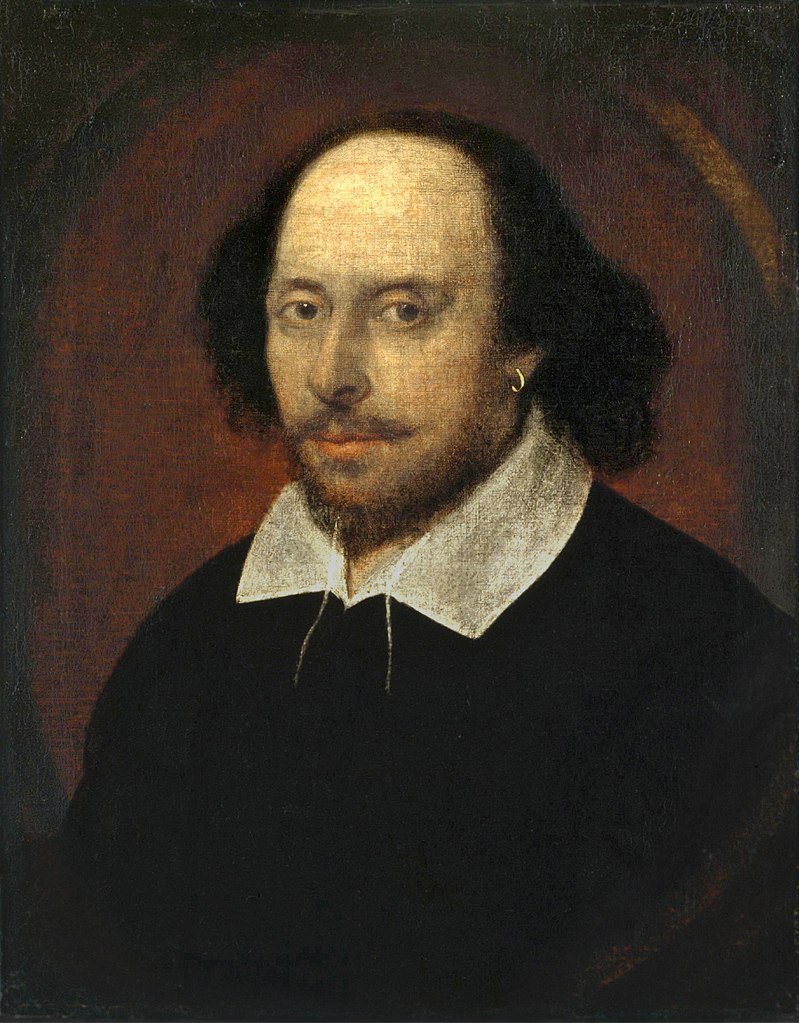
This was long thought to be the only portrait of William Shakespeare that had any claim to have been painted from life, until another possible life portrait, the Cobbe portrait, was revealed in 2009. The portrait is known as the “Chandos portrait” after a previous owner, James Brydges, 1st Duke of Chandos. It was the first portrait to be acquired by the National Portrait Gallery in 1856. The artist may be by a painter called John Taylor who was an important member of the Painter-Stainers’ Company.
National Portrait Gallery image via Wikimedia Commons.

[Winkler] accuses what she calls orthodox Shakespeare scholars of “a dogmatism of their own” on the issue, whereby “even to dabble in authorship questions is considered a sign of bad faith, a blinkered failure to countenance genius in a glover’s son.” Armed with this tendentious premise, along with the less contentious one that Shakespeare depicts female characters with unrivalled sympathy and insight, Winkler spins a hypothesis that Emilia Bassano, born in London in 1569 to Venetian immigrants, is a viable candidate for the true author.

Even as I read Winkler’s piece, I expected a denouement that it was all a piece of fiction, analogous to the enjoyable 2009 caper St Trinian’s 2: The Legend of Fritton’s Gold, which ends with buried treasure under the Globe Theatre and the discovery of Shakespeare’s true identity. It never came. The article was presented as a serious contribution to a debate in which Winkler has made a potentially historic discovery.

In British newspapers, there is a longstanding technique of obscuring a paucity of evidence in support of a preposterous thesis by posing it as a question. It’s been dubbed by the political commentator John Rentoul “Questions to Which the Answer is No” (QTWAIN). Winkler’s article employs the stratagem liberally. “Was Shakespeare’s name useful camouflage, allowing [Bassano] to publish what she otherwise couldn’t?” “Could Bassano have contributed [to literature] even more widely and directly?” In a moment of self-knowledge, Winkler asks: “Was I getting carried away, reinventing Shakespeare in the image of our age?” Yet she immediately supplies not the correct answer but yet another QTWAIN: “Or was I seeing past gendered assumptions to the woman who — like Shakespeare’s heroines — had fashioned herself a clever disguise?”

Feminist readings of Shakespeare have enriched literary criticism and scholarship in, among other areas, reconsidering genre distinctions and examining the effects of patriarchal structures on relations between the sexes. There is no decorous way of saying that Winkler’s article, by contrast, is a farrago that should never have been conceived, pitched, commissioned or published. Winkler credulously retails a series of purported mysteries about Shakespeare’s authorship that are no mystery at all, and repeats claims derived from Shakespeare denialists that any capable scholar would have been able to correct. She places particular stress on the work of a “meticulous scholar” Diana Price, who claims: “Writers in Elizabethan and Jacobean England left behind records of their professional activities. Shakespeare left behind documentation of his professional activities, but none is literary… He is the only alleged [emphasis added] writer of any consequence from the time period who left behind no personal evidence of his career as a professional writer.”

Price is neither meticulous nor a scholar (she designates herself “an independent scholar,” which should have caused Winkler greater wariness). As Alan Nelson of Berkeley University has put it, Price knows how to put a sentence together but she doesn’t know how to put an argument together.

We in fact have unimpeachable evidence of Shakespeare’s activities as a writer, far more than we do for, say, his fellow-dramatists John Webster or Cyril Tourneur, but by a series of rhetorical sleights-of-hand Price rules it all inadmissible. To give a single but weighty example: Shakespeare’s fellow actors John Heminge and Henry Condell assembled the First Folio of Shakespeare’s works, published in 1623, with Shakespeare’s name on the title page and his engraved image in the frontispiece, and with a laudatory poem by Ben Jonson referring to the author as “Sweet Swan of Avon.” Price dismisses this as evidence of authorship because it’s posthumous, coming seven years after Shakespeare’s death, even though the planning and publishing of the book must have taken years, and Heminge, Condell and Jonson all knew Shakespeare personally. This isn’t scholarship but sophistry.

A noteworthy example of Betteridge’s Law of Headlines. (As is, of course, the headline on this post.)

May 1, 2019

The Wine Lover Meltdown that Changed the Wine World Forever

Filed under: France, History, Media, USA, Wine — Tags: , , , — Nicholas @ 02:00

Today I Found Out
Published on 26 Mar 2019

Check out my other channel TopTenz! https://www.youtube.com/user/toptenznet

Follow Simon on social media:
https://twitter.com/SimonWhistler
https://www.instagram.com/simonwhistler/

Never run out of things to say at the water cooler with TodayIFoundOut! Brand new videos 7 days a week!

More from TodayIFoundOut:

Why Does the Yolk of an Overcooked Hard Boiled Egg Turn Green
https://youtu.be/ytqpeHcFT3Y

What’s the Difference Between Brown Eggs and White Eggs?
https://youtu.be/je44qy-_MHY

In this video:

Outside of wine snobs, I think we can all agree that wine snobs are just the worst. This is not because virtually every study ever conducted into the field of wine tasting as a whole has concluded that it’s ridiculously easy to convince even the top sommeliers that $5 boxed white wine is the finest red wine ever bottled. Nor is it because wines they would happily sacrifice their first born to have a glass of and would have otherwise raved about, when told the glass contains a variety of some cheap wine they are to identify, are more than likely to claim it tastes akin to horse piss.

Want the text version? http://www.todayifoundout.com/index.p…

April 26, 2019

The ill-founded notion that rural peasants had a better life than the city-dwelling poor

Filed under: Europe, Food, History — Tags: , , — Nicholas @ 03:00

Historical illiteracy — encouraged by totally unrealistic historical fiction and highly selective memories — places the lifestyle of farm workers, herders, and other rural people before the industrial era in almost a Disneyfied state of Arcadian paradise. This misunderstanding of reality fed many of the complaints about the terrible living conditions of the poor in industrial towns and cities up to almost living memory — which, to be fair, were terrible, by the standards of the upper and middle classes of the day. Marian L. Tupy provides a bit of evidence for the horrible poverty and miserable living conditions of the majority of Europeans living outside the major towns and cities:

In my last two pieces for CapX, I sketched out the miserable existence of our ancestors in the pre-industrial era. My focus was on life in the city, a task made easier by the fact that urban folk, thanks to higher literacy rates, have left us more detailed accounts of their lives.

This week I want to look at rural life, for that is where most people lived. At least theoretically, country folk could have enjoyed a better standard of living due to their “access to abundant commons – land, water, forests, livestock and robust systems of sharing and reciprocity,” which the anthropologist Jason Hickel praised in a recent article in The Guardian. In fact, the life of a peasant was, in some important aspects, worse than that of a city dweller.

[…]

An account of rural life in 16th century Lombardy found that “the peasants live on wheat … and it seems to us that we can disregard their other expenses because it is the shortage of wheat that induces the labourers to raise their claims; their expenses for clothing and other needs are practically non-existent”. In 15th century England, 80 per cent of private expenditure went on food. Of that amount, 20 per cent was spent on bread alone.

By comparison, by 2013 only 10 per cent of private expenditure in the United States was spent on food, a figure which is itself inflated by the amount Americans spend in restaurants. For health reasons, many Americans today eschew eating bread altogether.

What about food derived from water, forests and livestock? “In pre-industrial England,” Cipolla notes, “people were convinced that vegetables ‘ingender ylle humours and be oftetymes the cause of putrid fevers,’ melancholy and flatulence. As a consequence of these ideas there was little demand for fruit and vegetables and the population lived in a prescorbutic state”. For cultural reasons, most people also avoided fresh cow’s milk, which is an excellent source of protein. Instead, the well-off preferred to pay wet nurses to suckle milk directly from their breasts.

The diet on the continent was somewhat more varied, though peasants’ standard of living was, if anything, lower than that in England. According to a 17th century account of rural living in France: “As for the poore paisant, he fareth very hardly and feedeth most upon bread and fruits, but yet he may comfort himselfe with this, and though his fare be nothing so good as the ploughmans and poore artificers in England, yet it is much better than that of the villano [peasant] in Italy.”

The pursuit of sufficient calories to survive preoccupied the crushing majority of our ancestors, including, of course, women and children. In addition to employment as domestic servants, women produced marketable commodities, such as bread, pasta, woollen garments and socks. Miniatures going back to the 14th century show women employed in agriculture as well. As late as the 18th century, an Austrian physician wrote, “In many villages [of the Austrian Empire] the dung has to be carried on human backs up high mountains and the soil has to be scraped in a crouching position; this is the reason why most of the young people [men and women] are deformed and misshapen.”

April 5, 2019

QotD: Debunking the “MSG is harmful” myth

Filed under: Business, Food, Health, Quotations, Science — Tags: , — Nicholas @ 01:00

The story of MSG is a true tragedy. The negativity associated with this delicious amino acid is due to a spurious study from 1968 that linked MSG with the “Chinese Restaurant Syndrome.” This study connected that gut-bomb feeling you sometimes get after eating Chinese food to MSG, despite the fact that the typically cheap Chinese food prepared in American restaurants is fatty and served in large portions, and (like any restaurant), the food can be spoiled. My mom theorizes that lots of MSG was used to cover up the fact that, say, shrimp was a day past its prime, and that the sick feeling was due to the food but got blamed on the MSG. There’s never been a scientifically rigorous study that’s linked MSG with any negative effects. MSG should be used frequently and added to anything that needs the flavor drawn out, especially soups. But it enhances virtually anything it touches: Once, eating pizza at home, a friend scanned my spice rack and saw a jar with white powder whose label, in my grandfather’s messy scrawl, read what looked like “MS6.” He sprinkled it on his pizza and came to find me, telling me that whatever MS6 was, it was the most amazing thing he’d ever tasted. Yes, MSG makes even pizza better.

Caitlin PenzeyMoog, “Salt grinders are bullshit, and other lessons from growing up in the spice trade”, The A.V. Club, 2017-04-06.

March 30, 2019

QotD: Organic spices are a racket

Filed under: Bureaucracy, Business, Environment, Food, Health, Quotations, USA — Tags: , , — Nicholas @ 01:00

There’s a whole other piece to be written about organic spices, but the short version is that demanding organic spices is never going to be good for the farmers growing them. The U.S. standards for organic products amounts to ridiculously expensive and oftentimes unnecessary practices for small farmers who just don’t have the resources to do it. There are plenty of ways to arrive at ethical treatment of animals and land that are not part of our complicated organic laws. And that’s not to mention the people who demand organic products but will also freak out at the sight of a bug or won’t buy something that’s even a little bit misshapen or with a tiny brown spot on it. You can have pesticides or you can have pests.

Caitlin PenzeyMoog, “Salt grinders are bullshit, and other lessons from growing up in the spice trade”, The A.V. Club, 2017-04-06.

March 26, 2019

QotD: Salt

Filed under: Food, Health, Quotations — Tags: , — Nicholas @ 01:00

My grandfather used to say this all the time, and it’s true. Salt brings out the flavor of the food, full stop. There are a great variety of salts, but the reality is they’re all the same mineral. Coloration in salt comes from the minerals near the salt as it forms. There’s nothing inherently better about colored salts, but the marketers selling you that stuff will try to convince you otherwise. I’ve seen pink salt promoted as an “alternative” salt that doesn’t cause blood pressure issues. That’s a lie. My advice is to buy kosher salt or the chunkier white salt if you like the crunchiness. If you really like the mild flavoring of gray salt, that’s fine, just know that it’s sold at a higher cost for what comes down to the same thing as my box of salt I can get for a couple bucks. And one more thing: All salt is sea salt.

Salt grinders are bullshit

I’m not done with salt yet: Don’t put your salt in a grinder. All you’re doing is making your salt smaller than it was before. Unlike pepper, which is actually processed in the grinder, salt does not need to be ground and is not fresher after coming out of a grinder. It’s just smaller. Use a shaker.

Caitlin PenzeyMoog, “Salt grinders are bullshit, and other lessons from growing up in the spice trade”, The A.V. Club, 2017-04-06.

March 23, 2019

The NHS, Britain’s “national treasure”, gets panned by other EU patients who’ve experienced non-NHS care

Filed under: Britain, Europe, Government, Health — Tags: , , — Nicholas @ 03:00

In The Conversation, Chris Moreh, Athina Vlachantoni, and Derek McGhee report that — contrary to British myth-making — the National Health Service isn’t the envy of the civilized world:

Britain’s National Health Service is often described as a “national treasure”. And it is a sentiment those on the left and the right of the political divide agree on. The British public are so proud of the NHS, they made it the central theme of the opening ceremony of the 2012 London Olympic Games.

But this pride has also been coupled with fears that the universal healthcare provided by the NHS might be taken advantage of by patients from outside the UK. A few months after the Olympics, the then health secretary, Jeremy Hunt, felt the need to clarify that “we are a national health service, not an international health service”. The 2015 election-winning manifesto of the Conservative party made this point even clearer when it pledged to “tackle health tourism” and “recover up to £500m from migrants who use the NHS”.

But our research shows that while the NHS may be a national treasure to British people, EU migrants would rather be treated in their countries of origin. As a 38-year-old woman from Germany put it: “Sorry, NHS? No thanks.” And the reasons for rejecting the NHS? A 25-year-old man from the Netherlands says it’s because the “NHS is slow and the medical care mediocre”. Or, at least, it “is rather poor compared to healthcare in my country,” says a 45-year-old woman from Germany.

But why should British people worry about what EU migrants think of their health service? What EU migrants think and choose is important because they are familiar with at least two European healthcare systems. They have the information and personal experience that most British citizens do not. There is a lot to be learnt from them.

March 22, 2019

Debunking Stephen Jay Gould

Filed under: Books, History, Science — Tags: , , , , , — Nicholas @ 03:00

Several years back, I linked to a David Friedman post on a study that contradicted a key argument in Stephen Jay Gould’s book The Mismeasure of Man. While I’ve read a few of his books, it’s been nearly 15 years since I last read anything by him … by now I only have a vague recollection of what he wrote, but his works were quite popular at the time. Much more recently Russell T. Warne looked at different problems in Gould’s work that are much more damaging to his reputation:

Stephen Jay Gould, the famous 20th century paleontologist, published his most celebrated work, The Mismeasure of Man, in 1981. Gould’s thesis is that throughout the history of science, prejudiced scientists studying human beings allowed their social beliefs to color their data collection and analysis. Gould believed that this confirmation bias was particularly powerful when a scientists’ beliefs were socially important to them. […] The Mismeasure of Man provides a great deal of evidence that scientists’ pre-existing beliefs color their judgment — but not in the way he intended. Rather, the book is a perfect example of the sin it purports to expose in others. Gould’s Marxist political beliefs made him attack intelligence research because he saw it as a threat to his egalitarian social goals. Ironically, it was this allegiance to ideology over data that made Gould himself a classic examplar of a biased scientist.

[…]

Most criticism of The Mismeasure of Man was confined to the recherché world of psychologists who study intelligence. However, a new debate opened up in 2011 when a team of anthropologists argued that Gould’s analysis of the data on cranium measurements from 19th century scientist Samuel George Morton was flawed. Gould cast Morton as a racist who fudged his data to match his beliefs about white racial superiority because of a supposed larger skull capacity. Instead, the anthropologists argued, it was Gould who manipulated the data to support his biases.

This ignited a series of follow-up articles in the scholarly literature by authors taking a variety of positions regarding Morton’s data and Gould’s interpretations. Weisberg believed that the re-analysis was flawed and Gould was mostly correct. Kaplan and his colleagues claimed that Morton’s interpretations were flawed, but that Gould was incorrect in believing that he could discern Morton’s actions and motivations. Finally, Mitchell believed that Morton’s data were accurate and that the interpretations were colored by the racism of the era, but the claim that Morton subtly manipulated the data was a fiction created by Gould.

Though still unresolved, the debate shows that a critical analysis of specific sections of The Mismeasure of Man is warranted. After writing an article about Lewis Terman, an important developer of early intelligence tests, I decided that a 23-page section of The Mismeasure of Man would be a valuable section of the book to analyze. This section is Gould’s description and analysis of the Army Beta test, one of the tests that Terman helped create. The Army Beta was used in World War I to screen illiterate recruits for military service.

Having read some of the primary scholarly work about the Army Beta, I knew that some of Gould’s claims were inaccurate. However, I was unprepared for the level of pervasive deception that I encountered when I carefully checked Gould’s claims against the historical record. Moreover, I discovered overwhelming evidence that any pretense of Gould being “objective” — even if defined as “fair treatment of data” — is a farce. In The Mismeasure of Man, Gould elevates his biases to the status of uncontestable facts and to great lengths to hide the truth from his readers.

March 20, 2019

QotD: The Progressive view of American history

Filed under: History, Politics, Quotations, USA — Tags: , , — Nicholas @ 01:00

The debunking mind is typical of the American Left, which feels itself compelled to rewrite every episode in history in such a way as to put black hats on the heads of any and all American heroes: Jefferson? Slave-owning rapist. Lincoln? Not really all that enlightened on race. Saving the world from the Nazis? Sure, but what about the internment of the Japanese? Etc. […]

In high school, I had a very left-wing American history teacher who was a teachers’-union activist (a very lonely position in Lubbock, Texas, where the existence of such unions was hardly acknowledged) for whom the entirety of the great American story was slavery, the Triangle Shirtwaist fire, the Great Depression, and the momentary heroism of the New Deal (we were not far from New Deal, Texas), with the great arc of American history concluding on the steps of Central High School in Little Rock on September 23, 1957. It was, for reasons that remain mysterious to me, very important to her — plainly urgent to her — that the American story be one of disappointment, betrayal, and falling short of our founding ideals.

Kevin D. Williamson, “Bitter Laughter: Humor and the politics of hate”, National Review, 2016-08-11.

March 16, 2019

MMT – Magic Money Theory

Filed under: Economics, Government, Politics — Tags: , , , , , , , — Nicholas @ 05:00

Antony Davies and James R. Harrigan explain just why so many progressives are so excited about MMT:

Modern Monetary Theory, or MMT, is all the rage in the halls of Congress lately.

To hear the Progressive left tell it, MMT is not unlike a goose that keeps laying golden eggs. All we have to do is pick up all the free money. This is music to politicians’ ears, but Fed Chairman Jerome Powell is singing a decidedly different tune. Said Powell recently on MMT, “The idea that deficits don’t matter for countries that can borrow in their own currency … is just wrong.”

MMT advocates see this as outdated thinking. We can, they claim, spend as much as we want on whatever we want, unencumbered by trivialities like how much we have. But MMT is a bait-and-switch wrapped in a sleight-of-hand. It focuses on debt and dollars rather than resources and products. Debt and dollars are merely tools we use to transfer ownership of resources and products. It’s the resources and products that matter. Shuffling debt and dollars merely changes the ownership of resources and products. It doesn’t create more.

[…]

So here’s the sleight of hand. MMT advocates say that we won’t experience inflation because the U.S. dollar is a reserve currency — foreigners hold lots of U.S. dollars. First, increasing the money supply, other things constant, does create inflation. But when a reserve currency inflates, the pain gets spread around the world instead of being concentrated within one country. In short, MMT advocates believe our government should print money and let foreigners bear some of the inflation pain. Second, there’s no law that says that the U.S. dollar must be a reserve currency. The British Pound was one, but as its value declined, foreigners stopped holding it. Foreigners will stop holding U.S. dollars too as their value declines.

And here’s the bait-and-switch. MMTers say that if inflation does become a problem, the government can simply raise tax rates to soak up excess dollars. In short, the government would print money with one hand, buying whatever it wants and causing inflation. It would then tax with the other, thereby removing dollars from the economy and counteracting the inflation. In the end, all that’s happened is that the government has replaced goods and services that people want with goods and services politicians want.

After a bout of MMT, we might have the same GDP and zero inflation, but what constitutes that GDP would have changed dramatically. Instead of having more cars and houses, we might have more tanks and border walls.

February 17, 2019

QotD: Nanotechnology and quantum computing

When I say Quantum Computing is a bullshit field, I don’t mean everything in the field is bullshit, though to first order, this appears to be approximately true. I don’t have a mathematical proof that Quantum Computing isn’t at least theoretically possible. I also do not have a mathematical proof that we can make the artificial bacteria of K. Eric Drexler’s nanotech fantasies. Yet, I know both fields are bullshit. Both fields involve forming new kinds of matter that we haven’t the slightest idea how to construct. Neither field has a sane ‘first step’ to make their large claims true.

Drexler and the “nanotechnologists” who followed him, they assume because we know about the Schroedinger equation we can make artificial forms of life out of arbitrary forms of matter. This is nonsense; nobody understands enough about matter in detail or life in particular to do this. There are also reasonable thermodynamic, chemical and physical arguments against this sort of thing. I have opined on this at length, and at this point, I am so obviously correct on the nanotech front, there is nobody left to argue with me. A generation of people who probably would have made first rate chemists or materials scientists wasted their early, creative careers following this over hyped and completely worthless woo. Billions of dollars squandered down a rat hole of rubbish and wishful thinking. Legal wankers wrote legal reviews of regulatory regimes to protect us from this nonexistent technology. We even had congressional hearings on this nonsense topic back in 2003 and again in 2005 (and probably some other times I forgot about). Russians built a nanotech park to cash in on the nanopocalyptic trillion dollar nanotech economy which was supposed to happen by now.

Similarly, “quantum computing” enthusiasts expect you to overlook the fact that they haven’t a clue as to how to build and manipulate quantum coherent forms of matter necessary to achieve quantum computation. A quantum computer capable of truly factoring the number 21 is missing in action. In fact, the factoring of the number 15 into 3 and 5 is a bit of a parlour trick, as they design the experiment while knowing the answer, thus leaving out the gates required if we didn’t know how to factor 15. The actual number of gates needed to factor a n-bit number is 72 * n^3; so for 15, it’s 4 bits, 4608 gates; not happening any time soon.

It’s been almost 25 years since Peter Shor had his big idea, and we are no closer to factoring large numbers than we were … 15 years ago when we were also able to kinda sorta vaguely factor the number 15 using NMR ‘quantum computers.’

I had this conversation talking with a pal at … a nice restaurant near one of America’s great centers of learning. Our waiter was amazed and shared with us the fact that he had done a Ph.D. thesis on the subject of quantum computing. My pal was convinced by this that my skepticism is justified; in fact he accused me of arranging this. I didn’t, but am motivated to write to prevent future Ivy League Ph.D. level talent having to make a living by bringing a couple of finance nerds their steaks.

Scott Locklin, “Quantum computing as a field is obvious bullshit”, Locklin on Science, 2019-01-15.

February 2, 2019

Did People in Medieval Times Really Wear Lockable Chastity Belts?

Filed under: Europe, Health, History — Tags: , , — Nicholas @ 02:00

Today I Found Out
Published on 28 Mar 2016

Never run out of things to say at the water cooler with TodayIFoundOut! Brand new videos 7 days a week!

In this video:

The lasting images of what most of us perceive to be the “medieval times” includes heroic knights, stampeding horses, court jesters, giant turkey legs, ruling kings, and pure maidens wearing chastity belts. But the fact is that, besides the more obvious of those that aren’t accurate, most scholars believe that the chastity belt didn’t actually exist during medieval times, but rather is a product of 18th and 19th century obsession with masturbation as a societal ill and safeguarding women in the workplace.

Want the text version?: http://www.todayifoundout.com/index.p…

« Newer PostsOlder Posts »

Powered by WordPress