
The story of MSG is a true tragedy. The negativity associated with this delicious amino acid is due to a spurious study from 1968 that linked MSG with the “Chinese Restaurant Syndrome.” This study connected that gut-bomb feeling you sometimes get after eating Chinese food to MSG, despite the fact that the typically cheap Chinese food prepared in American restaurants is fatty and served in large portions, and (like any restaurant), the food can be spoiled. My mom theorizes that lots of MSG was used to cover up the fact that, say, shrimp was a day past its prime, and that the sick feeling was due to the food but got blamed on the MSG. There’s never been a scientifically rigorous study that’s linked MSG with any negative effects. MSG should be used frequently and added to anything that needs the flavor drawn out, especially soups. But it enhances virtually anything it touches: Once, eating pizza at home, a friend scanned my spice rack and saw a jar with white powder whose label, in my grandfather’s messy scrawl, read what looked like “MS6.” He sprinkled it on his pizza and came to find me, telling me that whatever MS6 was, it was the most amazing thing he’d ever tasted. Yes, MSG makes even pizza better.
Caitlin PenzeyMoog, “Salt grinders are bullshit, and other lessons from growing up in the spice trade”, The A.V. Club, 2017-04-06.
April 5, 2019
QotD: Debunking the “MSG is harmful” myth
March 30, 2019
QotD: Organic spices are a racket
There’s a whole other piece to be written about organic spices, but the short version is that demanding organic spices is never going to be good for the farmers growing them. The U.S. standards for organic products amounts to ridiculously expensive and oftentimes unnecessary practices for small farmers who just don’t have the resources to do it. There are plenty of ways to arrive at ethical treatment of animals and land that are not part of our complicated organic laws. And that’s not to mention the people who demand organic products but will also freak out at the sight of a bug or won’t buy something that’s even a little bit misshapen or with a tiny brown spot on it. You can have pesticides or you can have pests.
Caitlin PenzeyMoog, “Salt grinders are bullshit, and other lessons from growing up in the spice trade”, The A.V. Club, 2017-04-06.
March 26, 2019
QotD: Salt
My grandfather used to say this all the time, and it’s true. Salt brings out the flavor of the food, full stop. There are a great variety of salts, but the reality is they’re all the same mineral. Coloration in salt comes from the minerals near the salt as it forms. There’s nothing inherently better about colored salts, but the marketers selling you that stuff will try to convince you otherwise. I’ve seen pink salt promoted as an “alternative” salt that doesn’t cause blood pressure issues. That’s a lie. My advice is to buy kosher salt or the chunkier white salt if you like the crunchiness. If you really like the mild flavoring of gray salt, that’s fine, just know that it’s sold at a higher cost for what comes down to the same thing as my box of salt I can get for a couple bucks. And one more thing: All salt is sea salt.
Salt grinders are bullshit
I’m not done with salt yet: Don’t put your salt in a grinder. All you’re doing is making your salt smaller than it was before. Unlike pepper, which is actually processed in the grinder, salt does not need to be ground and is not fresher after coming out of a grinder. It’s just smaller. Use a shaker.
Caitlin PenzeyMoog, “Salt grinders are bullshit, and other lessons from growing up in the spice trade”, The A.V. Club, 2017-04-06.
March 23, 2019
The NHS, Britain’s “national treasure”, gets panned by other EU patients who’ve experienced non-NHS care
In The Conversation, Chris Moreh, Athina Vlachantoni, and Derek McGhee report that — contrary to British myth-making — the National Health Service isn’t the envy of the civilized world:

Britain’s National Health Service is often described as a “national treasure”. And it is a sentiment those on the left and the right of the political divide agree on. The British public are so proud of the NHS, they made it the central theme of the opening ceremony of the 2012 London Olympic Games.
But this pride has also been coupled with fears that the universal healthcare provided by the NHS might be taken advantage of by patients from outside the UK. A few months after the Olympics, the then health secretary, Jeremy Hunt, felt the need to clarify that “we are a national health service, not an international health service”. The 2015 election-winning manifesto of the Conservative party made this point even clearer when it pledged to “tackle health tourism” and “recover up to £500m from migrants who use the NHS”.
But our research shows that while the NHS may be a national treasure to British people, EU migrants would rather be treated in their countries of origin. As a 38-year-old woman from Germany put it: “Sorry, NHS? No thanks.” And the reasons for rejecting the NHS? A 25-year-old man from the Netherlands says it’s because the “NHS is slow and the medical care mediocre”. Or, at least, it “is rather poor compared to healthcare in my country,” says a 45-year-old woman from Germany.
But why should British people worry about what EU migrants think of their health service? What EU migrants think and choose is important because they are familiar with at least two European healthcare systems. They have the information and personal experience that most British citizens do not. There is a lot to be learnt from them.
March 22, 2019
Debunking Stephen Jay Gould
Several years back, I linked to a David Friedman post on a study that contradicted a key argument in Stephen Jay Gould’s book The Mismeasure of Man. While I’ve read a few of his books, it’s been nearly 15 years since I last read anything by him … by now I only have a vague recollection of what he wrote, but his works were quite popular at the time. Much more recently Russell T. Warne looked at different problems in Gould’s work that are much more damaging to his reputation:
Stephen Jay Gould, the famous 20th century paleontologist, published his most celebrated work, The Mismeasure of Man, in 1981. Gould’s thesis is that throughout the history of science, prejudiced scientists studying human beings allowed their social beliefs to color their data collection and analysis. Gould believed that this confirmation bias was particularly powerful when a scientists’ beliefs were socially important to them. […] The Mismeasure of Man provides a great deal of evidence that scientists’ pre-existing beliefs color their judgment — but not in the way he intended. Rather, the book is a perfect example of the sin it purports to expose in others. Gould’s Marxist political beliefs made him attack intelligence research because he saw it as a threat to his egalitarian social goals. Ironically, it was this allegiance to ideology over data that made Gould himself a classic examplar of a biased scientist.
[…]
Most criticism of The Mismeasure of Man was confined to the recherché world of psychologists who study intelligence. However, a new debate opened up in 2011 when a team of anthropologists argued that Gould’s analysis of the data on cranium measurements from 19th century scientist Samuel George Morton was flawed. Gould cast Morton as a racist who fudged his data to match his beliefs about white racial superiority because of a supposed larger skull capacity. Instead, the anthropologists argued, it was Gould who manipulated the data to support his biases.
This ignited a series of follow-up articles in the scholarly literature by authors taking a variety of positions regarding Morton’s data and Gould’s interpretations. Weisberg believed that the re-analysis was flawed and Gould was mostly correct. Kaplan and his colleagues claimed that Morton’s interpretations were flawed, but that Gould was incorrect in believing that he could discern Morton’s actions and motivations. Finally, Mitchell believed that Morton’s data were accurate and that the interpretations were colored by the racism of the era, but the claim that Morton subtly manipulated the data was a fiction created by Gould.
Though still unresolved, the debate shows that a critical analysis of specific sections of The Mismeasure of Man is warranted. After writing an article about Lewis Terman, an important developer of early intelligence tests, I decided that a 23-page section of The Mismeasure of Man would be a valuable section of the book to analyze. This section is Gould’s description and analysis of the Army Beta test, one of the tests that Terman helped create. The Army Beta was used in World War I to screen illiterate recruits for military service.
Having read some of the primary scholarly work about the Army Beta, I knew that some of Gould’s claims were inaccurate. However, I was unprepared for the level of pervasive deception that I encountered when I carefully checked Gould’s claims against the historical record. Moreover, I discovered overwhelming evidence that any pretense of Gould being “objective” — even if defined as “fair treatment of data” — is a farce. In The Mismeasure of Man, Gould elevates his biases to the status of uncontestable facts and to great lengths to hide the truth from his readers.
March 20, 2019
QotD: The Progressive view of American history
The debunking mind is typical of the American Left, which feels itself compelled to rewrite every episode in history in such a way as to put black hats on the heads of any and all American heroes: Jefferson? Slave-owning rapist. Lincoln? Not really all that enlightened on race. Saving the world from the Nazis? Sure, but what about the internment of the Japanese? Etc. […]
In high school, I had a very left-wing American history teacher who was a teachers’-union activist (a very lonely position in Lubbock, Texas, where the existence of such unions was hardly acknowledged) for whom the entirety of the great American story was slavery, the Triangle Shirtwaist fire, the Great Depression, and the momentary heroism of the New Deal (we were not far from New Deal, Texas), with the great arc of American history concluding on the steps of Central High School in Little Rock on September 23, 1957. It was, for reasons that remain mysterious to me, very important to her — plainly urgent to her — that the American story be one of disappointment, betrayal, and falling short of our founding ideals.
Kevin D. Williamson, “Bitter Laughter: Humor and the politics of hate”, National Review, 2016-08-11.
March 16, 2019
MMT – Magic Money Theory
Antony Davies and James R. Harrigan explain just why so many progressives are so excited about MMT:
Modern Monetary Theory, or MMT, is all the rage in the halls of Congress lately.
To hear the Progressive left tell it, MMT is not unlike a goose that keeps laying golden eggs. All we have to do is pick up all the free money. This is music to politicians’ ears, but Fed Chairman Jerome Powell is singing a decidedly different tune. Said Powell recently on MMT, “The idea that deficits don’t matter for countries that can borrow in their own currency … is just wrong.”
MMT advocates see this as outdated thinking. We can, they claim, spend as much as we want on whatever we want, unencumbered by trivialities like how much we have. But MMT is a bait-and-switch wrapped in a sleight-of-hand. It focuses on debt and dollars rather than resources and products. Debt and dollars are merely tools we use to transfer ownership of resources and products. It’s the resources and products that matter. Shuffling debt and dollars merely changes the ownership of resources and products. It doesn’t create more.
[…]
So here’s the sleight of hand. MMT advocates say that we won’t experience inflation because the U.S. dollar is a reserve currency — foreigners hold lots of U.S. dollars. First, increasing the money supply, other things constant, does create inflation. But when a reserve currency inflates, the pain gets spread around the world instead of being concentrated within one country. In short, MMT advocates believe our government should print money and let foreigners bear some of the inflation pain. Second, there’s no law that says that the U.S. dollar must be a reserve currency. The British Pound was one, but as its value declined, foreigners stopped holding it. Foreigners will stop holding U.S. dollars too as their value declines.
And here’s the bait-and-switch. MMTers say that if inflation does become a problem, the government can simply raise tax rates to soak up excess dollars. In short, the government would print money with one hand, buying whatever it wants and causing inflation. It would then tax with the other, thereby removing dollars from the economy and counteracting the inflation. In the end, all that’s happened is that the government has replaced goods and services that people want with goods and services politicians want.
After a bout of MMT, we might have the same GDP and zero inflation, but what constitutes that GDP would have changed dramatically. Instead of having more cars and houses, we might have more tanks and border walls.
February 17, 2019
QotD: Nanotechnology and quantum computing
When I say Quantum Computing is a bullshit field, I don’t mean everything in the field is bullshit, though to first order, this appears to be approximately true. I don’t have a mathematical proof that Quantum Computing isn’t at least theoretically possible. I also do not have a mathematical proof that we can make the artificial bacteria of K. Eric Drexler’s nanotech fantasies. Yet, I know both fields are bullshit. Both fields involve forming new kinds of matter that we haven’t the slightest idea how to construct. Neither field has a sane ‘first step’ to make their large claims true.
Drexler and the “nanotechnologists” who followed him, they assume because we know about the Schroedinger equation we can make artificial forms of life out of arbitrary forms of matter. This is nonsense; nobody understands enough about matter in detail or life in particular to do this. There are also reasonable thermodynamic, chemical and physical arguments against this sort of thing. I have opined on this at length, and at this point, I am so obviously correct on the nanotech front, there is nobody left to argue with me. A generation of people who probably would have made first rate chemists or materials scientists wasted their early, creative careers following this over hyped and completely worthless woo. Billions of dollars squandered down a rat hole of rubbish and wishful thinking. Legal wankers wrote legal reviews of regulatory regimes to protect us from this nonexistent technology. We even had congressional hearings on this nonsense topic back in 2003 and again in 2005 (and probably some other times I forgot about). Russians built a nanotech park to cash in on the nanopocalyptic trillion dollar nanotech economy which was supposed to happen by now.
Similarly, “quantum computing” enthusiasts expect you to overlook the fact that they haven’t a clue as to how to build and manipulate quantum coherent forms of matter necessary to achieve quantum computation. A quantum computer capable of truly factoring the number 21 is missing in action. In fact, the factoring of the number 15 into 3 and 5 is a bit of a parlour trick, as they design the experiment while knowing the answer, thus leaving out the gates required if we didn’t know how to factor 15. The actual number of gates needed to factor a n-bit number is 72 * n^3; so for 15, it’s 4 bits, 4608 gates; not happening any time soon.
It’s been almost 25 years since Peter Shor had his big idea, and we are no closer to factoring large numbers than we were … 15 years ago when we were also able to kinda sorta vaguely factor the number 15 using NMR ‘quantum computers.’
I had this conversation talking with a pal at … a nice restaurant near one of America’s great centers of learning. Our waiter was amazed and shared with us the fact that he had done a Ph.D. thesis on the subject of quantum computing. My pal was convinced by this that my skepticism is justified; in fact he accused me of arranging this. I didn’t, but am motivated to write to prevent future Ivy League Ph.D. level talent having to make a living by bringing a couple of finance nerds their steaks.
Scott Locklin, “Quantum computing as a field is obvious bullshit”, Locklin on Science, 2019-01-15.
February 2, 2019
Did People in Medieval Times Really Wear Lockable Chastity Belts?
Today I Found Out
Published on 28 Mar 2016Never run out of things to say at the water cooler with TodayIFoundOut! Brand new videos 7 days a week!
In this video:
The lasting images of what most of us perceive to be the “medieval times” includes heroic knights, stampeding horses, court jesters, giant turkey legs, ruling kings, and pure maidens wearing chastity belts. But the fact is that, besides the more obvious of those that aren’t accurate, most scholars believe that the chastity belt didn’t actually exist during medieval times, but rather is a product of 18th and 19th century obsession with masturbation as a societal ill and safeguarding women in the workplace.
Want the text version?: http://www.todayifoundout.com/index.p…
November 12, 2018
Woodrow Wilson
In City Journal, Lance Morrow looks back at the successes and failures of President Wilson:
It’s been a century since President Woodrow Wilson arrived in Europe, weeks after the Armistice ending World War I. A crowd of 2 million cheered him in Paris. The papers called him the “God of Peace,” the “Savior of Humanity,” a “Moses from America.” He bowed, he tipped his silk top hat — the newsreel images come flickering to us from an earlier world. He sat down with Georges Clemenceau and David Lloyd George and the others to hash out the fiasco of the Versailles Treaty. He returned home to the fatal wrangle over the League of Nations with Henry Cabot Lodge in the Senate. Then came the cross-country tour to sell the treaty to the American people, his collapse on the train near Wichita, and, back in Washington, the terrible stroke and the long twilight — a sequence that led, further down the road, to Warren G. Harding and, in the fullness of time, to Adolf Hitler and World War II.
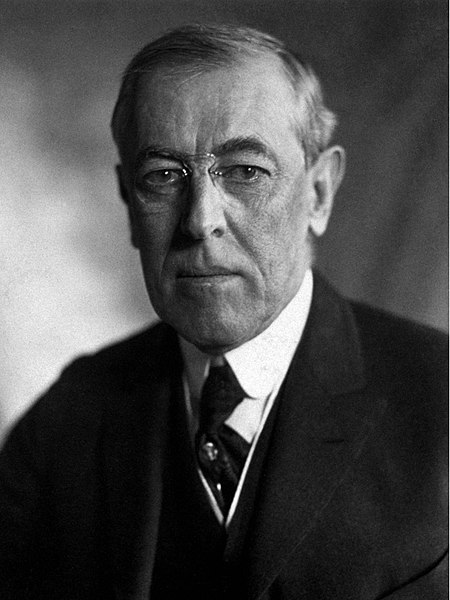
Woodrow Wilson, 1919
Photo via Wikimedia Commons.The Woodrow Wilson story is an American classic — a set piece, like the rise and fall of Joseph McCarthy, or the fable of John F. Kennedy. Of Wilson, the historian Barbara Tuchman wrote: “Since Americans are not, by and large, a people associated with tragedy, it is strange and unexpected that the most tragic figure in modern history — judged by the greatness of expectations and the measure of the falling off — should have been an American.”
People speak of “settled science.” One might also speak of “settled myth.” (The Kennedys are one of those.) But Wilson’s myth remains vexed and unsettled. He persists, in American memory, as a sort of botched paragon — a man who remains almost irritatingly alive and imperfect and somehow touching. The respect that he deserves is complicated — and so is the contempt. The same has been said of American idealism itself.
As with America, there are two basic versions of Wilson: the sacred and the profane. Was his greatness real or fake? He ranks in polls in the top quarter of American presidents, but with a dissenting asterisk. Was he the superbly effective Progressive president (who introduced the Federal Reserve and the graduated income tax and much else) and the prophet of twentieth-century internationalism? (Wait: Are we to thank Wilson for Vietnam? Iraq? Afghanistan?) Or was he the last fling of nineteenth-century moralism and hypocrisy — a Southern-born racist or near-racist, and a brute on the subject of civil liberties? (He tossed Eugene V. Debs in jail merely for disagreeing with him on the war, leaving it to Warren G. Harding to pardon Debs.) Some said that his mind was a Sunday school; others, that it was the pool of Narcissus. Yet he managed to be a great man all the same. It’s too bad that he did not leave the presidency, one way or another, in 1919, after the damage from his stroke became evident. Amazingly, even in the summer of 1920, the broken man had delusions of running for a third term. He felt embittered and betrayed when the Democratic nomination went to Governor James Cox of Ohio. Woodrow Wilson’s ego died harder than Rasputin.
An indispensable aspect of Wilson’s genius—and a key, perhaps, to his failure — was his lambent but vaguely narcissistic prose style, sweet in its clarities but sometimes too supple and manipulative. Unlike most presidents, he wrote his own speeches. He governed a good deal by means of language, and he used words to impose his will or to conjure up an ideal world that might be mistaken, from a distance, for the Kingdom of God. He was also a theatrical man, an actor, an excellent mimic: a performer. Was he Prospero? Or was he, in the end, Christ crucified? People spoke routinely of his messiah complex. At one point during the Paris Peace Conference, he seemed to suggest that he was actually an improvement on the messiah. Lloyd George listened in amazement as Wilson observed that organized religion had yet to devise practical solutions to the problems of the world. Christ had articulated the ideal, Wilson said, but he had offered no instructions on how to attain it. “That is the reason why I am proposing a practical scheme to carry out his aims.” Self-righteousness is tiresome in the end. Many concluded that Wilson should be remembered, without appeals to either religion or literature, as the stiff-necked, hypochondriacal son of a Presbyterian minister, led astray by his own moral vanity — either that, or as the uxorious hero of ladies’ teas. He loved the companionship of doting women but not necessarily that of strong men.
H.L. Mencken wrote of Wilson, shortly after the President’s death, in a review of The Story of a Style by Dr. William Bayard Hale:
Two or three years ago, at the height of his illustriousness, it was spoken of in whispers, as if there were something almost supernatural about its merits. I read articles, in those days, comparing it to the style of the Biblical prophets, and arguing that it vastly exceeded the manner of any living literatus. Looking backward, it is not difficult to see how that doctrine arose. Its chief sponsors, first and last, were not men who actually knew anything about the writing of English, but simply editorial writers on party newspapers, i.e., men who related themselves to literary artists in much the same way that Dr. Billy Sunday relates himself to the late Paul of Tarsus. What intrigued such gentlemen in the compositions of Dr. Wilson was the plain fact that he was their superior in their own special field — that he accomplished with a great deal more skill than they did themselves the great task of reducing all the difficulties of the hour to a few sonorous and unintelligible phrases, often with theological overtones – that he knew better than they did how to arrest and enchant the boobery with words that were simply words, and nothing else. The vulgar like and respect that sort of balderdash. A discourse packed with valid ideas, accurately expressed, is quite incomprehensible to them. What they want is the sough of vague and comforting words – words cast into phrases made familiar to them by the whooping of their customary political and ecclesiastical rabble-rousers, and by the highfalutin style of the newspapers that they read. Woodrow knew how to conjure up such words. He knew how to make them glow, and weep. He wasted no time upon the heads of his dupes, but aimed directly at their ears, diaphragms and hearts.
But reading his speeches in cold blood offers a curious experience. It is difficult to believe that even idiots ever succumbed to such transparent contradictions, to such gaudy processions of mere counter-words, to so vast and obvious a nonsensicality. Hale produces sentence after sentence that has no apparent meaning at all — stuff quite as bad as the worst bosh of the Hon. Gamaliel Harding. When Wilson got upon his legs in those days he seems to have gone into a sort of trance, with all the peculiar illusions and delusions that belong to a frenzied pedagogue. He heard words giving three cheers; he saw them race across a blackboard like Socialists pursued by the Polizei; he felt them rush up and kiss him. The result was the grand series of moral, political, sociological and theological maxims which now lodges imperishably in the cultural heritage of the American people, along with Lincoln’s “government for the people, by the people,” etc., Perry’s “We have met the enemy, and they are ours,” and Vanderbilt’s “The public be damned.” The important thing is not that a popular orator should have uttered such grand and glittering phrases, but that they should have been gravely received, for many weary months, by a whole race of men, some of them intelligent. Here is a matter that deserves the sober inquiry of competent psychologists. The boobs took fire first, but after a while even college presidents — who certainly ought to be cynical men, if ladies of joy are cynical women — were sending up sparks, and for a long while anyone who laughed was in danger of the calaboose. Hale does not go into the question; he confines himself to the concrete procession of words. His book represents tedious and vexatious labor; it is, despite some obvious defects, very well managed; it opens the way for future works of the same sort. Imagine Harding on the Hale operating table!
October 31, 2018
Some Criticism of The Infographics Show – Best World War 2 Battleships and Battlecruisers
iChaseGaming
Published on 10 Oct 2018There is something called Wikipedia. You can find it here: https://en.wikipedia.org/wiki/Main_Page
October 23, 2018
Myers-Briggs Type Indicators as a “variety of psychobullshit rune-gazing”
In the latest issue of Reason, Katrina Gulliver reviews a new book on a pop psychology notion that escaped into the wild for a generation, wreaking havoc in corporate HR departments across the country:
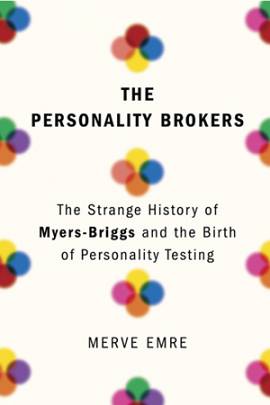
The Myers-Briggs test and others like it were huge in the corporate world in the 1980s and ’90s. Individuals took them to see what kind of careers they should pursue; H.R. offices used them to decide who to hire or promote. In The Personality Brokers, Merve Emre explores how, precisely, this variety of psychobullshit rune-gazing was born.
Briggs and Myers were a mother and daughter who shared a personal fascination with psychology. Katharine Briggs, born in the last quarter of the 19th century, was one of the few women of her generation to gain a college degree. Like most female members of the upper-middle-class in her time, however, she didn’t pursue a career, instead marrying young and raising a family. Rather than the chemistry she had studied at college, children became her research subject.With an intensity that sounds frightening, Briggs believed she could develop a scientific approach to raising well-behaved, intelligent children. She seemed to do a good job with her daughter Isabel, and other parents soon sought her advice. Briggs was well-connected — her husband was a Washington bureaucrat, so of course she knew magazine editors. Soon she was writing columns for various publications about ideal parenting and child behavior.
As a devotee of psychology, she developed a correspondence with Carl Jung. She drew on his psychological theories to interpret the personalities of kids, the better to advise their parents on behavior management. The 16 “types” of the Myers-Briggs index directly relate to Jung’s thinking, and Jung’s approval of her ideas offered validation for her explorations.
But the commercial Myers-Briggs test came later, and it was far more her daughter’s achievement. Isabel Myers was also fascinated with psychological type. But being a generation younger, she was better placed to pursue this professionally. Again, she had the advantages of social connection: Her husband was an attorney, and she happened to know Edward Northup Hay, one of the first personality consultants in the United States.
In 1943, Hay allowed Briggs — despite her having no formal qualifications or experience — to offer her test to his clients. The takers were few: mostly small outfits, sometimes just a single test for a potential employee. She continued working to perfect the evaluation, trying it on friends and neighbors.
September 25, 2018
Amazons – fierce fighting tribe or just ancient Greek porn?
Lindybeige
Published on 21 Jun 2011You can believe in them if you want, but if you do, you should out of fairness to other mythological characters believe in giants, cyclopes, griffins, and gorgons.
September 17, 2018
“Nazis on Drugs” – Wehrmacht & Meth – Wunderwaffe?
Military History not Visualized
Published on 17 Aug 2018There some over-blown claims out there that the “Blitzkriege” were mainly achieved due to the use of Meth (Pervitin) and that historians had ignored this issue. Is it true or false? In this video we take a look at Pervitin, the Wehrmacht, the early German victories aka “Blitzkriege” and various aspects. Was Pervitin a Wunderwaffe? Was the Wehrmacht on Meth? How long was it used? And some aspects.
September 14, 2018
Are Guards Historically Accurate? | Feature Enquiry
Feature History
Published on 22 Aug 2018Use this link to get your first 2 months of Skillshare for FREE! http://skl.sh/featurehistory2
———————————————————————————————————–
Often fantasy and medieval media will show armoured guards patrolling settlements and enforcing the law. Is that historically accurate? No.
———————————————————————————————————–
Patreon
https://www.patreon.com/FeatureHistory
https://twitter.com/Feature_History
Discord
https://discord.gg/Zbk4CvR
———————————————————————————————————–
I do the research, writing, narration, art, and animation. Yes, it is very lonely
Music by Epidemic Sound: http://epidemicsound.com


