
First, company stores flourished in many parts of the USA, especially in the coal regions and other places with many isolated work sites, long before any legal minimum wages were put into effect. Second, Alchian is right that the workers understood perfectly how these stores worked (how could they not have when the stores were so common?): they provided basic consumption goods — flour, bacon, beans, kerosene, matches, cotton cloth — at the work-and-living site on credit, as advances against the workers’ future pay. Yes, the prices were higher than in, say, the closest towns. But the closest towns were often much too far away to allow the workers or their wives to go there easily, frequently, or cheaply. So, what the stores actually did was to reduce transaction costs for the workers, who otherwise would have been unlikely to accept employment in remote, isolated places far from stores.
Robert Higgs, letter to Don Boudreaux, 2016-11-06.
September 11, 2018
QotD: Debunking the “company store” story
September 8, 2018
A key statistic in the debate over gun violence in Toronto … turns out to be an invention
Matt Gurney on an important claim in the controversy about guns and crime in Toronto — that will probably not get anything like as much coverage because it doesn’t support the prohibitionists’ narrative:

Earlier this summer — a summer that has seen Toronto wracked by gun violence — a report came out that suggested lawful Canadian gun owners were to blame for at least some of the violence. The article was originally published by the Canadian Press, and was widely republished elsewhere, including at the CBC, the National Post, a dozen local newspapers, CTV News, and, yes, here at Global News. Since then, it has been widely cited in other news stories covering the issue, including in The Toronto Star and The Globe and Mail. The report was everywhere.
Here’s the problem. Newly released stats show clearly that it was wrong.
The article was based around an interview with a Toronto Police Services detective, Rob Di Danieli. Det. Di Danieli told the Canadian Press that Canadians who were lawfully licensed to purchase and possess firearms were increasingly a public safety issue. “They go get their licence for the purpose of becoming a firearms trafficker,” Di Danieli told the CP. “A lot of people are so ready to blame the big bad Americans, but we had our own little problem here.”
The CP article hangs on this revelation from the detective. It notes, in various places, “The number of guns obtained legally in Canada but are then sold to people who use them for criminal purposes has surged dramatically in recent years compared to firearms smuggled from the United States, Toronto police say,” and, “In recent years [investigators say they] have noticed a stark shift in where guns used to commit crimes are coming from,” and, “Legal Canadian gun owners are selling their weapons illegally, Di Danieli said, noting that police have seen more than 40 such cases in recent years.”
[…]
At the time the CP story first ran, there were no publicly available stats to support (or contradict) what di Danieli had told them. But now, those numbers are publicly available, thanks to Dennis R. Young, an Alberta-based researcher who filed a Freedom of Information request with the Toronto police and published their reply on his website. And these stats tell a very different story.
September 4, 2018
Debunking claims from The Technology of Orgasm
Alex Tabarrok linked to this paper [PDF] examining the claims that have long since become embedded in academia but appear to have no factual basis at all:

You know the story about the male Victorian physicians who unwittingly produced orgasms in their female clients by treating them for “hysteria” with newly-invented, labor-saving, mechanical vibrators? It’s little more than an urban legend albeit one transmitted through academic books and articles. Hallie Lieberman and Eric Schatzberg, the authors of a shocking new paper, A Failure of Academic Quality Control: The Technology of Orgasm, don’t quite use the word fraud but they come close.
The Technology of Orgasm by Rachel Maines is one of the most widely cited works on the history of sex and technology. Maines argues that Victorian physicians routinely used electromechanical vibrators to stimulate female patients to orgasm as a treatment for hysteria. She claims that physicians did not perceive the practice as sexual because it did not involve vaginal penetration. The vibrator was, according to Maines, a labor-saving technology to replace the well-established medical practice of clitoral massage for hysteria. This argument has been repeated almost verbatim in dozens of scholarly works, popular books and articles, a Broadway play, and a feature-length film. Although a few scholars have challenged parts of the book, no one has contested her central argument in the peer-reviewed literature. In this article, we carefully assess the sources cited in the book. We found no evidence in these sources that physicians ever used electromechanical vibrators to induce orgasms in female patients as a medical treatment. The success of Technology of Orgasm serves as a cautionary tale for how easily falsehoods can become embedded in the humanities.
I was not surprised when I ran a quick search for the cover of the Maines book (embedded above) and the vast majority of images returned were NSFW.
September 1, 2018
The Tartan Myth | Stuff That I Find Interesting
Jabzy
Published on 22 Jun 2017
August 29, 2018
Out of Context: How to Make Bad History Worse | World War 2
Knowing Better
Published on 5 Mar 2018Churchill was a genocidal maniac. The Japanese were rounded up into concentration camps. FDR let Pearl Harbor happen. When you take history out of context, you can make it say whatever you want – including making bad things worse.
A long list of links to sources is included, but I’m too lazy to re-link ’em all, just go to YouTube to see them. Back in 2009, I did a short fisking of Pat Buchanan’s hit-piece on Churchill’s “reponsibility” for the outbreak of WW2.
August 18, 2018
Mythbusting with the .30-06 American Chauchat: Reliability Test
Forgotten Weapons
Published on 28 Jul 2018http://www.patreon.com/ForgottenWeapons
Everyone knows, of course, that the Chauchat is the worst gun ever, and can’t normally get through an entire magazine without malfunctioning. Well, let’s try that out … and with an even worse culprit; an M1918 Chauchat made for the AEF in .30-06.
If you enjoy Forgotten Weapons, check out its sister channel, InRangeTV! http://www.youtube.com/InRangeTVShow
August 10, 2018
“The banality of evil”
Anthony Daniels in the most recent issue of Quadrant:
“The banality of evil” is a phrase that suddenly entered the English language, probably for ever, in 1963, on the publication of Hannah Arendt’s book about Adolf Eichmann’s trial in Jerusalem, Eichmann in Jerusalem: A Report on the Banality of Evil.
It hardly matters that Hannah Arendt, after much arduous study and conscientious effort, got Eichmann entirely wrong, and had the wool pulled comprehensively over her eyes by the man she thought an utter mediocrity. Surely scum like him were no match for a much-garlanded political philosopher? But far from having been a faceless bureaucrat as she portrayed him, or mere pen-pusher who somehow, as if by accident, wandered into the organisation of genocide, Eichmann was an ardent and committed Nazi, an idealist of evil so to speak, who knew exactly what he was doing and regretted only that he had been unable to do more and finish the job. Bettina Stangneth’s book Eichmann Before Jerusalem should have put paid once and for all to the notion of Eichmann as a kind of sleep-walking little man, the post office clerk of extermination. But image often triumphs over reality, and in any case, the banality of evil could well survive as a concept, even if it had been grotesquely misapplied on its first outing.Recently, I seem to be surrounded by the banality of evil: in books, I mean, not in real life (assuming that books are not part of real life, that is). For example, I just picked up a book by the well-known French forensic psychiatrist Daniel Zagury, titled La Barbarie des hommes ordinaires: Ces criminels qui pourraient être nous (The Barbarity of Ordinary Men: These Criminals Who Could Be Us). The very title, of course, makes reference to Arendt’s famous phase, and I had not gone many pages into it when her name cropped up: because Zagury is writing about men (mainly men in contrast to women) who commit appalling violent crimes without being obviously mad, he makes reference to Arendt and her banality of evil. The banality lies in the absence of all thought or reflection, of foresight or imagination. The most atrocious acts occasion no more mental trouble than, say, that entailed in the making of a sandwich.
Before I took up Zagury, I had just read Behind the Shock Machine, a book by the Australian psychologist and writer Gina Perry, about the famous, or infamous, experiments carried out by Stanley Milgram in the early 1960s at Yale on man’s obedience to authority. These experiments, as written up by Milgram in his book Obedience to Authority, have more or less entered common consciousness, at least that of intellectuals, as proving that there is in most of us an inner Eichmann, if not quite struggling to get out, at least prepared to obey the most frightful orders if authority gives them.
Milgram published his book in 1974, which was twelve years after the conclusion of his experiments and eleven years after the publication of Arendt’s book. He was, I surmise, much influenced by Arendt’s masterfully summarising — or one might say misleading — phrase, for the truth behind which he retrospectively tried to supply some psychological evidence. Gina Perry, by examining the records of his experiments in detail, found that Milgram had misrepresented his results, exaggerating his subjects’ willingness to comply with orders in his eagerness to show man’s tendency to obey, a tendency which demonstrates that the Holocaust could happen again — by implication anywhere.

July 19, 2018
Mucking around with Stonehenge
Many people are still under the impression that Stonehenge was built by the Druids (debunked in this video by Siobhan Thompson). At least as many people think that the modern day stone circle is an undisturbed historical relic, and that the stones are standing today as and where they have for thousands of years. All the way back in 2001, Emma Young did a quick debunking of that theory in New Scientist:

An early photograph of Stonehenge taken in July 1877 by Philip Rupert Acott
Via Wikimedia Commons

Photo from a similar angle in 2008 showing the extent of reconstruction.
Via Wikimedia Commons
Most of the one million visitors who visit Stonehenge on Salisbury Plain every year believe they are looking at untouched 4,000-year-old remains. But virtually every stone was re-erected, straightened or embedded in concrete between 1901 and 1964, says a British doctoral student.
“What we have been looking at is a 20th-century landscape, reminiscent of what Stonehenge might have looked like thousands of years ago,” says Brian Edwards, a student at the University of the West of England in Bristol.
Stonehenge isn’t the only ancient site to have been transformed in recent years, he says. “Even many of the local people in Avebury weren’t aware that a lot of the stones were put up in the 1930s,” he told New Scientist.
[…]
English Heritage says it is now considering covering the Stonehenge alteration programme in detail in the next edition of its official guidebook to the site. A decision not to include the work in official guides was taken in the 1960s, says Dave Batchelor, English Heritage’s senior archaeologist.
The first restoration project took place in 1901. A leaning stone was straightened and set in concrete, to prevent it falling.
More drastic renovations were carried out in the 1920s. Under the direction of Colonel William Hawley, a member of the Stonehenge Society, six stones were moved and re-erected.
Cranes were used to reposition three more stones in 1958. One giant fallen lintel, or cross stone, was replaced. Then in 1964, four stones were repositioned to prevent them falling.
The 1920s ‘restoration’ was the most “vigorous”, says Christopher Chippindale of the Cambridge University Museum of Archaeology and Anthropology. “The work in the 1920s under Colonel William Crawley is a sad story,” he says.
As I commented on a post back in 2010:
I imagine, given how many times Stonehenge has been mucked about with by earlier enthusiasts, there must be much misleading data has to be sifted and re-sifted before any definite discoveries can be announced. Stonehenge has been fascinating people for centuries and there are probably lots of amateur investigations that may well have made the situation more confusing (think of a sixteenth century equivalent of Indiana Jones or Lara Croft with a nose for treasure).
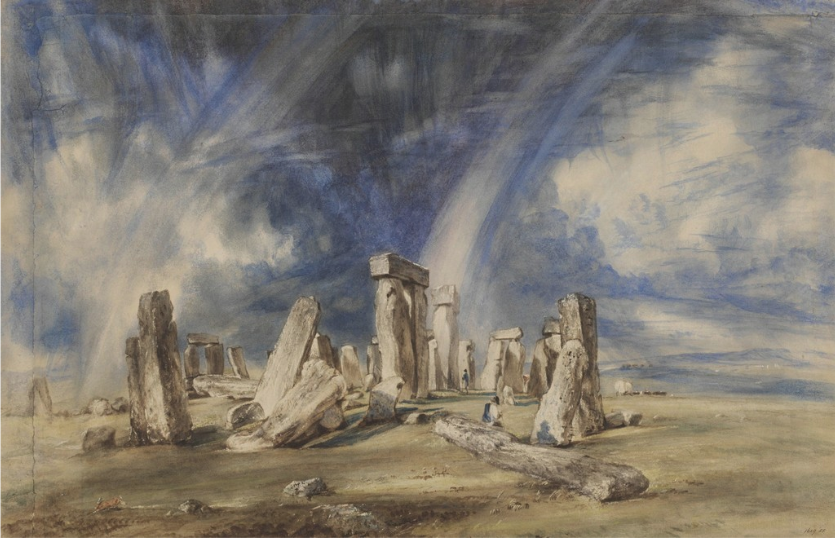
Atlas Obscura recently had a set of photos of Stonehenge taken in 1867 likely featuring the family of Colonel Sir Henry James, of the Ordnance Survey. There’s also a watercolour by John Constable from around 1835 showing a very different, more ruin-y monument:
July 11, 2018
Men of Harlech
Mark Mains
Published on 16 Apr 2011This stirring music first appeared as “March of the Men of Harlech” in Musical and Poetical Relics of the Welsh Bards (Edward Jones, London 1784). The song was also used in the movie Zulu (1964). To learn more visit: http://www.rorkesdriftvc.com/myths/my… http://en.wikipedia.org/wiki/Men_of_H…
July 2, 2018
History of Non-Euclidean Geometry – Lies – Extra History – #6
Extra Credits
Published on 30 Jun 2018You gently corrected out our math mistakes and artistic slip-ups, and we’re here to tell you it was all part of Bismarck’s plans—er, it’s Euclid’s fault. Time for another episode of Lies!
June 15, 2018
Looking at US farm subsidy claims
On Twitter, Chris Auld, an economics professor at the University of Victoria explains why Canadian journalists should stop using the $22 billion figure for US farm subsidies to justify Canada’s unjustifiable supply management regime:
It's been widely reported that the U.S. subsidizes dairy farms $22B per year, or 71% of revenues. Which seems… large. That figure comes from a report paid for by the Dairy Farmers of Canada by a small consulting firm. (https://t.co/2v4xkOZRBU). 1/5 pic.twitter.com/chMnPeRMZx
— Chris Auld (@Chris_Auld) June 12, 2018
If we follow their source to pg 111 of the cited USDA document, we find what they're counting as the $225B of "agricultural subsidies" includes absolutely everything in the USDA's budget! More than half goes to SNAP ("food stamps") and other anti-poverty programs. 2/5 pic.twitter.com/tPhR3Qtb6d
— Chris Auld (@Chris_Auld) June 12, 2018
And much of the remainder, including programs like food safety, the forest service, and research, are not agricultural subsidies, either. See pages 210-211 here: https://t.co/BBmjD41AWZ 3/5
— Chris Auld (@Chris_Auld) June 12, 2018
Some of what's left is subsidies, but the report just takes 10.54% of the total as allocated to dairy since that's the percentage of dairy in U.S. agriculture. What most people would think of as actual "dairy subsidies," direct or indirect payments to dairy farmers, 4/5
— Chris Auld (@Chris_Auld) June 12, 2018
are a trivial fraction of the staggering sums claimed in this report. And if we calculated Canadian "dairy subsidies" in the same silly manner, we'd wind up with similarly vast sums. This figure is rubbish and journalists in particular should stop repeating it. 5/5 pic.twitter.com/Hg0M3vpOuB
— Chris Auld (@Chris_Auld) June 12, 2018
May 28, 2018
Leopard tanks in Afghanistan – “When the legend becomes fact, print the legend”
There’s a story that’s been told for more than a decade and — given the Canadian government’s legendary unwillingness to spend money on the military — widely believed. David Pugliese does his best to debunk it here:
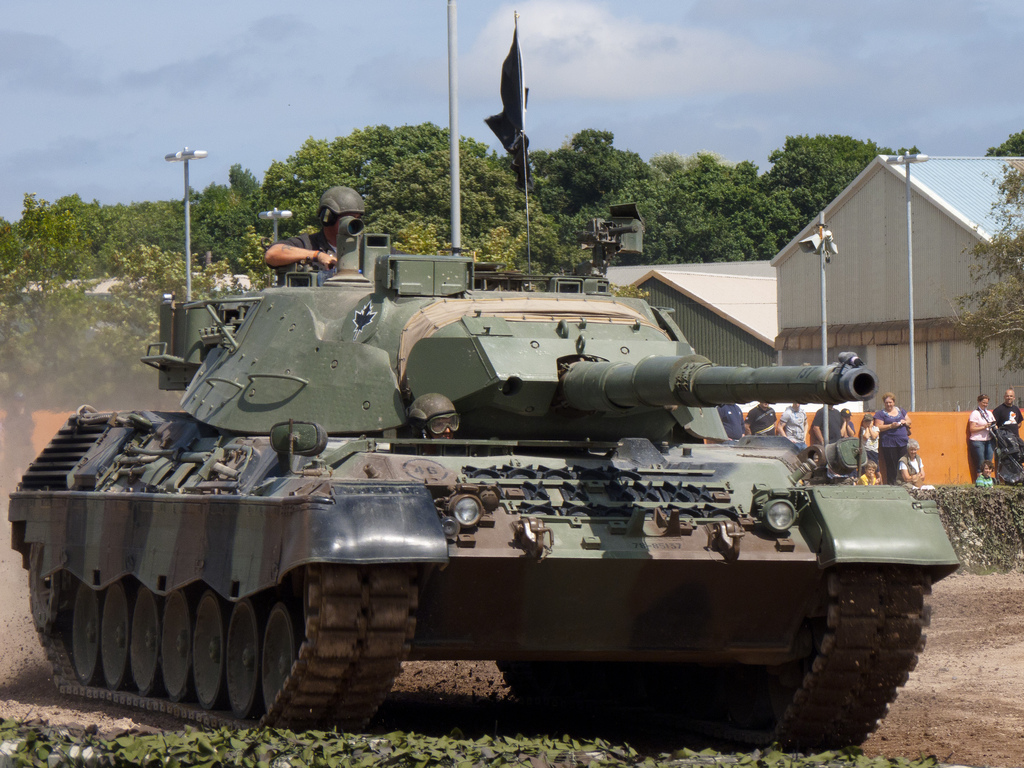
Canadian Leopard 1A3 (Leopard C1) at the Bovington Tank Museum.
Photo by Chris Parfeniuk, via Flickr.
As stories go it’s a pretty good one.
The Canadian Army was up against a tough enemy – the Taliban – in Afghanistan. Commanders called for Leopard tanks to join the battle but those armored vehicles had been mothballed and made into monuments.
So the ever resourceful Canadian Army crews jumped in the Leopard tanks mounted on concrete pads outside bases as monuments and drove them off those platforms, making sure they were shipped to their comrades in Afghanistan.
This myth has been around since 2007 and has once again resurfaced in a new book by retired Maj.-Gen. David Fraser about Operation Medusa.
Fraser also repeated the story in a recent CBC interview with Anna-Maria Tremonti, noting that he knew of at least one Leopard tank pulled off its concrete pad and brought back to serviceability and then shipped to Afghanistan.
In the 2008 book Kandahar Tour by Lee Windsor, David Charters and Brent Wilson the story gets even better. The tanks were driven off the concrete pads and then sent to Afghanistan, according to those authors.
A similar claim is made at the museum devoted to telling the story of the “Essex Regiment (Tank).” On its website the museum claims multiple numbers of Canadian Leopard tanks were taken from monuments (“A mad scramble to retrieve tanks from monuments and prepare them for war,” it claims).
Again, a great story.
But the Canadian Army says it never happened.
The Army points out that Leopard tanks, positioned on the concrete pads as monuments, had already been demilitarized so no one was driving them anywhere.
So what did happen?
May 21, 2018
The Empire of Mali – Lies – Extra History – #6
Extra Credits
Published on 19 May 2018History, and the past, can be two different concepts. Is Mansa Musa REALLY that wealthy? Did his son really die of “sleeping sickness”? It’s time for Lies, featuring Robert Rath, Jac Kjellberg, and James Portnow!
April 20, 2018
April 19, 2018
“Blitzkrieg” – What most people get Wrong – Myth vs “Reality”
Military History Visualized
Published on 18 Aug 2017“Blitzkrieg” is probably the most wrongly used word when it comes to Military History. Its buzzword effect is widely known. The question is what was “Blitzkrieg” actually and is it used “correctly” at all? Additionally, the question if “Blitzkrieg” was something unique to the Wehrmacht will be answered?
Military History Visualized provides a series of short narrative and visual presentations like documentaries based on academic literature or sometimes primary sources. Videos are intended as introduction to military history, but also contain a lot of details for history buffs. Since the aim is to keep the episodes short and comprehensive some details are often cut.
» SOURCES «
Citino, Robert M.: The German Way of War
Hughes, Daniel J.: “Blitzkrieg”, in: Brassey’s Encyclopedia of Land Forces and Warfare, p. 155-162
Ong, Weichong: “Blitzkrieg: Revolution or Evolution?”, in: RUSI December 2017 – Vol. 152 No. 6, p. 82-87
Harris, J.P.: “The Myth of Blitzkrieg”, in War in History 1995 2 (3), p. 335-352
Frieser, Karl-Heinz: The Blitzkrieg Legend
Frieser, Karl-Heinz: “The war in the West, 1939-1940: an unplanned Blitzkrieg”. In: Cambridge History of the Second World War, Volume I: p. 287-314


