We study history to learn from it. If we can discover what worked and what didn’t work, we can use this knowledge wisely to create a better future. Studying the triumph of American industry, for example, is important because it is the story of how the United States became the world’s leading economic power. The years when this happened, from 1865 to the early 1900s, saw the U.S. encourage entrepreneurs indirectly by limiting government. Slavery was abolished and so was the income tax. Federal spending was slashed and federal budgets had surpluses almost every year in the late 1800s. In other words, the federal government created more freedom and a stable marketplace in which entrepreneurs could operate.
To some extent, during the late 1800s — a period historians call the “Gilded Age” — American politicians learned from the past. They had dabbled in federal subsidies from steamships to transcontinental railroads, and those experiments dismally failed. Politicians then turned to free markets as a better strategy for economic development. The world-dominating achievements of Cornelius Vanderbilt, James J. Hill, John D. Rockefeller, and Charles Schwab validated America’s unprecedented limited government. And when politicians sometimes veered off course later with government interventions for tariffs, high income taxes, anti-trust laws, and an effort to run a steel plant to make armor for war — the results again often hindered American economic progress. Free markets worked well; government intervention usually failed.
Why is it, then, that for so many years, most historians have been teaching the opposite lesson? They have made no distinction between political entrepreneurs, who tried to succeed through federal aid, and market entrepreneurs, who avoided subsidies and sought to create better products at lower prices. Instead, most historians have preached that many, if not all, entrepreneurs were “robber barons”. They did not enrich the U.S. with their investments; instead, they bilked the public and corrupted political and economic life in America. Therefore, government intervention in the economy was needed to save the country from these greedy businessmen.
Burton W. Folsum, “How the Myth of the ‘Robber Barons’ Began — and Why It Persists”, Foundation for Economic Education, 2018-09-21.
December 16, 2020
QotD: Distorting the history of America’s “Gilded Age”
December 11, 2020
QotD: Airbrushing out the worst parts of “Lost Cause” mythology
Looking back, we can see that between 1865 and around 1914 the Union and the former South negotiated an imperfect but workable peace. The first step in that negotiation took place at Appomattox, when the Union troops accepting General Robert E. Lee’s surrender saluted the defeated and allowed them to retain their arms, treating them with the most punctilious military courtesy due to honorable foes.
Over the next few years, the Union Army reintegrated the Confederate military into itself. Confederate officers not charged with war crimes were generally able to retain rank and seniority; many served in the frontier wars of the next 35 years. Elements of Confederate uniform were adopted for Western service.
The political leaders of the revolt were not executed. Instead, they were spared to urge reconciliation, and generally did. By all historical precedent they were treated with shocking leniency. This paid off.
Of course, not all went smoothly. The Reconstruction of the South between 1863 and 1877 was badly bungled, creating resentments that linger to this day and – in the folk memory of Southerners – often overshadow the harms of the war itself. The condition of emancipated blacks remained dire.
But overall, the reintegration of the South went far better than it could have. Confederate nationalism was successfully reabsorbed into American nationalism. One of the prices of this adjustment was that Confederate heroes had to become American heroes. An early and continuing example of this was the reverence paid to Robert E. Lee by Unionists after the war; his qualities as a military leader were extolled and his opposition to full civil rights for black freedmen memory-holed.
Lee’s heroism and ascribed saintliness would layer become a central prop in “Lost Cause” romanticism, which portrayed the revolt as an honorable struggle for a Southern way of life while mostly airbrushing out – but sometimes, unforgiveably, defending – the institution of slavery. Even today, the “soft” airbrushing version of Lost Cause retains a significant hold on Southerners who would never dream of defending slavery.
Eric S. Raymond, “Unlearning history”, Armed and Dangerous, 2017-09-22.
December 7, 2020
Churchill and the Bengal Famine of 1943
In The Critic, Zareer Masani debunks a recent book’s claim that British PM Winston Churchill was responsible for the Bengal famine during the Second World War:
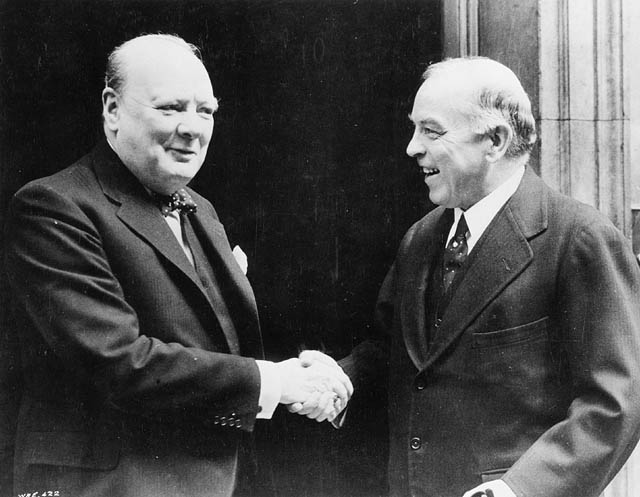
Prime Minister Winston Churchill greets Canadian PM William Lyon Mackenzie King, 1941.
Photo from Library and Archives Canada (reference number C-047565) via Wikimedia Commons.
A favourite trope of the current Black Lives Madness and its left-liberal white apologists has been the alleged infamy of Britain’s most cherished hero, Winston Churchill, charged with everything from mere racism to actual genocide. The worst accusation is that of deliberately starving four million Bengalis to death in the famine of 1943.
The famine took place at the height of World War Two, with the Japanese already occupying Burma and invading the British Indian province of Bengal, bombing its capital, Calcutta, and patrolling its coast with submarines.
The famine raged for about six months, from the summer of 1943 until the end of that year, and estimates of its victims range from half a million upwards, depending on whether one includes its indirect and long-term effects. Most famine experts agree that famines can be caused by both nature and human agency, but never by any single individual. So how has a 67-year-old British prime minister in poor health, 5,000 miles away, fighting near-annihilation in a world war, come to be charged with causing such a cataclysmic disaster?
The attempt to lay this at Churchill’s door stems from a sensationalist book by a Bengali-American journalist called Madhusree Mukerjee. As its title, Churchill’s Secret War, indicates, it was a largely conspiracist attempt to pin responsibility on distant Churchill for undoubted mistakes on the ground in Bengal.
The actual evidence shows that Churchill believed, based on the information he had been getting, that there was no food supply shortage in Bengal, but a demand problem caused by local mismanagement of the distribution system. Ironically, his view found unexpected support in a 2010 exchange between Mukerjee and the Nobel Prize-winning economist Amartya Sen, the world’s foremost expert on famine in India.
Commenting in the New York Times, Sen said of Mukerjee, that “she seems satisfied with little information” and that her data came from only two rice research stations, and those in only two out of 27 districts in Bengal. “The analysis I made,” countered Sen, “using data from all districts … indicated that food availability in 1943 (the famine year) was significantly higher than in 1941 (when there was no famine) … There was indeed a substantial shortfall compared with demand, hugely enhanced in a war economy … but that is quite different from a shortfall of supply compared with supply in previous years … Mukerjee seems to miss this crucial distinction, and in her single-minded … attempt to nail down Churchill, she ends up absolving British imperial policy of confusion and callousness.”
November 29, 2020
An unusually sympathetic biography of George III
Andrew Roberts reviews a new biography of King George III for The Critic:
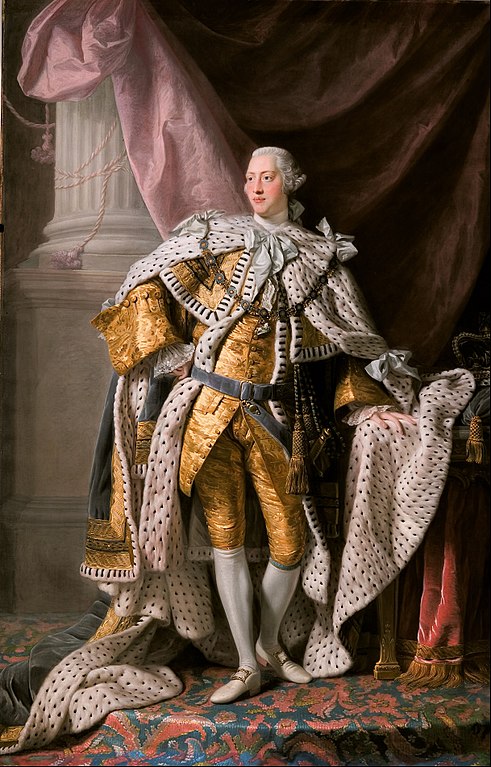
King George III in his coronation robes.
Portrait by Allan Ramsay (1713-1784), original in the Art Gallery of South Australia via Wikimedia Commons.
Over the past six years, Penguin have been publishing their excellent Monarchs series in which a leading historian writes a 30,000-word book on a king or queen from Athelstan to Elizabeth II. There are now 45 of them (including David Horspool on Oliver Cromwell, who sneaks in despite the monarchical rubric, and Jonathan Keates who reasonably enough lumped William III and Queen Mary together). These extended essays are attractively produced, can be read in a couple of hours, and many are true gems, from historians such as Tom Holland, John Guy, Tim Blanning, Norman Davies, Roger Knight, Jane Ridley, Richard Davenport-Hines, David Cannadine — you get the idea.
Now Professor Jeremy Black gives us a full-throated defence of the monarch who is only really generally known as the king who went insane and who lost the American colonies, and who now prances around in the camp-yet-sinister show-stopping song in Hamilton: The Musical. “When considering George III’s mistakes,” Black argues, persuasively, “it is important to assess the parameters of the possible and to consider comparisons.” With his expertise in eighteenth-century European history, Black is able to place George III in the wider context of contemporary monarchs such as Catherine the Great, Frederick the Great, Louis XVI and Napoleon.
“In contradiction to the Whig and American image of George as a tyrant, or at least a would-be tyrant,” Black states, “he had a strong conviction of the value of limited monarchy and was a willing student of the lessons of the Glorious Revolution and the subsequent Revolution Settlement.”
Black brilliantly demolishes the paranoiac Whig view of George as trying to accrete powers to himself unconstitutionally. The George who emerges is a far more attractive figure than the Whig historians depicted, let alone Thomas Jefferson with his 28 histrionic and inaccurate accusations against George in the Declaration of Independence, and especially Lin-Manuel Miranda’s hilarious but profoundly historically incorrect caricature.
Instead, Black portrays a monarch with “a strong religious faith, a passion for hunting and an interest in art, architecture, music, astronomy and exploration”. He was a Renaissance man with an Enlightenment viewpoint, although Black also lists his failings, which were obstinacy, self-righteousness and a certain amount of priggishness when young. Black calls him a “fogey”. These were hardly cardinal sins, and a world away from the lust for dictatorship of which he has been accused.
Jeremy Black — who is fast becoming a national treasure in his own right, having written well over 100 books — takes a refreshingly unmodish stance towards George (as you might have guessed from listing hunting amongst the king’s attributes). “His qualities are easier to understand for those who prize commitment, duty, and integrity,” he concludes, “than in a modern age when scorn and satire, even hatred of the nation’s history, are often prominent.”
October 27, 2020
America’s “brutal system of slavery [was] unlike anything that had existed in the world before”
I missed this article by Kay S. Hymowitz when it was published by City Journal a couple of weeks back:
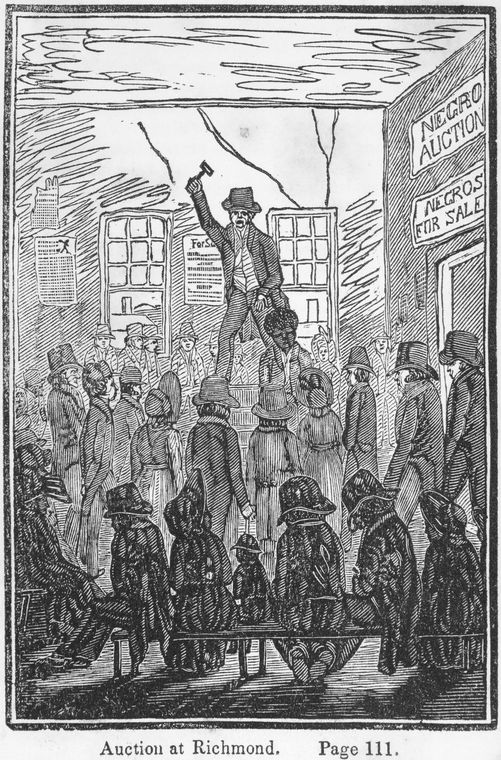
Auction at Richmond. (1834)
“Five hundred thousand strokes for freedom ; a series of anti-slavery tracts, of which half a million are now first issued by the friends of the Negro.” by Armistead, Wilson, 1819?-1868 and “Picture of slavery in the United States of America. ” by Bourne, George, 1780-1845
New York Public Library via Wikimedia Commons.
… slavery was a mundane fact in most human civilizations, neither questioned nor much thought about. It appeared in the earliest settlements of Sumer, Babylonia, China, and Egypt, and it continues in many parts of the world to this day. Far from grappling with whether slavery should be legal, the code of Hammurabi, civilization’s first known legal text, simply defines appropriate punishments for recalcitrant slaves (cutting off their ears) or those who help them escape (death). Both the Hebrew Bible and the New Testament take for granted the existence of slaves. Slavery was so firmly established in ancient Greece that Plato could not imagine his ideal Republic without them, though he rejected the idea of individual ownership in favor of state control. As for Rome, well, Spartacus, anyone?
In the ancient world, slaves were almost always captives from the era’s endless wars of conquest. They were forced to do all the heavy labor required for building and sustaining cities and towns: clearing forests; building roads, temples, and palaces; digging and transporting stone; hoeing fields; rowing galley ships; and marching to almost-certain death in the front line of battle. Women (and often enough boy) slaves had the task of servicing the sexual appetites of their masters. None of that changed with the arrival of a new millennium. Gaelic tribes took advantage of the fall of the Roman Empire to raid the west coast of England and Wales for strong bodies; one belonged to a 16-year-old later anointed St. Patrick, patron saint of Ireland. “In the slavery business, no tribe was fiercer or more feared than the Irish,” writes Thomas Cahill in How the Irish Saved Civilization.
Today, of course, the immorality of slave-owning is as clear as day. But in the premodern world, no neat division existed between evil slaveowners and their innocent victims. Once the Vikings arrived in their longboats in the 700s, the Irish enslavers found themselves the enslaved. Slavery became the commanding height of the Viking economy; Norsemen raided coastal villages across Europe and brought their captives to Dublin, which became one of the largest slave markets of the time. The Vikings thought of their slaves as more like cattle than people; the unlucky victims had to sleep alongside the domestic animals, according to the National Museum of Denmark in Copenhagen. Norsemen rounded up captured Irish men and women to settle the desolate landscape of Iceland; scientists have found Irish DNA in present-day Icelanders, a legacy of that time. The Slavic tribes in Eastern Europe were an especially fertile supplier for Viking slave traders as well as for Muslim dealers from Spain: their Latin name gave us the word slave. Slavs were evidently not deterred by the misery they must have suffered; when Viking power waned by the twelfth century, the Slavs turned around and enslaved Vikings as well as Greeks.
Slavery was a normal state of affairs well beyond the territory we now call Europe. The Mayans had slaves; the Aztecs harnessed the labor of captives to build their temples and then serve as human sacrifices at the altars they had helped construct. The ancient Near East and Asia Minor were chockfull of slaves, mostly from East Africa. According to eminent slavery scholar Orlando Patterson, East Africa was plundered for human chattel as far back as 1580 BC. Muhammad called for compassion for the enslaved, but that didn’t stop his followers from expanding their search for chattel beyond the east coast into the interior of Africa, where the trade flourished for many centuries before those first West Africans arrived in Jamestown. Throughout that time, African kings and merchants grew rich from capturing and selling the millions of African slaves sent through the Persian Gulf and Indian Ocean to Persians and Ottomans.
From the fifteenth to the eighteenth centuries, the North African Barbary coast was a hub for “white slavery.” This episode was relatively short-lived in the global history of slavery, but one with overlooked impact on Western culture. Around 1619, just as the first Africans were being sailed from the African coast to Jamestown, Algerian and Tunisian pirates, or “corsairs” as they were known, were using their boats to raid seaside villages on the Mediterranean and Atlantic for slaves who happened in this case to be white. In 1631, Ottoman pirates sacked Baltimore on the southern coast of Ireland, capturing and enslaving the villagers. Around the same time, Iceland was raided by Barbary corsairs who took hundreds of prisoners, selling them into lifetime bondage.
October 25, 2020
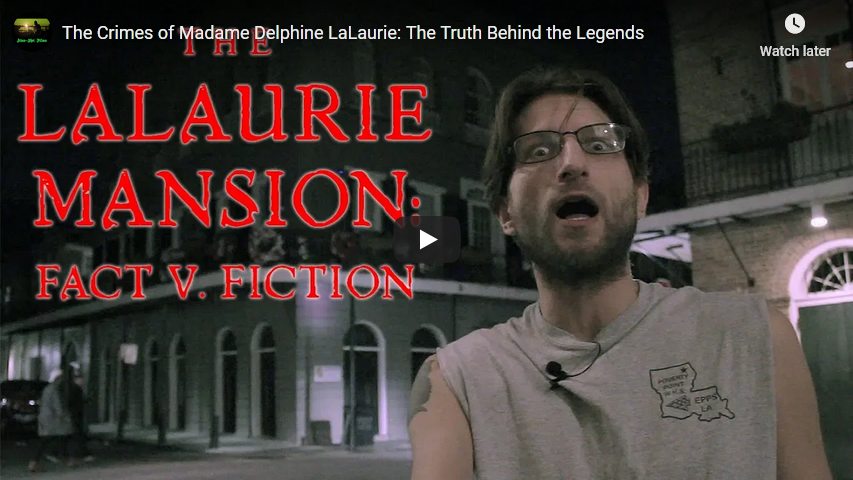
The Crimes of Madame Delphine LaLaurie: The Truth Behind the Legends
Atun-Shei Films
Published 16 Dec 2019Madame Delphine LaLaurie, New Orleans’ most reviled serial killer, has become world famous thanks to American Horror Story and the wildly popular French Quarter ghost tour industry. The story of this deranged socialite who tortured, mutilated, and murdered her slaves has lost none of its horrifying bite, and the supposedly haunted mansion where her home once stood has become a major tourist attraction. Despite its popularity (or perhaps because of it), this story is steeped in legend and folklore. Most online sources about LaLaurie’s crimes are outdated, wrong, or both. In this video I attempt to separate the truth from the myth, and tell a purely historical account of the crimes of Delphine LaLaurie.
Support Atun-Shei Films on Patreon ► https://www.patreon.com/atunsheifilms
#MadameLaLaurie #NewOrleans #History
Watch our film ALIEN, BABY! free with Prime ► http://a.co/d/3QjqOWv
Reddit ► https://www.reddit.com/r/atunsheifilms
Twitter ► https://twitter.com/atun_shei
Instagram ► https://www.instagram.com/atunsheifilms
Merch ► https://atun-sheifilms.bandcamp.com
September 27, 2020
CHECKMATE, LINCOLNITES! Confederate DESTROYS Yankee with FACTS and LOGIC
Atun-Shei Films
Published 23 May 2019Checkmate, Lincolnites! Debunking the three or four arguments Neo-Confederates always make when they talk about the Civil War.
Support Atun-Shei Films on Patreon ► https://www.patreon.com/atunsheifilms
#CheckmateLincolnites #CivilWar #AmericanHistory
Watch our film ALIEN, BABY! free with Prime ► http://a.co/d/3QjqOWv
Reddit ► https://www.reddit.com/r/atunsheifilms
Twitter ► https://twitter.com/alienbabymovie
Instagram ► https://www.instagram.com/atunsheifilms
Merch ► https://atun-sheifilms.bandcamp.com

QotD: The persuasive power of the newspapers
Or, as we might put it, the reason the left doesn’t sweep the board with the votes of the proletariat is because large numbers of the proletariat think the left either don’t represent them, or are aware that the left are nuts.
Tim Worstall, “This Will Be An Interesting Test – Geordie Greig To Daily Mail Editor”, Continental Telegraph, 2018-06-08.
September 25, 2020
QotD: “Qu’ils mangent de la brioche!” [“Let them eat cake!”]
In the original French, the Queen allegedly said, Qu’ils mangent de la brioche!, which doesn’t quite translate to “let them eat cake.” Brioche is sweet, eggy bread that tastes only vaguely like cake. The translated English word “cake” made Marie Antoinette seem even haughtier than in French. But it’s beside the point, since Marie Antoinette never uttered “let them eat cake” in any language. There is no historical evidence that she ever uttered that phrase. The story is pure invention. It’s a historical legend that rivals the myth of Nero “fiddling” while Rome burned. And yet this outlandish fabrication has shaped our image of Marie Antoinette for more than two centuries.
Compared to other historical falsehoods, this legend is easy to trace to its source. It was the French philosopher Jean-Jacques Rousseau. In book six of his Confessions, written in 1767, Rousseau wrote of a “great princess” who had, when told that the peasants had no bread, replied with those words cited above, Qu’ils mangent de la brioche! Was Rousseau referring to Marie Antoinette? This is impossible. When he wrote that passage, Marie Antoinette was still a girl living at the Habsburg court in Vienna (under her original name, Maria Antonia Josepha Johanna). Rousseau’s story was entirely made up, probably borrowed from another source. And while his book wasn’t published till 1782, this was still seven years before the French Revolution began. In fact, the first time someone (spuriously) put the words “let them eat cake” in Marie Antoinette’s mouth was a half-century later, in a book published by Jean-Baptiste Alphonse Karr, Les Guêpes.
Matthew Fraser, “Marie Antoinette: Figure of Myth, Magnet for Lies”, Quillette, 2020-06-24.
September 16, 2020
QotD: Firearms apocrypha
People like to repeat the myth that the tiny M-frame .22 “Ladysmith” was discontinued because a puritanical D.B. Wesson heard that it was popular with “ladies of the night”, because that’s sexier than the fact that it was selling poorly, expensive to make, and constantly broke when people ran the then-new .22 Long Rifle cartridges through the fragile little guns.
Similarly, there’s a legend involving Mr. Wesson that’s attached to the final iteration of the .38 Double Action […] In this case, the story goes, D.B. heard the tale of a police officer who, while arresting a miscreant, had the offender reach over and pop the latch on his top-break Smith, dumping the rounds on the ground, like Jet Li with the slide of a movie prop Beretta. The officer, goes the legend as it was told to yours truly, was killed in the ensuing struggle.
Moved by the fate of the dead officer, the apocryphal tale has Mr. Wesson designing the Perfected Model top-break. This model features a Hand-Ejector style cylinder latch that must be operated in conjunction with the more normal “T”-shaped barrel toggle in order to break the revolver open.
This origin myth is almost certainly, to use the technical term, a load of hooey.
Tamara Keel, “Sunday Smith #60: .38 Double Action Perfected Model”, The Arms Room, 2020-06-14.
August 7, 2020
Myth and Reality of the Ross MkIII Rifle
Forgotten Weapons
Published 16 Jun 2013There is a long-standing urban legend about the Canadian Ross rifle, a straight-pull bolt action that was used in lieu of the SMLE by Canadian troops early in World War One. The story is that the Ross would sometimes malfunction and blow the bolt back into its shooter’s face, with pretty horrible results. Well, I wanted to learn “the rest of the story” — could this actually happen? What caused it? How could it be prevented? In short, what would a Ross shooter need to know to remain safe? And if I could get some cool footage of a bolt blowing out of a Ross in the process, all the better.
Well, reader Andy very generously provided a sporterized Ross for the experiments, and I started reading into what the issue really was. Turns out that the legend was quite true — you can put a Ross MkIII bolt together the wrong way, and it will allow you to fire without the locking lugs engaged, thus throwing the bolt back out of the gun at high velocity. However, the issue was recognized fairly quickly, and the vast majority of Ross rifles were modified with a safety rivet to prevent this from happening. It is also quite easy to determine if a Ross is assembled correctly, once you know what to look for.

July 29, 2020
QotD: Grog in the Royal Navy
Actually, we do, at least as a floor: we know the quantity of the Royal Navy’s spirit ration, which until 1823 was based on half a pint of rum (284 millilitres in foreign) per man per day. We also know its minimum strength, since it was tested by trying to ignite gunpowder soaked in it: it had to be over 57% alcohol by volume (“proof strength”) to pass. That’s sixteen units of alcohol – not per week, but per day – or north of a hundred units a week, just for the issued ration before sailors bought any extra from the purser. (No wonder Jack Tar was jolly back in those days!)
But clearly, we would expect a body of men consuming such suicidally destructive quantities of booze to be physical wrecks, raddled by cirrhosis and disease? As Dr James Lind (he of the discovery that citrus fruits were a sovereign remedy for scurvy) put it,
It is an observation, I think, worthy of record that fourteen thousand persons, pent up in ships, should continue, for six or seven months, to enjoy a better state of health upon the watery element, than it can well be imagined so great a number of people would enjoy, on the most healthful spot of ground in the world.
(For context, around this point the Navy won the battle of Quiberon Bay, with twenty ships – who had less than one man sick per ship).
The ration was halved in 1823, and again in 1850, but for a hundred and twenty years until Black Tot Day in 1970, the Navy still issued nearly thirty units of alcohol a week to everyone on the lower deck (junior rates got theirs diluted, seniors got neat rum). Either folk were hardier back then, or Britannia managed to rule the waves and keep her sailors reasonably healthy despite being a pack of hopelessly addicted alcoholics.
Jason Lynch, “How Much Is ‘Too Much’?”, Continental Telegraph, 2018-05-08.
June 21, 2020
QotD: “[T]he fascinating modern science of high-tech grave robbing”
As Fitzgerald’s friend Hemingway ended The Sun Also Rises, “Isn’t it pretty to think so?”
But now the brilliant Harvard geneticist David Reich has published a bombshell scientific book, Who We Are and How We Got Here: Ancient DNA and the New Science of the Human Past, whose revelations would have been found congenial by a smarter version of Buchanan (such as Fitzgerald himself).
Despite Reich’s occasional need to stop his otherwise lucid narrative to spew irrational rage against his fellow race-science heretics such as James D. Watson, the genome expert conclusively demolishes the post-Boasian anthropologists’ conventional wisdom.
[…]
Reich learned the fascinating modern science of high-tech grave robbing from Svante Pääbo. This Swedish biologist invented the techniques for extracting from ancient skeletons their DNA. (Interestingly, the 1990 Native American Graves Protection and Repatriation Act makes it hard to get hold of ancient American Indian skeletons, but other races’ ancestors appear to be fair game.)
Reich applied to Pääbo’s breakthrough the traditional American knack for vast industrial scale. Assisted by English code-cracker Nick Patterson’s innovations in extracting meaning from bits and pieces of ancient genomes, Reich’s factory-like lab at the Broad Institute has been churning out a tsunami of papers on fascinating questions of prehistory.
Steve Sailer, “Reich’s Laboratory”, Taki’s Magazine, 2018-03-28.
June 15, 2020
African History Disproves Guns Germs and Steel by Jared Diamond
The Cynical Historian
Published 26 Oct 2019There’s a question in the history profession that if sufficiently answered could not only reshape how we conceive ourselves, but reveal the best course of action for politics around the world. What makes the West strong? While there are many answers, the most popular of these has been Jared Diamond’s Guns Germs and Steel. You’ll see his argument all over the place, including a NatGeo documentary. But of course it has its detractors, to the point that some historians consider it pseudo-history. Now I think that’s going too far, but there are enough problems with his thesis that we can’t take it as the final answer to these questions. So let’s talk about that.
————————————————————
errata
10:32 – not “Blaut’s theory” but “Diamond’s theory” (thx PunkSci)
————————————————————references:
James M. Blaut, Eight Eurocentric Historians: The Colonizer’s Model of the World, Volume Two (New York: The Guilford Press, 2000), 149-172. https://amzn.to/2YFt0iQMichael C. Campbell and Sarah A. Tishkoff, “African Genetic Diversity: Implications for Human Demographic History, Modern Human Origins, and Complex Disease Mapping,” Annual Review of Genomics and Human Genetics 9 (22 September 2008): 403-433.
Jared Diamond, Guns Germs and Steel: The Fates of Human Societies (New York: WW Norton, 1997). https://amzn.to/2GK6AqI
Martin W. Lewis and Karen E. Wigen, The Myth of Continents: A Critique of Metageography (Berkeley: University of California Press, 1997). https://amzn.to/2H0ylv7
Richard York and Philip Mancus, “Diamond in the Rough: Reflections on Guns, Germs, and Steel,” Human Ecology Review 14, no. 2 (2007): 157-162.
https://thetruesize.com
————————————————————
Support the channel through PATREON: https://www.patreon.com/CynicalHistorianLET’S CONNECT:
Subreddit: https://www.reddit.com/r/CynicalHistory/
Discord: https://discord.gg/Ukthk4U
Twitter: https://twitter.com/Cynical_History

May 10, 2020
“Blitzkrieg”: Stuka & Panzer – DEBUNKED
Military History Visualized
Published 21 Aug 2018Join me in War Thunder for free using this link http://v2.xyz/WarThunderMilitaryHistory and get a premium tank or aircraft and three days of premium time as a bonus.
The popular view is that the Wehrmacht used a combination of Panzers and Stukas to roll over Poland, Denmark, the Netherlands, Belgium, France and later the Soviet Union. Whereas the Panzers were heavily supported by Stukas overwhelming enemy ground forces.
The problem is that the details on how this was actually done are rather scarce. As such, there are various assumptions and misconceptions around, at least I had plenty of them myself before I took a closer look. So, in this video we will take a deeper dive on how Panzers and Stukas actually coordinated their efforts in Poland 1939, France 1940 and the Soviet Union 1941 (Operation Barbarossa).
“Kommandeure der Luftwaffe” (Commanders of the Air Force) – usually called Koluft.
“Flieger Verbindungsoffiziere” (Pilot Liason Officers) – usually called Flivo.
»» SUPPORT MHV ««
» patreon – https://www.patreon.com/join/mhv
» paypal donation – https://www.paypal.com/cgi-bin/webscr…
» Book Wishlist https://www.amazon.de/gp/registry/wis…»» MERCHANDISE – SPOILS OF WAR ««
» shop – https://www.redbubble.com/people/mhvi…»» SOCIAL MEDIA ««
» twitter – https://twitter.com/MilHiVisualized
» twitch – https://www.twitch.tv/militaryhistory…
» minds.com – https://www.minds.com/militaryhistory...» SOURCES «
Corum, James S.: “The Luftwaffe’s Army Support Doctrine, 1918-1941”. In: The Journal of Military History, Vol. 59, No. 1 (Jan., 1995), p. 53-76
Murray, Williamson: “The Luftwaffe Experience, 1939-1941”. In: Cooling, Benjamin Franklin (ed.): Case Studies in the Development of Close Air Support. Office of Air Force History: Washington DC, United States (1990), p. 71-113
Citino, Robert M.: Blitzkrieg to Desert Storm. The Evolution of Operational Warfare. Kansas University Press: US (2004).
Pöhlmann, Markus: Der Panzer und die Mechanisierung des Krieges: Eine deutsche Geschichte 1890 bis 1945 (Zeitalter der Weltkriege), Paderborn 2016.
Creveld, Martin van; Canby, Steven L.; Brower, Kenneth S.: Air Power and Maneuver Warfare, Air University Press: 1994.
Brütting, Georg: Das waren die deutschen Stuka-Asse. 1939-1945. Motorbuch Verlag: Stuttgart, Germany (1984)
Stahel, David: Operation Barbarossa and Germany’s Defeat in the East. Cambridge University Press: UK (2009)
Das Deutsche Reich und der Zweite Weltkrieg, Band 2: Die Errichtung der Hegemonie auf dem europäischen Kontinent
Das Deutsche Reich und der Zweite Weltkrieg, Band 4: Der Angriff auf die Sowjetunion
Munzel, Oskar: Die deutschen gepanzerten Truppen bis 1945
Corum, James S.: The Roots of Blitzkrieg. Hans von Seeckt and German Military Reform
» DATA CHAIN «
Made with Natural Earth. Free vector and raster map data @ naturalearthdata.com.