Quotulatiousness

May 13, 2021

Were There Really BLACK CONFEDERATES???!!!

Filed under: History, Humour, Military, USA — Tags: , , , , , , — Nicholas @ 02:00

Atun-Shei Films
Published 24 Dec 2020

Checkmate, Lincolnites! Debunking the Lost Cause myth that tens of thousands of black men served as soldiers in the Confederate army during the American Civil War.

Support Atun-Shei Films on Patreon ► https://www.patreon.com/atunsheifilms

Leave a Tip via Paypal ► https://www.paypal.me/atunsheifilms

Buy Merch ► teespring.com/stores/atun-shei-films

#CheckmateLincolnites #CivilWar #AmericanHistory

Original Music by Dillon DeRosa ► http://dillonderosa.com/
Reddit ► https://www.reddit.com/r/atunsheifilms
Twitter ► https://twitter.com/atun_shei

~REFERENCES~

[1] “Black Confederate Movement ‘Demented'” (2014). AmericanForum https://youtu.be/fYFIWlGJhjM

[2] Sam Smith. “Black Confederates: Myth and Legend.” American Battlefield Trust https://www.battlefields.org/learn/ar…

[3] “25th USCT: The Sable Sons of Uncle Abe.” National Park Service https://www.nps.gov/articles/25-usct.htm

[4] Justin A. Nystrom. New Orleans After the Civil War (2010). Johns Hopkins Press, Page 20-27

[5] Kevin M. Levin. Searching for Black Confederates (2019). University of North Carolina Press, Page 45

[6] James Parton. General Butler in New Orleans (1864). Mason & Hamlin, Page 516-517

[7] Levin, Page 12-15

[8] Levin, Page 34-35

[9] Myra Chandler Sampson & Kevin M. Levin. “The Loyalty of ‘Heroic Black Confederate’ Silas Chandler” (2012). HistoryNet https://www.historynet.com/loyalty-si…

[10] Levin, Page 82-83

[11] James G. Hollandsworth, Jr. “Looking for Bob: Black Confederate Pensioners After the Civil War” (2007). The Journal of Mississippi History, Vol. LXVIX, Page 304-306

[12] Lewis H. Steiner. An Account of the Operations of the U.S. Sanitary Commission During the Campaign in Maryland, September 1862 (1862). Anson D. F. Randolph, Page 19-20

[13] Levin, Page 32-33

[14] Charles Augustus Stevens. Berdan’s United States Sharpshooters in the Army of the Potomac (1892). Price-McGill Company, Page 54-55

[15] Levin, Page 44

[16] Andy Hall. “Frederick Douglass and the ‘N*gro Regiment’ at First Manassas” (2011). Dead Confederates Blog https://deadconfederates.com/2011/07/…

[17] Jaime Amanda Martinez. “Black Confederates” (2018). Encyclopedia Virginia https://www.encyclopediavirginia.org/…

[18] Levin, Page 58-61

[19] Levin, Page 39

[20] Levin, Page 46

May 9, 2021

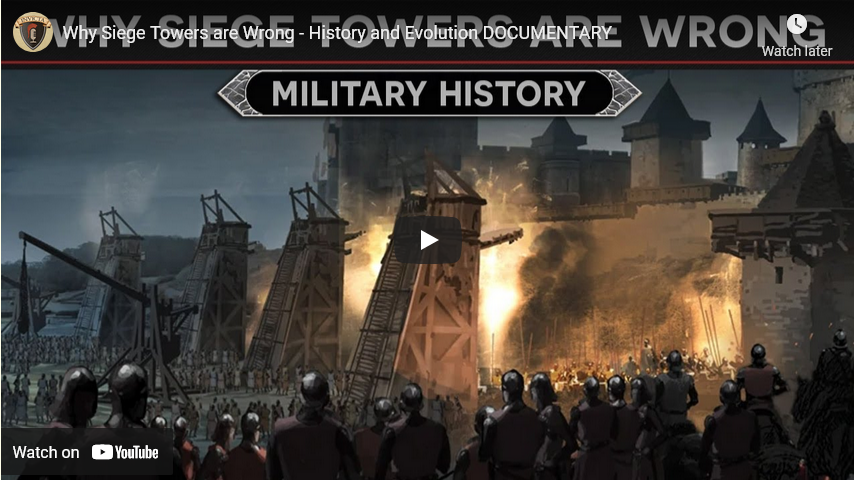
Why Siege Towers are Wrong – History and Evolution

Invicta
Published 1 Feb 2021

The depiction of siege towers as massed, glorified troop elevators in most modern media is completely a-historic. In this video let’s reveal the true history of the Siege Tower.

Check out The Great Courses Plus to learn about daily life in the past: http://ow.ly/DWyz30rsjSX

In this video we explore the history of siege warfare and in particular the siege tower. This begins with our earliest civilizations in the Fertile Crescent. It is here in ancient Mesopotamia that people like the Assyrians began to experiment with new siege technology such as the siege tower. We look specifically at the best example of Assyrian Warfare and the Assyrian army with the Siege of Lachish. From here, siege technology would spread to nearby Egypt and across the Mediterranean. The Greeks picked it up and helped push the technology forward with great application in the campaigns of Alexander the Great. The Roman Army then adopted the Siege Tower and worked to perfect its application. We then finally turn to the use of the Siege Tower in the middle ages. Along the way we cover lots of specific examples like The Siege of Alesia, The Siege of Jerusalem, the Siege of Masada and much more.

#History
#Documentary

April 26, 2021

Was GENERAL SHERMAN a WAR CRIMINAL?!?!?!?!

Atun-Shei Films
Published 11 Aug 2020

Checkmate, Lincolnites! Debunking the Lost Cause myths surrounding William Tecumseh Sherman during the American Civil War, including the Atlanta Campaign, the March to the Sea, and the burning of Columbia — and tackling the “slavery would have gone away on its own” thing while we’re at it. Surprisingly, Johnny Reb gets in one or two really solid points.

[Updated 8 Feb 2023: Vlogging Through History’s reaction video to Atun-Shei’s interpretation is here – https://youtu.be/CTVr4YgB5VI]
(more…)

April 13, 2021

Was it REALLY the WAR of NORTHERN AGGRESSION?!?!?!

Filed under: History, Humour, Military, USA — Tags: , , , , , — Nicholas @ 02:00

Atun-Shei Films
Published 28 Apr 2020

Checkmate, Lincolnites! Debunking the Lost Cause myths that Abraham Lincoln was a tyrant, that nobody in the North cared about slavery or abolitionism, and that the warmongering Union invaded the South without provocation or just cause during the Civil War. Featuring some special guest appearances from your favorite kooky historical characters!

[Update, 8 Feb, 2023: Here’s a Vlogging Through History reaction video that amplifies several of the points Atun-Shei makes – https://www.youtube.com/watch?v=rTQzXG15QsU]
(more…)

March 28, 2021

TARIFFS and TAXES: The REAL Cause of the CIVIL WAR?!

Filed under: History, Humour, Military, USA — Tags: , , , , — Nicholas @ 02:00

Atun-Shei Films
Published 16 Jan 2020

Checkmate, Lincolnites! Debunking the Lost Cause myth that the American Civil War was fought over taxes and protectionist tariffs. Was the South subjected to disproportionate taxation? Did the Morrill Tariff cause secession? Watch and find out, you no-account, yellow-bellied sesech!

Support Atun-Shei Films on Patreon ► https://www.patreon.com/atunsheifilms

Leave a Tip via Paypal ► https://www.paypal.me/atunsheifilms (All donations made here will go toward the production of The Sudbury Devil, our historical feature film)

Buy Merch ► teespring.com/stores/atun-shei-films

#CheckmateLincolnites #CivilWar #AmericanHistory

Reddit ► https://www.reddit.com/r/atunsheifilms
Twitter ► https://twitter.com/atun_shei

March 25, 2021

Hunter S. Thompson’s Fear and Loathing in Las Vegas

Filed under: Books, Humour, USA — Tags: , , , , , — Nicholas @ 05:00

I first read Thompson’s Fear and Loathing in the late 1970s and being as callow and inexperienced as most teenagers, I took it for a mostly factual exploit (along with many older readers who didn’t have my excuse for gullibility). I passed the book on to one of my friends who became mildly obsessed with “Raoul Duke” and the adventures recounted in the book. I’ve long since lost touch with him, but I’m sure he’d be horribly disappointed to discover that Thompson probably imagined 90% of it:

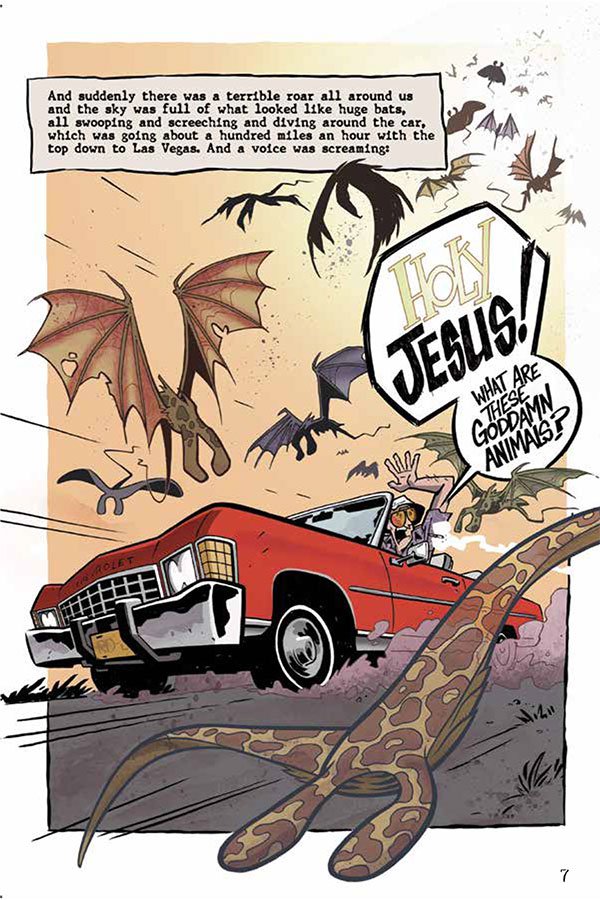
    We were somewhere around Barstow on the edge of the desert when the drugs began to take hold. I remember saying something like “I feel a bit lightheaded; maybe you should drive …” And suddenly there was a terrible roar all around us and the sky was full of what looked like huge bats, all swooping and screeching and diving around the car, which was going about a hundred miles an hour with the top down to Las Vegas.

From the outset, Fear and Loathing in Las Vegas is an outrageous and darkly amusing tale of two crazed men turned loose in the world’s capital of decadence. Raoul Duke and Doctor Gonzo, clearly based upon Thompson and Acosta, are carrying a veritable pharmacopoeia in the trunk of their rented car, and throughout the novel they abuse a litany of substances as they stumble through casinos, bars, and hotels terrorising staff and patrons alike. Though Duke and Gonzo are, like the real Thompson and Acosta, tasked with covering the Mint 400, their assignment is quickly lost in the carnage. Near the end of the book, Duke admits he “didn’t even know who’d won the race.”

If you are unfamiliar with Thompson’s work, you may wonder why it matters that their efforts to complete a minor assignment ended in failure. Authors like Ernest Hemingway had mined their journalistic experience for material to incorporate into their fiction, so it is hardly unusual that Thompson would find inspiration for a novel whilst covering the Mint 400. But his approach with this book went beyond mere inspiration. Throughout Fear and Loathing, reality and imagination are blurred to the extent that no one really has much idea of what really happened on their trip.

[…]

In this letter, he made the startling confession that Fear and Loathing had not merely exaggerated the debauchery that took place in Vegas, but that there had in fact been no drugs at all. Could this really be true? Was the most notorious drug book of its era really inspired by a drug-free journey?

Before we can answer that, it is important to note the chronology of events on which the book was based. Whilst the book portrays the two men tearing apart hotels and casinos over a period of several days, there were in fact two distinct trips. First, they went to cover the Mint 400 on Mach 21st–23rd, then they returned for the National District Attorneys’ Conference on Narcotics and Dangerous Drugs on April 25th–29th. Thompson simply rolled the two events together into a single narrative. The evidence suggests that, during the first trip, Thompson and Acosta drank heavily and perhaps smoked a little pot, but certainly did no serious drug-taking. The famed pharmacopeia in the trunk of their convertible was fictitious:

    The trunk of the car looked like a mobile police narcotics lab. We had two bags of grass, seventy-five pellets of mescaline, five sheets of high-powered blotter acid, a salt shaker half full of cocaine, and a whole galaxy of multi-colored uppers, downers, screamers, laughers … and also a quart of tequila, a quart of rum, a case of Budweiser, a pint of raw ether and two dozen amyls.

As tempting as it is to believe that this existed, it was a product of Thompson’s prodigious imagination. He was, however, keen to keep his readers in the dark, hence his letter to Silberman and the inclusion of his photo on the back cover. Since childhood, he had been obsessed with appearing as an outlaw, yet real outlaws never explicitly said that’s what they were. They merely hinted at it.

Of course, Thompson’s “drug-diet” did consist of various illegal substances, which made his descriptions of their effects rather convincing, but not only did he remain mostly drug-free in Vegas, he also wrote the novel with little more than beer and tobacco in his system. Back home in Colorado, he polished his story carefully through many drafts. The result was a far more intelligent and coherent work than almost anything else he published.

It was only during the second of the two trips that they began to consume drugs, but even then their indulgence was mild when compared with Duke and Gonzo’s extravagant excesses. They had marijuana, a few pills, and possibly some mescaline, but nothing else. His descriptions of LSD came from experiments several years earlier, the parts about adrenochrome were entirely fabricated, and — surprisingly — Thompson had not yet tried cocaine by 1971.

March 17, 2021

The long-gone economic framework of print newspapers

Filed under: Business, Cancon, Media — Tags: , , , — Nicholas @ 03:00

In The Line, Peter Menzies explains the economic underpinnings of the newspaper world back in the “good old days” before first radio, then TV, and finally the internet took all the profits out of their model:

“Newspaper Boxes” by Randy Landicho is licensed under CC BY 2.0

We will hear a lot in the months ahead about who’s making money from news, so let’s get something straight: Even in the profit-soaked heyday of Canadian newspapers, no one made money from news.

That all ended about 100 years ago when radio — and then television — began delivering it for free.

Oh sure, the occasional ongoing news story would inspire people to buy more newspapers. But in my 30 years in that business the only event that did so in any significant way was the death and funeral of Princess Diana. Even then, after the extra cost of newsprint and distribution, the financial return was insignificant.

But mythologies die hard. People in newsrooms believed news made money — and apparently some still do — even when year after year, surveys of readers showed that there were lots of other things that sold and sustained newspapers.

Some people bought them because they were looking for a job. For others, it was a house, a plumber, a companion, a pet, a car or, really, almost anything else you can think of that might be needed. Classified pages were every town and city’s marketplace. That’s where you found stuff you had to get and bought an ad when you had something to sell or tell people about. It was where you announced the births of your babies, the graduations, engagements and weddings of your children and the deaths of your parents. The lives of communities were recorded in the classified pages of their newspapers.

After a glance at the headlines, many other readers’ first and sometimes only stops were the horoscope, comics, crossword (an error there generated far more calls than a rogue columnist ever could) and other pleasant distractions. For still more, it was the stocks listings, sports scores or recipes to which they were primarily drawn.

There were movie and entertainment listings — even a TV guide so you’d know where and when to find Seinfeld. On Thursdays, you might buy a paper just for the Canadian Tire flyer. On weekends, specialty sections discussed books and told tales of travel adventures well-supported by the latest deals advertised by travel agencies. Housing developers pitched their latest home designs in special real estate sections. And there were magazines. Honestly, there were.

It’s been literal decades since we last subscribed to a print newspaper, and nearly as long since I picked one up from a news stand. My mother is the last person I recall still depending on buying a physical newspaper — she only stopped buying a Saturday Toronto Star in the last year or so — but that was mainly for the TV listings. Back when I still occasionally travelled on business (also more than a decade ago, now), it was a nostalgic treat to find a copy of USA Today at the door of my hotel room in the morning.

March 13, 2021

Confederate Soldiers DIDN’T Fight for SLAVERY!! (Or Did They?)

Filed under: History, Humour, Military, USA — Tags: , , , — Nicholas @ 02:00

Atun-Shei Films
Published 20 Sep 2019

Checkmate, Lincolnites! Debunking the Lost Cause myth that Johnny Reb, the common Confederate soldier, didn’t fight to preserve the institution of slavery.

Support Atun-Shei Films on Patreon ► https://www.patreon.com/atunsheifilms

Leave a Tip via Paypal ► https://www.paypal.me/atunsheifilms (All donations made here will go toward the production of The Sudbury Devil, our historical feature film)

Buy Merch ► teespring.com/stores/atun-shei-films

#CheckmateLincolnites #CivilWar #AmericanHistory

Reddit ► https://www.reddit.com/r/atunsheifilms
Twitter ► https://twitter.com/atun_shei

February 24, 2021

An antidote to the poison of modern architecture?

Filed under: Architecture, Books, History — Tags: , , — Nicholas @ 03:00

In The Critic, James Stevens Curl reviews a new work by Mark Alan Hewitt that he calls “a welcome breath of sound common sense in a field where expensive insanity seems to have ruled the roost for far too long”:

Draw in Order to See: A Cognitive History of Architectural Design
by Mark Alan Hewitt

That architecture and architectural education are in a terrible state is obvious to anybody in the field. The reasons for this catastrophe are many, but some of the primary causes have been the universal embrace of the cult of inhumane modernism devoid of ornament (“a crime”), beauty, or even fun; the arrogant ditching of history and disregard of architectural precedents; the devaluation of craftsmanship through the adoption of factory-made components; and the desensitisation of architectural students terrorised and bullied into acceptance of nonsense by means of design “juries”, and by the compulsory study of false “grand narratives” of modernism that are patently distorted.

One of the worst of those pernicious texts was Nikolaus Pevsner’s Pioneers of the Modern Movement from William Morris to Walter Gropius (1936), the title of which should have been enough to put off anyone who knew anything about art history. The creation of an entirely spurious connection between Arts-and-Crafts practitioners like Morris and modernists like Gropius was part of a campaign to create respectable father-figures for disreputable modernism; to legitimise the unspeakable by giving it a fabricated historical pedigree.

It says a lot about the flabbiness of the architectural world that it so readily accepted not only Pevsner’s sacred cowdom, but his enthusiastic endorsement of the Modern Movement in architecture as the “new style” of the twentieth century; a “genuine style as opposed to a passing fashion”, and one, moreover, that was, as Pevsner approvingly noted, “totalitarian”, a remark that did not even arouse a frisson of anxiety among the dimwits. Elizabeth Cumming and Wendy Kaplan put it neatly in their The Arts and Crafts Movement (1991 & 2002): they observed that few “now accept the view of Nikolaus Pevsner, put forward in his influential Pioneers … of Arts and Crafts as an antecedent of modernism”. Unfortunately, that is not true of “schools of architecture” in which falsehoods are still taught, and people like C.F.A. Voysey, who hated the modernists and everything they stood for, was held by Pevsner, in the teeth of objections by Voysey himself, to have been such a “pioneer”, a libel still perpetrated to this day in recent publications.

The widespread acceptance of untruths, obvious errors, and false attributions can only be explained if some cognitive functions have been shut down. To swallow the sort of twaddle peddled by Pevsner one would need to disengage what one actually sees from one’s understanding: in other words, instead of looking at something with care and forming sensible judgements based on careful comparisons and observations, one has one’s vision impaired by peering through Bauhaus-tinted spectacles, and therefore sees what Pevsner & Co. want one to see. In other words, whole generations have been brought up, not to see with their eyes, but to look with their ears.

Hewitt’s intelligent new book argues persuasively for the advantages of drawing in helping us to see. So often, the camera and the mobile phone are used to record something, but it is true (and I speak from many years of experience), that one can really only understand a building or an artefact by drawing it.

February 23, 2021

QotD: Canadian myths

Filed under: Cancon, Quotations — Tags: , — Nicholas @ 01:00

The Canadian national temper is a funny thing, riddled with contradictions. It is plainly an abstraction, and yet it does seem to have discernible traits. Some jokingly regard it as absurdly apologetic — a Canadian is someone who says “sorry” when he is jostled. Canadians are polite and amiable, pacifist by nature; they are the world’s peacekeepers. Canadians regard themselves as morally superior, especially with regard to Americans. Canadians are inwardly attracted to failure, as Margaret Atwood contended in Survival — Canadians have a will to lose as powerful as the American will to win. And so on.

Canada is a huge but under-populated country. The wind echoes in our ears. Much has been made in our literature of the hardiness and resilience necessary for existence in a punishing climate and of the harsh labor required to extract the benefits of a resource-based economy. Susanna Moodie’s Roughing It in the Bush is an early classic detailing the rigors and challenges of domesticating an unforgiving milieu. Canadian fortitude is a national foundation myth.

David Solway, “The Canadian Mind: A Culture So Open, Its ‘Brains Fall Out'”, PJ Media, 2018-10-10.

February 16, 2021

Reduce, re-use, recycle … reject

Filed under: China, Economics, Environment, Government, Media, USA — Tags: , , , , — Nicholas @ 03:00

John Miltimore rounds up several recent stories about American cities backing away from their elaborate, expensive, and wasteful recycling programs. We’ve had three generations of kids brought up indoctrinated into the belief that recycling was not only a good idea, but that it had almost mystical qualities and that it was essential to “saving the world”. The economic facts strongly contradict that, and have always revealed the inefficiencies and outright waste produced by even the best-run municipal recycling programs.

China, perhaps the largest buyer of US recyclables, stopped accepting them in 2018. Other countries, such as Thailand and India, have increased imports, but not in sufficient tonnage to alleviate the mounting costs cities are facing.

“We are in a crisis moment in the recycling movement right now,” Fiona Ma, the treasurer of California, told the Times.

Cost is the key word. Like any activity or service, recycling is an economic activity. The dirty little secret is that the benefits of recycling have been dubious for some time.

“Recycling has been dysfunctional for a long time,” Mitch Hedlund, executive director of Recycle Across America, told The Times.

[…]

And then there are the energy and resources that go into recycling. How much water do Americans spend annually rinsing items that end up in a landfill? How much fuel is spent deploying fleets of barges and trucks across highways and oceans, carrying tons of garbage to be processed at facilities that belch their own emissions?

The data on this front is thin, and results on the environmental effectiveness of recycling vary based on the material being recycled. Yet all of this presumes the recyclables are not being cleaned and shipped only to be buried in a landfill, like so much of it is today. This, Mises would say, is planned chaos, the inevitable result of central planners making decisions instead of consumers through free markets.

Most market economists, Reed points out, “by nature, philosophy, and experience” a bunch skeptical of centrally planned schemes that supplant choice, were wise to the dynamics of recycling from the beginning.

In a 2004 episode of Penn & Teller’s Bullshit, they discussed recycling:

February 8, 2021

Why Everybody Disagrees on the Efficacy of the English Longbow – A Video Essay

Filed under: Britain, France, History, Military, Weapons — Tags: , , , , , , , — Nicholas @ 04:00

SandRhoman History
Published 7 Feb 2021

Everybody quarrels over the efficacy of the English longbow. Many historians, reenactors and history enthusiasts alike hold the view that arrows piercing armor is a myth. Some base this view on testing as was done for example by Tod from Tod’s workshop. Together with his team, he provided an invaluable data point for this debate. Others, such as traditionalist historians are often open to the possibility of arrows piercing armor, even though they are aware of actual testing of the longbow. In general, the efficacy of a weapon is much more complicated than its mere armor penetration value. So, in this video we’d like to shed light on the whole debate and explain why it is so hard to find common ground on this issue. This is why everybody disagrees on the efficacy of the English longbow.

Patreon: https://www.patreon.com/sandrhomanhis…​

Twitter: https://twitter.com/Sandrhoman​

Tod’s Video: ARROWS vs ARMOUR – Medieval Myth Busting https://youtu.be/DBxdTkddHaE​

Tod’s playlist: MEDIEVAL MYTH BUSTING https://youtube.com/playlist?list=PLI…​

Bibliography:
Rogers, C.J., The Efficacy of the English Longbow, 1998.
Devries, K., Medieval Military Technology, 1994.
Bane, M., “English Longbow Testing against various armor circa 1400”, 2006.
Soar, H., Gibbs, J., Jury, C., Stretton, M., Secrets of the English War Bow. Westholme, 2010, pp. 127–151.
Magier, Mariusz; Nowak, Adrian; et al., “Numerical Analysis of English Bows used in Battle of Crécy”. Problemy Techniki Uzbrojenia. 142 (2), 2017, 69–85.

January 27, 2021

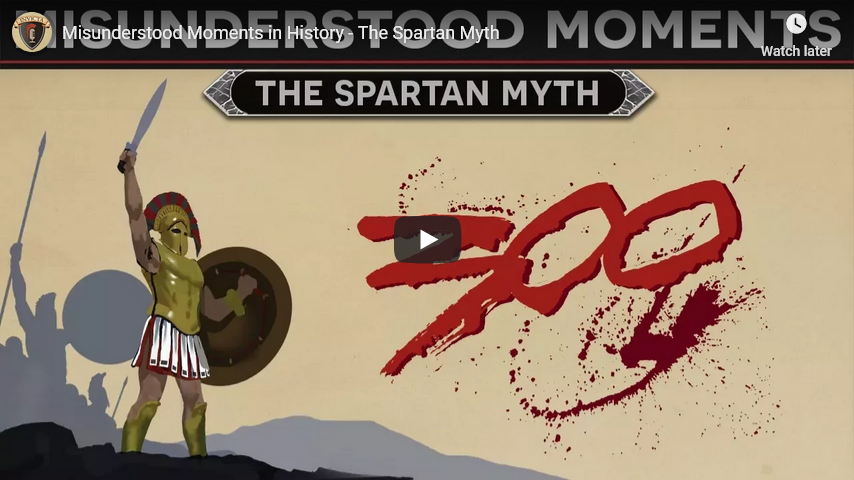
Misunderstood Moments in History – The Spartan Myth

Filed under: Europe, Greece, History, Military — Tags: , , , , , , — Nicholas @ 02:00

Invicta
Published 27 Oct 2017

Start your 30 day free trial here: http://ow.ly/eCd230fiZ7Q

The Spartans are immortalized in history as super soldiers bred for war. However most of what we think we know about them is a lie. Today we will unmask the truth behind the Spartan Myth.

The Great Courses Plus is currently available to watch through a web browser to almost anyone in the world and optimized for the US market. The Great Courses Plus is currently working to both optimize the product globally and accept credit card payments globally.

Documentary Credits:
Research: Dr Roel Konijnendijk
Script: Invicta
Artwork: Milek J
Editing: Invicta
Music: Total War OST, Soundnote

Documentary Bibliography:
Paul Anthony Cartledge, The Spartans: The World of the Warrior-heroes of Ancient Greece
Nigel Kennell, Spartans: A New History (2010)
S. Hodkinson, Property and Wealth in Classical Sparta (2000)
J. Ducat, Spartan Education: Youth and Society in the Classical Period (2006)
S.M. Rusch, Sparta at War: Strategy, Tactics and Campaigns, 550-362 BC (2011)
E. Rawson, The Spartan Tradition in European Thought (1969)
S. Hodkinson & I.M. Morris (eds.), Sparta in Modern Thought (2012)

January 7, 2021

QotD: Sneering at “the throwaway society”

Filed under: Economics, Environment, Health, Media, Quotations, USA — Tags: , , , — Nicholas @ 01:00

For half a century, it’s been a term of disdain: the “throwaway society,” uttered with disgust by the environmentally enlightened. But now that their reusable tote bags are taboo at grocery stores and Starbucks is refusing to refill their ceramic mugs, they’ve had to face some unpleasant realities. Disposable products aren’t merely more convenient than the alternative; they’re also safer, particularly during a pandemic but also at any other time. And they have other virtues: the throwaway society is healthier, cleaner, more economical, less wasteful, less environmentally damaging — and yes, more “sustainable” than the green vision of utopia.

These are not new truths, even if it took the Covid-19 pandemic to reveal them again. The throwaway age began because of public-health campaigns a century ago to control the spread of pathogens. Disposable products were celebrated for decades for promoting hygiene and saving everyone time and money. It wasn’t until the 1970s that they became symbols of decadent excess, and then only because of economic and ecological fallacies repeated so often that they became conventional wisdom.

In a strange turn of events, the most affluent society in history suddenly turned into a mass of neurotic hoarders. Sifting through garbage for valuables, an activity formerly associated with the most destitute inhabitants of Third World shantytowns, became a moral duty in American suburbs. Greens campaigned for “zero waste” and a “circular economy” in which disposable products would be outlawed. They confidently predicted that the throwaway society was doomed, but if they’d known anything about its history, they would have realized that it was created for very good reasons — and that it will endure long after their lamentations are forgotten.

John Tierney, “Let’s Hold On to the Throwaway Society”, City Journal, 2020-09-13.

December 31, 2020

QotD: The “noble savage” belief system

… the whole weeks-long saga, which featured urban protestors appearing alongside their Indigenous counterparts at road and rail barricades throughout Canada, tapped into a strongly held noble-savage belief system within progressive circles. Various formulations of this mythology have become encoded in public land acknowledgments, college courses, and even journalism. The overall theme is that Indigenous peoples traditionally lived their lives in harmony with the land and its creatures, and so their land-use demands transcend the realm of politics, and represent quasi-oracular revealed truths. As has been pointed out by others, this mythology now has a severe, and likely negative, distorting effect on public policy, one that hurts Indigenous peoples themselves. In recent years, Indigenous groups have finally gotten a fair cut of the proceeds of industrial-development and commodity-extraction revenues originating on their lands. And increasingly, they are telling white policy makers to stop listening to those activists who seek to portray them as perpetual children of the forest. It is for their benefit, as much as anyone else’s, to explore the truth about the myth of harmonious Indigenous conservationism.

***

When the ancestors of North America’s Indigenous peoples entered the New World some 16,000 years ago via Siberia, they hunted many of the mammals, reptiles, and birds, from the Arctic down to Tierra del Fuego. Mammoths, mastodons, and enormous ground-dwelling sloths, as well as giant bears, giant tortoises, and enormous teratorn birds with 16-foot wingspans — animals that had never had a chance to evolve in the presence of humans — were among the many species that disappeared from the Americas. Some medium-sized animals — such as horse, peccary, and antelope species — were also wiped out. But others survived: Bison and deer species, tree sloths, tapirs, jaguars, bear species, alligators, and big birds such as rheas and condors are, at least for the time being, still with us. The existence of these survivors, along with the relatively unspoiled forests, grasslands, and rivers seen by the first Europeans to enter the Americas, served to support the illusion that America’s first peoples had been maintaining what popular environmentalist David Suzuki calls a “sacred balance” with the natural world. Throughout history, however, humans killed animals that were tasty, numerous, and huntable. For kin-groups, staying alive meant making life-and-death cost-benefit calculations about where to send your berry-pickers and hunters. “Sacredness” had nothing to do with it.

This is not to say that the Indigenous peoples who migrated from Asia to the Americas were especially bloodthirsty (though Europeans typically reported that their hunting and fishing skills were excellent). In every known case where humans entered continents formerly uninhabited by our species, the bigger animals tended to disappear, since they provided the most sustenance per kill. The first humans to enter Australia some 70,000 years ago wiped out giant kangaroo species, rhino-sized marsupial herbivores, jaguar-sized marsupial carnivores, big flightless birds, and many other megafauna. The same thing would happen in Europe: After sapiens completed its occupation of that sub-continent some 30,000 years ago, the mammoths, woolly rhinos, giant deer, and lions they recorded in their cave paintings and carvings also disappeared.

Baz Edmeades, “The Myth of Harmonious Indigenous Conservationism”, Quillette, 2020-09-06.

« Newer Posts — Older Posts »

Powered by WordPress