TimeGhost History
Published 30 Nov 2025The Vietnam War didn’t begin with American boots on the ground. It began with a promise — and a break. After the French defeat at Dien Bien Phu in 1954, the Geneva Accords split Vietnam at the 17th parallel. Ho Chi Minh led the North. In the South, Ngo Dinh Diem struggled to hold a fragile new state together while armed sects, crime syndicates, and political rivals challenged his rule. Washington saw Vietnam as the next battleground of the Cold War, and threw its support behind Diem — believing he could stop the spread of communism in Southeast Asia.
But as elections for reunification approached, tensions rose. Diem refused the vote. The North rebuilt. The South descended into repression, unrest, and quiet rebellion. Former Viet Minh fighters slipped into the shadows. Secret networks formed. Targeted killings began. By 1958, the storm clouds of a new war gathered — one the United States could no longer afford to ignore.
This episode explores how the U.S. found itself pulled into Vietnam, how Diem rose to power, why the reunification election collapsed, how American aid reshaped the South, and how the first sparks of insurgency ignited a conflict that would define a generation.
Join us as we trace the origins of a war long before the Marines landed at Da Nang — to understand why Uncle Sam entered the Vietnam War in the first place.
(more…)
December 1, 2025
Why Uncle Sam entered the Vietnam War – W2W 055
October 16, 2025
The hereditary aristocrats of the People’s Republic of China
To many western liberals, an aristocratic system is a disparaged and vestigial remnant of the distant past. An echo of the “bad old days” of anti-meritocratic wealth and privilege enjoyed by the lucky descendants of ancient conquerors and oppressors. Yet among the most well-connected and powerful people in China can only be described as “princelings”, as they are literally the children and grandchildren of the leaders of the Communist Party, especially those who took part in the “Long March”:

“The Chinese People’s Liberation Army is the great school of Mao Zedong Thought”, 1969.
A poster from the Cultural Revolution, featuring an image of Chairman Mao, published by the government of the People’s Republic of China.
Image via Wikimedia Commons.
In 1926, five years after becoming one of the founders of the Chinese Communist Party (CCP), Mao Zedong listed China’s enemies as “the warlords, the bureaucrats, the comprador class [businessmen dealing with foreign interests] and the reactionary section of the intelligentsia attached to them”. It is ironic that Mao would eventually create a new aristocracy, often referred to as the “princelings” (taizidang), every bit as hierarchical as that against which he had previously railed.
Perversely, when Mao Zedong came to power in China in 1949, there were not many structures of authority left to destroy. In the period of warlordism that succeeded the overthrow of the Qing dynasty by Sun Yat-sen in 2011 and ended with the consolidation of nationalist (Kuomintang) power by Chiang Kai-shek in 1936, the aristocracy of imperial China had been swept away. So too the Mandarin class, the Chinese bureaucrats selected by civil service examination, a system that started with the Sui dynasty in AD 581. As for the Chinese aristocracy, its last vestiges ended with the abolition in 1935 of the Dukedom of Yansheng which belonged to the descendants of Confucius.
So, in terms of social hierarchies, Mao inherited a clean sheet when he established the People’s Republic of China on October 1, 1949. The CCP leadership soon proved that, in the immortal words of George Orwell in his novel Animal Farm, “all animals are equal, but some animals are more equal than others”. In Beijing, Mao and China’s CCP leaders took residence in the palatial compounds located in Zhongnanhai, a waterside park established by the Yuan dynasty in the 13th century.
There is not even equality within the “red aristocracy”. Gradations are as clear-cut as if there were princes, dukes or marquises. The highest rank is accredited to the offspring of those CCP leaders who participated in the Long March. This iconic fighting retreat to a remote plateau in Shaanxi province followed the defeat of the Red Army in October 1934.
It is perhaps difficult for people in the West to understand the scale of Chinese veneration for the individuals who completed the Long March. With the possible exception of the migratory treks along the Oregon Trail, there is no comparable event in American or European history. Throughout their lives, leaders of the Long March enjoyed unparalleled prestige; it was a prestige that passed down to their children – hence the princelings.
The creation of the red aristocracy started with Mao himself. Within a few years of the establishment of the People’s Republic of China, Mao became a de facto emperor. On occasions he even referred to himself as such. He certainly lived the life of an emperor. At his commodious palace in Zhongnanhai, Mao surrounded himself with a harem of dancing girls who would occupy his bed and his swimming pool. In time-honoured fashion, China’s head of security and intelligence, Kang Sheng, procured girls for Mao as well as thousands of volumes of pornography.
[…]
My own experience of the princeling world confirmed that in China, despite its vast population a very small group of families form a governing nexus that has power far beyond its numbers. It is a group that seem to be getting stronger. The princeling proportion of the CCP central committee rose from 6 per cent in 1982 to 9 per cent in 2012. When I spoke to a princeling friend about the politburo standing committee that was elected in 2012, she told me that she personally knew five of its seven members; to her great delight three of them were princelings. It was through her that I met Deng Xiaoping’s daughters and spent a “country house” weekend with them and her princeling pals.
Here it became clear that, while most of the princelings I met were reformists in the Deng mode, there are also factions that are hard-line Maoists, like the one led by Xi Jinping. At the moment it appears that the reformist princelings have gained the upper hand. More light on Xi Jinping’s future and the outcome of this princeling tug of war may be shed at the Fourth Plenum of the 20th CCP Congress starting on October 20.
October 14, 2025
White Hoods, Bloody Hands: The Klan as America’s First Terrorists – W2W 048
TimeGhost History
Published 12 Oct 2025From Pulaski to Stone Mountain to Brown v. Board, the Ku Klux Klan evolves from Reconstruction terror to a decentralized, Cold War–era movement that bombed churches, lynched citizens, and hid behind “anti-communism”. We trace the First, Second, and Third Klans — rituals, networks, and the brutal campaign against desegregation and civil rights.
(more…)
October 13, 2025
October 7, 2025
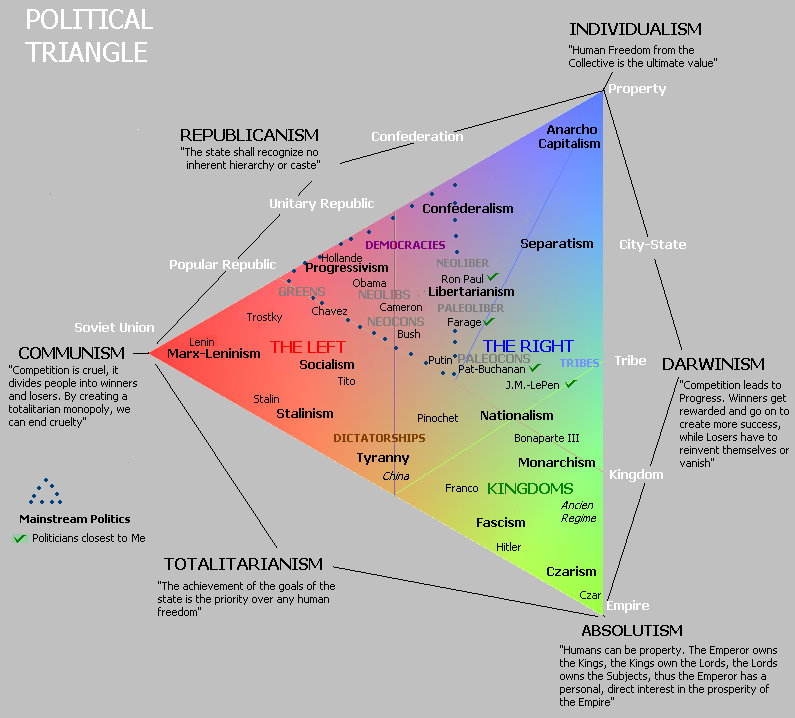
QotD: “That wasn’t real communism …”
Leftism has always been a ridiculously reductive creed, but the One Thing all Leftism reduces to has undergone a radical shift. For Marx, of course, the One Thing was that thesis-antithesis-synthesis Hegelian schmear. Hegel’s ontology claims that the universe is talking to itself. Literally. That thesis-antithesis-synthesis thing, summarized by the untranslatable German word Aufheben (“self-transcendence”; something like that), is literally a debate the World Spirit (or whatever) is having with itself.
All Karl Marx did was bring that down to the material level — it’s not the world spirit having a debate with itself, it’s the world, the material object. Both the debate and its conclusion are made manifest in History, capital-H, which is why Marx was one of a long line of gurus who claimed to make History into a hard science. That “wrong side of History” stuff the Left is always going on about? That’s why they use that phrase so much, and why it has such emotional resonance for them. If you’re a Dialectical Materialist, being against Socialism is like being against gravity. What could possibly be the point? You’re just being perverse, comrade, and on some level you must know that …
Alas, History isn’t a hard science. There are patterns, of course, any fool can see that, but those patterns are the intersection of human nature and emergent behavior. The proof is in the writings of Karl Marx himself — every prediction the man ever made was not just wrong, but ludicrously so, and after getting burned a few times he admitted in his letters to writing in such a way that he could never be “proven” wrong. See also: The complete history of the Soviet Union, 1917-1991, and as a side note, you can tell the intellectual caliber of Socialism’s defenders by the fact that they trot out the excuse “That wasn’t real Communism; real Communism has never been tried.” Ah, so Lenin — he of Marxism-Leninism — wasn’t a true Communist. They’ll shoot you for saying that in, say, China, but do please go on …
Severian, “Power”, Founding Questions, 2022-02-02.
Update, 8 October: Welcome, Instapundit readers! Please do have a look around at some of my other posts you may find of interest. I send out a daily summary of posts here through my Substack – https://substack.com/@nicholasrusson that you can subscribe to if you’d like to be informed of new posts in the future.
October 3, 2025
QotD: The role of the True Believer
Anon @Greynxgga69
Abolish The Family.
Abolish Religion.
Abolish Wage Labour.
Abolish Money.
Abolish Work.
Abolish Commodity Production.
Abolish the State.
Abolish Class.
Abolish Private Property.
Abolish the Nation.
Abolish Patriarchy.
Abolish Gender.
Abolish Town and Country.The True Believers imagine they will live in Utopia after the Revolution.
They will instead be sent to the gulag, or lined up against the wall and shot.
Why?
Because the function of the True Believer is to make the Revolution. And the purpose of the Revolution is to replace The Regime.
Once the Revolution is made, and The Regime has been replaced, no further Revolutions are wanted. Therefore the True Believer serves no purpose.
He is a liability, because he has been promised Utopia, and Utopia is hard, even perhaps impossible, to deliver. If he does not receive the promised Utopia, he is apt to make Revolution again.
The Regime does not want this. It does not wish to be replaced in the same fashion that it replaced The Regime. So the True Believer must be disposed of. He must be replaced with the Opportunist.
The Opportunist can be relied upon, because he does not want Utopia. He wants to have more than his comrades. So long as he receives more than his comrades, he will serve The Regime.
As above, so below.
As before, so after.
Meet the New Boss. Same as the Old Boss.
Devon Eriksen, The social media site formerly known as Twitter , 2025-07-01.
September 30, 2025
How Tyrants Rise — and How to Stop Them – W2W 46
TimeGhost History
Published 28 Sept 2025Tyrants don’t just appear overnight — they rise through propaganda, fear, and control. In this episode of War 2 War, we explore how authoritarian leaders consolidated power in the 20th century, from the ruins of World War Two to the opening battles of the Cold War. How do tyrants gain control, how can you recognize the warning signs, and what can societies do to resist them? Drawing on lessons from Hitler, Stalin, and beyond, we break down the patterns of dictatorship and what history can teach us about confronting them.
(more…)
September 27, 2025
QotD: Utopian revolution
One of the virtues of You Say You Want a Revolution is that it admits and illuminates, though it does not altogether explain, the failure of post-colonial regimes in Africa — even those that were established without much in the way of violent struggle. The first generation of post-colonial leaders were so taken by the prestige and perhaps by the glamour of revolution that they employed revolutionary rhetoric themselves, and sometimes went in for utopian schemes of their own. Julius Nyerere of Tanzania, for example (he is not mentioned in the book), was bitten by the bug of utopianism, caught in part from socialists at the University of Edinburgh, calling the sole permitted political party in Tanzania the Party of the Revolution. In the name of creating a just and equal society, he forcibly removed at least 70 per cent of the population from where it was living and herded it into collectivised villages. This was, all too predictably, an economic disaster, famine having been prevented only by large infusions of foreign aid, but it served the interests of members of the Party. Tanzania was saved from being much worse than it was by the fact that Nyerere, though perfectly capable of ruthlessness, was not personally a monster, and also by the peaceful nature of the Tanzania people themselves. Another saving grace was that there was no ethnic group that could have become dominant, so ethnic antagonism could not be added to the witches’ brew.
This illustrates a point that Professor Chirot makes clear in his discussion as to why the Vietnamese communist regime, though often brutal, never descended to anything like the level of horror of neighbouring Cambodia. Among the factors must surely have been the character and personality of the leaders as well as of the countries themselves. In other words, the fate of countries cannot be reduced, either in prospect or in retrospect, to an invariable formula. Human affairs will, to an extent, always be incalculable.
Still, some degree of regularity is possible. I was rather surprised that Professor Chirot overlooked one such. He writes the following of the corruption endemic under communist regimes: “a function of a deliberately exploitative, thieving elite that staved the general economy by its dishonesty than it was the essence of the system itself. Avoiding corruption was impossible because without it the society could not function.”
What is surprising here is that he does not mention why it could not function, but the answer seems to me perfectly obvious: it was because the communist system abolished the price system and substituted political decision-making in its place. This explanation is sufficient, for where there are no prices, and the economy is thereby largely demonetarised, goods and services can be distributed only by corruption. This is not to say that where there is a price system there will automatically be no corruption, obviously this is not the case; but such corruption will be limited by the very need for money to retain its value where such a price system exists. To that extent, it imposes at least a degree of honesty. The mystery of the Soviet Union or any other communist country is not why it produced so little, but why it produced anything at all: and here Professor Chirot is quite right. The answer is because of corruption: an “honest” communist state would produce nothing. It could not survive.
Theodore Dalrymple, “Longing for Revolution”, New English Review, 2020-05-13.
September 15, 2025
The Cold War in Latin America Begins: Coups, Communists, and Castro – W2W 44
TimeGhost History
Published 14 Sept 2025Spy rings, covert operations, coups, street violence, and sudden regime changes. This is the turmoil that awaits Latin America after the Second World War. As new ideas from the East gain momentum, the United States tries to hold on to its role as the region’s self-appointed guardian. Which side will ultimately shape the future of this rich and populous region?
(more…)
September 14, 2025
August 20, 2025
August 5, 2025
Origin of the China-Taiwan Conflict: Chinese Civil War 1945-1949
Real Time History
Published 21 Feb 2025With the Japanese surrender in September 1945, the Second World War comes to an end. But for China there won’t be peace right away because the nationalists under Chiang Kai-Shek and the communists under Mao Zedong still haven’t resolved their struggle and so the Chinese Civil War will flare up once again.
Chapters:
00:00 Japanese Surrender
03:44 Opposing Forces
07:33 KMT Offensives
12:18 CCP vs KMT Strategy
14.45 CCP Counterattack
19:19 Civilian Experience
23:23 CCP Huaihai Campaign
26:30 Final CCP Offensives
29:31 KMT Escape to Taiwan
31:59 Why did the Communists Win?
36:07 The United States and Taiwan
(more…)
August 1, 2025
When Stalin and Hitler Teamed Up – Prussia 1931 – Rise of Hitler 20, August 1931
World War Two
Published 31 Jul 2025August 1931: Prussia becomes the battleground as a bizarre alliance of Nazis, Communists (under Stalin’s orders), right-wing elites, and President Hindenburg tries to topple Germany’s last major democracy. With foreign meddling, political violence, and backroom deals, the fate of the Weimar Republic hangs by a thread. Against all odds, the democratic coalition prevails — at least for now. But with chaos spreading and the world watching, can democracy survive the next assault?
(more…)
July 8, 2025
June 7, 2025
QotD: The decline and fall of the Soviet experiment
One of the most remarkable and perhaps most relevant aspects of communism is how it regressed from an idealistic and inspirational world view to nothing more than a deeply flawed engineering project. Communism started out as a set of beliefs about liberating mankind to reach its full potential. It was not about material goods or political power, but human accomplishment. By the time the Soviet empire collapsed at the end of the 20th century, it was about making enough toilet paper and boots.
The early communists, including Marx, looked at work and the pursuit of material goods as a burden on mankind. Capitalism turned men into slaves to their own desires for wealth and property. This crude desire for material goods made them easy to exploit by the capital class. The point of overthrowing the capitalist system and replacing it with communism was to free man from that burden. The resulting material prosperity of communism would allow mankind to reach its full creative potential.
The Soviet empire that emerged from the Second World War was noticeably short on talk about mankind reaching its full potential. The practical necessity of feeding, housing and clothing its people consumed the regime. The great dream of a post-scarcity world of mankind united in brotherhood had given way to figuring out how to produce enough necessities to prevent rebellion. The last half of the 20th century was communism trying to keep pace with capitalism in the production of consumer goods.
The Z Man, “Human Progress”, The Z Blog, 2020-04-27.