Quotulatiousness

March 12, 2019

Genocide in the French Revolution – the Vendée from 1793 to 1795

Filed under: France, History, Military, Religion — Tags: , , , — Nicholas @ 05:00

In Quillette, Jaspreet Singh Boparai tells the long-suppressed story of the counter-revolution centred in the Vendée and the genocidal repression that followed:
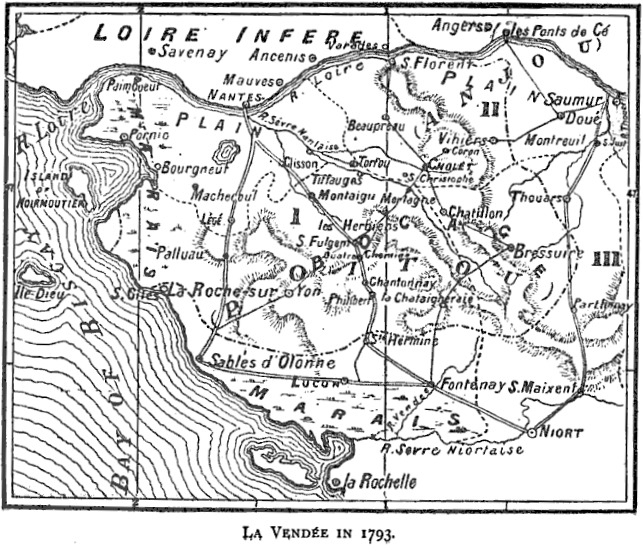
Map of the Vendée region of France in 1793. From page 123 of Francois-Severin Marceau (1769-1796) by Thomas George Johnson published in 1896 in London.
Via Wikimedia Commons.

On March 4 2011, the French historian Reynald Secher discovered documents in the National Archives in Paris confirming what he had known since the early 1980s: there had been a genocide during the French Revolution. Historians have always been aware of widespread resistance to the Revolution. But (with a few exceptions) they invariably characterize the rebellion in the Vendée (1793–95) as an abortive civil war rather than a genocide.

In 1986, Secher published his initial findings in Le Génocide franco-français, a lightly revised version of his doctoral dissertation. This book sold well, but destroyed any chance he might have had for a university career. Secher was slandered by journalists and tenured academics for daring to question the official version of events that had taken place two centuries earlier. The Revolution has become a sacred creation myth for at least some of the French; they do not take kindly to blasphemers.

[…]

The Vendée is a region in the west of France whose residents became renowned for their piety after Protestants were driven out of the area in the wake of King Louis XIV’s Edict of Fontainebleau (1685). Throughout the 18th century, the Vendée was, culturally, politically and economically, a backwater. The closest major city, Nantes, remains noted for its role in the slave trade.

Vendéens seem to have welcomed the French Revolution, at least initially. Everybody was annoyed with high levels of taxation. Even the pious were fed up with what they had to pay to the Church. The problem was not so much with the clergy as with parish assemblies (fabriques), which controlled parish finances. Vendéens had little quarrel with the local nobility, who as a rule stayed in the region and knew the peasantry well. Few of them spent any time in Paris, Versailles or even Nantes. The nobles too resented centralized administration.

The revolutionary government was determined to break the remaining power of the Catholic church, and seized most of the church properties, followed by a secularization of the church hierarchy in France which was intended to turn the priests and bishops into civil servants loyal to the French state rather than to the Pope in Rome. Resistance to this was particularly strong in Nantes and the surrounding region, which encouraged the revolutionary government to shut down all churches that did not conform to state directives. At the same time, the government introduced conscription, which was even more fiercely opposed in the Vendée and triggered armed conflict.

The rebels’ volunteer army numbered between 25,000–40,000 peasants whose main fighting experience consisted of drunken brawls in village taverns. They had no uniforms; most wore “sabots” (wooden clogs) instead of boots. Yet they consistently managed to beat back well-armed, experienced professional soldiers. A few had hunting rifles and were excellent shots; but the vast majority were armed with pitchforks, shovels and hoes. When the Revolutionary forces retreated, the rebels went back home to attend to their farms so that their families would not starve.

Revolutionary generals did not expect them to fight so fiercely. Of course, the rebels had no reinforcements behind them, and they knew that if they did not repel the Revolutionaries their homes would be destroyed, and their families butchered. The Vendéens were not paid for their fighting. Their main rewards for winning a battle was not being slaughtered for a little while longer. Under the circumstances, their discipline was outstanding, as even the Revolutionary generals admitted.

But the resources of the rebels were few, and casualties could not be replaced, unlike the government’s forces, so the tide eventually turned against the outnumbered rebels.

It became customary to drown brigands naked, not merely so that the Revolutionaries could help themselves to the Vendéens’ clothes, but also so that the younger women among them could be raped before death. Drownings spread far beyond Nantes: on 16th December, General Marceau sent a letter to the Revolutionary Minister of War triumphantly announcing, among other victories, that at least 3,000 non-combatant Vendéen women had been drowned at Pont-au-Baux.

The Revolutionaries were drunk with blood, and could not slaughter their brigand prisoners fast enough — women, children, old people, priests, the sick, the infirm. If the prisoners could not walk fast enough to the killing grounds, they were bayoneted in the stomach and left on the ground to be trampled by other prisoners as they bled to death.

General Westermann, one of the Revolution’s most celebrated soldiers, noted with satisfaction that he arrived at Laval on December 14 with his cavalry to see piles of cadavers — thousands of them — heaped up on either side of the road. The bodies were not counted; they were simply dumped after the soldiers had a chance of strip them of any valuables (mainly clothes).

The final death toll could only be an educated guess:

Reynald Secher estimates that just over 117,000 Vendéens disappeared as a result of the brigands’ rebellion, out of a population of just over 815,000. This amounts to roughly one in seven Vendéens fatally affected by military actions and the Crusade for Liberty. Though some areas lost half their population or more, with notably heavy losses at Cholet, which lost three fifths of its houses as well as the same proportion of its people. Colleges, libraries and schools were destroyed as well as churches, private houses, farms, workshops and places of business. The Vendée lost 18 percent of its private houses; a quarter of the communes in Deux-Sèvres saw the destruction of 50 percent or more of all habitable buildings. Other consequences of the Crusade for Liberty included a widespread epidemic of venereal disease.

March 10, 2019

Irish Potato Famine – The American Wake – Extra History – #4

Filed under: Britain, Cancon, Food, History, Religion, USA — Tags: , , , , , — Nicholas @ 06:00

Extra Credits
Published on 9 Mar 2019

Not all of the 214,000 Irish immigrants in 1847 made it safely to their new homes — and of those who did, many faced classism and xenophobia and even bullying from the “Ulster Irish” or “Scots-Irish” folks who had previously established themselves. In New York City specifically, the Five Points neighborhood became an infamous center of conflict — while local Irish-American John Joseph Hughes became instrumental in restoring Irish Catholicism.

Join us on Patreon! http://bit.ly/EHPatreon

March 6, 2019

QotD: Teaching evolution in the “Bible Belt”

Filed under: Africa, Education, History, Quotations, Religion, Science, USA — Tags: , , , — Nicholas @ 01:00

I teach college in a small city in Arkansas, deep in the American Bible Belt. I am a historian of Africa and in my department that means that I also teach a world history survey. I always start with the expansion of modern humans out of Africa and their encounter with other types of humans: Neanderthals, Homo erectus, Denesovians and what seems like an ever-growing list of newly discovered human-like creatures. It’s less the case now, but when I started twenty years ago this part of the course was initially met with polite but firm resistance, which gradually gave way to a sort of furtive curiosity. I eventually realized that even my cleverest students knew very little about human evolution except that it was false and that they were supposed to reject it. They came to the university having been taught that evolution was part of a larger attack on their faith and values, but they had never really been exposed to anything but a sort of parody version of it. A small number of them accepted evolutionary theory, but being a Darwinian in rural Arkansas was usually more about youthful rebellion and non-conformity than it was about informed, rational consideration of evidence.

Once we got past the denunciation or acceptance of evolutionary theory as a form of tribal affiliation, I found students to be deeply curious about it. It was such a taboo subject that their high school teachers had only skimmed over it and often with some careful personal distancing from the material. So the opportunity to delve into the details of this forbidden knowledge was intellectually thrilling for them. Despite the excitement engendered by the topic only a few changed their minds; most did not.

My students had grown up in communities where evolutionary theory was so wrong, so contrary to the accepted worldview of all decent people, that the only acceptable way to talk about it was to denounce it or reject it. The result was that most of my students rejected evolution, but getting a chance to learn about it was profoundly exciting, even if most of them were too conformist (these were Honors students after all) to change their positions.

Erik Gilbert, “Liberal Orthodoxy and the New Heresy”, Quillette, 2019-02-04.

February 28, 2019

First Crusade Part 2 of 2

Filed under: Europe, History, Middle East, Military, Religion — Tags: , , , , , — Nicholas @ 02:00

Epic History TV
Published on 31 Mar 2017

Part 2 of Epic History TV’s story of the First Crusade continues with the Siege of Antioch. The Crusaders endure immense hardships outside the city walls, but finally take Antioch thanks to a ruse by Bohemond of Taranto. Against the odds, and inspired by their recent discovery of a relic believed to be the ‘Holy Lance’, the Crusaders then defeat the Seljuk army of Kur Burgha. After disagreements within the Crusader camp, the army finally moves on to Jerusalem in the spring of 1099. During a full-scale assault of the city walls, Godfrey of Bouillon’s troops gain a foothold in the defences, and Crusader troops pour into the city. A bloodbath follows. Victory results in the creation of four Crusader states, but their existence is precarious, surrounded by hostile Muslim powers, who will one day return with a vengeance.

Produced in partnership with Osprey Publishing
https://ospreypublishing.com/

Campaign: The First Crusade 1096–99
https://ospreypublishing.com/the-firs…

Essential Histories: The Crusades
https://ospreypublishing.com/the-crus…

The Armies of Islam 7th–11th Centuries
https://ospreypublishing.com/the-armi…

Armies of the Crusades
https://ospreypublishing.com/armies-o…

Music with thanks to Filmstro: https://www.filmstro.com/
Get 20% off an annual license! Use our exclusive coupon code: EPICHISTORYTV_ANN

Image credits – via Flickr under Creative Commons CC-BY-SA 2.0
Sky – Anyul Rivas
Wooded Hills – Alexander Annenkov
Dramatic Fields – Antonio Caiazzo
Twin peaks of Mount Ararat – Adam Jones

Please help me make more videos at Patreon: https://www.patreon.com/EpicHistoryTV

February 27, 2019

First Crusade Part 1 of 2

Filed under: Europe, History, Middle East, Military, Religion — Tags: , , , , — Nicholas @ 02:00

Epic History TV
Published on 13 Jan 2017

The First Crusade was one of the most extraordinary, bloody and significant episodes in medieval history. It began with an appeal for aid from the Christian Byzantine Empire, threatened by the rising power of the Muslim Seljuk Turks. But when Pope Urban II preached a sermon at Clermont in 1095, the result was unlike anything ever seen before. The Pope offered spiritual salvation to those willing to go east to aid their fellow Christians in a holy war, and help liberate Jerusalem from Muslim rule. Knights and peasants alike signed up in their thousands, leading to the disastrous People’s, or Peasants’, Crusade, then to a much more organised and powerful Princes’ Crusade. Their forces gathered at Constantinople, where they made an uneasy alliance with Byzantine Emperor Alexius I Comnenus. Entering Anatolia, they helped to win back the city of Nicaea, then won a decisive but hard-fought victory at Dorlyaeum, before marching on the great city of Antioch…

Produced in partnership with Osprey Publishing
https://ospreypublishing.com/

Campaign: The First Crusade 1096–99
https://ospreypublishing.com/the-firs…

Essential Histories: The Crusades
https://ospreypublishing.com/the-crus…

The Armies of Islam 7th–11th Centuries
https://ospreypublishing.com/the-armi…

Armies of the Crusades
https://ospreypublishing.com/armies-o…

Music with thanks to Filmstro: https://www.filmstro.com/
Get 20% off an annual license! Use our exclusive coupon code: EPICHISTORYTV_ANN

Image credits – via Flickr under Creative Commons CC-BY-SA 2.0
Sky – Anyul Rivas
Wooded Hills – Alexander Annenkov
Dramatic Fields – Antonio Caiazzo
Twin peaks of Mount Ararat – Adam Jones

Please help me make more videos at Patreon: https://www.patreon.com/EpicHistoryTV

February 7, 2019

Lord of the Rings – The Return of the King – Extra Sci Fi – #3

Filed under: Books, Media, Religion — Tags: , , — Nicholas @ 04:00

Extra Credits
Published on 5 Feb 2019

Tolkien lived in a dark time in history, but he believed not only in having hope, but in sacrifice as a means to redemption, which is why we get such a satisfyingly bittersweet ending in the Lord of the Rings.

January 25, 2019

The Greco-Turkish War and Legalisation of Ethnic Cleaning | Between 2 Wars | 1922 Part 2 of 2

TimeGhost History
Published on 24 Jan 2019

When the Ottoman empire is torn apart by the Treaty of Sevres, ethnic conflicts in the old empire that have been boiling for almost a century lead to war between Greece and the parts of the Empire that will soon become the Republic of Turkey. A war that will have lasting effect on the world as both sides proceed to carry out stunning actions of ethnic violence, which is shockingly also sanctioned by international treaty after the fact.

Special thanks to Jonas Yazo Srouji and Valantis Athanasiou, who helped us with the research and image research for this episode. This behemoth of an episode is with 27 minutes the longest Between Two Wars episode yet. We really wanted to do the events justice. To deliver an unbiased, full telling of this eventful and controversial part of history, we couldn’t and didn’t want to make it any shorter.

An important note about the difference between ‘nationality’ and ‘ethnicity’: While ‘nationality’ is merely the relationship between an individual person and a state, someones ‘ethnicity’ depends on the racial, cultural, or religious group that a person is part of or identifies with. While these can overlap, they don’t necessarily have to.

Extra note: we recorded this way back in 2018, when our sound was not optimized. We apologise for the varying audio quality.

Cheers, Joram.

Join us on Patreon: https://www.patreon.com/TimeGhostHistory

Hosted by: Indy Neidell
Directed by: Spartacus Olsson
Written by: Spartacus Olsson
Produced by: Astrid Deinhard
Executive Producers: Bodo Rittenauer, Astrid Deinhard, Indy Neidell, Spartacus Olsson
Creative Producer: Joram Appel
Edited by: Wieke Kapteijns
Research by: Spartacus Olsson and Jonas Yazo Srouji and Valantis Athanasiou.

Thumbnail depicts Ataturk colorised by Olga Shirnina aka Klimbim.

Colorized Pictures by Olga Shirnina and Norman Stewart

Olga’s pictures: https://klimbim2014.wordpress.com
Norman’s pictures https://oldtimesincolor.blogspot.com/

Video Archive by Screenocean/Reuters http://www.screenocean.com

A TimeGhost chronological documentary produced by OnLion Entertainment GmbH

December 23, 2018

Repost – “Merry Christmas” versus “Happy Holidays” versus “Happy Midwinter Break”

L. Neil Smith on the joy-sucking use of terms like “Happy Midwinter Break” to avoid antagonizing the non-religious among us at this time of year:

Conservatives have long whimpered about corporate and government policies forbidding employees who make contact with the public to wish said members “Merry Christmas!” at the appropriate time of the year, out of a moronic and purely irrational fear of offending members of the public who don’t happen to be Christian, but are Jewish, Muslim, Hindu, Buddhist, Sikh, Jain, Rastafarian, Ba’hai, Cthuluites, Wiccans, worshippers of the Flying Spaghetti Monster, or None of the Above. The politically correct benediction, these employees are instructed, is “Happy Holidays”.

Feh.

As a lifelong atheist, I never take “Merry Christmas” as anything but a cheerful and sincere desire to share the spirit of the happiest time of the year. I enjoy Christmas as the ultimate capitalist celebration. It’s a multiple-usage occasion and has been so since the dawn of history. I wish them “Merry Christmas” right back, and I mean it.

Unless I wish them a “Happy Zagmuk”, sharing the oldest midwinter festival in our culture I can find any trace of. It’s Babylonian, and celebrates the victory of the god-king Marduk over the forces of Chaos.

But as anybody with the merest understanding of history and human nature could have predicted, if you give the Political Correctness Zombies (Good King Marduk needs to get back to work again) an Angstrom unit, they’ll demand a parsec. It now appears that for the past couple of years, as soon as the Merry Christmases and Happy Holidayses start getting slung around, a certain professor (not of Liberal Arts, so he should know better) at a nearby university (to remain unnamed) sends out what he hopes are intimidating e-mails, scolding careless well-wishers, and asserting that these are not holidays (“holy days”) to everyone, and that the only politically acceptable greeting is “Happy Midwinter Break”. He signs this exercise in stupidity “A Jewish Faculty Member”.

Double feh.

Two responses come immediately to mind, both of them derived from good, basic Anglo-Saxon, which is not originally a Christian language. As soon as the almost overwhelming temptation to use them has been successfully resisted, there are some other matters for profound consideration…

December 21, 2018

Why do we celebrate Christmas in December?

Filed under: Europe, Food, History, Religion — Tags: , , , — Nicholas @ 03:00

The obvious answer is quite wrong: December 25th isn’t actually the birth date of Jesus … we don’t know when he was born (rather like the Queen’s Official Birthday, it’s been set to a particular date rather than tracking the actual natal day of the current monarch). So why did we end up with a fixed date in December? Tim Worstall explains:

… if you’re sitting in the middle of a culture that has a religious holiday that sends all children into a frenzy, you’re not part of that dominant religion, then you’d better come up with something quick. Don’t and you’ll find your hold on the minds – thus future religion of – the children loosening. Thus Hanukkah’s elevation in the holiday, if not liturgical, calendar. Thus, also, obviously the invention of Kwanzaa by those who would very much prefer not to be part of that dominant culture but were rather geographically stuck with it.

But then that’s why Jesus wasn’t born at Christmas too. We have absolutely no evidence at all that he turned up even one winter night let alone on Dec 25. What the Catholic Church in Europe did have – and at the relevant time there really only was the Catholic Church – was this inconvenient fact of a massive winter feast, what we might call Yuletide. This was very definitely pre-Christian and was sorta determined by climate.

You’re in Europe, you’re doing subsistence or at least peasant farming, this means you’ve not got enough fodder to keep all the animals going until the spring. Thus you slaughter near all – pigs not so much as they eat scraps, can forage for themselves etc – except your breeding stock. This gives you lots and lots of fresh meat and few good methods of meat preservation. This is also the last fresh meat you’re going to get until those spring lambs are ready in, say, April. So, you gorge on all that fresh meat.

Also, it’s cold outside, the days are short, why the heck not stay in by the fire while you burp through it all? Hey, bring the family ’round! And Pops, didn’t you get that beer going earlier in the year? OK, no hops, so ale. But mead maybe. Wine in many areas would be just about drinkable by now from that autumn crop.

This had been going on perhaps 6,000 years by the time those Christians turned up. The Church really needed to impose its views and authority on all of this, seriously, we can’t have the peasants continuing to celebrate the Old Gods, can we? Thus the invention of Christmas, a time for celebration, that called for lots of feasting of a happy event just about the time when everyone would be feasting anyway.

This is also the explanation for Halloween, All Hallows Eve. Or, All Souls Day followed By All Saints Day to replace the Celtic Samhaim. Hell, the oiks are going to be celebrating anyway, better make it a Church celebration.

Thus Hanukkah, thus Kwanzaa and thus whatever the next religion will come up with assuming that it’s one that initially grows in a European influenced culture. Even, perhaps any Northern Hemisphere, or northerly part of it, influenced one. Islam’s going to have a problem as it uses the lunar calendar and so no fixed feast will work, it’ll precess though the calendar and miss the yearly meeting with midwinter.

Hanukkah’s a big thing for the same reason Jesus wasn’t born at Christmas. At which point you’re expecting me to say Happy Holidays, aren’t you? Bah, Humbug!

December 19, 2018

Krampus – Christmas Demon – Extra Mythology

Filed under: Germany, History, Religion, USA — Tags: , , , , — Nicholas @ 04:00

Extra Credits
Published on 17 Dec 2018

Join the Patreon community! http://bit.ly/EMPatreon

Krampus’s name is growing popular in the United States, but most of us don’t really know what he does OR that he is partners with St. Nicholas himself. He is in fact just one of many Christmas demons…

December 12, 2018

QotD: G.K. Chesterton’s political Catholicism

Ten or twenty years ago, the form of nationalism most closely corresponding to Communism today was political Catholicism. Its most outstanding exponent — though he was perhaps an extreme case rather than a typical one — was G. K. Chesterton. Chesterton was a writer of considerable talent who whose to suppress both his sensibilities and his intellectual honesty in the cause of Roman Catholic propaganda. During the last twenty years or so of his life, his entire output was in reality an endless repetition of the same thing, under its laboured cleverness as simple and boring as ‘Great is Diana of the Ephesians.’ Every book that he wrote, every scrap of dialogue, had to demonstrate beyond the possibility of mistake the superiority of the Catholic over the Protestant or the pagan. But Chesterton was not content to think of this superiority as merely intellectual or spiritual: it had to be translated into terms of national prestige and military power, which entailed an ignorant idealisation of the Latin countries, especially France. Chesterton had not lived long in France, and his picture of it — as a land of Catholic peasants incessantly singing the Marseillaise over glasses of red wine — had about as much relation to reality as Chu Chin Chow has to everyday life in Baghdad. And with this went not only an enormous overestimation of French military power (both before and after 1914-18 he maintained that France, by itself, was stronger than Germany), but a silly and vulgar glorification of the actual process of war. Chesterton’s battle poems, such as Lepanto or The Ballad of Saint Barbara, make The Charge of the Light Brigade read like a pacifist tract: they are perhaps the most tawdry bits of bombast to be found in our language. The interesting thing is that had the romantic rubbish which he habitually wrote about France and the French army been written by somebody else about Britain and the British army, he would have been the first to jeer. In home politics he was a Little Englander, a true hater of jingoism and imperialism, and according to his lights a true friend of democracy. Yet when he looked outwards into the international field, he could forsake his principles without even noticing he was doing so. Thus, his almost mystical belief in the virtues of democracy did not prevent him from admiring Mussolini. Mussolini had destroyed the representative government and the freedom of the press for which Chesterton had struggled so hard at home, but Mussolini was an Italian and had made Italy strong, and that settled the matter. Nor did Chesterton ever find a word to say about imperialism and the conquest of coloured races when they were practised by Italians or Frenchmen. His hold on reality, his literary taste, and even to some extent his moral sense, were dislocated as soon as his nationalistic loyalties were involved.

Obviously there are considerable resemblances between political Catholicism, as exemplified by Chesterton, and Communism. So there are between either of these and for instance Scottish nationalism, Zionism, Antisemitism or Trotskyism. It would be an oversimplification to say that all forms of nationalism are the same, even in their mental atmosphere, but there are certain rules that hold good in all cases.

George Orwell, “Notes on Nationalism”, Polemic, 1945-05.

December 11, 2018

Why the Byzantine Empire Never Existed

Filed under: Europe, History, Middle East, Religion — Tags: , , — Nicholas @ 02:00

KhAnubis
Published on 12 Aug 2018

We frequently talk about the Eastern Roman Empire as if it were some separate empire from the Roman Empire, when in fact, in a lot of ways, the Roman and Byzantine Empires were really the same empire.

December 3, 2018

Viking Expansion – Wine Land – Extra History – #6

Filed under: Americas, Europe, History, Religion — Tags: , , , , — Nicholas @ 04:00

Extra Credits
Published on 1 Dec 2018

From Greenland, explorers like Bjarni, Freydis, and Leif Erikson — aka “Leif the Lucky” — ventured into Vinland, the very first bit of North America sighted by Europeans. It was rich in natural resources, including the grapes (and thus wine) for which it received its title, but this set of expeditions would be very, very short-lived…

Join us on Patreon! http://bit.ly/EHPatreon

November 19, 2018

Viking Expansion – The Lands of the Rus – Extra History – #4

Filed under: Europe, History, Middle East, Religion, Russia — Tags: , , , , — Nicholas @ 04:00

Extra Credits
Published on 17 Nov 2018

The Rus Vikings headed further inland into eastern Europe, raiding Constantinople (unsuccessfully) at first, and then eventually falling into negotiations with the Byzantines and changing their own culture over time. One of their most famous descending rulers was Olga of Kiev, who was also the grandmother of Vladimir.

Join us on Patreon! http://bit.ly/EHPatreon

November 13, 2018

General Sir Charles Napier lived in vain

Filed under: Asia, Britain, Law, Liberty, Religion — Tags: , , , — Nicholas @ 03:00

Douglas Murray on the Asia Bibi case:

All of this is to say that the latest news from the U.K. is both thoroughly predictable and deeply disturbing. Readers of National Review will be familiar with the case of Asia Bibi. She is the Christian woman from Pakistan who has been in prison on death row for the last eight years. Her “crime” is that a neighbor accused her of “blasphemy.” […]

Her case has had ramifications throughout Pakistani society in the years since. For instance, it provoked the statement by the brave governor of Punjab, Salman Taseer, which led to his own murder by one of his own bodyguards. In the days since her release from jail, there have been mass protests in Pakistan where thousands of enraged fanatics have called, literally, for Asia Bibi’s head. The case has amply demonstrated the type of country that Pakistan is these days. But who would have guessed that her case would also throw so much light on the type of country Britain now is?

There are clearly international efforts underway to get Bibi out of Pakistan. If anybody in the world deserves asylum it is her. And any civilized country should be queuing up to give asylum to her and her family. Among those reported to have done so is the Netherlands.

But today there are reports that the British government has said that it will not offer asylum to Asia Bibi. The reason being “security concerns” — that weasel term now used by all officialdom whenever it needs one last reason to avoid doing the right thing. According to this report, the government is concerned that if the U.K. offered asylum to Bibi it could cause “unrest among certain sections of the community.” And which sections would that be? Would it be Anglicans or atheists who would be furious that an impoverished and severely traumatized woman should be given shelter in their country? Of course not. The “community” that the British government will be scared of is the community that comes from the same country that has tortured Asia Bibi for the last eight years.

So what’s the tie-in with General Sir Charles Napier? He was the governor of Sindh from 1843 to 1847. During his time in that office, he had opportunity to challenge certain long-established barbaric cultural practices:

Napier opposed suttee, or sati. This was the custom of burning a widow alive on the funeral pyre of her husband. Sati was rare in Sindh during the time Napier stayed in this region. Napier judged that the immolation was motivated by profits for the priests, and when told of an actual Sati about to take place, he informed those involved that he would stop the sacrifice. The priests complained to him that this was a customary religious rite, and that customs of a nation should be respected. As recounted by his brother William, he replied:

    “Be it so. This burning of widows is your custom; prepare the funeral pile. But my nation has also a custom. When men burn women alive we hang them, and confiscate all their property. My carpenters shall therefore erect gibbets on which to hang all concerned when the widow is consumed. Let us all act according to national customs.”

Britain could use another General Napier.

« Newer PostsOlder Posts »

Powered by WordPress