Quotulatiousness

June 18, 2019

QotD: The birth of Jesus and the open concept house

Filed under: Architecture, Economics, History, Middle East, Quotations, Religion — Tags: , , , — Nicholas @ 01:00

Jesus was not born in a stable. That’s not to say the birth wasn’t attended by farm animals — the Gospel of Luke tells us twice the baby’s first bed was a feeding trough — but rather that the animals lived in the house.

Peasant homes in first century Bethlehem were designed with what we would today call an “open concept.” They typically had one large room with the nicer living space in an open loft or on the roof, while the main floor area was where the family’s animals would be brought for safekeeping at night. The guestroom that was unavailable to Jesus, Mary, and Joseph was that loft or roof space, and the big room where they stayed instead served as the kitchen, living room, dining room, and farmyard all at once. The defining feature of Jesus’ birthplace was not isolation, as we often tend to think, but an utter lack of privacy: Mary delivered in a crowded farmhouse with few, if any, interior walls.

And that was perfectly normal, if not exactly desirable, for our modern fixation on the open floor plan is a historical anomaly. It flies in the face of literally millennia of consensus that more rooms is better, and it is a dreadful mistake. The last 70 years of open concept construction and remodeling has left us with dysfunctional houses, homes that are less conducive to hospitality, less energy efficient, and more given to mess.

Bonnie Kristian, “Open concept homes are for peasants”, The Week, 2019-05-12.

June 17, 2019

100 Years War

Filed under: Britain, France, History, Military, Religion — Tags: , , , — Nicholas @ 02:00

Ryan Reeves
Published on 2 Jul 2014

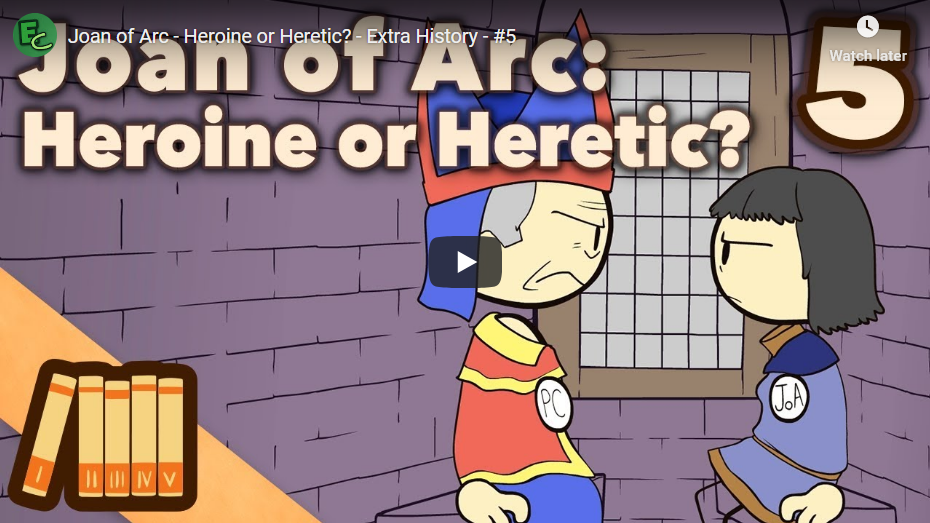
The 100 Years War between France and England lasted more than 100 years and was not one war but many. We explore Henry V and other important kings, and finish by exploring Joan of Arc as the savior of France.

Ryan M. Reeves (PhD Cambridge) is Assistant Professor of Historical Theology at Gordon-Conwell Theological Seminary.
Twitter: https://twitter.com/RyanMReeves

Website: http://www.gordonconwell.edu/academic…

For the entire course on ‘Church History: Reformation to Modern’, see the playlist: https://www.youtube.com/playlist?list…

May 20, 2019

A Guide to Dark Age British Politics

Filed under: Britain, History, Religion — Tags: , , , , — Nicholas @ 02:00

History With Hilbert
Published on 26 Sep 2017

A beginner’s guide to the politics of Dark Age Britain, from the southern Celts to the Anglo-Saxon kingdoms and the Pictish north.

Patreon: https://www.patreon.com/HistorywithHi…

May 19, 2019

Siege of Vienna & Queen Nzinga – Lies – Extra History

Filed under: Africa, Europe, History, Religion — Tags: , , , , , , — Nicholas @ 06:00

Extra Credits
Published on 18 May 2019

Writer Rob Rath talks about all the cool stories and facts we didn’t get to cover in our two special short series on the Siege of Vienna, and the life of Queen Nzinga.
Join us on Patreon! http://bit.ly/EHPatreon

From the comments:

Extra Credits
Timestamps:
2:00 – Demonetization sucks. THANK YOU PATRONS!
7:15 – Istanbul was Constantinople now it’s Istanbul not Constantinople been a long time gone oh Constantinople
11:07 – the arrival of the Winged Hussars wasn’t exactly the same as Rohan answering Gondor’s call for aid
16:20 – Nzinga’s controversial role in slavery
19:25 – what’s next on Extra History?
21:02 – SIX DEGREES OF WALPOLE

Recommended reading:
The Enemy at the Gate: Habsburgs, Ottomans, and the Battle for Europe by Andrew Wheatcroft
The Siege of Vienna: The Last Great Trial Between Cross & Crescent by John Stoye
Hispanics and the Civil War: From Battlefield to Homefront by the National Park Service

Music videos:
Queen Nzinga: https://www.youtube.com/watch?v=N94H6F0WObc

Siege of Vienna: https://www.youtube.com/watch?v=jQ_HV57cgbg

May 16, 2019

Remembering Monte Cassino … and Wojtek the Bear, a Polish war hero

Filed under: Architecture, Europe, Germany, History, Italy, Military, WW2 — Tags: , , , — Nicholas @ 05:00

At the Daily Chrenk, Arthur Chrenkoff remembers the Polish soldiers who finally took Monte Cassino from the Germans in 1944, after earlier allied attempts by soldiers of many other nations (including Canada) had failed:

The ruins of the abbey at Monte Cassino after the 1944 battle.
Photograph credited to “Wittke” in the German Federal Archive (Bundesarchiv) via Wikimedia Commons.

On May 18, the day Australia goes to the polls, on the other side of the world we will be commemorating the 75th anniversary of the end of the bloodiest and hardest fought battle of the Italian campaign if not the whole of the Western front of WW2. On that day, a patrol from the 12th Podolian Cavalry Regiment raised the Polish flag above the ruins of the Benedictine monastery on top of Monte Cassino, bringing to an end four months and four Allied offensives against the heavily fortified Gustav (or Winter) Line, manned by crack German divisions across the entire width of the Italian boot about 100 miles south of Rome. Some of the German troops, veterans of the Eastern front, thought the fighting was worse than at Stalingrad. Others, on the Allied side, compared the conditions to Verdun. Unlike Russian cities or French fields, most of the fighting around Monte Cassino took place over an unimaginably difficult terrain of steep mountain slopes, deep valleys, wild rivers and landscape stripped bare by the artillery. It was a truly world battle in a world war: pitted against the Wehrmacht were the units from Great Britain, including British India and Rhodesia, the United States, France and its north African colonies like Morocco, Canada, Australia, New Zealand, including Maori troops, South Africa, Italy and Poland. Since the start of the Allied offensive in January 1944, waves after waves of troops of the 5th US and the 8th British armies smashed themselves against the rocks, unable to dislodge the well dug-in Germans. Finally, the fourth battle code-named Operation Diadem, which commenced with a massive bombardment on May 16, threw the British 13th Army Corp and the 2nd Polish Corp against the very linchpin of the Gustav Line at Monte Cassino and its monastery. Two days later it was over.

[…]

Churchill, right from the time of the Gallipoli disaster, remained obsessed about the vulnerability of the continental powers – primarily Germany – through what he called “the soft underbelly of Europe”. The war records are full of his harebrained schemes to attack the Axis through Italy, the Balkans or Greece and knock them out of the fight by a sharp thrust into the Central Europe. This was to be a masterstroke in place of the Normandy invasion, which Churchill strenuously opposed, and later in addition to it, to draw some of the German troops away from the northern France and indeed to get to Austria and southern Germany before the Red Army.

The problem with the soft underbelly of Europe is that it’s anything but. In fact it’s the hardest part of Europe; all rock, no roll. It’s mountains and deep valleys, fast rivers and vast forests, rudimentary roads and virtually no useful infrastructure. Unlike the northern European plains, this is the defender’s country where the Allies lost all the advantage of their numbers, their maneuverability and their armour. The two years of arduous slogfest from the southern Sicily to the Emilia-Romagna in the north might have indeed drawn valuable German troops from the other theaters of war but it was a bloody dead end. Poles were still stuck taking Bologna in April 1945, while only days later the patrols from Patton’s 3rd US Army were reaching the outskirts of Prague.

And Wojtek?

Monte Cassino is on my mind today, because entirely coincidentally I’m reading a delightful war book (that’s an oxymoron if there is one) titled Wojtek the Bear: Polish War Hero. It tells the surreal but entirely true story of a bear cub adopted by the Polish troops in northern Iran in 1942, towards the start of their anabasis from Stalin’s Siberia all the way to Italy and eventually Scotland. Accompanying the Poles through all their service in the Middle East and then southern Europe, Wojtek grew up to be a 6-foot, 500-pound ursine, who always thought he was a human. Quintessentially Polish (if only by adoption), he loved beer and cigarettes (he also ate them, but only if lit), taking showers with the troops and riding shotgun in army trucks. Some of his war-time exploits included capturing an Arab spy in Iraq and stealing underwear from a female support unit. But Wojtek truly became a legend during the battle of Monte Cassino, when to his comrades’ amazement he volunteered to carry ammunition in his paws. He was eventually made a Private in the Polish Army, and lived until 1963, continuing to win hearts in Scotland, where the Polish troops were repatriated after the war.

May 6, 2019

Queen Nzinga – The Double Queen – Extra History – #2

Filed under: Africa, History, Military, Religion — Tags: , , , — Nicholas @ 06:00

Extra Credits
Published on 4 May 2019

Nzinga was briefly, temporarily supplanted by Ngola Hari who had been installed by the Portuguese, but she was determined to let nothing get in the way of keeping West Africa safe from colonial powers. To achieve this end, she would go on to form — and break, as she pleased — alliances with the Dutch, the Imbangala, and even the Catholic Church!

Thanks again to Cassandra Khaw for guest-writing this mini-series!

Join us on Patreon! http://bit.ly/EHPatreon

From the comments:

Extra Credits
Queen Nzinga is a woman who, despite being one of the best-documented rulers in early modern Africa, still presents a puzzle. Her record, from ambitious noble, to guerrilla fighter, to consummate diplomat and religious reformer is still haunted by myths conjured up by her enemies — and a few constructed by Nzinga herself.

Catch our Lies episode next week for behind-the-scenes on our research for the Siege of Vienna and Queen Nzinga series!

April 28, 2019

The Battle of Lützen – 1632 – The 30 Years War (in Swedish, with English sub-titles)

Gripen
Published on 3 Dec 2015

One of the bloodiest battles of the Thirty Years War. Sweden vs. the Holy Roman Empire. A mass grave has been found, with the victims from the battle. Are they Swedish/Finnish soldiers or German mercenaries?

(This Swedish documentary has English subtitles).

From the comments:

Blah b
2 years ago
This documentary is often painful to watch, the way inexperienced modern people with no sense of empathy project their values onto those times. They weren’t “defenseless men standing still”. Armies had learned the hard way that massed musket fire won battles. If everybody is looking for cover and looking out for themselves, you can never operate such rigid units.

So the individual soldier was harshly drilled to indeed stand still even with cannonballs tearing through his unit, or another unit standing 30-80 meters away. Because if individuals acted as individuals, the battle would be lost and the army would be destroyed.

But when that machine operated, it would win battles. The system invented by Maurice of the Netherlands ensured that if you were attacking a group of musketeers, every 20-25 seconds, they could deliver a crushing volley that can kill or injure 10-25% of a another unit, that means they only needed 2-3 salvos to achieve a local victory. Untrained units would literally never touch a musketeer, as his unit would’ve routed the attackers before they got within touching range.

Also there were no standing armies, there was no national identity as such. Mercenaries were totally acceptable. Mercenaries could become very loyal and reliable if paid on time [and] consistently, and would easily crush national armies that usually lacked the routine of professional soldiers. Loyalty and your identity was constructed differently. It would’ve been perfectly normal for me to utterly hate and maybe kill my neighbours if they were of a different religion. Otherwise, a Swedish protestant from far away was an ally with the right ideas. I wouldn’t have been able to understand him and everything would be alien about him, but I’d consider him a friend, and Catholics from the next village where I’d lived all my life would be enemies.

Unless the king comes around and says the Catholics are friends. Because the king is appointed by God who runs the world on a day to day [basis], and you obey without question. If the king says it’s so, that means God himself agrees and says it’s so, and you don’t question God. Loyalty until death is about the least you owed your king in those days.

People who can’t understand how such things worked historically, really should not be making documentaries…

April 23, 2019

David Warren’s musings on the Notre-Dame de Paris fire

Filed under: Architecture, France, Media, Religion — Tags: , , — Nicholas @ 05:00

There have been other incidents since the fire, most pressingly the horrific bombing attacks on Easter Sunday in Sri Lanka, but David Warren would still like us to remember what happened a week ago in Paris:

A week has passed since the fire in, or on, Notre Dame de Paris; let me be the last to comment on a story that is stale-dated by any meejah standard. It dominated international mindwaves for only two days, but left images that viewers may be able to recall many decades from now.

“The church is on fire,” is a commonplace thought, when a church is visibly on fire, and I who am commonplace was thinking that while turning to the news. As an old meejah hack, who happens to know a little about Gothic architecture, I was prepared to discount the “fake news” that would be disseminated in “live time.” For instance, when told that the roof had collapsed, with strong hints that the building was now a write-off, I reflected that the roof is a hat, only. Stone vaulting lies underneath it, except the circle much of the spire fell through (as burnt offering onto the altar). Stone doesn’t burn easily; and even fallen vaulting can be repaired, having been erected with technology we would consider primitive today.

A spectacle: to see the ancient oak timbers, of great girth, burning up like matchsticks. But the craft masons of Notre Dame — far, far in advance of our modern Lego builders — expected fire and lived in a time so simple that they knew oak doesn’t burn without help. It isn’t big matchsticks. The idea that you need some serious accelerants to make it burn, and that only the accelerants would flame like that, was among my initial thoughts. We’ll see what comes of investigations. I also recalled two recent attempts to torch the cathedral, associated with terrorism.

Instead, the explanation of a clumsy accident by restoration workers was immediately accepted by the talking heads, and even Fox News hung up on a guest who had another theory. In favour of the politically correct, plausible account, I learnt that a fire alarm had sounded 23 minutes before the blaze itself was spotted. Paradoxically, this showed the ruinous consequences of depending exclusively on modern technology: the computers directed the first responders to the wrong place, away from the actual heat source.

I can easily believe in electrical short circuits as a fire hazard, especially since having had myself to flee a building where a cost-cutting landlord was having an elevator repaired by what I characterized as “a Romanian comedy team.” (They buzz-sawed through a live electrical cable, then themselves fled the scene of their handiwork as smoke shot up the shaft through the building. Luckily this smoke warned all tenants to evacuate; the building’s siren alone would have been taken by everyone as yet another false alarm.)

April 20, 2019

The damage to (and the PR spin about) Notre-Dame de Paris

Filed under: France, Media — Tags: , , , , — Nicholas @ 03:00

At Never Yet Melted, some quick analysis from Matthew Keogh (posted originally to Facebook) are quoted on the carefully curated public information made available about Notre-Dame de Paris, even while firefighters were still busy trying to contain the blaze:

Notre Dame Cathedral Fire, a few facts you should know courtesy of the mainstream media:

1. The exact cause of the blaze is still unknown.

2. The exact cause of the blaze is still unknown, but it has been ruled an accident (despite the fact that the exact cause of the blaze is still unknown).

3. The exact cause of the blaze is still unknown, but Islam is the real victim here.

4. The exact cause of the blaze is still unknown which means the damage has not been thoroughly assessed, but it’s not arson.

5. The exact cause of the blaze is still unknown which means the damage has not been thoroughly assessed, but Macron is setting up an international appeal for funding to rebuild despite not knowing how much is needed because the damage has not been thoroughly assessed.

This is the sort of information you get when journalists are in bed with the politicians.

April 18, 2019

Holiday Tales: Easter!

Overly Sarcastic Productions
Published on 30 Mar 2018

Happy Good Friday, everyone! Easter’s in two days, so let’s take a hot minute to see if we can figure out what exactly we’re celebrating when we pull out our egg baskets and chocolate bunnies, and why exactly we do it the way we do. Will we be able to unravel the mysteries of Easter before Jesus’s death timer hits zero? (Spoiler: no!)

PATREON: www.patreon.com/user?u=4664797

April 17, 2019

Some good news in the aftermath of the Notre-Dame de Paris fire

Filed under: Architecture, France, History, Religion — Tags: , , — Nicholas @ 05:00

Mark Steyn, who is not normally noted for his habit of bringing good news, actually has some good news to share as the authorities in Paris evaluate the damage to the cathedral after the fire of April 15th:

The north rose window of the Cathédrale Notre-Dame de Paris, in a photo from 22 August, 2010. This and the other two rose windows are reported to have survived the fire of 15 April, 2019.
Photo by Julie Anne Workman. License: CC-BY-SA 3.0 via Wikimedia Commons.

Twenty-four hours after Notre Dame de Paris began to burn, there is better news than we might have expected: More of the cathedral than appeared likely to has, in fact, survived intact – including the famous rose windows, among the most beautiful human creations I’ve ever seen. The “new” Notre Dame will be mostly high up and out of sight, which is just as well given that modern man prides himself on having no smidgeonette of empathy with his flawed forebears and thus the chances of historic recreation of the animating spirit of 1160 are near zero.

There is an architectural debate to be had, I suppose, about whether a reconstructed twelfth-century cathedral requires nineteeth-century appurtenances such as its spire. But the minute that starts you risk some insecure dweeb like Macron, on whose watch the thing went up in smoke, getting fanciful ideas about bequeathing to posterity some I M Pei pyramid on the top of the roof. France’s revolution, unlike America’s, was aggressively secular, and it ultimately found expression in the 1905 law on the separation of churches and the state. Since then the French state has owned the cathedral, and thus it will be Macron who ultimately decides what arises in its place.

Beyond that are the larger questions: When the iconic house of worship at the heart of French Christianity decides to mark Holy Week by going up in flames, it’s too obviously symbolic of something … but of what exactly? Two thousand churches have been vandalized in the last two years: Valérie Boyer, who represents Bouches-du-Rhône in the National Assembly, said earlier this month that “every day at least two churches are profaned” – by which she means arson, smashed statutes of Jesus and Mary, and protestors who leave human fecal matter in the shape of a cross. This is a fact of life in modern France.

As it is, there is no shortage of excitable young Mohammedans gleefully celebrating on social media. In 2017 some inept hammer-wielding nutter yelling “Allahu Akbar!” had a crack at Notre Dame, and a couple of years before that the historian Dominique Venner blew his brains out on the altar to protest same-sex marriage. I love France but, in recent years, it’s hard not to pick up on the sense that it’s coming apart – and that, when the center cannot hold, the things at that center, the obsolete embodiments of a once cohesive society, are a natural target.

In addition, the authorities’ eagerness to assure us that it was an accident at a time when such a conclusion could not possibly be known – and when their own response to the emergency was, to put it politely, somewhat dilatory – was itself enough to invite suspicion: “Sure, it might be an accident. But, even if it weren’t, they’d still tell us it was…

So, precisely because Paris is full of people who would love to burn down Notre Dame four days before Good Friday, it seems bizarrely improbable that it should happen by accident: that a highly desirable target should be taken out by some slapdash workman leaving a cigarette butt near his combustible foam take-out box – the lunchpack of Notre Dame – and letting the dried-out twelfth-century timbers do the rest.

April 16, 2019

The fire at Notre-Dame de Paris

Filed under: Architecture, France, Religion — Tags: , — Nicholas @ 11:29

The central Paris landmark has been severely damaged by a fire that broke out beneath the roof of the cathedral early in the evening of April 15th. Here are a few images from the Wikimedia Commons page on the fire:


Officials were quick to announce that the fire was not the result of terrorist action … while the fire was still raging (that is, before anyone could have made any scientific determination on the cause), which only made those inclined to suspect terrorist activity even more suspicious. Conspiracy theorists gotta theorize, after all. Robert Harris discusses this aspect of the story at the New English Review:

Ruling out any cause other than accidental fire, at such an early stage, did seem to be an assumption made with [undue] rapidity, not least because it occurred within a week of Easter when such a religious landmark would be a prime target within a city and a nation that has suffered more than its share of acts of Islamist terrorism, and especially at a time when numerous French churches have been targeted.

The international media was similarly unanimous in describing the cause of the blaze, with some carrying critical coverage of Youtube’s automated topical descriptors linking the event with 9/11. Even Fox News’ Shepard Smith was rather more than simply unwilling to entertain the speculations of one French interviewee that tried to note some of the above surrounding circumstances.

Prima facie, it might have also been thought that it was peculiar that such a serious fire became so advanced during a time of day when the cathedral would have been in use by public visitors. There have been numerous serious fires during periods of restoration, as the mainstream media rightly noted, but less mentioned was the likely fact that such work would have ceased some hours before smoke became visible.

[…]

The prospect of a terrorist act rears but there is perhaps some reason to assume a non-terrorist motive because there doesn’t seem to have been any claims of responsibility. It may be thought that any Islamist organisation linked with the blaze of such a major Christian/Western landmark would be very keen to boast about the deed on social media when the story hit the international news. Alternatively, the inferno could have been caused by a lone-wolf terrorist attack but such individuals commonly swear allegiance to a particular group and/or make some sort of public statement before a given attack.

If religiously motivated terrorism can be deemed to be unlikely at this stage, obvious alternatives still remain, such as an act of criminal arson or non-religious terrorism in which the perpetrators might be less keen to voice their involvement with the crime. For example, the blaze could have been an act of secular quasi-terrorism/arson/vandalism by the left-wing ‘Black-Bloc’, which has been responsible for much of the recent violence within the ‘Yellow Vest’ protest movement. It may therefore be suggested that the French authorities came to an unduly prompt reaction, given the surrounding circumstances.

April 9, 2019

Siege of Vienna – Opening Bombardment – Extra History – #1

Filed under: Europe, History, Middle East, Military, Religion — Tags: , , , , — Nicholas @ 04:00

Extra Credits
Published on 6 Apr 2019

Mehmed IV wanted to live up to, and even surpass, the legacy of his forefather Mehmed II, who had secured the Ottomans’ inheritance to the Roman Empire through his conquest of Constantinople. So the current Mehmed decided to target Vienna — but Emperor Leopold dismissed these threats…

Over a hundred thousand Ottoman troops are heading for Vienna. Only 15,000 men defend the walls. They have only six days to prepare the city. How long can they hold?

Join us on Patreon! http://bit.ly/EHPatreon

March 18, 2019

6 Worst British Rulers – Anglophenia Ep 8

Filed under: Britain, History, Religion — Tags: , , — Nicholas @ 02:00

Anglophenia
Published on 15 Jul 2014

Britain has had a number of great kings and queens, but also some truly terrible ones. Siobhan Thompson looks at the worst of the worst.

March 17, 2019

Apologizing for the Crusades

Filed under: History, Middle East, Religion — Tags: , , — Nicholas @ 05:00

Perhaps our media-seeking politicians and activists are running out of other things to apologize for, so next on the apology tour may well be the Crusades:

Wherever one looks, the historic crusades against Islam are demonized and distorted in ways designed to exonerate jihadi terror. “Unless we get on our high horse,” Barack Obama once chided Americans who were overly critical of Islamic terror, “and think this [beheadings, sex-slavery, crucifixion, roasting humans] is unique to some other place, remember that during the Crusades and the Inquisition, people committed terrible deeds in the name of Christ.”

Others, primarily academics and self-professed “experts,” insist that the crusades are one of the main reasons modern day Muslims are still angry. According to Georgetown University’s John Esposito, “[f]ive centuries of peaceful coexistence [between Islam and Christendom] elapsed before political events and an imperial-papal power play led to [a] centuries-long series of so-called holy wars that pitted Christendom against Islam and left an enduring legacy of misunderstanding and distrust.”

Nor is this characterization limited to abstract theorizing; it continues to have a profound impact on the psyche of Westerners everywhere. Thus in 1999 and to mark the 900th anniversary of the crusader conquest of Jerusalem, hundreds of devout Protestants participated in a so-called “reconciliation walk” that began in Germany and ended in the holy city. Along the way, they wore T-shirts bearing the message “I apologize” in Arabic. Their official statement:

    Nine hundred years ago, our forefathers carried the name of Jesus Christ in battle across the Middle East. Fueled by fear, greed and hatred … the Crusaders lifted the banner of the Cross above your people … On the anniversary of the first Crusade, we … wish to retrace the footsteps of the Crusaders in apology for their deeds … We deeply regret the atrocities committed in the name of Christ by our predecessors. We renounce greed, hatred and fear, and condemn all violence done in the name of Jesus Christ.

After outlining the Western concept of “Just War” in contrast to the Islamic concept of “Jihad”, Raymond Ibrahim puts the Crusades into historical context:

From the very start, at Clermont in 1095, Pope Urban never offered forgiveness of sins (but rather remission of the penances for sins to which crusaders had already confessed). Those who took the cross were required to be sincerely penitent.

This is a far cry from what Muslims were (and are) taught about fighting and dying in jihad: Every sin they ever committed is instantly forgiven, and the highest level of paradise is theirs. “Lining up for battle in the path of Allah,” Muhammad had decreed in a canonical hadith, “is worthier than 60 years of worship.” Muhammad also said, “I cannot find anything” as meritorious as jihad, which he further likened to “praying ceaselessly and fasting continuously.” As for the “martyr” — the shahid — he “is special to Allah,” announced the prophet. “He is forgiven from the first drop of blood [he sheds]. He sees his throne in paradise. … Fixed atop his head will be a crown of honor, a ruby that is greater than the world and all it contains. And he will copulate with seventy-two Houris.” (The houris are supernatural, celestial women — “wide-eyed” and “big-bosomed,” says the Koran — created by Allah for the express purpose of gratifying his favorites in perpetuity.)

Crusader motives also had to be sincere: “Whoever shall set forth to liberate the church of God at Jerusalem for the sake of devotion alone and not to obtain honor or money will be able to substitute that journey for all penance,” Urban had said. Similarly, Spanish Prince Juan Manuel (d. 1348) explained that “all those who go to war against the Moors in true repentance and with a right intention … and die are without any doubt holy and rightful martyrs, and they have no other punishment than the death they suffer.”

In this, Christian war significantly departed from Islamic jihad. Allah and his prophet never asked for or required sincere hearts from those flocking to the jihad; as long as they proclaimed the shahada — thereby pledging allegiance to Islam — and nominally fought for and obeyed the caliph or sultan, men could invade, plunder, rape and enslave infidels to their hearts’ content.

The cold, businesslike language of the Koran makes this clear. Whoever wages jihad makes a “fine loan to Allah,” which the latter guarantees to pay back “many times over” in booty and bliss either in the here or hereafter (e.g., Koran 2:245, 4:95, 9:111). “I guarantee him [the jihadi] either admission to Paradise,” said Muhammad, “or return to whence he set out with a reward or booty.”

In short, fighting in Islam’s service — with the risk of dying — is all the proof of piety needed. Indeed, sometimes fighting has precedence over piety: Many dispensations, including not upholding prayers and fasting, are granted those who participate in jihad. Ottoman sultans were actually forbidden from going on pilgrimage to Mecca — an otherwise individual obligation for Muslims, especially those who can afford it, such as the sultan — simply because doing so could jeopardize the prosecution of the jihad.

Little wonder that, whereas there was never a shortage of Muslims willing to participate in a jihad, “85-90 percent of the Frankish knights did not respond to the pope’s call to the Crusade,” explains Tony Stark, and “those [10-15 percent] who went were motivated primarily by pious idealism.”

Little wonder that there are still countless jihadis today but no crusaders.

« Newer PostsOlder Posts »

Powered by WordPress