
That frankly unusual structure for a multi-ethnic imperial army [the non-citizen auxilia numbering about half the total “Roman” army] brought three principal benefits for the Roman army and consequently for the Roman empire itself.
The most obvious of these is manpower. Especially with a long-service professional army, capable and qualified recruits are in limited supply. The size of the Roman army during the imperial period ranged from around 300,000 to around 500,000, but in 14 AD (the year of Augustus‘ death) there were only 4,937,000 Roman citizens (Res Gestae 8.11), a figure which probably (a word I am using to gloss over one of the most technical and complex arguments in the field) includes women and children. Needless to say, keeping something close to a fifth of the adult male citizen population under arms continually, forever was simply never going to be feasible. After his victory in 31 BC at Actium, Octavian (soon to be Augustus) had acted quickly to pare down the legions, disbanding some, merging others, until he reached a strength of just 28 (25 after the three legions lost in 9 AD were not replaced). It was a necessary move, as the massive armies that had been raised during the fever-pitch climax of the civil wars simply could not be kept under arms indefinitely, nor could a short-term service conscript army be expected to garrison the hundreds of miles of Roman limes (“frontier, border”) in perpetuity.
Harnessing the manpower of the provinces was simply the necessary solution – so necessary that almost every empire does it. By their very nature, empires consist of a core which rules over a much larger subject region, typically with far greater population; securing all of that territory almost always requires larger forces than the core’s population is able or willing to provide, leading to the recruitment of auxiliaries of all kinds. But whereas many imperial auxiliaries, as noted above, turn out to be potential dangers or weaknesses, Rome’s auxilia seem to have been fairly robustly “bought in” on the system, allowing Rome to access motivated, loyal, cohesive and highly effective manpower, quite literally doubling the amount of military force at their disposal. Which in turn mattered a great deal because the combat role of the auxilia was significant, in stark contrast to many other imperial armies which might use auxiliaries only in subsidiary roles.
The auxilia also served to supply many of the combat arms the Romans themselves weren’t particularly good at. The Romans had always performed very well as heavy infantry and combat engineers, but only passably as light infantry and truly poorly as shock cavalry; they generally hadn’t deployed meaningful numbers of their own missile cavalry or archers at all. We’ve already talked a lot about how social institutions and civilian culture can be important foundational elements for certain kinds of warfare, and this is no less true with the Romans. But by recruiting from subject peoples whose societies did value and practice the kinds of warfare the Romans were, frankly, bad at, the Roman skill-set could be diversified. And early on, this is exactly what we see the auxilia being used for (along with also providing supplemental heavy infantry), with sagitarii (archers), funditores (slingers), exploratores (scouts) and cavalry (light, heavy and missile), giving the Romans access to a combined arms fighting force with considerable flexibility. And the system clearly works – even accounting for exaggerated victories, it is clear that Roman armies, stretched over so long a frontier, were both routinely outnumbered but also routinely victorious anyway.
As Ian Haynes notes, the ethnic distinctiveness of various auxilia units does not seem to have lasted forever, though in some cases distinctive dress, equipment and fighting styles lasted longer. Most auxilia were posted far from their regions of origin and their units couldn’t rely on access to recruits from their “homeland” to sustain their numbers over the long haul (although some number of recruits would almost certainly come from the military families of veterans settled near the forts). But that didn’t mean the loss of the expertise and distinctive fighting styles of the auxilia. Rather skills, weapons and systems which worked tended to get diffused through the Roman army (particularly in the auxilia, but it is hard not to notice that eventually the spatha replaces the gladius as the sword of the legions). As Ovid quips, Fas est et ab hoste doceri, “It is right to learn, even from the enemy” (Met. 4.428); the Romans do that a lot. The long-service professional nature of these units presumably made a lot of this possible, with individual cohortes and alae becoming their own pockets of living tradition in the practice of various kinds of fighting and acclimating new recruits to it. Consequently, not only did the Roman army get access to these fighting-styles, because the auxilia were actually integrated into the military system rather than merely attached to it, they also got the opportunity to adopt or imitate the elements of the fighting styles that worked.
Finally, the auxilia system also minted new Romans. We’ve already mentioned that auxilia veterans received Roman citizenship on retirement, but that wasn’t the extent of it. We can see in inscriptions that the degree of cultural fluency that soldiers in the auxilia gained with Roman culture was high; they often adopted Roman or Romanized names and seem to have basically always learned Latin (presumably because their Roman officers wouldn’t have spoken their language). While some units of the auxilia kept distinctive national dress as a sort of uniform, most of the auxilia seem to have adopted a style of dress that, while distinct from the legions, was generally in keeping with the Roman tradition of military dress (which was not quite the same as Roman civilian dress). They also partook of the Roman military diet (Roman soldiers kept a similar diet all over the empire, even if that meant shipping thousands of amphora of olive-oil and sour wine to northern England) which would have given them a diet in common with many work-a-day Romans too. Once retired, auxilia soldiers tended to settle where they served (rather than returning to their “home” provinces), which meant settling in frontier provinces where their citizenship set them apart as distinctively Roman, wherever they may have come from.
Exactly how many auxilia would have retired like this requires a degree of number crunching. Given a 20-year tour of service and zero mortality, we might expect around 7,500 men to pass through the auxilia each year. But of course, mortality wasn’t zero and so we have to expect that of our c. 20-year-old recruits, some number are going to die before retirement. Using some model life tables (following B. Frier, “Demography” in CAH^2 XI (2000)), we should figure that very roughly one third of our recruits will have died before reaching discharge. We then we need to adjust our recruitment figures to retain the same total strength and we get something like 9,000 new recruits each year to keep a strength of c. 150,000 with mortality counted for and 20 year tours. That gives us roughly 6,000 auxilia living to retirement each year. That may seem a small number, but that gradual accretion matters when it runs for decades and centuries and the newly enfranchised family units (recall that the citizenship grant covers children and sort-of-kind-of his spouse1) tend to settle on the frontiers, which is a really handy place to have communities of citizens. If we assume that these new citizen families mostly reproduced themselves (or more correctly that they went extinct or split with multiple children at roughly the same rate with no natural population growth), then we’d expect this process to produce perhaps something like 1.5 million new citizen households up until the Constitutio Antoniniana. Being very back of the envelope then, we might – once we account for women and children descendants of those soldiers – assume that on the eve of the general grant of citizenship in 212, there were perhaps 4 million Romans whose citizenship status was a product of service in the auxilia somewhere in their history; perhaps representing something like 7% of the entire population (including non-free persons). Were we to assume larger households (which seems wise, given that retired auxiliaries are probably more likely than average to be in an economic position to have a larger family), that figure would be even higher.
That is a very meaningful number of new Romans. And those figures don’t account for some of the other ways Roman citizenship tended to expand through communities both through manumission but also the political networks citizenship created (your Latin-speaking former-auxiliary citizen neighbors are a lot more likely to be able to help intercede to get you citizenship or get your community recognized as a municipia with that attendant citizenship grant). And not only are those new Romans by legal status, but new Romans who have, by dint of military training and discipline, absorbed quite a lot of Roman culture. As best we can tell, they tended to view the Roman Empire as their polity, rather than as a foreign or oppressive entity. They were “bought in” as it were. Again, this does not seem to have been the Roman intent, but rather an opportunistic, self-serving response to the need to maintain the loyalty of these troops; citizenship was, after all, a free benefit the emperor might bestow at no cost to the treasury (since citizens who lived outside of Italy still owed taxes) or himself.
Of course that fits the auxilia in to a later pattern in the provinces which becomes perhaps most apparent as the Roman Empire begins to collapse …
Bret Devereaux, “Collections: The Queen’s Latin or Who Were the Romans, Part V: Saving and Losing and Empire”, A Collection of Unmitigated Pedantry, 2021-07-30.
- Note on the coverage of the spouse. The grant of citizenship covered any biological children of the discharged auxiliary but did not extend citizenship to his wife. It did however, give an auxiliary the right to contract a lawful marriage with effectively any free woman, including non-citizens and the children resulting from such a union would be citizens themselves. Consequently, it extended one of the core privileges of citizenship to the non-citizen wife of a discharged auxiliary: the right to bear citizen children. Since the wife would be part of the retired auxiliary’s household (and then later, if he predeceased her, potentially in the household of her male citizen children) she’d be legally covered in many cases because a legal action against her would generally be an action against her husband/child. Given that a number of the rights of citizens simply didn’t apply to women in the Roman world (e.g. office holding), this system left the wife of a retired auxiliary with many, but not all, of the privileges of citizenship, so long as her husband and her marriage survived. That said, the legal status remained vested in her husband or her children, which made it more than a little precarious. One of these days, we can talk more about the structure of the Roman familia.
August 17, 2025
QotD: The benefits of using auxilia units to the Roman Empire
August 14, 2025
D-Day’s Flat Pack Ports OR Lord HT Gets Cross with The Fat Electrician
HardThrasher
Published 13 Aug 2025In which we use the @the_fat_electrician as an excuse to talk about the Mulberry Harbours, make a specific threat to a building in the United States and get to oogle at giant bits of floating concrete.
Primary Source – Codename Mulberry – Guy Hartcup, Pen & Sword Military. Kindle Edition 2014 (org. 1977)
(more…)
August 10, 2025
QotD: The “generations” of warfare
First Generation Warfare, abbreviated 1GW, was war as it was waged from the dawn of civilization up through roughly the Civil War. This style of conflict involved massed line infantry, equipped with spears, pikes, swords, or line-of-sight ranged weapons such as longbows, crossbows, or muskets. The basic tactic was to draw up two large groups of armed men, bring them into close contact, and have them hack at one another until one side grew demoralized by the slaughter, at which point their line would break and the real slaughter could begin.
Industrial or Second Generation Warfare (2GW) brought rifled firearms, machine-guns, and indirect artillery. Men could now be killed at a great distance, without ever seeing the enemy. Camouflage, concealment, and cover became the keys to victory. Its heyday was roughly from the Civil War to the Great War.
Mechanized warfare or 3GW arrived with the internal combustion engine and powered flight. Tactics now depended on speed and manoeuvrability. It dawned with the Second World War and reached its apogee with the invasion of Iraq.
Mechanized warfare created an overwhelming advantage for large industrial states. Small states and non-state actors responded with 4GW, which can be thought of as televisual warfare – combat via propaganda. This is war as fought with cameras and media distribution networks. It is guerrilla warfare via weaponized morality: using the enemy’s own military actions against it by showing the consequences of war for one’s civilian population to the enemy civilian population. Bait the enemy into killing babies, then ask them how many more babies they’re willing to murder. Think Vietnam, Afghanistan, Iraq.
The response to 4GW is 5GW – warfare by psyop, utilizing misinformation and sentiment engineering. Its characteristic weapons platform is the social network. Where 4GW seeks to use the enemy’s own morality against it, 5GW seeks to change that morality, to transform the enemy’s inner nature, getting the enemy to attack themselves for you, to surrender with open arms and smiles on their faces … ideally, without the enemy even realizing that they’re under attack.
John Carter, “Political Conflict in the Age of Psychic Warfare”, Postcards From Barsoom, 2024-03-01.
August 5, 2025
QotD: Fighting a Middle Republic Legion
As you approach the velites, they scatter back to their lines and now the first real trial comes: when you are about twenty meters out from the enemy line, a storm of those heavy pila come in, thick and all at once. Each one masses around 1.3kg (just short of three pounds) so even if the tip doesn’t bite, one of these things clanging off of armor or a shield is going to hurt, the impacts stagger men near you as you struggle to keep formation (and for a Hellenistic army, get and keep those sarisa-points down). The impact of the massed volley, especially against close-order infantry with tight fighting-width, is going to be chaotic as some men are killed, others disabled, still more suddenly staggered. The volley is followed almost immediately by the on-rush of the hastati. These guys don’t have a long spear for keeping you at a distance, they’re all brandishing swords and aim to get in close, using their large body-shields to absorb any blows you might throw while they get right up in your face, where their swords can stab and slash viciously over or under your shield. These hastati are aggressive and they’re probably better armored than you are.
And of course an engagement in contact like this is unpredictable. Perhaps in some areas, your lines push forward, whereas in other places it bends back. For large maneuver units (like taxeis!) this can be a real problem, but Roman maniples are small, so one maniple can advance if it finds the opportunity while others hold position or are even forced back (we actually see a general give, essentially, an “advance at your own discretion” order at Pydna, Plut. Aem. 20.8).
After a short and terrifying experience – these moments of shock combat probably didn’t last all that long, perhaps as little as just a few minutes – the hastati fall back. The front of your line is already physically and mentally exhausted. Many men are wounded and certainly some have been killed or disabled. I don’t want to oversell the casualties aspect of this: armies don’t annihilate each other in stand-up engagements (instead more casualties happen in pursuit), but wounds and exhaustion matter. Latin has this phrase, of being confectus vulneribus, “exhausted by wounds” or perhaps “worn down by wounds” (Liv. 24.26.14, 31.17.11, Caes. BGall. 5.45) to describe how the accumulation of a lot of little wounds can sap soldiers of their ability to resist effectively, even if no one wound is lethal. And just as important, all of the emotional impetus of your initial attack is spent. And there’s a decent chance that, as you try to breath, you still have these light velites‘ javelins (the hasta velitaris) thudding into your line every few seconds, because – again – they carry seven of them. They’re not out.
And then, as you are getting your bearings, trying desperately to catch your breath, the principes come up. They’re not physically tired or emotionally exhausted, but eager (like you were a half an hour ago when you advanced), they’ve been waiting all this time. Worse yet, these are probably the most combat-effective soldiers the Romans have, in the prime of their life, with years of combat experience. Now the second volley of pila comes in, creating yet more chaos. And then more angry, heavily armored Romans, behind their big shields, stabbing and cutting with their deadly gladii.
Now the men at the back of your single line may be relatively fresh, but you have no real way to get them to the front, so the wrath of the principes falls on men who are already exhausted, already wounded, already tired and already out of fight. Your line isn’t advancing so stridently; the men in the back, if the formation is deep, don’t know why the advance is slowed, why the line seems to be wavering, only that it seems to be wavering. And meanwhile, everyone is hoping that, at any moment, the victorious cavalry on the flanks is going to show up and win the battle, but they can’t see it anywhere in the confusion. Maybe your cavalry has won and is moments away – or perhaps Antiochus III charged it off the field again and no help is coming. Or perhaps the enemy cavalry has tied it up or worse yet, the Romans’ highly skilled Numidian allies might have mastered the flanks. You have no idea, you only know that help isn’t here, you are tired and more Romans are upon you. And somewhere, the thin thread of human courage snaps, either from the exhausted men in front or the confused men behind and the formation begins to collapse.
As the collective defense of lapped shields or serried pikes gives way, the Romans are now truly in their element: their large shields function just fine in individual combat and their versatile swords do as well. Lead by their centurions, the principes, with practiced and experienced skill, are finding the gaps, cutting as they go. As the formation crumbles, the velites can pursue – lightly armored, but well enough armed, backed up by the equites if there are any left.
You can see thus how this is a formation designed to wear down an enemy’s main battle line. It isn’t that the Romans are set massively deeper than a Hellenistic army, either. Assuming a base-3 set of file-depths (which seems to me the most likely), the Roman ranks are probably six, six and three men deep (hastati, principes, triarii), for a total depth over each file of 15, one less than the normal Macedonian formation. And with the wider fighting intervals the Romans use, they won’t normally have much of a problem matching the fighting width of the enemy army, unless substantially outnumbered (as, for instance, at Magnesia).
It’s not the Roman formation is deeper, it’s that its successive battle lines avoid exposing the entire army to exhaustion, attrition and friction all at once. In effect, it uses the same principles as defense-in-depth, exploiting the effect of friction on the enemy line to wear it down, but does so on the offensive. I don’t think it is an accident that when the Romans do lose, it tends to be because this model battle was spoiled in some way, either because the army was ambushed, enveloped, something disrupted the triplex acies or because the enemy was able to carry the field with just the momentum of the first charge – the Roman lines essentially failing like a building undergoing controlled demolition, as each floor pancakes the next without slowing.
But an army that isn’t able to decisively win the battle either at the first onset or somewhere else on the line is going to find itself in quite a lot of trouble as the Romans almost inevitably sandpaper away the morale and stamina of the main line of resistance until it collapses.
Now many of you may already be realizing that this kind of force is going to present a Hellenistic army with a lot of problems, both because it is set up for a different kind of fight than they are, but also because it may end up matching much heavier troops against the lighter parts of a Hellenistic army. But before we jump into battles, we need to zoom up to the upper levels of military analysis – operations and strategy – and talk about the advantages the Romans have there.
Because if all the Romans had was an edge in their tactical system, we might expect them to win battles but sometimes lose wars. Instead, while the Romans sometimes lose battles, they seemingly always win the war.
Bret Devereaux, “Collections: Phalanx’s Twilight, Legion’s Triumph, Part IIa: How a Legion Fights”, A Collection of Unmitigated Pedantry, 2024-02-09.
July 30, 2025
History of Britain VI: Prime Roman Britain
Thersites the Historian
Published 13 Feb 2025Britain became a quietly productive part of the Roman Empire once the Celts of southern Britain were subjugated. This was the period when the Romans built cities, forts, and roads across the southern portion of the island. The good times corresponded with the Classical Optimum. However, after 150 or 200 CE, Britain was beginning to experience a decline in its material well-being.
July 26, 2025
The unaffordable luxury of a second-best army
At History Does You, Secretary of Defense Rock considers the downfall of Prussia’s vaunted army at the hands of Napoleon in a blink-of-the-eye campaign in 1806:
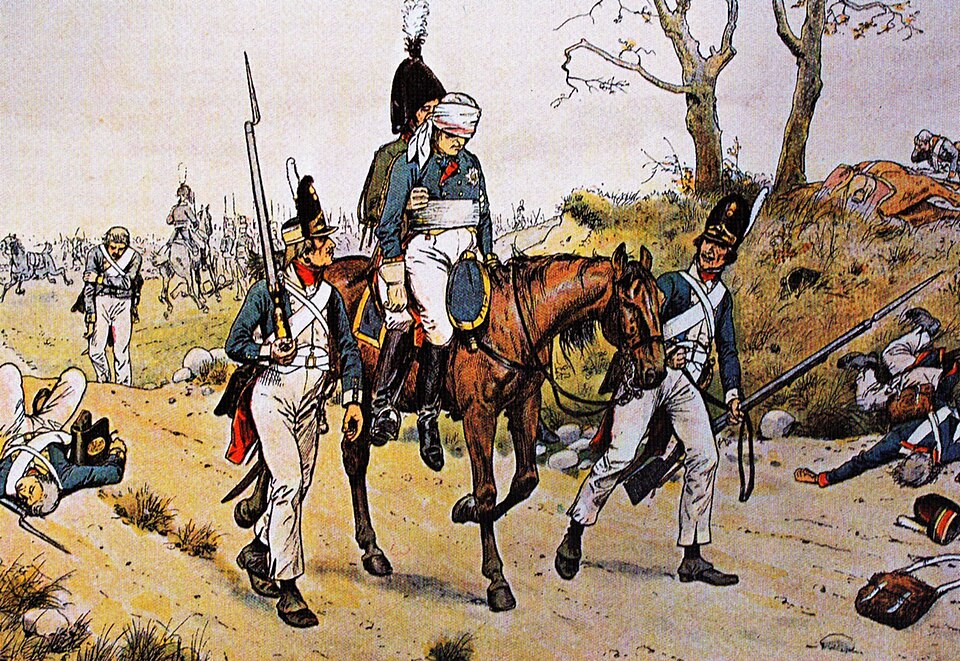
“Prussian wounded and stragglers leaving battle [after the battles of Jena and Auerstadt]. The mortally wounded Duke of Brunswick is the prominent figure in the painting.”
Painting by Richard Knötel (1857–1914) via Wikimedia Commons.
A vain, immoderate faith in these institutions made it possible to overlook the fact that their vitality was gone. The machine could still be heard clattering along, so no one asked if it was still doing its job.1
– Carl von Clausewitz on Prussia in 1806In the autumn of 1806, the Kingdom of Prussia, “The Iron Kingdom”, suffered one of the most rapid and humiliating military defeats in modern European history.2 The twin battles of Jena and Auerstedt shattered not only its army but the myth of invincibility that had surrounded the legacy of Frederick the Great. For the young Carl von Clausewitz, then a junior officer in the collapsing Prussian forces, this moment marked a personal and national catastrophe that would shape his life’s work. Clausewitz would come to see the defeat not simply as a failure of generalship or tactics, but as the exposure of a more profound institutional and societal crisis; one in which a state had grown complacent, a military rendered obsolete, and a society stripped of civic vitality falling apart during “the most decisive conflict in which they would ever have to fight”.3 In that collapse and Clausewitz’s later reflections, one finds an unsettling parallel to present-day America, a powerful nation outwardly strong, yet increasingly vulnerable to the same internal rot.
Prussia’s disaster in 1806 was the formative experience for the author of On War. How the armies of Frederick the Great and the state that he painstakingly built collapsed like a house of cards was a question that bothered Clausewitz for many years.4 It was a comprehensive disintegration of a system that had, since the mid-eighteenth century, claimed a position of prominence in European military affairs based on its discipline, linear tactics, and centralized command. Yet by the turn of the nineteenth century, these very strengths had calcified into weaknesses. Clausewitz foresaw disaster. Even as a young lieutenant, he was already warning of the Prussian army’s growing detachment from reality. In his early writings, he criticized military exercises as highly scripted performances, lacking genuine tactical challenge, unpredictability, and creativity.5 The number of steps marched in a minute of the cadence, what awards should be placed on a uniform, how a rifle should be cleaned for parade, all of this he feared, was cultivating a “lassitude of tradition and detail”.6 Clausewitz understood that rehearsing war under artificial constraints produced not readiness but ritual. Even though he later wrote, “no general can accustom an army to war”, he worried, presciently, that when confronted by a real enemy operating under real conditions, the army would collapse, and in 1806, it did.7
Whatever reservations he may have held, Clausewitz fulfilled his duty. He led a battalion of grenadiers at the battle of Auerstedt and managed to withdraw with most of his men intact in the chaotic aftermath of defeat. His escape was short-lived; however, he was captured on October 28, 1806, and subsequently marched into captivity in France, where he would spend the next year as a prisoner.8 Napoleon’s campaigns revealed that war had been transformed: faster, larger, and fundamentally political. Clausewitz wrote, “War was returned to the people, who to some extent had been separated from it by the professional standing armies; war cast off its shackles and crossed the bounds of what had once seemed possible”.9 The levée en masse and the corps system shattered the static paradigms of eighteenth-century warfare. Yet the Prussian high command, clinging to the geometries of the past, failed to respond with imagination or speed with any kind of seriousness.
Clausewitz’s later concept of friction — the unpredictable resistance that disrupts even the best plans — emerged directly from this experience.10 The Prussian army collapsed not for lack of courage, but because its institutional mindset could not withstand the volatility of an age that demanded adaptability, political intelligence, and creative command.
1. Carl von Clausewitz, Historical and Political Writings, ed. and trans. Peter Paret and Daniel Moran (Princeton, NJ: Princeton University Press, 1992), 32.
2. Christopher Clark, Iron Kingdom: The Rise and Downfall of Prussia, 1600–1947 (Cambridge: Belknap Press, 2006).
3. Clausewitz, Historical and Political Writings, 81.
4. Frederick the Great ruled from 1740-1786 and is usually credited as turning Prussia from a regional power to a continental power.
5. Peter Paret, Clausewitz and the State (Oxford: Oxford University Press, 1976), 92-93.
6. Clausewitz, Historical and Political Writings, 36.
7. Carl von Clausewitz, On War, trans. Michael Howard and Peter Paret (Princeton: Princeton University Press, 1984), 122.
8. Partet, 126.
9. Clausewitz, Historical and Political Writings, 287.
10. Clausewitz discusses this concept in Chapter 7 in On War, 119-121.
QotD: The accumulated friction of bureaucratic growth
[…] In the early Republic, raising a legion was as simple as a patrician calling his clients to service, or the Senate issuing a conscription decree. One task: the summoning of free men, with their own equipment, and there you go — Legio I Hypothetica.
By the late Empire, though, all those freeholds had been turned into slave-worked Latifundia, so the effort of raising a legion increased enormously. Now the bureaucracy had to go out and hire freemen (if it could even find them), equip them at State expense, train them (again at State expense), and so on. In itself, the number of tasks isn’t that large — we’ve identified three — and they only increase at the rate of n+1.
But the effort each task requires increases to the power of n, such that if you could somehow express the effort expended in physical terms — joules or kilowatts or whatever — you’d see that the creation of Legio I Hypothetica under Scipio Africanus took 10 kilowatts, while raising the same legion under Diocletian took 10,000,000.
This isn’t (just) corruption. Sure, everyone at every level of the Imperial Bureaucracy was getting his beak wet, that goes without saying, but it’s the nature of bureaucracy itself that’s most to blame.
Severian, “Collapse II”, Founding Questions, 2021-12-09.
July 25, 2025
The ongoing conflict in Gaza
On his Substack, John Spencer responds to a New York Times op-ed that claims Israeli forces in Gaza are engaged in genocide:
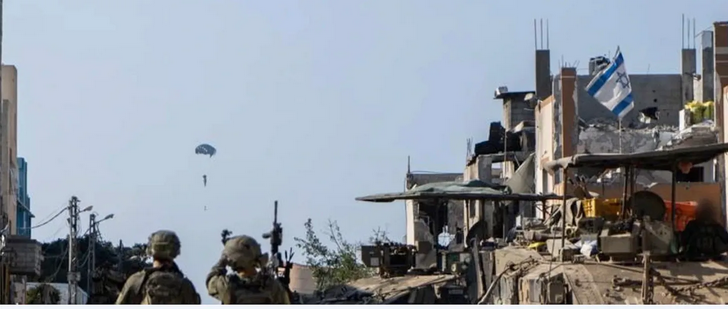
In his New York Times op-ed titled “I’m a Genocide Scholar. I Know It When I See It“, Omer Bartov accused Israel of committing genocide in Gaza. As a professor of genocide studies, he should know better. Genocide is not defined by a few comments taken out of context, by estimates of casualties or destruction, or by how war looks in headlines or on social media. It is defined by specific intent to destroy a national, ethnic, racial, or religious group in whole or in part. That is a high legal bar. Bartov did not meet it. He did not even try.
I am not a lawyer or a political activist. I am a war expert. I have led soldiers in combat. I have trained military units in urban warfare for decades and studied and taught military history, strategy, and the laws of war for years. Since October 7, I have been to Gaza four times embedded with the Israel Defense Forces. I have interviewed the Prime Minister of Israel, the Defense Minister, the IDF Chief of Staff, Southern Command leadership, and dozens of commanders and soldiers on the front lines. I have reviewed their orders, watched their targeting process, and seen soldiers take real risks to avoid harming civilians. Nothing I have seen or studied resembles genocide or genocidal intent.
Bartov claims that five statements by Israeli leaders prove genocidal intent. He begins with Prime Minister Netanyahu’s comment on October 7 that Hamas would “pay a huge price”. That is not a call for genocide. It is what any leader would say after the worst terrorist attack in the nation’s history. He also cites Netanyahu’s statements that Hamas would be destroyed and that civilians should evacuate combat zones. That is not evidence of a desire to destroy a people. It is what professional militaries do when fighting an enemy that hides among civilians.
Bartov presents Netanyahu’s reference to “remember Amalek” as a smoking gun. But this is a phrase from Jewish history and tradition. It is engraved at Israel’s Holocaust memorial, Yad Vashem, and also appears on the Holocaust memorial in The Hague. In both places, it serves as a warning to remain vigilant against threats, not as a call for mass killing.
He also highlights Defense Minister Gallant’s use of the term “human animals” to describe Hamas fighters. That is not a war crime. After the slaughter, rape, and kidnapping of civilians on October 7, many would understand or even share that reaction.
Unable to find intent among those actually directing the war, Bartov turns to far-right politicians like Bezalel Smotrich and Nissim Vaturi. These individuals do not command troops, issue orders, or shape battlefield decisions. I have studied the actual orders. They focus on destroying Hamas, rescuing hostages, and protecting civilians whenever possible. Their rhetoric is irrelevant to the legal case.
Israel has taken extraordinary steps to limit civilian harm. It warns before attacks using text messages, phone calls, leaflets, and broadcasts. It opens safe corridors and pauses operations so civilians can leave combat areas. It tracks civilian presence down to the building level. I have seen missions delayed or canceled because children were nearby. I have seen Israeli troops come under fire and still be ordered not to shoot back because civilians might be harmed.
Israel has delivered more humanitarian aid to Gaza than any military in history has provided to an enemy population during wartime. More than 94,000 trucks carrying over 1.8 million tons of aid have entered the territory. Israel has supported hospitals, repaired water pipelines, increased access to clean water, and enabled over 36,000 patients to leave Gaza for treatment abroad.
July 23, 2025
QotD: The legion of the Middle Republic
With that said, we reach the first and arguably most important thing to know about the legion: the Roman legion (and socii ala) of the Middle Republic is an integrated combined arms unit. That is to say, unlike a Hellenistic army, where different “arms” (light infantry, heavy infantry, cavalry, etc.) are split into different, largely homogeneous units, these are “organic” to the legion, that is to say they are part of its internal structure (we might say they are “brigaded together” into the legion as well). Consequently, whereas the Hellenistic army aims to have different arms on the battlefield in different places doing different things to produce victory, the Roman legion instead understands these different arms to be functioning in a fairly tightly integrated fashion with a single theory of victory all operating on the same “space” in the enemy’s line.
And you may well ask, before we get to organization, “What is that theory of victory?” As we saw, the Hellenistic army aims to fix the enemy with its heavy infantry center, hold the flanks with lighter, more mobile infantry (to protect that formation) and win the battle with a decisive cavalry-led hammer-blow on a flank. By contrast, the Romans seem to have decided that the quickest way to an enemy’s vulnerable rear was through their front. The legion is thus not built for flanking, its cavalry component – while ample in numbers – is distinctly secondary. Instead, the legion is built to sandpaper away the enemy’s main battle line in the center through attrition, in order to produce a rupture and thus victory.
To do that, you need to create a lot of attrition and this is what the manipular legion is built to do.
The legion of the Middle Republic is built out of five components: three lines of heavy infantry (hastati, principes and triariivelites), and a cavalry contingent (the equites). Specifically, a normal legion has 1200 each of velites, hastati and principes, 600 triarii and 300 equites, making a total combined unit of 4,500. Organizationally, the light infantry velites were packaged in with the heavy infantry (Polyb. 6.24.2-5) for things like marching and duties in camp, but in battle they typically function separately as a screening force thrown forward of the legion.
So to take the legion as an enemy would experience them, the first force were the velites. These seem to have been deployed in open order in front of the legion to screen its advance. These fellows had lighter javelins, the hasta velitaris (Livy notes they carried seven, Livy 39.21.13), no body armor and a “simple headcovering” (λιτός περικεφάλαιος, Polyb. 6.22.3), possibly hide or textile; they also carried a smaller round shield, the parma, and the gladius Hispaniensis for close-in defense (Livy 38.21.13). These are, all things considered, fairly typical ancient javelin troops, aiming to use the mobility their light equipment offers them to stay out of close-combat.
Behind the velites was the first line of the heavy infantry, the hastati. These fellows were organized into units called maniples (lit: “a handful”) of 120, which in turn are divided into centuries of 60 each. The maniples are their own semi-independent maneuvering units (note how much smaller they are than the equivalent taxeis in the phalanx, this is a more flexible fighting system), each with its own small standard (Polyb. 6.24.6) to enable it to maintain coherence as it maneuvers. That said, they normally form up in a quincunx (5/12ths, after a Roman coin with the symbol of five punches, like on dice) formation with the rear ranks, as you can see above.
The hastati (and the principes, who are equipped the same way) have the large Roman shield, the scutum, two heavy javelins (pila), the gladius Hispaniensis sword, a helmet (almost always a Montefortino-type in bronze in this period) and body armor. Poorer soldiers, we’re told, wore a pectoral, wealthier soldiers (probably post-225, though we cannot be certain) wore mail. That is, by the standards of antiquity, quite a lot of armor, actually – probably more armor per-man than any other infantry formation on their contemporary battlefield. That relatively higher degree of protection – big shield, stout helmet (Montefortino’s in this period range from 1.5-2.5kg, making them unusually robust), and lots of body armor – makes sense because these fellows are going to aim to grind the enemy down.
Note that a lot of popular treatments of this assume that the hastati were worse equipped than the principes; there’s no reason to assume this is actually true. The principes are older than the hastati, but the way to understand this formation is that the velites are young or poor, whereas for the upper-classes of the infantry (probably pedites I-IV) after maybe the first year or so, they serve in the heavy infantry (hastati, principes, triarii) based on age, not on wealth (and then the equites are the truly rich, regardless of what age they are; the relevant passage here is Polyb. 6.21.7-9, which is, admittedly, not entirely clear on what is an age distinction and what is a wealth distinction).
We’ve discussed the combat width these guys fight with already – somewhat wider spacing than most, so that each man covers the other’s flanks but they all have room to maneuver. It seems like the standard depth in the Middle Republic was either base-3 (so 3 deep on close order, 6 deep for “fighting” open order) or base-4 (so 4 and 8). Even in open-order with the maniples stretched wide (possibly by having rear centuries move forward), there would have been open intervals (10-20m) between maniples, which reinforces the role of a maniple as a potentially independent maneuvering unit – it has the space to move.2
Behind the hastati are the principes, with the same equipment and organization, slightly off-set to cover the intervals between the hastati, with a gap between the two lines (we do not know how large a gap). These men are slightly older, though not “old”. The whole field army generally consists of iuniores (men under 46) and given how the Romans seem to like to conscript, the vast majority of men will be in their late teens and 20s. So we might imagine the velites to be poorer men, or men in their late teens (17 being the age when one become liable for conscription) or so, while the hastati are early twenties, the principes mid-twenties and the handful of triarii being men in their late twenties or perhaps early 30s. The positioning of the principes isn’t to spare older men the rigors of combat, but rather to put more experienced veterans in a position where they can steady the less experienced hastati.3
Finally, behind them are the triarii, who trade the pila for a thrusting spear, the hasta, the Roman version of the Mediterranean omni-spear. These men are, as noted, the oldest and so likely the calmest under pressure and thus form a reserve in the rear. The three-line system here is what the Romans call a triplex acies (“three battle lines”). This wasn’t the only way these armies engaged and they could sometimes be formed up into a single solid line, but the triplex acies seems to have been the standard. We don’t know exactly how deep such a formation would run, but we have fairly good evidence that a legion might occupy a space around 400m wide (with some variation), meaning a whole Roman army’s core heavy infantry component (the two legions and two alae) might be some 1.6km (about a mile) across.
The equites, while organic to the legion organizationally, will be tactically grouped in battle to form cavalry screens on the edges of the army, not as a grand flanking cavalry “hammer”, but as flank-protection for the advancing infantry body (as a result, they tend to fight more cautiously). The equites in this period are heavy cavalry, with armored riders (after c. 225, that would be mail), using a shield and a hasta, along with a gladius as a backup weapon and thus serving as “shock” cavalry. Roman cavalry, if we look at their deployments, is generally ample in numbers, but the Romans seem to have been well aware it wasn’t very good, and sought allied cavalry (especially non-Italian allied cavalry) whenever they could get it. But the cavalry, Roman or not, was almost never the decisive part of the army.
Polybius tells us that the socii supplies more cavalry than the Romans and implies that there was a standard rule of three socii cavalrymen to every Roman equites, while socii infantry matched Roman infantry numbers (Polyb. 6.26.7). Looking at actual deployments though, we see that the socii tend to outnumber the Romans modestly, on about a 2:3 ratio, with socii cavalry only modestly outnumbering Roman cavalry.4 Consequently a normal Roman consular field army (of which the Romans generally had at least two every year) was 8,400 Roman infantry, around 12,600 socii infantry, 600 Roman cavalry and perhaps a thousand or so socii cavalry, for a combined force of 21,000 infantry (c. 5,000 light 16,000 heavy, so that’s a lot of heavy infantry) and 1,600 cavalry. That somewhat undersells the cavalry force the Romans might bring, as Roman armies also often move with auxilia externa (allied forces not part of the socii), which are very frequently cavalry-heavy (especially, after 203, that really good Numidian cavalry).5 By and large, it’s not that the Romans bring a lot less cavalry (as a percentage of army size), but that Italian cavalry tends to perform poorly and the as a result the Romans do not built their battle plans around their weakest combat arm.
Perhaps ironically, the Romans used their cavalry like Alexander and Hellenistic armies used their light infantry: holding forces designed to keep the flanks of the battlefield busy while the decisive action happened somewhere else.
Bret Devereaux, “Collections: Phalanx’s Twilight, Legion’s Triumph, Part IIa: How a Legion Fights”, A Collection of Unmitigated Pedantry, 2024-02-09.
1. On this, see Burns, M. T. “The Homogenisation of Military Equipment under the Roman Republic”. In Romanization? Digressus Supplement I. London: Institute of Archaeology, University College London, 2003.
2. On this, M.J. Taylor, “Roman Infantry Tactics in the Mid-Republic: A Reassessment”, Historia 63.3 (2014): 301-322.
3. To expound at some length on my own thoughts on how I think the wealth/age issue was probably managed, Dionysius (4.19.2) claims that the Romans recruited by centuries in the comitia centuriata such that the wealthy, divided into fewer voting blocks, served more often, and we know from Polybius that the maximum period of service for the infantry was sixteen years and from some math done by N. Rosenstein in Rome at War (2004) that the average service must have been around seven years. My suspicion, which I cannot prove is that the very poorest Roman assidui (men liable for conscription) might have only been serving fewer years on average and so it wasn’t a problem having them do all of their service as velites (the only role they can afford), whereas wealthier Romans (my guess is pedites IV and up) are the ones who age into the heavy infantry, with pedites I, whose members probably serve more than the seven-year average (perhaps around 10?) might make up close to 40% of the actual heavy infantry body (which is their balance in the comitia centuriata). The velites thus serves two important functions: a place to “blood” wealthier young Roman men to prepare them to stand firm in the heavy infantry line, as well as a place for poorer Romans to contribute militarily in a way they could afford. But I think that, once in the heavy infantry, the division between hastati, principes and triarii was – as Polybius says (6.21.7-9 and 6.23.1) – an age division, not a wealth division. Instead, the next wealth line is for the equites.
4. The data on this is compiled by Taylor, Soldiers & Silver (2020), 26-28.
5. Taylor, op. cit., 54-7 compiles examples.

July 15, 2025
Why France Couldn’t Crush the Viet Minh – W2W 36
TimeGhost History
Published 13 Jul 2025Why couldn’t France crush the Viet Minh after war broke out in Vietnam? In this episode we dive into the brutal opening years of the First Indochina War, from the outbreak of violence in Hanoi in December 1946 to France’s failed military campaigns and the rise of Vietnamese resistance.
Despite having superior weapons, colonial experience, and Foreign Legion reinforcements, France failed to defeat Ho Chi Minh’s forces. We explore why early offensives like Operation Léa and Ceinture fell short, how the Viet Minh’s rural strategy kept them alive, and why French hopes of ending the war quickly vanished.
As Mao Zedong’s Communist China consolidates power just across the border, the Viet Minh gain strength, support, and a long-term advantage that France simply cannot match.
This video is part of War 2 War, our Cold War history series covering the decade after WW2, a time of seismic global transformation.
(more…)
July 12, 2025
Organizing two new divisions for the Canadian Army
To emphasize, these are just strong rumours and have not been formally announced or confirmed by the Department of National Defence or the Canadian Armed Forces:
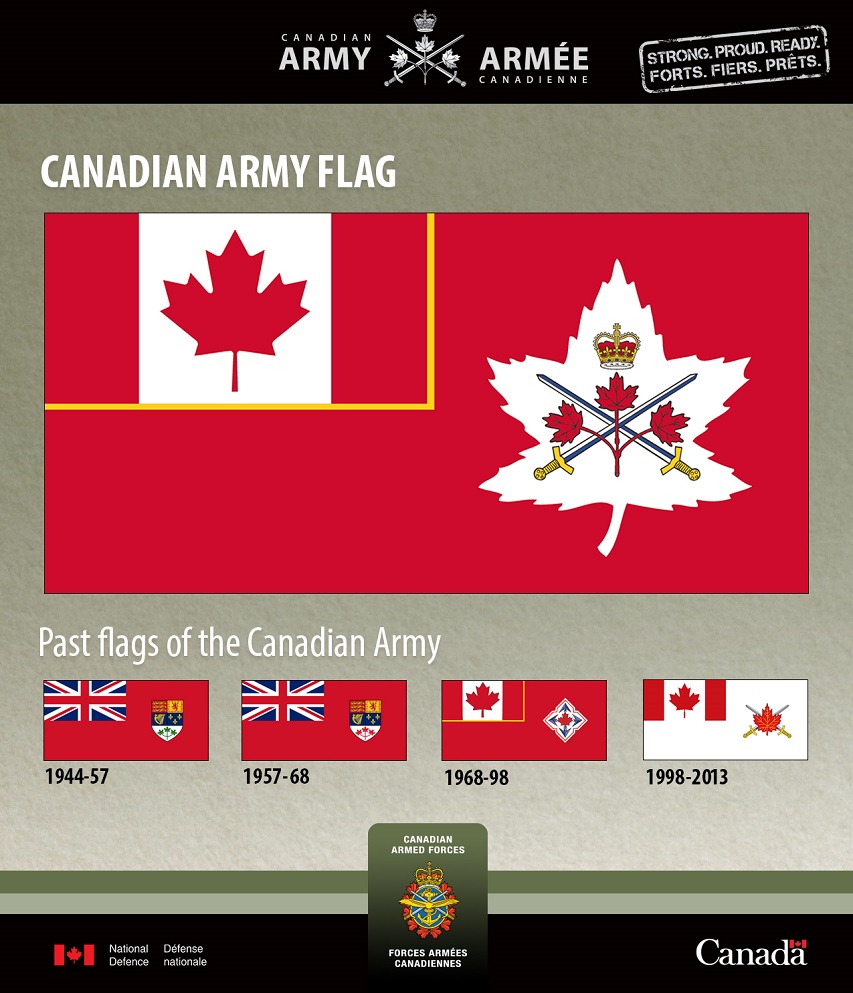
Let’s start with the major aspect of today’s rumours, restructuring. This has been a hot topic for the last few months and one I have been very hesitant to put in here due to the conflicting and volatile information.
However with plans approved in the last few weeks, as well as going though about four different people for verification, I think I’m finally in a position where I can confidently put this out there.
The new army will be centered around three [two?] divisions, broken down between the regular, reserve, and a support division. The working designation for these two new Divisions are the 6th and 7th.
The 6th Division will be comprised of:
- 1 CMBG
- 2 CMBG
- 5 CMBG
- 1x Light Infantry Regiment
- 1x Fires Brigade
- 1x Protection Brigade
- 1x Sustainment Brigade
The 7th Division will be the reserves and rangers and has been, at least in some documentation, been referred to as the “Continental Division”. I sadly don’t have much on the Seventh.
This is the info that I have as of now. I am still working on gathering more details but this is the basic structure of how the future army will look. Obviously some of you were expecting more, and hoped to see something more radical done.
Some of you will be very happy with this and how straightforward it is. It is a plan that makes sense and is within realistic expectations. As always, we take these as speculation and not as fact. Plans can change but I am fairly confident that this is the active plan.
July 11, 2025
Why Didn’t France and Britain Stop Germany’s Secret Rearmament? – Out of the Bullpen 001
World War Two
Published 10 Jul 2025In this special “Out of the Bullpen” episode, we answer your burning questions about Weimar Germany’s most turbulent years. From clandestine military pacts with the Soviets to the creative ways Germany sidestepped Versailles, we dig into aspects which shaped a republic on the brink.
(more…)
QotD: Pyrrhus arrives in Magna Graecia to support the Tarantines
There are a few reasons I think this is unlikely. First, sources enlarging armies to fit the narrative magnitude of battles is a very common thing. But more to the point, Pyrrhus has crossed to Italy with 28,500 men total and – as Plutarch notes – hasn’t had a chance to link any of his allies up to his army. That may mean he hasn’t even reabsorbed his scouting force of 3,000 and he may well have also had to drop troops off to hold settlements, secure supplies and so on. Pyrrhus’ initial reluctance to engage (reported by Plutarch) is inconsistent with him wildly outnumbering the Romans, but his decision to wait for reinforcements within reach of the Romans is also inconsistent with the Romans wildly outnumbering him. So a battle in which Pyrrhus has perhaps 20-25,000 men and the Romans a standard two-legion, two-alae army of 20,000 give or take, seems the most plausible.1
The two forces met along the River Siris at Heraclea on the coastal edge of Lucania, Laevinius having pushed deep into southern Italy to engage Pyrrhus. As usual for these battles, we have descriptions or partial descriptions from a host of sources (in this case, Plutarch, Dionysius of Halicarnassus, Zonaras, Florus) which don’t always agree, leaving the modern historian in a bit of a pickle. Generally, we assume that a lot of the later Roman narratives of a famous defeat are likely to have been tailored to try and minimize the embarrassment, either by implying the battle was closer than it was or that Pyrrhus was a very impressive foe (or both) or other “face-saving” inventions. Worse yet, all of our sources are writing at substantial chronological distance, the Romans not really having started to record their own history until decades later (though there would have been Greek sources for later historians to work with). Generally, Patrick Kent tends to conclude that – somewhat unusually – Plutarch’s moralizing focus renders him more reliable here: Plutarch feels no need to cover for embarrassing Roman defeats or to embellish battle narratives (which he’d rather keep short, generally) because his focus is on the character of Pyrrhus. Broadly speaking, I think that’s right and so I too am going to generally prefer Plutarch’s narratives here.
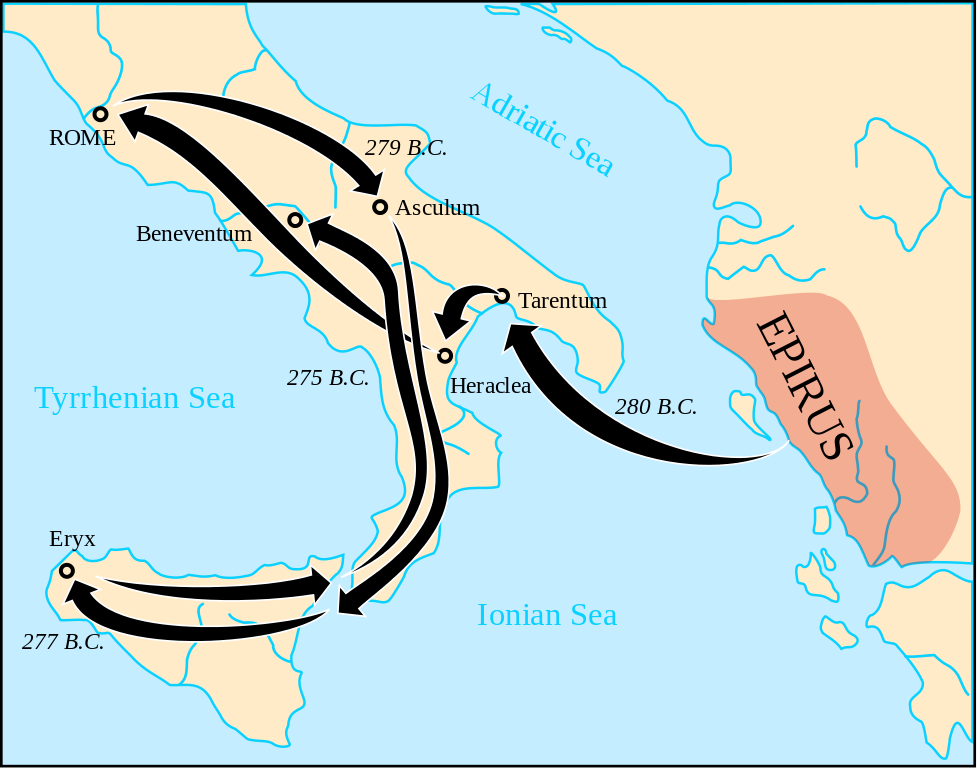
A fairly handy map of Pyrrhus’ campaigns (though some of the detail is lost in the big sweeping arrows). What is notable is, apart from Pyrrhus’ lightning raid into Latium in 280, he is almost invariably fighting in “friendly” territory, either in Lucania (Heraclea), Apulia (Asculum) or Samnium (Beneventum), the lands of his allies. Pyrrhus never fights an actual pitched battle on Roman-controlled territory, which I think speaks to his strategic intent: to carve out a kingdom in Greater Greece, not to conquer the whole of Italy.
Wikimedia Commons.The battle was defined by Pyrrhus’ use of terrain – Pyrrhus thought delay might be wiser (to link up with his allies) but left a blocking force on the river (the Romans being on the other side). The Romans responded by forcing the river – typical Roman aggression – but Plutarch at least thinks it caught Pyrrhus by surprise (he hadn’t fought Romans before) and so it leaves him in a scramble. He charges his cavalry (Plut. Pyrrh. 16.5) to give his main phalanx time to form up for battle resulting in what seems like a cavalry engagement near the river. Pyrrhus nearly gets himself killed in the fighting, but survives and falls back to his main infantry force, which then met the Romans in an infantry clash. The infantry fighting was fierce according to Plutarch and Pyrrhus, still shaken from being almost killed, had to come out and rally his troops. In the end, the Romans are described as hemmed in by Pyrrhus’ infantry and elephants before some of his Greek cavalry – from Thessaly, the best horse-country in Greece – delivers the decisive blow, routing the Roman force.
It is, on the one hand, a good example of the Hellenistic army “kit” using almost all of its tactical elements: an initial – presumably light infantry – screen holding the river, followed by a cavalry screen to enable the phalanx to deploy, then a fierce and even infantry fight, finally decided by what seems to be flanking actions by cavalry and elephants. Plutarch (Pyrrh. 17.4) gives two sets of casualty figures, one from Dionysius and another from Hieronymus; the former says that the Romans lost 15,000 to Pyrrhus’ 13,000 killed, the latter that the Romans lost 7,000 to Pyrrhus’ just a bit less than 4,000 killed. The latter seems almost certainly more accurate. In either case, the Roman losses were heavier, but Pyrrhus’ losses were significant and as Plutarch notes, his losses were among his best troops.
Even in the best case, in victory, Pyrrhus had lost around 15% of his force (~4,000 out of 28,000), a heavy set of losses. Indeed, normally if an army loses 15% of its total number in a battle, we might well assume they lost. Roman losses, as noted, were heavier still, but as we’ve discussed, the Romans have strategic depth (in both geography, political will and military reserves) – Pyrrhus does not. By contrast, Alexander III reportedly wins at Issus (333) with just 150 dead (and another 4,802 wounded or missing; out of c. 37,000) and at Gaugamela (331) with roughly 1,500 losses (out of c. 47,000). The Romans will win at Cynoscephelae (197) with just 700 killed.
This isn’t, I think, a product of Pyrrhus failing at all, but rather a product of the attritional nature of Roman armies: even in defeat they draw blood. Even Hannibal’s great victory at Cannae (216) costs him 5,700 men, according to Polybius (more, according to Livy). But the problem for Pyrrhus is that his relatively fragile Hellenistic army isn’t built to repeatedly take those kinds of hits: Pyrrhus instead really needs big blow-out victories where he takes few losses and destroys or demoralizes his enemy. And the Roman military system does not offer such one-sided battles often.
Nevertheless, Pyrrhus shows that a Hellenistic army, capable handled, could beat a third-century Roman army, albeit not cleanly, and that is well worth noting.
Bret Devereaux, “Collections: Phalanx’s Twilight, Legion’s Triumph, Part IIIb: Pyrrhus”, A Collection of Unmitigated Pedantry, 2024-03-08.
1. I should note, this is Kent’s assessment as well.
July 10, 2025
The Prussian defeats at Jena and Auerstadt in 1806
At Dead Carl and You, Kiran Pfitzner describes the disastrous 1806 campaign that knocked Prussia out of the war against Napoleon and shattered the military reputation of the army built by Frederick the Great:
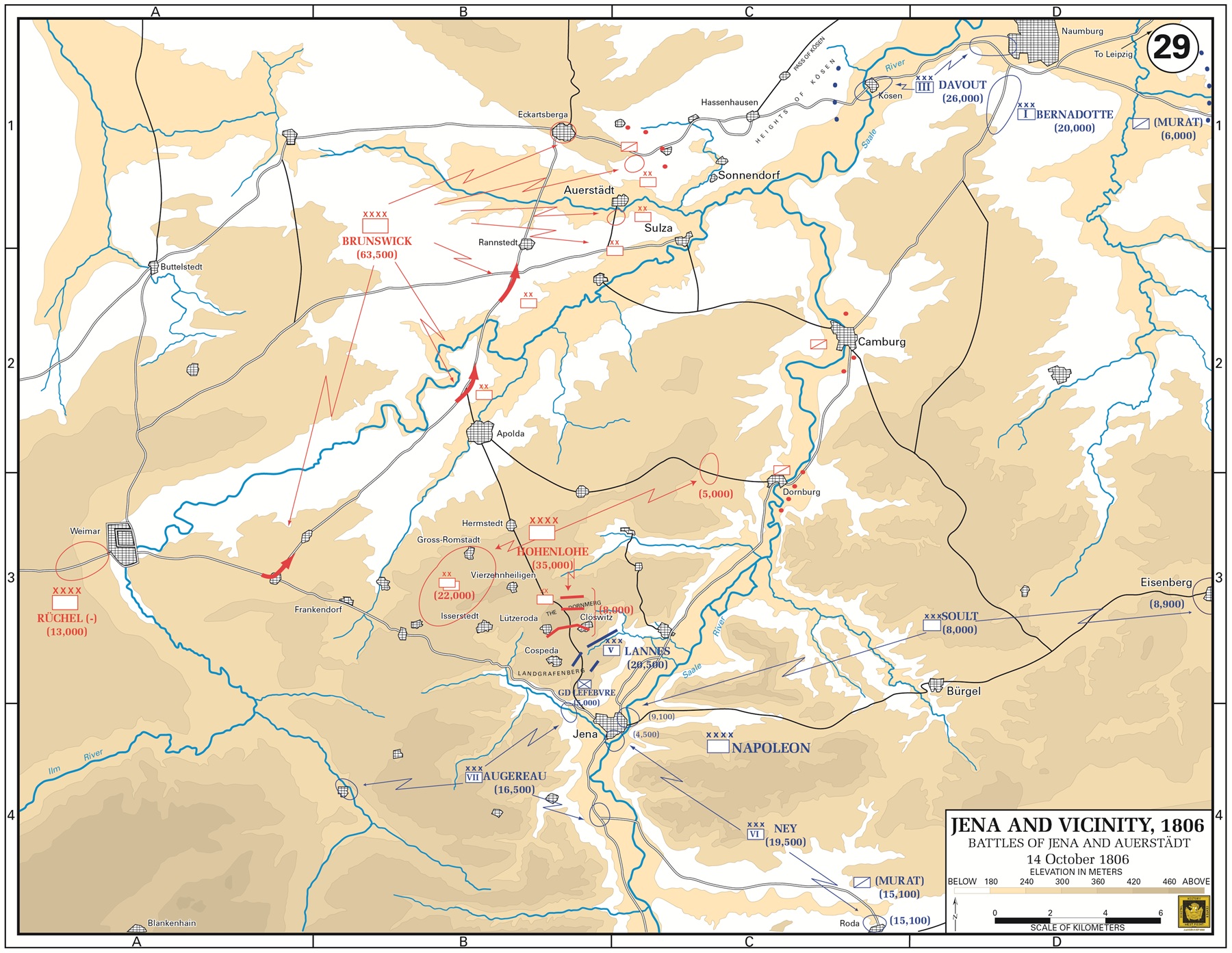
In brief, the course of the 1806 campaign was that the Prussians met the French at Saalfeld and were initially defeated. The Prussians therefore decided to retreat before meeting Napoleon himself in battle. However, poor command organization and irresolution ended up dividing and delaying the Prussian forces. Thus, the rearguard ended up meeting the French main body under Napoleon which was able to overwhelm it at Jena.
The battle itself was not especially punishing, but the relentless pursuit of the French cavalry yielded many prisoners and prevented the reconstitution of the army. On the same day, the Prussian main body had encountered a French corps under Marshal Davout at Auerstedt, but failed to overcome it in a series of piecemeal attacks that cost it the lives of its commanders. The Prussians were demoralized enough that an attack from the outnumbered French was enough to force the main body into disorder. The arrival of fleeing forces from Jena spread a general panic and prevented any chance of recovery. From there, the campaign was a matter of pursuit and capitulation — within weeks the French were parading through the streets of Berlin. This humiliating defeat gave Clausewitz impetus to seek an understanding of the nature of war. How could the vaunted Prussian army, envy of the world in the days of Frederick the Great (still within living memory), be so summarily dispatched?
It was clear to virtually all military thinkers of the time that war had changed. To many, Napoleon was utilizing a higher, more perfect form of war than had been previously known. Clausewitz instead recognized that Napoleon was not refining war, but recognizing that changes in social conditions had enabled fighting with more energy and violence than had been possible in the cabinet wars of the 18th century. This had proven significant because the limitations of the 18th century made maneuver and logistics central to skilled generalship. Battles were important, but much that was won or lost in a battle could be subsequently lost or won outside it.
The removal of these restrictions drastically increased the importance of battle as it was able to produce results that could not be compensated for actions outside of it. Skilled generalship was therefore no longer a matter of outmaneuvering the enemy or protecting your supply lines while threatening his, but of bringing maximum force to the point of battle. Initiative, coordination, and aggression become the key traits of an officer. Thus, more expansively, the task of the officer is to recognize changes to the character of war and so understand what is required in practice. Neither history nor experience can anticipate these developments — it falls to the judgment of the individual to recognize them.
This framing shows clearly the mistakes of the Prussians. Operating in the old paradigm, they sought to make good with maneuver what they had lost in the opening battle of the campaign. They had divided their forces under the assumption the French would be unable or unwilling to aggressively pursue their retreat. At the same time, when they engaged the French, they showed caution entirely congruent with a cabinet army but fatally out of place when facing a Napoleonic force. On numerous occasions, the French made serious blunders that went unpunished because the Prussians failed to take the initiative and capitalize on them.
Nowhere is this more clear than in the failure of the Prussian main body to overcome the single corps it faced at Auerstedt. While outnumbering the French, the Prussian attacked piecemeal, becoming demoralized under French fire. The morale of the Prussians was substantially more brittle on account of their relative lack of nationalism — the state and therefore the army were not objects of any great affection by those subject to them. While this would require social reforms to remedy, Auerstedt had nevertheless been an opportunity for the Prussians. They had a French corps outnumbered more than two-to-one and merely needed to bring that force to bear to inflict a serious defeat. A Prussian victory would have positioned the main body to receive the retreating forces from Jena, allowing another confrontation with Napoleon on at least equal terms. Timidity and irresolution therefore played as big a part in the disaster as did the deeper defects.
In part, this must be ascribed to the advanced age of Prussian leadership. The senior commanders at both Jena and Auerstedt were over seventy. Not only did this ensure continuity with older forms of war, but men of such an age were unlikely to have the energy to campaign aggressively — by contrast, Napoleon and his marshals were three or four decades younger. The Prussian leaders did not lack physical courage, as their valiant deaths attest, but exposing oneself to danger is not the same quality that is needed for decisive and energetic action over an extended period of time.
The Prussian strategy deserves further criticism because by that point Bonaparte’s character was well known. There was no justification to have any illusions as to what the consequences of defeat would be. Prussia’s status amongst the great powers — if not its very existence as an independent state — would be determined by the confrontation. Leaving troops in Silesian fortresses or Polish garrisons (through which Prussia’s available forces were reduced by half) meant narrowing the odds of victory in pursuit of things that could be no substitute for victory and no comfort in defeat.
July 3, 2025
Bill Slim, the most forward-looking British commander of WW2
At The War Room, Dr. Robert Lyman explains how and why General (later Field Marshal) William Slim was able to turn around British and allied military fortunes in Burma and drive the Japanese out of India to their eventual defeat:
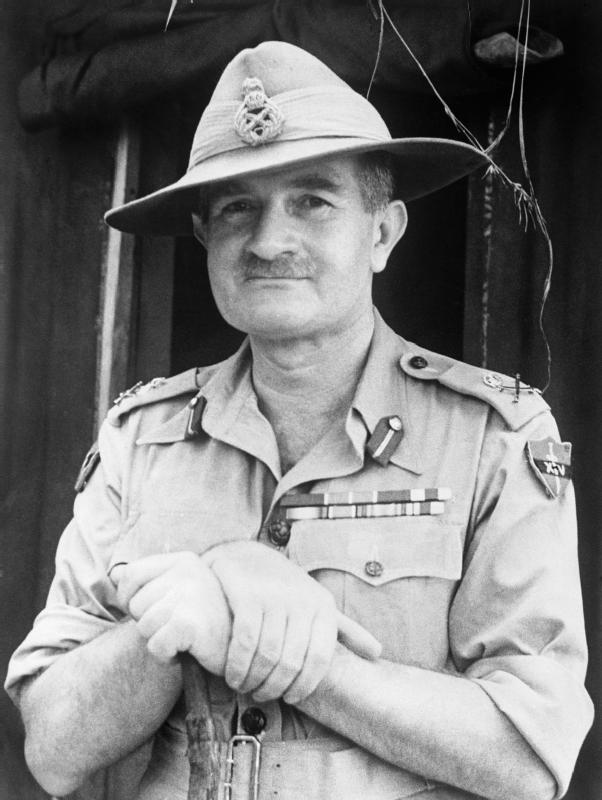
Field Marshal Sir William Slim (1891-1970), during his time as GOC XIVth Army.
Portrait by No. 9 Army Film & Photographic Unit via Wikimedia Commons.
“Burma and the Birth of Modern Warfare” is the subtitle to my 2004 book and PhD about General Slim’s command of the 14th Army in Burma during the last war, titled Slim, Master of War, a use of Sun Tzu’s description of a “heaven-born” commander. It may appear a rather grand claim, and perhaps it is, but the purpose of the subtitle reflects that fact that Slim’s conduct of operations in India and Burma in 1944 and 1945 represented an entirely new style of warfighting to that experienced by the British Army during the war. Instead of looking back to the lessons of World War One, Slim’s conduct of operations looked forward to reflect a style of warfare that would only be adopted as formal doctrine by the British Army in the 1980s. In the mid-1940s it remained alien to the vast bulk of similar British military experience and understanding.
My argument wasn’t that Slim was the best general who had ever commanded men in the history of warfare. That may or may not be true, but for the sake of my argument is irrelevant. My proposition, rather, is that:
Slim was the foremost British exponent in the Second World War of the “indirect approach” and that in his conduct of operations in 1944 and 1945 he provided a clear foreshadowing of “manoeuvre warfare”.
My idea, which first saw expression in my 2004 book, has been developed since then in my subsequent writings, including that of Japan’s Last Bid for Victory, which deals with the great events in the Assam and Manipur in 1944 (2011) and A War of Empires (2021). A major reason for the continuing amnesia in British military thinking about the warfighting characteristics of the Burma Campaign – apart from the fact that it is a long way to go for a staff ride – seems to be the fact that Slim’s style of warfighting remained largely alien to the British Army’s doctrinal precepts until the late 1980s. Until then, Slim’s strategic conceptions had been considered an aberration, and Slim himself regarded merely as the epitome of a fine military leader, and nothing more. Then, in a doctrinal revolution which began in the 1980s, the old firepower-based foundations – which themselves were largely a product of Montgomery’s approach to war in 1944 and 1945 – in which the supreme military virtue was the effective and coordinated application of force, were replaced. This revolution in doctrine and thinking about warfighting exchanged the old foundations with new ones based on an entirely different conception, that of manoeuvre at the operational level of war, in which notions of subtlety, guile and psychological dislocation came to be emphasised in an entirely new and refreshing way. My belief is that it was the effective and pragmatic employment of manoeuvre at the operational level of war by Slim in Burma that was the direct cause of the extraordinary victories the 14th Army achieved in 1944 and 1945 and which led to the two greatest defeats the Japanese Army suffered in the field in the Second World War, the first at Imphal-Kohima in India in 1944 and the second at Mandalay-Meiktila in Burma in 1945. My argument I suppose is that Slim’s exercise of command in Burma makes him not merely a fine example of a “manoeuvrist” commander but in actuality the template for modern manoeuvrist command.
[…]
First, the 14th Army was the only truly joint formation in the British armed forces during WW2. Nothing else, in North Africa, Italy or North-West Europe came close to it. Slim insisted on nothing less than full integration. Not only were headquarters joint, but operational and tactic delivery was also joint. At every level of command air and land headquarters were completely interlinked. I became convinced of this fact when I discovered that the RAF and the Army even shared messes! Strategic air transport, winning the air war, the operational reach and flexibility provided by air power underwrote Slim’s conception of battle, to the extent that the senior RAF officer in the theatre ruefully concluded in 1945, and I quote, that:
Slim was quicker to grasp the potentialities and value of air support in the jungles of Burma than most Air Force officers.
There was no snobbery and no shibboleths with Slim: if it worked, it was pressed into action.
[…]
Professor Dixon argues [in On the Psychology of Military Incompetence] that, unusually for a senior commander of his ilk in WW2, Slim was non-ethnocentric. He had no intrinsic prejudices about the virtues of one race over another. Slim, after all, was an officer of the Indian Army, and I have yet to come across any evidence that British regimental officers of the Indian Army regarded their soldiers in any way inferior to themselves. He was commonly known to those who served under him as “Uncle Bill” from the special affinity British troops had to him: the remarkable fact, however, was that at least 87% of his Army of several hundred thousand men recalled him as “Cha Cha Slim Sahib”: 14th Army was, after all, very largely Indian, Gurkha and West and East African. I certainly cannot think of any other Indian Army general who had such an impact on British troops. He became, of course, Chief of the Imperial General Staff following Field Marshal Montgomery, in 1948, which securely establishes this feat. On that note, I cannot conceive of “Uncle Bernard” when referring to Field Marshal Montgomery!
The Burma campaign was as much a struggle for mastery of logistics as it was a struggle for mastery on the battlefield, and it was about risk as much as it was about adherence to logistical principles. Slim had an implicit understanding of the constraints placed on warfare by the demands of logistics. Great efforts were made to increase the quantity of supplies to Burma. Railways were extended, roads built and surfaced, sunken ferries refloated and repaired, barges and rafts built for use on the numerous waterways. In this regard Archibald Nye, the VCIGS under Alan Brooke, regarded Slim’s mastery of logistics to be the most significant measure of his greatness as commander of 14 Army in Burma:
He never had enough to do what he had to do and this … is the measure of his greatness.
The practice of war in Burma by Slim was so startling in its modernity, and unlike any other pattern of warfighting by operational level British commanders in the war. My view of Slim as a commander can be interpreted at two levels. He was, first of all, a great commander and leader. Being a master of strategy, of logistics, of technical proficiency and so on are important in themselves when considering the nature of leadership in war, but by themselves they remain insufficient. Successful military command requires someone who can, through dint of personality and inspirational leadership, wield all of the components of fighting power together so that an extraordinary result transpires. What marks Slim out from the crowd was much more than just his winning of a succession of extraordinary battles. His strength lay in his ability to produce a decisive effect from scratch; to mould thousands of disparate individuals together into a single team with a single goal; to persuade a defeated army that it had the potential to turn the tables on their enemies; to master the complexities of terrain, climate and administrative deficiency so that self-help, resourcefulness and ingenuity could become as much prized as fighting skill. In these individual areas, and more, Slim proved the master. His genius for war was the consequence of his ability to bring together all of these elements to create an extraordinary result, the visible sign of which was the greatest defeat suffered by the Japanese on land during the Second World War.


