
Thersites the Historian
Published 29 Jan 2025Caesar’s landings in Britain illustrate his willingness to take risks, even unnecessary ones. The questionable decision-making, however, also led to the first surviving detailed description of people and events in Britain.
(more…)
July 2, 2025
History of Britain IV: Caesar in Britain, Reconnaissance in Force, 55-54 BCE
Comments Off on History of Britain IV: Caesar in Britain, Reconnaissance in Force, 55-54 BCE
June 23, 2025
Augustus and the empire – The Conquered and the Proud 14
Adrian Goldsworthy. Historian and Novelist
Published 15 Jan 2025This time we look at Augustus, the empire and the army. The man who built the Altar of Augustan Peace in Rome was also the last of the great conquerors, who added more territory to the Roman Empire than any other individual leader. How he did this, and how he kept the army under control, is the theme of this video.
Comments Off on Augustus and the empire – The Conquered and the Proud 14
QotD: Recruiting and organization under the “Marian reforms”
This is the most important one, but perhaps a bit less complicated than cohorts: the notion that Marius began the process of taking volunteers and proletarii at that and thus “professionalized” the Roman army. As with the equipment, this is at least something our sources do say … more or less.
Sallust reports that Marius, “after he saw that the spirits of the plebs were aroused, he swiftly loaded ships with supplies, pay, weapons and other requirements; with them he ordered Aulus Manlius, his legate, to set out. Meanwhile himself he enrolled soldiers, not according to the mos maiorum [‘the customs of the ancestors’] from the census classes, but making use of whoever wished to go, mostly the capite censi [‘those counted by heads’ = the propertyless poor or proletarii]” (Sall. Iug. 86.1-2, trans mine). Plutarch repeats this report, that Marius violated custom by enrolling men who didn’t meet the property qualification for military service (Plut. Mar. 9.1).
There are a few oddities here to start, though. First, Sallust quickly notes that this resulted in Marius having an army rather larger than what the Senate had actually authorized (Sall. Iug. 86.4) and that’s actually quite a neat detail that may explain part of what’s going on here because this has, in a way, happened before. In 134, Scipio Aemilianus was elected consul for the second time (illegally, again) with a mandate to end the frustrating Roman war against the Celtiberian stronghold of Numantia in Spain. The Senate, however, denied Scipio authorization to raise fresh troops, to which Scipio responded by enlisting some 4,000 volunteers to replenish his legion; Appian says this was done with the consent of the Senate, but Plutarch’s brief note on it sure implies Scipio Aemilianus is end-running around Senatorial efforts to stifle him (App. Hisp. 84; Plut. Mor. 201A-B). And this too was hardly the first time for this sort of end-run; Scipio Africanus (what is it with Scipiones!?) back in 205 agitated for his invasion of Africa to end the Second Punic War and was given the province of Sicily with authorization to go to Africa if he thought it necessary, but the Senate registered its displeasure by refusing to let him levy troops, at which point – wait for it – Scipio took volunteers, equipping and financing his force through the socii and even building a fleet that way (Liv. 28.45.9-12).
In short, the Senate sometimes tried to trim the sails of generals it was displeased with – and Marius reportedly had gotten elected on a campaign platform of “to hell with the Senate” (Sall. Iug. 84.1) – by limiting the size of their armies or refusing to allow them to conduct a levy. And since 205 (a century before Marius), popular generals had occasionally juked this effort by the Senate by instead calling for volunteers, which the Senate could not stop. Marius is not doing something new in taking volunteers to supplement an army through the levy.
He also doesn’t keep doing it. After Marius wins in Africa with his volunteer-supplemented army (the bulk of which of course were still recruited through the dilectus under Metellus), he returns to Italy to take over the war against the Cimbri and Teutones but he doesn’t keep up the volunteer force, instead taking command of his predecessor Rutilius Rufus’ normally levied army (Front. Strat. 4.2.2). In practice, Marius probably took volunteers in part for that first army because the Senate was diverting available levy manpower towards the early phases of the Cimbric War (or at least that was a convenient excuse to kneecap him) – a series of costly military disasters for Rome which likely soaked up much of the manpower the Senate was willing to raise. Once Marius has access to that “primary” stream of manpower generated through the dilectus, he uses it and seems to stop using volunteers.
But what of recruiting the capite censi? Well, that isn’t quite new either, although it surely wasn’t typical. For one, it wasn’t that the poor absolutely never served; Polybius notes that the capite censi served in the fleet (Polyb. 6.19.2). But we also see non-assidui (assidui being the term for those wealthy enough to be liable for normal conscription) in a range of other emergencies. Livy reports in 329 a “crowd of sellularii [men who work sedentary trades, literally, ‘stoolsmen’], a type least suited for military service, were called into the army” (Livy 8.20.4), though the historicity of this report is questionable given the early date. In 296, Etruscan entrance into the Third Samnite War causes a draft of “not only the freeborn or the iuniores took the oath, but cohorts were made of seniores and centuries of freedmen” (Livy 10.21.4). Gellius (16.10.1) quotes Ennius reporting the proletarii were pulled into the armies in 280, presumably in response to Pyrrhus’ victory at Heraclea. And during the Second Punic War the Romans pulled out all of the stops, recruiting debtors and men convicted of capital crimes (Livy 23.14.3), enrolling slaves into the army (called the volones; you free them first and then draft them, Livy 27.38 and 28.10, Val. Max. 7.6.1) and as noted above, taking volunteers more generally.
As an aside, if you are wondering why the Romans seem in some of these to skip recruiting freeborn capite censi and go straight to freedmen and enslaved people, I think there are two answers here for this period. First, many of the available freeborn poor are probably already in service in the fleet. Second, there probably aren’t that many of them. Recall our chart of Roman social classes – the capite censi in the third century is quite small, almost certainly outnumbered by enslaved persons in Italy. But the population of Italy was rising over the third and especially second century and without adding new farmland, those new freeborn Romans may have swelled the ranks of the capite censi, leading to a much larger propertyless class by the late second century or the first century.1 Consequently, there may have been a lot more capite censi worth recruiting by Marius’ day, when Rome no longer needed to keep a large navy at sea (not facing any naval powers in its wars) and the number of capite censi having risen.
Finally, Marius does not mark the end of the Roman dilectus! Evidently Roman conscription persisted at least to the end of the Roman civil wars, as Suetonius reports Augustus (perhaps when he was still Octavian) inflicting the traditional penalty of being sold into slavery for draft-dodging on a Roman eques who cut the fingers off of his two sons to make them ineligible for military service (Suet. Aug. 24.1). Indeed we have attestations of the dilectus in 55, 52, 50, 49, AD 6 and AD 9.2 Even once the army is fairly clearly primarily a volunteer force, at least notionally the ability to hold a levy when necessary to fill the ranks remained “on the books” and Trajan (r. 98-117 AD) holds at least one levy because he punishes a father for the same reason Augustus had done (Dig. 49.16.4.12). So the traditional dilectus remained a thing Roman leaders could do well into the empire. In practice it seems safe to assume the system by the mid-first century is substantially ad hoc, as the census straight up doesn’t happen from 69 BC to 28 BC, which would make it hard to actually enforce the property requirements. But the process doesn’t stop in 107 and there’s no reason to suppose from 107 to 69, with the census being regularly conducted, that most annual levies were not conducted along traditional property lines.3
So the most we might say is that a one-time crisis expedient in earlier periods slowly becomes a standard way to supplement legions and then the standard way to recruit them, with the old normal method of the dilectus instead becoming the unusual way to supplement in a crisis. It’s unclear exactly when that shift-over point happens, but it sure isn’t in the career of Gaius Marius, who sits clearly in the “volunteers as a crisis response” side of the issue.
And what of the notion that Gaius Marius introduced both citizenship as a reward for service as a regular bonus and also that he instituted the paying of soldiers at the completion of a campaign to render them loyal? Well on the latter point, the Romans had been distributing spoils to the soldiers at the end of a campaign as a lump-sum payment since the beginning. This is exceedingly well reflected in Livy’s accounting of the years from 201 to 167 (where we have a nice continuous burst of Livy), see for instance Livy ::deep breath:: 30.45, 31.20, 33.23, 33.37, 34.46, 34.52, 36.40, 37.59, 39.5, 39.7, 40.34, 40.43, 40.59, 41.7, 41.13, 45.40, 45.43.4 And the idea that Roman victories might seize land which would then be settled as Roman coloniae, creating new land for Roman settlers was also not new (Wikipedia has a convenient list of Roman coloniae). So Marius is simply promising to do a thing Roman commanders regularly did, essentially saying, “serve with me, because I’m going to win and victory will make us rich”. Which is exactly the reason volunteers rushed to serve with Scipio Africanus and Scipio Aemilianus: they anticipated a lucrative victory for such well-regarded commanders.
And by now you may well be asking, “but wait, then when does the system change?” Because after all, I said that by the early empire, we can pretty clearly see an army primarily composed of professional, long-service volunteers who receive substantial retirement bonuses and are permanently stationed on the frontiers. Who is responsible for that? And in response, I give you, this guy.
It’s Augustus. It was always Augustus. Or at least I should say that is my view, given the evidence. Older scholarship – I think here of Keppie (1984) in particular – tended to assume that because most of the big changes happened with Marius (but we’ve seen they don’t) that Octavian/Augustus probably made only minimal changes to the military system he inherited from Julius Caesar. I don’t think that’s correct. I think if we look at the evidence in more detail it becomes clear that Augustus is the “break” (though not a clean break by any means) and that in fact we need to start regarding Augustus as a military reformer of some significant scale rather than merely the codifier of a Caesarian military system (though he probably does that too).
Augustus, after all, institutes regular bonuses for discharge, establishing a treasury funded by a regular tax to meet the expense rather than simply promising that he would win a lot and so soldiers would get rich off of their share of the booty (Res Gestae 17). And it’s not hard to see the problem he’s responding to – the massive military buildup of the Roman civil wars had left Octavian, as the victor, with the red-hot potato of hundreds of thousands of soldiers who were promised the spoils of victory, including large numbers of men who didn’t win but who, if not settled down somehow would disrupt the state (RG 3). Earlier in the civil wars, Octavian had used proscriptions and land confiscations to solve this problem but as emperor, he needed a permanent solution, thus the establishment of the aerarium militare and its discharge bonuses (praemia). Before that, you simply had generals promising to feast their soldiers off of the property of the vanquished; the civil wars had only changed that in that the vanquished were now Romans. It also establishes a standard length of service, creating that professional, long-service army.
There’s a related issue which is the fate of the citizen equites and the velites. Caesar’s armies in Gaul seem to have neither, so the assumption was that the shift to recruiting proletarii meant that these wealth-based distinctions (the richest Romans serve as equites, the poorest as velites) dropped away, leaving a uniform heavy infantry legion. And in a schematic it makes sense: both roles are absorbed by the auxilia and indeed Caesar makes use of a lot of Gallic cavalry auxiliaries. But as François Gauthier recently pointed out,5 it’s not all clear that the velites really did vanish in the late-second/early-first century. Cicero still refers to to them writing in the 40s (Cic. Fam. 9.20; Brut., 271) and their apparent absence in Caesar’s writing may well just be an accident of Caesar’s avoidance of technical language. Caesar doesn’t generally talk about hastati or triarii much either; he prefers milites (“soldiers”). Likewise, it’s clear the citizen cavalry – the equites – survived Marius; as Jeremiah McCall notes, we have good evidence for citizen equites at least as late as the 90s BC and suggests the citizen cavalry probably vanished in the 80s as a result of the Social War and Sulla‘s Civil War.6 It surely did not happen in 107 or 104.
Meanwhile the auxilia as a mature part of the Roman army really only emerge under Augustus, and not even right at the beginning of his reign either. Roman armies needed cavalry and light infantry to function, so once again we may not be looking at a clean break but rather a period of transition as a result of some generals preference for (non-Italian) allied or auxiliary cavalry and light infantry and the formalization of that system not in 107 with Marius but again in 27 with Augustus.
Marius is also sometimes credited with the idea of extending citizenship to non-citizens who served, which is a catastrophic misreading of one episode in his career. For one, this gets read as meaning that Marius extended citizenship to all of the Italians in his army or that he made it standard to do so. Note for instance this line pulled from Wikipedia:
Finally, Marius granted citizens of the Italian allies (Etruria, Picenum, etc.) full Roman citizenship if they fought for Rome and completed a period of service in the Roman army.
[Dated] 6/25/2023, specified in the hope this page changes to be less wrong.
And that’s very much not right either. We have evidence for only a handful of citizenship extensions by Marius. In particular, of his army he extended citizenship to just two cohorts (c. 1,000 men) from Camerinum (Plut. Mor. 202D, Cic. Pro Balbo 46.). I can only assume this gets misunderstood because some writers don’t know their unit sizes, but Marius had 32,000 men in his army at Vercellae (101 BC), probably something like half of which were socii. These two cohorts were a comparatively tiny fraction. Marius also seems to have selected a very small number of his other socii veterans for citizenship (Cic. Pro Balbo 48), but there was no blanket grant of citizenship. Of course there wasn’t, this issue remained substantially unsolved until the Social War (91-87BC); if Roman levies had been calmly minting new citizens out of thousands of Italians through the 90s, there would hardly have been a cause for the Social War.
Instead, citizenship as a reward for service is an artifact of the imperial period and the auxilia. The Roman use of non-Roman, non-socii troops to supplement their armies was not new, but it emerged as a formalized, permanent part of the Roman army not during the civil wars – where such units where both ad hoc but also not nearly so numerous – but under the reign of Augustus, coming to form about half of the army by the end of his reign (Tac. Ann. 4.5; on the emergence of the auxilia, see I. Haynes, Blood of the Provinces (2013)). Indeed, as Haynes notes (op. cit. 49), it is actually only under Tiberius (r. 14-37) that we get direct evidence of citizenship grants to auxilia and the practice even then seems at least somewhat irregular (though it comes to be regularized).
In short that, the notion that Gaius Marius instituted the pattern of granting citizenship to serving non-citizens on discharge is simply wrong; that’s not in our sources. That doesn’t become consistent until Tiberius well over a century later. Gaius Marius did recruit volunteer capite censi into his army once but didn’t make a habit of it and as such isn’t a major reformer so much as a key step in a slow process of change which reaches its decisive point probably under Augustus, more than half a century after Gaius Marius died. He wasn’t the first to do either thing, whatever our sources say.
Bret Devereaux, “Collections: The Marian Reforms Weren’t a Thing”, A Collection of Unmitigated Pedantry, 2023-06-30.
1. For more on the dynamics of this, see N. Rosenstein, Rome at War (2004), as this is part of his central argument.
2. For textual references, see Brunt, Italian Manpower (1971), 636-7.
3. We do not know how that process would have accounted for the massive expansion of the Roman citizen class due to the Social War. But evidently it did!
4. These were happily already compiled by Brunt, op. cit., 394.
5. “Did velites Really Disappear in the Late Roman Republic?” Historia 70 (2021).
6. J.B. McCall, The Cavalry of the Roman Republic (2002), 100-113..
Comments Off on QotD: Recruiting and organization under the “Marian reforms”
June 11, 2025
QotD: “Pike and Shot” in the early gunpowder era
Instead, pike and shot were combined into a single unit. The “standard” form of this was the tercio, the Spanish organizational form of pike and shot and one which was imitated by many others. In the early 16th century, the standard organization of a tercio – at least notionally, as these units were almost never at full strength – was 2,400 pikemen and 600 arquebusiers. In battle, the tercio itself was the maneuver unit, moving as a single formation (albeit with changing shape); they were often deployed in threes (thus the name “tercio” meaning “a third”) with two positioned forward and the third behind and between, allowing them to support each other. The normal arrangement for a tercio was a “bastioned square” with a “sleeve of shot”: the pikes formed a square at the center, which was surrounded by a thin “sleeve” of muskets, then at each corner of the sleeve there was an additional, smaller square of shot. Placing those secondary squares (the “bastions” – named after the fortification element) on the corner allowed each one a wide potential range of fire and would mean that any enemy approaching the square would be under fire at minimum from one side of the sleeve and two of the bastions.
That said, if drilled properly, the formation could respond dynamically to changing conditions. Shot might be thrown forward to provide volley-fire if there was no imminent threat of an enemy advance, or it might be moved back to shelter behind the square if there was. If cavalry approached, the square might be hollowed and the shot brought inside to protect it from being overrun by cavalry. In the 1600s, against other pike-and-shot formations, it became more common to arrange the formation linearly, with the pike square in the center with a thin sleeve of shot while most of the shot was deployed in two large blocks to its right and left, firing in “countermarch” (each man firing and moving to the rear to reload) in order to bring the full potential firepower of the formation to bear.
Indeed it is worth expanding on that point: volley fire. The great limitation for firearms (and to a lesser extent crossbows) was the combination of frontage and reloading time: the limited frontage of a unit restricted how many men could shoot at once (but too wide a unit was vulnerable and hard to control) and long reload times meant long gaps between shots. The solution was synchronized volley fire allowing part of a unit to be reloading while another part fired. In China, this seems to have been first used with crossbows, but in Europe it really only catches on with muskets – we see early experiments with volley fire in the late 1500s, with the version that “catches on” being proposed by William Louis of Nassau-Dillenburg (1560-1620) to Maurice of Nassau (1567-1625) in 1594; the “countermarch” as it came to be known ends up associated with Maurice. Initially, the formation was six ranks deep but as reloading speed and drill improved, it could be made thinner without a break in firing, eventually leading to 18th century fire-by-rank drills with three ranks (though by this time these were opposed by drills where the first three ranks – the front kneeling, the back slightly offset – would all fire at once but with different sections of the line firing at different times (“fire-by-platoon”)).
Coming back to Total War, the irony is that while the basic components of pike-and-shot warfare exist in both Empire: Total War and for the Empire faction in Total War: Warhammer, in both games it isn’t really possible to actually do pike-and-shot warfare. Even if an army combines pikes and muskets, the unit sizes make the kind of fine maneuvers required of a pike-and-shot formation impossible and while it is possible to have missile units automatically retreat from contact, it is not possible to have them pointedly retreat into a pike unit (even though in Empire, it was possible to form hollow squares, a formation developed for this very purpose).
Indeed if anything the Total War series has been moving away from the gameplay elements which would be necessary to make representing this kind of synchronized discipline and careful formation fighting possible. While earlier Total War games experimented with synchronized discipline in the form of volley-fire drills (e.g. fire by rank), that feature was essentially abandoned after Total War: Shogun 2‘s Fall of the Samurai DLC in 2012. Instead of firing by rank, musket units in Total War: Warhammer are just permitted to fire through other members of their unit to allow all of the soldiers in a formation – regardless of depth or width – to fire (they cannot fire through other friendly units, however). That’s actually a striking and frustrating simplification: volley fire drills and indeed everything about subsequent linear firearm warfare was focused on efficient ways to allow more men to be actively firing at once; that complexity is simply abandoned in the current generation of Total War games.
Bret Devereaux, “Collection: Total War‘s Missing Infantry-Type”, A Collection of Unmitigated Pedantry, 2022-04-01.
Comments Off on QotD: “Pike and Shot” in the early gunpowder era
June 2, 2025
Fighting at Yenangyaung, 17-19 April 1942
Dr. Robert Lyman on the battle at Yenangyaung between 17-19 April 1942 early in the Burma campaign:
… the Yenangyaung battle is a fascinating one, with its own small degree of controversy, I decided to lay it out in this post. A mystery of the battle is the differing accounts of the Chinese attacks on the 19th April. In the British accounts (including Bill Slim’s in Defeat into Victory) the Chinese are blamed for failing to attack in the morning as they had promised, adding further jeopardy to the fate of the encircled 1st Burma Division. But was this true? The Japanese, Chinese and American accounts differ, so I thought I’d lay out the story to allow you, dear reader, to come to your own conclusion.
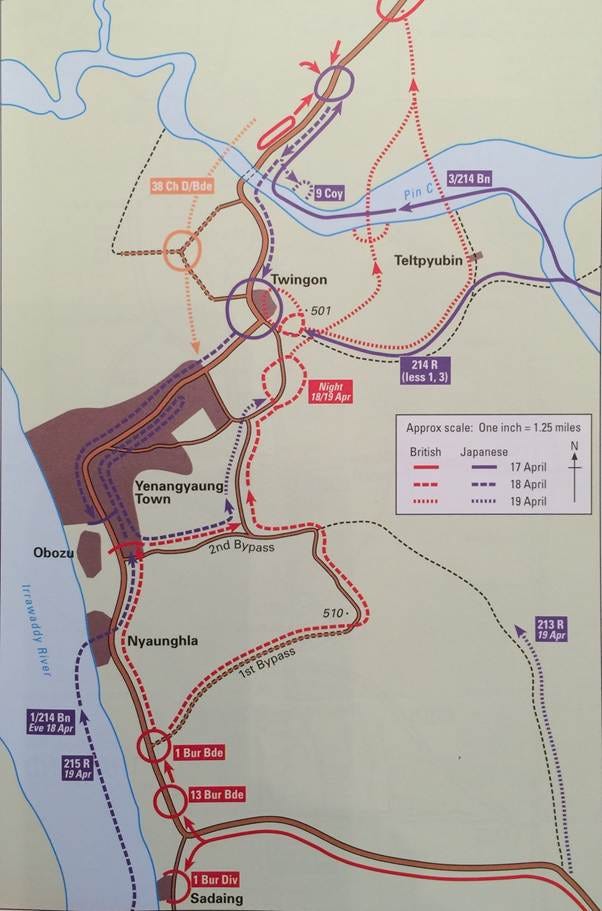
The fabulous map of Yenangyaung produced by the late Ian Lyall Grant.
The scrap at Yenangyaung was the final Corps-sized battle before the order to evacuate Burma Corps was given in early May. The Japanese had pushed out of Rangoon in mid-March, driving up the Irrawaddy on the left and against Toungoo on the right. Allied plans for the defence of Burma were inadequate, both Chinese (on the right) and Slim’s Burcorps (on the left) effectively fighting separate battles. Attempts by General Harold Alexander, the Army Commander, to control the battle and constrain the advancing Japanese ultimately came to naught. Alexander, Slim and Lieutenant General Joe Stilwell, nominally commanding the Chinese 5th Army, tried every trick in the tactical rule book to bring a halt to the relentless Japanese advance, and to destroy them in battle. After a month of fighting in which the Chinese were pushed out of Toungoo, the British lost control of Prome and an attempt to consolidate a defensive line across the country failed, the Japanese moved up the Irrawaddy in an attempt to turn the British flank, breaking in at the oilfield town of Yenangyaung on 17 April. At the time Slim’s Burma Corps was attempting to withdraw to the north from Allamyo. The Japanese infiltration into Yenangyaung cut the British in half. The 1st Burma Division was now cut off in Yenangyaung. The battle by the already weakened division (amounting to probably no more than 4,000 troops) into the Yenangyaung pocket over the period 17 and 19 April proved to be the severest trial yet faced by British troops in the short Burma campaign, the pressure applied by the Japanese exacerbated by the intense heat and the lack of water.
It was critical that Slim defeated this Japanese infiltration, rescue the 1st Burma Division from encirclement and retain the integrity of his Corps. If Yenangyaung were lost the Japanese would be free to sweep north to threaten Mandalay. It was crucial therefore that the divisional commander – Major General Bruce Scott – held on for as long as he could. But Slim had no reserve. The only hope of relief lay in assistance from the Chinese far to his right. He concluded that if he could engineer a attack into the pocket by the Chinese, across the Pin Chaung, combined with a breakout attack by 1st Burma Division, they might have a chance of escape. Nothing else looked likely to succeed.
When asked, Stilwell agreed to Alexander’s request for help to be provided to Slim, and gave him Lieutenant General Sun Lijen’s 38th Division – responsible for the defence of Mandalay – for the task. Chiang Kai-shek had given Sun responsibility for defending Mandalay. At midnight on 16 April Sun received an order from General Lo Cho-yin, “to dispatch his 113th Regiment to Kyaukpadaung, there to be commanded by the British General Slim …” Sun’s friend, Dr Ho Yungchi, recorded that by 3 a.m. he had arrived at Lo’s HQ at Pyawbe to discuss the order. Lo explained that the British were in serious trouble “in the oil town of Yenangyaung and had sent repeated requests for help”. By 6.30 a.m. it was agreed that Sun would personally take command of the 113th Regiment, while the two remaining regiments stayed to defend Mandalay. Sun and 1,121 men of 113th Regiment (commanded by Colonel Liu Fang-wu) arrived at Kyaukpadaung on the morning of 17 April.
Slim recalled: “The situation was not encouraging, and I was greatly relieved to hear that 113 Regiment of the Chinese 38th Division was just arriving at Kyaukpadaung. I dashed off in my jeep to meet their commander and give him his orders … this was the first time I had had Chinese troops under me … I got to like all, or almost all, my Chinese very much. They are a likeable people and as soldiers they have in a high degree the fighting man’s basic qualities – courage, endurance, cheerfulness, and an eye for country.”1
At Yenangyaung, Slim’s plan was for Sun’s 38th Division to attack from the north on the morning of 18th April while the 1st Burma Division, within the pocket, fought its way out. As Slim and Sun Lijen talked, discussing the details of the attack planned for the following morning Slim decided that he would place the Stuart tanks of the 7th Armoured Brigade directly under Sun’s command. It was only a move a man confident in the capabilities of his allies could make. Slim commented that “I was impressed by Sun and it was essential to gain his confidence. His division had no artillery or tanks of its own, and I was therefore arranging that all the artillery we had this side of the Pin Chaung and all available tanks should support his attack.” The commander of the British armoured brigade – Brigadier John Anstice – accepted this arrangement and according to Slim “he and Sun got on famously together”. What’s more, the soldiers worked well together too, Slim recording that the “gunners and tank crews, as is the way of British soldiers, soon got on good terms with their new comrades, and, in spite of language difficulties of an extreme kind, co-operation was, I was assured by both sides, not only close but mostly friendly.”2 Accordingly, at 6.15 a.m. on 18 April, Major Mark Rudkin of 2nd Royal Tank Regiment (2RTR) reported as instructed by Anstice to 38th Division HQ:
There was little activity except for the cooking of breakfast and it seemed most unlikely that the attack could start on time. I asked the British liaison officer with the Chinese what was happening and he informed me that as the Chinese realized that they would not be ready to attack at 0630 hours, they had put their watches back one hour, so that officially they were still attacking at 0630 though the time would in reality be 0730. They had, therefore, not lost “face” by being late.
The plan was that a troop of tanks would follow the leading troops of the leading Chinese battalion and give what support it could. Another troop was to follow the leading infantry battalion and assist the leading troop if required. The tanks would be almost entirely road bound owing to the going off the road.
At 0730 the assaulting Chinese moved forward off the ridge on a front of about four hundred yards, the leading troop keeping very close behind on the road. On foot near the tanks was a Chinese interpreter who carried out liaison between the tanks and infantry.
After advancing about half a mile the leading tank was hit by a Japanese 75-mm gun situated on the road just north of the Pin Chaung which was firing straight up 300 yards of road. The tank was disabled but there were no casualties.
The Chinese advance continued and by afternoon had almost reached the line of the ford on the Pin Chaung which was still held by the enemy. The Chinese had had heavy casualties, especially amongst officers, as it was the custom for Chinese officers to lead, whatever their rank. It was finally decided to hold positions about half a mile north of the crossing and continue the attack next day.3
With the first attack a failure, the Japanese retained their grip on both the ford and the village of Twingon. The situation for the surrounded remnants of the 1st Burma Division was desperate; the Japanese close to achieving a complete victory. Slim and Sun then worked through a plan for another attempt to be made the following morning, 19th April. This day also began badly, however. The Chinese attack was scheduled to begin at 7 a.m. British accounts subsequently recorded that a Chinese attack did not materialise at this time. Slim subsequently recorded in Defeat into Victory that the failure to attack must have been a function of the administrative difficulties faced by the Chinese. He wrote that with the Chinese “lack of signalling equipment, of means of evacuating wounded and of replenishing ammunition, and their paucity of trained junior leaders it was not surprising that to sort themselves out, reform, and start a fresh attack took time”.4 Slim was invariably impressed with what he saw of the Chinese soldier in action, but considered their support and command functions to be shockingly poor and a source of constant frustration to themselves, and to all who had occasion to operate with them.
Slim, and most other British published accounts, including the Indian and British Official Histories, record that the attack finally went in at 3 p.m., when Colonel Liu’s 113th Regiment successfully captured the ford and penetrated into Yenangyaung.5 “When the Chinese did attack they went in splendidly” wrote Slim in admiration. “They were thrilled at the tank and artillery support they were getting and showed real dash. They took Twingon, rescuing some two hundred of our prisoners and wounded. Next day, 20th April, the 38th Division attacked again and with tanks penetrated into Yenangyaung itself, repulsing a Japanese counter-attack. The fighting was severe and the Chinese acquitted themselves well, inflicting heavy losses, vouched for by our own officers.”
1. Slim, Defeat into Victory (1956), p. 63.
2. Ibid., p. 65.
3. Bryan Perrett, Tank Tracks to Rangoon: The Story of British Armour in Burma (London: Robert Hale, 1978)
4. Slim, op. cit., p. 70.
5. Bisheshwar Prasad (ed,) The Retreat from Burma 1941 – 42 (Calcutta, Combined Inter-Service Historical Section, 1954), p. 296.
Comments Off on Fighting at Yenangyaung, 17-19 April 1942
June 1, 2025
Panzers Attack! – Ten Days in Sedan
World War Two
Published 31 May 2025May 10, 1940. A new kind of warfare comes to the fore as a German Panzer Group rumbles through the Ardennes towards Sedan. Heinz Guderian has one goal in mind — Get to the Meuse! If he can manage that, then the Battle of France may be over before it even begins. Can the Allies hold back the armoured armada?
Chapters
01:05 German Forces
04:13 Blitzkrieg Theory, Applied
07:37 The Advance Begins
14:50 The Allied Plan
17:59 A Tight Schedule
20:57 Summary
21:16 Conclusion
(more…)
Comments Off on Panzers Attack! – Ten Days in Sedan
May 30, 2025
QotD: “Have fun storming the castle!”
Clifford Rogers has already laid out a pretty lay-person accessible account of the medieval siege playbook (in Soldiers’ Lives Through History: The Middle Ages (2007), 111-143; the book is pricey, so consider your local library), so I won’t re-invent the wheel here but merely note some general features. Rogers distinguishes between hasty assaults using mostly ladders launched as soon as possible as a gamble with a small number of troops to try to avoid a long siege, and deliberate assaults made after considerable preparation, often using towers, sapping, moveable shelters designed to resist arrow fire and possibly even catapults. We’ve already discussed hasty assaults here, so let’s focus on deliberate assaults.
While sapping (tunneling under and collapsing fortifications) remained in use, apart from filling in ditches, the mole-and-ramp style assaults of the ancient world are far less common, precisely because most armies (due to the aforementioned fragmentation combined with the increasing importance in warfare of a fairly small mounted elite) lacked both the organizational capacity and the raw numbers to do them. The nature of these armies as retinues of retinues also made coordination between army elements difficult. The Siege of Antioch (1097-8) [during] the First Crusade is instructive; though the siege lasted nine months, the crusaders struggled to even effectively blockade the city until a shipment of siege materials (lumber, mostly) arrived in March of 1098 (five months after the beginning of the siege). Meanwhile, coordinating so that part of the army guarded the exits of the city (to prevent raids by the garrison) while the other part of the army foraged supplies had proved mostly too difficult, leading to bitter supply shortages among the crusaders. Even with materials delivered to them, the crusaders used them to build a pair of fortified towers blocking exits from the city, rather than the sort of elaborate sapping and ramps; the city was taken not by assault but by treachery – a very common outcome to a siege! – when Bohemond of Taranto bribed a guard within the city to let the crusaders sneak a small force in. All of this despite the fact that the crusader army was uncommonly large by medieval European standards, numbering perhaps 45,000.
Crucially, in both hasty and deliberate assaults, the emphasis for the small army toolkit tends to be on escalade (going over the walls) using ladders or moveable wooden towers, rather than the complex systems of earthworks favored by the “big army” siege system or breaching – a task which medieval (or ancient!) artillery was generally not capable of. The latter, of course, is a much more certain method of assault – give a Roman army a few months and almost any fortress could be taken with near certainty – but it was a much more demanding method in terms of the required labor and coordination. Thwarting escalade is mostly a question of the height of defenses (because a taller wall requires a taller ladder, tower or ramp) and good fields of fire for the defenders (particularly the ability to fire at attackers directly up against the wall, since that’s where the ladders are likely to be).
The other major threat to castle walls (apart from the ever-present threat of sapping) was catapults, but I want to deal with those next time for reasons that I suspect will make sense then. For now it is worth simply noting that catapults, even the mighty trebuchets of the 14th century were generally used to degrade defenses (smashing towers, destroying crenellation, damaging gatehouses) rather than to produce breaches. They could in some cases do that, but only with tremendous effort and a lot of time (and sometimes not even then). Consequently, for most castles the greatest threat remained escalade, followed by treachery or starvation, followed by sapping, followed by artillery.
Bret Devereaux, “Collections: Fortification, Part III: Castling”, A Collection of Unmitigated Pedantry, 2021-12-10.
Comments Off on QotD: “Have fun storming the castle!”
May 15, 2025
Inventing “American Bushido“
Secretary of Defense Rock identifies where this new military cult came from:
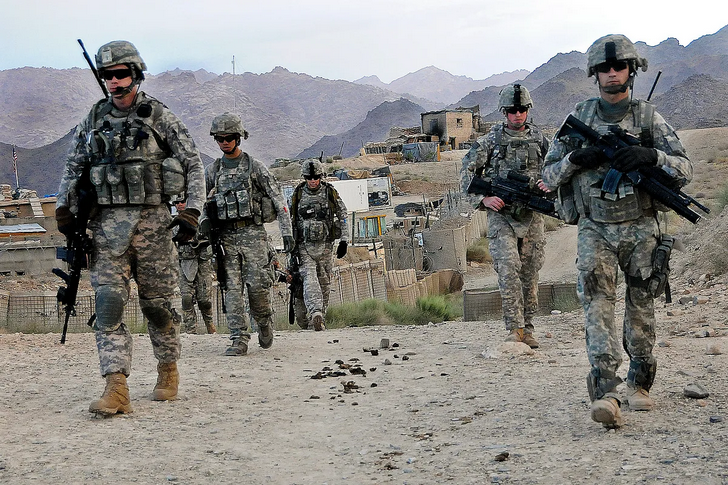
In the decades since the end of the Cold War, the United States military has undergone a cultural transformation — not merely in terms of technology, doctrine, or geopolitical posture, but in its self-conception. What has emerged is a new martial identity, one that fuses an idealized warrior code with fetishized notions of lethality and tactical superiority. This identity, what might be termed an “American Bushido“, is not merely a rhetorical or symbolic phenomenon. It is an ideological formation with material consequences for how wars are planned, how personnel are trained and selected, and how national security strategy is interpreted through the narrow prism of combat prowess. At its core, this American Bushido enshrines tactical skill and lethal capacity as ends in themselves, rather than as tools in service of coherent political objectives. But has also branched out more broadly into American society in unhealthy ways, corroding civic culture. This elevation of the warrior ethos risks distorting strategic judgment, encouraging a professional military caste isolated from civilian oversight, and glorifying violence as the central expression of national power at home and abroad.
The concept of Bushido, the feudal Japanese code of honor among the samurai, was historically a synthesis of martial discipline, spiritual rectitude, and absolute loyalty.1 In the twentieth century, however, Imperial Japan weaponized Bushido as state propaganda stripping it of nuance and repurposing it to justify fanatical nationalism, unquestioning obedience, and mass sacrifice in the service of empire leaving a trail of destruction and war crimes that rivaled Nazi Germany in World War II.2 On the tactical level, that meant banzai charges into machine gun fire and kamikaze missions that turned pilots into human-guided cruise missiles. On the strategic level, that meant one decisive battle that would single-handedly win the war in an era of mass mobilization. In the American context, however, Bushido has been appropriated and reimagined as a branding tool and cultural phenomenon: a way to market military service as a modern warrior whose path translates to all walks of life, stripped of its philosophical depth but saturated with over-the-top aggression.
[…]
In this context, the move toward an AVF, formalized by President Nixon in 1973 and championed by the Gates Commission in 1970, was seen as a political necessity and a strategic recalibration.3 The commission drew a sharp analogy between military service and public infrastructure, framing the draft as a form of taxation in service of national needs. As they put it, “It can expropriate the required tools and compel construction men and others to work until the job is finished or it can purchase the goods and manpower necessary to complete the job.”4 In this view, conscription was not a moral aberration but a practical mechanism through which the state could marshal resources, including human labor, to fulfill collective obligations.5 But this collective obligation had been pushed to the brink, and an all-volunteer force offered a path to professionalize the force, improve quality and morale, and insulate the military from the social upheavals tearing through the nation. Voluntarism was framed as a means of restoring legitimacy and operational effectiveness, ensuring that those who served did so by choice, not coercion. In many ways, voluntarism was a return to the American tradition but did so embracing the concept of the professional soldier and not the citizen soldier. While this shift solved many short-term problems, it also began a long-term process of separating the military from the broader public, contributing to the rise of a distinct warrior class and the cultural isolation of the armed forces from civilian society.
The development of the AVF worked about as one could expect through the 1980s, eventually culminating in the 100-hour war in the Persian Gulf, a campaign that showcased overwhelming American technological and tactical superiority with just 63 American dead.6 In the aftermath, President George H. W. Bush famously proclaimed, “By God, we’ve kicked the Vietnam syndrome once and for all!“7 But while the battlefield triumph seemed to bury the ghosts of Vietnam, the underlying mentality never truly died; it was only displaced. What had definitively died was the draft, and with it, the citizen-soldier model that had once anchored the American military to broader society. In its place emerged an increasingly professionalized force, insulated from the public and shaped by the lessons and traumas of a war that continued to cast a long shadow over American strategy, civil-military relations, and the political appetite for sustained conflict.
GWOT has accelerated American Bushido
The U.S. military’s post-9/11 transformation unwittingly accelerated this. Terms like “warfighter”, “operator”, and “lethality” replaced earlier bureaucratic or strategic vocabulary. Secretary of Defense Jim Mattis, nicknamed “Mad Dog” and revered for his battle-hardened persona, became the symbolic vanguard of this transformation. Phrases such as “unleash lethality” began appearing in speeches, documents, and strategic vision statements.8 Underlying all of this was a single premise: that the decisive instrument of American power was the warrior, and that the ultimate measure of military effectiveness is the capacity to kill.9
There is no doubt that tactical excellence is a prerequisite for military success, and nobody has done it better than the modern American military. But the rise of American Bushido has elevated tactical proficiency to the level of doctrine itself, often at the expense of strategic clarity. This phenomenon is not unique to the U.S., but it is particularly acute within a military-industrial ecosystem flush with funding, prestige, and cultural deference. The result has been a proliferation of elite units, special operations forces, and kinetic capabilities, often deployed with great fanfare but little discernible strategic gain, as given by the recent two-billion-dollar campaign attempting to pound the Houthis into submission in Yemen from the air.
[…]
Even still, it’s a bizarre framing because there never was a “warrior ethos” in the American tradition to nostalgically return to, at least not in the mythologized sense currently being invoked. The foundational ideal of national defense was not the professional warrior, but the citizen-soldier: an ordinary individual who took up arms out of civic duty, served for a finite period, and then returned to civilian life. Soldiering, in this tradition, was a temporary obligation, not a permanent identity. It was a job — necessary and honorable, but not meant to confer moral superiority or define a lifelong caste. Only a small number of officers and NCOs were considered to be professionals who led a variety of militia and volunteers in American conflicts.
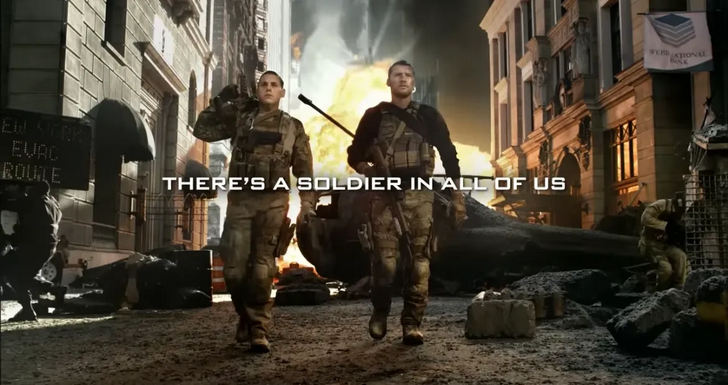
One might mistake the famous Call of Duty tagline “there’s a soldier in all of us”, as a manifestation of American Bushido. But in truth, it gestures toward the opposite. The commercial depicts ordinary people stepping briefly into a role demanded by extraordinary circumstances, the very ethos of the citizen-soldier tradition. However stylized or commercialized, the message remains: soldiering is not a sacred vocation reserved for an elite few, but a responsibility that can emerge from within the ordinary citizen. In that sense, there is a soldier in all of us.
1. See Inazō Nitobe, Bushido: The Soul of Japan (1900), Cameron Hurst, “Death, Honor, and Loyalty: The Bushidō Ideal”. Philosophy East and West 40, no. 4 (1990): 511–27. Tasuke Kawakami, “BUSHIDŌ IN ITS FORMATIVE PERIOD”. The Annals of the Hitotsubashi Academy 3, no. 1 (1952): 65–83, Karl F. Friday, “Bushidō or Bull? A Medieval Historian’s Perspective on the Imperial Army and the Japanese Warrior Tradition”. The History Teacher 27, no. 3 (1994): 339–49, and Stephen Turnbull, The Samurai and the Sacred (Osprey Publishing: Oxford, 1999).
2. For Bushido in the Imperial Japanese context, see John W. Dower, War Without Mercy: Race & Power in the Pacific War (Pantheon Books: New York, 1986), Edward J. Drea, Japan’s Imperial Army: Its Rise and Fall (University Press of Kansas: Lawrence, 2016, S. C. M. Paine, The Japanese Empire: Grand Strategy from the Meiji Restoration to the Pacific War (Cambridge University Press: Cambridge, 2017) The Wars for Asia, 1911–1949, (Cambridge University Press: Cambridge, 2012), and Robert Edgerton, Warriors Of The Rising Sun: A History Of The Japanese Military (Basic Books: New York, 1999).
3. Thomas S. Gates, The Report of the President’s Commission on an All-Volunteer Armed Force (Washington, DC: U.S. Government Printing Office, 1970).
4. Ibid., 23.
5. Milton Friedman, the 1976 Nobel Prize-winning economist, played a pivotal role on the Commission, where his influential intellectual arguments helped overcome the significant institutional resistance.
6. For scholarship on the military’s post-Vietnam recovery and AVF transition, see James F. Dunnigan, Raymond M. Macedonia, Getting It Right: American Military Reforms After Vietnam to the Gulf War and Beyond (William Morrow & Co: New York, 1993) and Suzanne C. Nielsen Lieutenant Colonel, An Army Transformed: The U.S. Army’s Post-Vietnam Recovery and the Dynamics of Change in Military Organizations (US Army War College Press: Carlisle, 2010).
7. Quoted from Maureen Dowd, “After the War: White House Memo; War Introduces a Tougher Bush to Nation”, New York Times, March 2, 1991.
8. U.S. Department of Defense, Summary of the 2018 National Defense Strategy of the United States of America (Washington, DC: DoD, 2018), 1.
9. The emphasis on the warrior ethos was set in motion in part because the events of March 23, 2003, when an 18-vehicle convoy from the 507th Maintenance Company took a wrong turn and was ambushed by insurgents in Nasiriyah, southern Iraq. See Vernon Loeb, “Army Plans Steps to Heighten ‘Warrior Ethos'”, Washington Post, September 8, 2003.
Comments Off on Inventing “American Bushido“
May 14, 2025
The Bomber Mafia & The Norden Bombsight – What The Heck Happened? The Bomber War Episode 2
HardThrasher
Published 28 Oct 2023Selected Internet Sources
Target for Today (1944) – Target For Today (1944)
https://www.navsea.navy.mil/Home/Warf… – LTE Thompson, first lead scientist at Dahlgren
https://www.amazon.co.uk/Scientist-Ex… – Donald Jacobs
The Fairey Battle – Light Bomber, Hea…
https://en.m.wikipedia.org/wiki/Point…
https://en.m.wikipedia.org/wiki/Butt_…
https://en.m.wikipedia.org/wiki/Area_…
https://en.m.wikipedia.org/wiki/Casab…
https://discovery.nationalarchives.go… – Western War Plan W5a and W6Selected Bibliography
America’s Pursuit of Precision Bombing 1910-1945 – McFarland et al.
Dresden – Sinclair McKay
Dresden; Tuesday … – Fredrick Taylor
Absolute War – The Firebombing of Tokyo – Chris Bellamy
Black Snow –
Bomber Command – Max Hastings
Bomber Command’s War Against Germany, An Official History – Nobel Franklin et al.
The Bomber Mafia – Malcolm Gladwell
Undaunted and Through Adversity (Vol 1 &2) – Ben Kite
United States Strategic Bombing Survey (European War) (USSBS) Sept 1945 – Var. – https://collections.nlm.nih.gov/catal…
America’s Pursuit of Precision Bombing 1910-1945, McFarland
Big Week – James Holland
Comments Off on The Bomber Mafia & The Norden Bombsight – What The Heck Happened? The Bomber War Episode 2
May 12, 2025
(A Few of) The Many Faces of the Dutch M95 Carbine
Forgotten Weapons
Published 16 Jun 2015When the Dutch military adopted the M95 Mannlicher rifle, they made a rifle for standard infantry, and a variety of carbines for specialist troops. These included artillery, cavalry, bicycle, engineers, and colonial service carbines. During World War I they attempted to standardize these and reduce the number of different designs, but met with only limited success. By the time World War II began, there were at least 13 different variants of M95 carbine in service with the Dutch military.
Comments Off on (A Few of) The Many Faces of the Dutch M95 Carbine
May 6, 2025
QotD: World War I shattered the European notion of what “war” actually was
We’ve actually talked before about just how profoundly our modern view of war and battle (and battlefields) is conditioned by the experience of the first world war and the vast literary production of the generation that went through those trenches. Certainly for English (and German and French, etc.) literature, World War I seems to almost snap the tradition in half, making everything before it feel trite and washing the whole of war literature in grim tones of field grey.
And, of course, that is the point. World War I was a new kind of war that shattered the old certainties born out of the old kinds of war. It is often a mistake to assume those old certainties had been born out of some eternal peace, but while the 1800s had not seen a general European war, they had seen many wars, in the many imperial possessions of European countries, on the edges of what the British or French considered “Europe” and also in the heart of Europe itself (not to mention a few dust–ups in the Americas). These were not peaceful societies confronting their first war and shocked by the experience, but very bellicose societies encountering for the first time a new sort of war and being stunned at how different it was from what they had expected, from the wars of their (recent!) past.
All of which is to say war, war really does change. And warriors with it.
Bret Devereaux, “Collections: The Universal Warrior, Part IIb: A Soldier’s Lot”, A Collection of Unmitigated Pedantry, 2021-02-05.
Comments Off on QotD: World War I shattered the European notion of what “war” actually was
May 2, 2025
The New York Times still values “the narrative” more than the truth
Alex Berenson on the way the New York Times chose to present the summary of the crash investigation on the fatal collision between a US Army Black Hawk helicopter and a commercial passenger aircraft over Washington DC:
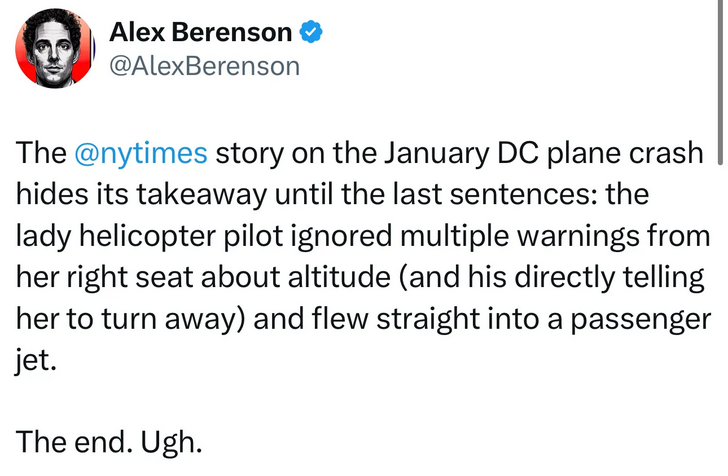
The New York Times cannot stop mangling the truth to serve its political goals.
On Sunday, the paper exhaustively examined the collision between an Army Black Hawk and an American Airlines jet that killed 67 people over the Potomac in January.
The massive 4,000-word article claimed the crash had many causes, including an overworked air traffic controller. “Missteps, Equipment Problems and a Common but Risky Practice Led to a Fatal Crash“, the Times proclaimed.
Except that’s not really what happened. Or what the Times found.
Yes, the controller was busy. Yes, the Black Hawk pilots wore night-vision goggles that can, ironically, complicate seeing in cities with lots of ambient light.
Those choices and problems raised the risks of an accident.
But despite all the words the Times devoted to explaining the crash, its root cause was simple. The Black Hawk was flying too high. It flew directly into the CRJ700 regional jet. The plane’s pilots and passengers had no chance.
That’s the reality. The second reality is that an inexperienced female Army pilot, Capt. Rebecca Lobach, 28, (CORRECTION: original article said 36) was at the controls of the Black Hawk when it hit the CRJ700, on a training and evaluation mission.
What the Times actually found, the news in the article, is that the Lobach’s copilot repeatedly warned her the helicopter needed to descend in the minutes before the accident. Just seconds before the crash, he suggested she tack left, a path that would likely have avoided the jet.
She didn’t respond.
In other words, the story here is that Lobach — who had never deployed overseas but had volunteered in the Biden White House and whose obituary prominently called her a certified advocate for “sexual harassment” victims — flew her helicopter into a passenger jet and killed 67 people, including herself.
Comments Off on The New York Times still values “the narrative” more than the truth
May 1, 2025
Military Tactics In The Falklands
Pegasus Tests
Published 27 Dec 2024A discussion with Ian McCollum of Forgotten Weapons about Argentine and British tactics during the Falklands War.
#forgottenweapons
Comments Off on Military Tactics In The Falklands
April 30, 2025
QotD: The experience of the infantryman through the ages
Well, here is where we come back to the note I made earlier about how “warring” and “soldiering” were different verbs with different meanings. After all, while soldiering implies these difficulties, warring doesn’t, necessarily. And it isn’t hard to see why – the warrior classes in these societies, often being aristocrats, generally didn’t do a lot of these things. It is, for instance, noted in the Roman sources when a general chose to eat the same food as his soldiers, because most Roman aristocrats didn’t when they served as generals or military tribunes. The privileges of rank and class applied.
And that’s something we see with medieval aristocrats too. On the one hand, Jean de Bueil talks about the “difficulties and travail” of war, but at the same time, Clifford Rogers notes one (fictional and lavish, but not outrageous) war party “suitable for a baron or banneret” included a chaplain, three heralds, four trumpeters, two drummers, four pages, two varlets (that is, servants for the pages), two cooks, a forager, a farrier, an armorer, twelve more serving men (with horses, presumably both as combatants and as servants), and a majordomo to manage them all – in addition to the one lord, three knights and nine esquires (C. Rogers, Soldiers’ Lives through History: the Middle Ages (2007), 28-9).
Jean le Bel (quoted in Rogers, op. cit.) contrasts the situation of the nobles in Edward III’s army (1327), where “one could see great nobility well served with a great plenty of dishes and sweets – such strange ones that I wouldn’t know to name or describe them. There one could see ladies richly adorned and nobly ornamented” while in the camp proper an open brawl between the regular soldiers from England and Hainault broke out and eventually turned into an open battle in which 316 died, but so segregated was the camp that, “most of the knights and of their masters were then at court, and knew nothing of this” (Rogers, 66-7). Likewise, except in fairly extreme positions, most of the ditch-digging, camp-building duties would fall to the common soldiers (and, as Roel Konijnendijk can quite accurately tell you, ditches are important! When in doubt, dig some ditches – or make others dig ditches for you).
That said, these differences are not merely confined to the high aristocrats. Marching under a heavy load is often given as one example of the quintessential “soldier experience”, but it seems that many Greek hoplites went to war with a personal slave or servant to carry their equipment for them, despite being infantrymen. The Romans carried equipment and supplies something closer to what a modern soldier might (both in terms of weight and also, apart from ammunition, in terms of what was carried), but then non-Roman sources like the Greek writer Polybius (18.18.1-7) or the Jewish writer Josephus (BJ 3.95) appear quite stunned with the amount of tools and equipment the Romans carry (and Polybius, by the by, is writing before Marius’ mules). Evidently the Roman impedementia was quite a bit heavier, though even the Macedonians carried much more than a Greek hoplite army (Note Engels, Alexander the Great and the Logistics of the Macedonian Army, 1978 on this).
Meanwhile, Jonathan Roth is quick to note (in The Logistics of the Roman Army at War (264 B.C. – A.D. 235) (1999)) that despite either bad or insufficient rations being a common complaint of soldiers, such complaints appear absent from Roman sources, even in the context of legionary mutinies. Indeed, the evidence suggests that Roman soldiers ate quite well, with fairly ample rations. In camp the Roman soldier’s diet was not so different from what he might eat in peacetime (especially once we get into the imperial period with legions stationed in semi-permanent bases); on the march they had to make do with bucellatum, a hard biscuit something like hardtack. But for many Italian peasants, the diet doesn’t seem to have been much worse – or much different – from what they ate in peacetime.
By way of sharp contrast to the plodding, heavily loaded but surely very lethal Roman legionary, the impis of the Zulu traveled fast, light and sometimes somewhat hungry. Zulu warriors generally carried only their equipment on the march, while supplies were carried by udibi, boys serving as porters. Even then, such supplies were minimal – the Zulu force that arrived at Rorke’s Drift (1879) had only been out six days, but none of the warriors in it had eaten in two. Such minimally supplied flying columns, moving fast and with considerable stealth (one cannot read anything on the Anglo-Zulu war without noticing how, even with cavalry scouts, Zulu impis seem so often just to appear next to British forces) were the norm for Zulu warfare. And to be clear, this wasn’t some “primitive” or underdeveloped form of war – the light and fast operational movements of the Zulu were intentional (much of it was a product of Shaka’s reforms) and very effective – albeit not so effective as to offset the massive advantages the British possessed in population, economic capacity or military technology. Nevertheless, not even every sort of common soldier was the heavily loaded, slow moving, well-fed ditch-digging sort like the Romans. The “soldier experience” needs to cover the lightly loaded and armed, fast moving, hungry, non-ditch-digging Zulu experience too.
And then of course when we consider nomadic peoples, we find that in many cases their lives on campaign were not that much different from their lives at peacetime, involving many of the same skills and activities.
In short, the experience of the drudgery of war – the bad food, long toil, heavy encumbrance and so on was all still quite contingent (or we might say “dependent”) on the society going to war. Social divisions mattered. Expectations about masculine behavior mattered. Military systems mattered. Yes, modern armies in the European tradition expect their soldiers to do a lot of labor and drudgery, but remember where that military system came from: it was the system of the common soldiers serving under the aristocrats who most certainly did not do those things but who did impose sharp, corporal discipline. Which, to be clear, doesn’t make this system ineffective – it was clearly effective. The point here is that it was socially contingent – a different society would have come up with a different system. And they did! The Early Modern European system is only one way to organize an army and historically speaking not even the most common.
Bret Devereaux, “Collections: The Universal Warrior, Part IIb: A Soldier’s Lot”, A Collection of Unmitigated Pedantry, 2021-02-05.
Comments Off on QotD: The experience of the infantryman through the ages
April 14, 2025
Huế: Battle for the Heart of Vietnam
Army University Press
Published 22 Nov 2024The Battle of Huế is known for urban combat, destruction, and anguish. The city of Huế mattered to all the combatant forces. The city and its people paid the price. Interviews with noted subject matter experts Drs. Pierre Asselin, Gregory Daddis, James Willbanks, and Cpt. Wyatt Harper are augmented with archival audio and film, and detailed maps. This documentary places the Battle of Huế within the context of Hanoi’s 1968 Tet Offensive. How North Vietnam, South Vietnam, and the United States perceived the Vietnam War in 1967 and 1968 are central to this documentary. Covered are the key moments of the battle — including the People’s Armed Forces of Vietnam (PAVN) and People’s Liberation Armed Forces (PLAF) planning and assault on Hue. The responses of the Army of the Republic of Vietnam (ARVN), Vietnam Marine Corps (VNMC), the United States Marine Corps (USMC), and the U.S. Army (USA) are addressed to offer insight into an informative example of urban warfare.
0:02:39 – Why the Tet Offensive
0:10:53 – Why Huế
0:15:53 – Military Decision Making Process | Doctrine
0:26:51 – Warfighting Function | Doctrine
0:27:59 – Paralysis by analysis | Doctrine
0:33:15 – Courses of action | Doctrine
0:38:22 – Weather and operations | Doctrine
0:40:52 – Huế Massacre
0:41:18 – My Lai
0:46:05 – Huế and Modern Warfare
Comments Off on Huế: Battle for the Heart of Vietnam


