Quotulatiousness

September 5, 2018

QotD: Why did appeasing the Fascist dictators seem such a sensible policy?

Filed under: Europe, History, Quotations — Tags: , , , , , — Nicholas @ 01:00

It is a familiar student essay question, whether the revolution could have been averted, but for the world war and resultant loss of up to three million Russian lives. It seems more useful merely to suggest that, in the political and ideological climate of the early 20th century, the collectivist experiment was bound to be attempted somewhere, and Russia or China were obvious testbeds. The consequences for millions of Russian peasants, together with the ferocity of Soviet oppression, were successfully concealed from most western eyes for half a century. The 1789 French revolution killed only a few thousand aristocrats and transferred land to peasants, who thus became ardent upholders of property rights. The Russian version required liquidation of the entire governing class and transfer of land to collective ownership, an incomparably more radical proceeding. Douglas Smith’s 2012 book Former People gives a harrowing account of the fate of the Tsarist aristocracy.

In the West, the gullibility of the Webbs, Bernard Shaw and the rest of the ‘true believers’ was fed by a desperation to suppose the Soviet example viable. ‘Looking around us at our own hells,’ wrote the historian Philip Toynbee, who became a communist at Cambridge, ‘we had to invent an earthly paradise somewhere else’. As late as 1945, the leftist publisher Victor Gollancz brought posterity’s contempt upon himself by declining to publish Animal Farm, George Orwell’s great satire on Bolshevism.

For a counter-revolutionary contemporary perspective, it is impossible to understand the 1930s appeasement of the dictators without grasping the traumatic impact of events in Russia on the propertied classes everywhere. The Winter Palace was stormed only 16 years before Hitler came to power. For at least two decades, Europe’s ‘haves’ were far more frightened of Bolshevism than of fascism.

The ‘clubland hero’ novels of John Buchan and Sapper offer embarrassing glimpses of the British bourgeois view of Lenin’s people and their followers in the decades following the revolution. A belief took hold in polite circles that the bloodiest revolutionaries were not merely communists but also Jews, which meant they were doubly damned in St James’s clubs.

Max Hastings, “The centenary of the Russian revolution should be mourned, not celebrated”, The Spectator, 2016-12-10.

August 22, 2018

“The current spate of Jew-baiting is … like a Lord Of the Flies of the Woke”

Filed under: Britain, Media, Politics — Tags: , , , , — Nicholas @ 05:00

Julie Burchill‘s latest column at Spiked:

As a lifelong cheerleader for the Jewish people, these recent months have been bittersweet for me; a highly unusual example of not wanting to be proved right. I resigned from the Guardian a whopping 15 years ago in protest over what I perceived as its slimy anti-Semitism – and, it must be admitted, the offer of three times the wages from The Times. I often wonder how the left-wing Jewish half-wits who slammed me then feel now that they’ve been well and truly trashed by the bullies they sucked up to.

The current spate of Jew-baiting is interesting in that it’s like a Lord Of the Flies of the Woke; raised on tofu and now high on the taste of blood, the snowflakes have finally found a minority group it’s fine to demonise, and my gosh, doesn’t that Two Minute Twitter Hate feel good! (The meekness of the diaspora Jews makes them honorary women in the eyes of the left – then the toughness of the Israelis sends the brosocialists into a maelstrom of cognitive dissonance a gogo.) But I’m hoping my Jewish chums and I can put the unpleasantness out of our minds for a few tuneful hours when Trevor Nunn’s revival of Fiddler On The Roof opens in December, just in time for Hanukkah.

This heart-warming story follows the fortunes of a Jewish milkman living in a Russian village with his wife and five daughters as he fights to hold on to his dignity among growing anti-Semitism – what a relief that times have changed! In the spirit of keeping an open mind, I’m going to apply the popular PC theory of extreme type-casting to my appreciation of the new Fiddler, and sincerely trust that JEWS ONLY will be cast in the main roles – I don’t mind if Gentiles play such minor roles as Russian Official and Priest. After all, the singer Sierra Boggess, after being judged too pallid for the role of West Side Story’s Puerto Rican heroine Maria in the BBC Proms production, recanted in a positively Orwellian fashion after social-media monstering. As did Scarlett Johansson recently after being being bullied out of a putative role as a cross-dresser. Women, eh? Even the divas among us are so used to saying sorry that it’s a wonder we ever got the vote – imagine the Suffragettes today, going around apologising to racehorses for being insufficiently sensitive to their shared cultural oppression!

May 23, 2018

“Red Ken” leaves the Labour Party

Filed under: Britain, Politics — Tags: , , , — Nicholas @ 03:00

The former Lord Mayor of London resigned from the British Labour Party earlier this week:

Ken Livingstone resigned from the Labour Party yesterday. Allegations of anti-Semitism, following his comments about Hitler supporting Zionism, had, he said, become a distraction. Indeed, his ongoing membership of the party had become a particular problem for Labour leader Jeremy Corbyn, his friend and ally, whose leadership has been dogged by the suggestion that he is soft on left anti-Semitism. Nevertheless, Livingstone’s resignation is a cruel end to a career that saw him twice govern London as mayor, earn a reputation for radicalism, and play a decisive part in the development of the policy of ‘equal opportunities’ at work.

He was elected to represent Norwood on the Greater London Council (GLC) in 1973. He became head of the GLC in 1981, until it was abolished by the Conservative government in 1986. In 2000, when the Labour government created the Greater London Authority, and a new elected mayoral position, Livingstone was blocked by the party hierarchy from standing. Instead he ran as an independent and won. Later he was re-elected as a Labour candidate and held the position until he was defeated by Boris Johnson in 2008.

In the 1980s, Livingstone was one of the left-wingers who took control of London boroughs after Labour lost control of central government. Seeing that the old alliance of trade unions and Labour was no longer successful in rallying voters, Livingstone set about mobilising other constituencies. As had been trialled in Lambeth council by Ted Knight and Herman Ouseley, Livingstone set up a race-relations unit at the GLC, with a special remit to address discrimination in the recruitment of its workforce.

With similar policies extended to women’s employment, and later to the employment of lesbian and gay employees and those with disabilities, the GLC policy formed the archetype for the equal-opportunities policies that are today ubiquitous.

[…]

Livingstone has certainly given his opponents a lot of ammunition. He defends a view of Zionism as a collaboration with Nazism that loses sight of the difference between the two. He could claim that it is not his historical thesis, but one supported by such writers as Lenni Brenner. Still, more than a few people have noticed that Livingstone seems a bit stuck on this claim, in a way that suggests he might relish provoking Jewish activists and journalists.

Nevertheless, there is a lot of bitter resentment held by more moderate Labour supporters about the way that the left of the party has berated them over questions of racial justice over the years. And so the issue of anti-Semitism has become a means for some of them to get some payback by denouncing Livingstone’s supposed anti-Semitism.

Many of those denouncing Livingstone today are seeking to paint him – and, by connection, Corbyn’s team – as hopelessly anti-Semitic. In doing so they appear indifferent to the debt they owe to Livingstone for the development of equal-opportunities policies, whose very logic they are using to denounce an enemy for his improper expressions.

May 22, 2018

“[Hamas] knows there is a market for stories of Palestinian pain, and it is happy to flood that market”

Filed under: Media, Middle East — Tags: , , , , , , , — Nicholas @ 05:00

In Spiked, Brendan O’Neill explains why Hamas is so willing to literally sacrifice Palestinian lives for media coverage:

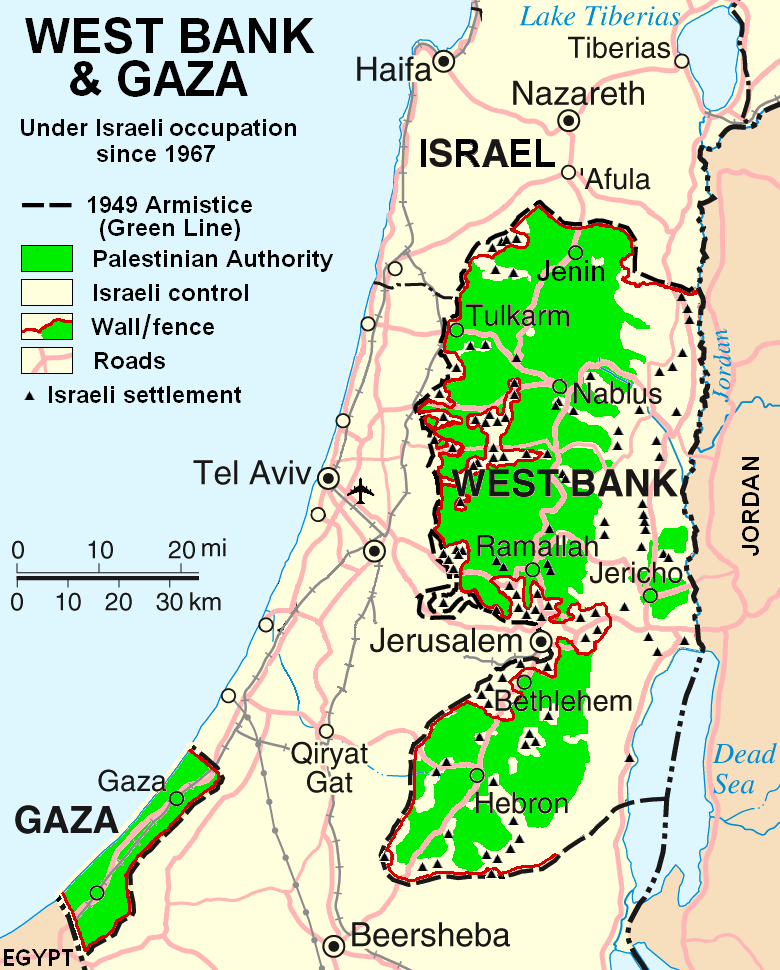
A 2007 map of the West Bank and Gaza, showing Israeli settlements
Via Wikimedia Commons

It is becoming increasingly clear that Hamas pushes Gaza’s people into harm’s way because it knows their suffering will strike a chord across the West. Because it knows images of their hardship will be shared widely, wept over, and held up as proof of the allegedly uniquely barbarous nature of the Jewish State. Hamas knows there is a hunger among the West’s so-called progressives for evidence of Palestinian pain, and by extension of Israeli evil, and it is more than willing to feed this hunger.

The clashes at the Gaza border, in which more than 60 Palestinians were killed and hundreds injured, cannot be viewed in isolation from Western liberals’ peculiar and disproportionate obsession with Israel. It now seems undeniable that this was no instinctive, grassroots protest, but rather one that was carefully orchestrated by Hamas. As a New York Times reporter described it, after midday prayers clerics and leaders of Hamas ‘urged thousands of worshippers to join the protests’. And Hamas’s urging was littered with false claims. It told people ‘the fence had already been breached’ and Palestinians were ‘flooding into Israel’. This was a lie. A Washington Post reporter details how Hamas’s leaders told people to keep attacking the border fence because ‘Israeli soldiers [are] fleeing their positions’. In truth, as Hamas knew only too well, the IDF was reinforcing its positions.

Israel had made clear, including in an airdrop of leaflets, that anyone who sought to dismantle the fence in Gaza, the de facto border between this part of Palestine and Israel, risked coming to harm. And still Hamas encouraged the protesters to strike at the fence. Still it sought to swell the angry ranks by pleading with people to go from their mosques to the border. Why would it do this? Why would the governing party of a territory knowingly put that territory’s citizens into serious danger?

This is the rub. This is the central question. And the answer is a disturbing one: Hamas does this because it knows it will benefit politically and morally if Palestinians suffer. It knows there is a market for stories of Palestinian pain, and it is happy to flood that market.

Writing in the New York Times last week, Matti Friedman, a former AP desk editor in Jerusalem, touched upon this trade in Palestinian horror. He said that during his years reporting from the Middle East he even developed a certain respect for Hamas’s ‘keen ability to tell a story’. Hamas’s great insight was to recognise that the vast majority of the Western media wanted ‘a simple story about villains and victims’, says Friedman. Most Western reporters and commentators weren’t interested in nuance and certainly not in any reading of events that might seek to understand the Israeli position. No, they wanted stories of ‘dead human beings’, made dead by ‘unwarranted Israeli slaughter’, says Friedman.

May 18, 2018

Rebellion I THE GREAT WAR Week 199

Filed under: Europe, France, History, Military, WW1 — Tags: , , , , , , — Nicholas @ 04:00

The Great War
Published on 17 May 2018

The summer of 1918 saw many ethnic and political groups within the warring empires to openly rebel. The Austro-Hungarian Army saw open mutiny every week, the Irish rebelled against the British, the situation in the newly annexed Eastern European territories that were now part of the German Empire was a powder keg. And in France civilians were sentenced to death for treason.

April 18, 2018

Israel at 70

Filed under: History, Middle East, Religion — Tags: , , , , — Nicholas @ 03:00

In the National Post, Barbara Kay explains why the world should (but largely will not) celebrate the 70th anniversary of the foundation of the state of Israel on Thursday:

Making the case for Israel’s territorial and political rights involves a deep knowledge of Jewish and Arab history, understanding of the complexities around the reconstruction of the modern Middle East from the ashes of the Ottoman empire, and a plod through a litany of declarations, mandates, commissions, conferences and international legal documents that most Israel defenders aren’t even aware of, let alone able to deploy in debate with rhetorical economy.

Moreover, since the 1967 war, which changed so much on the ground, even the Israeli government hasn’t pressed itself to defend Israel’s historic rights in any systematic way (apart from crises, as in 2016, when the Palestinians drafted a resolution for UNESCO, whose language deliberately detached Jewish ties from Judaism’s holiest sites). With the 1993 Oslo peace process, the issue of legal rights fell further off the communications radar.

When it became clear over the next tumultuous decade that terrorism could not destroy Israel, Israel’s enemies ramped up the campaign to undermine her legitimacy as a member state within the international community. Once the Palestinian strategy of revisionist history replaced organized physical violence — including outright lies as in the UNESCO fiasco — it became clear that a fact-based counteroffensive was needed.

For in the end, it will be international law and accords, not blood libels and emotional mantras, that will settle the matter of Israel’s literal legitimacy. Israel was created, like many other countries, after a successful war in which no other country came to its aid. Gaza, Judea and Samaria were conquered by Jordan and Egypt illegally, as they had no claim to them, while Israel did. The Palestinian territories are not in fact “occupied” in law; rather they are “disputed.” The word “settlements” imply Jews are foreigners in their own homeland, which they are not. Jews have built 140 communities in Judea and Samaria since 1967, which excites condemnation. The Arabs have built 260 communities in Judea and Samaria since 1967, which excites … silence.

April 10, 2018

France Before WW1 – La Belle Époque? I THE GREAT WAR Special

Filed under: France, History, Military, WW1 — Tags: , , , , — Nicholas @ 04:00

The Great War
Published on 9 Apr 2018

The time between the French defeat against Prussia in the Franco-Prussian War and the outbreak of the First World War is often described as the Belle Époque. But it certainly was a turbulent time for one of the major world powers too.

March 16, 2018

Anti-semitism and the alt-right

Filed under: History, Politics — Tags: , , — Nicholas @ 03:00

Jonathan Anomaly and Nathan Cofnas discuss the widespread anti-semitism of the various groups we generally lump together as “alt-right”:

For many on the alt-right, every grievance is, at root, about Jews. Andrew Anglin, host of the most popular alt-right/neo-Nazi website, explains: “the only thing in our movement that really matters [is] anti-Semitism.” If only the Jews were gone, he argues, the white race, freed from bondage, would immediately overcome all of its problems. Where does this attitude come from?

Jews are a conspicuous people, small in number but large in footprint. As Mark Twain wrote in 1899:

    If the statistics are right, the Jews constitute but one quarter of one percent of the human race….Properly, the Jew ought hardly to be heard of, but he is heard of, has always been heard of. He is as prominent on the planet as any other people, and his importance is extravagantly out of proportion to the smallness of his bulk….What is the secret of his immortality?

For many people throughout history, the answer to Twain’s question was simple: Jews conspire among themselves to dominate and disadvantage gentiles. This answer fell out of fashion, at least in polite society, after World War II. Since the 1990s, however, the conspiratorial account of Jewish prominence has taken on a new, more meretricious form in the work of (now retired) California State University, Long Beach psychologist Kevin MacDonald, known affectionately among alt-righters as “KMac.” According to Richard Spencer, the inventor of the term “alt-right” and unofficial leader of the movement: “There is no man on the planet who has done more for the understanding of the pole around which the world revolves than Kevin MacDonald.” And: “KMac…may be the most essential man in our movement in terms of thought leader[ship].” To understand the alt-right’s anti-Semitism, we must understand MacDonald’s ideas, particularly as outlined in his most influential book, The Culture of Critique.

According to MacDonald, Judaism is a “group evolutionary strategy.” Jews possess both genetic and cultural adaptations (including, on the genetic side, high IQ and ethnocentrism) that allow them to develop successful intellectual movements that undermine gentile society and promote their own group continuity. “Jewish intellectual movements,” MacDonald argues, are led by charismatic figures analogous to rabbis. They attack white nationalism while promoting Jewish nationalism, and use pseudoscience to “pathologize” anti-Semitism, which in reality is a justified response to “Jewish aggression.” According to MacDonald, Jewish intellectual movements include Freudianism, Frankfurt School critical theory, and multiculturalism. These movements, MacDonald claims, taught white gentiles to reject ethnocentrism and accept high levels of nonwhite immigration to their countries while tolerating Jewish ethnocentrism and racially restrictive immigration policies in Israel.

MacDonald’s theory and the anti-Semitism of many on the alt-right are largely reactions to the perceived liberalism of Jews. One of us (Cofnas) has just published an academic paper that examines MacDonald’s most influential book, The Culture of Critique, and finds that it is chock full of misrepresented sources, cherry-picked facts, and egregious distortions of history. MacDonald and the alt-righters are, nevertheless, correct that many liberal leaders over the last hundred years have been Jewish. We’d like to offer an explanation for this phenomenon, as well as determine whether Jewish liberalism is the cause or the result of anti-Semitism.

February 22, 2018

DicKtionary – E is for Eugenics – Otmar von Verschuer

Filed under: Germany, History, Science — Tags: , , , , — Nicholas @ 06:00

TimeGhost
Published on 21 Feb 2018

E for eugenics, pseudo science about race,
Selective breeding of humans can make the world a purer place,
When saying, “that’s scary”, those words are ne’er truer,
Then of the main man today, Otmar von Verschuer.

Hosted by: Indy Neidell
Written by: Spartacus Olsson
Produced and Directed by: Astrid Deinhard
Executive Producers: Bodo Rittenauer, Astrid Deinhard, Indy Neidell, Spartacus Olsson
Camera by: Jonas Klein
Edited by: Spartacus Olsson, Jonas Klein

A TimeGhost chronological documentary produced by OnLion Entertainment GmbH

February 9, 2018

DicKtionary – C is for Car – Henry Ford

Filed under: Business, History, USA — Tags: , , , , — Nicholas @ 06:00

TimeGhost
Published on 8 Feb 2018

C is for car – the automobiles
And nothing is cooler than a boss set of wheels,
From selling some cars, this man made a horde,
Mechanic and boss man, here’s Henry Ford.

Hosted and Written by: Indy Neidell
Based on a concept by Astrid Deinhard and Indy Neidell
Produced by: Spartacus Olsson
Executive Producers: Bodo Rittenauer, Astrid Deinhard, Indy Neidell, Spartacus Olsson
Camera by: Ryan
Edited by: Bastian Beißwenger

A TimeGhost documentary format produced by OnLion Entertainment GmbH

August 18, 2017

QotD: “Justifying” the Holocaust

Filed under: Europe, History, Media, Politics, Quotations — Tags: , , , , , — Nicholas @ 01:00

… that underlying tone of “Of course what Hitler and the Nazis did was unjustifiable, they were wrong about what was going on around them” whenever the topic of the Holocaust is discussed implies that, if they had been right, what they did would have been, at least, justifiable. In other words, there’s an acceptance of the underlying logic of collective justice going on there, and when you put adjectives in front of justice, you almost never get justice.

Which brings us to the current brawl in SF/F and the wider culture. There’s a very large swathe, of Western society that has regressed, though they call it progress, to the idea that one should deliberately punish all members of a group for the actions, real or imagined, of a few members, and to the idea that because members of a group are over-represented in a particular area that it is a deliberate choice on the part of the group, rather than an accident of history.

You see it nearly everywhere. The idea that SF was somehow filled with racist, sexist hatemongers until … well, as near as I can tell, around five years ago is ludicrous when you have H. Beam Piper writing stories where racial intermarriage has turned almost all of humanity a nice shade of brown and there are heroic characters with names like Themistocles M’Zangwe. But, even if that were true — what, we should stop reading (and buying books from) straight white male authors for an entire year? Because a bunch of people they never even met were theoretically jerks?

Sarah Hoyt, “Social Injustice – 60 Guilders”, According to Hoyt, 2015-07-31.

August 9, 2017

Ernst Zündel, “the Zelig of Holocaust denial”

Filed under: Cancon, Germany, History, Media, Politics, WW2 — Tags: , , , , — Nicholas @ 05:00

In the National Post, Colby Cosh tells the tale of Canada’s “favourite” holocaust denial specialist:

Ernst Zündel in 1992 on the day of his legal victory in R. v. Zündel (via Wikipedia)

Ernst Zündel, the Zelig of Holocaust denial, died suddenly this weekend at his ancestral home in the Black Forest of Germany. If he had died sooner, before his 2005 deportation from this country, I am afraid he would have been widely described in obituaries as “German-Canadian.” He lived here from 1958 to 2000, unsuccessfully trying a couple of times to obtain official citizenship, and was visible for years as a self-styled opponent of Germanophobic stereotypes in the popular media.

Foreseeably, Zündel turned out to be the ultimate German stereotype himself: a war baby who used Canada as a refuge from conscription and anti-Nazi laws back home, all while obsessively re-litigating the Second World War in pseudonymous anti-Semitic pamphlets and books. Most ethnic Germans abroad wouldn’t deny the Holocaust or complain of a worldwide Jewish conspiracy, as Zündel did, but… well, if you have studied German history seriously enough to talk about it socially, you will have run into folks who have funny ideas and tiny chips on their shoulder about, say, First World War reparations or the bombing of Dresden.

[…]

It should be remembered that by 1986 Zündel was already well on his way to establishing his place in Canadian legal history. He had already been convicted once under the Criminal Code’s “spreading false news” section, eventually struck down by the Supreme Court in 1992’s R. v. Zündel. Free speech absolutists argued then that the legal and social pursuit of Zündel merely served to increase his notoriety.

As a purely empirical question of history, this is hard to resolve. But we know that protests and the exertions of the police failed to stop Zündel from winning over Irving, and thus acquiring international influence. It may have done nothing but enhance his credentials as a pseudo-intellectual grappler, defying social scorn and the force of law.

The authorities were eventually able to bundle Zündel off to Germany through a legal door that has since closed. He was deported as an undesirable alien on the basis of a ministerial “security certificate” — not long before the Supreme Court denounced the use of secret evidence in deportation proceedings, and made such certificates harder to obtain. After Zündel’s deportation, an apparatus of progressive opposition to security certificates was quick to materialize. One cannot help wondering: if he were still alive in Canada in 2017, and the state tried to banish him, who might be out marching on his behalf, defending him as an “undocumented Canadian”?

April 1, 2017

Catherine the Great – Lies – Extra History

Filed under: Europe, History, Russia — Tags: , — Nicholas @ 02:00

Published on 11 Mar 2017

Catherine the Great ruled for many years – too many for a six episode show to cover completely. James talks about the mistakes we made and the stories we left out!

March 20, 2017

“We call this pope’s persistent heresy ‘Marcionism'”

Filed under: Religion — Tags: , , , , — Nicholas @ 05:00

David Warren calls out the pope for his heterodox views:

The Left mildly disguise their anti-Semitism by substituting the term “Zionists” for Jews. Our pope does it by substituting “Pharisees” and like terms, in his daily homiletic attacks from Santa Marta — aimed chiefly against Catholic doctrinal precision. Our Saviour, who could hardly have been an anti-Semite, being Jewish himself, did make actual Scribes and Pharisees the butt of parables, and was very sharp on religious hypocrisy. But this was not to the purpose of disowning their religion; rather of showing how representative characters were disowning their own.

As many popes before him were at pains to explain, to Catholics and to others, we are Jews ourselves and our religion is not a contradiction of, but a continuation from, the Truth and truths going back to Moses and before. The Ten Commandments apply to us, too; the Great Commandment that Our Lord specified was itself paraphrased from Hebrew Scripture. He does not “invent” this, He shows it to be the structural and hermeneutic core of the Torah and the Prophets. Echoes of the ancient Scripture are everywhere in our Gospels.

Christ did not come to overthrow the Law, but to fulfil it. He said as much. He came as a scourge not to those who upheld the Law in their lives and hearts, but to those who twisted it. He preached Love, in all its mystery and toughness, not Climate Change.

We call this pope’s persistent heresy “Marcionism,” after Marcion of Sinope, who came to Rome about the year 140, after the Bar Kokhba revolt. Marcion taught that the revelations of Christ and the traditions from Paul were incompatible with what he thought the legalistic, bellicose, jealous and spiteful God of the Jews and their Torah. Gnostic not Christian, he may be found in the roots of the Eastern religion of Manichaeism, which spread through the declining Roman Empire in the fourth century, and flourished in competition with Catholic Christianity for many centuries thereafter.

While I don’t have a god in this fight, isn’t it a bit … presumptuous … to denounce the leader of your own religion as a heretic?

September 1, 2016

QotD: People being post-things

Filed under: Humour, Quotations, Religion — Tags: , , — Nicholas @ 01:00

I recently heard someone describe themselves as “post-Zionist”, then go on to give what sounded like pretty standard criticism of Zionism. I don’t want to get too heavily into this particular example, because I understand post-Zionism is complex and every time I write something about Israel I get Israeli commenters saying I’ve gotten it wrong and other Israeli commenters saying no they’ve gotten it wrong and still other Israeli commenters saying we’ve all got it wrong. What was that saying about “two Jews, three opinions” again?

But what bothers me about post-Zionism is that it seems to carry this kind of smug “Oh, you guys are still Zionist? Don’t you know Zionism is, like, totally five years ago? Nowadays all the cool people have moved on to more exciting things,” which I don’t think really adds to the argument. Zionism versus anti-Zionism suggests a picture of two sides with two different opinions – which seems to match the reality pretty well. Zionism versus post-Zionism suggests one side just hasn’t gotten the message yet.

I feel the same way about post-rationalism. Yes, maybe you’ve seen through rationalism in some profound way and transcended it. Or maybe you just don’t get it. This is exactly the point under debate, and naming yourselves “post-rationalists” seems like an attempt to short-circuit it, not to mention leaving everyone else confused. And maybe you could give yourself a name that actually reflected your beliefs (“Kind Of New-Age-y People Who Are Better At Math Than Usual For That Demographic And Will Angrily Deny Being New-Age-y If Asked Directly”?) and we wouldn’t have to have a new “but what is post-rationalism?!?!” conversation every month.

Post-modernism can stay, though. At this point it’s less of a name than a warning label.

Scott Alexander, “These Are A Few (More) Of My (Least) Favourite Things”, Slate Star Codex, 2015-01-21.

« Newer PostsOlder Posts »

Powered by WordPress