Quotulatiousness

March 23, 2010

Post-traumatic stress in soldiers

Filed under: Health, Middle East, Military — Tags: , , , — Nicholas @ 07:35

Strategy Page looks at the rising rate of reported Post-Traumatic Stress Disorder (PTSD) in the forces engaged in Afghanistan and Iraq:

As expected the U.S. Army is beginning to see more widespread effects from PTSD (post-traumatic stress disorder). There are two main indicators. The suicide rate, which has gone from 9 per 100,000 troops in 2001, to 23 last year, gets most of the media attention. The less noticed indicator, which impacts a lot more people, is the use of anti-stress medications. These have gone up 76 percent since 2001. About 17 percent of all troops now take these drugs, including six percent of those in combat zones. In 2001, the troops used these drugs to about the same degree as the civilian population (ten percent.) The impact of these drugs, especially in combination, can be unpredictable. The army is still waiting to see how this increased use of anti-stress medications will play out. This is all unknown territory.

[. . .]

Nearly a century of energetic effort to diagnose and treat PTSD (including much recent attention to civilian victims, via accidents or criminal assault), had made it clear that most troops eventually got PTSD if they were in combat long enough. During World War II, it was found that, on average, 200 days of combat would bring on a case of PTSD for American troops. After World War II, methods were found to delay the onset of PTSD (more breaks from combat, better living conditions in the combat zone, prompt treatment when PTSD was detected). That’s why combat troops in Iraq and Afghanistan often sleep in air conditioned quarters, have Internet access, lots of amenities, and a two week vacation (anywhere) in the middle of their combat tour. This has extended their useful time in combat, before PTSD sets in. No one is yet sure what the new combat days average is, and new screening methods are an attempt to find out. But more troops appear to be hitting, or approaching, the limits.

March 12, 2010

Striking at the enemy’s head

Filed under: Middle East, Military, USA — Tags: , , , , , — Nicholas @ 08:44

Strategy Page looks at the relative success of both intelligence and implementation in attacks directed at Taliban leaders:

The American campaign against the Taliban and al Qaeda leadership in Pakistan continues, mainly because it works. Since this “decapitation” (of key terrorists) program began in 2008, about 120 attacks have been made, killing about a thousand people. Some 30 percent of the dead were civilians, as the terrorists try to surround themselves with women and children. They believe that the American ROE (Rules of Engagement) will not permit missiles to be fired at them when there are obviously civilians nearby. But most of the missiles hit buildings at night. The Taliban and al Qaeda don’t like to discuss these attacks, even to score some media points by complaining of civilian casualties. But the U.S. and Pakistani intelligence services do monitor radio and email in the area, and believe that about 700 terrorists, including two dozen senior al Qaeda and Taliban leaders, and nearly a hundred mid-level ones, have died from the UAV missile attacks. Civilian deaths are minimized by trying to catch the terrorists while travelling, or otherwise away from civilians.

[. . .]

While the terrorist groups are concerned about the losses, especially among the leadership, what alarms them the most is how frequently the American UAVs are finding their key people. The real problem the terrorists have is that someone is ratting them out. Someone, or something, is helping the Americans find the terrorist leaders. That would be Pakistani intelligence (ISI), which promptly began feeling some heat when the civilians were back in power in 2008. After the purge of many Islamic radical (or pro-radical) officers, the information from the Pakistani informant network began to reach the Americans.

This Hellfire campaign is hitting al Qaeda at the very top, although only a quarter of the attacks so far have taken out any of the most senior leaders. But that means over half the senior leadership have been killed or badly wounded in the last two years. Perhaps even greater damage has been done to the terrorist middle management. These are old and experienced lieutenants, as well as young up-and-comers. They are the glue that holds al Qaeda and the Taliban together. Their loss is one reason why it’s easier to get more information on where leaders are, and why rank-and-file al Qaeda and Taliban are less effective of late.

March 3, 2010

Horses for courses: weapons and targets

Filed under: Middle East, Military, Weapons — Tags: , , — Nicholas @ 09:00

Strategy Page reports on changing conditions in Afghanistan forcing troops to adapt, especially in the personal weapons category:

In Afghanistan, the Taliban has learned that the safest way to attack foreign troops, is at long distance (at least 300 meters away). That’s because most foreign troops are armed with 5.56mm assault rifles. These are very accurate, and deadly, at under 200 meters. But beyond that, the 5.56mm bullet rapidly loses accuracy and hitting power. So the Taliban will set up a long range ambush using one or more 7.62mm machine-guns, 7.62mm rifles (preferred by snipers and sharpshooters everywhere, but in Afghanistan this often means a decades old bolt action weapon) and RPGs(rocket propelled grenades.)

[. . .]

The foreign troops have learned to adapt. For example, British infantry squads in Afghanistan have learned to adjust their armament to the mission. For example, when the troops will not be travelling long distances, over rough terrain, and expect to encounter armed resistance, they will carry more firepower, including more long range weapons. Thus an eight man squad will go out with two men armed with L85 5.56mm assault rifles (one equipped with a 40mm grenade launcher), two with 5.56mm LSW automatic rifles (an L85 with a longer and heavier barrel), two with 5.56mm FN Minimi machine-guns and two with FN-MAG 7.62mm machine-guns. The latter are particularly useful if the squad is fired on by an enemy several hundred meters away. These “heavy” squads are also receiving the new 7.62mm L129A1 semi-automatic sharpshooter rifles, and one of those will often be carried along as well. Most squads already have one man armed with the existing FN-FAL 7.62mm sharpshooter rifle. Thus the heavy squad would go out with only one standard L85 assault rifle, and that one carrying a 40mm grenade launcher attachment under the barrel. The 40mm grenades are officially accurate out to 400 meters. But an experienced grenadier can put rounds on targets at twice that range.

Under normal conditions, the squad is armed with four L85s, two LSWs and two FN Minimis. One L85 has the 40mm grenade launcher and, especially in Afghanistan (where longer shots are more common), one L85 is often replaced with a 7.62mm sharpshooter rifle. In some cases, one or both of the LSWs are replaced by a 7.62mm or .338 sniper rifle.

This informal upgrading of squad firepower is nothing new, and was quite common during World War II, where even captured enemy weapons (particularly automatics) were carried instead of the standard infantry rifle.

During peacetime, there’s the official, standard TO&E. When the shooting starts, the troops on the ground quickly adapt. That’s SOP.

February 24, 2010

Sex and the single warlord

Filed under: Media, Middle East, Military — Tags: , , , , , — Nicholas @ 12:50

Strategy Page discusses one of the less-well-publicized aspects of life in Afghanistan:

[. . .] in the Islamic world, sex is, well classified. Especially illicit sex. Thus some enterprising reporters have latched onto the ancient practice (in the entire region, from North Africa to India) of using young (well, teenage down to about ten) boys for sex and other entertainments (dancing, cross dressing, camel jockeys). This has been a thing with the rich and powerful in the area, for thousands of years. In some places it is sort of legal, but generally it is tolerated, even if officially forbidden. That’s because this sort of thing is most popular among the wealthy and powerful. Getting this story for Western audiences is dangerous, as those who indulge would rather make Western reporters disappear, than stop. These guys don’t consider themselves pederasts, just the custodians of ancient cultural traditions. Or something like that.

When the Taliban came to power in the mid 1990s, they outlawed the practice, but it continued anyway, just more discreetly. The Taliban tried to crack down on homosexuality in general, especially in the south, around Kandahar (the “capital” of the pro-Taliban Pushtun tribes.) Didn’t work. Casual homosexuality has long been the custom down there, and Afghans from other parts of the country (especially non-Pushtuns) have a large repertoire of humor and insults about the proclivities of those Kandaharis (one of the more printable ones is about how birds flying over Kandahar have to do so with one wing, as the other one must be used to cover the avian backside.)

February 21, 2010

Sports bulletin: Canada defeats US 16-2 in hockey

Filed under: Cancon, Military, Sports, USA — Tags: , , — Nicholas @ 12:36

But that’s not the Olympic match-up, that’s in Kandahar:

“Half of our team is in Iraq” was one of the good-natured excuses offered by U.S. troops to explain Canada’s 16-2 victory over the United States in a ball-hockey game on Sunday that had all the passion, but none of the drama, expected of the Olympic ice hockey tilt between the two countries later in the day in Vancouver.

The lopsided score was a fair indication of the play before a crowd of nearly 1,000 often deliriously happy soldiers at the smartly laid out ball-hockey rink that Canada built at Kandahar Airfield in 2006.

Honestly taken aback by a Canadian offer to balance the game by swapping a few players when the score stood 10-1 in Canada’s favour, U.S. army Col. Mark Murray, invoked the immortal words of Gen. Anthony McAuliffe, commander of the 101st Airborne, who responded to a Nazi ultimatum to surrender during the Battle of the Bulge, by replying: “Nuts! It will be a cold day in hell before we do that.”

February 18, 2010

Artillery in Afghanistan

Filed under: Military, Technology, Weapons — Tags: , , — Nicholas @ 07:35

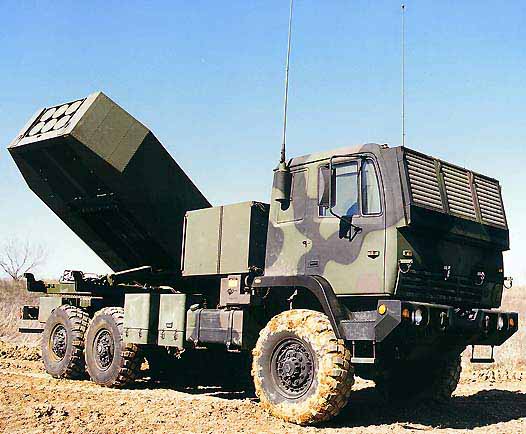
The most useful artillery for US troops in Afghanistan is reported to be the HIMARS rocket launcher system:

HIMARS carriers only one six MLRS rocket container (instead of two in the original MLRS vehicle), but the 12 ton truck can fit into a C-130 transport (unlike the 22 ton tracked MLRS) and is much cheaper to operate. The first HIMARS entered service in 2005, about a year after GPS guided rockets did.

The 680 pound GMLRS (guided multiple launch rocket system) missile is as GPS guided 227mm rocket that entered service six years ago. It was designed to have a range of 70 kilometers and the ability to land within meters of its intended target, at any range. This is possible because it uses GPS (plus a back up inertial guidance system) to find its target. Two years ago, the army tested GMLRS at max range (about 85 kilometers) and found that it worked fine. This enables one HIMARS vehicle to provide support over a frontage of 170 kilometers, or, in places like Afghanistan, where the fighting can be anywhere, an area of over 20,000 square kilometers. This is a huge footprint for a single weapon (an individual HIMARS vehicle), and fundamentally changes the way you deploy artillery in combat.


HIMARS: High Mobility Artillery Rocket System

January 29, 2010

This is more than a slight confusion of terminology

Filed under: Asia, Health, Military — Tags: , , , — Nicholas @ 08:33

Jon (my former virtual landlord) sent along a link to this FoxNews story indicating that there is a long road ahead — sociologically speaking — for Afghanistan:

An unclassified study from a military research unit in southern Afghanistan details how homosexual behavior is unusually common among men in the large ethnic group known as Pashtuns — though they seem to be in complete denial about it.

The study, obtained by Fox News, found that Pashtun men commonly have sex with other men, admire other men physically, have sexual relationships with boys and shun women both socially and sexually — yet they completely reject the label of “homosexual.” The research was conducted as part of a longstanding effort to better understand Afghan culture and improve Western interaction with the local people.

The research unit, which was attached to a Marine battalion in southern Afghanistan, acknowledged that the behavior of some Afghan men has left Western forces “frequently confused.”

The report details the bizarre interactions a U.S. Army medic and her colleagues had with Afghan men in the southern province of Kandahar.

[. . .]

Apparently, according to the report, Pashtun men interpret the Islamic prohibition on homosexuality to mean they cannot “love” another man — but that doesn’t mean they can’t use men for “sexual gratification.”

Trying to use a western term, which almost certainly has highly negative connotations to Afghans who may have encountered it, isn’t likely to be helpful in dealing with the Pashtuns. Labelling is the least of the concerns, I’d think.

The U.S. army medic also told members of the research unit that she and her colleagues had to explain to a local man how to get his wife pregnant.

The report said: “When it was explained to him what was necessary, he reacted with disgust and asked, ‘How could one feel desire to be with a woman, who God has made unclean, when one could be with a man, who is clean? Surely this must be wrong.'”

January 26, 2010

CF improve medical evacuation by adding medical technicians to crews

Filed under: Cancon, Health, Military — Tags: , , , — Nicholas @ 07:35

Strategy Page reports on a change in crew composition for Canadian Forces medical evacuation helicopters:

Canadian forces have added a medical technician to the crews of their medical evacuation helicopters, joining a trend that has played a part in saving the lives of many troops wounded in combat, or injured in a combat zone. Previously, Canadian troops had relied on American, or other NATO, air evacuation services. But now Canada has suitable helicopters (CH-146s) for that work, and established an air ambulance service. Following a four year old recommendation by their own military planners, Canada trained medical technicians to work on the medevac choppers, and thus increase the chances that badly wounded soldiers would survive. Canada has also upgraded all of its combat medical care during its years of operations in Afghanistan. This is part of a trend that has been going on since World War II. It’s all about having more medical care available sooner.

The fighting in Iraq and Afghanistan has brought about a major change in how the United States deals with combat casualties. The result is that over 90 percent of the troops wounded, survive their wounds. That’s the highest rate in history. There are several reasons for this. The main one is that medics, and the troops themselves, are being trained to deliver more complex, and effective first aid more quickly. Military doctors now talk of the “platinum 10 minutes,” meaning that if you can keep the wounded soldier, especially the ones who are hurt real bad, alive for ten minutes, their chances of survival go way up. Medics have been equipped and trained to perform procedures previously done only by physicians, while troops are trained to do some procedures previously handled only by medics.

January 5, 2010

A decade of war

Filed under: Africa, Asia, Europe, History, Middle East, Military — Tags: , , — Nicholas @ 07:19

Strategy Page has an annotated list of the last decade’s wars, declared and undeclared, and armed confrontations just short of warfare:

It’s actually been a decade of less and less war. There’s also been a lot of déjà vu, with many wars seeming to be endless. Some wars are like that. So what were all the current hot spots like a decade ago, and what happened to them? Below is a list, with the short version of what happened (check out archives for the much longer version).

Afghanistan was sort of under the control of the Pakistani backed Taliban in 2000. But the civil war, that began in the late 1970s, was still going on. The Taliban were winning, slowly, fueled by taxes on the heroin trade. But the Taliban were increasingly unpopular, mainly for trying to impose lifestyle rules on a hostile population. September 11, 2001 brought in the Americans to help the factions still fighting the Taliban, and within three months, the Taliban were out of power, and fleeing to Pakistan. A democracy was established, but corruption and tribal rivalries crippled it from the start. The Pushtun tribes resented the domination of the non-Pushtun tribes (60 percent of the population), and this enabled the Taliban to rebuild and undertake a terror campaign to regain control of the country. It’s a suicide mission (even most Pushtuns oppose them), but that’s pretty normal for Afghanistan.

[. . .]

Iraq- Saddam Hussein was under siege at the beginning of the decade, refusing to comply with the terms of his defeat in the 1991 war over Kuwait. Saddam, as he later admitted, had no weapons of mass destruction, but did not want the Iranians (who wanted to kill him for invading in 1980) to know. It was a successful deception, so much so that all the world’s intel agencies agreed that Saddam had these weapons, and that was used to justify the U.S./British invasion of 2003. There followed five years of terrorism, as the Sunni Arab minority (which Saddam had led) tried to murder their way back into power. That didn’t work, and Iraq ends the decade with a booming, not shrinking, economy, and a bloody resolution to some long time political disputes.

December 24, 2009

Jonathan Kay in praise of Paul Martin

Filed under: Cancon, Middle East, Military, Politics — Tags: , , , — Nicholas @ 11:52

In a column ostensibly about the triumph of Canada’s conservatives, Jonathan Kay makes a pitch for both Paul Martin and former Governor General Adrienne Clarkson as unsung political heroes:

Paul Martin will forever be known primarily as the guy who fumbled Jean Chrétien’s dynasty away to Stephen Harper. But if there were more justice in the world — or at least among pundits — he would get his due for making the single most momentous prime ministerial decision of the decade: sending a Canadian combat mission to Kandahar in 2005.

At the time, it hardly seemed epic: Most Canadians didn’t know Kandahar from Kunduz. But the military wonks immediately could tell this was a game-changer. Putting our troops in Kandahar, at the ideological and political center of Taliban territory, meant the Liberals were shedding decades of peacekeeper posturing, and were putting the country on a very real war footing.

[. . .]

Martin didn’t throw a dart at a map of Afghanistan. He fought for Kandahar in the face of U.S. skepticism — even though he knew it would mean body bags, and even though he probably could have landed the Canadian Forces a relatively cushy Euro-style sentry-duty assignment in the northern part of the country.

Our deployment set the stage for many of the other, seemingly unrelated, changes in Canadian policy and politics that followed in the latter part of the decade. A nation at war doesn’t think about itself in the same way as a nation at peace. We got more respect in foreign capitals. We began to take care of our military. We even started to treat our country’s identity and history more seriously.

And equally surprising, the praise for Adrienne Clarkson:

Nor should we ignore the contribution of Adrienne Clarkson. Whatever her elitist, media pedigree, the Canadian Forces had no better friend than the former Governor General. She was a constant presence at Remembrance Day events at home, as well as WWII anniversary ceremonies in Europe. She spent New Year’s with CF members in Afghanistan — twice; and even celebrated Christmas with our naval forces in the Persian Gulf.

That she was a woman, a former CBC staffer, and a visible minority, only increased the symbolic importance of her outreach. It showed Canada that our military is fighting for all us, not just white guys with brush cuts in Shilo and Petawawa.

December 16, 2009

More info on the RAF cuts

Filed under: Britain, Military — Tags: , , — Nicholas @ 12:50

Lewis Page finds the MoD’s recently announced cuts to — shock, horror — make good military and economic sense:

It doesn’t happen often, but just for once there’s good news out of the Ministry of Defence — good news for British troops in combat overseas, and good news for British taxpayers too. But it’s bad news for the UK arms biz, and bad news for certain regional communities who rely on the MoD to bring them government money they wouldn’t otherwise receive — and don’t particularly deserve.

So what’s the government done?

In essence, they have cut down massively on military things which we don’t — and almost certainly won’t — need, and ordered a lot of things which we are desperately short of.

Other than the reduction of the RAF’s Harrier force by one squadron, the government also indicated they may cut the Tornado force by one or two squadrons. This is sensible because the Tornado was designed to do a job that no longer needs to be done — or, rather, no longer needs to be done by manned bombers. Another big change is that the RAF will be losing their Nimrod aircraft, which has both military and political aspects:

Quite apart from all that, the Nimrod MR2 — being a flying antique — is horribly expensive to run, both in money and in lives. The MR2’s extensive use above Afghanistan in recent times as a flying spyeye and to relay radio messages between ground units in no way justified its continued, very expensive existence; far less could such unimportant work possibly have justified the known risks of refuelling these aged birds in mid-air.

So getting rid of the MR2s loses us nothing important, and will make our service people noticeably safer — the Nimrod has actually killed one of our people for every 15 killed by the Taliban. Better still, this will permit another pricey airbase here in the UK to largely close, saving money to be spent at the front line. As a fringe benefit, the base in question — RAF Kinloss — is in a Scottish National Party constituency, giving people there a taste of the independence from the UK that they have voted for. (Strangely the local SNP member of parliament still isn’t happy**.)

December 15, 2009

RAF and Royal Navy facing further cuts

Filed under: Britain, Bureaucracy, Military — Tags: , , , , — Nicholas @ 07:40

With the costs of maintaining British troops in Afghanistan still rising, the government is expected to announce further cuts to the Royal Air Force and Royal Navy today:

Some RAF bases face closure to pay for extra equipment for British forces in Afghanistan, a defence minister indicated this morning.

Quentin Davies said that it would be a “very good thing” to get by with fewer RAF bases if that was possible and that the Ministry of Defence wanted to spend its money with “maximum effect”.

[. . .]

Some Tornado and Harrier aircraft and small navy surface vessels are likely to face cuts. A number of RAF bases will be closed — including reportedly RAF Kinloss in Moray — and part of the sovereign base areas in Cyprus will be sold.

The two large aircraft carriers are expected to survive this particular cut, although it wouldn’t be surprising to see further delay introduced into their construction . . . even though stretching out delivery dates is an expensive way to increase short-term savings:

The announcement follows the publication of a report from the National Audit Office saying the gap between the cost of planned weapons projects and what the MoD can actually afford could be as much as £36bn.

The gap would have been larger had the ministry not delayed a number of projects, such as the construction of two large aircraft carriers, the Queen Elizabeth and the Prince of Wales, the NAO reports.

However, the decision to delay the carrier project to save £450m over the next four years will increase costs by £1.12bn over later years — a net increase of £674m, the NAO says.

The MoD has also decided to reduce an order of Lynx Wildcats from 80 to 62 helicopters, saving £194m but reducing planned flying hours by a third. The report says that last year the price for the 15 biggest military schemes rose by £1.2bn, £733m of which was the result of delays designed to save money in the short term.

Update: Believe it or not, there’s actually some sense to the government’s announced changes:

The headlining move comes with the announcement, widely anticipated, that the British fleet of US-made Chinook heavy-lift helicopters is to increase from 48 to 70 aircraft, with initial deliveries of ten new choppers arriving by 2013. The Chinook is the only helicopter in widespread Western service with enough spare lift to operate with any freedom in Afghanistan’s heat and high altitudes, and the new copters will be extremely welcome among British forces there.

It is also expected that another Boeing C-17 heavy transport plane will be ordered to join the existing UK fleet of 5, which are regarded as crucial to sustaining the “air bridge” logistic link between Blighty and its troops in Afghanistan.

These short-term improvements will be paid for not by any budget increase, but by reducing the active forces of Tornado bombers and Harrier close-support jets, and early retirement for much of the existing fleet of antique Nimrod MR2 maritime patrol aircraft. These moves will allow closure or mothballing of some of the RAF’s 45+ UK stations, with associated further job losses and savings.

They’ve also announced the retirement of the Sea King helicopter from active service, with the existing inventory of Merlin HC3 moving from the RAF to RN service (including whatever refitting will be necessary to “maricise” them for full-time service with the fleet).

Overall, the changes make a good deal of sense . . . what a surprise.

December 1, 2009

US Army bows to the inevitable

Filed under: Middle East, Military — Tags: , — Nicholas @ 08:23

With more than one in ten of the troops deployed to Afghanistan being female, the US Army had been trying desperately to prevent healthy young soldiers doing what healthy young soldiers are often most interested in. The army has finally acknowledged that their King Canute imitation wasn’t realistic, given human nature:

Last year, the U.S. Army in Afghanistan has removed the prohibition on sex between male and female soldiers. There are 68,000 U.S. troops in Afghanistan, and about ten percent of them are female. So far this year, about fifteen percent of these female troops have had pregnancy tests, and a few percent of the female troops have gone home because they were pregnant.

Since the 1990s, the army has been big on clean living (or whatever you want to call it) in combat zones. No booze, no sex and not cavorting (you know what that means) with the locals. But with most of the troops in combat zones being young and single, things happened. Some couples got caught. Commanders got tired of having to punish (usually with an Article 15, which is just short of a court martial) troops for “unauthorized fornication.” So now it is, if not authorized, not likely to get you punished (aside from the occasional unexpected pregnancy).

November 26, 2009

It’s not a protective force field . . .

Filed under: Military, Technology — Tags: , , — Nicholas @ 08:35

. . . but if it provides a useful degree of protection against splinters and shell fragments, it’s certainly worth testing in a combat zone:

The U.S. Army has developed shell proof wallpaper. The fabric is applied, like wallpaper, on the inside of troop work and living quarters, in areas where the enemy fires rockets and mortar shells into the area. Thus when fast moving fragments or debris hit the structure, the new material, called X-Flex, stretches and halts, or slows down, the fast moving object. This makes it much less likely that anyone inside the structure will be killed.

Over the last five years, the U.S. Army has gone to great lengths to protect troops in camps. Tight perimeter security has kept suicide bombers, and terrorists in general, out of the camps. But there are still rocket and mortar attacks. These usually cause few casualties, but those that do occur are the result of shell fragments or debris coming through the walls.

If it works as well in real life application as it apparently has done in controlled testing, it’ll be a welcome addition to the defenses.

November 14, 2009

Sneak peak at the next “Modern Warfare” game

Filed under: Humour, Military — Tags: , , — Nicholas @ 14:25


Ultra-Realistic Modern Warfare Game Features Awaiting Orders, Repairing Trucks

« Newer PostsOlder Posts »

Powered by WordPress