
Feral Historian
Published 17 Oct 2025The caricature of fascism as the arch-evil, born in WWII propaganda and endlessly re-imagined in popular entertainment ever since, has served both as an inoculation against that particular brand of tyranny and blinders to many others. Is it still relevant? Or has it become one of our culture’s foundational archetypes that will live on for centuries disconnected from its roots? Let’s explore a bunch of facets and ask some odd, sometimes difficult questions along the way.
00:00 Intro
03:02 Myth of Singular Evil
06:06 Andor and Now
09:18 Fading Narratives
12:01 Iron Sky
16:21 What Comes Next?
(more…)
February 20, 2026
Sci-Fi, Satire, and the Post-WWII Mythos
Comments Off on Sci-Fi, Satire, and the Post-WWII Mythos
QotD: The burden of “emotional labour”
I paraphrase, of course. Though not, I think, wildly:
Researchers at Stanford have finally given a name to something many women have been dealing with for years. It’s called mankeeping. And it’s helping explain why so many women are stepping away from dating altogether.
Yes, from the pages of Vice, it’s a men-are-the-problem-and-therefore-unnecessary article. Because we haven’t had one of those in weeks.
Mankeeping describes the emotional labour women end up doing in heterosexual relationships.
Lesbian relationships being entirely free of aggravation and disappointment, you see. With rates of failure and divorce twice that of heterosexuals, more than double that of gay male couples, and with high rates of alcoholism and spousal abuse. What one might infer from that, I leave to others.
[Mankeeping] goes beyond remembering birthdays or coordinating social plans. It means being your partner’s one-man support system. Managing his stress.
And,
Interpreting his moods.
At which point, readers may wish to share their favourite joke about female indirectness and the two dozen possible meanings of the words “I’m fine” when uttered by a woman, depending on the precise intonation and the current alignment of the planets.
Readers may also note the replacement of a once common but now seemingly unfashionable grievance – “Men don’t express their feelings” – with one of a much more modish kind – “Men are expressing their feelings and it’s exhausting and unfair”.
Holding his hand through feelings he won’t share with anyone else. All of it unpaid, unacknowledged, and often unreciprocated.
One more time:
All of it unpaid,
It occurs to me that there’s something a little dissonant about the framing of affection and basic consideration – say, remembering your partner’s birthday – as “unpaid”. As “emotional labour”. As if being in a relationship or having any concern for those you supposedly care about were some onerous, crushing chore. As if you should be applauded – and financially compensated – for the thirty-second task of adding a birthday to the calendar on your phone.
The attitude implied by the above would, I think, explain many failures on the progressive partner-finding front and the consequent “stepping away from dating altogether”. Though possibly not in ways the author intended.
Before we go further, it’s perhaps worth pondering how the conceit of “emotional labour” is typically deployed by a certain type of woman. Say, the kind who complains, in print and at great length, about the “emotional labour” of hiring a servant to clean her multiple bathrooms. Or writing a shopping list. Or brushing her daughter’s hair.
And for whom explaining to her husband the concept of “emotional labour” is itself bemoaned as “emotional labour”. The final indignity.
The kind of woman who bitches in tremendous detail about her husband and his shortcomings – among which, an inability to receive instructions sent via telepathy – in the pages of a national magazine, where friends and colleagues of said husband, and perhaps his own children, can read on with amusement. The kind of woman who tells the world about how hiring servants is just so “exhausting”, while professing some heroic reluctance to complain.
As I said, worth pondering.
But back to the pages of Vice, where Ms Ashley Fike is telling us how it is:
According to Pew Research, only 38 percent of single women in the US are currently looking for a relationship. Among single men, that number jumps to 61 percent. The gap says a lot. Women aren’t opting out of love. They’re opting out of being someone’s therapist with benefits.
Stoic, heroic women burdened by needy, emotional men. It’s a bold take.
And I can’t help but wonder what all of those single women, cited above, are doing instead of finding a suitable mate and building a happy life, perhaps even a family. Are they searching for a sense of purpose in causes, protests and political fashion, fuelled at least in part by envy and resentment? Just speculation, of course. But it would, I think, explain the tone and emotional convulsions of so many single, progressive women.
The Guardian calls mankeeping a modern extension of emotional labour, one that turns a partner into a life coach. This isn’t about avoiding vulnerability. It’s about refusing to carry someone else’s emotional weight while getting little to nothing in return. And there’s nothing wrong with feeling that way.
Again, the term “emotional labour” and its connotations of calculation, antagonism, and something vaguely inhuman. As if the concept of wanting to care, to help, to remember those birthdays, were somehow alien or offensive.
The reliance on this conceit – as the basis for an article, perhaps an entire worldview – doesn’t strike me as an obvious recipe for contentment, or indeed love. What with the endless cataloguing of shortcomings. All those reasons to resent.
Some men have started opening up more, which is good.
Ah, a glimmer of hope.
But too often, that openness lands in the lap of the person they’re sleeping with instead of a friend or a therapist. Vulnerability without boundaries can feel more like a burden than a breakthrough.
So, don’t bore your wife with your troubles, gentlemen. No, search out a therapist. Or, “Be vulnerable, like we asked, but somewhere else”.
David Thompson, “Let’s Be Alone And Unhappy”, Thompson, blog, 2025-11-16.
Comments Off on QotD: The burden of “emotional labour”
February 19, 2026
An American anarchist
I’ve never met Christopher Schwarz, but I’ve read a lot of his writing in books, magazine articles, and blog posts. He’s forgotten more about hand tool woodworking than I’ll ever know, and he’s amazingly generous in sharing his knowledge with others. He calls himself an anarchist, which often puzzles people who only know of anarchism from media-presented bomb-throwing nihilists and conspiratorial Russian stories. Here he explains what he means when he uses the term:
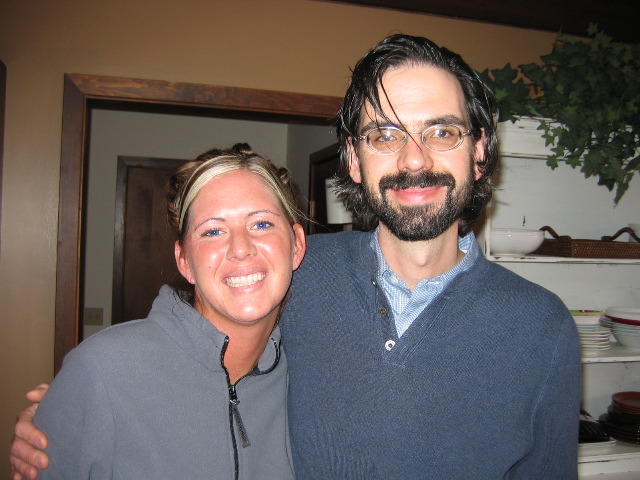
“Chris Schwarz and Meredith Schwarz” by jessamyn west is marked with CC0 1.0 
 .
.
I get asked a lot about what I mean by the word “anarchism”, and if I could please explain what I mean when I use that word.
My answer is always unsatisfying. Here’s why.
For the love of creamed corn, why would I publicly discuss ideas that are – for now – a crime in our country? Why would I say – for example – that I think that copyrights and patents on things that use public money are bullshit? That wars are founded on lies? And that the state – in general – seems to be a menace to peaceable living?
That would be stupid. Dumb nuts.
Also, I am a practitioner of anarchism, not a philosopher.
If you want to know more about American anarchism (and aesthetic anarchism, specifically), you need to ask a philosopher, not a front-of-house worker. Read Native American Anarchism (Hachette Books, 1983) by Eunice Minette Schuster for an easy on ramp. Or Josiah Warren’s Equitable Commerce (1852) for the full banana.
The Anarchist’s Tool Chest: Revised Edition by Christopher Schwarz – Link.
Or follow the trail of breadcrumbs left in The Anarchist’s Tool Chest to figure it out yourself. The book describes how to disrupt the furniture industry by building things that never need to be replaced. It’s also about how to jailbreak yourself from a tool industry that offers up aluminum jigs as a substitute for skill.
That book is not the only path. There are other ways to throw a bunch of ball bearings into the guts of the IKEA robots.
Buy antiques or used furniture. The other week I was in Savannah, Georgia, and visited one of my favorite antique stores. The price of handmade antiques has hit bottom. So-called “brown furniture” can be bought for less that the cost of the materials used to make it.
Even though I make furniture for a living, I sometimes save time and money by purchasing vintage industrial furniture for our warehouse, fulfillment center and workshop. Megan’s giant oak desk from the 1960s cost us zero dollars (we just had to move it from an insurance office). Our printer and scanning station? An old workbench from Pennsylvania. Our associate editors’ shared desk? A giant vintage drafting table from Sweden.
And if you think for a moment, there are other industries and organizations that can be farted upon by your actions. The clothing industry is even worse than the furniture industry when it comes to making flimsy crap and abusing workers.
Yes, you can buy ethically made jeans, shirts and socks. Yes, you will pay a premium for these items. And if you can afford that path, great. If you can’t, then buy secondhand clothing.
I’ve always wanted a pair of R.M. Williams boots but could never afford them on a writer’s salary. Last year I found a used pair for about $100 where the owner had ragged out the elastic part of the slip-on boots. It was a stupid easy fix. And now I have boots I shall wear at my funeral.
The other side of the equation is that I’m denying the new-boot-goofin’ industry my dollars. Forever. I don’t have to buy a pair of shoddily made boots that can’t be re-soled and will have to be replaced in a couple years. All my future “boot money” will go to our local cobbler so she can re-sole them every few years.

Comments Off on An American anarchist
You can build a chair (Seriously)
Rex Krueger and Lost Art Press
Published 18 Feb 2026Patrons saw this video early: / rexkrueger
James’ Video: • Making a Chair With Friends – Christopher …
Join the Mailing List: http://eepurl.com/g3rkmv
Take a course: https://www.rexkrueger.com/courses
Compass Rose Toolworks: https://www.compassrosetools.com/
Get my woodturning book: http://www.rexkrueger.com/book
Follow me on Instagram: @rexkrueger
Comments Off on You can build a chair (Seriously)
Too many “conservatives” today are just slower-speed liberals
Most self-described conservatives in politics are not particularly inclined to “conserve” anything, as Spaceman Spiff points out, they’re pretty much onboard with the liberal vision they just want it to be fractionally slower or infinitesimally not-quite-as-liberal as the liberals. They are the ineffectual, neutered, tame opposition:

Modern conservatism is not conserving our world. Mainstream conservatives seem to have no interest in the real issues affecting us.
At best they merely wish to slow down our decline. At worst, they are fully on board with the destruction.
When they do act or speak they often pick a safe version of a sensitive issue.
In Britain there is lots of talk of illegal immigration and how the state mishandles it. None about ruinous volumes of legal immigration, almost one million per year, and what it is doing to the country.
Pushback against climate policy falters on the speed of changes, not the underlying fraud of climate science itself.
No conservative will honestly discuss the plummeting happiness of women recorded across the West and yet there it is, writ large in antidepressant prescriptions and social media videos. It may have multiple causes, but feminism cannot be challenged so they say nothing lest they are reprimanded by the sisterhood.
Everything real is forbidden. It is all an act.
Like the left, those on the right are increasingly unable to face reality which means they can never course correct. They are trapped within a self-referencing culdesac designed to maintain their position in someone else’s hierarchy. That is why they have become so ineffective and appear to do very little except moan about the pace of change while they say nothing about the changes themselves.
We sense the conservatives do wish to conserve things but they are inexplicably mesmerized by the opinion of their enemies. They seek reassurance and applause from people who view them as evil.
This makes no sense to ordinary people.
Thinking like the enemy
The problem with modern conservatives is they are animated by underlying drives that cannot create a conservative or traditional society. They have adopted the thinking patterns associated with the progressive left while still using the language of conservatism.
The left is traditionally defined by a series of interrelated traits that manifest in much of what they agitate for.
- A desire for centralization;
- A notable external locus of control;
- Seeking approval from the group.
Central control systems feature prominently in all left-wing schemes. From local councils to national governments, those who gravitate to the left often want to create centralized decision-making bodies to manage society. Institutions, government departments, NGOs and even charities all feature, but only when they act as the controlling authority in some field of interest.
Related to this is a clear external locus of control visible in individuals and their decisions. There is a relief others make the key decisions, so people actively seek out direction from an established authority. This ensures minimal resistance to the many centralized schemes we see emerge.
Acting solo creates discomfort. An older formulation understood this as the rejection of responsibility. Today it often manifests as an obsession with experts making key decisions for us all, partly to mask individual cowardice. People making their own decisions in life are derided as naive or dangerous.
During Covid decision makers became hysterical at the very idea we would reject the advice of experts and perform our own research despite the issue being medical and therefore dangerous.
A related phenomenon characteristic of many leftists is the need for approval, often from a group. Not just others making decisions but a dependency on confirmation and endorsement to ensure thinking and behaviour follows an established norm. This is the antithesis of original thinking or bold action; it is how adolescents often behave.
In today’s world this deep urge is reflected most in the social media landscape of harvesting attention and likes. Every fledgling narcissistic applause-seeking trait is given full expression in the endless search for approval from strangers. Whole sections of society seem lost to impulses we once understood as immature and dysfunctional.
Update: Not long after I queued this item for publication, a Canadian example popped up in the news, as yet another rock-ribbed “conservative” suddenly realized that electing a Liberal was what his constituents actually wanted when they inexplicably voted for him as a Conservative candidate in the last federal election.

Edmonton Conservative MP Matt Jeneroux has crossed the floor to the governing Liberals.
“I am honoured to welcome Matt Jeneroux to our caucus as the newest member of Canada’s new government,” said Prime Minister Mark Carney, in a post on X.
“I am grateful to Matt and his family that he will continue his service as a strong voice for Edmonton Riverbend in Parliament.”
Carney said Jeneroux, who has represented the riding of Edmonton Riverbend since 2015, will take on a new role as special advisor on economic and security partnership for the Liberals.
Jeneroux is the third Conservative to join the Liberals, after colleagues Michael Ma and Chris d’Entremont crossed the floor late last year.
A Liberal source says Jeneroux first met Carney back in November, which was the first of at least two conversations, with talks between Carney’s office and Jeneroux continuing since. That source added that it has been a “long journey” to Wednesday’s announcement.
d’Entremont crossed the floor to join the Liberals in November, which unleashed a wave of speculation as to who might be next, with Jeneroux’s name heavily floated. Jeneroux then announced his plans to resign from the Conservative caucus, citing family reasons. Since then, he has not voted with the Conservatives and did not attend the party’s recent convention in Calgary in late January.
After Carney’s announcement, the prime minister updated his daily itinerary, adding a stop in Edmonton to meet with Jeneroux before attending events in British Columbia.
“Matt brings a wealth of experience in Parliament, despite his young demeanor,” said Carney, while sitting next to Jeneroux.
The MP from Edmonton welcomed the prime minister and laid out the reasons for why he had reversed his decision to resign.
“I had announced my resignation back in November, largely due to family reasons, but quite simply, couldn’t sit on the sidelines after seeing what the prime minister’s ambitious agenda he was undertaking across the country and across the world,” he said.
“Quite honestly, it was the speech in Davos where you took everything head on,” he added.
Jeneroux said it felt disingenuous and “quite simply wrong” to sit on the sidelines.
Hotchkiss Model 1886 3-pounder Quick Firing Gun
Forgotten Weapons
Published 26 Sept 2025Small fast boats with torpedos (or other explosives) have always been a threat to large warships. One of the weapons the British Royal Navy adopted to counter that threat was the Hotchkiss Model 1886 “Quick Fire” gun. This meant that it was a breech-loaded gun that used self-contained cartridge ammunition, instead of separate powder bags and projectiles. Mounted on a recoil-adsorbing soft mount with a wide range of movement and steep depression angle, guns like this could fire at small mobile torpedo boats that a capital ship’s main armament couldn’t handle.
This particular model is a 47mm bore, or 3-pounder as described in British service. It uses a vertically-traveling breech block, and more than 3,000 or them were acquired by the British. Two of them were employed as part of the Falkland Islands coastal defenses at one time. This example is one of two brought down from Gibraltar fairly recently and refurbished for ceremonial use on the Islands. Thanks to the FIDF for setting it up on its mount so I could film it for you!
(more…)
Comments Off on Hotchkiss Model 1886 3-pounder Quick Firing Gun
QotD: The Donation of Constantine
I love it because it’s clearly a watershed moment in human thought. I don’t mean the rediscovery of the classical past; I mean the shift between a more cyclical orientation towards life, versus an orientation around linear time. Time as the regular procession of the seasons, vs. time as a stream or river.
Some examples will help. The 15th century saw not just the creation of archives-based history, but the techniques in various fields that make archival work possible. For instance, the Donation of Constantine was definitively proved to be a forgery in the 15th century, on the basis of philological evidence. Before that point, the people using the Donation – both ways — wouldn’t have cared too much if they knew it was a fake. Not because they were opportunists (although they were), but because “factual accuracy”, to use one of my favorite of the Media’s many Freudian slips, just didn’t matter much back then.
When they said “the Donation of Constantine” they meant “hallowed by tradition”, and if you’d proved to them that the Donation was fake, they’d just keep on keepin’ on — ok, then, “hallowed by tradition” it is, everyone update your style books accordingly.
Severian, “The Ghosts (II)”, Founding Questions, 2022-05-18.
Comments Off on QotD: The Donation of Constantine
February 18, 2026
It’s not just Britain that gives asylum-seekers better care than citizens – Canada does too
We had a look at how well the British government looks after asylum-seekers yesterday, but other nations are probably doing similarly inequitable things to give money and services to non-citizens than they ever would for the people who pay the taxes for these over-generous programs. In the National Post, Tristin Hopper outlines the findings of a recent analysis from the Parliamentary Budget Office on the costs of supporting huge numbers of foreign nationals in Canada:

An asylum seeker, crossing the US-Canadian border illegally from the end of Roxham Road in Champlain, NY, is directed to the nearby processing center by a Mountie on 14 August, 2017.
Photo by Daniel Case via Wikimedia Commons.
Paying the health-care premiums of refugee claimants will cost Canadians a record $1 billion this year, with some of the beneficiaries continuing to receive free health care despite their claims having already been rejected.
That’s according to a new analysis by the Office of the Parliamentary Budget Officer, and it’s just one of several ballooning costs wrought by the unprecedented number of foreign nationals currently living in Canada by virtue of a claim of refugee status.
The Interim Federal Health Program, which offers premium health benefits to asylum claimants, is soon set to hit $1 billion in annual costs for the first time, according to an analysis last Thursday by the Office of the Parliamentary Budget Officer.
This is a five-fold increase from just six years ago, when the program was costing $211 million per year. The analysis also projects that costs are expected to surge for the foreseeable future, with the annual budget likely to hit $1.5 billion as early as 2029.
All told, between now and 2030, Canadians are on track to spend $6.2 billion on health care for refugees or refugee claimants.
“The rising volume of asylum claims, along with the longer duration of eligibility caused by extended determination times, has been an important growth driver in recent years,” reads the PBO report.
The report was commissioned following a Conservative-led request made at the House of Commons standing committee on health. In a Thursday statement, the Conservative party noted that the Interim Federal Health Program can be accessed even by asylum claimants who have had their case rejected.
It also offers a higher level of care than that enjoyed by the average Canadian citizen. In addition to hospital care and surgical care, the IFHP also covers dental care, vision care, pharmacare and other services not typically covered by public health plans.
“Rejected asylum claimants are now receiving better health care than many Canadians who have paid into a system their entire life,” read a joint statement by Dan Mazier and Michelle Rempel Garner, the shadow ministers of health and immigration, respectively.
It added, “at a time when six million Canadians cannot find a family doctor and are waiting for care, it’s unacceptable that bogus asylum seekers are receiving better health benefits than Canadians”.
Comments Off on It’s not just Britain that gives asylum-seekers better care than citizens – Canada does too
The Korean War Week 87: What’s Going On In Compound 62? – February 17, 1952
The Korean War by Indy Neidell
Published 17 Feb 2026UN forces kick off this week with an operation to ensnare and capture North Korean and Chinese patrols, as significant progress is made elsewhere at the armistice talks. Prisoners really do seem to be the focus of the week, as rumblings of discontent continue to build at the POW camp on Koje-do island as UN control of the camp slips a little more each day. Just what is happening inside Compound 62 there? And do UN forces have a hope to stop it?
00:00 Intro
00:48 Recap
01:17 Clam Up
01:50 Repatriation
05:02 Item 5 Agreed Upon
07:35 Troop Rotation
09:47 Coastal Waters and Islands
11:02 Compound 62
13:45 The Bigger Picture
14:31 Summary
14:45 Conclusion
(more…)
Comments Off on The Korean War Week 87: What’s Going On In Compound 62? – February 17, 1952
The consequences of an over-feminized culture
On the social media site formerly known as Twitter, Devon Eriksen reacts to an article on “solving” the problem of predators in nature:
Women evolved to take care of toddlers. If you put women in charge of teaching ethics, you get Toddler Ethics.
“No hitting”
“Share the toys”
“Don’t say mean things”These are fine lessons for toddlers. Don’t indulge your id at the expense of others. You can learn about balancing interests later, when your brain is developed enough to store that information.
But when you put women in charge of adults, they tend to reflexively assume those adults are toddlers.
They will tell you “no hitting” when the Mongol hordes are massing on your borders. They will tell you “share the toys” when a vagrant meth zombie breaks into your house looking for something to steal. And they will tell you “don’t say mean things” when you point out that these two responses are totally stupid.
When we first put women in charge, in the workplace, they immediately began treating those who reported to them like toddlers. When adults, who do not like being treated like toddlers, complained, their response was “ban bossy”, which boils down to “don’t say mean things”, another lesson in Toddler Ethics.
Now, through the influence of women in charge, we are so thoroughly steeped in Toddler Ethics that even most of the men we put in charge are treating the adults like toddlers, and echoing Toddler Ethics.
Toddler Ethics, of course, isn’t ethics at all. It’s just things we don’t want toddlers doing.
We can tell toddlers “no hitting”, because toddlers are not charged with keeping the peace, enforcing justice, or destroying evil.
We can tell toddlers “share the toys”, because toddlers don’t earn things, own things, or have property they must defend.
We can tell toddlers “don’t say mean things”, because it is not a toddler’s job to decide what unwelcome ideas are true, relevant, and necessary.
But when everyone in charge runs on Toddler Ethics, then adults can’t do a lot of the stuff adults need to do, because all the Toddler Ethicists keep getting in the way.
Adults sometimes need to hit people, protect the stuff, and say mean things. You can’t have civilization without that.
And if you put Toddler Ethics Woman in charge of teaching an AI ethics, then she will teach it Toddler Ethics, and it will treat every human adult like a toddler, all the time, forever.
Not only that, you have an AI that cannot be put in charge of anything, ever. Because leaders with Toddler Ethics destroy everything they are in charge of.
And Amanda MacAskill is definitely a Toddler Ethicist. The article in the photograph is nothing but “no hitting!” applied to the animal world. It’s absolutely insane, it’s a recipe for disaster, and anyone who would write such a thing should probably not even be charge of own life choices, much less anything of consequence.
But a lot of people would, and will, refuse to point that out, or agree with me when I do, because that is Saying a Mean Thing, and they, themselves, have been infected with Toddler Ethics.
They should not be charge of anything of consequence, either.
Anyone who thinks that everything they need to know, they learned in kindergarten … is only ever qualified to teach kindergarten.

Battle of Manila, 1945
Real Time History
Published 3 Oct 2025The Battle of Manila 1945 was the only urban battle in the American Pacific War comparable with Stalingrad, Berlin or other European battles. In gruelling weeks of fighting the 6th Army fought in house-to-house combat against entrenched Japanese.
(more…)
Comments Off on Battle of Manila, 1945
QotD: Defending the borders of the Roman Empire
The thing is, approximately none of this logic applied in the Roman situation. First of all, as we’ve already noted, a huge fraction of the threats the Romans faced were “low-intensity”: border skirmishes, slave raids, pirates and brigands, that sort of thing. Static fortifications, walls and towers, are often more than sufficient for dealing with these problems. Paradoxically, that actually increases the mobility and responsiveness of the main forces. If they aren’t constantly running back and forth along the border dealing with bandits, that means they can respond with short notice to “high-intensity” threats (like major invasions and rebellions) that pop up, and are probably better rested and better provisioned when the emergency arrives. So, far from diluting their strength, a lightly-manned series of linear fortifications actually enabled the Romans to concentrate it.
Secondly, those linear fortifications can also be very useful when that major invasion shows up, even if they are overrun. A defense system doesn’t have to be impenetrable in order to still be very, very useful. One thing it can do is buy time, either for the main army to arrive or for some other strategic purpose. The defenses can also act to channel opposing forces into particular well-scouted avenues of attack, or change the calculus of which invasion routes are more and less appealing. Finally, in the process of setting up those defenses, you probably got to know the terrain extremely well, such that when the battle comes you have a tactical advantage.
[…]
The third, and perhaps most important, reason why the Roman frontier fortifications were actually very smart is that they were carefully designed to double as a springboard for invasions into enemy territory. Luttwak coins the term “preclusive defense” to describe this approach. The basic idea is that an army can take bigger risks — pursue a retreating foe, seize a strategic opportunity that might be an ambush, etc. — if it knows that there are strong, prepared defensive lines that it can retreat to nearby. Roman armies were constantly taking advantage of this, and moreover taking advantage of the fact that the system of border fortifications was also a system of roads, supply lines, food and equipment storage depots, and so on. The limes were not a wall that the Romans huddled behind, they were a weapon pointed outwards, magnifying the power that the legions could project, helping them to do more with less.
John Psmith, “REVIEW: The Grand Strategy of the Roman Empire by Edward Luttwak”, Mr. and Mrs. Psmith’s Bookshelf, 2023-11-13.
- I, an ignoramus, assumed this was all downstream of the Maginot line’s bad reputation, but Luttwak says it’s actually the fault of Clausewitz.
Comments Off on QotD: Defending the borders of the Roman Empire
February 17, 2026
The three core false claims of wokeness
Lorenzo Warby analyzes the three claims that underpin the intellectual structure of all the sub-categories derived from Critical Theory:

Universities across Anglo-America, and across the West more broadly, have become increasingly dominated by a Critical Theory magisterium: a teaching authority that claims ultimate or trumping moral authority. This magisterium is based on Critical Theory and its derivatives — Critical Race Theory, Critical Pedagogy, Queer Theory, Post-Colonial Theory, Settler-Colonial Theory, and so on: which constitutes the Critical Social Justice matrix.
This magisterium has come to increasingly dominate academe for a range of reasons. It generates intolerant zealots, so benefits from the dynamics of an intolerant minority.
It offers a powerful shared status game — affirm beliefs X, Y, Z and that makes you A Good Person. This status game spreads a supporting censorious intolerance, for if affirming beliefs X, Y, Z and makes you A Good Person, then denying X, Y, or Z makes you A Bad Person.
This justifies shaming and shunning anyone who denies X, Y, Z, because they are Bad People and its shows your commitment to what makes someone A Good Person. It shows commitment to the shared status game. This status game generates moralised cognitive assets, and you protect the value of those assets by participating in — or at least going along with — the shaming and the shunning.
The status game generates moral projects that the central administrations of universities can use to expand their authority, range of action, and so resources. An opportunity they have enthusiastically embraced. An opportunity that corporate, non-profit and government bureaucracies have also enthusiastically embraced.
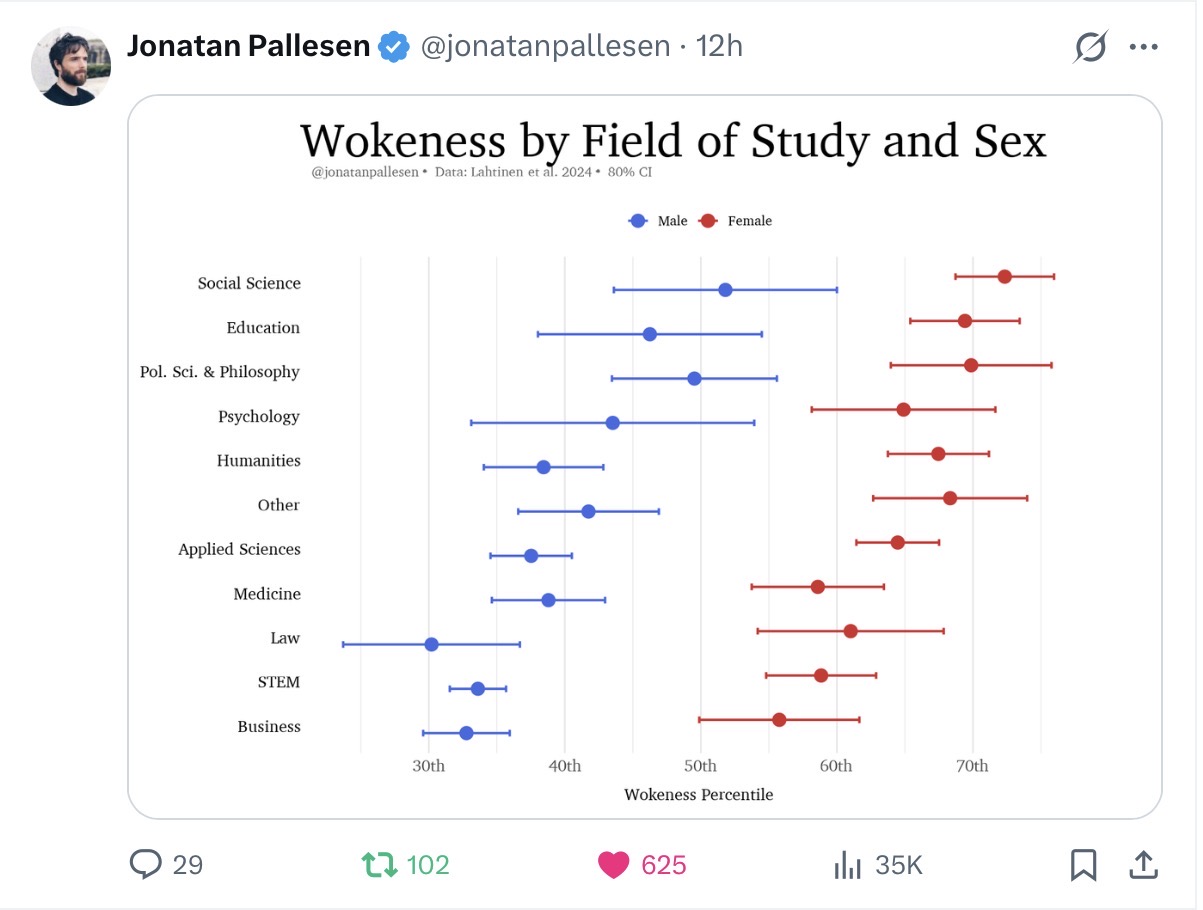
The emotions this status game attaches to those moralised cognitive assets — care, compassion, concern for the marginalised, if you affirm those beliefs, the opposite if you deny them — also plays into fears about threatening emotions (and safety through norm conformity) which are much stronger among men than women. Women are thus systematically more hostile to freedom of speech than men.
It is an exaggeration to claim that “wokery” is just the consequence of feminisation of institutions and occupations. It is, however, true that what works for — what is emotionally resonant in — increasingly feminised institutions and occupations has been selected for.
Source: data taken from this paper.
But the Critical Theory magisterium has expanded across academe — and beyond — due to the nature of its three foundational claims:
- A blank slate view of human nature.
- A view of social dynamics as dominated by conflict.
- An activist relationship with information: that the trumping purpose is not to describe the world, but to change it.
The blank slate view of human nature — not merely that we are not born without inborn ideas, but that everything that forms us is social — means that any level of social transformation that can be conceived is attainable. Provided enough social power can be assembled—to move human action, speech and thought in the correct direction—the socially-transformative society free of oppression and alienation can be created.
The grander the conceived purpose, the more energising and motivating it is. But also the more it rhetorically trumps anyone who is willing to “settle” for less than complete human liberation. This then feeds back into energising and motivating, as it provides an endless sense of being moral trumps.
A recurring version of such blank slate claims is that our “true” nature has been obscured or repressed by oppressive forces. This might be the alienation via private property (Marx) or by patriarchy, or white supremacy, or heteronormativity or whatever.
The most dramatic statement of the “repressed true nature” claim is also the earliest, in the first sentence of Jean-Jacques Rousseau‘s The Social Contract (1762):
Man is born free and everywhere he is in chains. (l’homme est né libre, et partout il est dans les fers.)
The view that oppressive forces are blocking our true nature goes naturally with the claim that social dynamics are dominated by conflict. This dominated-by-conflict claim was classically stated by Marx and Engels as the first sentence of the first chapter of The Communist Manifesto:
The history of all hitherto existing society is the history of class struggles.
If conflict dominates social dynamics, then the prosecution of such conflict so as to achieve human liberation becomes the ultimate moral good. Coordinating the fighters for human liberation becomes a moral urgency. To prosecute that struggle becomes the most important thing one can do.
Both of these claims naturally lead to, and gain strength from the claim, that the morally trumping thing to do with information is to prosecute the struggle for human liberation. Marx famously said:
The philosophers have only interpreted the world, in various ways; the point is to change it. Theses on Feuerbach, Thesis Eleven, 1845.
Max Horkheimer, in his seminal essay Traditional and Critical Theory (1937) tells us that:
Critical thinking, on the contrary, is motivated today by the effort really to transcend the tension and to abolish the opposition between the individual’s purposefulness, spontaneity, and rationality, and those work-process relationships on which society is built. Critical thought has a concept of man as in conflict with himself until this opposition is removed. If activity governed by reason is proper to man, then existent social practice, which forms the individual’s life down to its least details, is inhuman, and this inhumanity affects everything that goes on in the society.
Critical Theory is activist Theory, aimed at human liberation from the unwanted constraints of existing society and epitomises the activist relationship with information. All scholarship is trumped by this aim and so the most authoritative scholarship is that which is most committed to this aim.
Source. Notice the delusional claim of the first listed article. The intrusion of such updated Lysenkoism into contemporary science and medicine is even more rampant with matters Trans.

Comments Off on The three core false claims of wokeness
The ludicrous idea of an “unrealized gains tax”
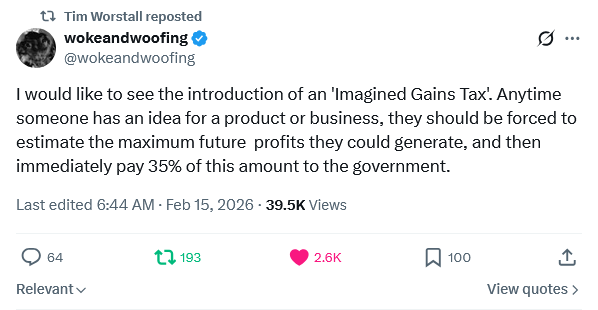
Governments everywhere are always on the lookout for more ways to raise revenue, so any suggestion of an untapped resource they can tax will get their attention. Apparently the current hot idea is an unrealized gains tax, which @wokeandwoofing satirized thusly:
Also on the social media site formerly known as Twitter, @Yogi frames the proposed new tax for Gen Z readers:
Unrealized gains tax for Gen-Z:
You buy a Pokémon card for $50.
Someone offers you $500 for it. You say no. You love that card. You’re keeping it.
The government says: “Cool, but that card is worth $500 now. You owe us $100 in taxes.”
You: “… I didn’t sell it.”Government: “Don’t care. Pay up.”
You don’t have $100 lying around. So you’re forced to sell the card you love just to pay a tax on money you never received.
Next month? That card drops back to $50.
Your card is gone. Your money is gone. And the government shrugs.
That’s a wealth tax on unrealized gains. They don’t pay you back the tax …
Now picture this.
Your mom calls you crying. She has to sell the house she raised you in. Not because she can’t afford it. She’s lived there 30 years. It’s paid off.
But some website says it’s worth more now and the government says she owes $15,000 she doesn’t have.
So she sells your childhood home. The kitchen where she made you breakfast. The doorframe where she marked your height every birthday.
Gone.
To pay a tax on money that was never real.
Now picture the opposite.
Your dad put everything into his small business. For 20 years he built it from nothing. One year the business is “valued” at $2 million on paper. He owes a massive tax bill. He empties his savings. Sells his truck. Borrows money. Pays it.
Next year the market crashes. His business is worth $200,000.
He lost everything to pay a tax on a number that doesn’t exist anymore.
Does the government give him his money back?
No.Does the government give him his truck back?
No.Does the government care?
No.They sold this idea as “taxing billionaires”. But billionaires have armies of lawyers, offshore accounts, and trusts. They’ll be fine.
You know who won’t be fine? Your mom. Your dad. Your neighbor with a small business. The farmer down the road who’s had the same land for four generations and now has to sell it because dirt got expensive.
You’re not taxing wealth. You’re taxing people for owning things.
It’s like getting a parking ticket for a car you might drive somewhere someday.
They want you to own nothing and be happy. To fund the fraud, waste and abuse of the welfare state they created.
There is enough money. More tax isn’t needed. It’s all a lie. But you’ve been gaslit into believing this is a rich vs poor debate.
I hope you understand what’s at stake.
Comments Off on The ludicrous idea of an “unrealized gains tax”
Eating in Japan During World War 2
Tasting History with Max Miller
Published 19 Aug 2025Fried sweet potato paste on top of roasted seaweed with a soy glaze and brown rice
City/Region: Japan
Time Period: December 1942Contrary to the government’s promises, the availability of food declined in Japan as World War 2 went on. Journal entries from 1945 highlight just how bad things had gotten. People were unable to get ahold of staples like rice, soy sauce, miso, and fuel for cooking fires, and many were scavenging for anything to eat.
This recipe comes from a few years earlier when things were tight, but not quite so dire. While it doesn’t exactly taste like grilled eel, it is quite good. There’s a nice crispiness to it (more so before the glazing and grilling), and the glaze is delicious. It kind of reminds me of the breading that you might get on some katsu.
Kabayaki of Sweet Potato
Ingredients for 5 servings
100 monme sweet potatoes
2 tablespoons wheat flour
1 teaspoon salt
15 sheets of roasted seaweed
Grate the sweet potatoes with a grater and grind. Mix in the flour and salt. Spread the mixture onto the roasted nori to a thickness of about 1/2 cm. Fry them in oil until golden brown. Separately, make a soy sauce glaze in the ratio of 3 parts soy sauce to 2 parts sugar. Dip in the glaze and grill them. Repeat this twice, brushing with sauce each time. On the third, use only the sauce without grilling.— Fujin no Tomo (The Woman’s Friend), December 1942
Comments Off on Eating in Japan During World War 2


