
I’m from Kentucky, and people tell me I should be loyal to Bourbon, but I see the whiskey hierarchy sort of like this:
- Scotch. Nectar of the Gods. Complex, smooth, and just the right thing to fill yourself up on before painting yourself blue and riding off to kick the crap out of a bunch of English gits. Lagavulin and Macallan (16 years) are the reason people have been able to tolerate life in the scrubby, bleak landscape of northern Great Britain. Or whatever the island that contains Scotland is called. For all I know, “Great Britain” includes the Falklands.
- Bourbon and sour mash. Only good for mixing, unless you spend at least forty dollars, because Bourbon is usually harsh. And that includes Wild Turkey. But the better ones are smooth and full-flavored, albeit about as complex as a Kool Pop. I like Blanton’s. Maker’s Mark gold is okay, but only if your friends are serving it free of charge. People holler about Knob Creek all the time. I’m suspicious of old-timey-looking products that didn’t seem to exist until 1985. I suspect that it’s a gimmick aimed at yuppie suckers, but I have not actually tried it.
- Irish whiskey. Wonderfully smooth; especially Black Bush, which is my favorite. Great subtle flavor. Even the cheaper brands are pretty good. But zero complexity.
- Canadian. This makes a good substitute for windshield-washer fluid. Absolutely the most boring whisky (with no “E”) in the universe. Tastes like brown water. Alcoholics love Canadian whisky, because there’s not much to it, and you can drink it day after day without much effort. I can’t believe Canadians waste their time driving to the distillery to make this garbage. Laughable.
I guess now I’ll get flames from the unfortunate people who enjoy Jack Daniel’s, and from pedantic losers who drink obscure distilled beverages made in Wales.
Canadian Club and Crown Royal drinkers won’t flame me until at least noon, because they are all alcoholics and won’t be done with their morning retching until then.
I still need to find some really bad Scotch on a par with Jack Daniel’s. Something packed in plastic bottles or even cans. You need a good cheap harsh whisky to marinate BBQ. The good stuff, I reserve for marinating myself.
Steve H., “Booze and Birds: My Stressful Life”, Hog On Ice, 2005-03-20
August 13, 2021
QotD: Whisky, whiskey, and Canadian whiskey
Comments Off on QotD: Whisky, whiskey, and Canadian whiskey
August 12, 2021
How to Find a Woodland Space for Green Woodwork
Rex Krueger
Published 11 Aug 2021Can I find a workspace in the woods, even though I live in a city?
More video and exclusive content: http://www.patreon.com/rexkrueger
Build your own Shavehorse: https://www.rexkrueger.com/store/shav…
Watch the video: https://youtu.be/hqudWoT_jkg
(more…)
Comments Off on How to Find a Woodland Space for Green Woodwork
The Canadian Historical Association’s “consensus” on genocide in Canada
In Quillette, Christopher Dummitt reports on last month’s declaration by the Canadian Historical Association that not only were past Canadian governments complicit in deliberate genocide against First Nations, but that such mass extermination efforts are current and ongoing:
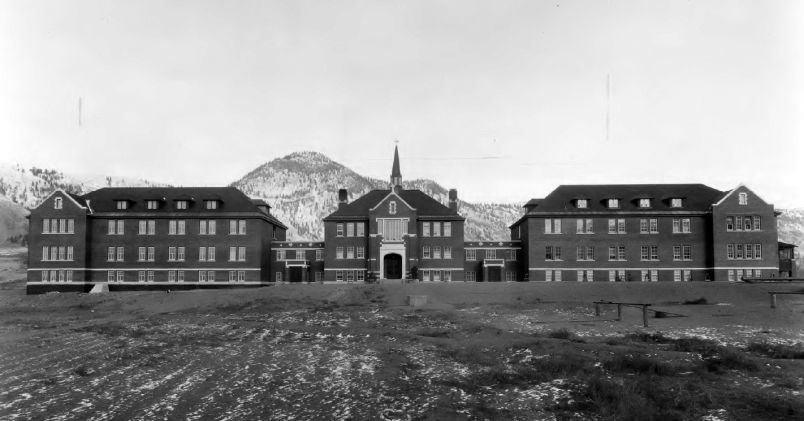
Kamloops Indian Residential School, 1930.
Photo from Archives Deschâtelets-NDC, Richelieu via Wikimedia Commons.
Last month, the Canadian Historical Association (CHA) issued a public “Canada Day Statement” — described as having been “unanimously approved” by the group’s governing council — declaring that “existing historical scholarship” makes it “abundantly clear” that Canada’s treatment of Indigenous peoples amounts to “genocide”. The authors also claimed that there is a “broad consensus” among historians on the existence of Canadian “genocidal intent” (also described elsewhere in the statement as “genocidal policies” and “genocidal systems”) — an alleged consensus that is “evidenced by the unanimous vote of our governing Council to make this Canada Day Statement”.
The authors went further by arguing that both federal and provincial governments in Canada “have worked, and arguably still work, towards the elimination of Indigenous peoples as both a distinct culture and physical group” (my emphasis); thereby suggesting that there is “arguably” an ongoing genocide going on, to this day, on Canadian soil.
The idea that Canada is currently waging a campaign of mass extermination against Indigenous people may sound like something emitted by Russian social-media bots or Chinese state media. But no, this is an official statement from the CHA, a body that describes itself as “the only organization representing the interests of all historians in Canada” — presumably including me.
In fact, there is no “broad consensus” for the proposition that Canadian authorities committed genocide, let alone for the completely bizarre idea that a genocide is unfolding on Canadian soil even as you read these words. And while many of us have become used to such plainly dilatory claims being circulated by individual Canadian academics in recent years, the CHA’s use of its institutional stature in this way was so shocking that it caused dozens of historians to affix their names to a letter of protest.
Notwithstanding what this (or any other) official body claims, the question of whether Canada committed genocide is not a settled issue among scholars. Canada is a relatively small country, home to only a small number of professional historians. And so even this modest-seeming collection of names suffices to disprove the CHA’s claim that it speaks for the entire profession. Moreover, many of those who have signed the letter are senior scholars giving voice to younger colleagues who (rightly) fear that speaking out publicly will hurt their careers.
I am not writing here to defend the actions of Canadian governments toward Indigenous populations. As most Canadians have known for decades, the policy of forcing Indigenous children to attend residential schools led to horrendous cases of sexual and physical abuse. There was also a long history in many schools of refusing to let children speak their native languages or continue their cultural traditions. These were assimilatory, underfunded institutions created and run by people who typically believed that they were doing Indigenous people a favour by “civilizing” them.
What I am addressing, rather, is (a) the question of whether these actions are correctly described with the word “genocide”, and (b) the CHA’s false claim that there is “broad consensus” on the answer to that question. As the letter of protest states:
The recent discovery of graves near former Indigenous residential schools is tragic evidence of what the Truth and Reconciliation Commission (TRC) documented in Volume 4 of its final report — a report that we encourage all Canadians to read. We also encourage further research into gravesites across Canada and support the completion of a register of children who died at these schools. Our commitment to interrogate the historical and ongoing legacies of residential schools and other forms of attempted assimilation is unshaken. However, the CHA exists to represent professional historians and, as such, has a duty to represent the ethics and values of historical scholarship. In making an announcement in support of a particular interpretation of history, and in insisting that there is only one valid interpretation, the CHA’s current leadership has fundamentally broken the norms and expectations of professional scholarship. With this coercive tactic, the CHA Council is acting as an activist organization and not as a professional body of scholars. This turn is unacceptable to us.
Historians are taught to approach their study of the past with humility, on the understanding that the emergence of new documents and perspectives may require us to revise our assessments. Moreover, even if an individual scholar might have strong opinions about a particular historical subject — having become certain that his or her interpretation represents the truth — the community of historians exists in a state of debate and disagreement. We are always aware that two historians sifting through the same archival box of documents can develop very different theories about what those documents mean.
It is true that there are some areas of history that might be fairly labelled as definitively “settled”. But these are few. And even in these cases, consensus typically arises organically, through the accumulated weight of scholarship — not, as in the case of the CHA’s Canada Day stunt, through ideologically charged public statements that seek to intimidate dissenting academics into silence.
Comments Off on The Canadian Historical Association’s “consensus” on genocide in Canada
FN CAL: Short-Lived Predecessor to the FNC
Forgotten Weapons
Published 4 Jan 2019http://www.patreon.com/ForgottenWeapons
Cool Forgotten Weapons merch! http://shop.bbtv.com/collections/forg…
The CAL (Carabine Automatique Leger; Light Automatic Carbine) was FN’s first attempt to produce a 5.56mm rifle as a counterpart to the 7.62mm FAL. While light and handy, the CAL was a relatively complex and expensive design, and failed to garner many sales. About 12,000 were made in total before FN pulled the gun in favor of the FN FNC, which would prove to be much more successful.
Contact:
Forgotten Weapons
PO Box 87647
Tucson, AZ 85754

Comments Off on FN CAL: Short-Lived Predecessor to the FNC
QotD: Ignoring the warnings
Let’s jump forward a few decades: in 1973, Israeli military intelligence was fully aware of a huge build-up of men and weapons on its borders with Syria and Egypt. The mobilizations were impossible to hide — tens of thousands of troops, tanks, artillery, the whole apparatus of modern warfare was lining up across Israel’s borders. But Israel’s top military intelligence officer concluded that the build-up was intended to apply political pressure ahead of negotiations, not actually to prepare for an assault. Israel was militarily superior, after all, and had handily defeated the combined Arab armies before, including just six years prior. The Arabs simply wouldn’t dare try again. Right?
Wrong. They dared, Israel was caught totally by surprise, and the Jewish state came shockingly close to defeat and likely destruction.
Ideally, these kinds of mistakes — mistakes of preparedness, mistakes of erroneous conclusion — are studied, learned from and then never repeated. In the real world, of course, we tend to make the same mistakes over and over.
Matt Gurney, “How the COVID crisis broke our leaders’ minds”, The Line, 2021-04-23.
Comments Off on QotD: Ignoring the warnings
August 11, 2021
The Symphony That Defeated the Wehrmacht – WAH 040 – August 1942, Pt .1
World War Two
Pubished 10 Aug 2021The Big Action at the Warsaw Ghetto continues, while The Japanese carry out retaliations against the Chinese for aiding American airmen. Dmitri Shostakovich’s “Symphony no. 7” premieres in the besieged city of Leningrad.
(more…)
Comments Off on The Symphony That Defeated the Wehrmacht – WAH 040 – August 1942, Pt .1
“What war is for a soldier, global pandemic is for a health professional – most might never wish for it, but it is what they have been preparing for their whole lives”
I spent most of my life avoiding the healthcare profession … not from antipathy but from the awareness that others almost always needed access far more than I did. That changed for me at the end of 2015, although I still avoid bothering any of “my” healthcare professionals for anything that isn’t fairly clearly urgent and I’d like to maintain as low a level of contact with doctors, clinics, hospitals, and other outposts of the profession as much as I can. That said, most of the doctors, nurses, and other professionals in that line of work I’ve dealt with have been professional, competent, and (within normal limits) friendly. This doesn’t mean I don’t take Arthur Chrenkoff‘s concerns quite seriously:

Not actually the official symbol of Britain’s National Health Services … probably.
If it’s up to our health experts – doctors, scientists and researchers, administrators and bureaucrats – we will never return to the “old normal”. If it’s up to our health professionals, COVID restrictions – border closures, lockdowns, masks, social distancing, etc. – will go on and on in the foreseeable future. The advent of COVID and its never ending mutations and strains might, in fact, mark the end of our life as we knew it and herald the “new normal”, ever under the shadow of a rolling pandemic.
Why? Because our health experts and professionals are enjoying it too much.Before you get outraged at my imputation, let me assure you I don’t mean the medical-industrial complex out there is hooting with joy and cracking up bottles of champagne to celebrate every new variant. By and large – and not being able to peer inside the souls of men and women I prefer to give them benefit of the doubt, though you, my reader, might have a different opinion about just how large in “by and large” is – they are honourable people with best intentions at heart. They want to save lives, prevent needless pain and suffering, minimise risks and banish sickness, save the grandmas from being killed and save the young from unforeseen long term consequences of what for them is generally a mild infection. These people take their Hippocratic Oath seriously, even those who are not medical practitioners and so not explicitly bound by it.
No, by enjoyment I really mean the satisfaction of what ancient Greeks called thymos, and which can be broadly translated into contemporary realities as the the desire to be valued and the desire for recognition.
What war is for a soldier, global pandemic is for a health professional – most might never wish for it, but it is what they have been preparing for their whole lives. It’s their time. It can be frustrating being a health expert during ordinary times; you are just one of many different voices competing to be heard about your priorities, opinions and your vision for a better life for all. Now, you are centre stage. You are important and respected. People, from a next door neighbour to the Prime Minister or the President, seek your guidance, listen to you, act on your input, appreciate your expertise. You finally have influence, real influence, if not actually a degree of control. What you say goes. The media hang on your every word, punters out there are your captive audience, leaders feel more or less strongly obliged to follow – after all, you’re the expert, you know what you’re talking about, you have the answers. Finally, you count, you really count, big time. Years of hard study and years of hard work have come to fruition, previous frustrations fall away. Millions of people appreciate your contribution and are grateful for your public service. You are a hero who is trying to keep the dragons at bay, save people from harm and death. This is not your everyday toil, patient by patient or a demographic by demographic; hell, this is the entire population, the whole humanity. There can’t be anything bigger or more important than that. Professional and public rewards are nice, but it’s not even about that – it’s the satisfaction of job well done, of having made a difference, of having made an impact, having done good.
Once you have tasted and experienced this God-like power to order entire societies according to your best designs, once you acquire this unparalleled position, with its influence and its quasi-saintly public status, do you really want to give it back and retreat again into the previous obscurity when hardly anyone listens to you?
Tank Chats #119 | Churchill Mark VI and VIII | The Tank Museum
The Tank Museum
Published 19 Mar 2021The Tank Museum’s Historian David Fletcher discusses a tank in the Museum’s collection which entails a certain level of controversy. Is it a Churchill Mark IV, or Mark VI? David believes it to be a Mark IV 75mm, with a number of updates, hence the disparity. David also covers the Mark VIII variant with the 95mm close support howitzer. Join him to find out more.
(more…)
Comments Off on Tank Chats #119 | Churchill Mark VI and VIII | The Tank Museum
QotD: Wellington and Napoleon
“Fought with his fiery few and one,”
remarking afterwards, “It was the bloodiest battle for numbers I ever knew.” It was, however, against Napoleon and his famous Marshals (such as Marshals Ney, Soult, Davos, Mürren, Soult, Blériot, Snelgrove, Ney, etc.) that Wellington became most memorable. Napoleon’s armies always used to march on their stomachs, shouting: “Vive l’Intérieur!” and so moved about very slowly (ventre-à-terre, as the French say), thus enabling Wellington to catch them up and defeat them. When Napoleon made his troops march all the way to Moscow on their stomachs they got frozen to death one by one, and even Napoleon himself admitted afterwards that it was rather a Bad Thing.
Gorilla War in Spain
The second part of the Napoleonic War was fought in Spain and Portugal and was called the Gorilla War on account of the primitive Spanish method of fighting.
Wellington became so impatient with the slow movements of the French troops that he occupied himself drawing imaginary lines all over Portugal and thus marking off the fighting zone; he made a rule that defeats beyond these lines did not count, while any French army that came his side of them was out of bounds. Having thus insured himself against disaster, Wellington won startling victories at Devalera, Albumina, Salamanda, etc.
Waterloo
After losing this war Napoleon was sent away by the French, since he had not succeeded in making them top nation; but he soon escaped and returned just in time to fight on the French side at the battle of Waterloo. This utterly memorable battle was fought at the end of a dance, on the Playing Fields of Eton, and resulted in the English definitely becoming top nation. It was thus a very Good Thing. During the engagement the French came on in their usual creeping and crawling method and were defeated by Wellington’s memorable order, “Up Jenkins and Smashems”.
This time Napoleon was sent right away for ever by everybody, and stood on the deck of a ship in white breeches with his arms like that.
W.C. Sellar & R.J. Yeatman, 1066 And All That, 1930.
Comments Off on QotD: Wellington and Napoleon
August 10, 2021
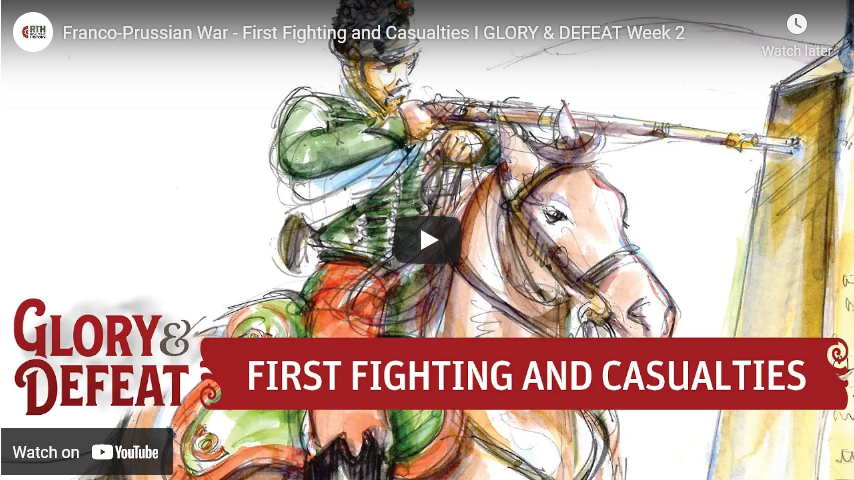
Franco-Prussian War – First Fighting and Casualties I GLORY & DEFEAT Week 2
realtimehistory
Published 22 Jul 2021Support Glory & Defeat: https://realtimehistory.net/gloryandd…
With the official declaration of war from France, Prussia mobilizes and calls in the defensive alliances with the other German states within the North German Confederation but also with Bavaria, Württemberg and Baden. And while the bigger armies still assemble, the first skirmishes happen near the French border.
» OUR PODCAST
https://realtimehistory.net/podcast – interviews with historians and background info for the show.» LITERATURE
Arand, Tobias: 1870/71. Der Deutsch-Französische Krieg erzählt in Einzelschicksalen. Hamburg 2018Arand, Tobias / Bunnenberg, Christian (Hrsg.): Karl Klein. Fröschweiler Chronik. Kriegs- und Friedensbilder aus dem Krieg 1870. Kommentierte Edition. Hamburg 2021
Bourguinat, Nicolas / Vogt, Gilles: La guerre franco-allemande de 1870. Une histoire globale. Paris 2020
Howard, Michael: The Franco-Prussian War. London 1961
Milza, Pierre: L’année terrible. La guerre franco-prussienne septembre 1870 – mars 1871. Paris 2009
» SOURCES
Becker, Josef (Hrsg.): Bismarcks spanische «Diversion« 1870 und der preußisch-deutsche Reichsgründungskrieg. Bd. III. Paderborn, München, Wien, Zürich 2003
Bebel, August / Bernstein, Eduard (Hrsg.): Der Briefwechsel zwischen Friedrich Engels und Karl Marx. Bd. IV. Stuttgart 1921
Fontane, Theodor: Krieg gegen Frankreich, Bd. 1. Berlin 1873
Napoléon III: Proclamation de l’Empereur. Paris, 23. Juillet 1870
» OUR STORE
Website: https://realtimehistory.net»CREDITS
Presented by: Jesse Alexander
Written by: Cathérine Pfauth, Prof. Dr. Tobias Arand, Jesse Alexander
Director: Toni Steller & Florian Wittig
Director of Photography: Toni Steller
Sound: Above Zero
Editing: Toni Steller
Motion Design: Philipp Appelt
Mixing, Mastering & Sound Design: http://above-zero.com
Maps: Battlefield Design
Research by: Cathérine Pfauth, Prof. Dr. Tobias Arand
Fact checking: Cathérine Pfauth, Prof. Dr. Tobias ArandChannel Design: Battlefield Design
Contains licensed material by getty images
All rights reserved – Real Time History GmbH 2021
Comments Off on Franco-Prussian War – First Fighting and Casualties I GLORY & DEFEAT Week 2
Elections not for changing things but merely for “sending messages”?
Jay Currie on the election that Justin Trudeau clearly itches to call at any moment:

“2019 Canadian federal election – VOTE” by Indrid__Cold is licensed under CC BY-SA 2.0


Apparently Justin Trudeau thinks that the best use of the nation’s time as we head into a Delta driven 4th wave of COVID is to have an election. Okay, I never thought he had any judgement and an election call at the moment would confirm that but here we are.
There are huge issues facing Canada. Unfettered immigration, useless but expensive carbon taxes, deficits to 2070, price inflation, real estate markets which have put housing in the luxury goods category, a stalled First Nations reconciliation process, the collapse of any number of energy projects, increased homelessness, opioid deaths, a health care system which seems incapable of dealing with even a fairly mild pandemic, senior care in a shambles where our elderly died in droves as much from neglect as COVID and on and on.
Judging from the Liberals activities in the run up to the election, while those issues get the occasional nod, the strategy seems to be to spend lots of money in seats the Libs either hold or would like to win. As to substance, the Libs seem very committed to “doing something” about climate change, keeping immigration levels up over 400,000 per year and not being racist. Unfortunately, this is also pretty much the substantive position of the Conservative Party. The CPC’s big selling point is getting rid of Justin and his gender balanced Cabinet of flakes.
Conservative leader Erin O’Toole (who also happens to be my local MP) seems to believe the only way he’s going to topple Trudeau and the liberals is by offering exactly the same policies but wrapped in false Tory blue instead of Liberal red. As far as I can tell, he’s the reddest of Red Tories to lead the party in decades (disclaimer: I’ve met O’Toole a few times and chatted about non-political topics … he seems a decent sort and he’s probably a good neighbour and an upstanding citizen in his private life). He’s certainly no Stephen Harper — and I wasn’t much of a Harper fan, but I’d strongly prefer Harper to O’Toole as Tory leader. I certainly don’t plan on voting for him, and unless the Libertarians scare up a candidate in my riding I’ll be voting PPC this time around:
You will notice I do not mention Max Bernier or the Peoples’ Party. I don’t because the PPC plays outside the consensus. The PPC and its supporters think that significant change is absolutely required and that issues like the deficit, immigration, economic development, First Nations policy, housing and health care need new thinking. […] In terms of seats and outcomes, while I would be delighted to see the PPC win a few seats, the real target for the PPC is the national and regional popular vote. Yes, I do know that does not matter electorally. After all, the CPC won the popular vote in the last federal election. (My own sense is that the Maverick Party has some chance of winning seats in Alberta and Saskatchewan which will be discussed in that subsequent post.)
Max and the PPC need to crack the 5% barrier this time out. If they can do that and Max can win in Beauce, they will have sent a huge message to the CPC. That message is important. Now, if Max and the PPC manage to cut through and beat the Greens – not an unrealistic goal – the message that there are real problems which need real solutions will go mainstream whether the gatekeepers like it or not.
There are really two elections coming up: the Tweedledum and Tweedledee, paid for media, horse race and a vote on whether Canada is a serious country.
Comments Off on Elections not for changing things but merely for “sending messages”?
Art Deco in the 1920s
The1920sChannel
Published 1 Nov 2019The aesthetic of the 1920s was certainly unique and instantly recognizable. For those of us (me included) who don’t know much about art, it’s difficult to pinpoint the characteristics. The most important art movement of the ’20 was Art Deco. So here’s a closer, though unprofessional, look at 1920s aesthetic.

Comments Off on Art Deco in the 1920s
QotD: Government workplace regulations still envision the unionized 1930s factory as “normal”
Warren Meyer, “When Regulation Hammers Those It is Supposed to Benefit — A Real Example in California”, Coyote Blog, 2021-05-06.
Comments Off on QotD: Government workplace regulations still envision the unionized 1930s factory as “normal”
August 9, 2021
The modern-day threat of being made an “unperson” is real and very dangerous
Sean Gabb explains why even libertarians need to consider the non-state power in the hands of corporations that can — and does — force people out of their jobs, their homes, and even deprive them of the ability to communicate or to access financial services merely for expressing unpopular opinions. As I said in a different venue, it’s a short step from “no fly lists” to “no eat lists”, especially when the enforcing entity is a nominally private organization:
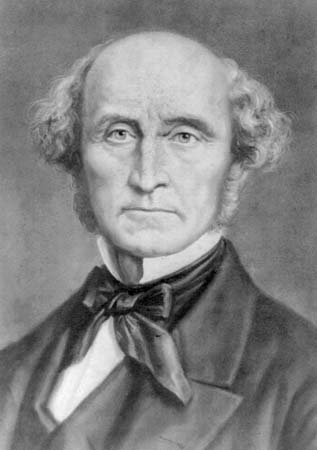
John Stuart Mill (1806-1873)
The old pressures to conform were wrong. So are the new. And they are wrong simply because they are pressures to conform. I find myself at last appreciating a part of Mill’s essay On Liberty for which I never used to have much time. Until recently, I would insist that the only real oppression was by the State: all else was the working of private choice. If the authorities fined a man £5 for having sex with another man, that was outrageous tyranny. If his tastes became public knowledge, and he was unable to find work, that was merely unfortunate. This is, I still believe, essentially true. Indeed, I could argue that, without a State having centralised and corporatised powers of discrimination that ought to be widely distributed, there would be no problem — or there would be a problem that was bearable. But these powers were centralised and corporatised a long time ago. They are now being used to achieve a uniformity of opinion outside the home in which the formal organs of compulsion have no obvious part. This is not the “tyranny of the majority” that worried Mill. I find it inconceivable that anything close to a majority could believe the insane drivel pouring from the regime media. Neither, though, is it the kind of oppression against which liberal bills of rights have traditionally been written. Because of this —
when society is itself the tyrant …, its means of tyrannising are not restricted to the acts which it may do by the hands of its political functionaries. Society can and does execute its own mandates: and if it issues wrong mandates instead of right, or any mandates at all in things with which it ought not to meddle, it practises a social tyranny more formidable than many kinds of political oppression, since, though not usually upheld by such extreme penalties, it leaves fewer means of escape, penetrating much more deeply into the details of life, and enslaving the soul itself. Protection, therefore, against the tyranny of the magistrate is not enough: there needs protection also against the tyranny of the prevailing opinion and feeling; against the tendency of society to impose, by other means than civil penalties, its own ideas and practices as rules of conduct on those who dissent from them …
(J.S. Mill On Liberty, 1859, “Introductory“)
We need protection indeed. But the protection we need is not yet another law telling the police to leave dissidents alone. We already have a stack of these, and they are protections against a threat that largely does not exist. The answer, I suggest, is an amendment to the anti-discrimination laws to outlaw discrimination on the grounds of what may be loosely called political opinion.
I say hardly anyone read my original essay. Sadly, most of those who did read it stand in the more wooden reaches of the libertarian movement, and these set up a cry that I had become a Communist. I was suggesting that private organisations should be coerced in their choices of whom and whom not to employ, and even in their choices of customer and supplier. I had abandoned the non-aggression principle. Here, briefly expressed, is my answer to these claims.
I run the Centre for Ancient Studies. This provides a range of tuition services in Greek and Latin. It is a sole tradership. As such, I reserve the unconditional right to decide what services I offer and to whom. If I dislike the colour of your face, or the status of your foreskin, or your tastes in love, or anything else that I may think relevant, it should be my right not to do business with you. It may be that only a fool turns away customers with money to spend, and I am not that sort of a fool. Even so, I do claim at least the theoretical right, and I ground it on my right to do as I please with my own. But I claim these rights as a human individual. A limited company is not a human individual. Whatever entrepreneurship may exist in them, these companies are artificial persons and creatures of the State. Their owners have the privilege of limited liability. That is, they have the right, in the event of insolvency, not to pay the debts of a company if these are greater than the assets of the company. If this were not a valuable right, there would not be so many limited companies. There are almost no large companies, and none lasting more than a single generation, that do not have limited liability.
This being so, limited companies benefit from a grant of privilege from the State, and are legitimate subjects of regulation by the State for as long as they are receipt of this privilege. No doubt, some forms of state regulation are bad in their objects, or bad as regards the means to their objects. But regulation is not in itself an aggression by the State. It follows that, whether or not we can get it, libertarians should not feel barred from demanding laws to prevent limited companies from discriminating against their employees on the grounds of political opinion, and to require them to do business with customers and suppliers regardless of political opinion.
I appreciate that I am asking for more than the regulation of limited companies. The anti-discrimination laws we have make no distinction between incorporated and unincorporated associations. Even so, the extension of these laws to cover political opinion would mainly affect only the larger limited companies. At the same time, there is an obvious and overriding public interest in the protection of political opinion. People are now scared to speak their minds. Whether intended or just revealed, this is part of the strategy. The reason why the collapse of both freedom and tradition is gathering pace is because no one dares stand up and protest. In the absence of protest, everything will carry on as it is. Given a restored right of protest, there is a chance of stopping the collapse. The only way to lift the blanket of fear that now lies over all but approved opinion is somehow or other to get a law making it clear that no one who speaks his mind can be loaded with shadow punishments.
“Somehow or other!” In a sense, I am making a fool of myself. I am asking the politicians to make a law against what they themselves may not be doing, but that has no effect on their main reason for being in politics, which is to fill their pockets. I am asking them to take on the entire mass of the non-elected Establishment. I am asking a lot of these people. On the other hand, the politicians still need to be elected, and that was the weak point in the Establishment’s plan to stay in the European Union. We had to spend four years voting and revoting, but we did eventually get what we wanted. It is conceivable that, if enough of us call loudly enough for protection, some kind of protection will be granted.
Short of that, we are lost.
Comments Off on The modern-day threat of being made an “unperson” is real and very dangerous
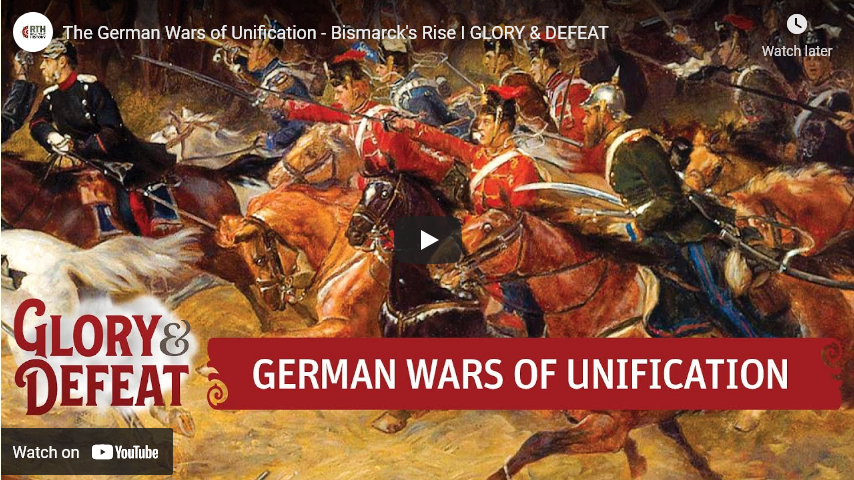
The German Wars of Unification – Bismarck’s Rise I GLORY & DEFEAT
realtimehistory
Published 19 Jul 2021Support Glory & Defeat: https://realtimehistory.net/gloryandd…
After the failed revolution of 1848, the German states within the German confederation were still moving towards unification. This movement would come from the citizens this time though but from the top. Prussia’s chancellor Otto von Bismarck was using clever and aggressive diplomacy to outmaneuver his biggest German rival: Austria.
» OUR PODCAST
https://realtimehistory.net/podcast – interviews with historians and background info for the show.» LITERATURE
Arand, Tobias: 1870/71. Der Deutsch-Französische Krieg erzählt in Einzelschicksalen. Hamburg 2018
Bremm, Klaus-Jürgen: 1866. Bismarcks Krieg gegen die Habsburger. Darmstadt 2016
Buk-Swienty: Schlachtbank Düppel. Geschichte einer Schlacht. Hamburg 2015
Fesser, Gerd: Königgrätz – Sadowa. Bismarck Sieg über Österreich. Berlin 1994» SOURCES
Böhme, Helmuth (Hrsg.): Die Reichsgründung. dtv-Dokumente. München 1967Dollinger, Hans: Das Kaiserreich. Seine Geschichte in Texten, Bildern und Dokumenten. München, 1966
Hardtwig, Wolfgang /Hinze, Helmuth (Hrsg.): Deutsche Geschichte in Quellen und Darstellungen. Bd. 7: Vom Deutschen Bund zum Kaiserreich 1815 – 1871. Stuttgart 1997
Huber, Ernst Rudolf (Hrsg.): Dokumente der Verfassungsgeschichte, Bd. 2. 1851 – 1900. Stuttgart u.a. 1961
N.N.: Helmuth von Moltkes Briefe an seine Braut und Frau. Stuttgart u.a. 1911
Low, Sidney / Sanders Lloyd C.: The History of England During the Reign of Victoria (1837-1901) Volume 12 of 12, [Part of Series: The Political History of England in Twelve Volumes, Edited by William Hunt and Reginald L. Poole], Longmans, Green, and Co., London. 1907
» OUR STORE
Website: https://realtimehistory.net»CREDITS
Presented by: Jesse Alexander
Written by: Cathérine Pfauth, Prof. Dr. Tobias Arand, Jesse Alexander
Director: Toni Steller & Florian Wittig
Director of Photography: Toni Steller
Sound: Above Zero
Editing: Toni Steller
Motion Design: Philipp Appelt
Mixing, Mastering & Sound Design: http://above-zero.com
Maps: Battlefield Design
Research by: Cathérine Pfauth, Prof. Dr. Tobias Arand
Fact checking: Cathérine Pfauth, Prof. Dr. Tobias ArandChannel Design: Battlefield Design
Contains licensed material by getty images
All rights reserved – Real Time History GmbH 2021
Comments Off on The German Wars of Unification – Bismarck’s Rise I GLORY & DEFEAT


