You can find huge shelves of books analyzing this, attributing it to every conceivable thing, from the ol’ “lead in the water pipes” to massive structural defects stretching into remote antiquity. There’s probably something to all of them, but the biggest proximate cause is probably one the Romans themselves had identified, as early as Sallust, way back in the last century BC: lack of purpose. Having defeated Carthage and salted the earth where once she stood, the Roman “security state” — the largest and most comprehensive ever assembled to that point — simply ran out of reasons to exist.
If you’ve read much about (or especially by) them, you know that the Romans were, for lack of a better term, paranoid. It was simply incompatible with the Roman psyche to have any large, organized group of non-Romans anywhere near the Empire’s borders … so the Empire kept expanding, first reducing, then Romanizing, every conceivable threat. They kept doing this long past the point of negative returns, such that the Empire collapsed under the strain of trying to hold itself together.
Stop me if this sounds familiar: A “government” whose only claim to legitimacy is naked force. A large, increasingly rapacious, increasingly class-conscious military with no obvious enemies to fight, and no ability to subdue the ones it settles for. A large, increasingly rapacious, increasingly caste-conscious bureaucracy that views the whole “Imperial” project as one big tax farming operation. Massive, ever-increasing wealth disparities that can only be very temporarily alleviated by debasing the currency, because structural reform is culturally impossible from above, and physically impossible from below. And to top it all off, a weird, apocalyptic religious cult totally destroying the few pan-imperial cultural institutions, including the military.
The history of the Third Century is insanely complex, not well understood in many respects even by field specialists, but the gist of it is clear enough: Some general somewhere decides he’d like to have a crack at emperorizing, so he gets his troops to throw a purple toga on him and proceeds to take on the incumbent. Some other general thinks that’s a pretty nifty idea, so he does the same thing, taking on both the incumbent and the pretender. Not wanting to be left out of the fun, the incumbent’s main general murders the incumbent and takes the crown for himself, fighting whoever’s left, plus whichever of his subordinate commanders decide they want a shot at the big chair. The Senate rubber-stamps one of these clowns, or some other general who decides he’d like to throw his toga into the ring, and civil war follows civil war until one of them temporarily triumphs … only for the same thing to happen again once the shine is off the new guy (usually in less than a year or two).
They called ’em the “Barracks Emperors” for a reason, y’all. And it’s actually worse than that, since lots of times the rebel generals didn’t bother going for the big prize back in Italy. Lots of them decided they’d do just fine ruling, say, Britain, or parts of Gaul, or Asia Minor or Egypt or what have you, while the other guys slugged it out for the increasingly marginalized, if not totally meaningless, “official” title. Declare yourself the Emperor of ___, issue some slapped-together coins with your picture on them, and go nuts. The “Gallic Emperors” had a run of nearly half a century like that — not bad at all for Late Antiquity.
Severian, “The Crisis of the Third Decade”, Rotten Chestnuts, 2021-03-18.
August 17, 2021
QotD: The “Crisis of the Third Century”
August 16, 2021
French and German Armies in 1870 – Dreyse and Chassepot Rifle Overview I GLORY & DEFEAT Week 3
realtimehistory
Published 29 Jul 2021Sign up for Curiosity Stream and get Nebula bundled in and SAVE 26%: https://curiositystream.com/realtimeh…
While the French and different German Armies are gathering we are taking the time this week to take a look at military organization and warfare in 1870. As a special guest we also have Cap And Ball on the show who introduces the famous Chassepot and Dreyse rifles which will be important in this conflict.
» THANK YOU TO OUR CO-PRODUCERS
John Ozment
James Darcangelo
Jacob Carter Landt
Thomas Brendan» OUR PODCAST
https://realtimehistory.net/podcast – interviews with historians and background info for the show.» LITERATURE
Arand, Tobias: 1870/71. Die Geschichte des Deutsch-Französischen Krieges erzählt in Einzelschicksalen. Hamburg 2018
Delpérier, Louis; Mirouze, Laurent: Der Deutsch-Französische Krieg 1870/71. Bd. 2. Uniformierung und Ausrüstung der französischen Armeen. Wien 2020
Herre, Franz: Kaiser Wilhelm I. Der letzte Preuße. Köln 1980
Milza, Pierre: L’année terrible. La guerre franco-prussienne. Septembre 1870 – mars 1871. Paris 2009
Stein, Markus; Bauer, Gerhard: Der Deutsch-Französische Krieg 1870/71. Bd. 1. Uniformierung und Ausrüstung der deutschen Armeen. Wien 2020» SOURCES
Fontane, Theodor: Der Krieg gegen Frankreich. Bd. 1. Berlin 1873
Kriegsgeschichtliche Abtheilung des Großen Generalstabs (Hg.): Der deutsch-französische Krieg 1870/71. Erster Theil. Erster Band. Berlin 1874
Pflugk-Harttung, Julius: Krieg und Sieg 1870-1871. Bd. 2 Berlin 1896» OUR STORE
Website: https://realtimehistory.net»CREDITS
Presented by: Jesse Alexander
Written by: Cathérine Pfauth, Prof. Dr. Tobias Arand, Jesse Alexander
Director: Toni Steller & Florian Wittig
Director of Photography: Toni Steller
Sound: Above Zero
Editing: Toni Steller
Motion Design: Philipp Appelt
Mixing, Mastering & Sound Design: http://above-zero.com
Maps: Battlefield Design
Research by: Cathérine Pfauth, Prof. Dr. Tobias Arand
Fact checking: Cathérine Pfauth, Prof. Dr. Tobias ArandChannel Design: Battlefield Design
Contains licensed material by getty images
All rights reserved – Real Time History GmbH 2021

L. Neil Smith – “Take your children out of school!”
In the latest Libertarian Enterprise, L. Neil Smith offers a useful bit of advice to parents concerned about their children being indoctrinated in state-run schools:

“Abandoned Schoolhouse and Wheat Field 3443 B” by jim.choate59 is licensed under CC BY-NC-ND 2.0


For quite a while now, the boob-tube has been filled with coverage of various Board of Education meetings around the country attended by parents murderously angry that their kids are being forcibly indoctrinated with utter claptrap like CRT, which apparently stands for Communist Racist Toxin, a new and poisonous religion where the color of your skin is an Original Sin for which you will be made to suffer no matter what you think, do, or say. My wife Cathy, passing by the TV set half a dozen times a day, invariably shouts, “Take your children out of school!” This essay is admiringly dedicated to her.
I suppose the Public Schools got started out of some sense of specialization. “You chip the flint, Og, Ogla cooks the mammoth, and we’ll teach the kids.” Evolution would have it the other way. The young have been learning from their parents for thousands of generations and it worked out pretty well until sinister figures like Horace Mann and John Dewey, equipped with the limitless power of the State, decided to use it to steal our children from us.
Take your children out of school!
It was perhaps, the stupidest thing that a people have ever done, and I’m pretty sure that Thomas Jefferson would have recognized it as the stupid thing it was, so it had to wait until he and those like him were safely dead. It isn’t brain science. It isn’t rocket surgery. Hand your offspring over to the State, and they will be taught every self-destructive thing the State wants them to be taught — and by now it should be clear, as it surely was to Jefferson, that the State is the enemy of everything decent and productive. Public education was probably responsible for both world wars.
Take your children out of school!
And if it was such a self-evidently good idea, then why did it have to be compulsory? The rows of desks in public schools are populated by conscription — no matter how many pleasant memories we may have of our school days. Public schools are financed by extortion and theft, two of the reasons we fought a revolution in the first place.
Take your children out of school!
It might be cynically observed that public schools are cheaper than paying for baby-sitting, but, given property taxes and the damage it does to the most important people in our lives, is it really? Idiots have whimpered for the last year that having your kids at home is inconvenient.
Public Schools are convenient for the State. They give government two incomes to tax, instead of only one. Take your children out of school!
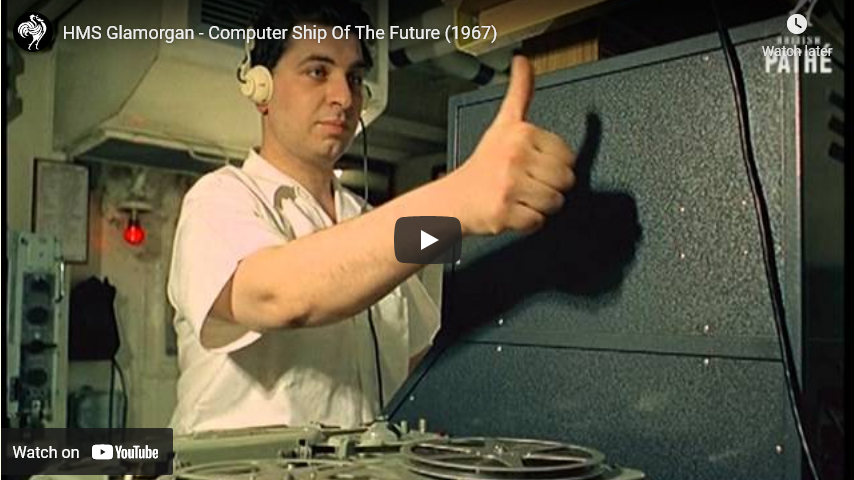
HMS Glamorgan – Computer Ship Of The Future (1967)
British Pathé
Published 13 Apr 2014English Channel.
Top shots of the guided missile destroyer
battleshipHMS Glamorgan at sea. In the control/computer room a man pulls out old-fashioned computer records [circuit packs, I believe] from a large control cupboard; officers on the bridge look at dials and through binoculars. Various shots in steering, control and engine rooms as the ship moves along. On the flight deck sailors play hockey while others watch and cheer them on. A navigator on deck looks through a sextant while another officer makes notes. A helicopter is moved from a hanger out onto the deck and prepared for takeoff; firemen in asbestos suits and helmets stand by with a hose; the chopper takes off.Three young men play guitars and banjos before a television camera in a tiny studio; we hear that the ship has its own closed circuit TV station; good shots of the filming; tape recording machines going round; picture being adjusted. Men in a mess room watch the performance on the television while they have a pint. Several shots of the sailors getting their rum rations. Various shots in the kitchens show food being prepared and served into the sailors mess tins; good canteen and catering shots (most of the food looks pretty unappetising) [the person writing the description clearly has no idea just how unappetizing British food could be in the 1960s … this looks well above average for the time]. In the sick bay a sailor gets a shot in the arm from the Medical Officer.
Several shots of the radar antennae on the ship and the men looking at the radar scanner screens in the control room. Men in protective gloves and hoods load shells in the gun turret; M/Ss of the main guns on the ship being fired. Several shots show the countdown for Seaslug missiles to be fired; men at control panels look at dials and radar screens; an officer counts down into a microphone (mute). Complicated boards of buttons show the location of the missiles, intercut with shots of the missiles moving into position by electronic instruction. The missiles move into the launchers on deck and are fired; men watch their progress on a radar screen. Another launcher moves into position; L/S of the ship as the missiles are fired.
Note: on file is correspondence and information about HMS Glamorgan. Cuts exist – see separate record. FILM ID:419.04
A VIDEO FROM BRITISH PATHÉ. EXPLORE OUR ONLINE CHANNEL, BRITISH PATHÉ TV. IT’S FULL OF GREAT DOCUMENTARIES, FASCINATING INTERVIEWS, AND CLASSIC MOVIES. http://www.britishpathe.tv/
FOR LICENSING ENQUIRIES VISIT http://www.britishpathe.com/
British Pathé also represents the Reuters historical collection, which includes more than 136,000 items from the news agencies Gaumont Graphic (1910-1932), Empire News Bulletin (1926-1930), British Paramount (1931-1957), and Gaumont British (1934-1959), as well as Visnews content from 1957 to the end of 1984. All footage can be viewed on the British Pathé website. https://www.britishpathe.com/
QotD: Biotechnology
Ignore the origin and look at the technology on its own terms. (This will be easier with the emergence of “open source” genetic engineering, which could work around restrictive corporate patents.) What is its net effect on the environment? GM crops are more efficient, giving higher yield on less land with less use of pesticides and herbicides. That’s why the Amish, the most technology-suspicious group in America (and the best farmers), have enthusiastically adopted GM crops.
There has yet to be a public debate among environmentalists about genetic engineering. Most of the scare stories that go around (Monarch caterpillars harmed by GM pollen!) have as much substance as urban legends about toxic rat urine on Coke can lids. Solid research is seldom reported widely, partly because no news is not news. A number of leading biologists in the U.S. are also leading environmentalists. I’ve asked them how worried they are about genetically engineered organisms. Their answer is “Not much,” because they know from their own work how robust wild ecologies are in defending against new genes, no matter how exotic. They don’t say so in public because they feel that entering the GM debate would strain relations with allies and would distract from their main focus, which is to research and defend biodiversity.
Stewart Brand, “Environmental Heresies”, Technology Review, 2005-05
August 15, 2021
No Soviet Oil for Hitler – WW2 – 155 – August 14, 1942
World War Two
Published 14 Aug 2021The Axis advance into the Caucasus is going great … except the oil towns they take have no oil, and wasn’t that the whole purpose? Meanwhile in the Pacific, the US Navy is suffering perhaps its greatest defeat ever off Savo Island, even as the Marines take Tulagi, Gavutu, and Tanambogo.
(more…)
Denel NTW 20: A Multi-Caliber Anti-Materiel Rifle
Forgotten Weapons
Published 7 Sep 2018http://www.patreon.com/ForgottenWeapons
Cool Forgotten Weapons merch! http://shop.bbtv.com/collections/forg…
Created by noted South African gun designer Tony Neophytou, the NTW-20 is a bolt action anti-materiel rifle made in 20x82mm, 20x110mm, and 14.5x115mm. The weapon began as idea to use the large quantities of surplus 14.5mm ammunition available at the time, and a recognition that the 14.5mm Soviet cartridge was an excellent anti-armor round, with a really remarkably high muzzle velocity. To widen the rifle’s capabilities, it was decided to incorporate an easily interchangeable barrel, and also chamber it for the 20x82mm round used in the Inkunzi PAW individual weapon and Inkunzi Strike machine gun. The 20x82mm is low velocity compared to traditional 20mm cartridges, carrying the same explosive or incendiary payload but without the punishing recoil of what was originally an aircraft cannon cartridge.
Both of these cartridges are fed from a 3-round box magazine on the left side of the action. A single-shot version in the longer 20x110mm cartridge was also developed by request of a military client, but this cartridge is too long to fit the magazine. A version in .50 BMG was considered, but decided against on the basis of the 14.5mm being just as available and substantially more effective.
The gun is liberally sprinkled with clever engineering and design features — things like using the recoil-absorbing travel of the action to recock the hammer, and the use of both 20mm and 14.5mm cartridge cases as levers for unlocking the barrel. The optic was custom made for the rifle, an 8x56mm long eye relief scope to prevent any chance of the scope bell injuring the shooter during recoil. The trigger mechanism uses only a single spring, and is easily removed from the action. The bolt handle itself is on a pivot pin, and provides the primary extraction leverage to ensure easy cycling with the high-pressure 14.5mm cartridge.
From a military perspective, the NTW-20 is easily broken apart into barrel and action loads, and can be transported more easily than any comparable weapon by a two-man team. The use of a recoil buffer in the action and an effective muzzle brake makes it a remarkably pleasant 20mm rifle to fire. Of all the anti-material rifles I have fired (Lahti L39, Solothurn S18-1000, Mauser T-Gewehr), the NTW-20 was by far the most comfortable to shoot. It was also the only one in which I jumped at the chance to fire more rounds once the filming needs were met. It certainly has a kick, but not at all a painful one.
Many thanks to Denel Land Systems for allowing me to try out this very cool rifle!
If you enjoy Forgotten Weapons, check out its sister channel, InRangeTV! http://www.youtube.com/InRangeTVShow

QotD: A bold new electoral strategy for the US Republican party
Hear me out. It’s kind of crazy, but it just might work.
A nominee who doesn’t suck has certain advantages over the usual losers we see all too often idioting up our ballots. One of those advantages is that people are more likely to vote for someone who is not terrible than one who manifestly is. And getting more votes than the Democrat – who is always terrible – is a very, very important part of electoral victory, though you would not know that from the GOPe’s actions. Its members seem to think the goal is polite defeat, but us unwashed Jesus people who like guns and America and don’t live near Washington have this weird notion that candidates should attempt to win their elections.
Maybe we should try that in 2022.
Kurt Schlichter, “Idea: In 2020, Let’s Nominate Candidates Who Aren’t Awful”, TownHall.com, 2021-05-12.
August 14, 2021
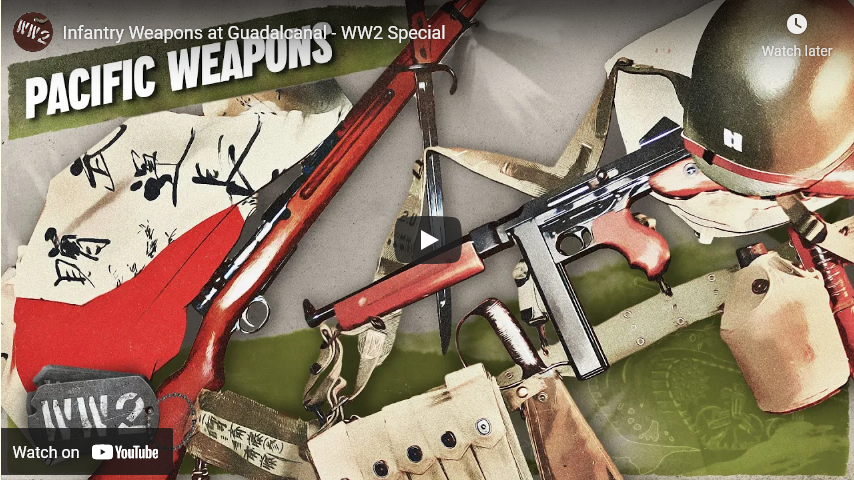
Infantry Weapons at Guadalcanal – WW2 Special
Update: The folks at the World War Two channel have taken down this video due to technical errors in the script. Here’s their explanation.
World War Two
21 hours ago
Video on Infantry Arms at Guadalcanal retracted. Indy explains why:Hi everyone. Indy here. As most of you know, I do the research and writing for all of the regular weekly episodes here. I host many of the specials as well, though I do not do the research for most of them- occasionally so, if it’s something that’s really in my field of expertise, like geopolitics, strategy, personal stories, communications, and international relations. The research for the other specials is done by a variety of specialists in their fields or historians, so we can maintain the quality you’ve come to expect from us. I understand, though, that many of you have serious issues with the research for the Guadalcanal infantry special. Our apologies for that- the research was done by an historian, a PhD [student], actually, and we also ensured it was double fact-checked, but obviously some serious mistakes slipped through. Live and learn. I will say that I think it is important that you continue to tell us when you take issue with something we present, since we strive to make the most complete and accurate documentary series possible, so although some of them are hard to read we appreciate such feedback from our community.
And this is from the researcher who worked on the script:
Marlon Londoño
18 hours ago
Hey guys! This is Marlon, the PhD student in question who helped with the researching and writing of the episode. Just to give a little background, I’m a volunteer researcher who helps with the channel over the summer while I’m not teaching/researching/taking coursework. I’m a military historian and my main academic focus is on social and cultural military history (i.e. what people’s wartime experiences were like and why. I’m especially interested in how people justify wartime violence and oftentimes the types of weapons they use play a role in that mental process, so that’s the context in which I usually think about weapons on the battlefield).I’m sorry that I let a lot of you down with the mistakes about the Garand and Arisaka, among others. To be honest, I was surprised to learn they were myths. But I certainly know now, and I don’t think I’ll be forgetting any time soon 😅 One thing that I firmly believe as a researcher and educator is that nobody has a monopoly on the truth, least of all me. I tell that to my students on the first day of class each semester. I certainly don’t presume that the degree I’m pursuing makes me infallible or instantly qualified for anything. And this was a classic example of just how wrong I can be sometimes!
For what it’s worth, I love war history just as much as anyone else in the community, and I’m sorry that my research wasn’t as rigorous as it might otherwise have been. I hope you all might be willing to give any future episodes of mine a second chance, and of course I’m all ears for any mistakes that you want to point out!
English wholesalers, Dutch retailers and the expansion of foreign trade by European sailors
In the latest Age of Invention newsletter, Anton Howes considers the changing nature of English foreign trade as possibly one of the main drivers of the unprecedented growth of London from 1550-1650, and how both English and Dutch sailors differed from most of the rest of Europe:
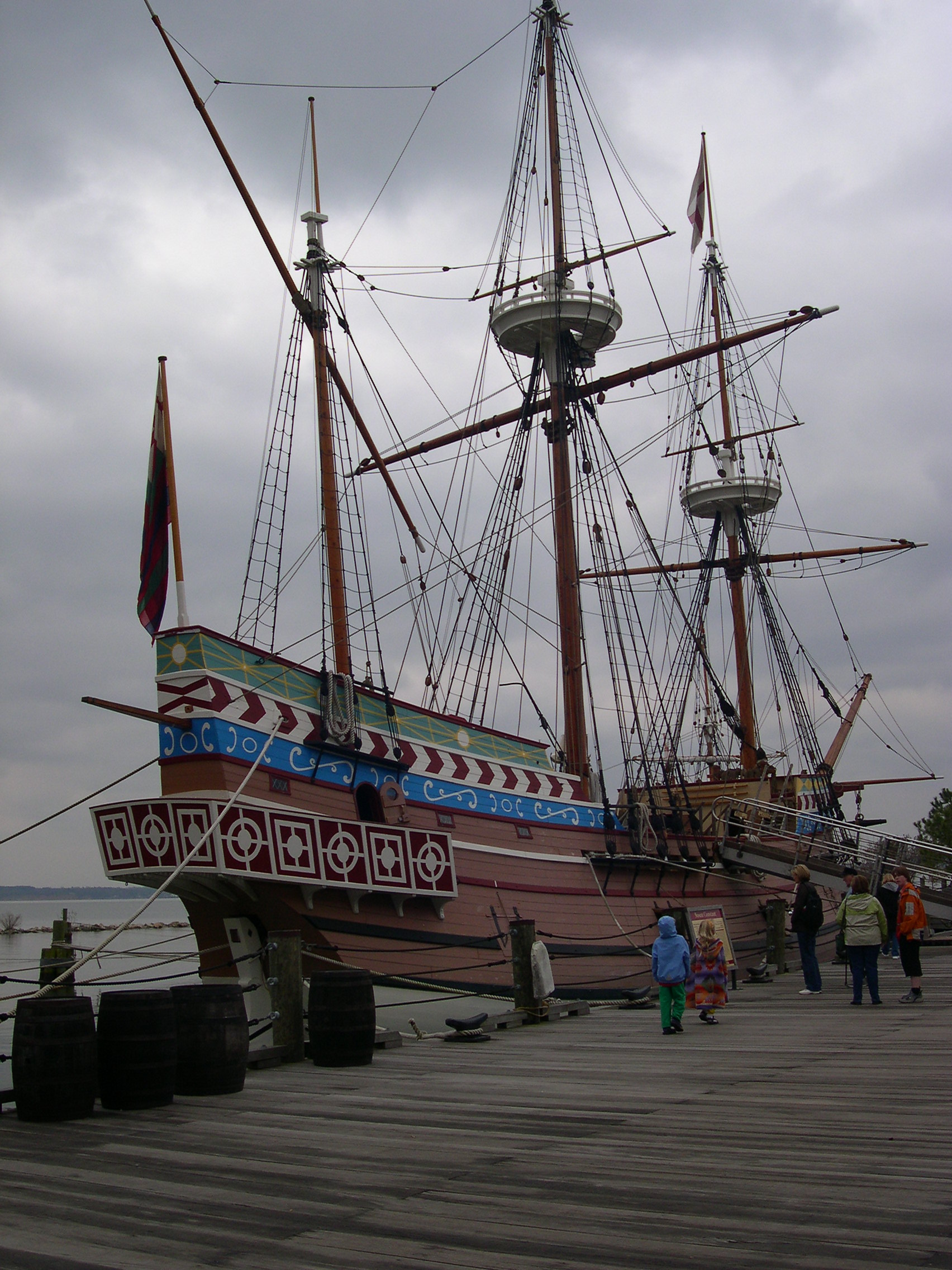
An English merchant ship of the late 16th to early 17th century: this is a replica of the Susan Constant at the Jamestown Settlement in Virginia. The original ship was built sometime before 1607 and rented by the Virginia Company of London to transport the original settlers to Jamestown.
Photo by Nicholas Russon, March 2004.
I am fairly convinced that this transformation was sparked by the changing nature of England’s trade, with its merchants taking near-total control of it themselves, whereas once they had relied on foreign merchants to bring many of their imports to them. And thanks to their adoption of celestial navigation techniques from the Iberians and Italians — learning to read the stars, to find their latitude at sea — the English gained the ability to discover new routes, noting details down for others to come back again and again and create more permanent new trades. In merchants’ parlance of the time, the English increasingly went in search of “the well head” — to buy things at source, where they were cheapest.
This sounds like the common-sense thing to do. But it was surprisingly rare. Very few countries’ merchants attempted to take advantage of such opportunities for arbitrage — to buy where things were cheapest and sell them where they were most expensive. Even the English themselves, despite their newfound search for well heads, rarely exploited arbitrage opportunities to the full. Although they bought at source, they tended, at first, to sell the goods they’d acquired back in London, to serve English consumers rather than taking them to wherever the goods would sell for the highest prices. This was instead the strategy of the Dutch, whose trading techniques were by 1600 said to surpass all others. Indeed, the Dutch were also some of the only merchants who discriminated on prices within markers, “not shaming to retail any commodity by small parts and parcels”, as one English merchant complained, charging a multitude of buyers according to what they thought they could get from them — something that “both English merchants and Italians disdain to do in any country whatsoever.” It was seemingly considered beneath them.
I’m not wholly clear why the English only sold wholesale when they knew that price discrimination was a Dutch advantage. It seems, at first, to be irrational. But I suspect it had something to do with the wider difficulties of trading abroad. For the English and Dutch were quite unusual in Europe in the early seventeenth century for being among the only merchants willing to risk sailing to shores where their own rulers held no sway.
The Hanseatic merchants of the North Sea and Baltic, who had once been dominant in London, had been stripped of their privileges there and displaced by the English, later confining themselves largely to the Baltic. German mercantile efforts were otherwise generally concentrated inland. And French merchants were apparently under-capitalised, or so the English suspected, because “gentlemen do not meddle with traffic, because they think such traffic ignoble and base”. French merchants did occasionally sail down the Atlantic coast to Spain, and into the Mediterranean to trade with Italy and the Ottoman Empire, but overall they were content to have third parties to come to them — there was always the attraction to foreign merchants of being able to buy French wines, salt, linens, and grain.
As for the once-great Italians, they had apparently been impoverished by the Portuguese discovery of a direct route around Africa to the Indian Ocean, and perhaps by the depredations of various Mediterranean predators too — Algerian corsairs, Ottoman galleys, and the like. Although their rulers could themselves be merchants — the Grand Duke of Tuscany, a Medici, was considered the greatest merchant of them all — by this stage the Italians only rarely ventured far abroad themselves, except over land. Indeed, the English considered them impious for not risking the seas, accusing them of blasphemy for not trusting their lives and livelihoods to God. Whereas the Venetian merchant-nobility had once been required to spend time aboard ship, English commentators by 1600 noticed that their mariners were now overwhelmingly Greek. “Their customs have decayed, their ships rotted and their mariners, the pride of their commonwealth all become poltrones” — that is, loafers or idlers — “and the worst accounted in all those seas”. A Tuscan exploration of the coast of South America in 1608, to look into founding a colony in what is now French Guiana, had to be captained and piloted by Englishmen. What reputation the Italians maintained was as financiers and money-exchangers — perhaps because the Genoese were the only merchants permitted to take the vast quantities of New World silver out of Spain.
Great Moments in Unintended Consequences (Vol. 3)
ReasonTV
Published 7 May 2021Good intentions, bad results.
——————
Follow us on Twitter: https://twitter.com/reasonReason is the planet’s leading source of news, politics, and culture from a libertarian perspective. Go to reason.com for a point of view you won’t get from legacy media and old left-right opinion magazines.
—————-Window Wealth
The Year: 1696
The Problem: Britain needs money.The Solution: Tax windows! A residence’s number of windows increases with relative wealth and is easily observed and verified from afar. A perfect revenue generator is born!
Sounds like a great idea! With the best of intentions. What could possibly go wrong?
To avoid higher taxes, houses were built with fewer windows, and existing windows were bricked up. Tenements were charged as single dwellings, putting them in a higher tax bracket, which then led to rising rents or windowless apartments. The lack of ventilation and sunlight led to greater disease prevalence, stunted growth, and one rather irate Charles Dickens.
It took more than 150 years for politicians to see the error of their ways — perhaps because their view was blocked by bricks.
Loonie Ladies
The Year: 1992
The Problem: Nude dancing is degrading to women and ruining the moral fabric of Alberta, Canada.The Solution: Establish a one-meter buffer zone between patrons and dancers.
Sounds like total buzzkill! With puritanical intentions. What could possibly go wrong?
It turns out that dancers earn most of their money in the form of tips, and dollar bills don’t fly through the air very well. Thus, the measure designed to protect dancers from degrading treatment resulted in “the loonie toss” — a creepy ritual where naked women are pelted with Canadian one-dollar coins, which are known as loonies.
Way to make the ladies feel special, Alberta.
Gallant Grocers
The Year: 2021
The Problem: Local bureaucrats need to look like they care.The Solution: Mandate that grocery stores provide “hero pay” to their workers.
Sounds like a great idea! With the best of intentions. What could possibly go wrong?
Besides the fact that these ordinances may preempt federal labor and equal protection laws, a 28 percent pay raise for employees can be catastrophic to grocery stores that traditionally operate on razor-thin margins. As a result, many underperforming stores closed, resulting in a “hero pay” of sudden unemployment.
Don’t spend it all in one place!
Written and produced by Meredith and Austin Bragg; narrated by Austin Bragg

QotD: Modern parenting
But we also fear their independence. We’re up there in the climber because we can’t afford to miss a minute of face time, you see. We believe our physical presence is the linchpin to the children’s emotional well-being and, although we never say so out loud, we want it that way — because it’s central to our well-being. We’re scared the kids will grow up to resent the fact that Mommy works, or — the biggest golem on the list — they just plain won’t like us. And in an age of high divorce rates and transient communities, kids who don’t like us suggest the possibility that we might really end up alone.
Beth Hawkins, “Safe Child Syndrome: Protecting kids to death”, City Pages, Volume 26 – Issue 1267 (posted to the old blog, 2005-04-01).
August 13, 2021
Spycraft and the Special Operations Executive – WW2 – Spies & Ties 07
World War Two
Published 12 Aug 2021Astrid talks about spying all the time, but what was it actually like for people on the ground? We look through the lens of the British Special Operations Executive (SOE) to find out!
(more…)
Millennial maternalism
In The Critic, Kittie Helmick considers the Millennial generation and their pronounced maternalistic worldview:

“Millennials” by EpicTop10.com is licensed under CC BY 2.0
The popular conception of millennials paints the generation as immature, living an extended adolescence: late to marry, late to have children, late to buy houses. Even the retort — that society hasn’t delivered on its promises; that an unfavourable job market has prevented them from living the lives expected of adults — reads as a refusal to accept responsibility.
The response to Simone Biles’s withdrawal from the Olympics demonstrates that the opposite is true. Millennials are not behaving like teenagers — they are responding like mothers. The breakdown in family life combined with quantum leaps in telecommunication technology has sent the 90s generation to their computer screens for meaningful connections. Instead of growing out of video games and chat rooms, millennials have grown with them. Online communities have not stunted young people’s growth, but absorbed it.
Millennials — now aged in their late 20s and early 30s, some with families of their own — have directed all the maternal instincts of adulthood towards online media. Rather than collect family albums, they amass Instagram and Tumblr accounts with thousands of images of their favourite characters and celebrities. Notifications act as little appeals for attention akin to the tug of a child’s hand. This otherwise unrealised yearning to nurture underpins much of the affective response to news stories about the latest victim of injustice.
There are many strands entangled in the knot of American leftism, but the maternalism of millennials manifests in the self-righteous defensiveness of Biles’s supporters and the emotional outrage they direct at anyone who criticizes the gymnast. Stripped of patriotic sentiments and religious traditions, millennials have nowhere to direct their human instincts of loyalty and affection but at the figures (fictional or fabled) who occupy so many of their hours.
The language of critical theory cloaks these sentiments in intellectual rigor, lending some dignity not only to the mouthpieces of these ideas, but also to the intended objects of their affections. Millennials don’t have to worry about infantilising Biles if they call her an “exceptional Black woman”, even while they simultaneously invoke the moral standards of a kindergarten classroom in asking, “How do we make it our responsibility to love and protect each other?”
Witness these impulses play out in the more thinly veiled account of a father who wonders if he has turned “soft” because his parental cares now eclipse his admiration of Kerri Strug’s feat during the 1996 Olympics: performing a “one-legged vault” on an injured ankle. The father implies that only a monster could cheer when a teenage girl sacrifices her health for victory. He makes no secret of the reason behind his change of heart: “Now that I have two young daughters in gymnastics, I expect their safety to be the coach’s number one priority.”
There is nothing amiss in his love for his daughters, or the extension of that concern to other children, but this father has lost sight of other principles that might compete for priority in the spotlit, split second decisions of athletes and trainers in Olympic competitions. Loyalty to something greater than oneself — to Strug’s teammates, to the country she represented — has fallen out of the picture, leaving behind only the petty incentive of winning. This perspective permits no higher motive to the coach responsible for urging Strug on, than greed for a gold medal.
Millennial parents run to the opposite extreme of the Spartan mother: instead of inculcating self-sacrifice for the good of the community, they insist, “Not my child.” They see their role as shielding children from the dangers of the outside world, rather than preparing them to face it.
[Military 101] NATO Unit Counters – Niehorster Dialect
Military History Visualized
Published 26 Jul 2016» HOW YOU CAN SUPPORT MILITARY HISTORY VISUALIZED «
(A) You can support my channel on Patreon: https://www.patreon.com/join/mhv(B) You can also buy “Spoils of War” (merchandise) in the online shop: https://www.redbubble.com/people/mhvi…
» SOCIAL MEDIA LINKS «
twitter: https://twitter.com/MilHiVisualized
tumblr: http://militaryhistoryvisualized.tumb…Script & Further Information: http://militaryhistoryvisualized.com/…
—Sources—
–Websites & Links–Niehorster – Military Organization Symbols Key
http://niehorster.org/000_admin/009_s…https://en.wikipedia.org/wiki/NATO_Jo…
—Credits & Special Thanks—
The Counter-Design is heavily inspired by Black ICE Mod for the game Hearts of Iron 3 by Paradox Interactive
https://forum.paradoxplaza.com/forum/…—Song—-
Ethan Meixsell – “Demilitarized Zone” (the Irony :D)