Livy’s life (roughly 59 BC to about 17 AD) spanned the most consequential period in the thousand-year history of ancient Rome. He witnessed the last decades of the crumbling old Republic and the rise in its place of the imperial autocracy we know as the Roman Empire. He was in his early twenties when the last great defender of the republican heritage, Cicero, was assassinated by a henchman of the tyrant Marc Antony. Livy observed the entirety of the reign of the first Emperor, Augustus. He is best known for his history of Rome, Ab Urbe Condita, described both in his day and in ours with such terms as “monumental” and “magisterial”.
What little we know of the man himself suggests he was somehow financially well-off, independent, and reclusive. He was schooled in rhetoric, philosophy, and history. He never served in any public position, though apparently, he personally knew Augustus. Writing his massive history of Rome absorbed his adult life.
Though Romans at the time of his writing held his work in high regard, we know that some parts of Livy’s historical accounts were surely based on minimal records, old and dubious oral stories, and even legend. After all, he wrote 2,000 years ago about people and events of as much as eight centuries before his time. “I hope my passion for Rome’s past has not impaired my judgment,” he opined in his introduction to Ab Urbe Condita, “for I do honestly believe that no country has ever been greater or purer than ours or richer in good citizens and noble deeds.”
“The old Romans,” wrote Livy of his countrymen before the beginning of the Republic, “all wished to have a king over them because they had not yet tasted the sweetness of freedom.” But then in 508 BC, Romans mounted a truly historic revolution of both ideas and governance. They overthrew the monarchy and established a new order that ultimately included a Senate of nobles, popularly elected Assemblies, the dispersion of centralized power, term limits, a constitution, due process, habeas corpus, and the widest practice of individual liberty the world had yet seen. Before they lost it all less than five centuries later, they experienced a remarkable rise and fall. […]
From Livy, we learn about Rome’s pivotal wars against the Carthaginians, the Samnites, and other peoples of the Italian Peninsula. He also informs us of the rivalry between Sulla and Marius, the tumultuous last days of the Republic as strong men fought each other for power, the murder of Julius Caesar, and the self-serving machinations of Augustus. Livy celebrated the courage of his ancestors; in fact, he originated the phrase, “Fortune favors the brave,” which is still used commonly today as a maxim and a motto.
Lawrence W. Reed, “Lessons from Livy on How Great Civilizations Rise and Fall”, Foundation for Economic Education, 2021-06-28.
October 12, 2021
QotD: Titus Livius, better known as Livy
October 11, 2021
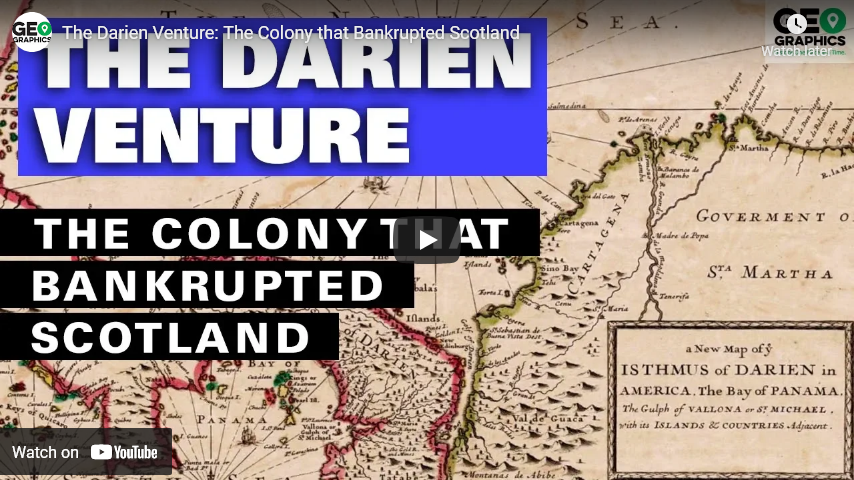
The Darien Venture: The Colony that Bankrupted Scotland
Geographics
Published 14 Nov 2019If a Nation’s wealth and power were to be measured in stubbornness, resilience, and inventiveness, rather than GDP, Scotland would be a top-5 superpower. The people that brought to you televisions, refrigerators, penicillin, and gin & tonic have gone through many a rough patch throughout their history. Very often, hard times were related to their rocky relationship with their Southern neighbours, the English.
Credits:
Host – Simon Whistler
Author – Arnaldo Teodorani
Producer – Jennifer Da Silva
Executive Producer – Shell HarrisBusiness inquiries to admin@toptenz.net
The Line responds to charges that their reporting on China is “anti-Asian racism”
As an impoverished cheapskate, I can’t afford to subscribe to The Line‘s full service, but they do allow a sub-set of their work to appear to non-paying subscribers, like this response to a former subscriber who accused them of “anti-Asian racism” in their posts involving the People’s Republic of China:

China’s emergence as a global power is going to be one of the defining stories of the first half of the 21st century. We probably aren’t reading and writing about it enough. Late this week, however, we received a note from a now-former reader, who said that the pieces we had run, and the overall focus on China, reflected anti-Asian racism, and they would not be supporting us going forward.
Look, it’s your money, folks. We want more and more of you to subscribe all the time. But we certainly respect your right to decline, or to unsubscribe if you don’t like the offerings. However, we do have a word of reply to those who would suggest that publishing articles about China is racist: get bent.
There is indeed anti-Asian racism out there. We have seen a lot of disturbing signs of it during the COVID-19 pandemic, when Asians of any description have been subjected to harassment and even random acts of violence. In the United States, some of the more fiery anti-Chinese rhetoric favoured by the former president also undoubtedly contributed to that wave, and that has spilled over here. Further, the problem of anti-Asian racism of course isn’t new. We have a long history of anti-Asian discrimination in North America. This must be acknowledged. Anti-Asian hate was real before Trump and COVID, and it’ll remain long after both are finished.
But writing critically about the People’s Republic of China, the Chinese Communist Party, the Chinese armed forces, the policies of the Chinese government, the actions of the Chinese government, and the increasingly overt meddling in the affairs of other nations by Chinese intelligence operations, does not reflect any discredit upon Asian-Canadians, or any Asian in general. The policies of the Chinese government are exactly that: policies of a government. Criticizing policies and governments is not just acceptable, it’s absolutely necessary.
Indeed, we noted with grim amusement during a recent conversation with a colleague, who is comfortably nestled within the left-leaning progressive side of Canada’s political spectrum, that progressives in particular ought to be 100 per cent comfortable criticizing Chinese government policy. After all, progressives have been loudly and correctly noting for generations that there is a difference between rank antisemitism and warranted criticism of Israeli government policy. We find it fascinating that some of the very same people who would be horrified to be accused of antisemitism for criticizing Israel get tongue-tied when the Chinese government starts throwing religious minority women into rape camps.
We suspect some of it is simply rooted in the rampant identitarian obsessions of Western political discourse. People who criticize white supremacist Western imperialism a dozen times before breakfast might find it intellectually discombobulating to acknowledge that Western liberal democracies are not the only big baddies on the global stage. We’ve witnessed the many mental gymnastics that have been deployed to minimize or wish away credible reports of genocide and concentration camps, as if they were merely a Western fantasy being used to concoct a pretext for war. This is an ahistoric argument, by the way. The West has not been angling for war with one of its most lucrative suppliers and customers, quite the opposite. Until recently, we’ve operated under a Fukuyama delusion: the ironclad belief that China would moderate and liberalize as it grew more prosperous. This was predicated on the arrogant assumption that the liberal democratic West was the end state of history and that China would eventually meet us here, thus allowing peace and profit for all. That optimism hasn’t panned out, and many Western countries — Canada among them — have spent the last few years trying to reconcile our economic interdependence with our collective “oh shit” epiphany.
City Minutes: The Athenian Empire
Overly Sarcastic Productions
Published 25 Jun 2021Deja Vu? Only slightly! I’m re-imaging City Minutes, and this time the plan is to *Actually Make It Good*! With MULTIPLE CITIES per episode, and HORIZONTAL VIDEO!
I heard your feedback on the first run of the shorts loud and clear — City Minutes Good, Shorts Bad — so this will be the format going forward: networks of cities, with each getting a minute of spotlight.
We’re starting where I always start, in ancient Athens (I wanted to give you the proper version of the pilot), but we’ve got tons of other City Minutes planned!
SOURCES & Further Reading: Thucydides History of the Peloponnesian War, World History Encyclopedia (https://www.worldhistory.org/Athens): “Athens”, “Piraeus”, “Sounion”, “Delos”, “Corcyra”, “The Delian League” parts 3 & 4, and my degree in Classical Studies
Cities by timestamp:
00:00 — Athens
1:00 — Piraeus
2:01 — Sounion
3:03 — Delos
4:05 — Mytilene
5:03 — Korkyra
6:03 — ConclusionOur content is intended for teenage audiences and up.
PATREON: https://www.Patreon.com/OSP
PODCAST: https://overlysarcasticpodcast.transi…
DISCORD: https://discord.gg/osp
MERCH LINKS: http://rdbl.co/osp
OUR WEBSITE: https://www.OverlySarcasticProductions.com
Find us on Twitter https://www.Twitter.com/OSPYouTube
Find us on Reddit https://www.Reddit.com/r/OSP/
From the comments:
Overly Sarcastic Productions
43 minutes ago
Fun linguistic shenanigans: The island of Korkyra (commonly spelled Corcyra when referring to the ancient city) is known today as both Kerkyra and Corfu. The name Corfu comes from an Italianized version of the Byzantine name Korufo.I use the pronunciation of “Korkyra” with an O because it reflects the more common version of the name as listed in ancient accounts — adherence to the original ancient version is also why I’m using Ks in place of any Latinized Cs.
Essentially: I’m spelling everything the ancient way, but using modern Greek phonetics to sound out those words. It’s an uncommon way to go about, but it feels like the right balance of ancient authenticity and modern linguistic continuity.
-B
QotD: Columbus Day
But when Columbus landed on the Caribbean Island of San Salvador in the Bahamas, he set off a wave of exploration and colonization which the previous discoveries had not. The Viking and Chinese settlements did not last, but the post-Columbian ones did. And that is an incredibly significant historical event, no matter how you view history.
In the 1970s it became popular on the left to consider Columbus a monster, a villain who gave the innocent and peaceful natives diseases, enslaved them, wiped out their culture, and destroyed all that was good. This theory teaches that the American natives were all good and peaceful and wonderful and just and true and righteous. They all ate free trade non-GMO gluten free food and were perfectly multicultural and non-judgmental, free of war and with perfect gender equality. Columbus, an evil white European showed up and ruined it all. In short, Columbus he infected the Eden-like paradise of the Americas with his Euro-masculinity.
And the origin of this theory is that of the Noble Savage. There were people living outside the evil corrupting influence of White European Males, and Columbus found them and ruined everything. That’s why when you hear someone talking about this, they never mention the nearly-constant wars, cannibalism, human sacrifice, rape, pillaging, genocide, disease, poverty, and incredible lack of technical and scientific, artistic, and literary knowledge of the native peoples of America.
Columbus was a man of his time, and a particularly greedy one at that. He ripped off his own people, acting as the King’s supreme representative and authority in the Americas (which at the time was not known to be as vast as it is). He took credit for what others did, he took over what they developed, he took the riches they found, and so on. And yes, he and his men enslaved the local natives, and because of their culture of “free love” spread European venereal diseases among the natives they were not exposed to before. Entire tribes were wiped out by the infections they had no resistances to.
Of course, the natives spread disease among the Europeans they hadn’t been exposed to, either, such as Typhus and Syphilis, and the natives were murderous and killed Europeans but those are details that modern revisionist historians either ignore, gloss over, or present as a rough sort of justice: they had it coming for daring to set foot in the Eden of the Americas.
Objectively, neither side was particularly admirable, as one would expect if you understand innate and original sin. If what’s bad comes from within us rather than outside influences, then its spread evenly throughout all humanity without regard to creed, culture, race, or location. The natives were bad because people are bad. The Spaniards and Columbus (who was Italian) was bad, because people are bad.
Christopher Taylor, “Eden Ruined By Italian”, Word Around the Net, 2018-10-09.
October 10, 2021
Three Years in Vinland: The Norse Attempt to Colonize America
Atun-Shei Films
Published 9 Oct 2021Happy Leif Erikson Day! Some time after Thorvald Erikson’s disastrous voyage to the mysterious lands west of Greenland, a wealthy Icelander named Thorfinn Karlsefni financed and led an expedition of his own, with the goal of establishing a permanent Norse settlement in Vinland. Karlsefni and his crew would spend three summers in the New World, where they would have to deal with internal division, hostile Native Americans, and (according to some) the wrath of demonic mythological creatures.
Support Atun-Shei Films on Patreon ► https://www.patreon.com/atunsheifilms
Leave a Tip via Paypal ► https://www.paypal.me/atunsheifilms
Buy Merch ► https://teespring.com/stores/atun-she…
#LeifErikson #Vinland #History
Original Music by Dillon DeRosa ► http://dillonderosa.com/
Reddit ► https://www.reddit.com/r/atunsheifilms
Twitter ► https://twitter.com/atun_shei~REFERENCES~
[1] Magnus Magnusson & Hermann Pálsson. The Vinland Sagas: The Norse Discovery of America (1965). Penguin Books, Page 7-43
[2] Birgitta Wallace. “Karlsefni” (2006). The Canadian Encyclopedia [https://www.thecanadianencyclopedia.c..].
[3] Lorraine Boissonault. “L’Anse Aux Meadows and the Viking Discovery of North America” (2005). JSTOR Daily https://daily.jstor.org/anse-aux-mead…

First the Bloc Québécois, then “Wexit”, now Bloc Montréal?
Barbara Kay makes the case for Montreal to re-evaluate its position within Quebec as the Quebec government pushes toward even more legal efforts to reduce the English-speaking community to a second- or even third-class citizenship:

Oct. 7 brought an end to consultations on Quebec’s Bill 96, which amends the 1977 Charter of the French Language (Bill 101) and — unilaterally, never before attempted by a province — the Constitution Act of 1867. A few anglophone institutions were invited to the hearings, but their inclusion was pro forma. Bill 96 will pass through use of the notwithstanding clause.
The bill affirms Quebec is a nation, with French as its “common” as well as its only official language, adding several new “fundamental language rights” for French. It effectively creates both a Canadian and Quebec Charter-free zone in a wide range of interactions between individuals and the state. Even before passage, use of the P-word (“province”) has become politically charged, and quietly redacted from public usage by Bill 96 dissidents.
The impact of Bill 96 on anglophones could be momentous. One amendment, which restricts access to English health and social services to those with education-eligibility certificates, could negatively affect upwards of 500,000 anglophone Quebecers. It speaks volumes that the Minister of the French Language will take responsibility for outcomes delivery in that sector away from the Minister of Health and Social Services. Bill 96 will also negatively affect young francophones by capping their numbers at English cegeps [Collège d’enseignement général et professionnel or “General and Vocational College”].
The previous expansions of French language rights in Quebec — and corresponding contractions of English language rights in the province — drove waves of emigration to other provinces, helping Toronto surpass Montreal as Canada’s largest city and economic powerhouse. In the middle of a pandemic, it’s much harder for those who are feeling oppressed to leave Quebec, but there may be another possibility:
Montreal as a city-state, or at least a special autonomous region — a status the Cree nation of northern Quebec has enjoyed for decades — was first raised as a serious idea eight years ago. In 2013 the Parti Québécois proposed language Bill 14, as draconian as Bill 96, which died when premier Pauline Marois’s minority government couldn’t enlist enough collegial support for its passage. Nevertheless, the attempt galvanized alarm sufficient to inspire a transiently influential city-state movement.
A 2014 Ipsos poll on the subject commissioned by that group elicited these key takeaways from Montrealers: Montreal is a distinct society within Quebec (90 per cent); to stop its decline, Montreal needs to take drastic steps to improve its performance (91 per cent); and Montreal deserves special status within Quebec because it is a world-class, cosmopolitan city (74 per cent). Those numbers would likely be as high or higher today.
[…]
We need a Bloc Montréal to represent Montreal/Greater Montreal’s “distinct society” at the Quebec National Assembly in Quebec City. The pivotal moment of the 1995 referendum campaign was the revelation — one that had never before occurred to the separatists — that “if Canada is divisible, then Quebec is divisible”. That was a sobering and clarifying moment. And Montreal has a greater need for augmented representation in Quebec City than Quebec has in Ottawa. After all, Quebec profits handsomely from its affiliation with Canada, while the opposite is true of Montreal and Quebec City.
Stalingrad Thunderdome: Paulus vs. Chuikov! – WW2 – 163 – October 9, 1942
World War Two
Published 9 Oct 2021Things are looking pretty grim for Vassily Chuikov’s 62nd Army in Stalingrad this week, as the German 6th Army launches its biggest series of attacks so far. The Axis are unable to get anywhere in the Caucasus, though, and the American Marines win a local victory over the Japanese on Guadalcanal, but everyone’s thoughts there are on reinforcing and more reinforcing.
(more…)
“The NSBA letter is a blood libel against America’s dissenting parents”
In this Substack essay, C. Bradley Thompson calls the National School Boards Association’s (NSBA) demand that the federal government treat dissenting parents as “domestic terrorists” a declaration of war against ordinary American citizens:
On September 30, the National School Boards Association (NSBA) sent a letter to the Biden administration denouncing the nationwide parental protests taking place at school board meetings against Critical Race Theory, Critical Gender Theory, pornography in the classroom, mask mandates, vaccine requirements, and remote learning. It turns out that parents all over the country are upset about the indoctrination and censorship in America’s government schools. An army of moms (and dads) have been asserting their parental responsibilities and their constitutional rights by showing up to school board meetings and voicing — sometimes angrily — their contempt and disgust for those school boards and teachers promoting and sanctioning ideas and ideologies opposed by the parents.
The NSBA letter (see here) begins rather ominously by declaring that “America’s public schools and its education leaders are under an immediate threat” and that “immediate assistance” is therefore “required to protect our students, school board members, and educators who are susceptible to acts of violence affecting interstate commerce because of threats to their districts, families, and personal safety.” The NSBA is essentially declaring a “State of Emergency” for America’s government school system. Let that sink in for a moment.
[…]
Let’s be clear about what the NSBA letter means in practice: first, it is dog-whistling a message which says that protesting parents are engaged in “domestic terrorism and hate crimes” (including, presumably, against their own children); and, second, it is requesting that the Biden administration use the full coercive power of the United States government — power that it has only previously been used against Islamic terrorists and foreign enemies of the United States — to monitor, investigate, arrest, interrogate, prosecute, convict and jail upset parents who are protesting AGAINST the teaching of systemic racism (i.e., CRT), pornography in the classroom, and the unscientific mask mandates for children.
The NSBA letter is saying, in effect, that complaining parents are the moral equivalent of jihadi terrorists, who are out to commit acts of violence and terror against America’s school board members, its teachers, and, yes, even the children. As such, these parents should be treated as a national security threat, and they must be dealt with by all means necessary.
The NSBA letter is a blood libel against America’s dissenting parents. In a decent, free, and just society such a letter would be condemned and dismissed out of hand, but that is not the kind of society in which we live today.
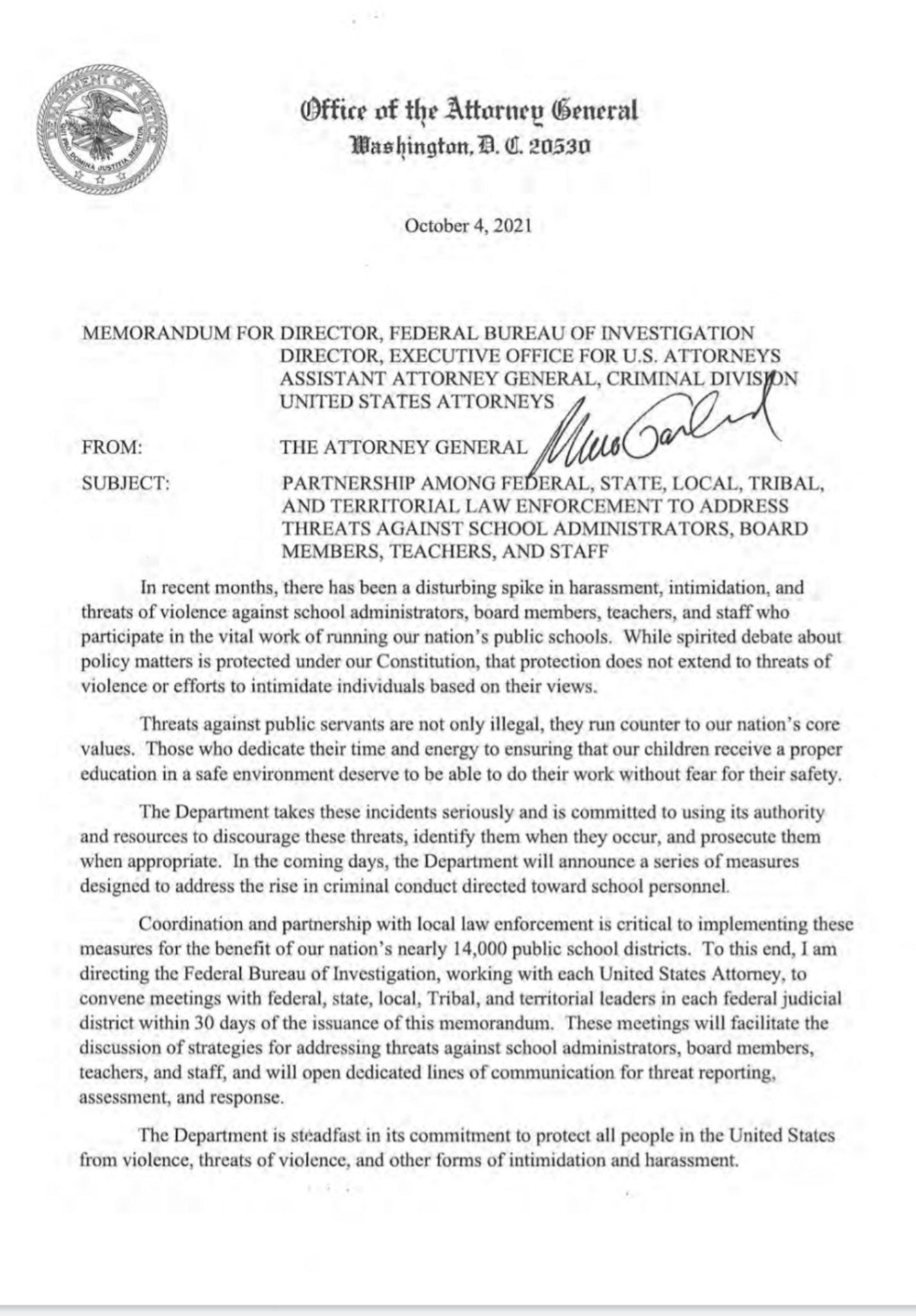
Rather than tossing the NSBA letter in the trash where it belongs, the Attorney General of the United States, Merrick Garland, read it and immediately ordered the FBI and America’s National Security State to mobilize its immense power against parents whose only real crime is to take seriously the education of their children. He did this within just a few days of receiving the NSBA letter.
I encourage you to read — and to read slowly — Garland’s official memorandum sent to the Director of the FBI and to various other law enforcement agencies, offices, and divisions.
Garland’s letter is a moral, political, and constitutional abomination. To say there are serious problems with the Attorney General’s Orwellian letter would be an understatement. The letter asserts, for instance, that “there has been a disturbing spike in harassment, intimidation, and threats of violence against school administrators, board members, teachers, and staff.” It claims as fact a “rise in criminal conduct directed toward school personnel”. Neither the NSBA nor the Justice Department have provided any credible or meaningful evidence to support this unfounded claim, nor does Garland’s passive-aggressive letter specify what it classifies as “criminal conduct” or “domestic terrorism”. (Not surprisingly, Garland’s letter neglects to mention that some school board members and the teachers’ unions have been harassing and threatening parents for months. See here, here, here, here, and here.) The simple fact of the matter is that virtually no violence has occurred at school board meetings this year.
In support of the NSBA request, Garland’s memorandum announced that he has directed the FBI and each U. S. Attorney to convene meetings immediately with “federal, state, local, Tribal, and territorial leaders in each federal judicial district” in order to “facilitate the discussion of strategies” for dealing with threats against school officials. The Department of Justice will also “open dedicated lines of communication for threat reporting, assessment, and response”. In other words, the government will establish “snitch” lines against parents. If a school board member doesn’t like what they hear in a public meeting, they will be able to report (presumably anonymously) threats of harassment and intimidation.
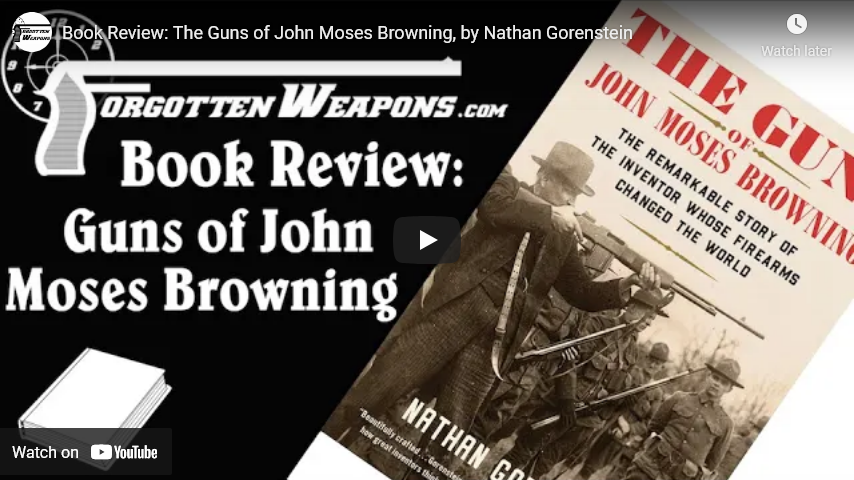
Book Review: The Guns of John Moses Browning, by Nathan Gorenstein
Forgotten Weapons
Published 24 Jun 2021http://www.patreon.com/ForgottenWeapons
https://www.floatplane.com/channel/Fo…
Cool Forgotten Weapons merch! http://shop.forgottenweapons.com
John Moses Browning is, without argument, the greatest firearms designer in history. While we have had many brilliant designers who had their names forever connected to guns (Maxim, Luger, Kalashnikov, …), Browning invented whole *categories* of firearms. Gorenstein’s new book The Guns of John Moses Browning is a welcome biography of the man, giving great insight into Browning’s life and work. The book is well researched, well written, and thoroughly engaging. It is also worth noting that Gorenstein is himself a competitive shooter, and understands the world that Browning operated in.
I think my back-cover blurb for the book (for which I received no compensation; full disclosure) sums it up well:
Following Browning from his birth in rural Utah to his death in urban Belgium, we see how a changing world shaped his inventions and how, in turn, his inventions shaped a changing world.
Browning began in the last years of the Wild West inventing lever action rifles, then became a major part of the blossoming of the automatic pistol, then invented the semiauto shotgun before designing the modern machine guns that become iconic to the United States’ involvement in two world wars. It is a tremendous story, and Gorenstein’s book lays it all out for the reader.
Available from Amazon here:
https://amzn.to/355eMxeContact:
Forgotten Weapons
6281 N. Oracle 36270
Tucson, AZ 85740
QotD: The taste for ugliness
The word ugly does not quite capture the connotations of the word “moche“, which include those of bad taste. If I were to try to make a table, it would probably be ugly due to my incapacity as a woodworker, but not moche.
I must say that the publishers of the book (Fayard) have done the author proud. The shiny cover of the book is vivid purple at the top, descending by various shades of unpleasant colours to a bilious yellow at the bottom. The typeface is also in purple, and the pages the same shade of yellow where they are bound into the spine. It is, as an artifact, aesthetically appalling, as obviously it was meant to be.
If we lived in a normal world, the deliberate creation of something ugly would be regarded as reprehensible: but we do not live in such a world.
The author is an apologist for the ugly, seeing the search for beauty as a kind of totalitarian dictatorship against which the ugly is a justified or necessary revolt or uprising, a cry for individual freedom.
She is a Parisian bourgeoise who has been taught to decry and therefore to reject her own previous privilege. In her own estimate, she was unfortunate to have been so fortunate as to have been surrounded by beauty.
This highly ideological, dog-in-the-manger attitude to beauty is commonplace and has almost been made the basis of official policy — or if it has not, it might just as well have been.
Theodore Dalrymple, “Kitsch and Our Taste for the Ugly”, The Iconoclast, 2021-06-18.
October 9, 2021
You need to ask yourself “Am I the crazy one?” (and hope you don’t hear yourself answering…)
In The Line, Jen Gerson considers the widely predicted epidemic of mental health issues the experts thought would follow the Wuhan Coronavirus pandemic as it faded:

That warning doesn’t seem to have panned out, exactly. As this more recent op-ed in the Atlantic pointed out, rates of depression and anxiety spiked at the beginning of the pandemic, but then receded. Rates of life satisfaction are near pre-pandemic norms. And the suicide rate has actually declined for reasons no one can quite pin.
“The pandemic has been a test of the global psychological immune system, which appears more robust than we would have guessed. When familiar sources of enjoyment evaporated in the spring of 2020, people got creative. They participated in drive-by birthday parties, mutual-assistance groups, virtual cocktail evenings with old friends, and nightly cheers for health-care workers. Some people got really good at baking,” the authors wrote, optimistically.
I think they’re wrong. Or, rather, I think we proved to be resilient in all the ways that the authors were looking at, and far more fragile in the ways they weren’t.
I think we’re in the middle of the mental-health pandemic right now; I think we’re in it so deep that we can’t even see it anymore. And I think we can’t see it because the crisis is not taking the form we expected it to take.
We expected the post-pandemic mental-health crisis to look the way they used to look — invisible. The depressed sister who hasn’t called for months. The anxiety-ridden best friend who drowns her tics in pills and alcohol. For the majority of the population that doesn’t suffer from a diagnosable mental-health issue, mental-health crises are often hidden. We expected a traumatic post-pandemic mental-health crisis to look a lot like this — another person’s problem — but on a grander scale.
This assumption leaves our entire framework with a missing link. A mental-health pandemic isn’t necessarily going to show up on a self-reported survey about anxiety and depression levels.
It’s going to show up in behaviour — and often behaviour that can be rationalized.
Because crazy people don’t think they’re crazy. You can’t see it when you’re in it.
Look around; are people acting normal lately? Think of the protests we saw during the election, or the anti-vaccine marches through our downtown cores. Think of the mom wearing two masks who screamed because your kid got too close on the playground — was that rational, grounded, sane behaviour?
Something is happening to a lot of people, and you see it in both the COVID deniers and also those who have made a religion out of the dangers of the disease. There are people out there that still can’t collect the mail without taking “precautions”. How about the people who are still sanitizing their groceries? That might have been reasonable in the Spring of 2020, when we weren’t sure how COVID spread. Now it looks a lot more like OCD.
Have you not noticed that some of the most brilliant people, after spending months devoid of much human contact, are now acting like raving loons on outlets like Twitter? Increased dependency on a gamified and polarizing social media for socialization during periods of extended isolation seems to have broken the ability to think clearly or behave civilly. This is hard to quantify, but I can’t be the only one to feel as if social media has grown palpably worse over the last year.
The USSR: A Conspiracy Disguised as a Country – WW2 – Spies & Ties 09
World War Two
Published 8 Oct 2021The Soviet Union is built on distrust and paranoia, giving birth to a system of intelligence and a huge spy network ran by agencies such as the GRU and NKVD. But what good is all that information if you don’t believe it?
(more…)
The incredible growth of London after 1550
In the latest Age of Invention newsletter, Anton Howes considers some alternative explanations for London’s spectacular growth beginning in the reign of Queen Elizabeth I:
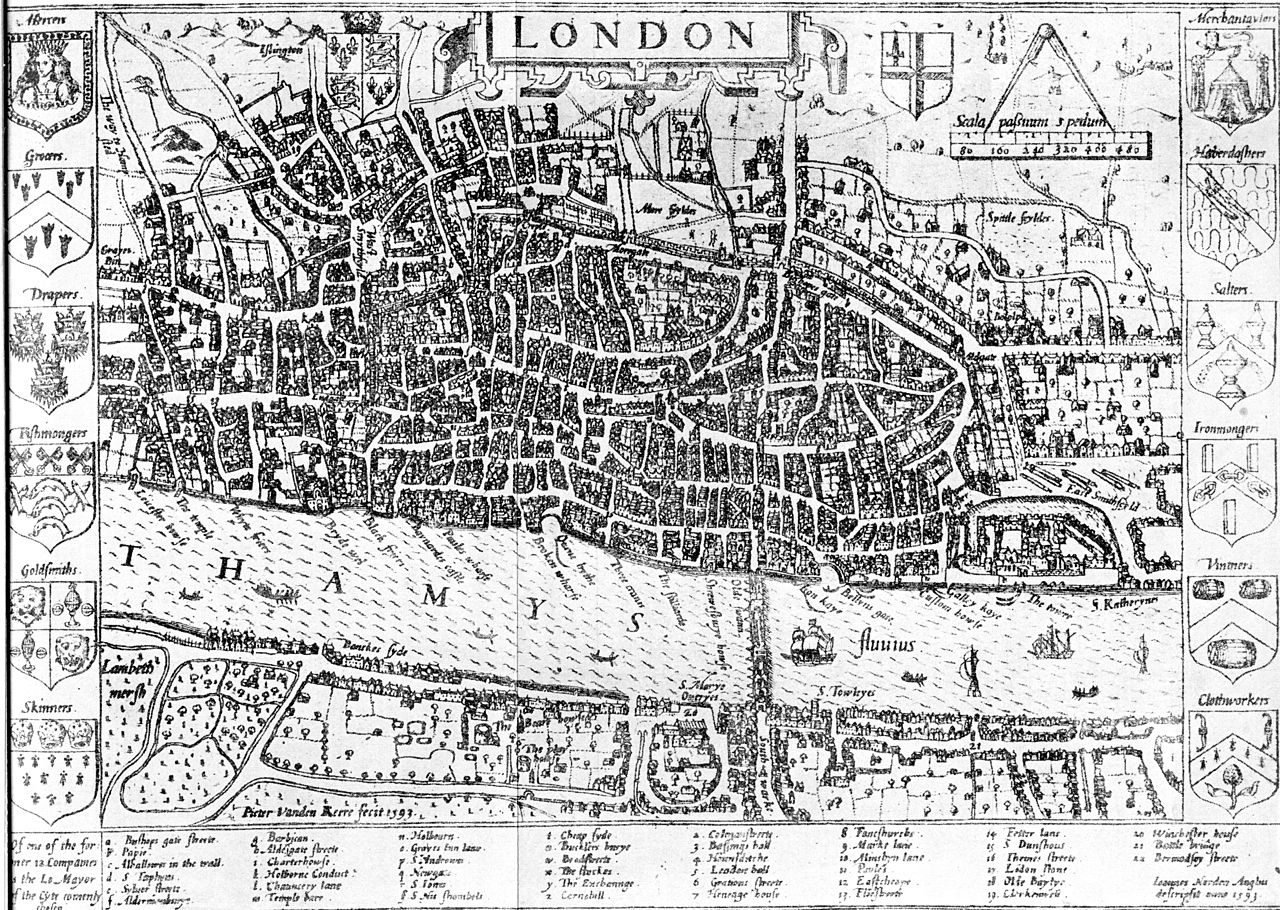
John Norden’s map of London in 1593. There is only one bridge across the Thames, but parts of Southwark on the south bank of the river have been developed.
Wikimedia Commons.
As regular readers will know, I’ve lately been obsessed with England’s various economic transformations between 1550 and 1650 — the dramatic eightfold growth of London, in particular, and the fall in the proportion of workers engaged in agriculture despite the growth of the overall population.
As I’ve argued before, I think that the original stimulus for many of these changes was the increased trading range of English overseas merchants. Thanks to advances in navigational techniques, they were able to find new markets and higher prices for their exports, particularly in the Mediterranean and then farter afield. And they were able to buy England’s imports much more cheaply, by going directly to their source. Although the total value of imports rose dramatically — by 150% in just 1600-38 — the value of exports seems to have risen by even more, as there’s plenty of evidence to suggest that for most of the period England had a trade surplus. The supply of money increased, even though Britain had no major gold or silver mines of its own.
The growing commerce was the major spur to London’s growth, with English merchants spending their profits in the city, and ever-cheaper and more varied luxury imports enticing the nobility from their country estates. Altogether, the concentration of people and wealth in London must have resulted in all sorts of spill-over effects to further drive its growth. After the initial push from overseas trade, I suspect that by the late seventeenth century the city was large enough that it was running on its own steam.
But on twitter, economic historian Joe Francis offered a slightly different narrative. Although he agrees that a change to overseas trade was the prime mover, he suggests that the trade itself was too small as a proportion of the economy to account for much of London’s growth. I disagree, for various reasons that I won’t go into now, but Joe brought to my attention various changes on the monetary side. Inspired by the work of Nuno Palma, he suspects that it was not the trade per se, but the fact of an export surplus that was doing the heavy lifting, by increasing the country’s money supply.
An increased money supply should have facilitated England’s internal trades, reducing their costs, and allowing for greater regional specialisation. Joe essentially thinks that I’ve got the mechanism slightly back to front: instead of London’s growing demands having reshaped the countryside, he contends that the specialisation of the entire country is what allowed for the better allocation of economic resources and workers to where they were most productive — a process from which a large city like London quite naturally then emerged.
I have some doubts about whether this process could really have been led from the countryside. The regional specialisation that we see in agriculture, for example, only really starts to become obvious from the 1600s onwards, by which stage London’s population had already begun to balloon from a puny 50,000 in 1550, to 200,000 and rising. I also haven’t found much evidence of other internal trade costs falling. Internal transportation — by packhorse, river, or down the coast — doesn’t seem to have become all that more efficient. Roads and waggon services don’t show much sign of improvement until the eighteenth century, and not many rivers were made more navigable before the mid-seventeenth century either. This is not to say that England’s internal trade didn’t increase. It certainly did, as London sucked in food and fuel in ever larger quantities, and from farther and farther afield. But it still looks like this was led by London demand, rather than by falling costs elsewhere.
Besides, the influxes of bullion from abroad would have all been channelled through London first, along with most of the country’s trade. To the extent that monetisation made a difference to the costs of trade then, this would have made a difference first in the city, before emanating out to its main suppliers, and then outwards. I thus see the Palma narrative as potentially complementary to my own.
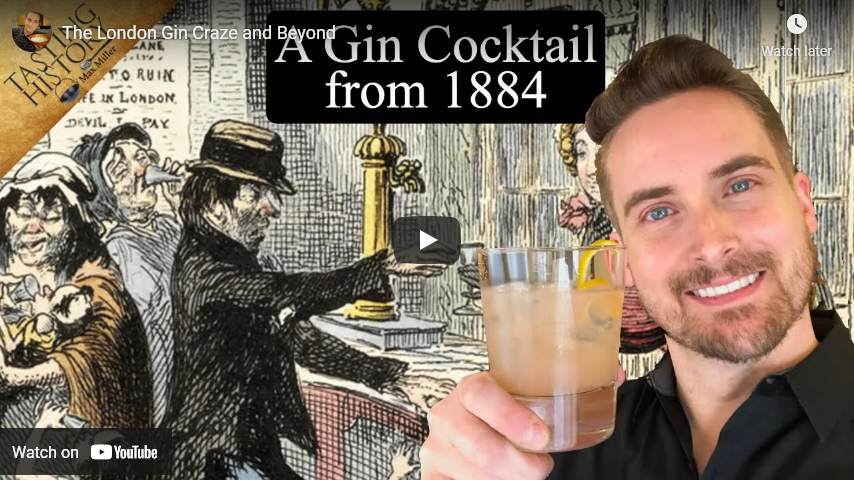
The London Gin Craze and Beyond
Tasting History with Max Miller
Published 26 Jan 2021Help Support the Channel with Patreon: https://www.patreon.com/tastinghistory
Tasting History Merchandise: crowdmade.com/collections/tastinghistoryFollow Tasting History here:
Instagram: https://www.instagram.com/tastinghist…
Twitter: https://twitter.com/TastingHistory1
Tiktok: TastingHistory
Reddit: r/TastingHistory
Discord: https://discord.gg/d7nbEpy
Ketchup with Max: https://www.youtube.com/channel/UC1DL3SXDAdrQs2WE4AMD4SwLINKS TO SOURCES**
Gin: The Much-lamented Death of Madam Geneva by Patrick Dillon: https://amzn.to/39VxZU7
Gin: A Global History by Lesley Solmonson: https://amzn.to/3c8sJzc
The Diary of Samuel Pepys: https://amzn.to/391W64u
The Fable of Bees by Bernard Mandeville: https://amzn.to/3c13Eq8
Sketches by Boz by Charles Dickens: https://amzn.to/3sTMUar**Amazon offers a small commission on products sold through their affiliate links, so each purchase made from this link, whether this product or another, will help to support this channel with no additional cost to you.
Subtitles: Jose Mendoza
MUSIC
“Divertissement” by Kevin MacLeod is licensed under a Creative Commons Attribution 4.0 license. https://creativecommons.org/licenses/…
Source: http://incompetech.com/music/royalty-…
Artist: http://incompetech.com/#tastinghistory #gin #cocktail #gincraze