
Vox
Published 12 Mar 2021It’s a simple innovation that helped win a war.
The Bailey bridge was Donald Bailey’s innovative solution to a number of wartime obstacles. The allies needed a way to cross bodies of water quickly, but bombed-out bridges — or an absence of crossings entirely — made that incredibly difficult. That was only compounded by new, heavy tanks that needed incredibly strong support.
Bailey’s innovation — a modular, moveable panel bridge — solved those problems and gave the allies a huge advantage. The 570-pound steel panel could be lifted by just six men, and the supplies could fit inside small service trucks. Using those manageable materials, soldiers could build crossings sufficient for heavy tanks and other vehicles.
As impressive, the Bailey bridge could be rolled across a gap from one side to the other, making it possible to build covertly or with little access to the other side. Together, all the Bailey bridge’s advantages changed bridge construction and may have helped win the war.
(more…)
August 18, 2022
The bridge design that helped win World War II
QotD: Nostalgie de la boue
TWS suggests we take a hard look at the concept of nostalgie de la boue:
Nostalgie de la boue (French: “nostalgia for mud”) is the attraction to low-life culture, experience, and degradation, found at times both in individuals and in cultural movements … Tom Wolfe described a party in New York in 1970: “It was at this party that a Black Panther field marshal rose up beside the north piano — there was also a south piano — in Leonard Bernstein’s living room and outlined the Panthers’ ten-point program to a roomful of socialites and celebrities, who, giddy with nostalgie de la boue, entertained a vision of the future in which, after the revolution, there would no longer be any such thing as a two-story, thirteen-room apartment on Park Avenue, with twin grand pianos in the living room, for one family.”
I think TWS is right:
It explains everything from those parties where they pretend to eat people and the Podesta brothers love of pedo-murder art to the Jersey Shore and all rap music. People of Wal-Mart and people who enjoy mocking them. The idea covers everything happening.
Back in the days, they called all that “authenticity”. The Working Man ™ was supposed to have an “authenticity”, a raw experience of life, that the Intelligentsia did not, so the Intelligentsia made it their mission to ape “authentic” proletarian manners and mores. That’s why every self-styled “Intellectual” since Marx has carried on like an unbathed schizophrenic hobo — they think they’re being “authentic”.
It never occurs to them that this is grossly insulting to The Workers they’re supposedly helping, because of course they never ever meet any Workers — they imagine how they think a longshoreman would act, and then go do that.
I have far more respect for “the People of Walmart” than I do for those who make fun of them, because “the People of Walmart” have been beaten down and brutalized by the dominant culture. They’ve had all their self-respect kicked out of them by little college snots with Gender Studies degrees. It’s like the peasantry in pre-Revolution Russia: Everything the intellectuals said about the nobility was true … but everything the nobility said about the serfs was also true. It was a chicken-and-egg problem with no solution save one.
I also have some respect for Walmart as an institution. Yeah, I know, it’s cheap Chinese shit, but trust me: Though I didn’t grow up poor, you could see “poor” from my house for a lot of my childhood. I don’t recall having Walmart back then, but K-Mart’s Blue Light Specials improved our day to day quality of life enormously. And when I first got out on my own, I decorated my entire first apartment in Walmart — it wasn’t fancy, but it worked, and I had a hell of a lot more stuff that I could actually use than I ever could’ve afforded any other way.
You want to make fun of Walmart, and the people who shop there? Ok, fine, motherfucker, but first try living in a trailer where your couch is patched up with duct tape, and go to school wearing your California cousins’ hand me down clothes, so that you’re dressed like a surfer when you’re 500 miles from the nearest ocean.
I will never, ever understand this. You can choose to be ugly, and to surround yourself with ugliness. Or you can choose NOT to do that. Why would anyone pick the former?
Severian, “Friday Mailbag”, Founding Questions, 2022-05-13.
August 17, 2022
“It’s weird what happens when you choke off people’s ability to make a living”
Elizabeth Nickson offers to decode the latest war cry from the great and the good, the well-meaning, the deluded, and the modern-day fellow travellers (who are still useful idiots):
The political circus is gripping, the play before us hypnotic. Audience members drop in, forswear the brutalism of it and go back to their lives, refusing engagement, refusing to look. That’s what it’s for, to alienate you from the real stuff that goes on in the middle of nowhere, where I live.
[…]
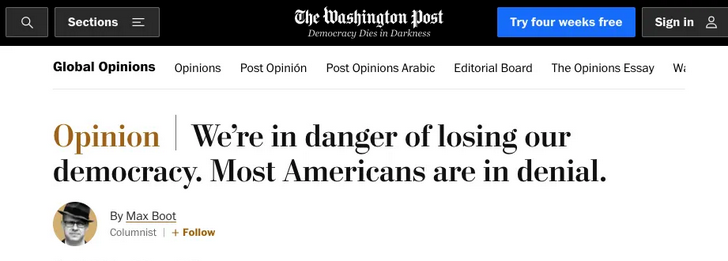
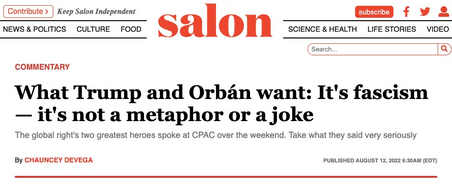
This is a slogan that has been picked up by every operative in every western democracy. State legislators appear on MSNBC frantic with fear, wall-eyed, saying the right is stealing democracy.
Expect to hear this ceaselessly for the next three years. Every hour of every day.
This is what they really mean:
When I moved to the middle of nowhere twenty years ago, I became fascinated with local politics. It seemed that there were a lot of little groups, attached like sucker fish to the giant tax eating behemoth that slid through our lives. Their aims were simple and seemingly good hearted, more waterbird protection, more water protection, more tree protection, more protection of the other sexed, more goodness towards and immigration of the huddled masses in South and Central America, more legislated feminist demands, endless demands of the schools by advocacy groups funded by teachers unions, and of course, stopping all development and industrial production because of climate change. They all had groups, they all lived on little bits of money, they were always harried and despairing. They fought a tight game. Small advances, lots of setbacks. Mostly innocent, though the enviro people had deep-buried terrorist groups who created lovely fires for any developer who particularly crossed them. But otherwise, you could invite them to tea with the Queen.
Twenty years on, they flourish with budgets of seven or eight figures, most of which they receive from the various governments they lobby, but also from the world’s greatest foundations, not to mention substantial funding from the EU, the WEF and the UN. And they are in every capital, waking up every morning for one reason: to force the government to cave to their needs. They are always attached to the bigger of the left-wing parties, who fund them big time. In the US it is the Democrats. In Canada, the Liberal Party. They are paid to act as political action committees, while posturing as neutral advocacy groups. They write legislation. And boy, have they written legislation. They developed a thousand, thousand committees which have methodically re-written laws from the extreme local to national.
The ones I met were upper-middle-class, from nominally Christian households, who had been captured by the socialist dream. They called what they did a new iteration: participatory democracy. Leaders were from Britain or the US. Those seemed the most aggressive. More connected. Very little work has been done on their unnerving connectedness. Most reporters agree with their task, don’t want to dig.
The reason they called it participatory democracy was because they were participating. It seemed no one else was, other than business needing a rule change or permit, so they had free rein. And, to give them credit, they did change the culture. It is rare to find a soul who does not support equality of the sexes, the protection of the environment, acceptance of the other-sexed, pity for the huddled masses in the south and an anxious wish for people of colour to do well.
But then … the German Malthusian Eugenicists at the WEF realized they could fund them and bend them to their purpose. With 100x the power, the good kids went rogue. The goal was to break the power of the American middle class in order to save the climate. To disenfranchise them, to de-legitimize them, to identify them as racist, sexist, homophobic and patriarchal. To de-pluralize them. To drive them to the margins. It was, frankly, an adoption of evil, an adoption of kill-to-save.
Amazing Money Heist by Polish Resistance – WAH 073 – August 14, 1943
World War Two
Published 14 Aug 2022The reality of war finally seeps through to the majority of Germans, and it didn’t match up with the propaganda. Meanwhile resistance is increasing, and part of that is a classic money carriers when the Polish Home Army robs a money transport.
(more…)
To understand Justin Trudeau, you need to look at his relationship with his mother
Janice Fiamengo on how a lot of Justin Trudeau’s personal quirks may be directly traced to his upbringing and particularly his relationship with Margaret Trudeau:

Malia and Sasha Obama talk with Prime Minister Trudeau and his mother Margaret Trudeau during a reception on the Truman Balcony, 10 March, 2016.
Official White House photo by Pete Souza via Wikimedia Commons.
Cue the popularity of Justin Trudeau, who at first seemed all sincerity, even to the point of public spectacles of tearfulness and child-like ebullience. He was the first Canadian leader to march in the Gay Pride Parade as if it were his natural milieu, not merely a vote-seeking opportunity. His enthusiasm for Bollywood-style gyving, Hindu fancy dress, and participation in Islamic prayer, though heavily criticized, seemed genuine, at least in a high-school drama teacher way.
When he refused to give a real answer to the question of why it was necessary to appoint a gender-equal cabinet as one of his first actions upon assuming office in 2015, his insouciant quip “Because it’s 2015” suggested an unstudied feminist commitment. His comments after the Boston bombings emphasized that empathy rather than harshness was the appropriate response to murderous acts of terror.
But there has always been a harsher side to Trudeau, a fondness for dictators, an attraction to brute power, and an inability (or unwillingness) to hide his contempt for political opponents. Perhaps his empathy for the Boston bombers was respect or even admiration for their willingness to use violence. Many were shocked by his open admission that one of the countries he most admired was the “basic dictatorship” of China. When churches burned across Canada in the summer of 2021 in response to the alleged discovery of “mass” graves at a residential school (a discovery that has not yet yielded a single body), Trudeau condemned the arson but hastened to say it was “understandable”. About Canadians who chose not to take the Covid-19 vaccines, he could not control his impatience, unleashing a volley of stigmatizing, scapegoating rhetoric. For the truckers who camped out in Ottawa amid a sea of Canadian flags and bouncy castles demanding vaccine mandates be revoked, he had a brutal contempt.
Which is he: the soft feminist with the fancy socks, joy in Gay Pride, and empathy for the marginalized? Or the hard, contemptuous leader who could oversee without flinching a violent RCMP crackdown on the Convoy protest that saw an Indigenous woman trampled under the hoofs of a police horse?
The answer is: both. A clue to his doubleness may be found in his relationship with his mother.
I recently watched an old interview with Margaret Trudeau that offers some illuminating glimpses into the character of the woman who mothered Justin. The interview took place in 1979, after Margaret had left Pierre Trudeau, Justin’s father, who was Prime Minister of Canada from 1968 until 1982. Pierre had primary custody of their three young children.
The interview shows a very beautiful woman whose consciousness of her attractiveness is a paramount part of her identity. She is not, as has sometimes been claimed, stupid; many of her answers to the interviewer are clever in the manner of a wayward adolescent convinced she can get away with nearly anything so long as she charms. At times she flirts openly, smiling suggestively, tongue protruding through her lips, confident in her sexual power.
The overall impact of her answers is horrifying for a viewer who fails to be enchanted. This is a woman who takes herself seriously but evidently does not take seriously her position as a mother to three young sons (all of them under 10 years old at the time) — and certainly not her position as estranged wife to the leader of the country.
She boasts girlishly about smoking marijuana, listening to psychedelic music, and giving up guilt over failing to meet others’ expectations. Spouting feminist rhetoric about being true to herself, she makes clear that she is more interested in having lovers than in looking after her children. She dismisses her husband’s shock at her unfaithfulness as owing to “old-fashioned principles of fidelity”, and indicates that Canadian society would be better off if more people heeded their “feelings” rather than stodgy moral precepts.
I cringe to think of Justin Trudeau, even today, watching this interview. The woman who presented herself therein — self-preoccupied, proudly promiscuous — must also have been evident to the son who watched her flamboyantly “find herself”, feminist-style, as his parents’ marriage crumbled.
H/T to Brian Peckford for the URL.
Prototype Gustloff 206 Rifle
Forgotten Weapons
Published 17 Aug 2016http://www.patreon.com/ForgottenWeapons
German arms development during World War II was quite the chaotic mess, in many ways. While it is not uncommon for different service branches to have independent procurement systems, in fascist-era Germany this was coupled with the close collaboration between industry and the Party structure. This led to competing and conflicting policies between military and political offices.
Semiautomatic rifle development was no exception. While the Walther and Mauser companies won the competitions to develop the Gewehr 41, the Gustloff concern had also produced a number of designs and these were continued after the trials by political decree. The best of these designs (apparently, from the sparse information available) was the model 206.
The Gustloff 206 is a largely sheet metal rifle with a gas piston operating system and an unusual vertically traveling locking block, akin to the Type 94 Nambu and Bergmann 1910 (as well as the much more recent Arsenal Strike One). The rifle is semiautomatic only (although it sounds like some select-fire models were also made) and feeds from MG-13 box magazines — cut down from 25 rounds to 10 rounds capacity on this example.
The rifle may be related to the Gustloff submission for the Luftwaffe’s FG-42 project, but may not be. All I have been able to find on that rifle is that Gustloff did submit one and it did not progress into any trials, most likely because it failed to meet the design criteria set out by the Luftwaffe. The model 206 would fit that description.
QotD: Larry Correia’s proposal for a DoFYJS
Depending on the department you could fire a ton of them and all it would do is free up parking spaces.
Now, there are some government employees who work their asses off. Good. There are some government functions which are necessary. Great.
A great many don’t work, or the work they do is utterly pointless.
Ask any honest gov employee. They will admit this to you in private.
If they say no, everything we do is vital and everyone here is vital, they’re a liar protecting their budget, or one of the useless ones.
Most places, if there are 5 employees, 2 do 90% of the work.
Pournelle’s Iron Law says that as it grows over time any bureaucracy’s purpose will change from its original mission, to a new mission of protecting and growing the bureaucracy.
So now our Department of Labor by itself is bigger than LBJ’s entire federal government. This stuff never shrinks. It only grows. It’s an endless Leviathan.
The Leviathan needs to grow and protect itself against all threats, which is how you get super evil shit like the CIA and FBI meddling in US elections …
Or constantly expanding its powers into new places, like the #MinistryOfTruth
This Leviathan will find allies which help it expand in size and power. The more power/money you give it, the more it can bribe and co-opt other institutions. Academia, media, corporations, etc.
Whichever political philosophy is the most unprincipled will rock this arrangement
As the Leviathan grows in power, it will become more malicious, spiteful, and controlling. Dissent is crushed. Freedom dies.
@elonmusk is currently a speed bump in this, which is why the control freak contingent is super pissed at him.
The big question is, do the people own their government, or does the government own its people? If we are just assets of the gov, we can be spent freely, and bad assets get eliminated.The Leviathan is compelled to own EVERYTHING.
Slowing the Leviathan down isn’t enough. If you concentrate on stopping one part, others keep growing. Then when our bipolar country elects a new leader, those parts start growing again. Repeat forever. And it just keeps getting bigger.
So we’ve got to shrink the whole thing
If the GOP had a brain/spine (lol) they’d slash the shit out of everything. They’d starve the beast. They usually don’t, because they are total chickenshits. They’ll pay lip service to this, do nothing, or feed their favorite parts.
The DNC gleefully feeds the whole thing.
Trump’s biggest weakness was he surrounded himself with people who loved government, and loved expanding government. Of course all of those fucked him at every opportunity.
We need somebody who actively HATES the government to run it.
If I was President (ha!) I would only create a single new executive branch entity. The Department of Fuck Your Job Security.
The DoFYJS would consist of surly auditors, and their only job would be to go into other government agencies to figure out-
A. do you fuckers do anything worth a shit?
B. which of you fuckers actually get shit done?Then fire everyone else.
Right now it is pretty much impossible to fire government employees. The process is asinine. It is so bad that the worst government employees, who nobody else can stand, don’t get fired. They get PROMOTED. It’s easier, and then it’s somebody else’s problem.
But the DoFYJS don’t care. If your job is making taxpayers fill out mandatory paperwork and then filing it somewhere nobody will ever read it?
Fuck you. Gone. Clean out your desk.
We need to get rid of entire agencies. Gone. WTF does the Department of Education improve? NOTHING.
Gone. Fire them all. Sell the assets.
Any agency that survives this purge, move it out of DC to an area more appropriate to its mission. Do we need a Dept of Agriculture? Okay. Go to Kansas.
This will also cause all the DC/NOVA powermonger set to resign so I don’t have to waste time firing them
Oh, and right wing pet causes, you’re not safe. I worked for the Air Force. We all know that we could fire 1/3 of the GS employees tomorrow and the only noticeable difference would be more parking available on base.
Cut everything. We never do, because somebody might cry. Too bad. They’re called budget cuts because they’re supposed to hurt. Not budget tickles. Fuck you. Cut.
Shutting off the money faucet will also destroy the unholy alliance between gov/media/academia/tech.
Right now there is a revolving door, government job, university job, corporate board, think tank, the same crowd who goes to the same parties and went to the same schools and all that other incestuous shit just take turns in the different chairs.
Sell the fucking chairs.
Every entity that gets tax money inevitably turns into a pig trough for these people. Cut it all off. All of these money faucets ALWAYS cause some kind of financial crisis later anyway.
See the student loan crisis caused by the government, here is free money, oh college has become expensive and useless, so now we need more government to solve it. You dummies get to pay for it. Have some inflation.
It’s all bullshit.
Quit pretending any of this makes sense.
The only way the Leviathan shrinks is we elect people who actively hate the government to the government, and then only let them stay there long enough to fuck the government without getting corrupted by it.
The instant you see the small government crusader you sent to DC going “Oh, well maybe an unholy alliance between the state and OmniGlobalMegaCorp to develop a mind control ray is a good thing” FIRE HIM.
So there you have it. That’s my platform if you elect me president. Fire fucking everybody. And only give me one term. Thank you.
Larry Correia, portion of a Twitter thread reposted at Monster Hunter Nation, 2022-05-11.
August 16, 2022
Manstein Goes Great War Style – WW2 – 207 – August 13, 1943
World War Two
Published 13 Aug 2022From Sicily to Spas-Demensk, the Axis continue conceding ground to the Allies this week. But the fighting is still tough. The Wehrmacht has halted the Red Army offensive in the Kuban, and the British and American armies have neither the strength nor the willpower to press the advantage against Axis troops retreating to the Italian mainland.
(more…)
“Penguin Random House is a vampire corporation”
Belatedly, as I was away for the weekend, here’s something from the latest SHuSH newsletter on the Random Penguin court case:

At the beginning of the millennium, Random House (pre-Penguin) had revenues of $2.3 billion (all US figures) and a profit margin of 9 per cent. At the end of the aughts, it had revenues of 2.3 billion and a profit margin of 9 per cent. It was the biggest publishing company on the planet but it had ceased to grow.
Growth matters, especially to Random House’s parent company, Bertelsmann SE, a public company. People buy shares in publicly listed companies because they believe the entity will grow and produce larger profits in the future, making the share price rise and the investor happy. That is the whole game for public companies.
When an asset at a public company does not contribute to growth it is dead weight. It needs to be fixed or jettisoned.
Bertelsmann decided to fix Random House. In 2012, it struck the richest deal in book publishing history, acquiring 53 per cent of Penguin Books, which it then merged with Random House to make the biggest publisher even bigger.
It was said at the time that the two publishers, with combined revenues of $3.9 billion, would be able to share costs, attract better talent, take more risks, offer new products, develop new markets, and otherwise innovate. Together they would have the scale to stand up to bookselling chains like Barnes & Noble and the massive digital players, Amazon and Apple.
It was a lot of hype, of course. Random House had its pick of talent, all the size it needed to negotiate with Barnes & Noble, and it would never be in the same league as Amazon. Markus Dohle, CEO of Penguin Random House, is lucky to get a mid-level account manager on the phone at Amazon.
But the deal went ahead and expectations for the new Penguin Random House were sky high. They had to be. Bertelsmann’s purchase price valued Penguin at $3.5 billion, or more than twenty times its annual profits of $171 million. Penguin Random House would have to be far more than the sum of its parts to justify that price.
Over the next several years, Bertelsmann doubled down on its bet, scooping up the remaining 47 per cent of Penguin in two separate transactions to eventually own it outright.
Did any of the anticipated magic happen?
The first full year of a combined Penguin Random House was 2014. Revenues were about $4 billion, and that’s where they’ve been ever since (leaving aside a nice bump in 2019, the year of Michelle Obama). Profits are up, which might be considered a good sign. But they didn’t grow as a result of the combined firm’s increased scale, new competitive muscle, better talent, new markets, new products, or innovations. As far as I can tell, the improved profitability was achieved the old-fashioned way: the payroll shrunk from a high of 12,800 to 10,800. Also, e-books and audiobooks improved the profitability of all publishers. And the Obamas each knocked one out of the park.
The point is that seven years down the road, Penguin Random House remained exactly the sum of its parts, minus 2000 workers. The acquisition was a big-time bust. Most of the $3.5 billion purchase price was wasted.
Nimble, Sleek, And Almost Useless In A Real Fight; the story of the Canadair CF-5 Freedom Fighter
Polyus Studios
Published 8 May 2021Don’t forget to like the video and subscribe to my channel!
Support me on Patreon – https://www.patreon.com/polyusstudiosThe multi-role CF-5 was intended to replace the nuclear-armed CF-104 Starfighter and CF-101 Voodoo squadrons with a conventional warfighter. However, as an air superiority fighter, it was useless against all but the oldest relics in the Warsaw Pact arsenal. It fared little better as a close air support tactical fighter, thanks to its short range, relatively small weapons load, lack of all-weather navigation, and its inability to survive in a sophisticated, integrated air defense environment. Despite this, 240 were built in Canada and served with the Canadian Armed Forces for 27 years, not as a replacement for the existing fleet, but as an addition to them no one in the military seemed to really want. So why did Canada operate the CF-5? As you might well have assumed, the story behind the acquisition and operation of the CF-5 is a complicated one.
(more…)
QotD: The first casualty of political campaigns
Walking in Paris just before the French election, I was handed some leaflets and stickers by partisans of Jean-Luc Mélenchon, the demagogic left-wing candidate. “The rich pollute,” said one of them, “the people pay.”
Am I one of the rich, I wonder? Or one of the people? What about the customers chatting over lunch in the nearby café? Are they rich or are they of the people? Mélanchon’s slogan is founded on the old lie, as Wilfred Owen calls Dulce et decorum, etc., that society is divided neatly into two distinct categories with interests diametrically opposed.
No lie appeals more to the dissatisfied than this, offering as it does the illusory hope of a confiscatory solution to life’s little problems. The best that can be said of it is that it permits the dissatisfied an access of hatred and moral outrage, which is always enjoyable and gratifying to experience.
Theodore Dalrymple, “Election bumf”, The Critic, 2022-04-29.
August 15, 2022
Look at Life – Goodbye, Picadilly (1967)
nostalgoteket
Published 1 Sep 2011U.K. Newsreel. A look at the Piccadilly Circus of the Swinging Sixties! A lot of what is shown here no longer exists as it was soon “modernized” to meet the demands of a changing world. Also a look at underground Piccadilly to see sights that few people have ever seen.
QotD: Sparta – the North Korea of the Classical era
But Sparta was not equal, in fact it was the least equal Greek polis we know of. It was one of the least equal societies in the ancient Mediterranean, and one which treated its underclasses – who made up to within a rounding error of the entire society by the end – terribly. You will occasionally see pat replies that Sparta was no more dependent on slave labor than the rest of Greece, but even a basic demographic look makes it clear this is not true. Moreover our sources are clear that the helots were the worst treated slaves in Greece. Even among the Spartiates, Sparta was not equal and it never was.
And Sparta was not militarily excellent. Its military was profoundly mediocre, depressingly average. Even in battle, the one thing they were supposed to be good at, Sparta lost as much as it won. Judging Sparta as we should – by how well it achieved strategic objects – Sparta’s armies are a comprehensive failure. The Spartan was no super-soldier and Spartan training was not excellent. Indeed, far from making him a super-soldier, the agoge made the Spartans inflexible, arrogant and uncreative, and those flaws led directly to Sparta’s decline in power.
And I want to stress this one last time, because I know there are so many people who would pardon all of Sparta’s ills if it meant that it created superlative soldiers: it did not. Spartan soldiers were average. The horror of the Spartan system, the nastiness of the agoge, the oppression of the helots, the regimentation of daily life, it was all for nothing. Worse yet, it created a Spartan leadership class that seemed incapable of thinking its way around even basic problems. All of that supposedly cool stuff made Sparta weaker, not stronger.
This would be bad enough, but the case for Sparta is worse because it – as a point of pride – provided nothing else. No innovation in law or government came from Sparta (I hope I have shown, if nothing else, that the Spartan social system is unworthy of emulation). After 550[BC], Sparta produced no trade goods or material culture of note. It produced no great art to raise up the human condition, no great literature to inspire. Despite possessing fairly decent farmland, it was economically underdeveloped, underpopulated and unimportant.
Athens produced great literature and innovative political thinking. Corinth was economically essential – a crucial port in the heart of Greece. Thebes gave us Pindar and was in the early fourth century a hotbed of military innovation. All three cities were adorned by magnificent architecture and supplied great art by great artists. But Sparta, Sparta gives us almost nothing.
Sparta was – if you will permit the comparison – an ancient North Korea. An over-militarized, paranoid state which was able only to protect its own systems of internal brutality and which added only oppression to the sum of the human experience. Little more than an extraordinarily effective prison, metastasized to the level of a state. There is nothing of redeeming value here.
Sparta is not something to be emulated. It is a cautionary tale.
Bret Devereaux, “Collections: This. Isn’t. Sparta. Part VII: Spartan Ends”, A Collection of Unmitigated Pedantry, 2019-09-27.
August 14, 2022
Book Review: FN Mauser Rifles by Anthony Vanderlinden
Forgotten Weapons
Published 2 Jan 2017Buy the book here: http://www.fnbrowning.com/fn-mauser-r…
When I was waiting for my copy of Anthony Vanderlinden’s new book FN Mauser Rifles to arrive, I was expecting a typical sort of dry reference work. You know, the sort of thing that is essential for looking up details like the serial number range for a specific contract, or the sling swivel location on some specific nation’s version of a rifle. When the book arrived and I cracked it open, I found something quite different.
What I found was an authentically engrossing history of Belgium, the Fabrique Nationale company, and the rifles it produced. It would have been a savvy move to deliberately expound on the context of FN’s Mausers to make them more interesting (let’s be honest; Mauser contract variations are not the most riveting subject in arms history), but I think the book took this path because of the author’s genuine passion for the subject and a desire to share that passion with others. Good grief, the man owns a 1926 FN car! If that’s not devotion to a subject, I don’t know what is (and it’s really cool!).
Anyway, the first half of the book is a tale of Belgian history and arms production. The trials that led to the adoption of the 18
9189 Mauser and the subsequent formation of the FN conglomerate by the preeminent armsmakers of Liege in order to secure a contract to make those 189189s. The production leading up to WWI, and the Belgian response to that war, including production in the United States and England. The company’s recovery after the war, including its efforts in the automotive industry. The buildup to WWII, and the response to yet another German occupation. Sabotage of German production. Recovery after that war as well, and FN’s role in post-war Europe as Mauser production came to an end. And throughout this tale, the simultaneous story of the Congo Free Sate as it became the Belgian Congo and took part in Belgium’s trials and tribulations.In the more technical sections of the book, Vanderlinder presents information that has heretofore been pretty hazy, like the actual differences between FN Mauser model designations, and exactly who ordered what and when. He also provides excellent detail on the manufacture, repair, and later conversions of the Model 18
9189 rifles for the Belgian military as well as the Congolese armed forces.As you have probably realized by this point, I found the book an excellent and compelling read … not the sort of thing one would normally expect from this subject matter. You don’t need to be an avid enthusiast of FN or Belgian history to appreciate it. Quite the opposite, in fact — if you (like most people) have only the most cursory knowledge of the subject, it is an excellent way for you to really find an appreciation for the company and country. Just be warned that the cover price doesn’t include the rifles you will want to buy once you’ve started reading!
FN Mauser Rifles is available directly from the publisher (who is also the author, but this is not a self-published work) at www.FNBrowning.com. Ordering there instead of from other dealers will get you an autographed copy, which is a nice bonus.
(more…)
QotD: The 2016 US election was a rejection of the media
The rise in support isn’t the surprising part. The surprising part is that the Media still find this surprising.
Not to toot my own horn too much here, but I’ve been writing about this since 2015 … “Make America Great Again” was the Trump campaign’s official slogan, but unofficially — and much, much more effectively — it was: “Fuck the Media”. The 2016 election is known far and wide as “The Great Fuck You”, but somehow, some way, almost everyone still fails to grasp that it wasn’t the Democrats who got told to fuck off. It wasn’t even the “Progressives”. It was The Media. The Great Fuck You was aimed entirely at the Media.
Severian, “Which Hand Holds the Whip?”, Rotten Chestnuts, 2019-07-17.


